




Abstract
The author presents a study of the relationship between expressive individualism and religiosity. Data were collected from participants in internet forums concerned with New Age and Christian religiosity (N=422). Through factor analysis, four dimensions of expressive individualism were identified: autonomy, setting oneself apart from others, personal development, and expression of emotions. The relationship between expressive individualism and religion was found to be ambivalent and negatively dominated by autonomy. After eliminating the effect of autonomy, two patterns remained visible, both characterized by a positive connection to religiosity. Setting oneself apart from others is associated with more traditional and institutional religiosity, and personal development with a more private mode of religiosity. The explanation of this concealed longing for religion is sought in the pressure resulting from expressive individualism as a way of life.
I believe in God. I’m not a religious fanatic. I can’t remember the last time I went to church. My faith carried me a long way. It’s Sheilaism. Just my own little voice. It’s just try to love yourself and be gentle with yourself. You know, I guess, take care of each other. I think He would want us to take care of each other.
The speaker is Sheila Larson (a pseudonym), who became well known after a study by the sociologist Robert N Bellah and his colleagues (Bellah et al., 1985). In their book Habits of the Heart, which describes the religious climate in the United States in the latter half of the 20th century, they presented Sheila Larson as representative of the state of religion in the Western world.
This modern mode of religiosity is often characterized as individualistic, meaning that religion is no longer primarily a communal or institutional matter, but a personal one. This mode also seems to be swiftly gaining ground in the Netherlands, judging by much of the data in the most recent God in the Netherlands survey (‘GN survey’; Bernts, Dekker and de Hart, 2007). 2 In 2006, 61% of the Dutch people surveyed said that they did not belong to a church. At the same time, however, 63% pray sometimes, 62% consider themselves religious believers, 60% believe in the existence of God or a higher power, and 50% say that they may at some point have experienced the existence of God or a higher power.
In short, there are many more people in the Netherlands who believe, consider themselves believers, and act in religious ways than people who are affiliated with a church. Despite the low level of church affiliation, the country has fairly few confirmed atheists (14%). There are other signs of the individualistic character of Dutch religiosity, such as the 90% of respondents who agreed with the statement in the GN survey that ‘truth must be experienced within’. There is absolutely no reason to assume that they did not mean to include religious truth. A full 81% believe that religion is ‘mainly a personal rather than group affair’. Finally, 79% believe that ‘religion doesn’t necessarily have so much to do with going to church’.
One major element of individualized religiosity is that everyone puts together his or her own religious package, a process sometimes termed bricolage. The recent GN survey provides insight into how widespread this type of bricolage may be. Among the respondents, 68% endorse the statement, ‘I believe you have to piece together religion out of the wisdom of many traditions and ideas’, and 74% agree that ‘religion can spring from many different sources’.
Self-constructed religious convictions of this kind are not embraced once and for all, but change over time, perhaps precisely because of the absence of an institutional framework. Batson calls this the ‘quest’ for religious orientation (Batson et al., 1993). A typical feature of this orientation is the view that (religious) existential questions can have only tentative rather than conclusive answers. The permanent process of questioning is seen as more important than the answers, and opinions and behaviours are subject to constant modification. The majority of Dutch people seem to adopt this orientation. For example, 64% agree with the statement, ‘For me religion is something that changes constantly through your life’, and 72% support the assertion, ‘I believe religion has more to do with searching than with firm convictions’ (Bernts et al., 2007).
This mutable, do-it-yourself form of religiosity has to be closely tailored to one’s own situation in life. Unquestionably, the choice among religious truths is influenced by practical considerations. One criterion seems to be that religion should help, and above all, that it should help me (Vuijsje, 2007). Charles Taylor powerfully evokes this pragmatism: ‘The religious life or practice that I become part of not only must be my choice, but must speak to me; it must make sense in terms of my spiritual development as I understand this’ (Taylor, 2002: 94). Like visitors to the Citibank website who click on the ‘My Citi’ logo to select their personal preferences, religiosity is about selecting ‘My Religion’.
Bellah et al. (1985) provide a useful typology of individualism, which they define as the belief in the inherent dignity of human beings. Any interference with the individual’s right to think, judge and decide for him- or herself is seen by individualists as morally wrong, and possibly even tantamount to sacrilege.
The authors identify four varieties of individualism: biblical, republican, utilitarian and expressive. Biblical individualism centres on the direct bond between God and humankind, which is believed to be located in the inner self. Republican individualism revolves around self-determination in the political sphere and commitment to the public welfare. Utilitarian individualism is concerned with the advancement of one’s material self-interest. Finally, expressive individualism emphasizes the existence of a unique core of feeling in each person that must be expressed if individuality is to be realized. According to Bellah et al. (1985) and other commentators on modern-day life, such as Taylor (2002) and De Dijn (2006), the expressive variety of individualism is dominant in the religious climate sketched above.
The origins of expressive individualism lie in the 19th century, in romanticism, a movement in which subjectivity, experience, introspection, intuition, emotion, spontaneity and imagination played a vital role. In expressive individualism, the self and self-expression are paramount. It is assumed that we all possess a self which we must discover, develop and express. The self must be protected from conditions imposed by other individuals and institutions (Capps and Fenn, 1992). Elchardus and Lauwers (2000) call this an article of faith, which is always accepted as obvious without ever being justified. Within expressive individualism, the self is viewed as having an inviolable, almost sacrosanct quality, from which everything else is derived. The self is ‘the only or main form of reality’ (Coles, 1980: 137).
To succeed in life from the expressive individualist perspective, it is important to be open to other people, to have a wealth of experience and a rich, deep, sensual emotional life, and to express all of this to others. This is why the term ‘expressive’ is used. An early illustration of expressive individualism can be found in the work of the American poet Walt Whitman (1819–1892). The first edition of his collection Leaves of Grass (1855) begins with the poem ‘Song of Myself’, the first sentence of which reads, ‘I celebrate myself’, a statement not far removed from Sheila Larson’s credo. In the early 21st century, what was once the preserve of the literary elite has become a lifestyle for the masses.
People with an expressive individualist attitude feel thrown back upon themselves. However, that does not imply a lack of communal embeddedness or orientation, in either religious or other terms. To be sure, highly individualistically oriented forms of religion – New Age forms, for example – can certainly be both socially and institutionally embedded. Even if those involved underline their independence of institutions and oppose institutional practices, their religiosity is socially constructed, transmitted and ratified and thus established in the public domain (Houtman and Aupers, 2010).
Neither does expressive individualism rule out a communal orientation in the form of involvement with others (Besecke, 2007). The Sheila Larson quote given above illustrates this point: ‘… take care of each other. I think He would want us to take care of each other’.
It may be useful to distinguish between individualized subjectivism and relational subjectivism (Heelas and Woodhead, 2005). In individualized subjectivism the self is seen as an atomic and self-contained unit, primarily concerned with its own interests. Other people are rivals rather than beings to whom you might be oriented for their own sake. The kinship between this individualized subjectivism and the utilitarian individualism described by Bellah et al. (1985) is easily recognized. The subjective and unique quality of the self dominates in relational subjectivism, too, but not at the cost of involvement with others. Subjective life can only be cultivated in involvement with others. This aspect is often overlooked in descriptions of expressive individualism, say Heelas and Woodhead (2005).
Elchardus and Heyvaert (1991) conclude from a theoretical analysis that expressive individualism has three defining characteristics. First, importance is attached to autonomy; that is, self-determination and the freedom to live one’s own life. The second defining characteristic is individual creativity. The individual is the main source of strength and must have the opportunity to develop in all his or her originality. Thirdly, expressive individualists wish to be original and unique. They believe you can only become a true person by setting yourself apart from others. Through a factor analysis of survey data, Elchardus and Lauwers (2000) established three dimensions of expressive individualism, which were only partly identical to the values identified in the previous study. They call the first dimension Self-identity. It involves discovering the self, identifying with it, and remaining faithful to it all your life. The second dimension is Self-distinction: seeing yourself as a unique person who is different from others. The third dimension is Emotional Drive: making your feelings the basis for your actions and needing to be, and to feel, free to express those feelings. 3 The only direct correspondence with the theoretical analysis is that with the value of originality and the dimension of Self-distinction. The above analyses show, in any case, that expressive individualism is not a homogeneous construct.
Expressive individualism involves distancing oneself from traditionally organized religion, while simultaneously subscribing to religious views in an idiosyncratic way. The question is what aspect of expressive individualism is responsible for this reserved attitude toward institutionalized religiosity, toward religion as a complete package of beliefs. Does this attitude stem from all dimensions described above, or just from one of them? This is the question I set out to answer in this article, in the hope of contributing to our understanding of the relationship between individualization and religiosity.
I aim to answer this question through empirical research. To that end, I first describe my research techniques; I then present the results; and, finally, I discuss their implications.
Method: instruments
Expressive individualism
The survey items measuring expressive individualism are taken from Elchardus and Lauwers (2000). Elchardus supplied additional items to measure personal development, an important aspect of expressive individualism. These additional items were not used in the study described in Elchardus and Lauwers (2000).
Some examples of survey items are: ‘I tend to do just as I please’, ‘What other people think of it does not matter much to me’, ‘I feel a strong urge for new experiences’ and ‘Being yourself means not concealing your emotions’. The possible answers lay on a scale from ‘Completely disagree’ (1) to ‘Completely agree’ (7).
Religion
In order to measure religion in the broadest possible sense, the survey covered many topics. Respondents were asked to evaluate their own religiosity, belief and spirituality; to state their views about the ultimate nature of reality; and to respond to items about commitment, prayer and church affiliation.
Religiosity, belief and spirituality: The extent to which respondents regarded themselves as religious, as spiritual and as believing was measured with three separate items: ‘Can you indicate how important spirituality is in your life?’ (spirituality); ‘Can you indicate how religious you are?’ (religiosity); and ‘Do you regard yourself as believing?’ (belief). 4 The possible responses to the spirituality item ranged from ‘Not at all important’ (1) to ‘Extremely important’ (10). The responses to the religiosity item ranged from ‘Not at all’ (1) to ‘Completely’ (7). There were three possible answers to the question about believing: ‘No’ (1), ‘Don’t know’ (2), and ‘Yes’ (3).
Beliefs about the ultimate nature of reality: The items relating to views about the ultimate nature of reality were taken from Eisinga, Felling and Peters (1988). A distinction was drawn between two views about the ultimate nature of reality: the transcendent view and the immanent view. According to the transcendent view, the ultimate reality is formed by a God (often personal) or a higher power. The immanent view denies the existence of God or a higher power or reduces ultimate reality to this world. Two illustrative items are, ‘There is a God who concerns himself with every human being’ (transcendent view) and ‘For me, God is nothing more than what is valuable in human beings’ (immanent view). The possible responses were ‘I have never thought about it’ (1) and a range from ‘I do not believe it at all’ (2) to ‘I believe it wholeheartedly’ (6). In the analysis, the response ‘I have never thought about it’ was regarded as a missing value. The scale for the transcendent view consisted of six items, and the scale for the immanent view consisted of four.
Commitment: A person may attach more or less importance to faith, religion, worldview or philosophy of life, and may be more or less engaged with these issues. This is referred to here as commitment. Commitment has three distinct aspects (Derks, 1990; Zondag, 1993). The first is the support a person draws from his or her faith or philosophy of life. Does it offer comfort and peace of mind? The second is a person’s willingness to bear witness to his or her faith. Is he or she prepared to defend his or her own view of life even if that has far-reaching consequences, such as conflicts with others? The third is the extent to which one reflects on faith and one’s philosophy of life. Examples of questions that measure these three aspects of commitment are: ‘My view of life (religious or otherwise) is a source of support in difficult times’ (support); ‘I must stand up for my view of life (religious or otherwise), even if it endangers my position in society’ (bearing witness); and ‘I have a need to ponder my view of life (religious or otherwise) in peace and quiet’ (reflection). The possible responses to these questions varied from ‘Completely disagree’ (1) to ‘Completely agree’ (7). The scales for support and for bearing witness each consisted of five items, while the scale for reflection consisted of three.
Prayer: First, respondents were asked whether and how often they prayed. The possible answers varied from ‘No, never’ (1) to ‘Yes, often’ (5). Then, on the model of Bänzinger (2007), the survey distinguished between two forms of prayer: prayer to God and meditative prayer. Prayer to God is prayer in which one seeks contact with God to experience connectedness, ask for support or voice one’s problems. Meditative prayer is characterized by reflection and introspection. It is not addressed to anyone in particular and does not ask for anything. The aims of this form of prayer are inner peace, contemplation and insight. Two items measuring prayer to God are ‘While praying I have the feeling that I am in touch with God’, and ‘When I am confronted with illness and death, I pray’. Two items measuring meditative prayer are ‘While praying I think about all sorts of events’, and ‘While praying I try to put my thoughts in order’. The responses to these questions vary from ‘Never’ (1) to ‘Always’ (7). The scales measuring prayer to God and meditative prayer consist of eighteen and six items respectively.
Church affiliation: To measure the degree of church affiliation, the survey included questions about church membership, church attendance, participation in church events, and performance of church duties. The question about church membership was, ‘Do you consider yourself a member of a church or religious community at this time?’. The possible answers were ‘No’ (1) and ‘Yes’ (2). The question about church attendance was, ‘Do you ever attend services offered by a church or religious community?’. The possible answers were, ‘No, never or hardly ever’ (1), ‘Yes, once or a few times a year’ (2), ‘Yes, about once a month’ (3) and ‘Yes, about once a week’ (4). The question about church duties was, ‘Do you perform any special duty or role within a church or religious community?’ The possible answers were ‘No’ (1) and ‘Yes’ (2).
Background data
Finally, respondents were asked to give their sex, date of birth and highest level of education attained.
Method: Participants and field work
The data were collected by means of two surveys. The first survey was administered to 264 respondents in 2005, and the second to 158 respondents in 2007, for a total of 422 respondents. This data collection took place online, among participants in internet forums about Christian religiosity and New Age themes. The average age of the participants was 30 (with a standard deviation of 12.75), with a range from 14 to 70. Among the respondents, 41% were men and 59% women.
In the first survey, expressive individualism was measured with a 28-item questionnaire which did not include items relating to the expression of emotions. The second survey involved a 33-item questionnaire which did include such items. The questions about church membership and church attendance were included in both surveys. The first survey also included questions about church activities, beliefs about the ultimate nature of reality, and self-assessment of spirituality. The second survey also included questions about prayer, commitment, and self-assessment of belief and religiosity.
Results
Expressive individualism: analysis
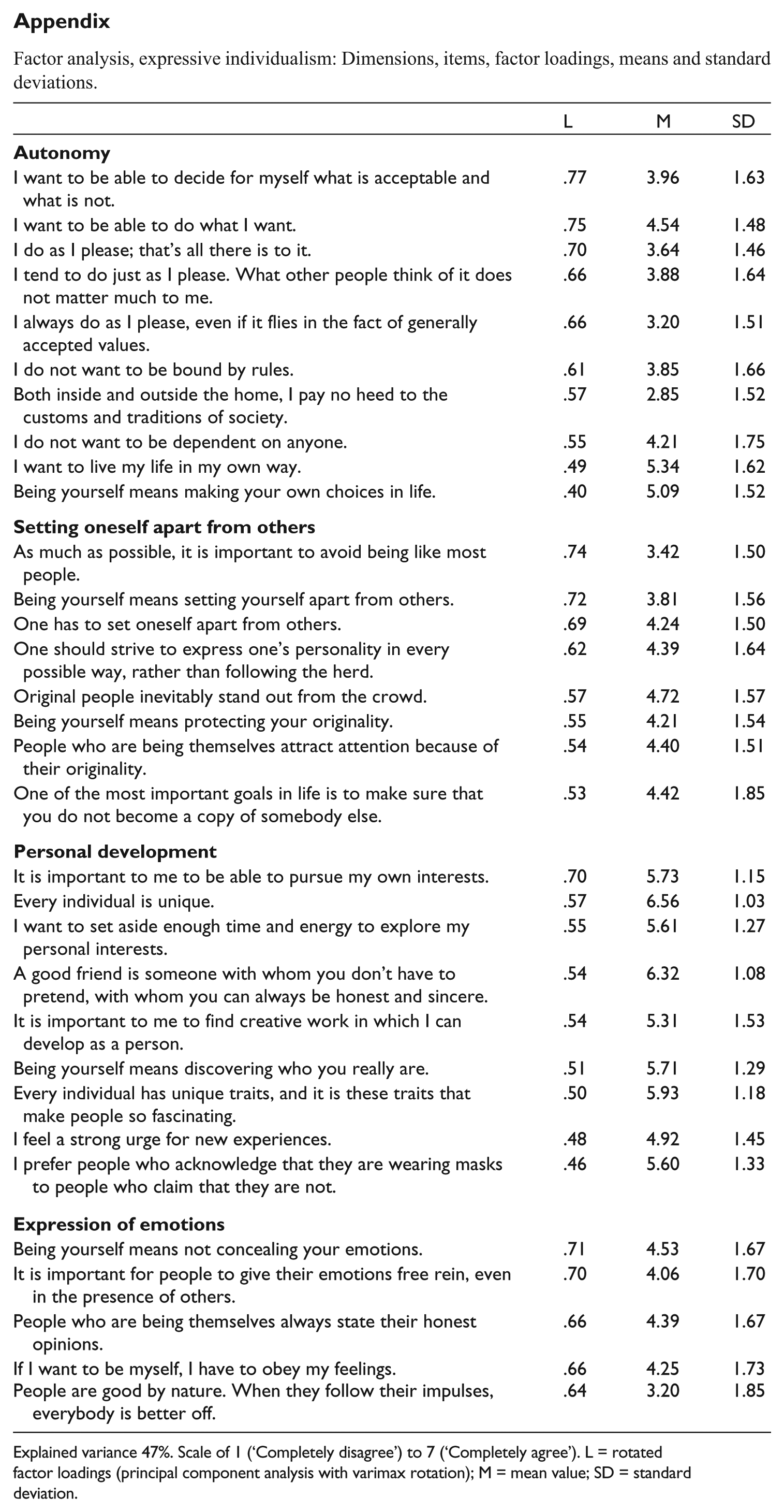
Factor analysis was applied to the data on expressive individualism. A four-dimensional solution with varimax rotation, which explained 47% of the variation, offered the best combination of item reduction and interpretation. In this procedure, the ‘Replace with mean’ option was used. Respondents with a missing value for an item were assigned the mean value for the respondents who did have a value for that item. The four dimensions identified were Autonomy, Setting oneself apart from others, Personal development, and Expression of emotions. The items used are listed in the Appendix, along with rotated factor loadings, mean values, and standard deviations.
Because not all the items were taken into consideration in both surveys, the results of the factor analysis were verified in two ways. First, they were repeated solely for the respondents who had a value for all 33 items; in technical terms, the ‘Exclude cases listwise’ option was used. This procedure yielded almost exactly the same results as the analysis described above. Second, a factor analysis was performed solely on the 28 items for which all the respondents had a value. These items related to the dimensions of Autonomy, Setting oneself apart from others, and Personal development. The aim was to verify that such a factor analysis would again yield these three dimensions, and this did indeed prove to be the case.
People to whom autonomy is important want to live their lives in their own way, ‘decide for themselves what is acceptable and what is not’, make their ‘own choices’, and ‘be able to do what they want’. Such people think highly of non-conformism and ‘pay no heed’ to ‘customs and traditions’. They are determined to ‘do as they please, even if it flies in the face of generally accepted values’, and ‘what other people think does not matter much’ to them. They say fairly decisively that they ‘do as they please; that’s all there is to it’. People who set themselves apart from others (the second dimension) consider it important to ‘avoid being like most people’ and ‘not to become a copy of somebody else’. To them, setting yourself apart from other people is essential if you are to be yourself. Being yourself involves ‘being original’ and ‘setting yourself apart from others’. ‘Being yourself means protecting your originality’, and ‘people who are being themselves attract attention because of their originality’. Those who attach importance to personal development (the third dimension) see a need to ‘pursue their own interests’ and make sure that they ‘set aside enough time and energy’ to do so. ‘Creative work’, ‘new experiences’, and ‘honesty and sincerity toward others’ are felt to contribute to personal development. People for whom personal development is important believe that they must be honest with themselves. It is better to admit that you ‘sometimes wear a mask’ than to deny it. The fourth and final dimension, the expression of emotions, involves ‘obeying your feelings’ and ‘following your impulses’. The people in question believe that this is ‘better for everyone’, that you have to ‘let emotions run their course, even when other people are present’. They say that ‘people who are being themselves always state their honest opinions’.
On the basis of the factor analysis, four scales were constructed: Autonomy (10 items), Setting oneself apart from others (8 items), Personal development (9 items), and Expression of emotions (5 items).
Expressive individualism and religion
An overview of the reliability levels, mean values, and standard deviations of the measurements of expressive individualism and religiosity can be found in Table 1.
Reliability levels, mean values and standard deviations (SD) for the scales.
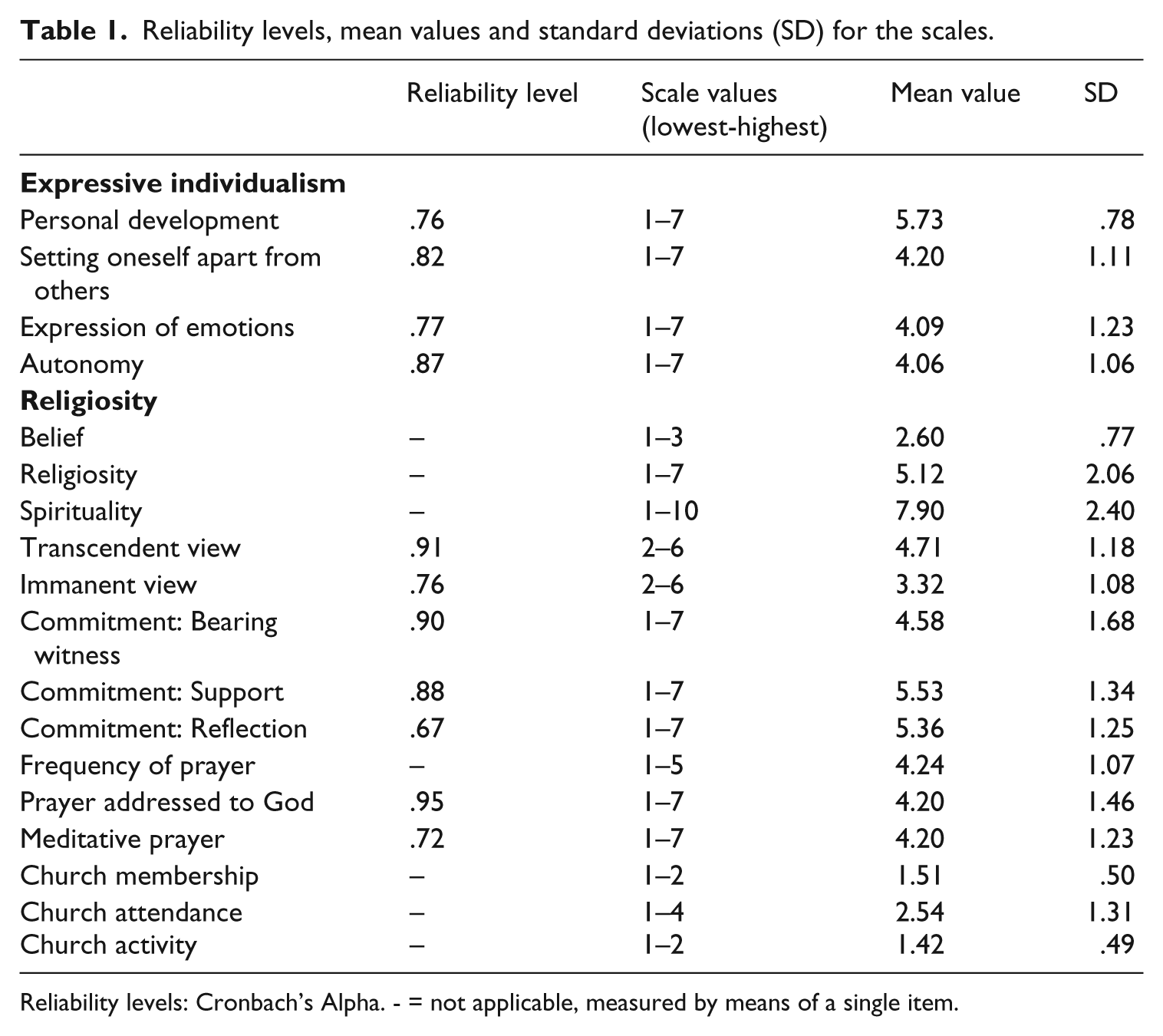
Reliability levels: Cronbach’s Alpha. - = not applicable, measured by means of a single item.
Personal development has the highest mean value of any dimension of expressive individualism, indicating that this was the group of items with which respondents most strongly agreed. Furthermore, the standard deviation is lowest for this dimension. This means that in addition to personal development being highly regarded, people’s opinions about it show relatively little variation. Autonomy has the lowest mean value, but the differences between the mean values for autonomy, expression of emotions, and setting oneself apart from others are small and do not exceed the p < .05 margin. The differences between the mean scores for personal development and for the other three dimensions are significant, however (p < .001). All the mean scores for the four aspects of expressive individualism were above the median scale value of 4. This means that all four aspects of expressive individualism tend to be endorsed, at least in the populations surveyed.
Neither sex nor age shows any correlation with the four dimensions of expressive individualism. There is, however, a relationship between expression of emotions and educational level (Pearson correlation of -.19, p < .05). In other words, there is a tendency for those with a higher educational level to attach less importance to expressing emotion. There is no correlation between educational level and the other dimensions of expressive individualism.
How are the four dimensions of expressive individualism interrelated? This question will be discussed with reference to Table 2.
Pearson correlations between dimensions of expressive individualism.
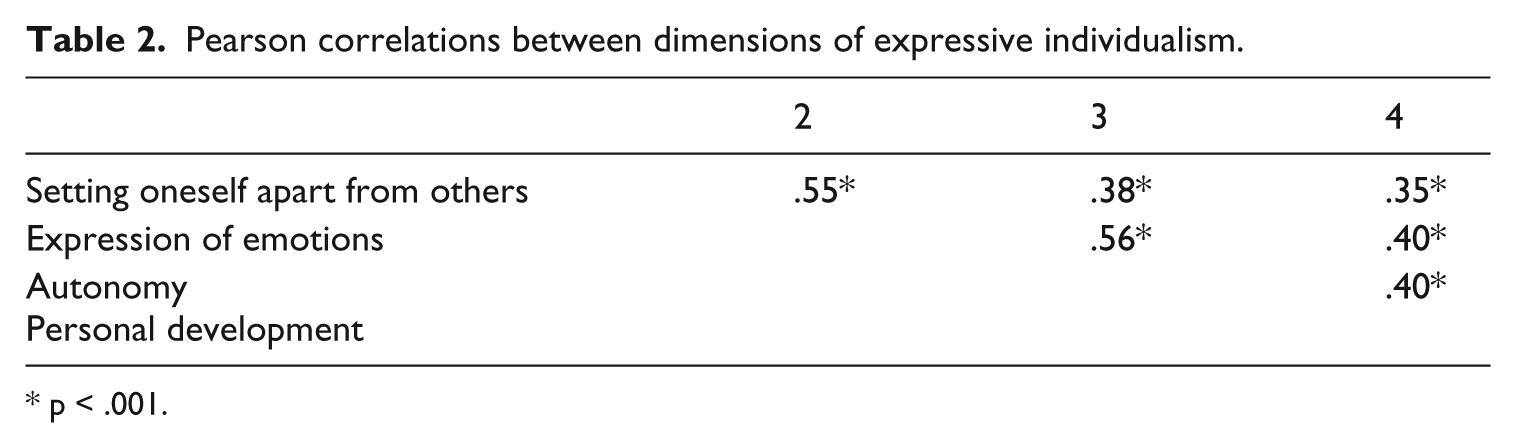
p < .001.
The four aspects of expressive individualism are closely and positively correlated, with Pearson coefficients ranging from .35 (the correlation between setting oneself apart from others and personal development) to .56 (the correlation between autonomy and the expression of emotions). The fact that all the correlation coefficients are positive implies that people who endorse one of the four aspects of expressive individualism will generally endorse the other three as well.
The relationship between expressive individualism and religiosity will be discussed in two steps: first, the linear correlations between expressive individualism and religiosity (Table 3), followed by a regression analysis of the four aspects of expressive individualism in relation to religiosity (Table 4).
Pearson correlations between expressive individualism and religiosity.
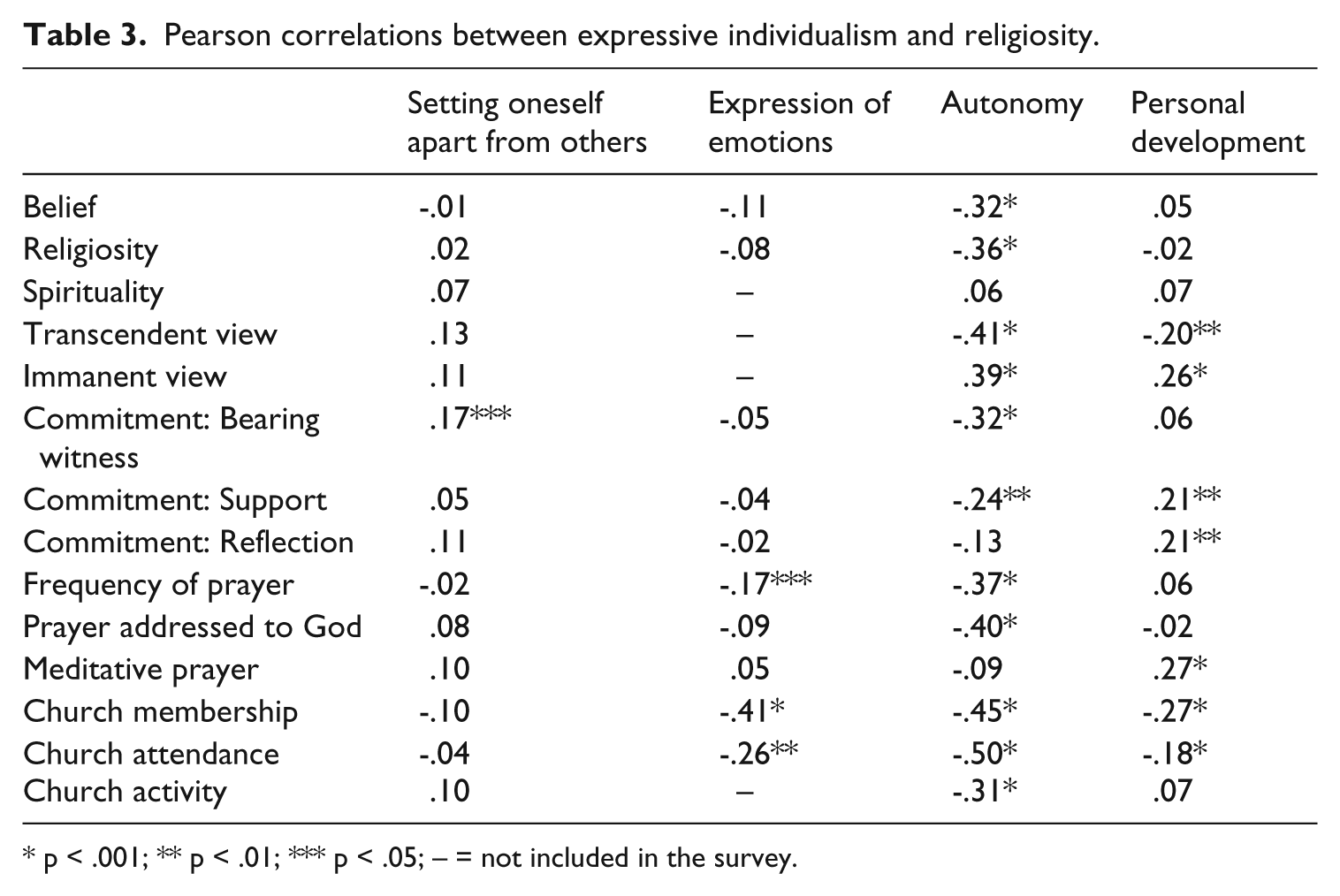
p < .001; ** p < .01; *** p < .05; – = not included in the survey.
Stepwise regression analysis of sex, age, educational level and the dimensions of expressive individualism on religiosity. Beta weights.
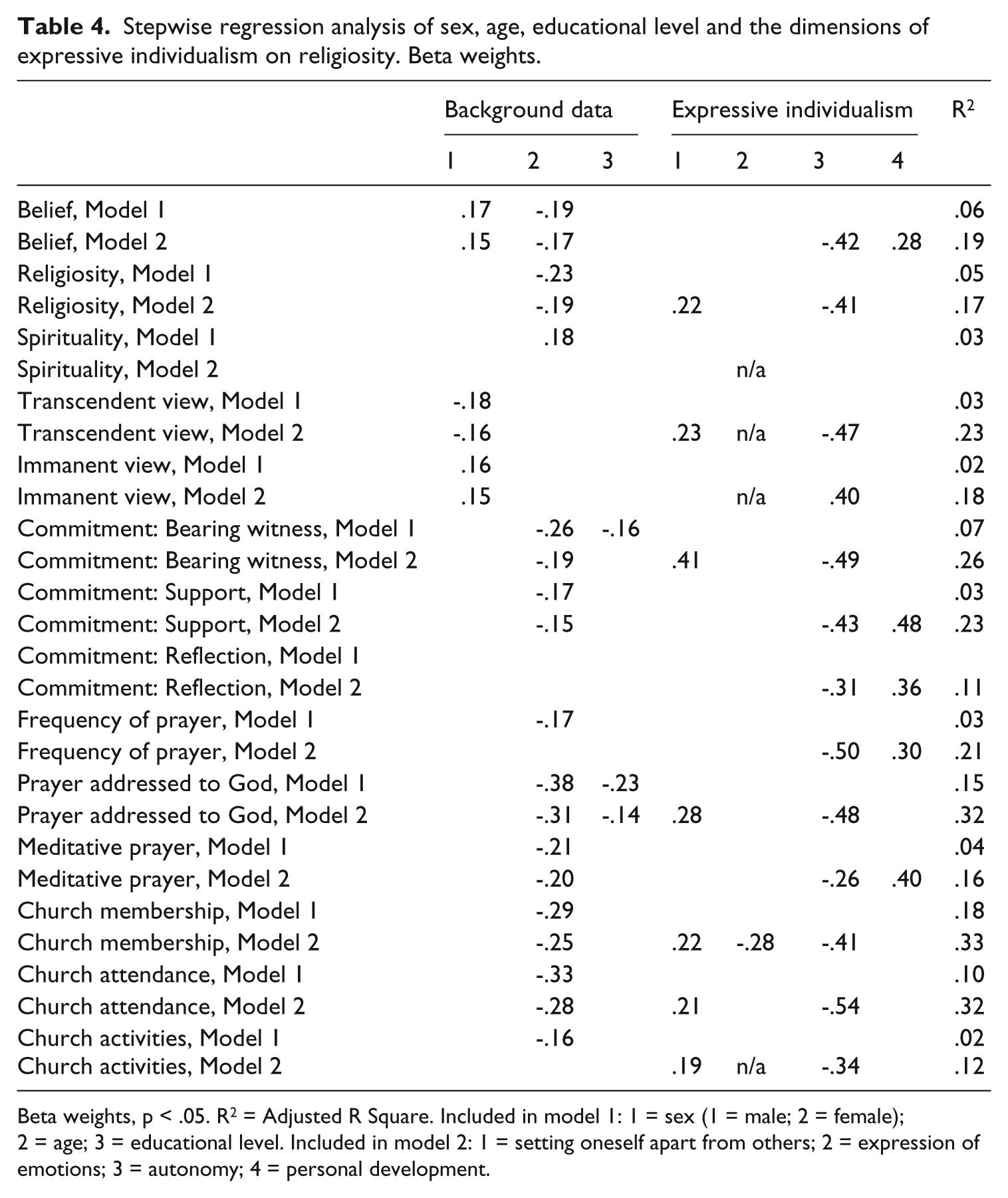
Beta weights, p < .05. R2 = Adjusted R Square. Included in model 1: 1 = sex (1 = male; 2 = female); 2 = age; 3 = educational level. Included in model 2: 1 = setting oneself apart from others; 2 = expression of emotions; 3 = autonomy; 4 = personal development.
The nature of the correlation between the four dimensions of expressive individualism and religiosity varies from dimension to dimension; that is, each dimension of expressive individualism is related to religiosity in a different way.
There is no relationship between setting oneself apart from others and religiosity, apart from a weak positive correlation with bearing witness. 5 The correlations between the expression of emotions and religiosity are all negative and vary in strength from weak (frequency of prayer) to fairly strong (church membership). Personal development correlates negatively with church membership, church attendance and a transcendent view of reality, and positively with meditative prayer and an immanent view of reality. Of the four dimensions of expressive individualism, autonomy is most strongly correlated with religiosity, and this correlation is negative. Individuals who value autonomy have little use for religion, a transcendent view of reality, prayer addressed to God, church membership or church attendance. Their negative stance toward religious matters is emphasized by the positive correlation between autonomy and an immanent view of reality, as well as by the negative correlation between the immanent and transcendent views. The Pearson correlation between these two views is -.59 (p < .001); in other words, the immanent and transcendent views of life are at odds with one another.
An initial explanation of the negative relationship between expressive individualism and religiosity is that it is primarily due to the value that expressive individualists attach to autonomy. Those who consider autonomy important distance themselves from religious institutions and practices and from a transcendent view of life and have little commitment to religion.
It was observed above that the four dimensions of expressive individualism are strongly interrelated. To gain more insight into the independent significance of each of these four dimensions, stepwise regression analyses were carried out, in two steps. In the first step, the predictors of religiosity were age, sex and educational level, and in the second step the four dimensions of expressive individualism were added. The results are reported in Table 4.
The results of the regression analyses confirm that there is a negative correlation between autonomy and religiosity. Again, autonomy proves to be the dominant factor (in a negative sense). It is involved in almost every prediction and often explains most of the variance. This is true in substantive terms (the rejection of a transcendental view of existence and endorsement of an immanent view), in institutional terms (less church affiliation by all three measures), in part with regard to commitment (less willingness to bear witness), and in part with regard to prayer (less frequent prayer and less prayer addressed to God).
But the regression analyses also reveal a more complex relationship between expressive individualism and religiosity. After the effects of autonomy were eliminated, positive correlations were often found between personal development and religiosity, and between setting oneself apart from others and religiosity. Those who wish to set themselves apart from others are more inclined toward a transcendent view of reality, are more likely to call themselves religious, are more willing to bear witness to their beliefs, address their prayers to God more frequently, and are more strongly affiliated with churches in every respect measured. Eliminating the effect of autonomy also reveals a positive correlation between personal development and frequency of prayer. Furthermore, it strengthens the positive correlations between personal development and drawing support from one’s beliefs, willingness to engage in reflection, and the practice of meditative prayer, and does away with the negative correlations between expressive individualism and a transcendent view of reality, church membership and church attendance.
Discussion
The relationship between the dimensions of expressive individualism – autonomy, setting oneself apart from others, personal development, and expression of emotions – and religion is characterized by three dissimilar patterns. Autonomy dominates the relation-ship, in a negative sense. Those who pride themselves on their autonomy have little interest in religion, and that applies to each individual aspect of religion considered in this study. They say a resounding ‘no’, amplified by their embrace of an immanent view of life. The reserved stance of expressive individualists toward institutional and traditional religiosity is thus related to the autonomy dimension of this attitude toward life.
There are two other patterns which do not find overt expression because of the dominant influence of autonomy. These patterns involve a positive stance toward religion and are clustered around the two dimensions of setting oneself apart from others and personal development. Setting oneself apart from others is positively correlated with describing oneself as religious, belief in a personal God to whom one prays, willingness to bear witness to one’s beliefs, church membership, church attendance, and the performance of church-related activities. Perhaps it is reasonable to say that setting oneself apart from others goes together with a preference for traditional, organized religion.
Personal development is positively correlated with describing oneself as believing, drawing support from and reflecting on one’s religion or philosophy of life, and praying, with a preference for meditative prayer. It seems as though personal development is linked to private religiosity. The absence of correlations between personal development and ties to organized religion (after removing the effect of autonomy) supports this conclusion. This private form of religiosity involves a strong emphasis on the self, as suggested by the preference for meditative prayer. This is prayer that focuses not on God, but on the person praying, and the purpose of which is to reflect on oneself. This form of prayer can be seen as a technique of applied psychology (Bernts et al., 2007), a way of coping with life’s problems. Coping with problems is an important part of private religiosity, as is also shown by the correlation between drawing support from one’s religion or philosophy of life and personal development. The authors of the most recent God in the Netherlands survey also referred to this private religiosity as postmodern religiosity. This form of religiosity is strongly connected to the individual and centred on reflection, seeking, and religious experience. It has been referred to as ‘ego religion’ (Dekker, 2004) and ‘self-religion’ (Elchardus and Lauwers, 2000).
In the debate about the changes in religious life a distinction is often made between religion and spirituality. Religion is seen as governed by church authority and established beliefs and practices, and spirituality by subjective experience, leaving those involved free to create their own religion (Heelas and Woodhead, 2005). 6 Setting oneself apart from others appears to coincide with a preference for religiosity, and personal development with a preference for spirituality.
In summary, the relationship between expressive individualism and religion is ambivalent. The first and dominant impulse is resistance, motivated by the importance attached to autonomy. At the same time, however, expressive individualism is characterized by a repressed longing for religious faith. What could be the source of this longing?
The project of expressive individualism presents many possibilities. To a large degree, people can plan their own lives and organize them as they see fit. This freedom is closely linked to the experience of happiness in life. For instance, members of cultures in which expressive individualism is the dominant lifestyle are happier than members of cultures in which it is not (Kitayama et al., 2007; Tov and Diener, 2007). Even so, this project of autonomy is not unproblematic, as illustrated by the paradoxical fact that those same cultures also have the highest numbers of suicides (Diener and Sun, 1999) and have had remarkably high rates of depression for a number of years (Dehue, 2008; Seligman, 1988).
An expressive individualist way of life can also be taxing. Within expressive individualism, the self is the focal point of one’s existence (Bellah et al., 1985). Those who manage to actualize their selves can praise themselves for it, and this expresses itself as an experience of happiness. Those who fail have no choice but to blame themselves (Baumeister, 1987, 1991a; Dehue, 2008; Seligman, 1988). This process, in which the events of a person’s life are ascribed to personal effort and capabilities rather than the workings of chance and uncontrollable external forces (Weiner, 1992), is almost impossible to escape. Expressive individualism is a not only an opportunity, but also an obligation. It has a strongly normative element; people must look to themselves, shape their own lives and fulfil their potential (Sunier, 2004; Yankelovich, 1981).
The permanent emphasis on personal responsibility is a burden that people sometimes wish to escape. In this context, Baumeister (1991b) speaks of ‘escaping the self’. In his book of that name, he describes a number of escape routes: indulgence in food, drugs and alcohol, and, most radically, suicide. He also mentions religion, which he regards as a constructive solution. By his definition, religiosity is the search for a power or an institution that transcends any human scale and thus goes beyond the self. This type of submission eases the burden on the self.
Van Harskamp (2000) also underlines the downside of an (expressive) individualist way of life. Individualistically inclined people are apt to reflect upon themselves. They keep on scrutinizing their intentions and wonder whether they have realized them, a process which is generally accompanied by endless attempts at self-improvement. They are endless because a permanently satisfactory result is never reached. The result is existential fear or ‘angst’. Existence is seen as pointless and meaningless and the individual lacks a basic trust that the world and our existence are good. Turning towards religion, or spirituality, can be an answer to this fear.
We have seen that there are two variants of the turn toward religion. One is directed toward traditional and collectively experienced religiosity. This solution could be called an orientation toward something other than the self. The other is toward personal religiosity. This involves the search for a solution in a type of religion strongly focused on the self. One might wonder whether the second solution is a satisfactory way of coping with the heavy burden of an expressive individualist lifestyle. The solution is to emphasize the self, even though it was an emphasis on self that caused the problem in the first place. Nevertheless, the data show that the people in question do draw support from this method of coping with problems, as evidenced by the correlation with the support aspect of their religion.
The survey was conducted among a Dutch research population, which prompts the question as to the scope of my conclusions – would they go beyond the Dutch borders? The article has pointed out the connection between expressive individualism and religion. Therefore, the scope of my conclusions is connected with the spread of expressive individualism. This variety of individualism is predominant mainly in North America and Northern and Western Europe (Hofstede, 2001).
Footnotes
Appendix
Factor analysis, expressive individualism: Dimensions, items, factor loadings, means and standard deviations.
| L | M | SD | |
|---|---|---|---|
|
|
|||
| I want to be able to decide for myself what is acceptable and what is not. | .77 | 3.96 | 1.63 |
| I want to be able to do what I want. | .75 | 4.54 | 1.48 |
| I do as I please; that’s all there is to it. | .70 | 3.64 | 1.46 |
| I tend to do just as I please. What other people think of it does not matter much to me. | .66 | 3.88 | 1.64 |
| I always do as I please, even if it flies in the fact of generally accepted values. | .66 | 3.20 | 1.51 |
| I do not want to be bound by rules. | .61 | 3.85 | 1.66 |
| Both inside and outside the home, I pay no heed to the customs and traditions of society. | .57 | 2.85 | 1.52 |
| I do not want to be dependent on anyone. | .55 | 4.21 | 1.75 |
| I want to live my life in my own way. | .49 | 5.34 | 1.62 |
| Being yourself means making your own choices in life. | .40 | 5.09 | 1.52 |
|
|
|||
| As much as possible, it is important to avoid being like most people. | .74 | 3.42 | 1.50 |
| Being yourself means setting yourself apart from others. | .72 | 3.81 | 1.56 |
| One has to set oneself apart from others. | .69 | 4.24 | 1.50 |
| One should strive to express one’s personality in every possible way, rather than following the herd. | .62 | 4.39 | 1.64 |
| Original people inevitably stand out from the crowd. | .57 | 4.72 | 1.57 |
| Being yourself means protecting your originality. | .55 | 4.21 | 1.54 |
| People who are being themselves attract attention because of their originality. | .54 | 4.40 | 1.51 |
| One of the most important goals in life is to make sure that you do not become a copy of somebody else. | .53 | 4.42 | 1.85 |
|
|
|||
| It is important to me to be able to pursue my own interests. | .70 | 5.73 | 1.15 |
| Every individual is unique. | .57 | 6.56 | 1.03 |
| I want to set aside enough time and energy to explore my personal interests. | .55 | 5.61 | 1.27 |
| A good friend is someone with whom you don’t have to pretend, with whom you can always be honest and sincere. | .54 | 6.32 | 1.08 |
| It is important to me to find creative work in which I can develop as a person. | .54 | 5.31 | 1.53 |
| Being yourself means discovering who you really are. | .51 | 5.71 | 1.29 |
| Every individual has unique traits, and it is these traits that make people so fascinating. | .50 | 5.93 | 1.18 |
| I feel a strong urge for new experiences. | .48 | 4.92 | 1.45 |
| I prefer people who acknowledge that they are wearing masks to people who claim that they are not. | .46 | 5.60 | 1.33 |
|
|
|||
| Being yourself means not concealing your emotions. | .71 | 4.53 | 1.67 |
| It is important for people to give their emotions free rein, even in the presence of others. | .70 | 4.06 | 1.70 |
| People who are being themselves always state their honest opinions. | .66 | 4.39 | 1.67 |
| If I want to be myself, I have to obey my feelings. | .66 | 4.25 | 1.73 |
| People are good by nature. When they follow their impulses, everybody is better off. | .64 | 3.20 | 1.85 |
Explained variance 47%. Scale of 1 (‘Completely disagree’) to 7 (‘Completely agree’). L = rotated factor loadings (principal component analysis with varimax rotation); M = mean value; SD = standard deviation.
Funding
This research received no specific grant from any funding agency in the public, commercial, or not-for-profit sectors.
Notes
Author biography
Address: Faculty of Humanities, Tilburg University, PO Box 90153, 5000 LE Tilburg, The Netherlands.
Email: