




Abstract
The author shows that religious affiliation is associated with socioeconomic status, but it is not clear how this relationship varies by national context. He examines religious group differences in education and wealth, comparing major religious groups in various countries. Some differences are large but not systematic. For example, Protestants and Catholics differ in wealth, but the differences favor Catholics in some countries and Protestants in others. Other differences are more systematic. For example, Muslim women have less education than other women in a variety of contexts. Those who hold traditional beliefs are also at an educational disadvantage. Findings indicate that religion does matter, but national context often shapes the nature of the relationship between religion and socioeconomic status.
The link between religion and other social institutions has been of interest to sociology from its inception (Lenski, 1961). Beginning with Weber’s foundational work ([1920] 2002) on the Protestant ethic, the relationship between religion and the economy has been of particular interest. Recent research has examined religious group differences in socioeconomic status at both the national and the individual level. Research in more developed settings yields mixed results. In the United States, distinctions between broad categories such as Protestants and Catholics may no longer be useful (Roof, 1979), but ethnic variation among Catholics and denominational differences among Protestants may be much greater than variation between these two groups. For example, Fundamentalist Protestants are less educated than other Protestants (Darnell and Sherkat, 1997), but Evangelical Protestants are not (Beyerlein, 2004). Other research concludes that religion is associated with wealth (Keister, 2003). Most of this research has been conducted in developed countries where Christianity predominates and where the infrastructure and support for research is well established. It may be that we know the most about religion in regions of the world where it matters least. Much less is known about the social correlates of religion in developing areas. Yet it is in these areas where religious change has been most dramatic. The religious composition of developing nations is diverse. Many developing nations contain a dominant group from one of the established religions such as Buddhism, Hinduism, Catholicism, or Islam. Others have a more diverse mixture. In many countries, Evangelical Protestantism has experienced dramatic growth. Of course there is a growing body of research about religion in many parts of the world, but this research is not always generalizable because of differences in method and measurement. The purpose of this study is to examine religious group differences in two key measures of socioeconomic status – education and wealth, comparing developing countries in different regions of the world. The analysis of education will give particular attention to gender differences.
This study takes a comparative approach. The disadvantage of such an approach is that it is not possible to consider the local context for each of the countries considered in depth, and local context can play a critical role in the nature of religious organizations and religious experience. The advantage of a broad approach is the possibility of generalization to religious groups as a whole. If there is a systematic influence of religious group membership, then that effect should be evident in a variety of settings. In contrast, dramatic variation in the association between religion and socioeconomic outcomes suggests that local conditions matter more than general aspects of religion.
Generalizability implies that religious group membership tends to have similar patterns in different areas. Several factors could contribute to similarity. Major religions have core texts such as the Bible and the Koran that are taken as the word of God. When these texts provide behavioral guidelines and adherents comply in a similar fashion in different countries, then similar patterns of social behavior should be more evident. Likewise, hierarchical organizations with a central source of teaching should be a force toward similarity. The Catholic Church is the clearest major example of hierarchical authority throughout the world. Less formal mechanisms including media presentations, printed materials, missionaries, and conferences tend to spread ideas and behavioral norms across national boundaries. In contrast, religious groups have been introduced into different countries in very different ways ranging from colonial rule to voluntary evangelizing. Some groups do not have a centralized authority structure, leaving local groups flexibility in establishing social norms. Religions are transformed by the people and context in which they exist so that social settings may have a greater role in molding behavior than do the international pressures toward homogeneity. Religious groups soon learn that they must adapt in order to attract new members, or even to survive.
Literature review
An emerging body of research demonstrates that there are religious group differences in socioeconomic status in developing nations. When nation states are the unit of analysis, religion has a complex relationship with economic growth. Barro and McCleary (2003) find that religious attendance is negatively associated with growth, but that some religious beliefs are positively associated with growth. They argue that religious attendance may divert resources from the economic sector, but that some religious beliefs may foster behaviors such as honesty, thrift and a work ethic. Greater concentrations of some groups such as Hindus and Muslims are negatively associated with growth. Religious composition is also associated with female education at the national level (Norton and Tomal, 2009). Norton and Tomal (2009) find that higher concentrations of ethnoreligions, Hindus, and Muslims are negatively related to female education. Some studies have also found differences at the individual level of analysis. For example, Muslims appear to have an educational disadvantage in India (Shariff, 1995; Borooah and Iyer, 2005), Indonesia (Jones, 1976), Nigeria (Reichmuth, 1996) and Ghana (Takyi and Addai, 2002; Heaton et al., 2009). It is hard to generalize from this research, however, because studies use different measures of education and research methods are not comparable across research settings.
Social scientists have considered a variety of explanations for social differences between religious groups. To begin with, religious group membership may motivate people to modify their behavior. McQuillan (2004) argues that three conditions must be present for religion to exert an influence on fertility. ‘First, the religion in question must articulate behavioral norms that have linkages to fertility outcomes’ (McQuillan, 2004: 49). ‘Second, a religious group must possess the means to communicate its teachings to its members and to enforce compliance’ (McQuillan, 2004: 49). ‘Finally, religious groups are more likely to influence the demographic choices of their followers when members feel a strong sense of attachment to the religious community’ (McQuillan, 2004: 50). Similar conditions could be postulated in order for religion to influence socioeconomic position.
Religious culture can also influence orientations toward education and wealth (Keister, 2003; Heaton, James and Oheneba-Sakyi, 2009). Religion may help to define the goals that are important and to pass on skills that are important in obtaining those goals (Keister, 2003). For example, religious groups may place specific importance on education and upward mobility in their teaching. Emphasis on the prosperity gospel legitimates more individualistic emphasis on upward mobility. Hefner argues that Islamic civilization lagged behind in capitalist development because ‘it never created the banks or other corporate instruments so central to the development of modern capitalism’ (2008: 141) and because education ignored scientific developments. The cultural influence might be less direct. For example, prominent leaders in the group may have achieved higher levels of socioeconomic attainment, or the group may be skeptical of secular learning. Religious teaching may also emphasize family roles and obligations that conflict with socioeconomic attainment. Whether direct or indirect, cultural influences alter the perceived costs and benefits of investing in education or labor market activity (Lehrer, 2004). Religion may take a more direct role by building and supporting schools as the Catholic Church and Protestants have done in many parts of Africa (Okpala and Okpala, 2006; Johnson-Hanks, 2003; MacGaffey, 1982). At the other extreme, religious movements can directly curtail educational opportunities, as in Afghanistan under the Taliban (Iacopino and Rasekh, 1998). Woodberry (2006) suggests several mechanisms whereby religion, and Pentecostal religion in particular, may influence economic outcomes. These include fostering practices that improve health, promoting investment in family life, reducing corruption, increasing volunteerism, and promoting education. Finally, religious activities may help to form peer groups that place more or less emphasis on education and economic success.
On the individual level, people may feel attracted to religious groups because of the social characteristics they already have. Stark and Bainbridge (1985) argue that emergent groups tend to attract people who are not well connected to dominant social institutions including the dominant religious group. People may also find that the teachings of a particular group fit with their perspectives. For example, the prosperity gospel common in some Pentecostal groups may resonate with those who aspire to be upwardly mobile. Style of language and dress along with the type of church buildings and location reflect social class differences. People in particular family circumstances may feel more accepted in some churches. For example, Catholic positions on divorce or birth control may attract people with similar feelings about the family and alienate others with different perspectives.
Religious influences may be different for men and women. Inglehart and Norris (2003) argue that religion influences gender equality through a variety of mechanisms including socialization of moral values and norms, and emphasis on separate spheres of responsibility where women hold familial roles and are subordinate, and through political activities. Lehrer (2004) proposes that emphasis on familial roles for women may reduce the perceived benefits of investing in female education. Heaton and Cornwall (1989) demonstrate greater gender inequality in religious groups with more traditional family roles. Takyi and Addai (2002) argue that several factors mediate the relationship between gender and educational attainment in Ghana. These include emphasis on differentiated gender roles where females have more responsibility for housekeeping and where male dominance creates more economic opportunities for men. Girls may even be taken out of school to help with household tasks. Muslim women are less likely to enter the labor force in some contexts, so that education may not provide the same economic benefits in this group (Foroutan and McDonald, 2008). The preference for sons is also related to religion (Pande and Astone, 2007) and may legitimate greater investment in male children. Various studies find significant gender inequality among some religious groups in developing nations. In particular, there is evidence that Muslim women receive less education and this pattern is observed in different national settings (Johnson-Hank, 2003; Takyi and Addai, 2002; Sengupta and Guha, 2002). In more extreme cases, religiously derived State policies have placed severe limits on female education, as was the case in Afghanistan (Iacopino and Rasekn, 1998). Inglehart and Norris also conclude that Islam is an important barrier to ‘the rising tide of gender equality (2003: 71).
Of course there is the possibility that any correlation between religion and social behavior is spurious in the sense that it is not religion that accounts for the correlation. Rather, religious groups may have other social characteristics, such as political dominance, better education, or economic advantage, that arise from historical or geographic circumstances. It is possible that these characteristics form the underlying explanation for an association between religion and socioeconomic characteristics.
In sum, a review of the literature suggests that there is substantial religious group variation in socioeconomic status in developing nations and that this variation includes important gender inequality. Most of the research supporting this conclusion, however, is specific to one or a few countries. Cross-national comparisons are often focused on the religious composition of the country rather than individual religious identity. There is little systematic comparison of religious group membership across countries, so that generalizations are problematic. This paper reports religious group difference in education and wealth from a broad sample of countries.
Data and methods
One of the major difficulties in doing comparative analysis is that comparable data are often not available. This study utilizes the Demographic and Health Surveys (DHS) funded by the U.S. Agency for International Development (USAID) (www.measuredhs.com). These surveys are designed to provide national-level data on critical aspects of fertility and reproductive health. The core questionnaire and research methodology is comparable across countries, but countries have the option of excluding particular questions and including additional modules on specific topics. While these data offer the advantage of comparability, there are several limitations. Several countries opted not to include the question about religious group membership so they cannot be included here. Analysis is also constrained by the categories of religious groups included. Different countries used different coding schemes. Coding schemes do not distinguish among various types of Muslims, Buddhists, or Hindus. On the other hand, Christians may or may not be divided into Catholic or Protestant and several different subcategories of Protestants are reported. To preserve anonymity and reduce sampling error, results are not reported for groups with fewer than 100 respondents. The catch-all category ‘other’ is also not reported. Since the goal is to compare religious groups, countries that do not have more than one group with at least 50 respondents are not included. Because the DHS focus on health and reproduction, respondents are women in the child-bearing ages. This limits the type of information available.
The utilization of DHS data constrains us to the topics covered by the survey. Fortunately, the DHS include the three main indicators of interest – respondent’s education, husband’s education and (for most countries) household wealth. Education is coded on a six-point scale ranging from 0 for those with no education to 5 for those with post-secondary education. Wealth is a factor score created by DHS staff. The scale includes household possessions and living conditions.
Religious group contrasts are complicated because each country has a different religious mix and includes different categories. This makes it impossible to create a universal code that fits all countries. To deal with this complexity, this paper codes a series of contrasts between particular religious groups. Tables report the contrasts for each country where the requisite religious categories are present and cell sizes meet the 100-person rule. Results are reported for the following contrasts: Christian–Muslim, Muslim–Hindu, Muslim–Buddhist, Protestant–Roman Catholic, new Protestants (largely evangelical)–historical Protestants (Methodist, Baptist, Anglican, Lutheran), and traditional–all other groups. If more than one group of new Protestants or historical Protestants are reported, these groups are combined. The category Christian includes Catholic and Protestant groups. Six regression models are estimated for each of these contrasts. For each of the three measures of socioeconomic status a simple model is estimated that includes only the dummy variable for the religious group contrast. A second model is estimated that includes control variables. In the education equations, the controls are for the person’s age and for urban/rural residence. In the wealth equation, controls include each partner’s age and education, as well as urban/rural residence. In the wealth equation, if husbands are not present the analysis uses mean substitution for husband’s age and education along with a dummy variable for husband’s presence.
Sorting out causal relationships between religion and other social behavior is virtually impossible with cross-sectional data. Even with carefully constructed longitudinal data, causality is not easy to demonstrate. Thus, this study will be limited to examination of the association between religion and socioeconomic status. Even if we cannot prove causation, stronger association is one important component of a causal relationship. A lack of association suggests that causation is weak or nonexistent.
Results
Table 1 reports descriptive statistics for the countries that are included in the analysis. Information includes the year of the survey, the religious groups with at least 100 respondents and the respective number of respondents, along with means for the variables in the analysis. The countries encompass broad regional representation with six Asian countries, three Latin American countries, and twenty-three African countries. Many countries have a dominant religion, such as Islam in Indonesia and Bangladesh, Hinduism in India and Nepal, or Catholicism in Brazil. In contrast, several African countries include a diverse mix. For example, Nigeria and Ghana include substantial numbers of Catholics, Muslims, and new Protestant groups. Educational attainment also varies widely across countries. For example, a majority of women do not go beyond primary school (the value for complete primary school is 2.0) in Nepal, Guatemala, and several African countries. In contrast, a majority of women have at least some secondary schooling (a value of 3.0) in the Philippines and Kazakhstan. The wealth index does not show much variation across countries because the factor score is calculated separately for each country and has a mean of 0. Results for control variables indicate that there is not a great deal of variation in the average age of adherents to different religious groups, with the exception that those in traditional groups tend to be somewhat older. This could be explained by the decline in adherents to traditional religion. There is, however, great variation in type of residence in some countries. Traditional groups are more likely to reside in rural areas. The residential distribution of other groups depends on national context.
Religious Composition and Characteristics of Religious Groups: Demographic and Health Surveys.
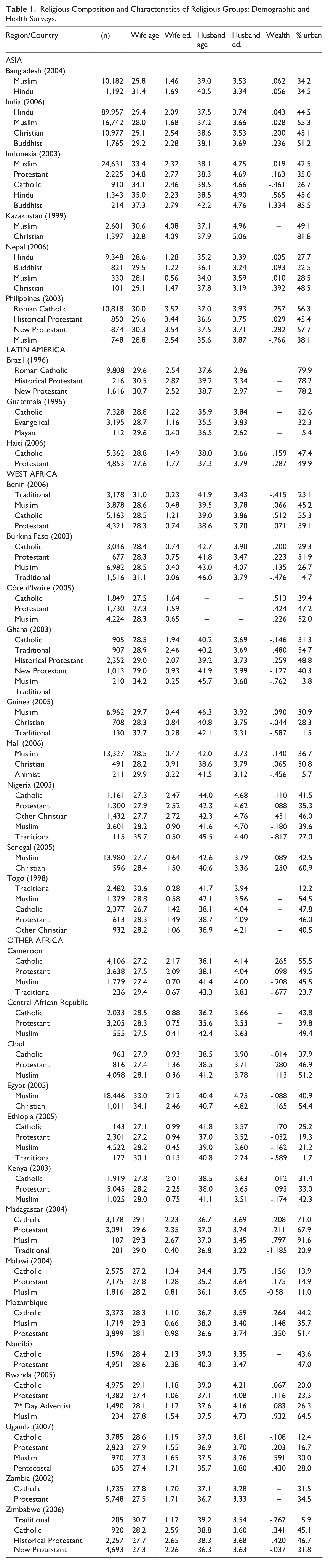
Table 2 reports the regressions for the contrast between Muslims (the implicit category) and Christians. Coefficients show the difference in each outcome. For example, the difference in female education between Christians and Muslims from Table 1 is .86 and the coefficient in Table 2 has the identical value (rounded to .86). The second model includes control variables (age and urban/rural residence in the education models, and age, urban/rural status, and education in the wealth model). The most salient finding in Table 2 is that Muslim women are at a substantial educational disadvantage when compared with Christian women in most countries of the sample. The average difference across all countries is .6, which reflects a difference of at least a few years of schooling. In Ghana, Nigeria, Cameroon, and Kenya the difference is greater than one. There are only four exceptions to this pattern. In Kazakhstan the Christian–Muslim difference is nil. In Madagascar, Rwanda, and Uganda Muslim women have an educational advantage. Muslims are a small minority (less than 4% of the population in Madagascar and Rwanda). These differences in female education are not greatly altered when controls for age and urban residence are included.
Regression Analysis: Christians compared with Muslims: Demographic and Health Surveys.
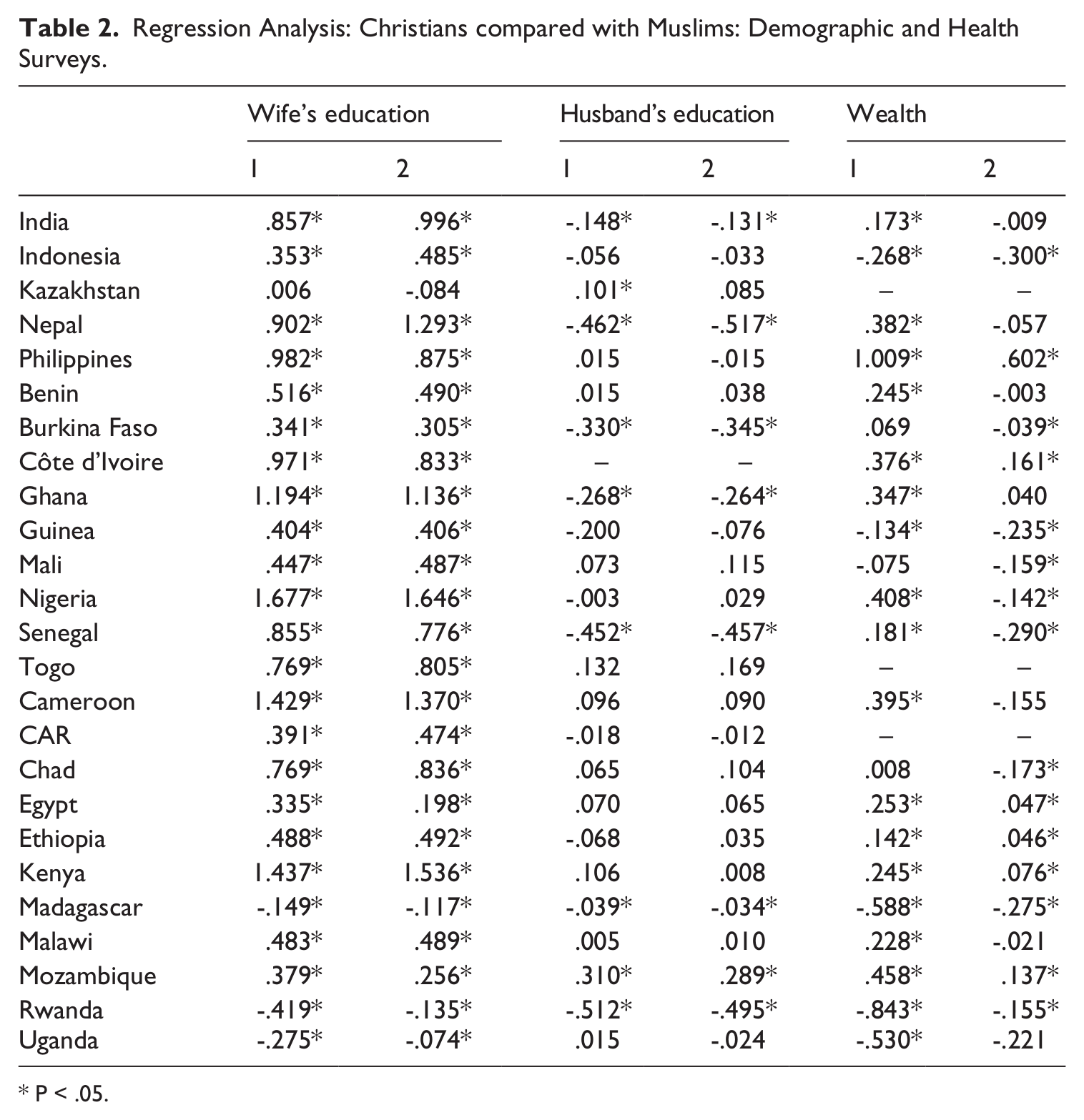
P < .05.
The same pattern does not apply to the comparison of Christian and Muslim men. Although Christian men do have an educational advantage in some countries, Muslim men have the advantage in others. Indeed, the average coefficient across all countries is -.04 indicating a slight overall advantage for Muslim men. In other words, there is much greater gender inequality in education among Muslims than among Christians.
The models for wealth also show a tendency toward a Christian advantage. Fourteen of the coefficients are positive and statistically significant and only five are negative and statistically significant. The average difference is .11, indicating that Christians score about .1 standard deviations higher on the wealth factor than Muslims. Interestingly, the Christian advantage often disappears or is diminished when control variables are added. This occurs because women’s education is associated with wealth and Muslim women tend to have lower education. Others have shown that women’s education has economic benefits (Glick and Sahn, 1997). Women’s education can play an important role in household wealth when women contribute directly to economic production, but may also occur through other mechanisms. More educated women may marry men with better economic prospects, may be able to allocate more of the household’s income to wealth, and may indirectly promote their husband’s productivity. The average coefficient in the model with controls is -.05, indicating a slight wealth advantage for Muslims. Results support the conclusion that the lack of female education among Muslims carries a significant economic disadvantage.
Table 3 shows contrasts between Muslims, Hindus, and Buddhists. Muslim women also have an educational disadvantage in these comparisons, the only exception being that Hindu women are slightly less educated than Muslim women in India. Differences are generally not attenuated when control variables are taken into account. In contrast with women, Muslim men are more educated than Hindus in Bangladesh and Nepal, and more educated than Buddhist men in Nepal. On the other hand Muslim men are more educated than Hindu men in India and Indonesia. As in the contrasts with Christians, the Muslim educational disadvantage is most pronounced among women, while the male comparisons do not give consistent results. Muslims have a wealth disadvantage when compared with Buddhists in India, and with Hindus and Buddhists in Indonesia. A significant portion of the wealth disadvantage can be attributed to lower education among Muslim women.
Regression Analysis: Hindus and Buddhists compared with Muslims: Demographic and Health Surveys.
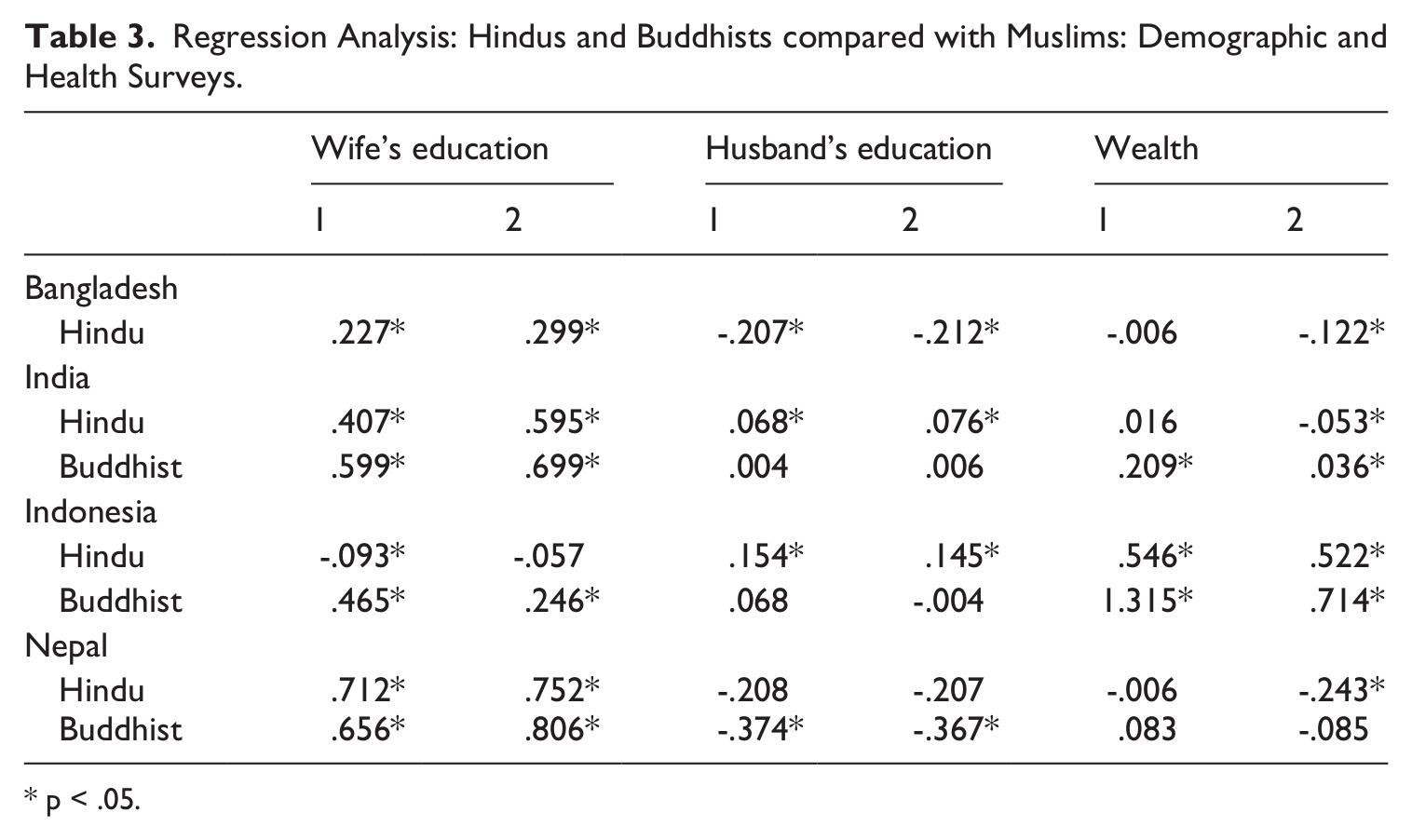
p < .05.
The differences between Hindus and Buddhists can be assessed by comparing their respective coefficients in Table 3. The pattern is mixed. In India, Hindus have an educational advantage, but Buddhists have a wealth advantage. In Indonesia, Buddhists have an advantage for female education and wealth, but Hindu men are more educated than Buddhist men. In Nepal, Hindu men are more educated than Buddhist men, but Buddhists score higher on the wealth index. In short, there is not a consistent socioeconomic difference between Hindus and Buddhists in the three countries where comparisons can be made.
The contrast between Catholics and Protestants is shown in Table 4. Coefficients show how much higher or lower Protestants are than Catholics. Results are mixed. When the outcome is female education, nine of the coefficients are positive and statistically significant, indicating a Protestant advantage, and ten are negative and statistically significant. But only five of the coefficients are not significant. The average across all countries is a meager .028. Results do not support the conclusion that there is little difference because several of the coefficients – both positive and negative – are quite large. Rather, there is no systematic difference. The Catholic/Protestant difference in female education appears to vary substantially by national context. Controls for age and urban residence generally do not make a big difference.
Regression Analysis: Protestants compared with Catholics: Demographic and Health Surveys.
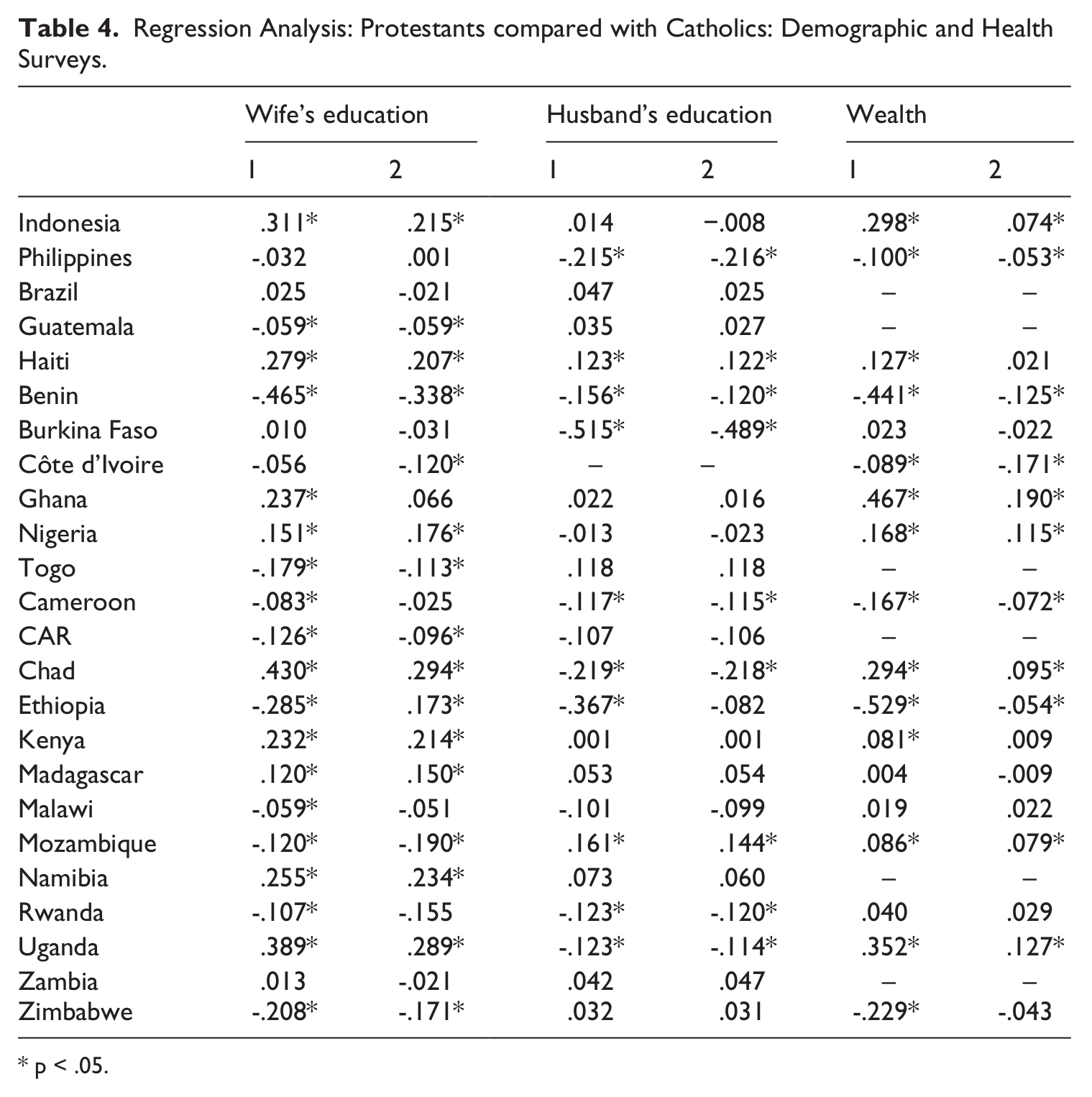
p < .05.
Protestant/Catholic differences in husband’s education tend to be slightly more negative than was the case for women, implying that Catholic men are more educated than Protestant men in some countries. Nine of the coefficients are negative and statistically significant, but only two are positive and statistically significant. The average across all coefficients is -.058. The results for wealth are as varied as for women’s education. Eight of the coefficients are positive and significant while six are negative and statistically significant. The average across coefficients is only .022. Although there is a Catholic/Protestant difference in a majority of countries, the difference is not in a consistent direction. In short, there is no strong evidence for a ‘Protestant ethic’ effect in these developing nations.
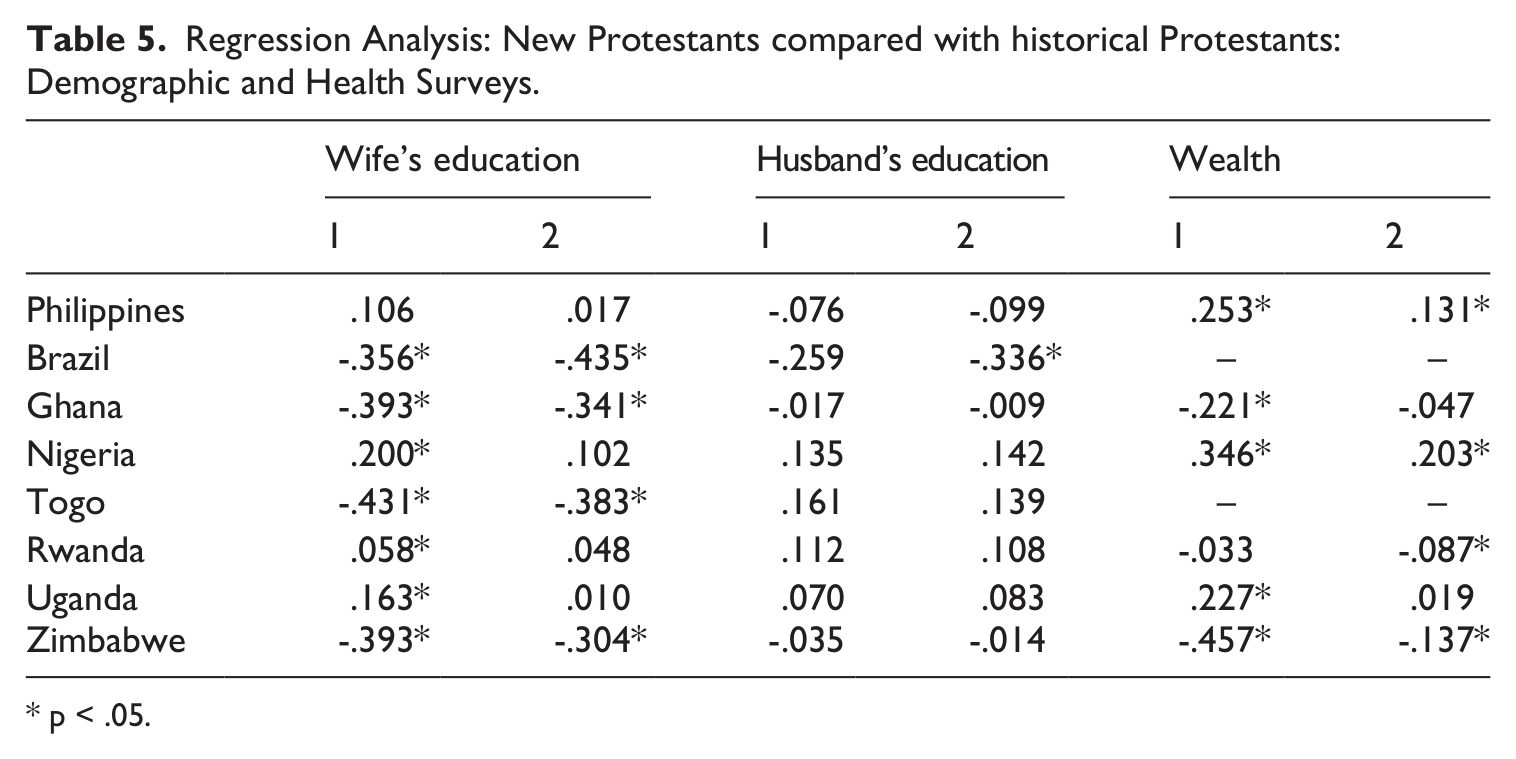
Table 5 reports comparisons between historical Protestants and new Protestants. These comparisons can only be considered to be preliminary since the religious mix of groups, and hence the categories included in the variable, vary from country to country. This inconsistency in the specific groups being compared could account for some of the inconsistency in results. For example, three of the comparisons for women’s education are positive and statistically significant, while four are negative and statistically significant. On the average, the coefficients for women’s education are negative, indicating that females in the new Protestant group have a disadvantage in comparison with historical Protestants. When the focus shifts to men, most coefficients are not statistically significant and the average is near zero, suggesting that there is not a strong tendency for these two religious categories to differ. The final two columns show results for wealth. Again, results are mixed. In the Philippines, Nigeria, and Uganda, new Protestants report higher wealth, but the difference in Uganda disappears when control variables are included. On the other hand, historical Protestants report higher wealth in Ghana and Zimbabwe, but coefficients are greatly reduced when control variables are included. As was the case for Muslims in several countries, it seems that there is a significant economic cost to having less educated females for members of new Protestant congregations.
Regression Analysis: New Protestants compared with historical Protestants: Demographic and Health Surveys.
p < .05.
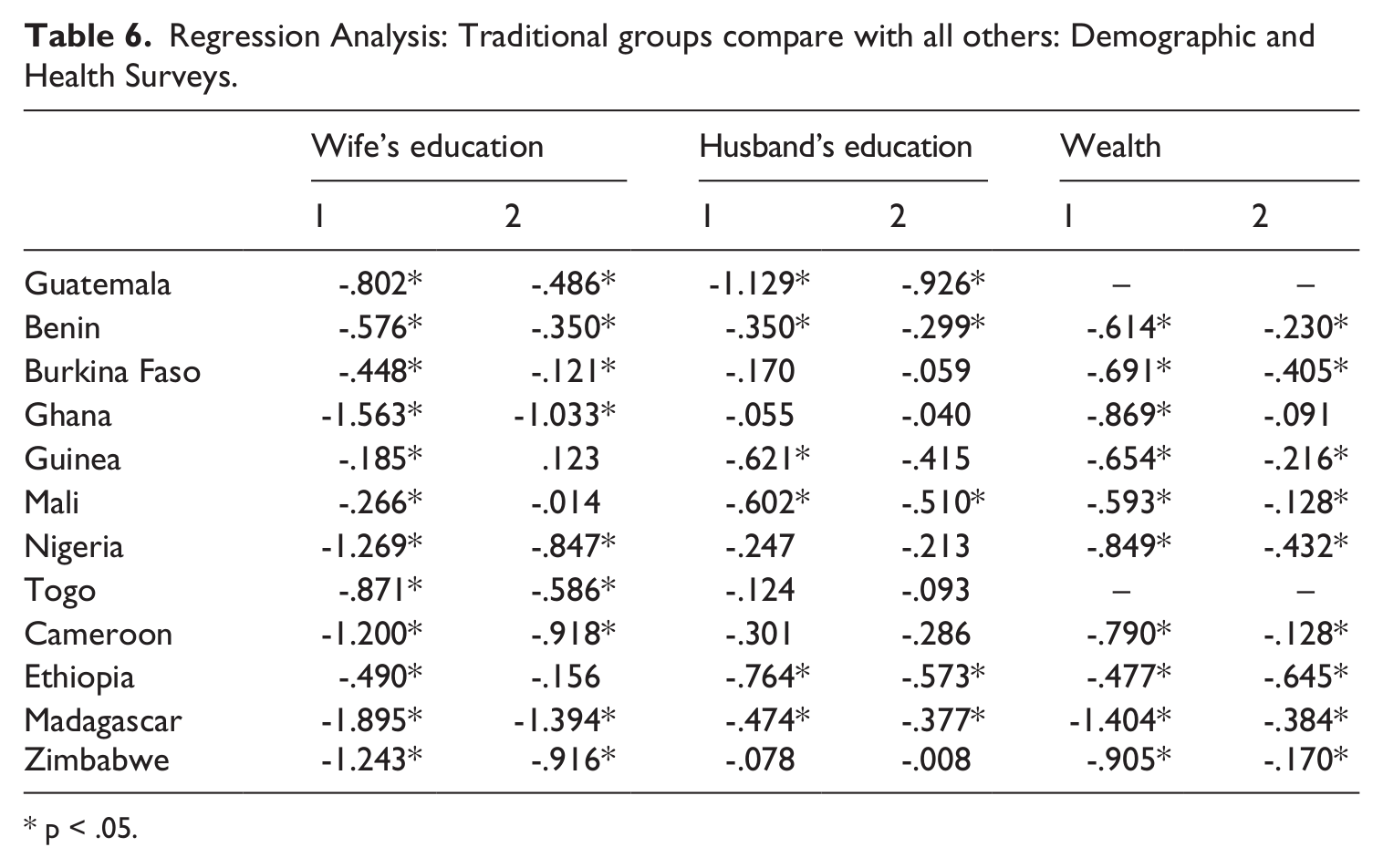
Regression Analysis: Traditional groups compare with all others: Demographic and Health Surveys.
p < .05.
Traditional religious groups are at a disadvantage on all measures of socioeconomic status. The magnitude of the disadvantage varies across countries, and females are at a greater disadvantage than males. Only some of the disadvantage can be attributed to greater concentration in rural areas. As with other comparisons, these data cannot be used to determine whether traditional beliefs are more antithetical to education and wealth accumulation or that people with lower socioeconomic status feel more comfortable with traditional beliefs. In either case, these groups lag behind in educational attainment and economic standing.
Conclusion
Comparisons between religious group categories in developing nations support the conclusion that religion is associated with socioeconomic status. But the nature of the association varies dramatically across countries. Three general patterns characterize the relationships observed here. First, differences are sometimes large but not systematic. That is to say, religion matters but not in the same way in every national context. The comparison of female education and household wealth between Protestants and Catholics demonstrates this pattern. The Catholic/Protestant difference on these measures averaged across all countries is close to zero. But it would be misleading to conclude that Catholics and Protestants do not differ on these measures. A majority of the coefficients are statistically significant and large enough to signal clear differences. A more appropriate conclusion is that the Catholic/Protestant difference is important but that the direction of difference depends on national context. This context could include the history of contact with the religion, the mix of Protestant denominations, and the role of religious institutions in providing education. The same can be said for differences in household wealth in the comparisons between historical Protestants and new Protestants, and for husband’s education when comparing Muslims, Hindus, and Buddhists.
The second pattern is observed in some comparisons when there is enough consistency across countries to indicate that a religious group has beliefs, teaching, and practices that have implications for the socioeconomic characteristics of its adherents in a wide variety of national settings. In most of the countries considered, Muslim women are less educated than Christian women, a pattern that is less evident for male education. The consistency and strength of this pattern is consistent with prior research in specific countries. Muslim women are also at a disadvantage in comparison with Hindus and Buddhists. Several factors may account for this difference, including the emphasis on familial roles for women, the subordination of women in the public sphere, the creation of school systems that favor men, and a social climate that discourages women from pursuing education. This pattern supports the position that Muslim countries may lag in economic development because of educational disadvantage, particularly among women (Norton and Tomal, 2009; Kuran, 2004). Yet the magnitude of the female educational disadvantage among Muslims varies a great deal across countries, again highlighting the role that national context can play even when systematic differences are evident. Adherents to traditional beliefs also experience socioeconomic disadvantage in a variety of national settings. Several factors could account for this pattern, including residence in rural areas where educational opportunities are lacking, preponderance of agricultural work where formal education is less relevant, and distrust of secular institutions.
The third common pattern occurs when religious differences are evident in some countries but not others, and the differences tend to be in one direction but there are several cases where the differences are in the opposite direction. There is a slight tendency for Muslim men to be more educated than Christian men, for Protestant men to be less educated than Catholic men, and for Christians to have more wealth than Muslims.
One of the most interesting patterns observed in the data is that religious group differences are greater when comparing women’s education than when comparing husband’s education. One possible explanation for this pattern is that most groups accept the importance of education for men because men have economic responsibilities and are more engaged in the public sphere. In contrast, religions vary greatly in their norms and practices regarding women’s roles. A very obvious implication is that household wealth is generally reduced in groups where female education is low. There is a substantial economic cost to limiting female education.
As is often the case, this study raises at least as many questions as it answers. The religious categories used here are very broad, leaving in question the variation within subgroups. No measures of religious participation are included, so the difference between nominal members and active participants is unknown. The inclusion of such a large sample of countries makes it difficult to quantify historical, cultural, and ethnic factors that undoubtedly play a role in cross-national variation. Examination of the complex historical and cultural forces that account for cross-national variation lies beyond the scope of this analysis. These forces include patterns of migration that establish religious presence in some countries, the connection between colonial domination and religious institutions, the context of missionary contact, and the status of converts to new religious groups. Despite these lingering questions, this study does document various patterns of association between religious group membership and socioeconomic status that are significant enough to merit further attention.
Footnotes
Funding
This research received no specific grant from any funding agency in the public, commercial, or not-for-profit sectors.
Author biography
Address: 2033 JFSB, Brigham Young University, Provo, Utah 84602, United States.
Email: