




Abstract
Religious diversity is posing new and urgent challenges to local authorities and there is no solid foundation of expertise in dealing with this issue at the local level. In some European cities, interfaith platforms are providing local authorities with new governance tools to cope with the challenges of religious diversity and are generating new ways of framing and representing religion in the public sphere. The author takes the city of Barcelona as a case study with the aim of exploring the emergence of a new model for dealing with religious minority issues that goes beyond State–Church relations and the political legacies in this area.
Introduction
Public policies on religious diversity issues are becoming increasingly relevant in the governance of contemporary European societies (Côté and Gunn, 2006; Koenig, 2005). This is clearly the case in Spain, where this sort of policy has undergone a major change in a short period. Before the 1990s, religious diversity issues were almost absent from the policy agenda and religious minority groups were largely ‘invisible’ to the authorities and the media. However, many new public bodies, specifically formed to manage religious diversity, have been created at State, regional and local level recently. 2 Likewise, new legislation in this area has been passed, new procedures have been implemented to deal with different religions in public institutions, and many controversies over religious minority issues have erupted in the media. To some extent, it can be said that the governance of religious diversity has become an institutionalized and important ‘policy sector’ (Muller, 2000) in Spain in less than 15 years.
However, not only have the public policies around religious issues changed considerably, but the religious scenario has also been transformed deeply. Religious actors have gained a major public profile, intrareligious and interreligious controversies have emerged in the public sphere, and new religious centers have been established due to, above all, the increasing number of immigrants with diverse religious backgrounds. It is also necessary to highlight the growing presence of interfaith groups, councils and initiatives all around the country, which have gained considerable prominence in a few years.
Recent changes to the governance of religious diversity are particularly noticeable at local level. To some extent, as Rath et al. pointed out, ‘the local authority is always the pivot upon which everything moves’ (2001: 193). First, religious challenges are perceived as more pressing and urgent in the local sphere due to the fact that that is the setting within which the specific controversies take place (and where the consequences of these controversies for social cohesion and urban coexistence can be most harmful). Second, local authorities are the first ‘port of call’ for religious minorities’ claims and demands. Finally, it is in the local sphere where the ‘political principles’ relating to the role of religious minorities in society such as ‘laïcité’ or rights to religious freedom must be translated into a set of specific, coherent, and worked-out policies (Galembert, 2007).
The aim of this article is to analyze the transformations in local public policies on religious issues with a focus on the emergence of a new policy model of dealing with religious minority affairs. The main questions addressed are the following: What are the main differences between the current and the former ways of dealing politically with religious issues in the local scene? What is the role played by interfaith platforms in the new model of public policies on religious issues? And, why are they playing such a role?
In this article, I argue that recent changes in the public policies on religious issues are not fully comprehensible without taking into account that there has been a ‘policy paradigm’ shift (Hall, 1993) in the religious governance field in recent years. My main argument is that the policy paradigm based on the ‘secularization thesis’ has been replaced by a new paradigm grounded on the fear that the revitalization of religion would undermine urban social cohesion. The concept of ‘policy paradigm’ is useful to broaden the scope of the analysis and contributes to reasserting the major role played by ideas, perceptions, and normative prescriptions in the current shape of the governance model of religious minorities.
In the first part of the article, I will say a few words about the concept of policy paradigm and the appropriateness of using it in this context. In the second part, I will present the main characteristics of the former model of dealing with religious minority issues. Thirdly, I will identify the factors that have generated a paradigm shift and then explain the main features of the new model. I will conclude the article briefly with some reflections on the role of interfaith groups in the new governance model of religious diversity.
This article focuses on the case of Barcelona. The research has adopted an ethnographic approach and three main sources of data have been used: observation of political, religious, and interfaith events and meetings; semi-structured interviews of policymakers and public officials (20) and interfaith organizations staff and members (15) as well as of religious leaders (30), interpreted by discourse analysis (Fairclough, and Wodak, 1997); and, finally, analysis of government data (parliamentary debates, commission reports, minutes of meetings, archives, etc.). The fieldwork was conducted between 2008 and 2010.
Some theoretical concerns: the crucial role of policy paradigms
Local European governments are paying much more attention to religious diversity issues than before and minority religious issues have become part of the local policy agenda all around Europe. The recent rise of public policies on religious minority issues is usually described as a direct consequence of or an automatic reaction to the emergence (and the growth) of new ‘problems’ in the religious field.
However, as Muller points out, public policies cannot, or cannot only, be understood as a mechanism to solve problems, because the relation between public policies and social problems is more complex than a mechanical one-way relationship (Muller, 2000: 1944). As many political scientists have argued, in order to find out why some questions become part of the policy agenda, it is more pertinent to analyze the evolution of the policymakers’ perceptions of these issues than to evaluate the changes in the events themselves (Hall, 1993; Kingdon, 1995; Muller, 2000; Subirats and Gomà, 2002). Events can always be read in different ways and, by themselves, do not give rise to a public policy. They can only do so when mediated by some perceptions. Or to put it in other words, a given condition only becomes a ‘political problem’ through a process of framing, conceptualization, and categorization.
Changes in the religious field have run in parallel with a deeper transformation of policymakers' perceptions about the role of religion in contemporary society, and this cognitive turn cannot be neglected in the analysis of the new public policies in this area. Ideas play a significant role in identifying, defining, and structuring a policy sector and a remarkable transformation of a policy area usually comes together with a ‘policy paradigm’ shift.
Peter Hall (1993) defines a ‘policy paradigm’ as a wider narrative that locates issues in a broader frame, gives them a meaning, and identifies what the problems are and what the solutions can be. As he pointed out, ‘policymakers customarily work within a framework of ideas and standards that specifies not only the goals of policy and the kind of instruments that can be used to attain them, but also the very nature of the problems they are meant to be addressing’ (Hall, 1993: 279). From this point of view, it becomes clear that to better comprehend the particularities associated with the new models of governance of religious diversity, it is crucial to understand what the ‘framework of ideas’ is that is legitimizing the increasing attention to religious diversity issues.
Hall (1993) demonstrates that policy paradigms are extended through three dimensions. The first dimension consists of a general explanation of the situation, the second identifies and categorizes the problems, and the third defines what kind of policy instruments are adequate.
Like scientific paradigms, a policy paradigm can be threatened by the appearance of anomalies, namely by developments that are not fully comprehensible, even as puzzles, within the terms of the paradigm. As these accumulate, ad hoc attempts are generally made to stretch the terms of the paradigm to cover them, but this gradually undermines the intellectual coherence and precision of the original paradigm. (Hall, 1993: 280)
It is at this point that policy failures precipitate the emergence of a new paradigm that goes along with a new configuration of power relations and the building of new meanings and new policy narratives.
When a paradigm enters a crisis, there are usually some political or social actors that take a leading role in fostering a new one. They are ‘advocates,’ ‘policy entrepreneurs,’ (Kingdon, 1995) or ‘mediators’ who work to disseminate new ideas that come to substitute the older ones. In this sense, ‘mediators are fundamental actors who perceive or construct a problem (cognitive function), while delineating and proposing solutions (normative function)’ (Draelants and Maroy, 2007: 15). As I will expound later on, interfaith organizations are playing a central role in drawing a new paradigm on religious diversity issues in the case of Barcelona.
Thus, to properly capture the complexities of the current governance model of religious diversity, it is appropriate to explore what the policy paradigm embedded in it is and to elucidate whether there has been a paradigm shift. To accomplish this task, and be methodologically sound, it is necessary to take a minimum historical perspective. Furthermore, it is important not to confine the research to concrete political action but to expand it to include the ideas, perceptions, and knowledge that have guided the political actors in carrying out that action.
The first paradigm: the secularization thesis as a policy paradigm
From the Spanish democratic transition until the late 1990s, the policy paradigm that was behind the policy agenda on religious minority issues was built on the idea that the secularization of society was an irreversible process. To some extent, and to put it simply, policymakers were convinced that religion was on the point of disappearing and their approach to religious minorities was driven by this belief. To understand how the secularization paradigm was built in Spain, it is necessary to first look at the historical background and, second, examine what the public policies (or absence of them) concerning religious minorities were during this period.
The secularization thesis was not only a sociological theory but also a powerful political program that was embedded in the liberal and leftist political movements of the former century. As Champion (2004) underlines, it was in the Catholic countries that the political battles between secularist and antisecularist factions were the strongest and where the secularist program was at the forefront of the modernization project. Some of the major political confrontations during the second democratic Spanish Republic (1931–1936) were clearly rooted in the opposition/defense of such a political program. However, if in other countries these confrontations strengthened liberal democracies, in the case of Spain they led to a civil war that gave rise to a bloody dictatorship. Catholicism played a significant role in legitimizing the dictatorship and the Catholic authorities worked hand in hand with the dictator, Francisco Franco. Religious minorities were defined as a threat to ‘national identity’, strongly persecuted, forced to act clandestinely, and publicly stigmatized (Rozenberg, 1996).
In the mid 1970s, the death of Franco opened the door to democracy. The discussion on the role of the Catholic Church in the new democratic system was foreseen as one of the most controversial issues of the democratic transition. However, an agreement was reached before anyone expected it, and Spain was declared an ‘aconfesional’ country, rejecting the idea of a state religion but giving ‘special status’ to the Catholic Church. To some extent, no political party was disposed to put the democratic process in peril for religious reasons. Through analysis of the parliamentary debates, it becomes clear that almost everyone considered the confrontations between secularist and antisecularist factions as an obsolete battle that had no place in the modern world (Griera, 2009).
In addition, a new act on religious freedom aimed at giving rights to religious minorities, which received unanimous support from all political sectors, was passed in 1980 (Rozenberg, 1996). However, the plight of religious minorities was not considered a priority issue by policymakers, and besides the formal awarding of new rights, there was no clear will to improve their situation.
It should be acknowledged that the political separation of State and Church coincided with a drastic fall in religious attendance and religious identification rates (Perez-Agote, 2007). In less than ten years (from the mid 1970s to the mid 1980s), the rate of attendance at Catholic church services in Spain (and especially Catalonia) 3 had declined to a level similar to that in other European countries. Likewise, the dissemination of statistical survey data on secularization contributed to a ‘scientific’ legitimation to policymakers for what was a political and normative belief about the role of religion in ‘modern countries.’ Secularization was understood as an inevitable process that came along with the democratization of the country and this had strong consequences on the definition of local public policies on religious minorities’ issues.
The City Council approach to religious minority issues during this period was characterized by:
Laissez-faire relating to religious minority groups: In a manner of speaking, the main feature of public policies on religious minority issues during the first 20 years of democracy was the absence of them. The Barcelona City Council, like almost every city council in Spain, did not develop any specific political program aimed at accommodating religious diversity. When facing the demands of religious minorities, local authorities argued that political jurisdiction regarding religious issues did not belong to city councils. Nevertheless, despite the fact that city councils were not directly granted political jurisdiction on religious affairs, they already had jurisdiction in other areas, such as urban planning or cemeteries, that indirectly concerned religious minorities. However, no political action was taken in this area besides the formal recognition of religious freedom rights that allowed religious minority groups to reopen their places of worship and permitted the opening of new centers. It is important to mention that despite the local authorities’ indifference to religious diversity, it can be estimated that there were around 120 places of worship for religious minorities in Barcelona at the beginning of the 1990s. 4 Likewise, the absence of public policies does not mean that there were no conflicts or controversies related to religious issues. On the one hand, as many minority religious actors point out, they had to face many obstacles in order to be able to practice their religion ‘in proper terms.’ For instance, they had to cope with many difficulties when performing their rites for the dead, they had no chance to apply for funding for charity issues, they were never publicly recognized or represented in official or public celebrations, and they had restrictions on their activities in the public space. On the other hand, there were a substantial number of localized conflicts related to neighbors’ complaints against places of worship (especially against Pentecostal Churches). However, such conflicts were never publicly framed as religious conflicts and the final ‘solution’ was almost always to the detriment of the religious minority groups, and implied the closing or moving of their centers of worship.
Significant resistance to new religious movements (NRMs): During the 1970s and 1980s, many NRMs such as the Jehovah’s Witnesses, the Hare Krishna, and the Church of Latter-Day Saints, taking advantage of the new democratic situation, sent missionaries to Catalonia and Spain. The missionaries’ efforts bore fruit and a substantial number of NRM worship centers were set up in Barcelona during this period (Estruch et al., 2004). However, the growth of NRMs in the city came along with a strong public and media campaign against these groups (Prat, 1997). It was not only the media that undertook a harsh campaign against NRMs – labelled ‘sects’ – but also local authorities, who felt that they had a role in fighting them. NRMs were perceived and defined as incompatible with ‘secular modernity’ and as a ‘peril’ to secular society. The Barcelona City Council put forward three strategies to control and ‘combat’ them. First, they placed many obstacles and barriers to the opening of NRM places of worship, although there was no legal basis for impeding them. Second, through local authorities and local police they kept them under strict surveillance and every minor illegal action was heavily penalized. Finally, they funded a Catalan civil association aimed at fighting these religious organizations. 5 Jointly with this association, the City Council launched public campaigns warning of the great danger of these groups, which strongly stigmatized NRM believers.
‘Banal Catholicism’: The Barcelona City Council’s approach to religious minority groups cannot be fully comprehended without bearing in mind the hegemonic role of Catholicism in Catalan history. Hence, despite the fact that the political speeches since the democratic transition began to place great emphasis on the secularization of the country and on the need to restrict the power of the Catholic Church, the dominant role of Catholicism did not fade away as quickly as the discourses had changed. The concept of ‘Banal Catholicism’ can help to shed light upon the ambiguous stance of local authorities towards Catholicism. The concept of ‘Banal Catholicism’ is an adaptation of what Michael Billig (1995), in his studies of nationalism, named ‘Banal Nationalism.’ Billig’s (1995) concept refers to the everyday practices and deeply-rooted customs that stealthily reinforce and reproduce the belonging to a nation while helping to ensure its hegemony in a territory. Billig (1995) was not interested in analyzing what has been identified as ‘aggressive’ or violent forms of nationalism, but rather the permanence of the almost-invisible nationalist ideology in ‘stable’ Western nation-states. A nationalist ideology that is reinforced on a daily basis in the most subtle and unnoticeable (and thus banal) manner: flags on the balconies of the City Hall or pictures of the ‘fathers’ of the country in schools, postage stamps depicting patriotic motifs, the national anthem at sports matches, etc. Translating it into our field of research, it is possible to state that while Catalan society was described as completely secular, the prominence of Catholicism in the country’s imagination was reinforced by ‘banal’ practices such as the presence of local authorities in the front row of Catholic processions, the opening of all city celebrations with a mass, the existence of crosses and other Catholic symbols in public institutions, the keeping (and funding) of Catholic chapels in hospitals and prisons, and the invitation of Catholic authorities to official events. However, this was generally perceived as ‘normal’ and ‘natural’ and did not generate much controversy. In fact, it was not seen as a contradiction of the belief in the irreversible character of the secularization process and the need to keep religion in the private sphere.
The Barcelona City Council’s first attempt to take religious minority issues into account was in 1992. That year, there were two events that could have marked the start of a new approach to local religious diversity.
On the one hand, Barcelona hosted the Olympic Games, and one of the requirements of the International Olympic Committee was the creation of a multi-faith center and provision of facilities for members of different faiths to observe their religious rituals during the Olympic Games. As the City Council did not have officials prepared to deal with religious minority issues or interlocutors in the religious field, the local political authorities asked the president of the Ecumenical Center of Barcelona to appoint a commission to carry out this task. A commission composed of representatives of minority religions were given responsibility for the multi-faith center project and played a major role as city advisors and in the running of the center (called ‘Centre Abraham’) during the Olympic Games.
On the other hand, 1992 was the 500th anniversary of the expulsion of Muslims and Jews from the peninsula. As a gesture of historical reconciliation, the Spanish government did sign an agreement with the Jewish, Muslim, and Protestant communities that granted them many new rights such as religious teaching at school, plots in the cemeteries, tax exemptions, the right to ask for halal and kosher food, and so forth. Although the agreements were fostered and signed by the Spanish government, most of their articles had to be formulated by local authorities.
As a member of the Protestant community asserted, ‘Ninety-two was a very exciting year and we thought that it would be the beginning of a new period where we would be publicly recognized and taken into account by the governments’ (personal interview with a Protestant leader). However, those expectations were not fulfilled.
On the one hand, some months after the Olympic Games, the multi-faith center became part of a Catholic parish and the Barcelona local authorities, ignoring the claims of religious minorities, stated that it was not their duty to maintain a multi-faith center or improve interreligious coexistence. Religion was still seen as a matter of private choice and local authorities said that they did not want to intervene. On the other hand, the agreements with the Muslim, Jewish, and Protestant communities became worthless. Almost no points of the agreements were implemented (there was no funding available, the agreements did not have an implementation plan, etc.) and many local city councils were scarcely aware of the existence of these agreements and their implications (Moreras, 2002).
The failure of these two events to inaugurate a new way to frame religious minority issues illustrates well the role of the policy paradigm in orienting the political approach. Policymakers and officials involved in these events argue (in the interviews) that if these did not yield a more proactive approach to religious diversity it was because immigration flows were still small and there were no ‘problems’ related to religious minorities. However, despite the virtual lack of ‘problems’ concerning the cultural integration of newcomers, for instance, many public policies aimed at recognizing (and managing) immigrant cultural and linguistic diversity were developed at the beginning of the 1990s by the Barcelona City Council. To some degree, as occurred in many other European contexts, while the government made a great effort to integrate migrants from a cultural perspective, they just ignored the religious dimension of immigration (Laurence, 2006; Koenig, 2005).
As the secularization theory was at the basis of the policy paradigm, political authorities were convinced that immigrants would lose their religion as soon as they became integrated and that they, as political authorities, had no role in facilitating the religious life of citizens. To sum up, the political approach to religious diversity was fully dependent on an imaginary notion that linked democracy closely with an idea of modernity and where religion was only a relic of the past.
The crisis of the ‘secularization paradigm’: a policy paradigm shift
The secularization paradigm entered a crisis at the end of the 1990s. The normative policy prescriptions associated with secular liberal ideologies were under discussion while the ‘imagined secular utopias’ began to blur. Religion was no longer perceived as a pre-modern remnant but as an important matter to take into account in order to ensure good governance. Religious diversity issues burst onto the policy agenda and many new initiatives in this area began to flourish all around Europe (Bader, 2007; Rath et al., 2001; Berger et al., 2008).
Barcelona City Council pioneered the development of a public policy on religious issues in Catalonia and Spain at the end of the 1990s. The starting point was the joint initiative of political authorities and interfaith leaders to set up a Religious Affairs Bureau within the City Council’s Civil Rights Department in 1998. The intention was to foster political activities on religious minority issues. In 2004, the management of the bureau was transferred to the Catalan Unesco Interfaith Association, which has been in charge of public policies on religious issues in the city since then. Barcelona was the first Catalan and Spanish city council to promote a proactive approach to religious minorities, but many other local authorities have also developed measures in this area. In fact, local councils have been identified as crucial actors for the governance of religious diversity, and state agencies and other public bodies have strongly encouraged the development of local political initiatives on these issues in recent years. In this regard, the Fundación Pluralismo y Convivencia, jointly with the Spanish Federation of Local Governments, has set up the Observatorio del Pluralismo Religioso en España (2011). The Observatorio aims to enable local authorities to cope with the challenges posed by the growth of religious diversity through the dissemination of best practices and the provision of advisory services and training for public officials.
To some extent, the emergence of a policy sector on the governance of religious diversity has been both the effect and the consequence of the crystallization of a new policy paradigm in the field.
New ideas, new challenges, and new actors
As I have already outlined, the change from one paradigm to another occurs when there is an ‘accumulation of anomalies, experimentation with new forms of policy and policy failures’ (Hall, 1993: 280). Uncovering what factors have precipitated the paradigm shift in the approach to religious minorities entails taking into account different elements that together have produced a new benchmark. In other words, it can be said that an ‘elective affinity’ between diverse, and somehow independent, factors has given rise to a new policy narrative on religious minority issues.
The main factors can be divided into those that have an ‘external’ dimension and those that have an ‘internal’ one.
First, looking at the ‘external’ factors, it is necessary to highlight that the perceptions, knowledge, and narratives surrounding religious issues have been deeply transformed in just a few years. On the one hand, if the secularization thesis was almost hegemonic 20 years ago, it is also hegemonically contested nowadays. New perspectives on religious issues have forced a rethink on the role of religion in the modern world. This paradigm shift in the academic field has obvious consequences in the policy field, since the close link between modernity, secularization, and privatization of religion has lost its scientific legitimation (Casanova, 1994; Asad, 2003; Thomas, 2005; Berger, 1999).
On the other hand, the emergence of new narratives on the role of religion in the contemporary world – and especially Huntington’s ‘Clash of Civilizations’ theory – has helped to popularize the idea of the ‘revitalization’ of religion. To better grasp the effects of the Clash of Civilizations theory, it is necessary to draw attention to the following three issues. First, as Sarto pointed out, ‘while Huntington’s argument, which devotes considerable attention to a clash between “Islam” and the “West” in the immediate future, was refuted as a myth by many well-informed Middle Eastern scholars …, it did strike a chord in public debates’ (Sarto, 2005: 315). That is to say, if it is important to take the theory into account, it is not for its scientific credibility but for its extensive effects on public debates. Second, the simplicity of the theory and the ‘vacuum’ left by the end of the Cold War (Seib, 2004) are key factors in explaining the quick acceptance of the theory by the media and public actors (Welch, 1997: 198). Finally, the use of the theory to frame international conflicts and, above all 9/11, is a crucial ingredient in comprehending its effects on the policy paradigm shift. Along this line, as Bottici and Challand point out, ‘the narrative has become one of the most powerful images through which people in both Western and non-Western societies perceive the world and act within it’ (2006: 323). To some extent, although it cannot be said that the Clash of Civilizations theory has determined the ‘policy paradigm’ shift in the Barcelona context, it cannot be denied that it did create a frame (Lakoff, 2004) through which the debates on religious diversity issues were tackled. In addition, the 3/11 (2004) Madrid bombing attacks deeply entrenched the explanatory power and popularity of such narratives in the Spanish context.
Regarding ‘internal’ factors, it should be underlined that immigration flows to Barcelona have increased substantially in the last ten years. This growth has encouraged the diversification of the religious field and the public visibility of such diversity (see Table 1).
Religious minority centers of worship in Barcelona (2010)
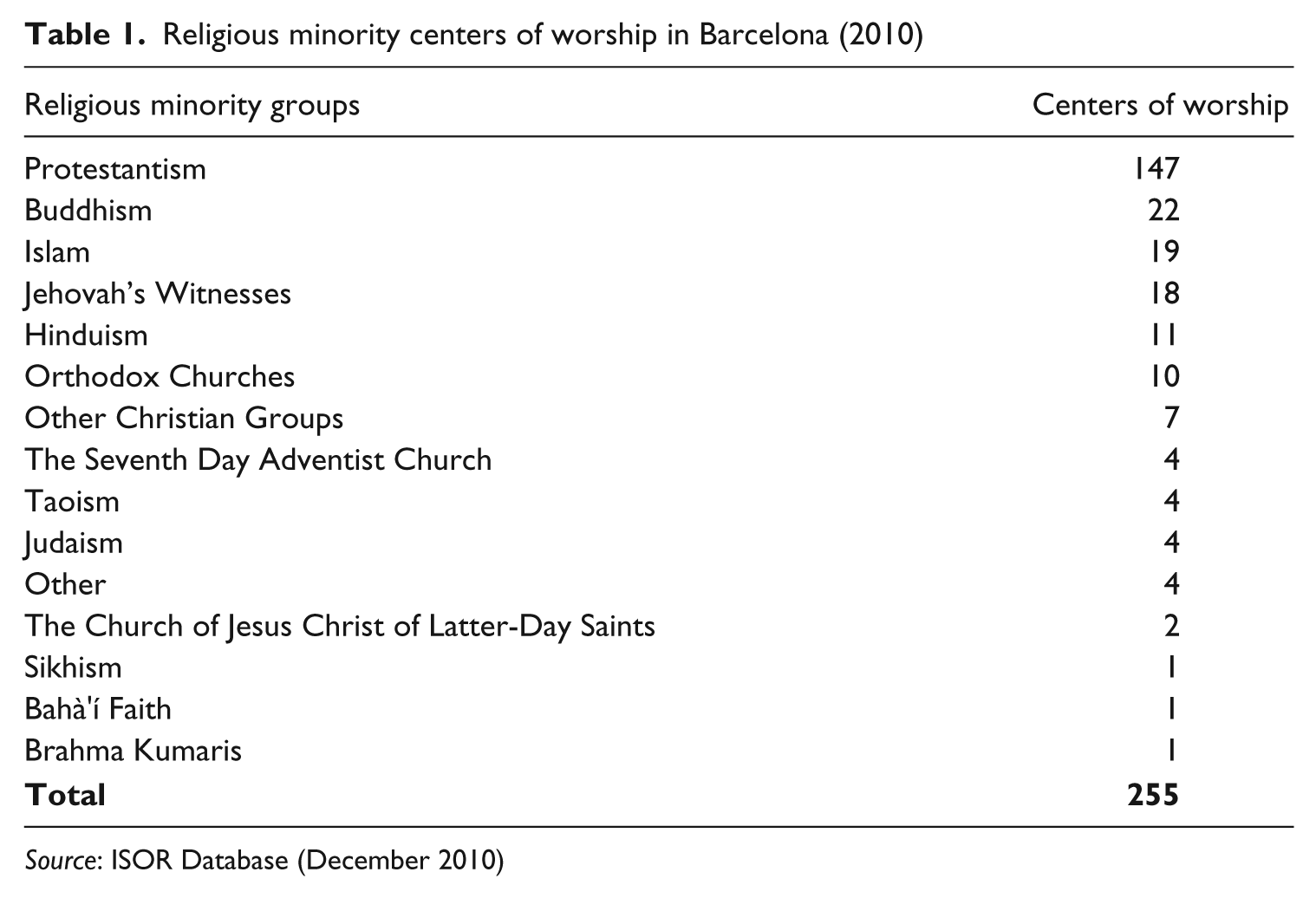
Source: ISOR Database (December 2010)
Moreover, religious minorities are increasing their visibility in the public sphere not only through the building of new places of worship, but also through the development of new strategies to make their voices heard. In this vein, religious minority groups are working cooperatively on setting up interfaith platforms that are taking a leading role in representing minorities in the public sphere and claiming minority religious rights. Interfaith platforms have rapidly increased in Catalonia since the end of the 1990s. Among them, the Catalan Network of Interreligious Organizations, which already comprises several Catalan interfaith associations, and the Grup de Treball Estable de les Religions (GTER) – the platform that brings religious leaders together – are the ones that have a major impact in the public sphere. Both are based in Barcelona. 6
On the other hand, far right-wing parties have used controversies on religious issues as an electoral strategy – especially those related to neighborhood complaints against the building of Muslim places of worship (Zapata-Barrero et al., 2007; Hernández-Carr, forthcoming). It is worth stressing that ‘conflicts relating to religious affairs and migration carry the seeds of extensive politicization of these issues’ (Itçaina and Burchianti, 2007: 123), which put tremendous pressure on local authorities to tackle them.
Finally, public debates on religious issues in neighboring countries – especially in France – are usually covered extensively by both the Catalan and Spanish media, a fact that contributes to emphasizing, even more, the increasing presence of religious minority issues in the media (Moreras, 2007; Griera, 2009).
In conclusion, both internal and external factors have played a role in undermining the former paradigm and generated a favorable breeding ground for the emergence of new perspectives on the issue.
Towards a new paradigm: the religious pluralism model
The nascent policy paradigm is grounded on these factors but it is essential to look also at policymakers’ discourses, perceptions, and ideas to achieve greater insight. What becomes clear from analysis of the interviews of local authorities is that almost all of them share the same diagnosis of the situation: they perceive religious diversity as a ‘risk factor’ that can easily threaten coexistence. In their discourse, Islam takes a prominent role and the fear of radicalization is central in their imaginations. However, the fear is related to not only the radicalization of Muslims, but also the radicalization of right-wing groups. To some extent, they are convinced of the importance of taking religious diversity seriously since they believe that a misguided policy could seriously damage social cohesion and lead to a governance crisis.
In a manner of speaking, the new paradigm has a reactive nature. It is grounded on the fear that Huntington’s predictions could become true. During the interviews, I became aware that despite local authorities’ explicit rejection of the Clash of Civilizations theory as an explanation of the current situation, the fear of a possible clash in the future pervades their discourses. They base this fear on tensions in the international context and the effects that the international ‘crisis’ could have on the local scene if religious coexistence is not properly addressed. This diagnosis forms the first dimension of a policy paradigm, the one that offers a general explanation of the situation.
The second dimension of a policy paradigm refers to the solutions that best suit the ‘problems.’ In this area, it is easy to appreciate discrepancies among policymakers. The line of division is on the kind of solutions proposed to tackle the ‘problem’: first, there is a group of policymakers, mainly from right-wing parties, who blame Islam for accentuating religious controversies and propose a policy course based on the control of immigration and the surveillance of Muslim communities. Second, there are those who are still anchored in the former paradigm – that of secularization – and propose a policy course in congruence with it. However, most of the Catalan policymakers interviewed adopt another position. From their point of view, the best way to ensure social cohesion and good coexistence is by promoting an inclusive policy towards religious minorities. In this way, to those who blame the Muslims, they state that if it is true that there are some people who use religion for some ‘obscure purposes’ (either radical Muslims, Catholics or atheists), the best way to stop them is by bringing religious groups together to work towards and promote an environment of respect and dialogue between different religions as well as between religious people and the wider society.’ (Interview with Barcelona local authority officer)
Likewise, to those who claim that it is better to ignore religious demands and promote laicization, they affirm that the encouragement of an atmosphere of coexistence and sharing of responsibility with religious minorities in this task can prevent future conflicts in this area. Interfaith actors initially set this discourse but local authorities have appropriated it recently. It should be acknowledged that interfaith leaders have been acting as ‘mediators’ or ‘advocates’ for this approach, giving tools to policymakers to build a discourse on religious pluralism. It is a discourse that, on the one hand, permits local authorities to distinguish their position from that of the far right-wing parties and, on the other, provides a meaningful receptacle for framing the emergent policy sector.
Peter Hall points out that the third dimension of a policy paradigm consists of the definition of policy instruments. In the case of Barcelona, the Catalan UNESCO Interfaith Association, which is in charge of the city council’s Religious Affairs Bureau, is responsible for doing it. The Bureau was initially managed by city council officials but there was neither a clear ‘road map’ nor any background experience in dealing with religious minority issues; as a result, the Religious Affairs Bureau was on stand-by for a short period (2002–2003). Transferring its management to the interfaith association was conceived as the best solution to improve local governance of religious diversity. This change was justified by arguing that interfaith leaders have a deeper expertise in religious minority issues than local council officials and by reaffirming the relevance of promoting an approach in line with the interfaith associations’ discourses. In this scenario, despite local authorities retaining the responsibility to define the aims and strategic goals, the interfaith association staff are responsible for proposing the approach and implementing it.
The paradigm shift in the Barcelona context is reflected in the following elements:
From indifference to religious minority issues to a ‘sense of urgency’ in dealing with them: If the most important feature in the previous period was the absence of political action in the matter, the most relevant characteristic of this new era has been the setting-up of a bureau specifically devoted to religious minorities issues – which counts on generous funding and three full-time officials (plus other officials as needed). The main policy areas of the Bureau can be categorized in relation to four major themes:
- The politics of proximity: The first action undertaken was the building of a database with information about all religious groups established in the city. This database – which is constantly updated – has provided officials with detailed information on religious minority groups, giving them the opportunity to monitor the evolution of religious diversity and reinforcing contact with religious leaders. - Defending the right of religious freedom: The bureau works as a ‘defender’ of religious minority rights in relation to the other departments of the city council by promoting a transversal policy more responsive to the needs and problems of religious minorities. For instance, a project aimed at ‘raising awareness’ of the need to respect religious minorities within the local police has been promoted by the city council. Moreover, on some occasions the bureau has worked as a mediator between the officials in charge of urban planning and religious minority groups that want to set up new worship centers in the city. - Integrating religious minority groups within the city’s social and cultural fabric: To prevent the isolation of groups and interreligious disputes, the bureau works to encourage the involvement of religious groups in social and cultural networks. Among other activities it organizes events to facilitate networking, provides information to religious groups on available funding for undertaking social and cultural projects, fosters cooperation among religious groups, and promotes incorporation of religious leaders in ‘city forums.’ - Encouraging the role of interfaith platforms: The bureau has empowered interfaith leaders to work as mediators in the resolution of local conflicts such as neighborhood complaints against places of worship and of specific crises such as the Danish cartoon affair.
From an imagined secular community to a pluralistic one: The development of a modern and democratic society was strongly connected in Catalonia to the trend towards modernity by diffusing secularization and the construction of an ‘imagined secular community.’ However, the secular narrative has lost its credibility and the growth of religious minorities as well as the increasing salience of religion in the contemporary world have generated the need to reshape the role and representation of religion in the public sphere (Bader, 2007). The success of interfaith platforms can be explained by the fact that they provide a ‘mise en scène’ for the new religious diversity and help to diffuse the idea of religious diversity in society (Griera and Forteza, 2011). The organization, promotion, or sponsoring of interfaith performances is becoming a common practice in the Barcelona City Council's policy. To some extent, the observation of Lamine in the case of France can also be applied to that of Barcelona: ‘L’« interreligieux » en général, et plus particulièrement dans sa dimension « politique », contribue à la fois à redonner une certaine place aux religions dans l’espace public et à la définition du « religieusement correct »’ (2005: 27).
From ‘Banal Catholicism’ to Contested Catholicism: The increasing visibility of religious minorities means that ‘Banal Catholicism’ is no longer ‘normal’. Currently, the local government is forced to justify the privileges awarded to Catholicism and ‘banal’ actions such as having a cross in the City Hall or the holding of a Catholic ‘official’ mass in city celebrations are put under scrutiny and are no longer ‘invisible’ or perceived as ‘normal’ by ordinary people. However, the discussion, at least at local level, it is not about clericalism/anticlericalism but about whether the benefits and privileges awarded to Catholicism should be extended to other religious groups. In most cases, local authorities extend the benefits that the Catholic Church enjoys to other religious minorities. For instance, if Catholic Church leaders are invited to official city celebrations, religious minority leaders are invited, too; or if priests are entitled to visit patients in public hospitals, other religious minorities are, too, and so on.
From ‘control’ to indifference towards new religious movements: The new approach to NRMs is demonstrated by the fact that the City Council has stopped using the word ‘sect’ to describe these groups and has included most of them, including the Jehovah’s Witnesses, in the list of the city’s religious minority groups. The policy change towards NRMs is not only a local feature and, as Liogier points out:
here are four possible factors to explain this transformation: the role of the European Court of Human Rights, the role of scientific forums in promoting a different view of new religious movements, changes in the strategies of recognized religions who felt attacked by the extension of the struggle for a new anti-cult ‘religious war’, and finally, the interconnection with the evolution of the problematization of Islam. (Liogier, 2006: 82)
Before tackling the final part of the paper, I would like to highlight two other issues. First, it is necessary to bear in mind that religious minorities are not ‘passive’ players. They proactively analyze the political context and select their strategies according to the prevailing political agenda. In this sense, the policy agenda is structurally selective, although it is also a terrain for strategy. Religious minority groups know that in order to be taken into consideration by local authorities, they must adapt to the ‘rules of the game’ and show that they are part of the ‘good religion.’ Thus, religious minority groups have adapted their discourses and their strategies to this new context in recent years by engaging in interfaith councils or associations, promoting open days at places of worship, inviting local authorities to religious celebrations, etc. However, it is important to note, as well, that among religious minority groups there are notorious differences relating to their capacity to take advantage of this new situation. Likewise, the ‘religiously correct’ behaviour of some religious minority leaders – such as those of Muslims and Jehovah’s Witnesses – are under greater public scrutiny than the rest, which is something that forces them to play the ‘religiously correct’ role more intensively.
Second, despite local authorities paying more attention to religious minority affairs than they did in the past, religious minority groups still cannot enjoy many of the benefits (and rights) laid out in the 1992 agreements. In a way, even though the symbolic recognition of minorities and actions aimed at promoting good coexistence have gained momentum recently, the implementation of new rights under the agreements of 1992 has not yet taken effect.
Conclusions
In recent years there has been a policy paradigm shift in relation to religious minority issues in Spain (and especially in Catalonia), and Barcelona City Council has taken a pioneering role by implementing new public policies in line with the new paradigm (Itçaina and Burchianti, 2007). The new policy paradigm gives more visibility to religious pluralism in the public sphere and encourages a more inclusive policy towards religious minorities by taking their claims and demands more seriously. The success of interfaith platforms in becoming both ‘mediators’ of the policy paradigm and key actors in the implementation of new policies in Barcelona can be explained by the following factors:
- Providing ‘recipe repertoires’ to policymakers. The challenges of religious diversity are becoming greater and more unpredictable day by day and there is no clearly established ‘road map’ (Goldstein and Keohane, 1993) or common vision regarding the best way to deal with these issues. In a situation characterized by uncertainty, policy actors become more permeable to ideas from civilian actors and policymakers are more receptive to new proposals (Haas, 2004). Furthermore, due to their lack of dependence on certain historical paths, local actors are more able than central government to adapt their governmental agendas quickly to changes in the current context of religious diversity. This context has facilitated the incorporation of interfaith platforms in the local governance of religious diversity.
- The construction of the ‘politically correct’ religion (Birt, 2006; Campiche, 2007; Lamine, 2004). Interfaith platforms are not neutral actors within the religious field. As Beckford (2003) shows, what is currently at stake in our societies is the definition of what counts as a religion and what the legitimate interlocutors within them are. Interfaith platforms are helping policymakers to define the highly contested borders regarding which religions should be taken into consideration and what demands have to be seriously addressed. Moreover, interfaith organizations, through symbolic performances in the public sphere, are helping to project a new image of the ‘politically correct’ religion and are constructing a sort of new ‘civil religion.’
- Bridging faith communities and local governments. Interfaith organizations are better prepared to deal with public authorities and media agents than most of the faith communities in Barcelona. Interfaith organizations have properly trained staff, funding to carry out activities and meetings, and the support of well positioned and connected civil society actors. These characteristics make them particularly skillful in taking the religious communities’ needs and claims into the public sphere and working as their interlocutors with the government.
To conclude, it is important to outline that the new policy approach to religious diversity has three main drawbacks. First, despite the efforts of local councils to build a more respectful and egalitarian approach to religious minorities, there are overlapping agendas (not controlled by local councils) that work in opposite directions. In this sense, the ‘security agenda’ is often putting the rights of Muslim populations on hold while the State keeps awarding notorious privileges to the Catholic Church to the detriment of religious minorities. Second, new public policies on religious issues place more emphasis on ensuring social cohesion than on guaranteeing religious minority rights in a democratic context. In such a context, rights can become ‘bargaining chips’ that are used to influence and control the behavior of religious minority groups. Therefore, in some cases, rights are not awarded ‘by default’ but as a kind of ‘gift’ or ‘compensation’ for ‘good behaviour.’ 7 Finally, interfaith associations aim to publicly counteract the ideas and predictions put forward by the Clash of Civilizations theory and foster a policy agenda that prevents religious conflicts. However, as Sarto has pointed out, ‘preventing, or counter-acting, a possible clash of civilizations, which is the conspicuous aim of any inter-cultural dialogue, cannot succeed if we operate with the same categories, concepts and cognitive boundaries as the “civilizations paradigm”’ (2005: 327).
Footnotes
Funding
This research received no specific grant from any funding agency in the public, commercial, or not-for-profit sectors.
1.
A preliminary version of this article was presented at the 5th ECPR General Conference. I am especially grateful to Professor Sieglinde Rosenberger and Julia Mourao Permoser for their comments. I would also like to thank Joan Estruch and Anja Van Heelsum for their comments on an earlier draft of this article.
Notes
Biography
Address: ISOR, Departament de Sociologia, Facultat de Ciències Polítiques i Sociologia, Edifici B, Universitat Autònoma de Barcelona, Cerdanyola del Vallès, Barcelona, Catalunya, 08193, Spain.
Email: