




Abstract
The author takes a historical and ethnographic approach to the rise of Korean Protestantism and its relationship to Korean modernization and capitalist development. He argues that while theories of Asian capitalism have looked at the ways a Confucian work ethic has helped the development of Asian capitalist economies, this perspective ignores the overarching concern with regional identity. This approach has also tended to ignore the diversity of religious landscapes in East Asia. The author argues that the phenomenal rise of Protestantism in South Korea has to be located within the context of processes of modernization. Exploring ethnographically the nature of Korean Protestantism reveals a theological doctrine of Puritanism, which shares ‘elective affinities’ with the capitalist ethic. Adopting a Weberian approach the author undertakes a detailed analysis of the sermons and ritual life of one Korean church in Seoul and relates this to larger historical and economic processes in South Korea.
After Sunday morning service I went down the steps into the huge basement hall where lunch is normally served. I was invited to line up with the elders. After receiving my portion I sat down waiting for the minister-in-training [jeondosa]. Kim jeondosa,
1
however, did not turn up. He was in a room to the side, behind a row of long tables. Little children were moving from table to table eyeing the plastic toys and sweets on display while tightly clutching small tokens. Every month a market is organised for the children that attend Sunday school. During the designated day they exchange tokens for toys and sweets. The tokens are awarded by the ministers in recognition of good behaviour and excellence in Bible study. To my way of thinking, there may be miracles in religion but not in politics or economics … we [Koreans] have accomplished the impossible. In fact we succeeded because our people devoted their enterprising spirits. They use the force of their minds. Conviction creates indomitable efforts. This is the key to miracles … Man’s potential is limitless. (Chung Ju Yung, cit. in Steers, 1999: 7)
The growth of Protestantism in Korea 2 is a unique case in Asia. Nowhere in Asia has Protestant Christianity achieved such a remarkable relationship with national identity, leading scholars to describe Korea as a regional ‘Protestant superpower’ (Freston, 2001: 61). While Protestantism, especially evangelical Protestantism, has grown in China and in Singapore, the growth of Protestantism in Korea remains unparalleled. The growth of Protestantism in Korea can be mapped to the modernization of the country to the extent that ‘[m]odern South Korea without Christianity is hardly conceivable’ (Buswell Jr and Lee, 2006: 1). The transformation of Korea’s economy, in terms of gross domestic product (GDP), in the post civil war period and the rise in the number of Protestants in Korea proceeded at similar rates (see Figures 1 and 2). It is, however, important to be mindful of denominational differences in Korean Protestantism. Presbyterianism is by far the largest denomination, claiming 62% of total number of Protestants. In the words of a distinguished missiologist: ‘Presbyterianism began in Geneva with John Calvin, but the largest Presbyterian congregation in the world is not in Geneva. It is in Seoul’ (Moffett, 2005: 207). Methodism is the second largest, with 11% of the total Protestant population, and Pentecostal churches account for a further 10%. The influence of Pentecostalism, however, needs to be considered within a wider framework, since Presbyterianism is ‘considerably Pentecostalised’ (Freston, 2001: 62) in Korea. Another remarkable feature of Korean Protestantism is the phenomenon of mega-churches. Greater Seoul is home to 23 of the 50 largest mega-churches in the world. The Assemblies of God Yeouido Full Gospel church alone claims a membership of over 800,000.
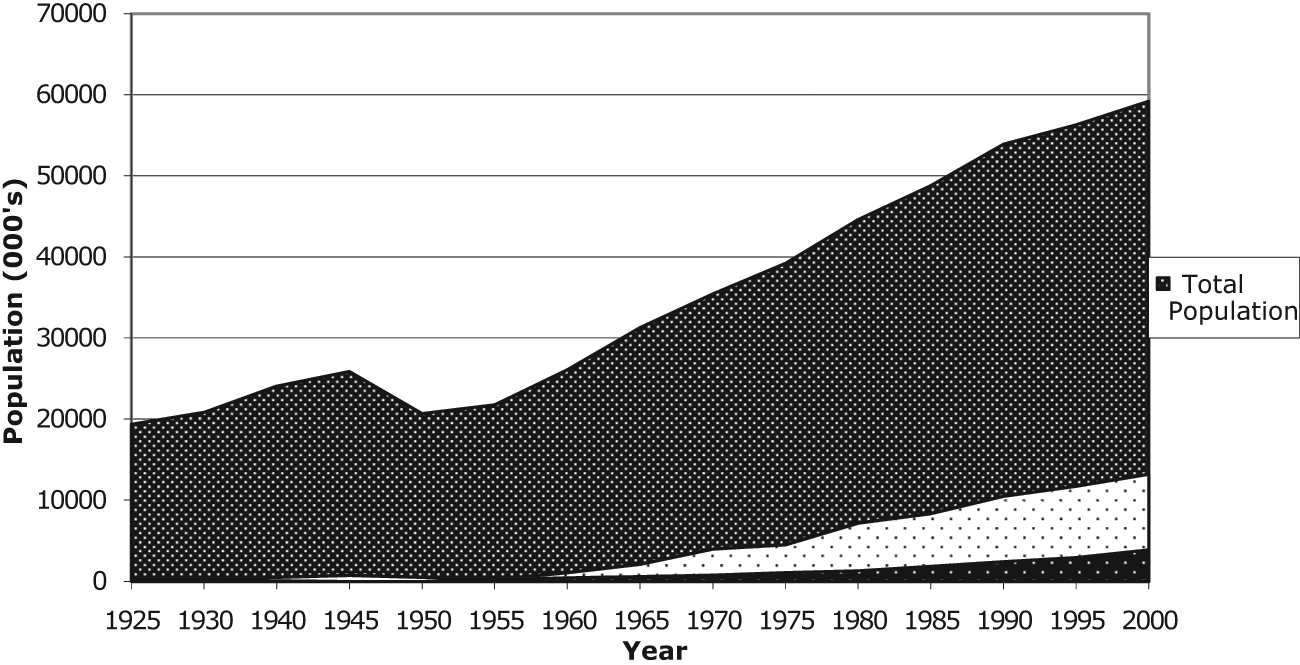
Growth of Protestantism and GDP compared
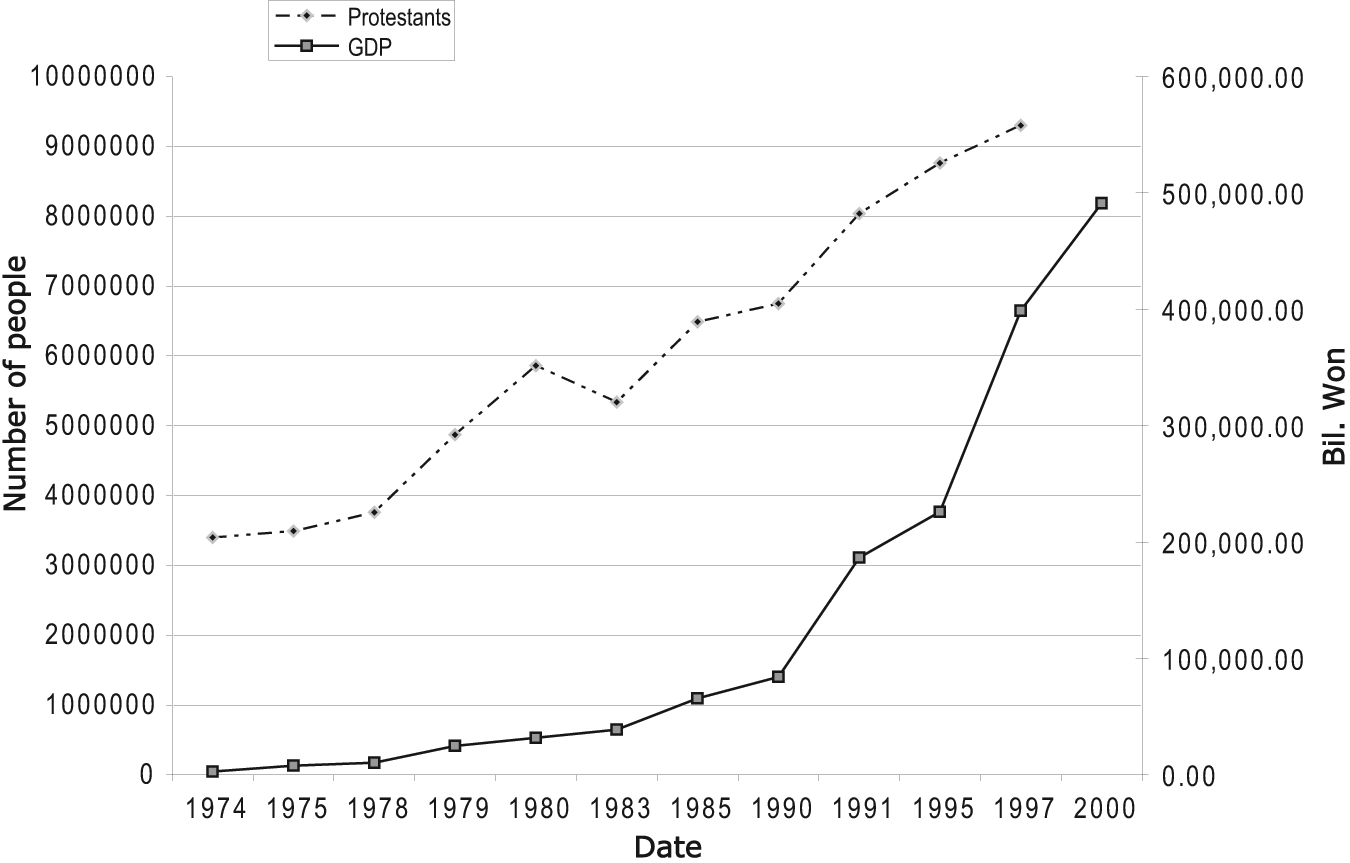
Growth of Protestantism and GDP compared
In this paper I re-examine some of the explanations for the exceptional success of Protestantism in Korea in the light of fieldwork conducted in Seoul (2005–2006). During this time I regularly attended church services and participated in community activities at the Presbyterian Hallelujah Church, located in an affluent outer suburb of Seoul. Park meoksanim (Minister Park) had directed the church since its foundation in 1986, and personally financed its construction through the sponsorship of his wealthy father. While not one of the larger churches by Korean standards, the Hallelujah Church is run by four full-time pastors and their wives together with another five ministers in training and two administrative officers. The church boasts an average monthly expenditure of 50,000 dollars, a large portion of which is used in the church’s missionary activities. Not only does the Hallelujah Church host a significant community of Filipino converts (mostly migrant labourers), but it also has active missions in Africa, Eastern Europe, Russia, Vietnam and the Philippines. Hallelujah Church is easily identifiable with the Pentecostalised Presbyterianism described by Freston (2001). Changes in the nature of worship and sermon have seen the church increasingly adopt Pentecostal practices, including the introduction of a huge television screen inside the church as well as modern musical performance and hymns, making it easy to claim that, while still Presbyterian, it forms part of the ‘Third Wave’.
From the teachings of Minister Park one can discern an emphasis on healing and conversion. In this paper I use Park’s sermons in order to shed light on the nature of the ‘elective affinities’ of Protestantism and the development of capitalism in Korea. Since the publication of Weber’s thesis much ink has been spilt on the relationship between Puritanism 3 and the development of capitalism. 4 Relatively little, however, has been expended to discuss Korean Protestantism in the light of Weber’s insights. After a brief discussion of the historical context of the growth of Christianity in Korea I examine the particular puritanical qualities of Protestantism in Korea.
The rise of Korean Protestantism
A ‘hermit kingdom’, Korea was closed to Western influences until the close of the 18th century, when Catholicism entered the country via the study of Chinese texts (Kim, 1995). At the time, the Korean class structure was built on education, and success in the civil service exams was the primary means of social mobility. The economy was mostly based on agriculture, with a more or less feudal structure. The Neo-Confucian disdain for trade meant that the isolationist policy pursued by Korea found a ready moral support at least among its upper classes. The level of education required to prepare for the state civil service exams also meant that civil service appointments were mostly limited to the sons of the dominant yangban class of officials and literati. Buddhism had, at least since the 15th century, been the subject of repeated persecution, sanctioned by the Confucian state. While it experienced sporadic revivals after the 15th century – a result of the personal whims and predilections of particular kings and queens – by the 16th century Buddhism was almost completely suppressed and had become a faith practised largely by women (Lee, 1984: 200). Shamanism, whose practitioners were also mostly women, suffered a similar fate, as it was often opposed to Confucian ritual power, which was the exclusive preserve of men. As power in this Confucian society became more and more concentrated in a few great yangban families during the 17th and 18th centuries, there was a growing sense of unrest as paths to social status became more and more restricted. A number of Confucian scholars turned toward Shilhak (Practical Learning), which sought to focus education on practical matters including reforming agriculture and technology. Christianity in Korea was a clandestine affair, attracting disaffected Shilhak Confucian scholars looking for something new (Kang, 1971: 43). As Lee notes, the initial converts to Catholicism saw within it a revolutionary system of belief that could address the inequalities within society. It is no surprise, therefore, that Catholicism became the target of persecution, which became particularly intense in the 19th century, culminating in the great massacres of 1866–1871, which killed more than 8000 believers (Grayson, 1989: 182; 2006: 11). Christianity at the time was considered a sakyo (evil religion) (Kang, 1971: 47), heterodox and an impediment to development of morality (Baker, 1999: 201). The Joseon dynasty’s fear of foreign infiltration was compounded by the doctrinal incompatibilities of Catholicism and chesa (ancestor worship) – the ritual basis of the state’s Neo-Confucian ideology. After the signing of the Chemulpo Treaty between Korea and United States in 1882, which specifically guaranteed the right of American missionaries to preach in Korea, Protestant proselytization began in earnest. Missionaries in Korea resolved to adopt the Nevius method, using native missionaries and targeting the lower classes. Among the early converts to Protestantism, however, one also finds the newly emerging middle (chungin) class, which comprised a large number of merchants (Oak, 2006: 75). The translation of Christian tracts into both Chinese, the language of the elite, and the vernacular Korean, helped to ensure that reform-minded yangban as well as commoners were able to engage with Protestantism.
It remarkable that, from such brutal beginnings, Christianity in Korea was able to rise to the status of a majority religion as described in the introduction to this paper. The unique status of Christianity in Korea as compared with its limited inroads among its neighbours has led to many differing explanations.
Broadly speaking, we characterize these explanations according to two ‘types’. First, historical explanations see the rise of Korean Christianity in terms of the peculiar status of Christianity as a revolutionary ideology allied to an incipient nationalism and anti-colonial struggle. Such explanations have provided a particularly powerful framework for accounting for the rise of Christianity at least until independence. These historical circumstances, however, cannot account for the more statistically significant growth experienced in the 1970s along with the rise of the modern Korean economy. The second type of explanation is sociological in origin. Sociologists have been divided over their accounts of Korean modernization during this period. Some have seen the rise of the modern Korean economy as a result of the native Confucian ethic, which was conducive to the logic of a capitalist economy. Others, focusing on Christianity, have chosen to interpret its rise as the desperate cry of the disaffected; the result of the anomie produced by a rapidly changing society. It is remarkable that very few authors have attempted to relate economic development to the rise of Christianity in Korea. In the following section I discuss some of the major historical and sociological explanations for the rise of Christianity in Korea before I go on to propose an alternative explanation. While I accept the historical explanation for the exceptional status of Christianity in Korea when compared to its East Asian neighbours, such an explanation cannot account for the fact that Christianity thrived when the historical circumstances that were initially favourable to its rise disappeared. The rise of Christianity in modern Korea needs to be analyzed in the light of the specificities of its religious teachings over and above any generic reference to religion and anomie. In looking at the particular form of Christianity in Korea, we can find more specific reasons for its pari passu rise with modern capitalism in terms of its ‘elective affinity’ with the logic of capitalism that transformed its revolutionary beginnings into an ideology.
Historical explanations for the growth of Protestantism: from Japanese rule till the liberation (1905–1945)
Historical explanations have been particularly effective in describing the development of Christianity from its clandestine Catholic origins to its nationalist Protestant character under Japanese colonialism. Historians have argued that the rise of Protestantism is impossible to isolate from colonialism and the struggle for independence. In the era of subjugation (1910–1945) Korean nationalism and Protestant Christianity became linked in the popular imagination (Grayson, 2006: 14–17). Christianity was the ‘new universal system’, out of which arose the ‘Protestants’ mission to construct a new nation founded on Christian ideals’ (Wells, 1990: 174). Many leaders of the pro-independence Sam Il Undong (March First Movement) of 1919 hailed from a Christian background. The Japanese even suspected foreign missionary involvement given the large number of Protestant believers and clergymen arrested by the military police (Lee, 2000: 139). Syngman Rhee (1875–1965), the first Korean President, was a product of this movement. After his imprisonment for involvement with the Independence Club he became a devout Christian with churches flourishing under his rule (Kim, 2006a).
The resistance of the Protestant Church to state-mandated Shintoism 5 served to cement the association of Protestantism with anti-Japanese sentiments. In the years between 1938 and 1945 about 2000 Protestants were arrested for non-compliance and 50 people died as martyrs (Grayson, 2006: 21). Protestantism found itself at the forefront of an incipient nationalism. The Nevius method and the Protestant imperative to build schools and hospitals served to combine social involvement and a democratized education system with the religious doctrines of Christianity. 6 The affiliation of Protestantism with the anti-colonial movement and its association with Western modernization provide a compelling historical explanation for the growth of Protestantism in Korea at least until independence. Such reasons alone, however, are not sufficient to account for its sustained growth in the post-liberation era.
Sociological accounts for the growth of Protestantism in the post-liberation era (1945–)
The phenomenal rise of Protestantism in the post-liberation era has usually been explained with reference to two sociological factors, the combined effects of industrialization and urbanization (Kim, 2006a: 318–329). The Korean economy underwent a massive transformation in the 1960s, from predominantly agricultural to largely manufacturing. Manufacturing for export and construction accounted for only 11% of GNP in the years following the civil war, whereas by 1976 this percentage had increased to 37% (Mason et al., 1980), with an average export growth rate of 30% between 1960 and 1975 (Chang, 1991: 109). Since the 1960s, through a series of five-year plans, the Korean economy has grown dramatically (Figure 2). Economic data show that following the Korean War (1950–1953) Korea experienced slow GDP growth until the 1960s; then it enjoyed dramatic growth, increasing real per capita GDP ‘over sixfold after 1970 and almost thirteenfold since 1953’ (Kuznets, 2006: 90). Economic transformation, post-war displacement and the decline of the agricultural sector led to mass urbanization: almost a quarter of Korea’s population now resides in Seoul (Kim and Choe 1997: 17, 30). Scholars have claimed that the rapidity of Korea’s modernization and urbanization
[c]reated a social-psychological condition of anomie. Koreans lost a clear direction in life, were burdened with strain and stress and loss of commonality … under such chaotic conditions that Korean Protestant churches grew explosively (Kim, 2006a: 322).
Such explanations, however, ignore the content of belief. Why did Protestantism specifically enjoy such a phenomenal growth?
Other sociological accounts of Korean modernity disagree as to the persistence of ‘traditional values’ in the wake of the country’s modernization. Yun-shik Chang (1991) has argued that Korean modernization did not mean the dissolution of community. Urban Korea is structured on a ‘personalist ethic’ and is ‘most emphatically part of a tightly clustered inner group of personal acquaintances’ (Chang, 1991: 123). This points to a more general problem with scholarship on tradition and modernity. As Mumford notes, the movement from tradition to modernity ‘reads one way if one looks for continuity and another if one looks for discontinuity’ (1944: 152). In Korea, an emphasis on continuity often comes at the expense of an adequate discussion of the role of Protestantism. Chang, for example, merely notes in a footnote that Christianity ‘considerably weakened this traditional normative system because of the undivided loyalty expected by the divinity’ (1991: 125). Sociologists seeking continuity tend to ignore the introduction and impact of Protestantism, seeing in it a weakening of Korean tradition, while scholars who have focused on the rise of the Korean economy and its relationship to religious values have considered Korean capitalism as part of a wider regional phenomenon. Looking for analogues to the Protestant ethic in the region they have argued in favour of a ‘Confucian ethic’, ‘similar to that of Calvinism on early Western Capitalists’ (Eckert et al., 1990: 410; Kim, 2006b: 223). Weber himself, however, was clearly of the opposing view. In Konfuzianismus und Taoismus [1913] (1964) he argued that Confucian Traditionalism acted as a decisive inhibiting factor for the development of capitalism (Eisenstadt, 1968: 26; Yang, 1964: xxviii). Korean scholars have themselves observed that Confucianism in many respects hindered modernization (Hong, 1973: 111; Lee, 1982: 5; Lie, 1998: 78–79).
A Weberian hypothesis: Christianity and capitalism in Korea
The rest of this paper is designed to offer an alternative sociological explanation for the rise of Korean capitalism. While historical explanations are useful to account for the rise of Protestantism until Korean liberation, neither they nor sociological explanations have offered adequate accounts of the post-liberation era. In this paper I argue that the Protestantism that took hold in Korea was Puritan in mode and drew heavily on Calvinist doctrine and as such shares much in common with the puritanical ethic described by Weber, not only in spirit, but in genealogy and in word. The similarities with the Confucian ethic, especially its emphasis on obedience and duty, could account for its ready acceptance within a largely Confucian society. It is, however, its relationship to the logics of the market that makes it a fertile religion for capitalist development and the expansion of a manufacturing and trade sector out of a mostly agrarian economy. Nationalist historians and their detractors have debated the significance of the colonial legacy for the development of capitalism in Korea. While the role of the state is a crucial and important factor, I focus my discussion on the psychological and moral motivations of its participants and actors in order to analyze the relationship between the rise of Protestantism as a religion in Korea and its place within the moral economy of the post-liberation state. Christianity in the post-liberation state found itself to be in line with the state’s imperatives for rapid industrialization and development. This could be usefully contrasted with the (largely) antagonistic and revolutionary position of Christianity under the Choson dynasty monarchs and subsequently the Japanese colonial state. In the post-liberation era Protestantism developed in a harmonious manner with the objectives of the modern state. Such an explanatory framework is certainly not meant to account for the development of capitalism in East Asia. The regional aspect, while striking, is far less interesting than the particularities of the trajectories within each individual nation-state.
The close affiliation between Protestantism and Korean capitalist development could be surmised by the religious backgrounds of its political leaders. In a study that surveyed the social backgrounds of Korean political leaders between the years 1952 and 1962, Hahn and Kim (1963) found that almost a third of them claimed a Protestant affiliation, while only 2.4% of the total Korean population claimed Protestant affiliation in 1962 (Hahn and Kim, 1963: 316). Korea’s current President, Lee Myung-bak, who formerly ran one of the country’s largest construction companies, is an elder in one of its largest churches, Somang Presbyterian Church (Lugo, 2007). While significant economic and political leaders in Korea hailed from Christian backgrounds, it would be absurd to say that all were in fact Presbyterian. My point is that the dominant sort of Protestant theology as it developed in Korea, at least after liberation, was remarkably well attuned to and harmonized with the sort of entrepreneurial spirit embodied by the leaders of Korean businesses including the large family business groups (chaebol).
Perhaps the best example of the entrepreneurial spirit that animated Korean capitalism is Chung Ju Yung, the billionaire founder of Korea’s largest chaebol – the Hyundai Business Group. The son of a small village farmer, he became one of the top six business leaders in Asia and was responsible for the region’s dramatic economic growth in the post-war period (Steers, 1999: 5). Richard Steers, Chung’s biographer, describes him as being part of a global entrepreneurial class exhibiting the same flair for creating value and finding new opportunities and markets, and he reaches the bold conclusion that ‘It is because of such individuals that the global economy advances’ (1999: 9). It is my contention in this paper that such individuals could emerge only once a certain relationship between wealth, the self and ultimately morality had taken hold. While Chung did not adhere to any religious creed, it would be a mistake to conclude from this that he was in any way anti-religious or atheistic. In his words: ‘I believe in nothing. I would prefer to try the religion that tells me that I will receive a great fortune in the present world. I can’t wait for a next world that might not exist’ (Chung Ju Yung, cit. in Steers, 1999: 40). In this paper I suggest that the sort of Puritanism encapsulated by Minister Park’s teachings is precisely the sort of religion that Chung Ju Yung would have ‘preferred’. In the following section I examine the specifically puritanical qualities of this brand of Protestantism before moving on to discuss Park’s own theology as part of this phenomenon.
Puritanical origins of Korean Protestantism and the community of the saved
One need not look far to uncover the puritanical qualities of Korean Protestantism. In a symposium celebrating the 80th anniversary of Protestantism in Korea, Chai Chun Kim, a professor of one of Korea’s eminent seminaries noted that Protestantism is taught according to an interpretation based on ‘fundamentalist theology, with the ethical viewpoint of New England pietism’ (Kim, 1966: 36). This puritanical character traversed denominational difference. Most of the Korean ministers ‘imbibed fundamentalism and Calvinism’ (Rhee, 1966: 136–137).
Dr Horace Underwood, a descendant of one of the esteemed missionary dynasties of Korea, wrote: ‘The Korean churches set a high and, according to some, a puritanical standard of membership’ (1951: 28–29). Similarly, Dr Paul Crane, director of a Presbyterian medical centre, noted that Koreans tended to be conservative theologically, with particular ‘puritanical distinctions’ (1967: 138). Native theologians and foreign missionaries note that, at least since the end of Japanese colonization, Korean Christianity had a marked puritanical character. Puritanism isolated a community of the saved from the rest of society, placing the Christian in the position of moral exemplar, whose actions were scrutinized by members of the community as well as by the wider society. This isolation contributed to a general image of Korean Christians as ‘affluent, self-satisfied hypocrites’ (Jacobs, 1985: 255). During my fieldwork, Yu Na, a recent graduate, described Christians as hypocrites, noting that her supposedly Christian ex-boyfriend got drunk on a regular basis.
The pressures of such public scrutiny compound a certain salvation anxiety. Eun Ran, a 26-year-old woman, told me that she is a Christian because ‘she wants the people she loves to be saved’. In Park’s words: ‘We are special, set aside, children of God.’ This notion of the Christian community resonates with Protestantism as ‘the place for perfect people’ (Hong, 1966: 15).
In the first service I attended at the Presbyterian Hallelujah Church, Park highlighted the three stresses in life: ‘Sickness, economic stress and death’. They can only be resolved by a Christian life: ‘You will have health, wealth and joy if you are right with God’. Weber pointed out that the pursuit of ‘intense worldly activity’ was not a means of achieving salvation but rather a sign of one’s salvation. It was the dual effect of Calvinism’s ‘condemnation of idleness and luxury’ and its ‘affirmation of the value of enterprise’ that was favourable to the rise of industry (Bataille, 1991: 125).
The condemnation of idleness in Calvinism consisted of both a positive and a negative component. Idleness was condemned while organization and discipline became marks of salvation. In Korea puritanical discipline reconciled capitalist accumulation with moral virtue and thereby circumvented the Neo-Confucian ‘contempt for commerce’ (see Eckert et al., 1990: 225; Kendall, 1996: 520).
Self-control, discipline and duty
Minister Park repeatedly emphasized the importance of discipline in the regulation of everyday life. He was a great believer in the virtues of a military education because youth ‘learn to obey the commands of their superiors’. He compared the Christian life with that of a sportsman because ‘sportsmen are very disciplined’:
A Korean golfer is now challenging Tiger Woods. The golfer is a church member who wanted to glorify God through his golfing; he received his power from God! Seven hundred of our football players going to Europe for the World Cup are Christians!
The discipline required for athletic greatness is the same virtue required of the puritan. The athlete’s control of his body, the control over one’s emotions and the obedience inculcated through military education are all aspects of the same Christian duty.
Park often ended sermons with a prayer asking God to grant us self-control. Contempt for drinking, smoking and fornication stems from their shared connection with lack of self-control. Smoking, drinking and rampant sexuality excluded people from the community of the saved: ‘The church door was very narrowly opened for the decent persons and not for the smokers and drinkers or the concubines’ (Hong, 1966: 15). Korean puritans were shocked by the ‘lax morals in regard to sex and social drinking among American Christians’ (Crane, 1967: 138). Protestantism in Korea, as in Europe and New England before it, required ‘every Christian to act ascetically in his everyday life’ (Žižek, 2008: 183).
Leadership, according to Park, is based on the confluence of two virtues: control over oneself and the denial of sensuality and emotion. According to Weber the puritan abhors emotions because they are of no use to salvation and promote ‘sentimental illusions and idolatrous superstitions’ (Weber, 1999: 105). Park compared undesirable emotions to a virus:
The virus that prevents people becoming great leaders is doubt in people. When I go to the mountain to pray, I kneel and pray. If you’re unstable emotionally you can’t be a good leader. I pray constantly to control my emotions and God helps me keep my emotions stable.
For the Korean Christian the basis of authority is the ability to exercise exemplary control over one’s own self. This self-control, however, is only the predicate for the organization of a social system.
Calvinism was more than a theological system; it was also a political system. Park moved from discussing control over emotions to discussing the qualities of good leadership. Duty is the fundamental unifying and disciplining force of the body, family and the nation. For Calvin the authority of the pater familias was the psychological template that produces obedience as the highest ‘work’ (Marcuse, 2008: 33). The importance of obedience to parental authority was very clear in Park’s sermons: ‘Be faithful to God, your duty and your parents. This is the best education children will receive’. Failure in one’s duty leads to powerful feelings of guilt: ‘To have a good life you must get rid of your burden of sin. Have a clear conscience! Unless we do our duty, we will always feel guilty. So we must always do our duty!’
Guilt is central to the psycho-dynamical operations of this moral system. According to Walzer, it was the central psychical meter that ensured that ‘Puritan discipline transform[ed] repression into self-control’ (Walzer, 1963: 65). In removing the relief of the confessional, Calvinism removed ‘the periodical discharge of the emotional state of sin’ (Weber, 1999: 106), making guilt ever present. In pointing to the ‘demonic ambiguity’ of Schuld – meaning both financial debt and legal, moral and affective guilt – Walter Benjamin described capitalism as a cult that produces ‘a monstrous consciousness of guilt’ (2004: 289). For Park, guilt could be absolved only through right moral conduct, the restitution of debts in line with our duty, and obedience to our parents, leader and God.
Purpose, hard work and belief
For Park, success is the mark of a Christian life, a sign that one has triumphed over evil through discipline and devotion. The Christian life was described by Park as a battle:
Fight the good fight and be victorious. Have you ever climbed to the top of a mountain? That is a Christian experience. At the top the whole world is under you; you are a victor, a winner.
The ‘Christian experience’ of being a victor on top of the world comes from hard work and its enemies are depression, disunity, poverty and ill-health.
One must also note that if God is the author of all fortunes, it is equally true that disasters are the results of leading an unchristian life: ‘Car accidents happen to depressed people who don’t have a purpose in life. Faith gives you purpose in life and car accidents won’t happen’. ‘Purpose in life’ is found in the single-minded pursuit of the calling, legitimated by religiously sanctioned duty and obedience, and internalized through the burden of guilt. Working hard is a moral obligation for my informants, encapsulated in the motto Nae ga halsu idda! (I can do it). The pastor regularly exhorted the congregation: ‘Let us not give up – we have to seek until we find it. Health, wealth and happiness come from God through our faith. If your spirit is right with God, everything will come to you’. The believer must have conviction and sureness of purpose: ‘When you say you have everything, you will have everything … You can become as rich as the Lee family! You’ll get rich if you believe everything is possible!’ Chung Ju Yung, the founder of Hyundai, shared this indomitable moral outlook: ‘[Koreans] succeeded because … they used the force of their minds. Conviction creates indomitable efforts. This is the key to miracles … Man’s potential is limitless’ (Chung Ju Yung, cit. in Steers, 1999: 7). A lapse in the conviction of economic success mirrors the moral failings manifested in doubt that results from an ‘imperfect faith’ (Giddens, 1971: 129).
Minister Park alternated between discussion of a Christian life in terms of inner control and discussion of political systems. In the moral economy of Park, there is a constant shift of focus between the body, economy and religion. Discipline and control in accordance with one’s duty need to be exercised over oneself, the family and the nation. Park considered the individual and the emotional to be intimately linked with the state of the economy, while he tended to conceive of the moral in biological terms. Hence, the relations between individual depression and economic depression, between ‘virus’ and sin, and between emotional stability and economic stability were all part of a coterminous moral universe. The Calvinist stamp on this moral economy of Korean Protestantism is apparent in the minister’s discussion of the ideal state – Calvin’s Geneva!
Let us control our thoughts and think about God. God is in perfect control of this world. Switzerland, founded by John Calvin [sic], is one of the safest and richest countries in the world because of this. The most dependable bank is over there, too. In its constitution Switzerland declares: “This country is founded in the name of God – the almighty and powerful”. What’s unique about Switzerland is that they don’t have an army. All the citizens are ready to fight in time of war. Let us endeavour to be Christians and serve God. Let us be good citizens in the kingdom of God.
Park linked duty with discipline and control exercised over the body, the family and ultimately the nation, drawing inspiration from Calvin. Control over one’s maeum (heart/mind) and disciplined obedience in the pursuit of duty lead to a wealthy nation.
Miracles of the mundane: health and wealth as indexes of morality
Modern Korean Puritanism presents a morality in which the physical is an important part of the moral. Theologians and sociologists have remarked that Shamanism predisposed Koreans to a Pentecostalism in which prayer is a magical means to a material end (see Kendall, 1996: 519). Andrew Kim, for example, argued that Korean Christianity was the ‘traditional religious system cloaked in the guise of modern, Western religion’ (2000: 129). Like Shamanism it was dominated by ‘this-worldly wish fulfilment’ (Kim, 2000: 130). Shamanism’s concern with wealth, however, is itself a product of the modern Korean economy. From her work with shamans in Seoul, Laurell Kendall (1996) found that shamans commonly complained that it was only now that kut (shamanic rituals) were held in the hope of riches.
Seeking divine help for worldly success makes of the secular world an ‘autonomous domain which neither bestows merit nor brings ultimate salvation’ (Pieris, 1963: 257). Protestantism, in contrast, eliminated the dualism that segregated the religious from the secular aspects of life. Calvinism attempted to ‘render unto God the things which are Caesar’s’ (Mumford, 1944: 192). The profane world became entirely sacralized, as every crisis in life was simultaneously the proof of and the grounds for defining claims to salvation; ‘Calvin did not desacralize the world; on the contrary he turned the entire world into a monastery’ (Jameson, 1988: 23). This is the fundamental difference between the Protestant emphasis on material success and the requests for material wealth found in Shamanism. Shamanism helps the individual to come to terms with a capricious market through the metonymical substitution of a whimsical ancestor. There is nothing whimsical about the Puritanical God, who demands righteous behaviour. Material wealth and health are indexical markers of one’s relationship to salvation, and their miraculous manifestations are dramatic presentations of the normal interpretative function of the world.
Protestant reformers declared the end of the age of miracles, considering modern miracles as Catholic deception. Calvin, however, brought a new emphasis to the doctrine of Providence as an alternative to miracles (Shaw, 2006). This doctrine meant that the world became subject to interpretation as people looked for events and signs ‘in a person’s, a community’s or a nation’s life’ (Shaw, 2006: 30). In Korean Puritanism, miracles are ‘special providences’ bestowed to the elect, mainly in two this-worldly categories: healing, and material wealth showing the presence of grace.
Failures in health or wealth are moral failures resulting from sinful lives: ‘Difficulties in life are made by yourself. You are the trouble makers – sinners! You have to repent. You have wasted time and money!’ This Puritan ethic that considers the waste of time and money as moral failures is well suited to capitalism with the latter’s transformation of labour power into a commodity ‘measured by the clock’ (Marx, 1891). Chung Ju Yung, though not a Protestant, would have approved of this sort of religion: ‘If you lose time, you lose not just money, but life, and everything you have done in life will wash away’ (cit. in Steers, 1999: 40). It is perhaps in this ‘not just, money, but life’ that we find the clearest elements of a moral connection to the accumulation of capital and discipline which makes of capitalist development in Korea more than a crude search for material gain. In this moralization of wealth one can fully appreciate the radical contrast to the Confucian yangban class ethic that disdained material wealth and its pursuit.
Corresponding to the three levels of self-control (self, family, nation) articulated in Park’s sermons, we identify three corresponding areas of life where the indexical value of wealth is made manifest. In one of his sermons Park told the story of a Korean immigrant to the United States:
His employer found favour in him. He said, ‘You say yes to whatever the company needs.’ The employee did well in the company. One day the company president told him, ‘I want you to work on Sunday.’ The man replied, ‘No, I want to go to church.’ This Jewish owner was so impressed that he gave him the company. Because of this, the Korean became a rich man. His company is now worth $5 million dollars. Faith has power. He even has a golf course in his grounds. Trust in God and you will be a success.
In this story material wealth resulted from faith, dedication to one’s work and discipline. Wealth was not valued in terms of exchange but rather as the indexical marker of virtue.
The disciplined Christian is the paradigm for the nation’s economic success. For Park, the ‘miracle of the Han’ (Eckert, 1990: 388) is not metaphorical at all: ‘Nowadays Korean ramyeon [instant noodles] are very popular in the States. God blessed us and listened to our prayers’. Korea’s economic success was seen by Park as the direct result of Korea’s Christianization, just as Switzerland’s success was due to its Calvinist reformation. The APEC meeting held in Korea (2005) was the subject of another of Park’s sermons:
The fireworks lasted for a whole day – it was spectacular. God gave us success because we cried out to him. It happened 120 years ago, when missionaries came and we accepted the good news [i.e. Christianity]. We had famine, disease, poverty and ignorance. Since then we have developed and advanced. God has helped us to develop rapidly. Now we are only second to the US in the sending of missionaries. Korea is advanced in IT; we are guaranteed ten more years of prosperity thanks to IT. Positive Protestants have contributed a great deal to our economy and development. Their motto was Hal Su Idda! (I can do it!). Farming, technology, construction, shipbuilding, electronics …
The economic miracle of development is interpreted by Park as the result of virtue on a national scale. The community of the saints becomes coterminous with the national boundaries of Korea. In turn, Korea’s export-driven economy and its export of missionaries are closely associated phenomena. The level of missionary activity of a church is a marker of its strength.
The virtues of discipline and control are also exercised at the familial level. Parents are still heavily involved in their children’s education, a sign that the belief that a child’s success is a reflection of one’s own perseveres to this day. Park made constant references to the family as a unit and the site of morality. Moral success manifested as wealth and greatness in this world is familial, not just individual. The individual subject is the first level of a self that extends outwards to encompass family, church and nation. We must be wary, however, of facile oppositions between individualism and familism. Park conceived of the self as the expanding ground for moral action. Park’s theology described the greatness of the self as intimately intertwined with the fate of the family, church and nation.
The family dynasties of Korean conglomerates, I believe, mirror such a structure. Korean capitalism is built on a heavily nationalistic and familial core. Chung’s own commitment to nationalism is well known: in making his family company great he also sought to make the name of Korea great, expanding its presence into global markets. In Minister Park’s theology it is the individual’s duty to contribute towards the growth of God’s kingdom on earth, bringing one’s family, the nation and the entire world into the community of the saved.
Right moral living is an investment that extends to the entire nation. Park made explicit analogies to the operations of the market and the operations of grace: ‘Store your treasures in heaven; let us invest our all in heaven – you will be rewarded. God will make the name of you and your family great.’ Heaven is directly compared to a bank that boasts the highest interest rate. Emphasizing investment and return as moral conduct and reward makes the operations of the market contingent on the logic of divine grace.
Special providences were also found in physical health. When Park came back from his missionary work in Africa, he spoke of a miracle he had witnessed:
Our tour guide had a terminal disease in the liver. He decided to spend the last days of his life serving in Africa as a guide helping others. He was healed – a miracle. Faith in God healed him.
Park spent an extra week in Mozambique because a fellow Korean pastor had broken his ribs in a car accident: ‘He never complained! Let us give thanks in all circumstances! He was healed in a week! A miracle!’ Miracles are marks of providence, singling out the faithful and the righteous. Physical health, like material wealth, is not an end in itself but an index of a virtuous life: ‘A healthy soul will give you good physical strength, too.’ Care of the soul is the predicate for the care of the body. The immaterial and the material are not separate worlds but are cut out of the same moral fabric. This is particularly apparent from Park’s closing prayer. He ended his service by asking his congregation to ‘Put your left hand where you are hurting and your right hand on your heart’. In Korean cultural physiology, the heart (maeum) is close to the concept of mind in Western philosophical anthropology. Laying the hand on this centre of will and emotion and simultaneously on the somatic centre of pain shows the direct relationship between the two. It is one’s moral health that has the determinative influence on one’s physical health: ‘Good food and diet is only 15% of what is good for your body – our heart (maeum) should be healthy to overcome hardship and sickness’. This is why health is an indexical value to moral standing.
In Korean Protestantism, God is a productive principle whose laws of operation pervade the mundane and can be ‘read’ through his providence. The Protestant, as moral interpreter, identifies indexes of morality in the body and in material wealth.
‘To market, to market …’
Weber’s contribution to the history of ideas has been caught up in debates over causality – of idealism vs materialism. Weber’s own anti-materialist stance hardly needs elucidation. Weber, however, was similarly opposed to any ‘equally one-sided spiritualistic causal interpretation’ (Weber, 1999: 183). In Korea, as in the West, capitalism is not the product of Calvinism. They both, however, ‘possessed a certain affinity for each other’ (Troeltsch [1931], cit. in Green, 1959: xi).
The concept of Wahlverwandtschaft (elective affinity) is decisive in Weber’s sociology of religion and yet is largely unstudied (Howe, 1978: 366). Post-war sociologists found the concept to be ‘fuzzy and romantic’ (Lash, 1999: 114). This was also undoubtedly the effect of the concept’s consistent mistranslation. In Parsons’ translation of The Protestant Ethic and the Spirit of Capitalism, ‘Wahlverwandtschaften’ was first translated as ‘certain correlations’ and a few paragraphs further on as ‘those relationships’ (see Löwy, 1992: 9–10; Weber, 1999: 91–92).
The concept originates from Goethe’s novel by the same name, Die Wahlverwandtschaften [1809] (Howe, 1978: 371–372). Goethe adopted the concept from chemical discourse of the time, which was clearly inspired by Torbern Bergman’s De attractionibus electivus [1755] (Adler, 1990: 268). While commentators have never agreed about the use of chemical analogy in Goethe, in an advertisement for the book, Goethe explained ‘the unusual title’:
[I]n the natural sciences one often uses ethical parables in order to bring closer what is quite distant from the circle of human knowledge; and so [I] also probably wanted, in a moral case, to bring a chemical figure of speech back to its spiritual origins (cit. in Tantillo, 2001: xviii).
Goethe’s novel could be read in the light of his views on the ‘elective affinities’ between science and morality.
While Weber did not construct a detailed topology or morphology of elective affinities in Economy and Society, he did come close to a definition:
[W]e can generalize about the degree of elective affinity between concrete structures of social action and concrete forms of economic organization; that means, we can state in general terms whether they further impede or exclude one another – whether they are ‘adequate’ or ‘inadequate’ in relation to one another (Weber, 1978: 342).
The concept clearly transcends the casuistry of mechanical causality, posing ‘a healthy and necessary counterpoint to positivist epistemology’ (de Paula, 2006: 72). Weber was trying to uncover the ‘definite elective affinities between certain forms of [the Reformation’s] religious faith and its work ethic’ (Weber [1904–1905], cit. in Howe, 1978: 368), applying the principles of his interpretative sociology. Meaning is the basis for social action and the task of interpretative sociology is to analyze social action with reference to the concrete meaning it holds for a given individual actor, and in relation to an ideal type of subjective meaning (Giddens, 1971: 146).
In highlighting the elective affinities between the working ethos of capitalism and the theological framework of Korean Protestantism, I have examined the ways in which webs of meaningful social action are (s)electively sutured. The market of piety with which I started this paper represents a key example of how the logics of the market and Puritanism in Korea exist in an elective affinity.
The Puritan emphasis on discipline and obedience when combined with the sacralization of everyday life had a certain elective affinity with a market that universalizes its reach and demands the utmost dedication, promising limitless rewards. Perhaps the spirit of this Korean capitalism was best described by Chung Ju Yung as he developed what became known as the ‘Hyundai spirit’: a set of values and beliefs taught to all new recruits of the company. As described in the company’s orientation manual: ‘An indomitable driving force, a religious belief in attaining a goal, and a commitment to personal diligence and frugality have materialized as a major part of the development of heavy industry in Korea’ (cit. in Steers, 1999: 40).
The Protestant ethic that emerged in Korea is reflected in this ‘Hyundai spirit’, and perhaps this Hyundai spirit could be considered as but a variant of the sort of moral economy that emerged in Korean Puritanism.
It is this particular, complex inter-relationship that has led some scholars to state that capitalism is ‘an essentially religious phenomenon’ (Benjamin, 2004: 288). For Benjamin, Reformation Christianity ‘transformed itself into capitalism’ (2004: 290). One could similarly say that Protestantism in Korea is a ‘vanishing mediator’ enabling the transition to capitalism and will, therefore, eventually disappear (Jameson, 1988). The inability of the Protestant Church in Korea to maintain its exponential growth rate (Baker, 2006: 298–299) vis-a-vis the steady growth rate of the Korean consumerist economy could certainly point to this conclusion. The Sunday school ‘market of piety’ is only a monthly event limited to the church basement. Perhaps, if one day the sphere of exchange represented by this ‘market of piety’ ceases to use plastic tokens as money and adopts the generalized standard of value of the Korean won, we will have to argue that capitalism is the religion.
For the moment at least, we are at the level of elective affinity, where Protestantism has adopted the mechanisms of capitalism to articulate a moral and political philosophy into social action while capitalists and political leaders have adopted a worldview that found in Protestantism a religion of preference.