




Abstract
In this paper the author will utilize both anthropological and historical approaches to illustrate how religion and the State intersect in the Dajia Mazu pilgrimage. Moreover, she will critique the conventional binary model of sacred versus profane by demonstrating how these two concepts are intricately intertwined in the course of the Dajia pilgrimage. The article aims to: provide a brief introduction and background to the Dajia pilgrimage; explore how the pilgrimage route is determined; discuss the protagonists involved in the choice of the pilgrimage route – temple committee leaders and members, as well as local politicians; and examine how temple committee members exploit the pilgrimage to express dissent against the central government of Taiwan.
Origins of the Dajia pilgrimage
According to legend, the goddess Mazu was born in 960 CE in Putian, China, and died in 987 CE on the Isle of Mei in the Chinese province of Fujian. The Mazu cult was formally introduced to Taiwan when the latter became part of the Chinese empire in 1683. Mazu was co-opted by the court, which has been described as the ‘imperial metaphor’ by Stephan Feuchtwang (1992). The imperial State governed all the temples in the country. Each district had one official Mazu temple and the hierarchy among the network of temples was clear and strict. After 1911, when China became a democratic State, the central government no longer monopolized religious life and institutions, and every citizen had the right to express himself religiously. Even though Taiwan was by then under Japanese control (Taiwan was a Japanese colony from 1895 until 1945) and the Mazu cult was officially suppressed, Mazu temples were allowed to record and narrate their individual temple histories, as well as engage in marketing to attract greater numbers of patrons. This resulted in competing claims to power among the Mazu temples in China and Taiwan.
Like Christian saints, most Chinese deities were previously mortal humans, born on a specific date. Mazu’s birthday is on the 23rd of the third lunar month, which typically corresponds to the Gregorian month of April. All Mazu temples hold a celebration to honor her on her birthday, which often takes the form of a pilgrimage or jinxiang. Donations from pilgrims and ordinary believers give every Mazu temple the potential to increase their efficacy and to upgrade their prestige.
There are similarities and differences in the Western conception of pilgrimage and the Chinese equivalent jinxiang (offering-incense). They are similar in that they both refer to a journey to a distant and sacred place where one may come into contact with a sacred entity. They differ in regard to the notion of the sacred itself. Sacredness in jinxiang is associated with an original image of the goddess (e.g., her icon), an original and historic temple, and/or the goddess’s place of origin. Hence, to burn incense shows respect to one’s origin. 1 Yet to what extent is one’s origin negotiable? Jinxiang may also imply an individual and/or collective journey. For instance, the Dajia jinxiang is a community pilgrimage. The Dajia Mazu guides the temple followers, who simultaneously escort her back to her temple of origin, the Beigang Temple.
Although jinxiang is a religious ritual, it is never a sacred ritual apart from the mundane world. According to the people of Dajia:
To the goddess Mazu, jinxiang is like returning to her natal family, a type of family reunion. For us as believers, jinxiang is a means to pray to the goddess for assistance, healing, health, or good fortune. Sometimes, it is simply a way to return thanks to the goddess for her many blessings throughout the year. (Mr Liu, regular pilgrim: personal interview)
This is not to say that for other pilgrims jinxiang is not a form of asceticism and/or a means to realize Mazu’s ethical teachings. The majority of pilgrims today openly and publicly express their pleasure while on pilgrimage, which they treat as a ‘spring break.’ We may thus observe how a profane purpose is accomplished on the sacred journey.
Previous religious studies scholars have argued that cultural meanings are embedded in rituals associated with pilgrimage. For example, Mercia Eliade (1957) suggested that pilgrimage is a journey back to the central point of the universe and/or the mother’s umbilicus. Echoing Victor Turner (1969), anthropologist P Steven Sangren (1993) posited that to traveling beyond the familiarity of one’s community produces an estranged and alienated self. Upon returning to his/her home community, the pilgrim may experience a state of transcendence.
For the people of Taiwan, the ultimate destination of jinxiang is the Isle of Mei, Fujian – the place where Mazu passed away and became deified. However, Taiwan and the Isle of Mei are separated by the Taiwan Strait. Until 1895, Taiwanese had been free to visit China. Japanese hostility towards China, however, meant that travel to the mainland was forbidden until the end of the Second World War. For a brief period, Taiwanese were free to travel across the Taiwan Strait, but in 1949, when the Chinese Kuomintang (KMT) government withdrew to Taiwan and mainland China was declared a communist state, the border was closed again. It was not until 1987, when Taiwan lifted Martial Law (and temples began to be constructed throughout the island), that its citizens were once more legally allowed to travel to China. These geopolitical obstacles required Mazu devotees in Taiwan to devise a substitute for the Isle of Mei.
During the Qing Dynasty (1683–1895) many Taiwanese regarded the Beigang Mazu Temple as a suitable substitute for Isle of Mei because it was the most efficacious Mazu temple in Taiwan – in other words, the most responsive to believers’ prayers. The Beigang Mazu Temple retained its status throughout the period of Japanese occupation. Like other Taiwanese Mazu temples, the Zhen Lan Temple, in the town of Dajia, Taizhong (Taichung) County, in central Taiwan, journeyed to the Beigang Mazu Temple to subdivide incense fire and acquire incense ashes to transport and place in its own temple. Taking incense fire and ashes from a temple with higher ritual status and placing them in temples of lower status improves and enhances the lower temples’ Mazu’s ling (efficacious power).
Once the geopolitical situation began to change after 1987, a large number of Mazu temple committee members and believers in Taiwan were eager to begin pilgrimages to Mazu’s homeland in China. In October 1987 committee members from the Zhen Lan Temple traveled to the Isle of Mei and returned with incense ashes, claiming that the Temple’s strength had thereby been upgraded and hence refusing to recognize Beigang Temple as its ‘mother temple.’ Beigang Temple took this as an insult and demanded an apology, but the Zhen Lan Temple leaders refused to apologize. They nonetheless had to continue a jinxiang ritual to accommodate their members’ religious needs and, as a solution, substituted Xingang Temple 2 in lieu of Beigang Temple.
In 1988, the pilgrimage to the Xingang Temple was represented as one sister going to visit another – which implied equality in ritual status – unlike the prior pilgrimage to Beigang, which had been represented as a daughter returning home to visit her mother. Here, the position of higher ritual status is clear. The two rituals – ‘dividing incense fire’ and acquiring ‘incense ashes’ – were not performed between the Xingang and Zhen Lan Temples because their Mazu’s ling was considered to be equally efficacious. This conflict and the subsequent changes in the pilgrimage route illustrate how sacred places are negotiable, not static and unchanging.
Statistical data shows that the Zhen Lan Temple income has been increasing since its pilgrimage to Mei Isle, while the Beigang Temple income has been decreasing since the Zhen Lan Temple stopped visiting.
In imperial China, temple hierarchy roughly corresponded to local administrative hierarchy. Therefore, the territorial sovereignty of the deities corresponded to the territory governed by the officials in each administrative level (e.g., there were provincial temples, county temples, town temples, and village temples). Deities housed in the provincial temples were supposed to govern people of the entire province. Deities housed in the provincial temples were supposed to be more powerful than deities housed in the county temples. After 1911, when China became a democratic State, this hierarchy ceased to exist. Yet when there is a dispute between two temples, this hierarchy comes into play.
There are four factors that determine a temple’s efficacious power:
whether the fengshui (geomantic position) of the temple is good;
whether the temple was bestowed by an emperor;
whether the temple has a long history; and
whether the corresponding administrative hierarchy is at a higher level than that of the temple.
In Taiwan there are roughly 15 temples that claim to have one of these four characteristics. As a result, smaller, lower status temples will pay homage to them during the pilgrimage season. Today, it is estimated that there are 1,000 Mazu temples in Taiwan. 3 The smaller temples try to go on pilgrimages to the larger or older temples to renew their power when necessary. It is thus not surprising to see pilgrimage buses on the highway all year round.
How does a smaller temple decide which larger temple to run a pilgrimage to? Beyond consideration of the above four variables, smaller temples will also consider whether or not the two temples and towns have a history of cooperation and/or history of inter-community migration. Most immigrants go back to their hometown temple for a pilgrimage because people believe that there is a life-long linkage between a person and his/her birth place. For example, Dajia immigrants in the City of Keelung, in northern Taiwan, make an annual pilgrimage to Dajia for blessings. Therefore, when choosing a temple for a pilgrimage the sacred (efficacy and/or power of the goddess) is never completely separated from the profane (interpersonal relationship or political hierarchy).
Nevertheless, the hierarchical power structure and differentiation of Taiwan’s Mazu temples are not always self-evident. Temples often argue over whose power is stronger. Somewhat like supporters of the Boston Red Socks and New York Yankees baseball teams, residents of the two disputed communities will not visit each other until the dispute is settled, as is the case with Beigang and Xingang. It is not theological interpretation at issue, because there is no theology in Chinese folk religion – nor, by extension, in the cult of Mazu.
Zhen Lan Temple pilgrimage
Before the 23rd of the third lunar month each year, Zhen Lan Temple organizes its pilgrimage to the Xingang Temple in the Chiayi County (see Figure 1), with the purpose of spiritually rejuvenating the goddess’s ling. Once the Zhen Lan Temple’s Mazu icon has been spiritually rejuvenated, she will be received by her community, newly empowered, and ready to serve her loyal devotees during her ritual birthday celebration.
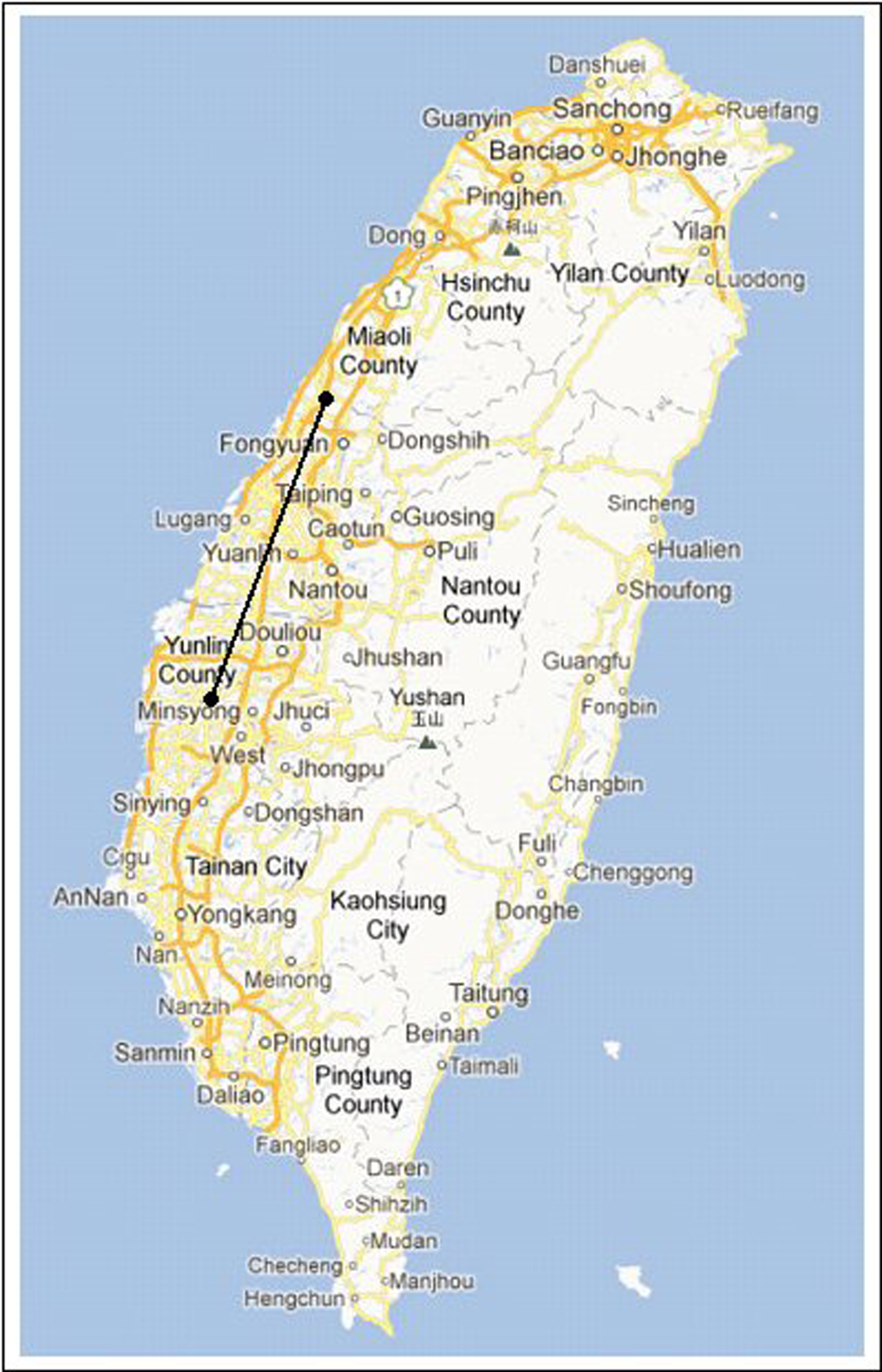
Pilgrimage route from Dajia to Chiayi
Zhen Lan Temple’s jinxiang is the largest in Taiwan because of several factors:
It has a long history that can be traced back to the Qing Dynasty (at least 130 years).
The total distance between the towns of Dajia and Xingang (Chiayi County) is 280 kilometers.
Pilgrims continue to walk the entire 280 kilometers, authenticating Dajia’s pilgrimage route, unlike many other pilgrims, who rely on modern modes of transportation (e.g., buses).
4) Traditionally the jinxiang was limited to people who lived within the Zhen Lan Temple jurisdiction. However, since 1974 the Zhen Lan Temple has allowed pilgrims from other towns to participate in their journey. In 2011 more than 100,000 pilgrims participated in Zhen Lan Temple’s eight-day walking pilgrimage. It is thus not surprising that Zhen Lan Temple’s jinxiang is considered one of Taiwan’s most important Mazu pilgrimage traditions.
At the Xingang Temple, Mazu’s (advance) birthday celebrations are in full swing. Her icons are ritually venerated and offered food, and are the focus of many devotees’ prayers. At the same time, temple committee leaders and members interact and socialize. After burning incense, Zhen Lan Temple pilgrims go shopping and sightseeing, and watch performances at the night market, such as demonstrations of herbal remedies and, in the side streets, striptease shows. They are consumed by a gluttonous orgy of pleasure-seeking, gambling, and shopping. Mazu’s birthday ritual is the only solemn event during this period; all the other activities relate to more mundane aspects of life. As such, I contend that sacred space and sacred time are never completely separated from the mundane world.
Temple committees and local politics
Zhen Lan Temple’s jurisdiction during the agricultural era (1890–1974) encompassed four towns: Dajia, Da-an, Waipu, and Houli of the Taizhong County in central Taiwan (see Figure 2). Believers in the area were protected by Zhen Lan Mazu (Dajia Mazu). In exchange, believers were responsible for providing the financial resources for repairs and maintenance of the temple, in addition to funding large-scale community rituals, especially during the pilgrimage season.
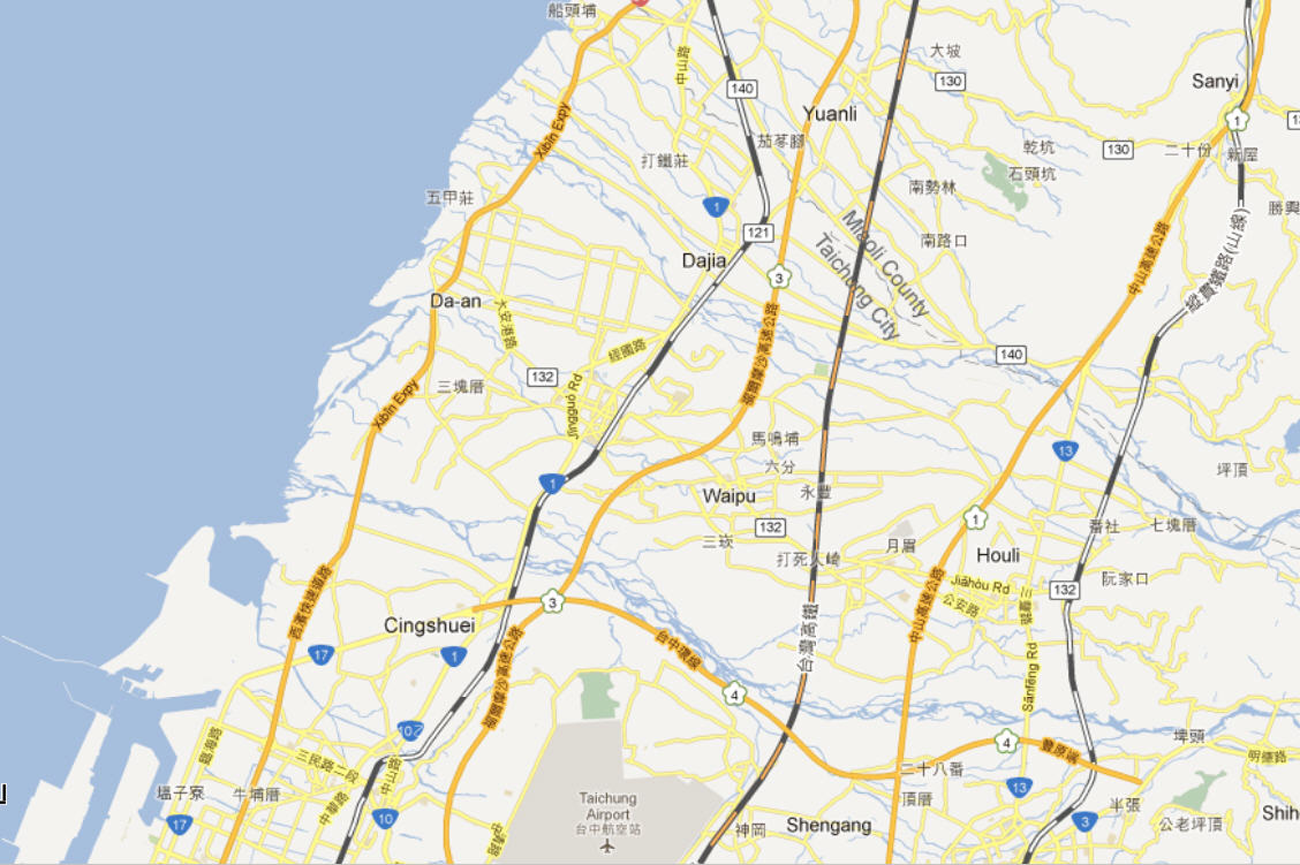
The four towns within Dajia Mazu’s jurisdiction (1890–1974)
The Zhen Lan Temple had two tracks of management during the Qing Dynasty: ‘administration’ and ‘organization of sacrifice.’ A Buddhist monk was in charge of administration, while the local elites were delegated the responsibility for organizing sacrifices. The sacrifice leader was annually chosen through a divination ritual using crescent moon blocks. These two tracks together supervised the management of the temple as well as the calendar of ritual sacrifices.
In 1924, while Taiwan was under Japanese occupation, a Buddhist monk left for China and never returned. As a result, the Japanese government delegated a mayor of Dajia to manage Zhen Lan Temple. From then on, the administrative track of Zhen Lan Temple was controlled by local administrators. But the sacrificial track was still in the hands of local elites. As such, mutual supervision was maintained, albeit at a minimal level. However, the situation deteriorated when the sacrificial track was taken over by the administrative track in 1974. As a consequence, the local elites were no longer able to participate in temple meetings.
This revealed the extent to which religion was influenced and supervised by Japanese local administrators during the occupation period. Research in other areas supports this finding (e.g., Hong, 2004). From 1924 to 1946 the Zhen Lan Temple was run by a manager elected by representatives from the four towns. The representatives were chosen from members of the township assembly of the four towns (e.g., mayors of the four towns and village heads). From 1946 to 1978 the Zhen Lan Temple was managed by an executive committee consisting of representatives from the four town assemblies (e.g., mayors of the four towns, and village heads). 4 Since 1978, the Zhen Lan Temple has been managed by a consortium of judicial persons, consisting of representatives 5 from the four town assemblies (e.g., mayors of four towns, and village heads). In fact, politicians outside the four towns and gangsters have gradually been able to encroach on this sphere of religio-political power.
This begs a question: Why would gangsters want to get involved in local politics? In 1951 the citizens of Taiwan were allowed to vote directly for their country magistrate, who had previously been appointed by the local governor. From then, there developed two factions in Taizhong local politics: black and red. The black faction represented the Zhangzhou and Hakka ethnic groups, predominantly in the mountains. The red faction represented the Quenzhou ethnic group, mainly in the coastal area. The county magistrate election system required town mayors and village heads to campaign on behalf of candidates. Gradually village heads and town mayors were labeled (‘colored,’ if you will) either black or red. Money was also paid to villagers to vote for one candidate or another. Some candidates asked gangsters to help them to ‘buy’ votes, which in effect made the gangsters lobbyists. Eventually the gangsters themselves started running for office. If they won, they could be ‘washed white’ to become politicians (Santos, 2007).
Gangster involvement can also permeate the temple committees themselves. The president and temple committee members of the Zhen Lan Temple are elected every four years. As described earlier, they are chosen from four town assemblies, composed of four town mayors and village heads. Since these local headmen are associated with either the black or red faction, it is inevitable that the temple committee members and the president are likewise ‘colored.’ Furthermore, since these local headmen are associated with gangsters, by extension, the temple committee members and the president are as well.
In addition, the Zhen Lan Temple is called a ‘tank of money and votes.’ When the jinxiang resumed in 1945, only a few dozen people participated in it, but the number of participants increased year after year. In 1974 there were roughly 30,000 pilgrims; in 1990, there were 60,000; in 2011, more than 100,000 pilgrims. With the large number of pilgrims comes a rich coffer. Both the participants and the income become important political resources for any politician who is able to access them.
The culmination of the ‘gangsterization’ of the Zhen Lan Temple’s leadership came in 1998, during the election of the sixth temple president. The two factions, black and red, reached a stalemate. In a bid to win the election, the black party invited Ching Biau Yen to be their candidate. Yen was a controversial politician who did not reside in the territory of the four towns; moreover, he was a notorious gangster. Surprisingly, Yen won the election and became the sixth president of the temple. He was also re-elected for two additional terms as president of the Zhen Lan Temple. But the members of the community voted for their Temple officials; they were not victims of some unfair election. Yen, although a gangster, was elected by popular vote.
As the new leader, Yen was required to follow tradition and perform and participate in the jinxiang ritual. The president must conform to the system. Every individual must comply with the local tradition. So the temple committee compromises with the believers from both the black and red parties. This illustrates how important it is that members of the community cooperate with each other to accomplish the annual jinxiang ritual.
In order to make their jinxiang ritual more prestigious and festive, Zhen Lan Temple used to invite groups of townsfolk to compete for the right to welcome the rejuvenated Mazu when she returned from her journey. Pilgrimage groups were organized according to their occupation, or place of residence, and/or hobbies. Three groups were named First, Second, and Third Incense Group. These three groups were urged to spend large sums of money on flower carts, folk opera performances, and so forth, to cheer both the goddess and the pilgrims along the journey. In exchange, they would be the first to receive blessings from the empowered Mazu, well before the other pilgrims. The First Incense Group had the right to welcome the empowered Mazu in the town of Huatan, about 80 km before Dajia, while the Second Incense Group would welcome the empowered Mazu in the town of Yunjin, about 70 km after from Dajia. The Third Incense Group would be positioned a few kilometers behind the Second Incense Group to welcome the empowered Mazu. This procedure reinforced community and temple coalitions between the Zhen Lan Temple and the towns visited.
As a result of the Second World War, the economy of Dajia was depressed. No group could afford to be part of the Incense Groups – the entertainment budget alone was prohibitive. To remedy this problem, in 1958 the chairman of the Zhen Lan Temple persuaded Dajia immigrants in Keelong (a port city north of Taipei) to compete to be the First Incense Group. Gradually, more and more immigrants in other towns throughout the island organized groups to compete for the right to welcome the rejuvenated and empowered Mazu back to the Zhen Lan Temple. In recent years, immigrants from Taipei and Taizhong, two major cities, have won because their resources and wealth are greater than those in rural areas. The result has been the grown of the Zhen Lan Temple’s alliance with various cities throughout Taiwan.
Since 2000 the Zhen Lan Temple’s financial resources have exponentially increased. This has gone hand-in-hand with the increase in pilgrim numbers. At the same time, the level of competition among the various communities to become an Incense Group has intensified. Further, there is increasing competition among the communities that Zhen Lan Temple pilgrims may visit. Places where pilgrims stop to eat, rest, and sleep not only have the opportunity to obtain Mazu’s blessings, but also have the opportunity to align themselves with a growing religio-political force. Moreover, at each stop, pilgrims become consumers for local businesses and provide an economic boost to the local temple coffers by purchasing incense oil.
The Zhen Lan Temple’s president is responsible for resolving the potential conflicts that may arise among these competing communities. For example, every year Zhen Lan Temple pilgrims pass through the City of Zhanghua, where local gangsters try to rob Mazu’s palanquin. As a result, local police forces are needed to protect the pilgrims, but more importantly the palanquin. By providing Zhen Lan Temple’s pilgrims with protection, the City of Zhanghua decreased its risk of being bypassed. In the past 60 years, the pilgrimage route has not changed much; now with a 100-year tradition behind it, it is expected to remain the same in future years. However, since the potential for minor alteration exists, the various communities and interested parties will need to compromise and negotiate with one another to benefit economically, politically, and religiously.
Battle against central government
Ching Biau Yen was elected president of the Zhen Lan Temple in 1998. Overnight, Yen’s economic, social, and political status changed because the temple maintains a bank account with more than US$10,000,000 and boasts 100,000 patrons. Consequently, both local and central government politicians wanted to ally themselves with Yen. Local politics were complicated during Taiwan’s 1994 presidential election because Zhen Lan Temple’s black and red fractions were able to influence the presidential campaign as well as the election of the county magistrate. During the presidential election in 2000, Yen supported the Song Party candidate. Even so, the Song Party lost the election. Half a year later, the newly elected President Chen had Yen arrested for illegal ‘possession of weapons.’
Yen is a controversial figure in the Dajia area. He not only expanded the popularity of the Zhen Lan Temple and enriched its bank account, but he also damaged Zhen Lan Mazu’s reputation. Many Daijia Mazu believers were worried about the possible pollution of Mazu’s palanquin during the 2004 pilgrimage because Yen had asked the pilgrims to stop by his home only a few months after his mother had passed away. In traditional Chinese belief, a house with a recent death is considered polluted; therefore, it is disrespectful to bring Mazu close to it, as she is pure. Hence, Zhen Lan Temple pilgrims had worried that Mazu would be offended and cause disasters to befall the Dajia area.
After 1949, communist China did not allow the free practice of religion. However, after 1989, when China opened itself to the international community, capitalist enterprises were able to take root, and the limitations on religious expression were relaxed. Christianity (e.g., Catholics and Protestants), Islam, Buddhism, and Taoism (institutional Taoism) were declared ‘official,’ while folk religious beliefs and rituals, which were still considered superstitious, remained ‘unofficial.’ Since the cult of Mazu is associated with folk religion, it also remained ‘unofficial’ and illegal. However, pilgrims from Taiwan have continuously gone to the Isle of Mei since 1987. Indeed, Taiwanese Mazu pilgrims have transformed Mei’s economy through their demand for lodging, food, and entertainment. Moreover, Taiwanese pilgrims have donated a significant amount of money to the Mei Mazu Temple and have financed new roads and a harbor.
The impact of pilgrimage brings into question religious and cultural identity issues between Mazu culture in Taiwan and Mazu culture in China. The People’s Republic of China (PRC) officials understood the implications of pilgrimage. They realized that even though the two parties across the Taiwan Strait were unable to unify politically, they were bound to some extent culturally and that eventually, cultural and religious unification might result in political and national unification. Hence, the PRC saw more than mere symbolic significance in Mei’s Mazu inspection tour of Taiwan in 1997, which had official approval from the socialist State.
The interaction between Mazu temples across the Taiwan Strait is primarily the result of Zhen Lan Temple’s long-term effort. As stated earlier, representatives of the Zhen Lan Temple secretly went to Isle of Mei in 1987 – a violation of Taiwan’s national security law – but they were not sanctioned. This prompted other Mazu temples from Taiwan to follow suit. After Yen was elected president of the Zhen Lan Temple in 1998 he petitioned for a direct flight to China for pilgrims. Not only would this save them time, but it would save them money as well. Traditionally, due to the geopolitical policies on both sides of the Strait, travel to China from Taiwan required a stop-over in Hong Kong or Macao (see Figure 3). Since President Chen of Taiwan’s Democratic Progressive Party (DPP) was anti-unification, Yen circumvented the DPP.
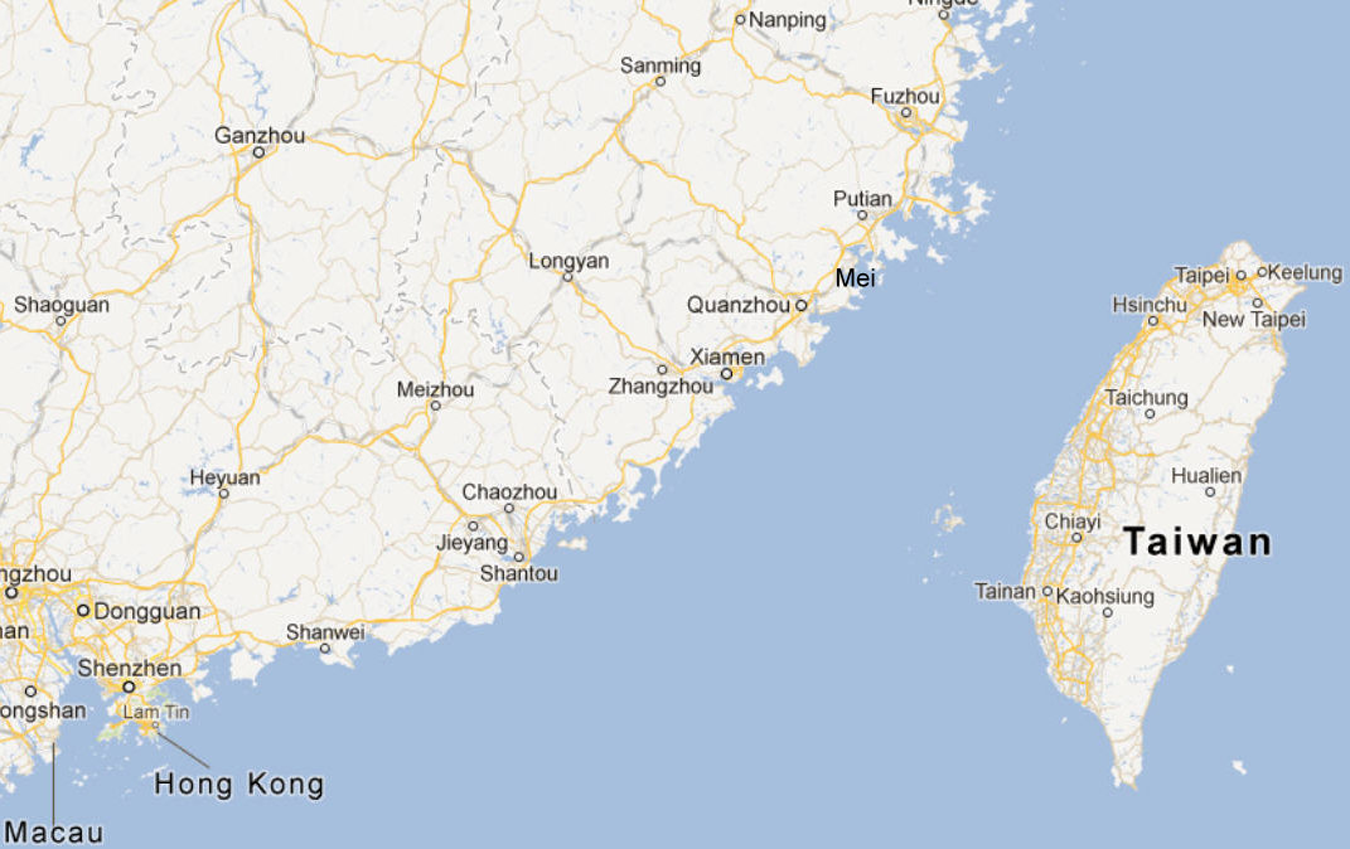
Location of the Isle of Mei
Twenty more years have passed since the Zhen Lan Temple’s historic pilgrimage to the Isle of Mei. Currently the KMT has regained power and is working tirelessly to establish a cross-strait relationship. Taiwan has agreed to open its ports and gates, making direct transport to and from China legal. The first direct flight between the two countries was conducted on July 4, 2008 and, currently, 3,000 mainland Chinese tourists are allowed to enter Taiwan each day. This can be considered an achievement of Zhen Lan Temple’s 20-year effort. The KMT wanted to promote economic development between Taiwan and China; Yen wants to extend his social and religious influence into China. Yen is an example of how religious leaders and resources may be used to assist politicians and even enhance their appeal among the common people. This encourages other Mazu temples and other politicians to publicly express their mutual support for each other. Evidence of this trend may be seen in newspapers and TV programs. The Taiwanese sociologist Hai-yuan Chu (1989) suggested that this phenomenon is an example of the ‘secularization of religion.’ Anthropologist Yih-yuan Li (1992) posited that this phenomenon illustrates the ‘practical side of Chinese folk religion.’
With regard to Mazu’s devotees, they do not believe in the DPP or KMT, but are more concerned with survival and supporting their families. When asked if they think a reunification of China and Taiwan could come about as a result of shared religious identity, most pilgrims hesitate to make a definitive statement.
Conclusion
Historically, Mazu was used by the State as a symbol of approved Chinese civilization. She was used by ministers and officials as a tool to educate the people in the meaning of loyalty to the imperial State. Mazu, as well as other deities of folk religion, was used to sinicize minority people in China’s frontier area (Faure, 2007). There has been a long and intricate relationship between religion and State throughout Chinese history. What is different in today’s Taiwan is that Mazu is used by the people, not by the court. Mazu stands with the ordinary people not with the government. In modern Taiwan, townsfolk carry icons of Mazu to protest against policies and decisions of the central government. People use Mazu to protest against archaic geopolitical policies (e.g., preventing direct travel between Taiwan and China), as well as government-supported nuclear power plants (Chang, 2003). Today, Mazu represents the people, not the State.
Footnotes
Notes
Biography
Address: Academia Sinica, Institute of Ethnology, 128 Academia Road, Section 2, Nankang, Taipei 115, Taiwan.
Email: