




Abstract
The majority of adults in England describe themselves as affiliated to a religious faith. However, little is known about the influence religion has on family life, particularly in relation to ways in which religion influences the parenting of adolescents. The authors seek to add to the limited body of knowledge by reporting the findings of a qualitative study of young people and parents who held a range of religious beliefs and engaged in varied religious practices. The findings indicate that religious beliefs influence both what parents want for their adolescents, and young people’s lifestyles. Moreover, the perceived views of grandparents and peer and societal pressures on young people inform both parents’ and young people’s attitudes. However, the views of faith leaders do not appear to have an influence. The authors conclude by drawing on the findings of this study to explore ways in which the young people and the parents in the study appeared to negotiate adolescent lifestyle choices.
Introduction
Despite Weber’s and Durkheim’s predictions, it appears that religion is not declining; rather, the construct of religion is changing from one that focused on the institution to one that focuses on human potential (Blasi, 2002; Pargament, Magyar-Russell and Murray-Swank, 2005). For example, Davie (2007), describing the British context, concludes that individuals are increasingly willing to express belief without belonging to a faith community. The result is that religious identity may be becoming fluid, shaped more by personal beliefs and context than by religious institutions (Gilbert and Slay, 2007). If this is the case, how does religion influence family functioning at the start of the new century’s second decade? Are those who remain actively engaged in faith communities guided by faith leaders or do their personal beliefs take precedence? Do young people in England maintain systems of belief acquired in early childhood, as Helve (1991) found in relation to young Finns? Or do English adolescents view religion as an optional dimension in life for those who find it appealing, as noted by Hughes, Suwanbubbha and Chaisri (2008) amongst Australian young people. It is these questions that the authors address in this paper, with a specific focus on family life and adolescence amongst those holding religious beliefs and engaging in religious practice in England.
Parents play a significant role in passing on attitudes, values and beliefs as they provide the developing child with the primary environment for socialisation. However in adolescence, young people begin to develop their own identity, worldview and beliefs (Aldgate, Jones, Rose and Jeffery, 2006). As the adolescent moves towards adulthood, the young person becomes increasingly independent of the family and secondary environments such as school, community and social networks are likely to influence the young person’s worldview (Helve, 1991).
Irrespective of religious beliefs there are challenges both parents and adolescents encounter in contemporary Western societies. These include the preparation of adolescents for adult roles, the increasing risks or perceived risks to adolescents in the world outside the family, and the erosion of family and social supports (Small and Eastman, 1991). Moreover, Coleman (2000) argues that rapid social and economic change, in the last few decades, means that young people are likely to think differently from their parents about work, family, gender and sex. This may, in turn, lead to tensions between young people and their parents. These differences may also extend to religion. For example, Davie (2007) cites the European Values Study (a study of socio-cultural and political change in Europe since 1945; see Halman, Anthony, Abela, Harding et al. (2001)), which, in the most recent set of data, collected between 1999 and 2001, found less religiosity amongst the young than amongst the older generations. However, the findings indicated that adolescents are more likely to experiment with new forms of religion. Davie concludes : ‘this is the generation most attracted to the idea of an immanent God (a God in me) and to the conviction that there is some sort of “life after death”’ (Halman et al., 2001: 239).
Despite recent growth in studies of religion and family life, there remain significant gaps in the research. For example, a literature search of empirical studies in the field, completed by the authors using seven electronic databases for the period 1996–2006, resulted in the identification of only 72 empirical studies published in journals (see Horwath and Lees, 2010). The search used the key word religion and variations, such as religious, combined with parenting, children, adolescents, good-enough parenting, family life and similar words (for example parent, teenager, family). Of the studies identified, 34 were completed in the USA and 20 in the UK; small-scale quantitative studies dominated. They also tended to be religion-specific, 55 papers focusing either on Judeo-Christian or Islamic faiths. Only 26 studies involved adolescents between the ages of 12 and 18. These studies tended to focus on one aspect of parenting, such as the transmission of religious beliefs (Flor and Knapp, 2001) or discipline (Gershoff, Miller and Holden, 1999).
The purpose of this paper is to add to the developing body of research in this area. This will be achieved by drawing on the findings of a small-scale qualitative study to identify areas of adolescent life in which parents and young people of different faiths believe religion influences both parenting and the young people’s values and beliefs. The paper concludes by exploring the different ways in which the parents and adolescents who participated in this study managed differences of opinion as to how adolescents should, and do, conduct their lives and make life choices.
Methodology
Qualitative research methods were used in this study as they enable data collection and analysis to be grounded in the social reality of the participants. These methods facilitate exploration of both the intricacies and the subtleties of a complex topic such as religion and parenting. Moreover, ambiguous and conflicting responses can be explored through further probing (Denscombe, 1998). Focus groups were used to gather data as they provide participants with an opportunity to discuss the research questions with others and enable researchers to explore views that are both convergent and divergent (Kitzinger, 2000).
Whilst Christianity remains dominant, England is becoming an increasingly multi-faith society, those holding Muslim beliefs constituting a significant religious group. There are believed to be 1.6 million people who describe themselves as Muslim living in the UK. They make up 2.8% of the population (Office for National Statistics, 2001). With this in mind, the study was completed in a city in the North of England that had a higher proportion than average of Muslims: 16% (Office for National Statistics, 2001). This city was selected to increase the likelihood of accessing a sample that included members of the Christian and of the Muslim faiths.
The study was executed in a number of stages:
Stage one: establishing a steering group
Establishing a local steering group to oversee the project was considered essential: in research of this nature it is important that the researchers have an understanding of the world in which the participants live (Matthews, 2005). This group played a valuable role throughout the study. For example, they advised the researchers as to sample selection, the data collection method, and possible interpretations of the findings. Local faith groups and organisations working with young people and parents in the locality were informed of this study and invited to participate in the steering group through leaflets sent by the city’s faith forum. (The leaflets provided information about the aims and objectives of the study, the sponsors of the research, the members of the research team, the approach to the study and the methods for disseminating the findings). Twenty organisations responded. This resulted in a mixed-sex group that included Christian, Hindu and Muslim members who either lived or worked in the community. Between them the group had both personal and professional knowledge about parenting adolescents.
Stage two: identifying themes for the study and data collection method
The studies included in the literature review, regarding the influence of religion on parenting adolescents, tended to use samples from specific faith groups in the USA. The researchers, therefore, needed to ensure that the research questions were relevant to young people and parents holding different beliefs and engaging in different religious practices in England. This was achieved by initially consulting with young people. A sample of young people aged 13–15 who held a range of religious beliefs was recruited from six local faith-based schools: Muslim (n=2 groups: one boys and one girls); Roman Catholic (n=2 groups: one boys and one girls) and Protestant (n=2 groups: both mixed-sex). We selected 13–15-year-olds because this is the age at which young people tend to not only develop but also begin to articulate their own views about the world, including religious beliefs (Helve, 1991).
Each school identified a member of staff to act as study coordinator. The coordinator circulated a leaflet, containing the information described above but adapted for this age group, to pupils within the age range. Forty young people self-selected to join school-based discussion groups of between six and eight participants. Two groups were held in each school. Within the groups the young people explored the relevance of the key findings from the literature to young people holding religious beliefs and living in their city. A variety of oral and written techniques were used for data collection. The techniques were designed to generate the young people’s views, together with relevant examples, of the ways in which religion may influence the parenting of adolescents in the UK (for further detail see Lees and Horwath, 2009).
The data were analysed inductively according to the principles of grounded theory; transcripts were compared with each other, coded and annotated, ensuring an open approach to identifying factors that the young people considered relevant (Strauss and Corbin, 1998).
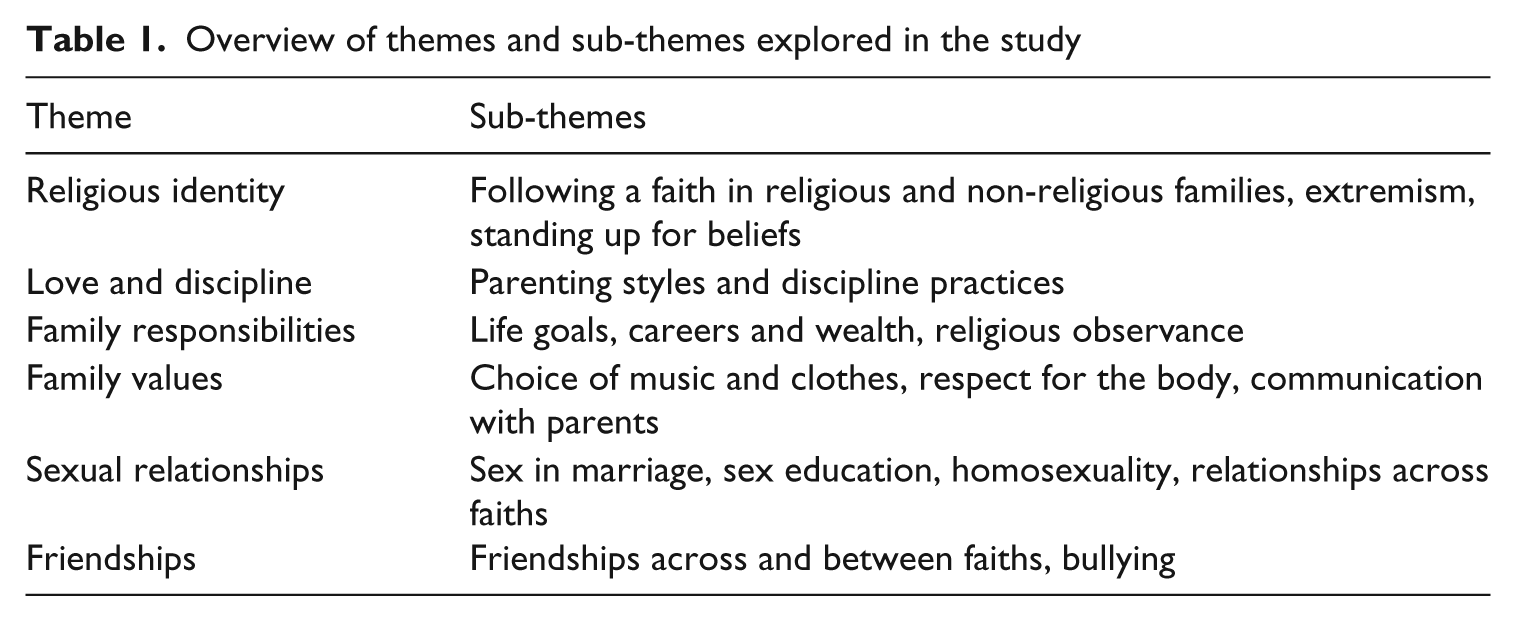
The significant examples, that is, those regarded by the young people as relevant to each theme, were then explored by the local steering group. This group identified those that they considered would be familiar to parents from the faith groups in the local community. This meant that the selected themes, sub-themes and examples eventually used in the study were considered relevant by both young people and adults. Table 1 provides an overview of the six themes and sub-themes that were used. The selected themes provided an opportunity to explore both the influence of religion on the family unit and ways in which young people relate to, and are expected by parents to relate to, the outside world. The research team intended to use the themes and sub-themes to initiate discussion in focus groups for other young people and for parents.
Overview of themes and sub-themes explored in the study
Both the young people and the members of the steering group believed that the examples used in the focus groups needed to be presented in an engaging way, in order to facilitate focus group discussion. A series of ‘talking heads’, presented on a DVD, was considered to be an effective medium. (‘Talking heads’ is a term used to describe a person making a statement directly to camera.). The ‘talking head’ DVD was produced with drama students in a multi-cultural state school in another English city. On the final DVD the examples were grouped under the different themes and sub-themes so that the focus group facilitator could stop and start the DVD at any point. Transcripts of what was said by the ‘talking heads’ were also made available to participants.
Stage three: focus groups for young people and parents
‘Religiosity is a complex, multidimensional concept with private and public aspects that defy simple explanation and that can yield very different results, depending on selected aspects (Regnerus and Burdette, 2006: 179). This raises issues regarding sample selection. Sharpe (1988) concludes that it is more important to be able to recognize religion than to define it and that the only real definition is ‘on the believer’s part (not the observer’s)’ (Sharpe, 1988: 48, italics and brackets in original). With this in mind, in this study, the sample of parents and young people was self-selected on the basis that they perceived themselves to hold both religious beliefs and engage in religious practices.
Young people were recruited from 10 secondary schools that provide education to 11–16-year-olds. The schools included the six faith-based schools that had assisted in stage two and four additional non-faith-based schools. As in stage two, the school co-ordinator circulated leaflets about the project to young people and ensured that forms from parents, giving permission for their children to participate, were returned to the researchers. Parents were recruited through contacts with local faith and community groups as well as schools, word of mouth, and leaflets left at community and faith venues.
Seventy-four additional pupils, aged 13–15, from the 10 local schools participated in 10 focus groups by commenting on the themes and sub-themes using the examples on the DVD; 34 were girls and 40 boys. Nine groups were held in total. Four groups were female only, one of these was for Muslim girls (n=4) the other three were mixed faith, although one group, held in a girls’ Roman Catholic school, was predominantly Roman Catholic, 12 of the 14 participants describing themselves as such and the others being Hindu (n=1) and Christian (n=1). Two groups were male only, one consisting of Muslim boys (n=3) the other multi-faith (n=13). Of the remaining two groups one was all-Muslim including six girls and five boys and the other group, of four Christians, consisted of three boys and one girl. All the groups met within the schools. Seventy-seven parents (unrelated to the young people) participated in a further 12 groups; 55 of these were women and 22 men (see Table 2 for further participant details). The majority of parent groups were mixed-sex; the exceptions were a group of Muslim men (n=7), three groups of Muslim women (n=20), a group of Protestant mothers (n=5) and a group of Roman Catholic mothers (n=2). The 22 focus groups were administered by the second author.
Breakdown of participants by own description of beliefs
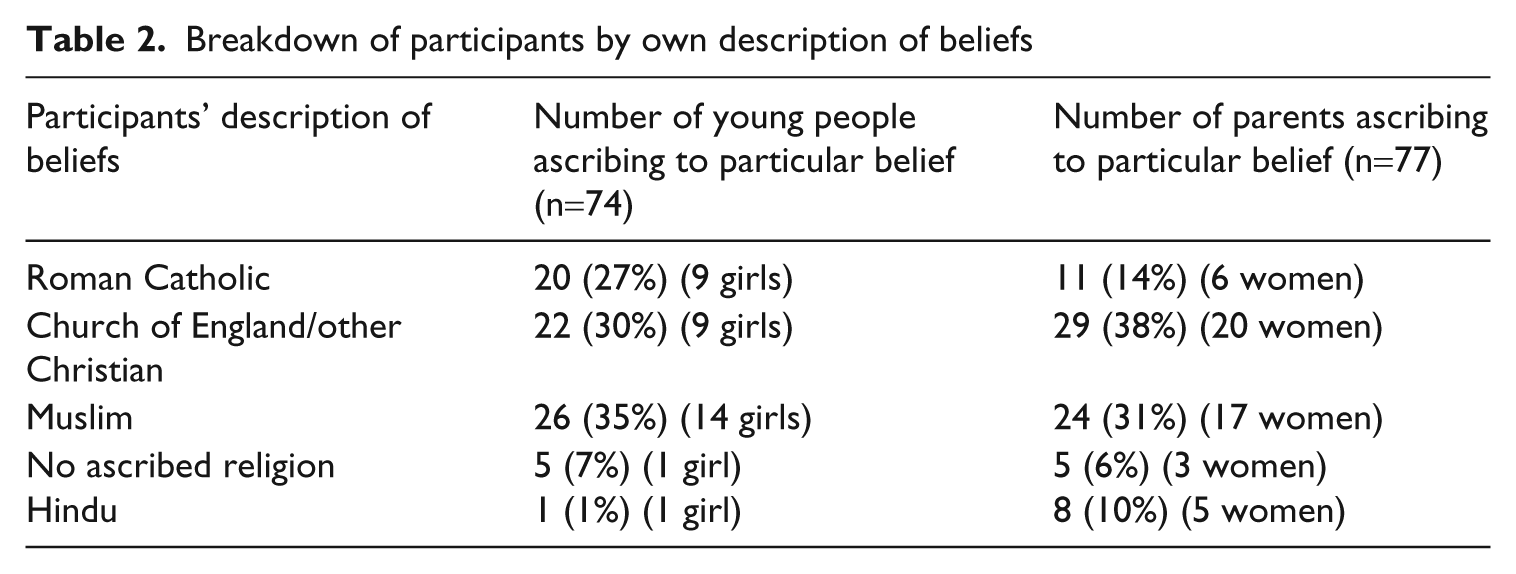
Table 2 provides a breakdown of participants and their descriptions of their religious beliefs and practices.
Religious identity, and love and discipline were identified as the major areas of influence by parents in the literature review, in discussions with the young people in stage one and amongst members of the steering group. Therefore, these themes were explored in this study, all the parents and young people viewing the ‘talking heads’ on these topics. Focus group members then explored two further themes from the remaining four. These were selected by the researchers to ensure that a cross-section of participants from different religious backgrounds, and, as far as possible, representatives of both sexes, discussed each theme.
Analysis and findings
The discussions from all the focus groups were audio-taped, transcribed and analysed using qualitative software NVIVO 7 following the principles of grounded theory. The themes and sub-themes were identified through comparison of the data and were grouped within a descriptive framework. All the data were interrogated by at least two members of the research team.
The nature of the study
The study’s aim was to gain insights into the ways in which young people and parents holding religious beliefs and engaging in religious practices believe that these influence adolescent life. This meant that comparisons in attitudes to parenting adolescents between parents and young people from different faiths and of different sex were beyond the scope of the study. As a result of this, whilst the findings below are supported by quotes, there are inconsistencies in the amount of detail available about the source of each quote, because some focus groups were mixed faith, for example consisting of Roman Catholic and Protestants (in which case the term ‘Christian’ is used). It was also not always possible to identify the sex of the parent or young person when transcribing and analysing the data from the focus group discussions. Moreover, although all the young people were aged between 13 and 15, their individual ages were not known. There is lack of information about age and sex because the researchers were concerned that asking participants to indicate their age and sex before every contribution during the focus group discussions might impede the flow of discussion.
It is also important to emphasise that the findings are based on the participants’ perceptions as to the influence of religion on parenting. This means that whilst the researchers explored ideas and cognitions about the influence of religion on adolescent life, they were able only to explore the theoretical implications for behaviour rather than the actual influence on behaviour. Whilst Knafo and Schwartz (2003) found that adolescents held accurate perceptions of parents’ attitudes, Holden and Edwards (1989) found a difference between what parents believe they are doing and their actual parenting practices. The researchers also recognise that one cannot isolate the influence of religious beliefs from other factors that may influence child-rearing. For example, Sherkat and Ellison (1999) recognise the interplay between religious beliefs and practices and other variables such as sex, social status and age. Moreover, the interface between religion and culture is complex and inextricably linked (Stewart, Bond, Ho, Zaman, Dar and Awar, 2000). For example, parents may hold similar religious beliefs but have different cultural backgrounds that influence their approach to child-rearing. Instead of attempting to differentiate between these variables, the participants were left to decide for themselves whether aspects of parenting were influenced by religion or other factors. Finally, the nature of this study means that no comparison was attempted in attitudes to parenting adolescents between parents who hold religious beliefs and parents who are non-believers.
Having established the parameters of the study, we turn our attention to the findings.
The participants
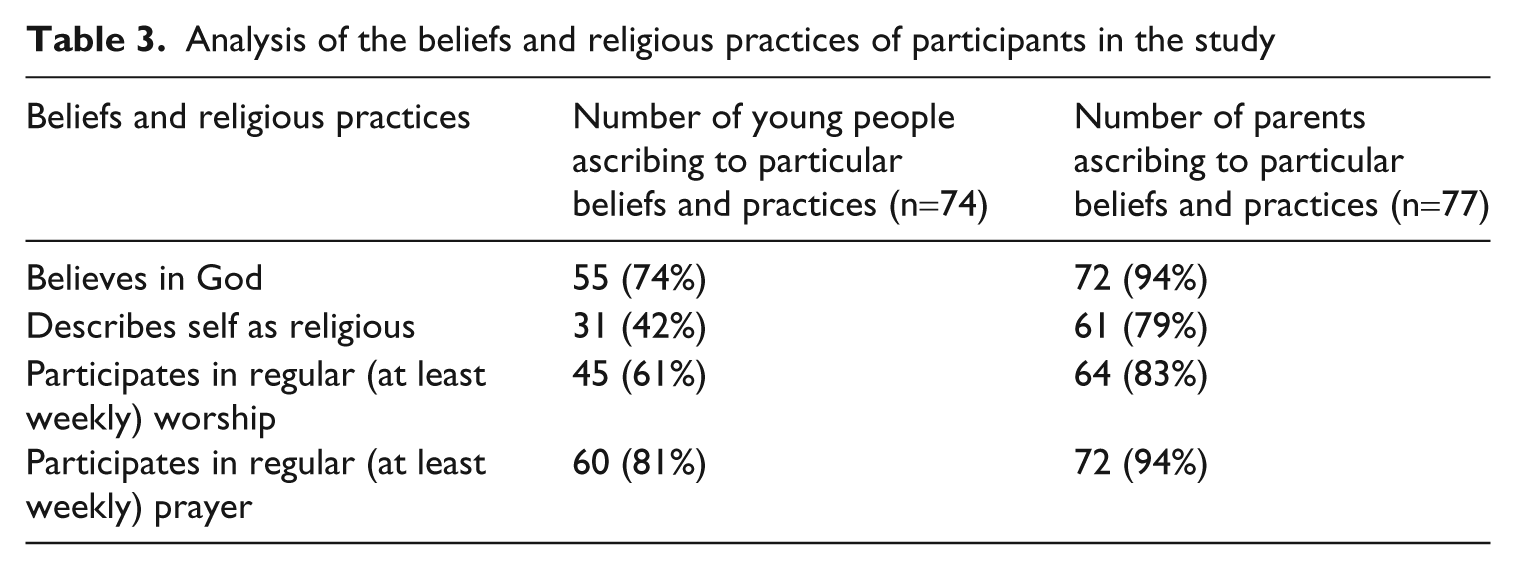
Overall, both the young people and the parents describe a high level of religious behaviour, belief and practice, the parents reporting higher levels of belief and practice than the young people: for example, 83% of parents participated in worship at least on a weekly basis, compared with 61% of young people. Interestingly, 74% of young people believed in God but 81% reported praying regularly, compared with 94% of parents who both believed in God and prayed regularly. This discrepancy may be due to the fact that young people are expected to participate in prayer at home or school. Alternatively, many who pray may believe in a ‘higher power’ rather than a personal god (Piggott, 2009).
Values, beliefs and practices
The participants interpreted ‘religion’ in different ways, from: ‘I think a lot of young people believe in God but it doesn’t mean they follow a religion’ (Protestant participant) to both believing and engaging in private and public religious practices. For many, it provided guiding principles for life (Knafo and Schwartz, 2003): ‘not only having a belief in the heart but also by affecting your morals and behaviours’ (Muslim boy). Interestingly, the focus in all the discussions was on religion as a belief system informing the way one lives rather than merely as an institutional activity such as attending church or mosque.
Like the parents in the studies by Flor and Knapp (2001) and Gunnoe, Hetherington and Reiss (1999) these parents emphasised religion as a way of life transmitted from generation to generation. They felt they had a responsibility to shape the religious identity of children and engage them in religious activities. The majority of young people appreciated and respected the religious beliefs and values they had been brought up with. However, they believed, as also noted by Herbert (1987), that adolescents need to work out their own values rather than accept ‘received wisdom’. This may mean developing values that are different from, and may conflict with, the religious values of the family, a finding also noted by Hennink, Diamond and Cooper (1999), Ream and Savin-Williams (2003) and Saeed, Blain and Forbes (1999). The participants recognised that influences outside the family also inform values. For this reason some parents felt that ‘you have to basically monitor what they’re watching, what they’re listening [to], what they’re doing and [what they] take part in as well’ (Hindu mother). In providing this direction for young people, the parents appeared to be motivated by a desire to meet the needs of the young person rather than by religious dogma.
Analysis of the beliefs and religious practices of participants in the study
The growing association in the media between the influence of religious beliefs and practices, most particularly Islam, on family life, and a perceived rise in Islamic ‘fundamentalism’ (Osler and Hussain, 2005) may influence people’s willingness to declare their religious affiliation. All the young people believed, however, that one should be able to declare one’s religious values without fear of the reactions of others. However, some young people, notably the Muslim participants, experienced a conflict between contemporary culture and religious values, feeling that they were in a no-win situation: Either you sort of go along with the Western culture and the girls dress in a way that their parents consider is not appropriate or they go along with their religious culture and then the parents are worried about that [i.e. that it is perceived as extreme]. (Muslim girl)
The participants also acknowledged that influences outside the family, such as peers, popular culture and the current political climate may negatively influence the attitudes of young people towards religious practices. As a Muslim father noted, ‘thinking their parents are being too passive about it [religious beliefs and practices]’. Parents thought that not giving young people a choice about their level of engagement in religious activities can lead to resentment. The parents and young people, however, could not agree as to the age at which a young person is able to make choices, such as deciding not to attend church. Some parents and young people considered 10 years of age appropriate whilst others thought the choice should be made when the child is a few years older.
Love and discipline
Discipline was considered fundamental to the scriptures of several religious traditions: ‘The basis for religion is discipline; it is there in the Koran, and right from Genesis right through to the New Testament. It underpins everything, discipline’ (Protestant adolescent). Without exception, discipline was also viewed by participants as an important and positive aspect of warm and loving parenting. Indeed, parents and young people believed in a form of authoritative parenting described by Maccoby and Martin (1983) as being warm but setting boundaries and standards. The parents felt ‘firm but fair’ discipline, with an emphasis on discussion and negotiation was an important and positive aspect of warm and loving parenting, providing important training for adolescence. Some of the young people emphasised that a lack of discipline shows that parents do not care. However, the young people recognised that discipline can be too strict or restrictive, leading to rebellion, or to the child being afraid of the parent. The parents also discussed the importance and challenge of finding a balance between strictness and love: ‘... we’re looking at can we modify what she wants to do in a way that suits us but still lets her do what she wants to do? And that’s us being fair but still being strict’ (Christian father).
Choice and age
Gillies, McCarthy and Holland (2001) found that non-directive support, guidance and advice, rather than control, is important to young people, as is space to make decisions without pressure or influence from parents. Young people in this study believed they had a right to make choices about how they conducted their life and should not have these imposed on them by their parents. However, whilst the parents tended to agree with this, key to these discussions was the age at which young people made choices about, for example, engaging in sexual relationships, with different views aired as to age-appropriate behaviour. Parents agreed that ‘you’ve got to recognise them as a person and respect them’ (Christian mother), whilst also encouraging the need for young people to respect their parents’ views. However, some young people argued that ‘Some parents think they are right all the time and it’s hard to tell them that they’re not’ (Muslim girl), and some of the parents felt that ‘you do have to give direction … especially being kind of [a] religious family; you want to make sure you give them the right direction’ (Muslim father). The parents concluded that an important role for a religious parent is the transmission of religious values: ‘If you build the base strong, then you don’t have to worry’ (Hindu father). But, as a Roman Catholic father said, ‘Whether it’s good or bad, society has moved towards a more lax attitude towards what children can do. And certainly the religious part of society hasn’t moved as quickly ... It’s dragging.’
Communication
The parents recognised the importance of open and frank discussion, even if this related to a difficult topic, such as sexual relationships: ‘We would like to think that we communicate well with our children and that … we would be able to listen to them without hitting the roof’ (Christian mother). However: ‘Sometimes children don’t know how we [parents] will respond, so we obviously haven’t communicated that well’ (Hindu mother). Indeed, the adolescents in the study tended to make negative presumptions as to their parents’ reactions to discussing topics such as sex, which may not be justified based on the responses of these parents.
Career choices
The majority of young people believed that they would be allowed to make their own career choice, although they recognised that parents have a contribution to make when advising about careers. Some jobs were seen by the young people as more acceptable to religious families than others because of the contribution they make to the community. These included ‘All the jobs that help people … doctor, fireman and policeman’ (Muslim boy). Both young people and parents agreed that jobs involving the consumption of alcohol, gambling, indecent behaviour or possible illegal activities were to be avoided. Nonetheless, parents ‘might object to you going in the army because religious families don’t like the idea of killing people’ (Roman Catholic boy). Moreover, both young people and parents recognised that education is important: ‘If she’s got a good education … she can get a good job’ (Muslim mother). Only a minority of participants, mainly young people, thought that money mattered when making a career choice. However, parents valued employability, job satisfaction and contributing to the community.
Recent government initiatives in England have emphasised positive engagement of adolescents within the community (Ajegbo, Kiwah and Sharma, 2007). In our study young people considered it natural for parents to want their children to contribute in a positive way to community life. Although they saw community involvement as valuable, it was not something young people thought anyone should be forced to do. More generally: ‘If you were able to help people, you should help people’ (Muslim girl). From the parents’ perspective, voluntary work was considered valuable. However, one Muslim girl was sceptical and felt parents may have an ulterior motive for encouraging this: ‘my mum [says], “Why don’t you do this, why don’t you do that?” Just because she looks good to other people.’
Relationships
The discussions about relationships centred on sexual relationships, relationships with peers and inter-generational relationships.
In relation to sexual relationships, the message given by all the faiths included in this study is that sex is for marriage. The young people recognised this: ‘That’s what the Bible says’ (Protestant young person). However, the young people emphasised the importance of freedom to make this choice, as did the parents: ‘It’s individual choice but as a Muslim I would strongly say sex should be after marriage and not before marriage’ (Muslim father). The parents recognised that saving sex for marriage had advantages: ‘It means security and stronger bonds’ (Muslim father); sex before marriage could have negative consequences such as abortion and single parenthood. However, young people’s attitudes towards sex are shaped by family values and influenced by the social and cultural context in which they live (Crockett, Raffaelli and Moilanen, 2003). A number of young people described the pressure of ‘saving’ oneself for marriage against a backcloth of significant sexual activity amongst young people. Parents also recognised that young people who make this stand need support. They also believed that saving sex for marriage can be harder for boys than for girls, as having sex ‘is part of becoming a man’ (Christian father).
The legalisation of same-sex relationships and the introduction of civil partnerships in the United Kingdom have gone a considerable way to normalising same-sex relationships. Yet some of the young people were very clear that from their faith perspective same-sex relationships were wrong: ‘it clearly says in the Bible that it’s wrong’ (Protestant young person). ‘If you do think that you are gay then you really need to get help’ (Muslim boy). As with sex before marriage, the responses of the parents were more measured. They recognised, however, that same-sex relationships could be ‘a big issue’ (Protestant mother) for religious families, particularly for grandparents: ‘If one of the boys … told us he was gay, my first reaction would be, “God how will I tell Mum and Dad?”’ (Roman Catholic mother). Discussing such behaviours with grandparents was a concern expressed by a number of the parents. In contrast to the expectations of the young people, the parents, in the main, were tolerant and supportive, recognising that: ‘You bring children up to know that they’re loved and wanted no matter what they do or what they are’ (Protestant mother).
The participants in the focus groups also explored inter-faith marital relationships. Some of the parents were clear that this was not appropriate: ‘We believe it’s important that you are able to share your life with somebody who believes the same things that you do’ (Protestant mother). Others considered that it may be easier if the other person had no faith, as with a person of ‘another faith they might clash’ (Roman Catholic mother). Some of the young people recognised, like the parents, that grandparents might not approve: ‘I know my granddad would be so mad, he really would be, he’d be really mad’ (Roman Catholic girl). There was also a sense, from the parents, of wanting what is in the best interests of their child whilst recognising that it could be a difficult situation: ‘… the kid is signing up for a tough life’ (Roman Catholic mother). The young people also considered the consequences of marrying someone from a different faith: ‘If he stuck to his faith and she stuck to her faith, what about the children, they’d be so confused’ (Muslim girl).
Adolescent relationships with peers were also discussed by both parents and young people. Peer groups become increasingly important and influential during adolescence (Aldgate, Jones, Rose and Jeffery, 2006). The young people considered that respect for and the acceptance of religious beliefs are crucial to friendship. Both parents and young people agreed that young people should have friends outside of their faith community because a variety of friendships broadened one’s horizons. Indeed, ‘It would be a disadvantage if they only stick to their own religion’ (Muslim mother). However, a minority of young people thought it was an opportunity to convert others to their faith: ‘I think there you have an opportunity to convert them’ (Christian boy).
During adolescence acceptance by peers is important, and those who are rejected feel isolated. This can result in young people experiencing pressure to conform to the norms of the friendship group. The participants acknowledged that peer pressure exists but: ‘you can’t allow [it] to get to you’ (Christian girl); ‘Good non-Christian friends are fine but, you know, if they’re a bad influence then they [Christians] can be pulled to that [undesirable behaviour]’ (Protestant mother). The pressure to conform to the norms of friendship groups may result in young people feeling embarrassed by family religious practices, such as blessing at mealtimes. In this regard, the parents were not very sympathetic: ‘That’s my job, to be embarrassing’ (Protestant father). Some of the parents discussed their role in steering their children in the right direction in relation to their finding suitable friends, whilst others recognised that the young people had some choice. Both young people and parents considered it crucial that from early childhood children are taught skills to resist peer pressure.
Arguably, some of the most striking findings from this study relate to inter-generational relationships. Both young people and parents considered the views and responses of grandparents to be important, particularly with regard to sexual relationships and maintaining religious practices. It appears from these comments that parenting adolescents in religious families is influenced by grandparents. This supports the research of Pearce and Axinn (1998) but contrasts with Helve’s (1991) finding, in relation to young Finns, that grandparents did not have an influence. The parents in this study recognised, as have parents in other studies, that religious values and practices change from generation to generation (Afshar, 1994; Fuligni, Tseng and Lam, 1999; Zokaei and Phillips, 2000). For example, the Church as an institution appears to be more significant to people of an older generation (Davie, 2007). As a result of this, the parents accepted, as both a Christian and Muslim mother noted, that they played a ‘bridging role’ between their parents’ generation and their children’s.
Discussion
The adolescent, the family and the outside world
For most of the young people and parents in this study, religion is a way of life influencing family relationships, decision-making, life choices and parenting styles. It provides a value system that influences the world in which adolescents operate. This is commensurate with findings from previous studies (Mahoney, 2005). Both the parents and the young people recognised that adolescents are not passive vessels: they are agents able to influence parents, family life and society. Kuczynski and Lollis (2004) describe a ‘bi-directional’ process occurring between child and parent whereby transactions and reconstructions occur as messages, and values and other information shape the interpretation of what is acceptable. The parents and young people in the study recognised this bi-directional process, acknowledging the influence of religion as an important factor in negotiations, shaping what is considered acceptable. They also noted that adolescence is a period of transition, during which parenting is about balancing direction and autonomy in order to prepare young people for independent engagement in the world outside the family. The parents accepted that it can be hard to allow young people autonomy and choice, particularly when the young people hold different views from their parents with regard to, for example, life choices. The young people, in turn, were aware of their right to make choices and recognised that these could bring them into conflict with their parents and, indeed, grandparents. What is also worthy of note is that this bi-directional process between parent and child carries on into adulthood, with parents and children still negotiating, as was evidenced in the findings related to grandparents. Indeed, a tri-directional process appears to exist in some cases, the parents in this study describing how they act as mediators between the younger and older generations.
The bi-directional process of negotiation between young person and parent is also influenced by the world in which the family lives. The responses of both the young people and the parents indicate that social networks, legislation and prevailing societal views all inform the negotiations between the young people and their parents. Each focus group considered who one might turn to for advice regarding appropriate adolescent behaviour. Whilst teachers, peers and family friends were mentioned, none of the participants referred to faith leaders. This suggests that for these parents and young people practical advice and support from faith leaders, in relation to everyday life issues, may be limited. Davie (2007) argues that in countries such as England, being a member of a faith community is not as dependent as it was in the past on custom or habit, rather it is informed by free choice. If this is the case, then it may be that members of different faiths interpret their religion in a way which is meaningful to themselves rather than having their life choices shaped by the views of their leaders. In other words, like the young Australians in Hughes, Suwanbubbha and Chaisri’s (2008) study, they take an individualistic, pick-and-mix approach to religion. It may also be that the local faith leaders do not feel it appropriate to provide advice and support in these circumstances. This hypothesis is worthy of testing through further study.
The findings from this study not only provide insights into the factors that inform the bi-directional process of transactions and reconstructions about acceptable adolescent behaviour and lifestyle choices in religious families, they also provide some indication as to how parents and adolescents negotiate acceptable behaviours and lifestyle choices. Five approaches were identified from the analysis of data; each is considered below.
Agreement
In this situation the parent and the young person are in agreement as to how religious beliefs and practices should inform particular aspects of adolescent behaviour and lifestyle choices. Agreement between parents and their adolescent children on acceptable standards of behaviour may result in a united family unit and promote positive engagement in the faith community and society at large. However, it may also result in the parents and young person taking a stance that goes against a societal norm. For example, agreement between the young person and parents that same-sex relationships are wrong despite legislation to the contrary. Alternatively, family agreement on a particular issue may challenge the tenets of the faith. For example, Roman Catholic parents may agree with their adolescent child that sex before marriage is acceptable provided they use contraception. In these situations the norm within the family unit has the potential to isolate members of the family from other systems, such as the faith community.
Accommodation
This response describes parents accepting and living with choices made by young people, even if they disagree with them. Personal choice has come to dominate the agenda for adolescence in the early 21st century (Coleman, 2000). There were examples in the study of young people expecting parents to support and accommodate their choices: for example, their religious beliefs, even if these beliefs are different from or more conservative or more liberal than those of the parents. Parents who accommodate young people’s choices allow them to select the identities that suit them, rather than forcing them to adopt ascribed identities (Afshar, 1994). When accepting young people’s right to make their own choices, most of the parents in the study hoped that their children’s past religious upbringing would provide them with a moral base for making sound, informed choices ‘and [then] you just have to trust them’ (Hindu mother).
Accommodation also worked the other way, young people accepting and going along with their parents’ views about particular behaviours and lifestyle choices, even if they did not agree with them. It was most evident in relation to family routines and practices, such as saying prayers before meals. In the study this was described by young people as ‘respecting’ their parents’ views.
Negotiation
In certain situations effective management of the interface between the family and the outside world is dependent on the parent’s and the young person’s ability to communicate and negotiate. Negotiation occurs when the parent and young person discuss the issue in order to reach an agreement or compromise. In the findings from this study there is evidence that young people and parents are aware of the need to negotiate in respect of family expectations, their own views and the influences that exist beyond the family in other social systems. The participants also recognised the need for negotiation in order to balance personal/individual and collectivistic/family responsibilities: ‘… there has to be an element of choice. It [the question of faith] does test your relationship. I think parents have to be very careful how they handle that kind of thing, because that can become a big fighting point’ (Christian father).
Both parents and young people were in agreement, whether regarding religious observance, life choices or relationships with peers, that effective communication is crucial to productive negotiation. The participants thought it important to create an environment for their children, from an early age, that encourages them to be open and honest and to feel that their views are listened to and respected. This enables young people to have the confidence to discuss potentially contentious issues with parents, such as sexual relationships.
Avoidance due to perceived difference
Where either parents or their children anticipate a difference in perceptions about acceptable behaviour or lifestyle choice, this could result in their both avoiding discussion on particular topics. For example, the young people in the study often presumed their parents would respond negatively to dilemmas they may face, such as whether to have sex before marriage. Whilst the parents in the study were not the actual parents of the young people, they were far more understanding and tolerant of these dilemmas than the young people had anticipated. As a Roman Catholic mother put it: ‘They think their parents will expect that [religious behaviour], without their parents actually expecting it’. If young people do not feel able to talk to their parents, because they anticipate a negative response, they may become isolated and unsupported and could make ill-informed decisions.
Time and again the parents in the study made reference to their own parents and what the latter would think of a particular situation. This would seem to indicate that avoidance due to perceived difference carries on into adulthood. As a Roman Catholic mother put it: ‘Even now I would not dream of talking to my mum about sex’. These discussions very much mirrored the discussions that the young people had. For example, the parents thought that their parents would disapprove of many of the situations they themselves would accept: ‘I think we do better with our children than our parents did, but I think it is by no means easy’ (Roman Catholic mother). Because of the limitations of this study we do not know whether these reported perceptions would apply in real situations.
Actual conflict
When there is ‘actual conflict’, either the parent is unable to accept the life choices made by the young person or the young person is unable to accept what parents consider appropriate. Whilst this was not a common theme in this study, judging from the discussions, conflict is likely to arise in relation to specific issues, such as same-sex and inter-faith relationships. This response can be damaging for relationships between young people and parents. For example, if the young person and the parents are unable to find any area for compromise, the young person could reject the family or be shunned by the parents because of behaviours that are perceived to ‘bring shame on the family’ (Muslim girl).
Summary
This study provides insights into the connections and influences between social systems and families that hold religious beliefs and follow religious practices. The findings indicate that for these parents and young people religion is an integral part of the family’s life and influences the way in which members of the family interact with the world outside the family. Yet, it is a bi-directional process with external influences, such as peers and popular culture, potentially influencing and altering a young person’s worldview. Moreover, parents’ perceptions of acceptable behaviour can also be influenced by these external factors. Both the parents and the young people recognised that parenting adolescents and being an adolescent in a religious family require a bi-directional process of transactions and reconstructions about acceptable adolescent behaviour and lifestyle choices that take account of the religious beliefs and practices of each individual. What was clear throughout this study, however, was that for these young people and the parents, religion has a significant and positive influence on their lives. As a Protestant boy put it: ‘I think it’s sometimes difficult to separate religion from your daily life because being polite, being nice to others, looking after your neighbour, all these are religious instructions.’
Footnotes
Acknowledgements
This study was funded by the Joseph Rowntree Foundation. We would also like to thank Cannon John Higgins and Atif Imtiaz for their contributions
Biographies
Jan HORWATH is Professor of Child Welfare at the University of Sheffield. She has a particular interest in child maltreatment policy and practice and the social and cultural factors influencing child rearing.
Address: Department of Sociological Studies, University of Sheffield, Elmfield, Northumberland Rd, Sheffield, S10 2TU, United Kingdom. Email:
Janet LEES is an ordained minister of the United Reformed Church in the United Kingdom, a registered speech and language therapist and a Visiting Research Fellow at the Research Institute for Health and Social Change at Manchester Metropolitan University. She is Chaplain of Silcoates School in Wakefield, West Yorkshire.
Address: Silcoates School, Wrenthorpe, Wakefield, WF2 0PD, United Kingdom. Email:
Peter SIDEBOTHAM is a consultant paediatrician and associate professor of child health. His clinical and academic interests include parenting, child maltreatment, disability and unexpected child deaths. He has taken a particular interest in the broader social and cultural influences on child health and development.
Address: Warwick Medical School, The University of Warwick, Coventry, CV4 7AL, United Kingdom. Email: