



Abstract
Perishable products are associated with a limited shelf-life, and their efficient management often requires close matching of supply with demand. Due to the inherent uncertainty in supply chains, determining stock reordering points and issuance policies is challenging. Tools and techniques from Operations Research/Management Science (OR/MS) support decision-makers in making well-informed decisions related to perishable inventory management. Among the plethora of OR/MS methods, discrete-event simulation (DES) is well suited for studying inventory systems, as this typically models products moving in and out of storage within a stochastic supply chain environment, and in the case of perishable goods, enabling age tracking of products. This paper presents a literature review of DES applied to perishable inventory management. Our base set of literature consists of 25 papers retrieved through searches of scholarly databases. Notably, our review highlights that fields such as the pharmaceutical, organ donation, and floral and horticultural supply chains are relatively underexplored. Furthermore, while most modeling studies consider uncertainty on the demand side, uncertainties related to lead time, yield, or product lifetime have not been modeled to a great extent. Our review is a key source of literature for researchers and practitioners on the current state-of-the-art in DES modeling for perishable inventory; it identifies research gaps and provides directions for future research.
Keywords
1. Introduction
Inventory may be defined as “the stock of any item or resource used in an organization”; 1 effective inventory management is imperative for organizations striving to meet demand. Striking the correct balance is key, as maintaining excess inventory can lead to unnecessary costs stemming from over-purchasing and associated storage, while inadequate inventory levels may lead to disruption of production lines and stockouts, leaving customers dissatisfied and eroding trust due to product unavailability or delay. The level of stock to hold is not a trivial decision, as it ideally should be able to serve as a buffer to deal with uncertainties on the supply and demand sides. 2 Inventory control revolves around aiding operational decision-making that is associated with the seemingly simple questions related to the volume of replenishment (“how much to replenish?”) at what time (“when (...) to replenish?”). 3 However, these decisions are often far from simple, as they must balance the complexities of budgetary constraints, fluctuating demand with the ultimate objective of optimizing inventory systems.
As well as being fundamental to the business operations of real-world organizations, inventory optimization is also an important research area focused on aspects such as stock level measurement and replacement volume and frequency. 1 In addition, the financial aspects of inventory value and opportunity costs arising from investment in inventory rather than other areas of production are also considered. When it comes to perishable goods, there is additional complexity to consider when optimizing inventory systems, namely that of wastage, the reduction of which favors the holding of lower inventory levels but which itself leads to a higher stockout risk. 4
In Operations Research/Management Science (OR/MS), many decision-support approaches for inventory management have been researched. Traditionally, approaches such as mixed-integer programming and dynamic programming have been used as deterministic and stochastic optimization techniques. However, computer modeling and simulation (M&S) offers significant advantages, particularly in its ability to incorporate time-dependent changes within the system investigated. Techniques such as discrete-event simulation (DES) and agent-based simulation (ABS) are particularly well suited for capturing the richness of real-life world complexities and the variability of inventory systems as they evolve over time. By incorporating both randomness and temporal changes, simulation allows for more realistic scenario analysis, enabling a better decision-making environment. As previously noted by Robinson, 5 these techniques “are normally developed because a system is too complex to be represented in any other way.” Hence, when addressing uncertainties in complex systems, M&S provides a compelling alternative.
The DES approach offers the ability to model a stochastic system at a fine level of detail. In addition to incorporating aspects related to uncertainty, DES models entities passing through networks of queues and undergoing activities. 6 Furthermore, being parameterizable, DES can readily compare multiple “what-if” scenarios. This can lead to improved decision-making, especially if stakeholders of the real-world system are involved in the model definition and scenario evaluations. DES is often used as a tool for operational and strategic-level decision-making, where scenarios for experimentation are often developed to test competing strategies against a base scenario, which represents the current system. These models typically include queuing structures to represent the processes around supply chains, incorporating distributions derived from real-world data. The results of such experimentations allow stakeholders to assess relative gains from potential system changes prior to often costly implementation. DES has been applied to multiple fields, such as logistics and supply chains, 7 healthcare,8–10 business, 11 and forestry. 12 In a 2020 literature review, Mustafee and Katsaliaki 13 employed a keyword classification approach to survey over 82,000 articles published between 1990 and 2019 in 26 leading OR/MS journals and found that DES was the most popular M&S technique employed for detailed analysis.
DES is a natural fit for studying inventory systems, as these typically involve moving entities in and out of storage within a stochastic supply chain environment. In the case of perishable goods, the modeling methodology enables tracking the age of items as they move through the system. DES thus provides an effective way to model inventory systems where it is often necessary to undertake granular analysis. The extent to which DES has been applied to the study of perishable inventory systems was the subject of our preliminary work-in-progress paper communicated during the 2023 Simulation Workshop. 14 In this contribution, we build on this previous work by presenting an extended data set of papers and including an enhanced review of publications where DES and inventory of perishables converge. This has been conducted by means of a systematic literature search.
Our findings identify five research gaps in this domain. First, we found that most studies did not take full advantage of DES’s capacity to model uncertainty, especially since they relied on fixed lead time on the supply side, rather than incorporating their stochastic nature. Second, we identified the need to standardize the key term “echelon” to improve consistency and comparability across the studies. Third, we found that research on perishable inventory systems has focused mainly on specific application areas, such as blood banking, while other important sectors, like pharmaceutical supplies, remain largely unaddressed, leaving opportunities for future exploration. Fourth, we observed inadequacies in how DES models are described, particularly concerning entities, activities, and resources. The lack of code availability and logic diagrams in the reviewed studies also present a clear area for improvement in terms of transparency and reproducibility. Finally, we observed low reporting of simulation study findings in real systems. These gaps highlight the potential for further advancement in applying DES to perishable inventory systems.
The remaining sections of this paper are structured as follows. Section 2 provides a background and a concise overview of inventory management. In section 3, we elaborate on the search strategy employed to identify the publications that formed the basis of our analyses. Section 4 explores the analysis and presents the findings. Section 5 discusses the research gaps identified in our literature review, followed by the paper’s concluding section (section 6), which offers the key conclusions.
2. An overview of inventory management
The first inventory control model was published in 1915 by Ford Whitman Harris—the classic Economic Order Quantity (EOQ) model. 15 It was another 40 years until the notion of inventory deterioration was established by Thomson M. Whitin. 16 Classification of inventory systems by product characteristics was subsequently described. The three “meta-categories” of obsolescence, deterioration, and neither obsolescence nor deterioration were described by Goyal and Giri, 17 representing the top-most tier of such classification concerning perishability. Products will be subject to obsolescence when demand for them becomes non-existent due to changes in the environment, whereas deterioration refers to the lowering of quantity/quality of the good itself. The latter can be divided into perishable goods and decaying goods. Perishable goods have a maximum usable lifetime, whereas decaying goods have no shelf-life limit but degrade over time. Products exhibiting neither external nor internal changes over time fall into the meta-category of neither obsolescence nor deterioration. The above-mentioned meta-categories 17 can be used to classify inventory systems spanning multiple application areas, such as manufacturing (which may rely on deteriorating decaying goods such as volatile liquids in the production process), fresh foods (generally deteriorating perishable goods), fashion (an example of obsolescence), and healthcare products.
Several reviews have been published on inventories of deteriorating goods; noteworthy among them are Perishable Inventory Theory by Nahmias, 18 which focused largely on inventory literature related to fixed shelf-life goods; the review by Raafat, 19 which was limited to mathematical models of continuously deteriorating inventories; and the reviews by Goyal and Giri 17 and Bakker et al., 20 which cover publications of deteriorating inventories over the 1990s and the 2000s, respectively. The latter two reviews included over 300 publications, demonstrating the research community’s significant focus in this area. Recent reviews have focused on topics such as multi-echelon inventories, 21 transportation, 22 and risk management through hedging. 23
A diagram of typical inventory management is shown in Figure 1. Within the DES paradigm, entities (which model goods) flow from a producer into the inventory system, with queues representing the stock. Demand from consumers in terms of received orders is fulfilled by entities leaving the system, according to an issuing policy (e.g., first-in-first-out (FIFO)). In the case of a multiple-echelon system, entities flow between the distinct queues associated with each echelon, with orders being fulfilled from the final echelon. Inventory replenishment (possibly with lead time) and an associated reordering strategy are also modeled. In the case of perishable goods, the age of each entity is tracked by means of assigning and tracking attributes, and product expiry/wastage is deemed to occur if a maximum shelf-life is attained.
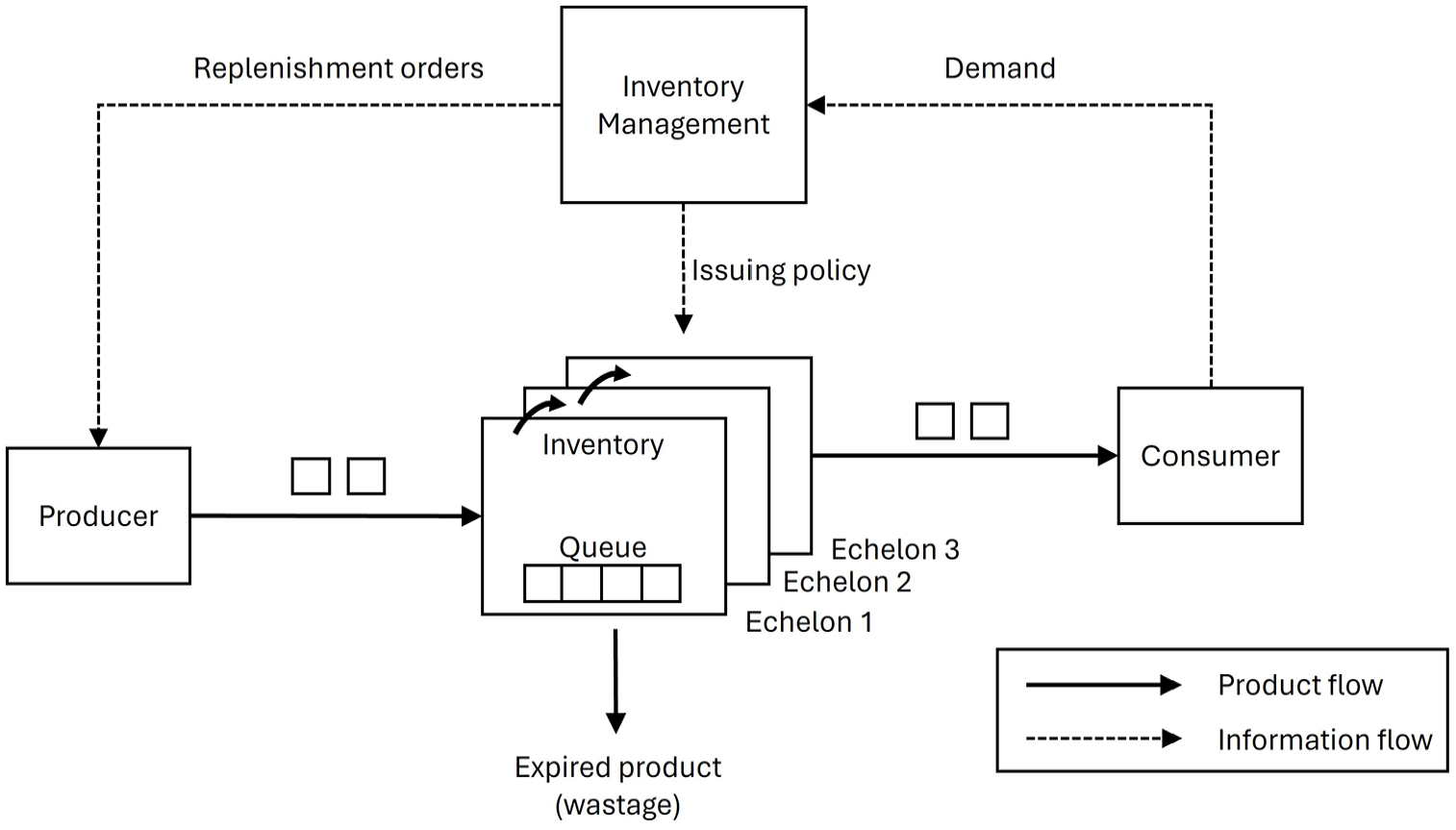
General outline of information and product flow of perishable inventory captured by discrete-event simulation.
3. Methodology and framework for literature analysis
The search strategy employed in Staff and Mustafee’s 14 Simulation Workshop 2023 (SW23) work-in-progress paper considered three themes related to perishability, inventory/production, and DES. While the focus of this extended review remains consistent with our preliminary work, this paper considered an extensive array of sources and studies by including additional databases for the search. The revised search strategy also entailed carefully selecting keywords to capture terms around perishability and DES, drawing from Bakker et al. 20 and Zhang, 24 respectively. On the contrary, inventory/production terms were less obvious. Therefore, we concluded that exploring linguistic diversity and including multiple terms was valuable, intending to enhance the likelihood of capturing references relevant to our area of interest. Furthermore, we introduced literature snowballing.
Our review specifically focuses on studies that explicitly employ DES as their methodological foundation. Accordingly, our search strategy was designed to identify studies that reference DES as a part of their methodology. We assumed it to be standard practice for studies to explicitly mention the methodology they employ; acknowledging that studies omitting that information, and as a result not being identified in our search, are those that raise concerns regarding the clarity and rigor of their communication.
The data set for the literature review was identified using Web of Science (WoS) Core Collection (Clarivate™ Analytics), Scopus, and IEEE Xplore (only WoS was used in our earlier paper).
We conducted an unrestricted search regarding the publication year and considered all papers published in English. The search was conducted in September 2023 and yielded 102 results in Scopus, 62 in WoS, and 11 results in IEEE Xplore (for detailed search terms, see Table 1). References identified were uploaded to Mendeley reference management application, and duplicates were removed.
Search terms used for identifying papers for the literature review.
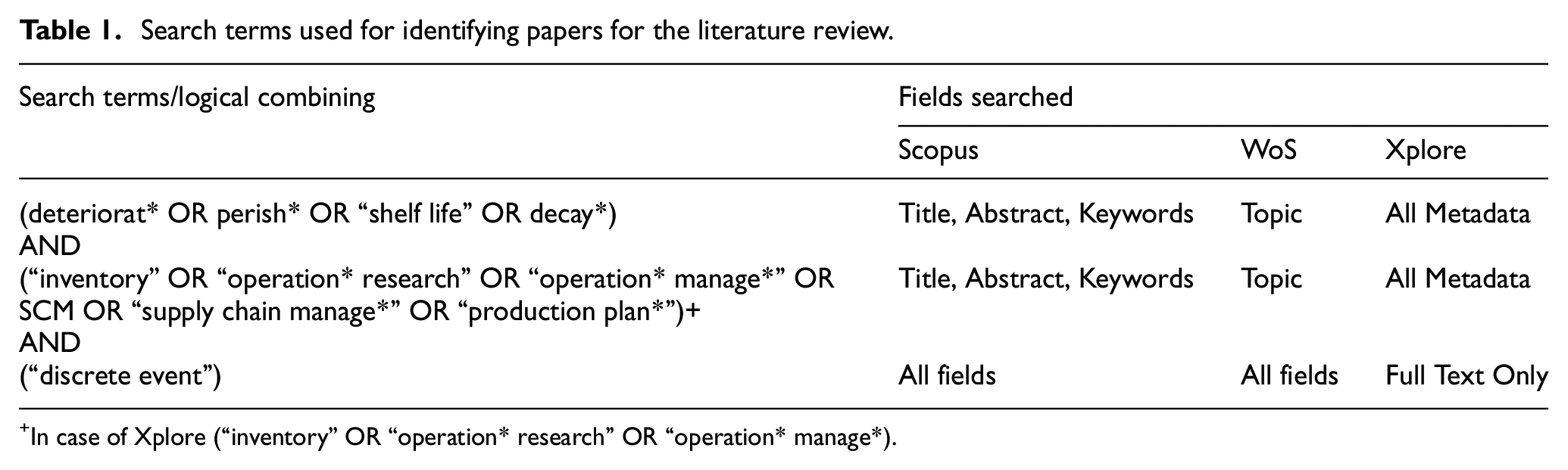
In case of Xplore (“inventory” OR “operation* research” OR “operation* manage*).
In the majority of research fields disaggregated by broad subject area, Martín-Martín et al. 25 previously reported that while Scopus captures most of the references, WoS typically identifies some additional references beyond the set found with Scopus. This observation proved to be consistent with our own search results, with WoS identifying an additional 35 articles beyond the 102 identified with Scopus.
While PRISMA (Preferred Reporting Items for Systematic Reviews and Meta-Analyses) constitutes a standardized reporting methodology, 26 to effectively capture our search approach, we present a modified PRISMA diagram, which reflects our article selection methodology (see Figure 2). The initial set of unique sources was subjected to preliminary screening based solely on examining titles, abstracts, and keywords. This screening process led to a binary decision regarding whether to proceed with a full-text review. Of the complete set, 37 articles were advanced to the next stage of full-text reading. This resulted in the identification of 20 articles, which represent the base set of papers initially identified through the search of the three abstract databases.
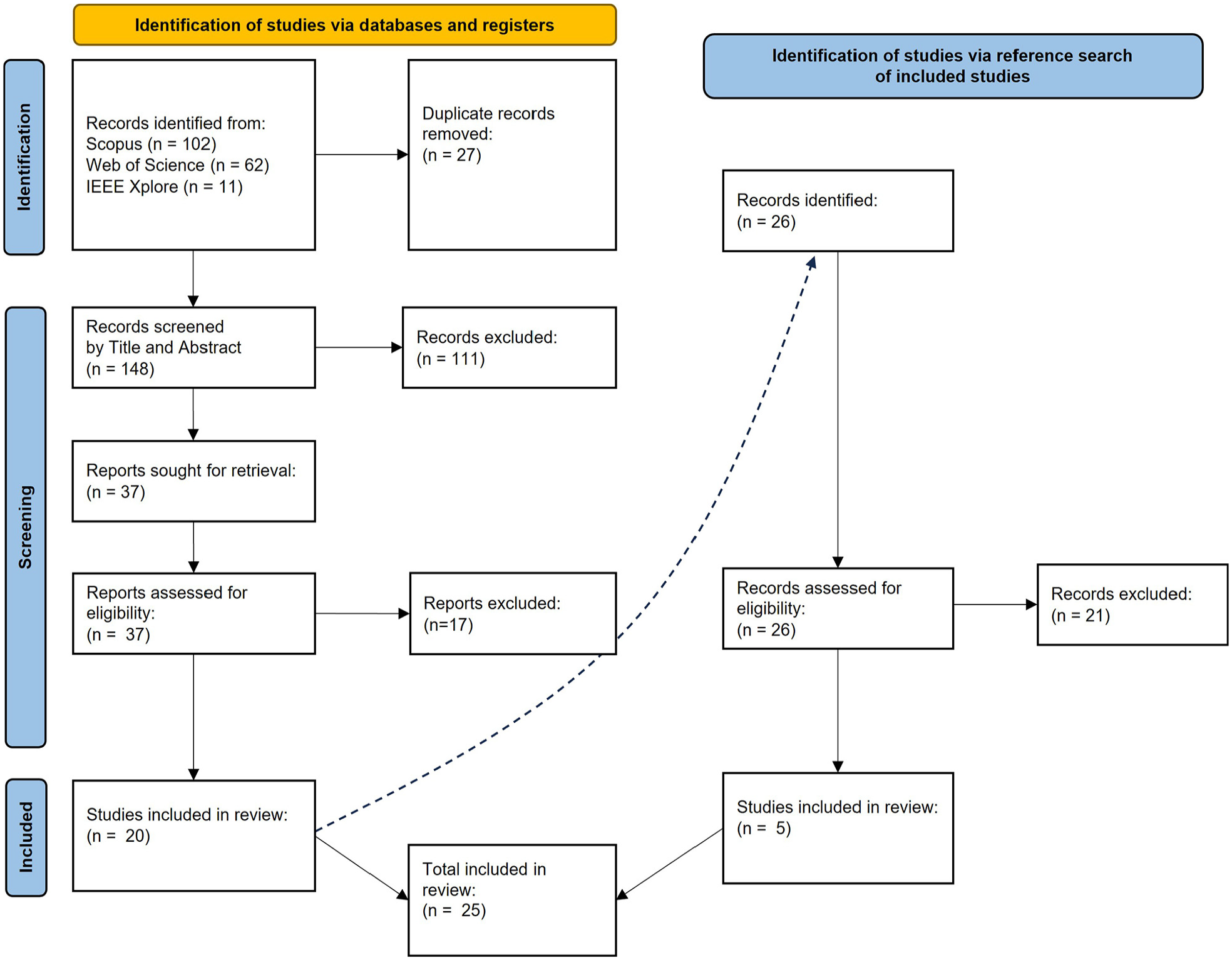
Modified-PRISMA flow chart.
During the second stage, from the 20 articles that were confirmed to cover the subject of interest, we conducted a backward search (literature snowballing) and identified 26 additional candidate articles. After a comprehensive review of the full texts, five of these were incorporated into the final set for detailed analysis. Thus, our final data set for the literature review consists of 25 publications.
We excluded publications for various reasons, and one primary criterion was the absence of physical (or hypothetical) perishable goods that were to be modeled. In other instances, otherwise promising papers fell short when it came to describing the model in sufficient depth. For instance, we encountered one article that stated that DES was used in the study of a sustainable beef supply chain; however, the model was not described sufficiently. Similarly, a paper which combined DES with multi-agent modeling for fast moving perishable consumer goods posed us challenges in disentangling and evaluating the employed models distinctly. Yet another paper identified by our search aimed to investigate hypothetical perishable products with resalable product returns using a simulation model. However, it refrained from elaborating on any characteristics of the DES model that it mentioned it had employed. Furthermore, our list of excluded papers also included an article that delved into addressing challenges related to perishable products in the retail industry. More specifically, while the article elaborated on various factors, including lead time, review period, and demand distributions, and offered valuable insights and approximations for minimizing waste, it fell short of providing specifics regarding the modeling methodology and the model type employed. Moreover, the paper lacked information of how the events were being scheduled and processed, making it challenging to arrive at a definitive conclusion regarding its classification as a DES model. Finally, within the excluded category, we came across four publications which utilized trace simulation, a method solely focused on recording and analyzing event sequences at a very fine-grained level. This approach differs from DES modeling, which aims to capture the broader behavior of the system and processes.
Beyond identifying possible research gaps, conducting a research review serves as a platform for gaining insights into individual studies. As highlighted by Monks et al., 27 research studies are published to expand current knowledge and offer the opportunity to “avoid reinventing the wheel” by building and/or reusing someone else’s work. A sufficient level of detail in the description of simulation models is thus desirable to allow the reproducibility of research findings. Even better practice would be for the authors of the studies to share the model code. Thus, our analysis has incorporated certain elements listed in the STRESS-DES guidelines. 27 We examined “what was modelled?” and “how the model was described?” Keeping the reproducibility aspect in mind, we paid particular attention to evaluating how easily one could build the model based on the description and visual aids and the possibility of accessing the model code. However, it is essential to acknowledge that a large proportion of the articles assessed were published prior to the release of these guidelines. Also, papers may have focused on theoretical and methodological contributions, with the DES application serving as a basic test case. Some studies could have been proof-of-concepts requiring specialized data and/or cross-disciplinary skills within the team, and the authors may have made the conscious decision that the state-of-the-art is not sufficiently developed to introduce formalizations of code and engagement with reproducibility initiatives (i.e., code and documentation would be provided as a tick-box exercise rather than serving the intrinsic purpose of value creation through the use (or extensions) of existing artifacts). Therefore, for some of the reasons outlined above, we do not intend to conduct a full retrospective assessment.
In this study, we applied the PPMO framework for literature synthesis, as outlined by Mustafee et al. 28 The framework delineates the key variables of interest, encompassing aspects related to profiling research (P), problem definition and context (P), model development and implementation (M), and study outcome (O).
4. Findings
Referring to the PPMO framework, 28 for three of the categories (profiling research (P) and problem definition and context (P) (which we consider together) and study outcome (O)), we report on several variables that are well aligned with the context of our study, such as application sector and stakeholder engagement. Regarding the model implementation category (M), we report the Tools/Languages used, whether simulation logic diagrams (e.g., flowcharts) are reported, and whether the DES models were standalone or combined with other techniques. Furthermore, several aspects relevant to perishable inventory systems, such as modeling uncertainty, were additionally described and added to category M, thus extending the PPMO framework in a direction relevant to the particular focus of this review.
4.1. Research profiling and context
4.1.1. Publications overview
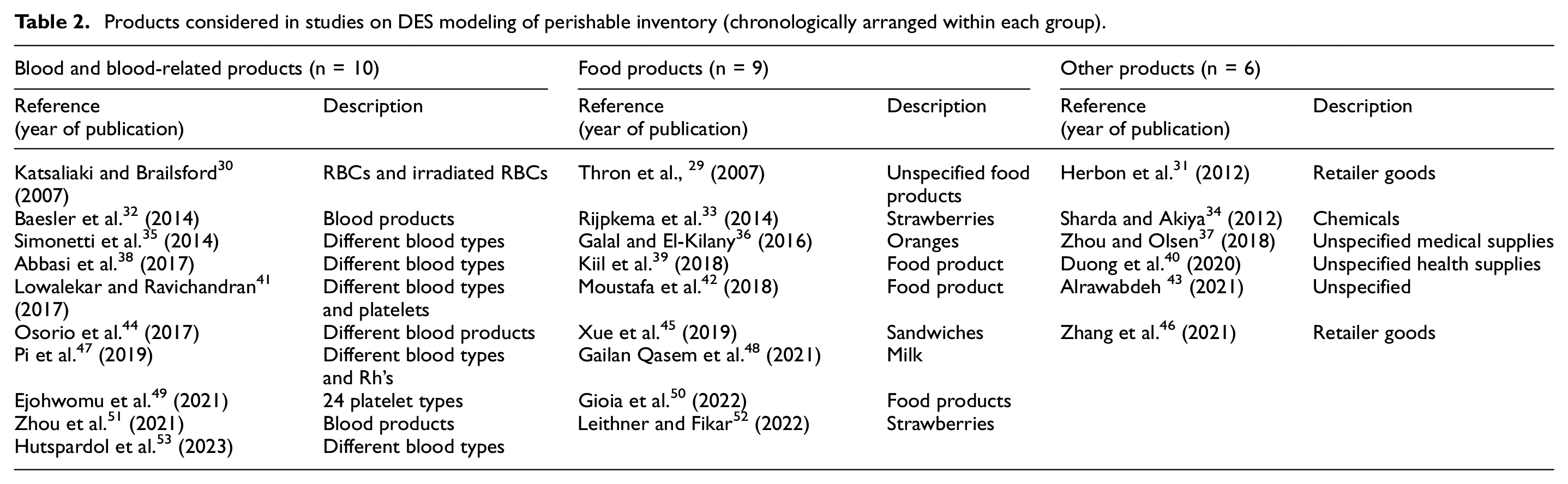
Of the 25 articles included in the review, 22 were journal articles, and three were conference proceedings. A significant proportion of these studies (n = 10) employed DES to model inventory aspects related to various blood products, followed by studies on food products (n = 9). Other application areas included retailing, medical supplies, and chemical manufacturing; there were also several unspecified domains (for specific products modeled, see Table 2). As shown in Figure 3, after two initial publications in 2007,29,30 there was a gap in reporting on perishable models. This was followed by a relatively low and steady frequency of papers published over the last decade. In addition, the topics covered have been spread across broad categories of blood, food, and other areas studied over this time.
Products considered in studies on DES modeling of perishable inventory (chronologically arranged within each group).
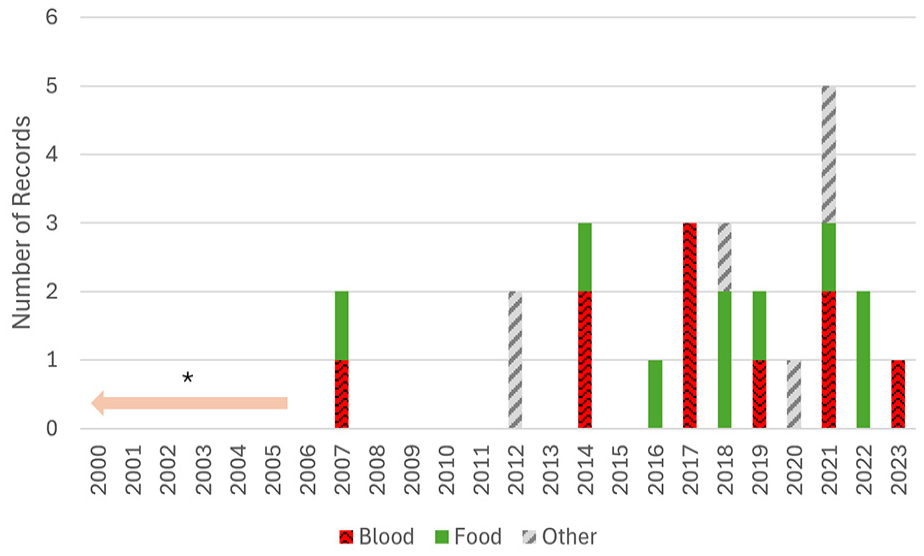
Publications of perishable inventory DES models over time by field.
4.1.2. Nature of problem and stakeholder engagement
Eight papers developed models aimed at hypothetical problems (see Table 3). Of these, notably, the study by Leithner and Fikar, 52 focusing on the organic food supply chain, went beyond theoretical modeling to estimate both supply (grounded in the agricultural sector land area and yield estimates) and demand (by taking into consideration the population-level expected demand). The model by Lowalekar and Ravichandran 41 is equally noteworthy; it was developed with a broad generalizability lens and was subsequently “put to the test” with empirical data of blood products, illustrating its pragmatic application in a real-world scenario.
Nature of problem reported in studies on DES modeling of perishable inventory.

The remaining 17 studies based their analysis on empirical data. Interestingly, most of these studies did not commit much effort to explaining the characteristics of stakeholder engagement and/or how they gained access to the primary data sets used for the analysis (Table 4). This is despite the widely acknowledged importance of involving stakeholders throughout the simulation lifecycle. Previous examples of studies in the realm of healthcare that aimed at enhancing stakeholder engagement include stakeholder involvement at the conceptualization stage by Kotiadis at al. 54 and at the coding stage by Proudlove et al. 55 Stakeholder participation is believed to benefit modeling studies as it allows for sharing multiple viewpoints and tacit knowledge from different parts of the system and at the various stages of the process. In recent years, the techniques that advocate stakeholder participation, such as PartiSim (originally reported by Kotiadis and Tako in 2010) 56 have been tested for their adaptability, when evolving from traditional face-to-face settings to virtual environments. 57 In addition, new frameworks such as FaMoSim have emerged to support DES online studies, responding to the challenging landscape brought about by the COVID-19 pandemic. 58
Stakeholder engagement in studies on DES modeling of perishable inventory.

Within our data set, the use of interviews to gain a comprehensive understanding of the system was reported by Rijpkema et al., 33 Kiil et al., 39 and Thron et al. 29 related to food inventories and by Katsaliaki and Brailsford, 30 who also mention augmenting interviews with survey data to gain an understanding of the entire horizontal section of the blood supply chain. While no mention of engagement with the stakeholders to gain insights about the milk production system is evident in the study by Gailan Qasem et al., 48 discussions with the management regarding the results were clearly stated. On the contrary, the study by Pi et al. 47 mentions collaboration with a blood supplier, but no further details to allow an understanding of that relationship are discussed. The publication by Osorio et al. 44 remains the sole publication that elaborates and reports the active involvement of problem owners in multiple stages of their simulation study of the blood supply chain; it remains the only study explicitly stating a preliminary agreement with the stakeholders for a future pilot study.
In terms of data used, four studies32,36,38,41 stated that their models made use of historical data. However, whether data were accessed through publicly available sources or collaborative undertakings is unclear. For instance, Lowalekar and Ravichandran 41 only state the use of a specific blood bank in southern India, without any further elaboration.
Jahangirian et al. 11 noted that DES had a relatively low reporting of stakeholder engagement among simulation studies. Despite recognizing that historical reporting of stakeholder engagement was suboptimal, it is noteworthy that our study did not demonstrate any strong trends of improvements in that area over the timeline of reviewed articles.
An interesting pattern emerges when analyzing the studies through the lens of stakeholder engagement and empirical data use (i.e., data from the case study context). Only two of the 12 studies that reported stakeholder engagement developed DES models of a hypothesized nature. These, understandably, did not need access to empirical data. On the contrary, seven out of 17 studies, despite focusing on real-world problems utilizing empirical data, did not report any stakeholder interactions (see Figure 4).
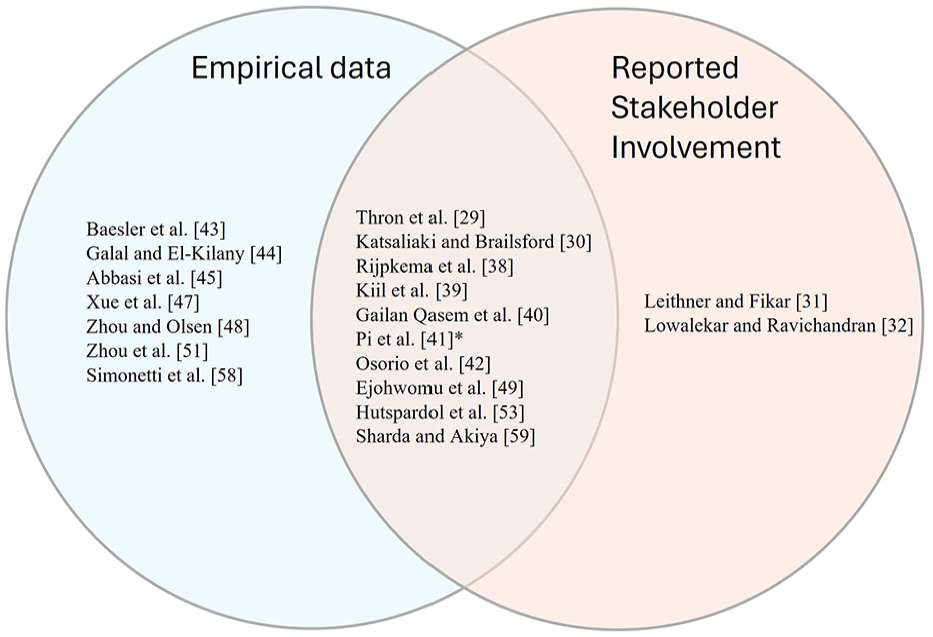
Studies that reported the use of empirical data and stakeholder engagement, including overlapping areas representing publications that reported both.
4.2. Model characteristics
4.2.1. Modeling methodology (including integrated approaches with DES)
DES was the only modeling methodology used in 17 of the 25 studies in our data set. Distinct from the conventional DES studies, several papers included integrated approaches to modeling. Simulation models employed in conjunction with other methods, such as optimization, could provide an enhanced environment for decision-making. Five studies presented integrated DES-optimization approaches37,41,44,43,45 and the study by Ejohwomu et al. 49 introduced a hybrid simulation using DES and ABS. In the study by Ejohwomu et al., 49 the DES element simulated the demand and supply of 24 different platelet types, ABS captured the dynamic representation of agent interactions within the blood supply chain. In addition, our review identified two studies using hybrid approaches combining DES with multi-criteria ranking techniques. In the study by Duong et al., 40 the complementary technique allowed the evaluation of KPIs, while in Zhou et al., 51 it facilitated the evaluation of different policies.
Upon examination of the study objectives, compiled alongside the model outputs in Table 5, several distinctive themes become apparent. First, several publications consider multiple policy options for inventory optimization and use DES to compare between them. Overall, 14 studies30,32,38,39,40,43,44,46,47,50–54 included aspects related to replenishment and order quantity. While the studies by Katsaliaki and Brailsford, 30 Gailan Qasem et al., 48 and Zhou et al. 51 all measure wastage, notably, only Gailan Qasem at al. 48 applied financial metrics to deterioration cost in the commercial setting of milk production. Although Gailan Qasem et al. 48 also incorporated order fulfillment as a model output, the remaining two studies, Katsaliaki and Brailsford 30 and Zhou et al., 51 also attempted to consider best serving the end user by using mismatched rates and a fairness index, respectively.
Modeling methodology (chronologically arranged).
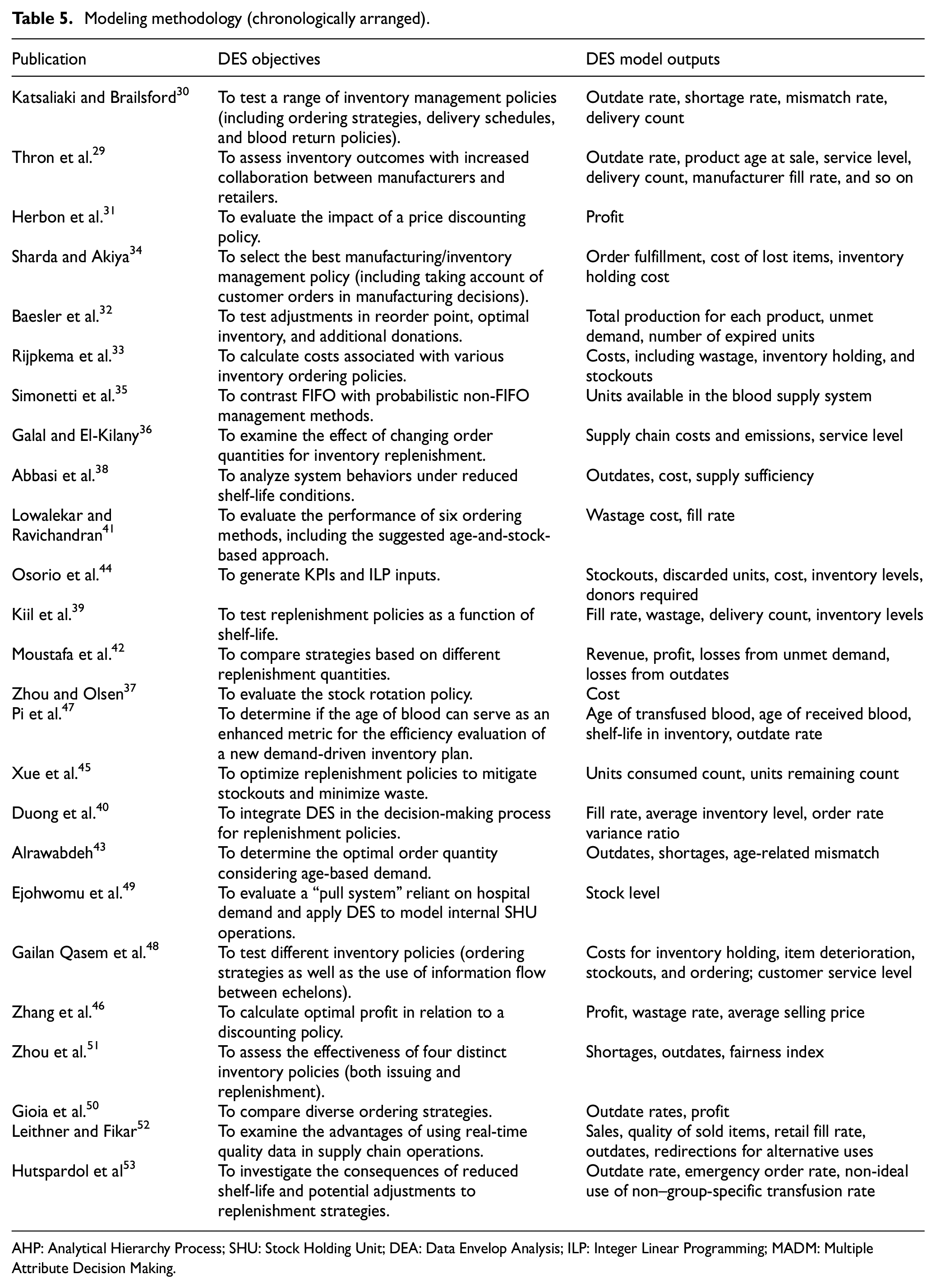
AHP: Analytical Hierarchy Process; SHU: Stock Holding Unit; DEA: Data Envelop Analysis; ILP: Integer Linear Programming; MADM: Multiple Attribute Decision Making.
Generally, when considering KPIs, unsurprisingly, the most commonly used KPIs relate to fill rates, inventory/product outdates, and finance (Table 5—column “DES Model Outputs”). One additional dimension is brought by Galal and El-Kilany, 36 who considered environmental sustainability aspects in their study of the supply chain of oranges, using DES to assess whether an order quantity can be determined, which reduces both emission levels and costs.
Another prominent theme centered around quality, shelf-life, and age-based metrics of products under investigation. Among these, Abbasi et al. 38 and Hutspardol et al., 53 given that some medical reports indicate an improvement in clinical outcomes for blood transfusion using more recently collected blood, investigated the effects of reduced shelf-life. Both studies assessed the system through the prism of outdates and incorporated outputs with the intent to capture the wider inventory system aspects; in the case of Abbasi et al., 38 this was the costs and supply sufficiency; for Hutspardol et al., 53 it was the rate of emergency orders and mismatches. Both concluded that a reduction in shelf-life would impact the system negatively. In addition, Pi et al., 47 apart from suggesting and testing a newly designed demand-driven inventory policy, also investigated whether the age of blood could serve as a good KPI to assess the blood supply chain efficiency.
Beyond these broad themes, six publications, notable for their unique characteristics, are described briefly. Zhou and Olsen 37 studied the benefits of stock rotation between regular hospital use and an emergency reserve. Their analysis considered factors such as handling costs, system uncertainties, and the medical supplies’ perishability. Ejohwomu et al. 49 investigate whether the introduction of a “pull-based” system between a stock holding unit and a hospital for blood platelets, based on hospital demand, would provide benefits relative to fixed stock-level targets; Herbon et al. 31 and Zhang et al. 46 study the effect of employing an age-based discounting policy to maximize profits in a retail environment. Thron et al. 29 examined the benefit of increased collaboration between manufacturers and retailers, and Leithner and Fikar 52 examined the advantages of using real-time quality data in supply chain operations.
4.2.2. Product variants and issuing policy
Once the perishable products surpass their expiry dates, they are unsuitable for consumption and must be discarded as waste. We analyzed the articles to identify the choice of issuing policy in the models (see Table 6). Given the shelf-life element of the products, the first-expires-first-out (FEFO) logic provides an optimal mechanism to minimize waste. Despite that, some inventory systems could purely rely on the simple FIFO approach, which coincides with FEFO logic in case items arrive in the inventory system in the same order as they were produced/harvested. This is particularly applicable in blood donations and direct inventory management (where product sourcing is “in-house”). Our analysis found four blood-related studies which defaulted to FIFO.38,41,44,49 This was also the case for a study which considered a health product, 40 for a study on reserve rotation, 37 and two studies related to food.36,42 However, it is essential to recognize that this approach might oversimplify the inventory management processes at different levels of the supply chain. For instance, in the blood supply chain, as mentioned above, there are scenarios where prioritizing fresher blood products is medically beneficial. 59 This might necessitate the introduction of a last-in-first-out (LIFO) issuing policy or a more nuanced approach. In the study by Zhou at al., 51 while modeling a single product, they added complexity to the model by incorporating different combinations of FIFO and LIFO. In another study on blood products, Katsaliaki and Brailsford 30 also integrated those two approaches, considering two different types of red blood cells (RBCs). In Simonetti et al., 35 a FIFO model, as well as two variants of non-FIFO models, is considered; the non-FIFO models include aspects of random selection, one being skewed toward “likely oldest” and the other toward “likely newest.”
Issuing Policy characteristics (arranged chronologically).
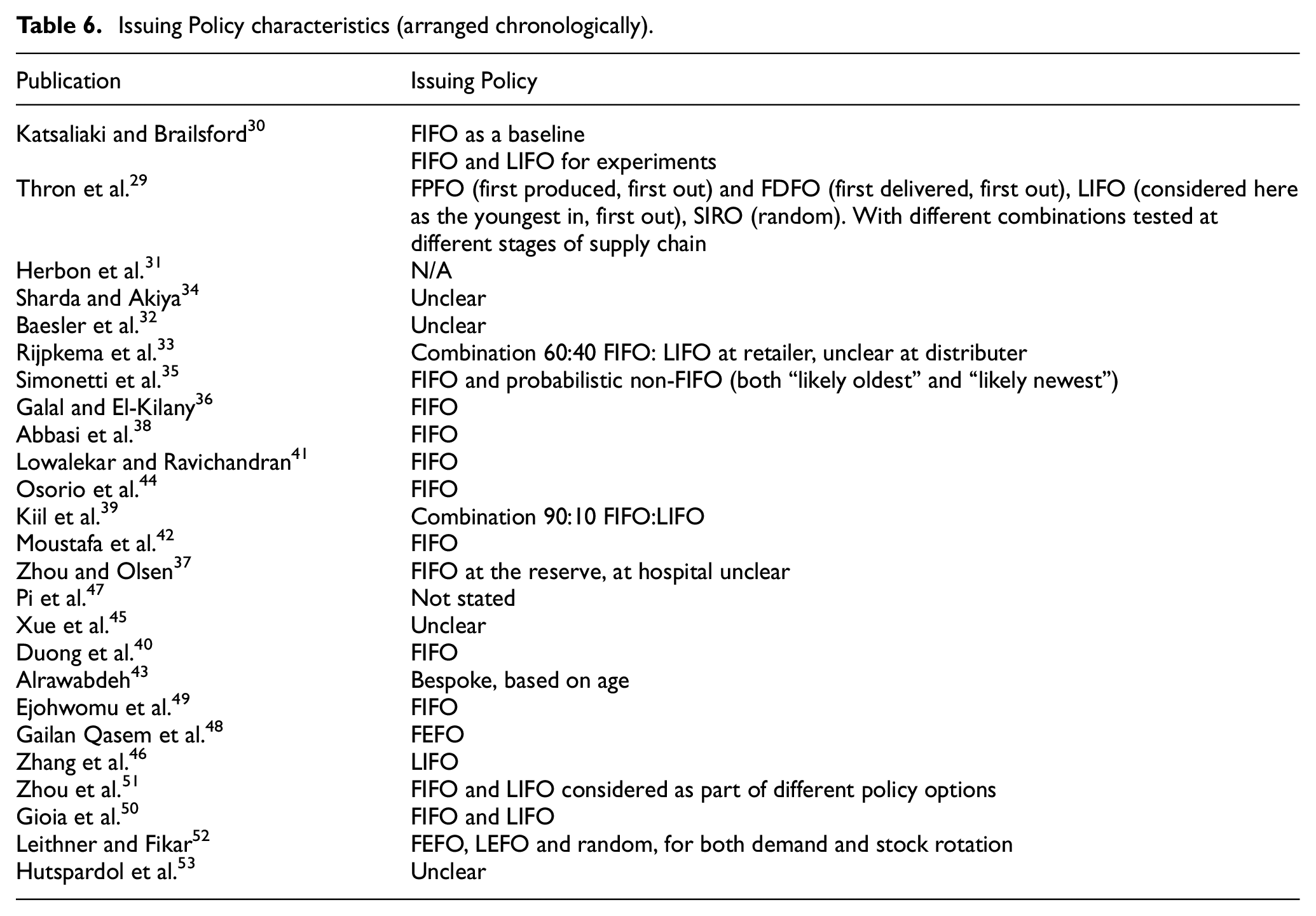
In the cases of highly perishable products such as milk 48 and strawberries,29,33 the fact that the time at which products are received might not directly align with the ordering of harvest is captured by explicitly applying the FEFO approach (at least as a subset of tested policies).
Moving on to the retailing paradigm, where products with different remaining shelf lives are commonly displayed, the issuing policy becomes harder to control and outcomes more difficult to predict. While in certain domains, a top-down issuing policy is feasible and maximizes control over waste, when the customer becomes a decision-maker, and often prefers items with a longer shelf-life, the logic will likely shift toward the last-expired-first-out strategy (LEFO). This, in turn, can negatively impact waste generated by the retailer, ultimately affecting the business’s profitability. To minimize this phenomenon, retailers often introduce discounts for products with shorter shelf lives; this was incorporated in the study by Gioia et al., 50 which combined FIFO and LIFO logics. Two further studies by Rijpkema et al. 33 and Kiil et al. 39 accounted for customer behavior when selecting products, again using mixed FIFO and LIFO models. However, only a deterministic approach of applying simple fractions of occurrence between the two issuing policies was used.
In addition, the study by Alrawabdeh 43 implemented a bespoke issuing model based on age. While most of the studies stated explicitly the issuing logic, there were also some which did not make that aspect apparent to the reader, which included studies by Pi et al., 47 Baesler et al., 32 and Sharda and Akiya. 34 Also, in the study by Rijpkema et al., 33 while the issuing logic is clear (FIFO and LIFO) at the retailer level, the logic employed at the distribution level is unclear. Similarly, in the research conducted by Zhou and Olsen, 37 the use of FIFO logic was evident in the reserve, yet the logic applied in the hospital remained unspecified.
Most of the studies either studied a single product31,33,36 or different products but displaying the same characteristics in terms of maximum shelf-life, e.g., Ejohwomu et al. 49 with 24 types of platelets; Abbasi et al., 38 Hutspardol et al., 53 Pi et al., 47 and Simonetti et al. 35 for blood types. On the contrary, the further two studies by Katsaliaki and Brailsford 30 and Alrawabdeh 43 each focused on single products but incorporated variations within those products. Specifically, Katsaliaki and Brailsford 30 explored the modeling of irradiated and non-irradiated RBCs, while Alrawabdeh 43 examined demand distributions based on the age of an unspecified product. In a separate study, Gioia et al. 50 extended their analysis to two vertically differentiated products. In addition to accounting for product age, they introduced a discounting mechanism to differentiate between these products.
4.2.3. Modeling uncertainty
Uncertainty is widely acknowledged as a key characteristic of supply chains. A major advantage of simulation modeling over mathematical modeling is its ability to capture uncertainty. We, therefore, assess the extent to which uncertainty is incorporated in the simulation models, including whether stochasticity is included in supply (for both volume and lead times), product shelf-life, and/or demand.
Uncertainty within inventory models has classically been considered as mostly demand-related, with studies considering the associated risk mitigation. Kumar et al. 60 acknowledged that supply uncertainty could stem from various sources, such as yield uncertainty, inconsistent product quality, or exogenous events, such as natural disasters or supplier insolvency. Supply chain disruption has been gaining increasing prominence, leading to an “explosion of research” in this area. 61 This trend, however, appears less pronounced when considering our sample. A majority of studies (16 out of 25) ignore supply yield uncertainty (Table 7). Of the nine studies modeling constrained supply, seven are related to blood and blood products30,32,35,38,44,47,51 and all rely on historical data, and all (with the possible exception of 47 ) fitting probability distributions to the historical data. Baesler et al. 32 allow a limited supply situation to be mitigated by making use of public calls for additional blood donations. The remaining two of the nine studies with constrained supply relate to food products.29,42
Uncertainty characteristics (arranged chronologically).
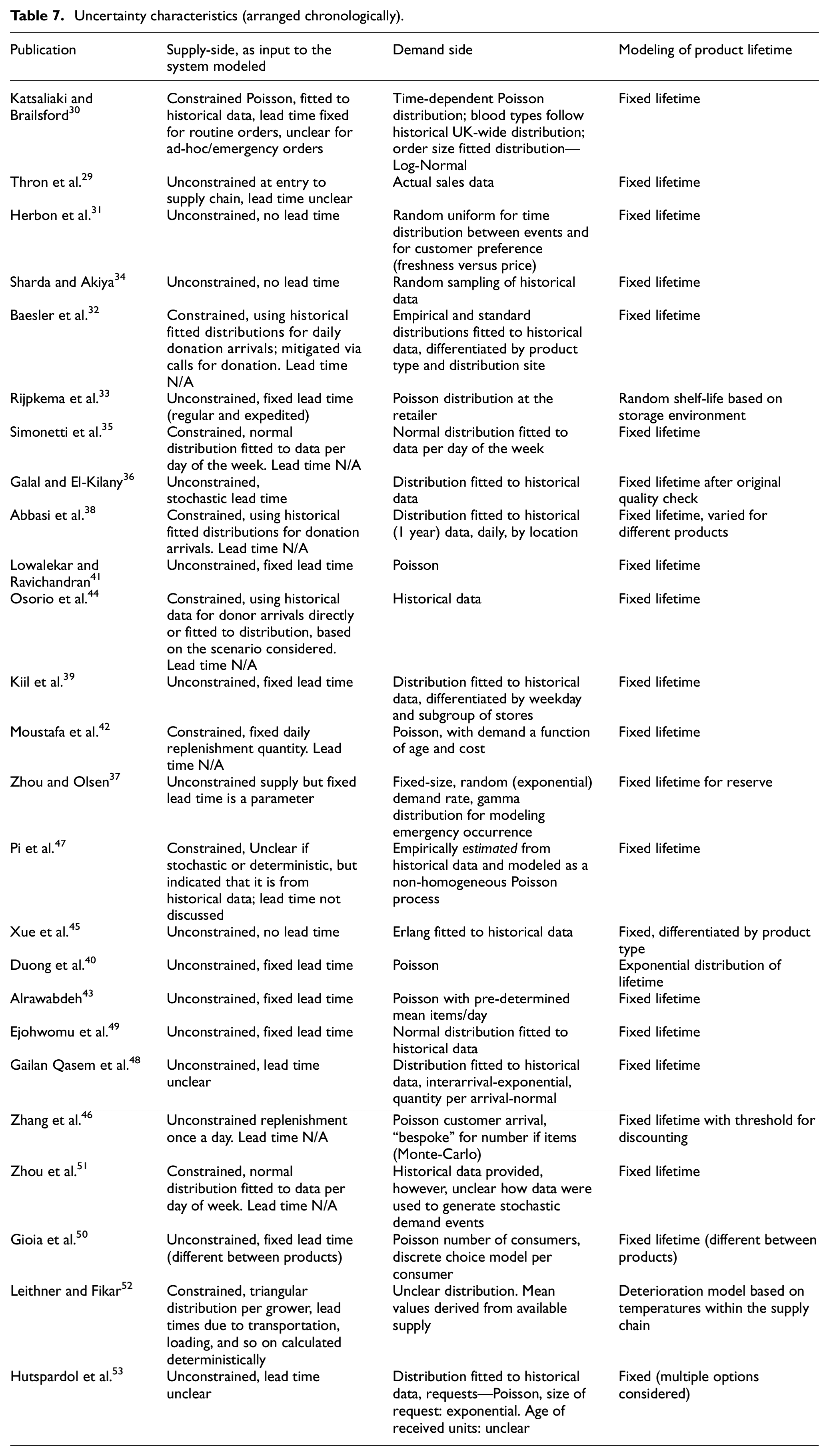
In addition, lead time-associated impact on supply and possible supply disruption has also been discussed by Fang and Shou, 62 who acknowledged that it is an important source of uncertainty. The lead time for many of our identified studies (12 out of 25) was fixed, in some cases at zero (Table 7). Included in the models with fixed lead times are Rijpkema et al., 33 who model two values of fixed lead times (corresponding to regular and expedited orders), and Zhou and Olsen, 37 for which the lead time is considered to be fixed, but the value of which is a parameter subject to investigation. Two studies model variable lead times: Galal and El-Kilany, 36 who model a stochastic lead time for an otherwise unconstrained supply, and Thron et al., 29 who have variable lead time but which is calculated deterministically based on distance traveled. For seven studies, the lead time is not applicable (marked N/A in the table) as supply is modeled as arrivals into the system, e.g., blood donations. For the remaining four studies, it remains unclear what assumptions were made regarding lead time.
With demand, uncertainty is widely assumed—within our sample, all the publications consider non-constant demand (Table 7), except possibly for Leithner and Fikar, 52 for which this aspect is unclear. Random demand models are considered in 20 out of the 25 publications, of which 1130,32,35,36,38,39,45,47,48,49,53 are based on fitting distributions to historical data. In contrast, studies by Sharda and Akiya, 34 Osorio et al., 44 and Thron et al. 29 all relied on historical data without distribution fitting, with Sharda and Akiya 34 applying a random sampling technique; and Osorio et al. 44 and Thron et al. 29 directly using historical data within the simulation model.
All articles in our sample assumed a fixed shelf-life for the perishable products, except for three studies.33,40,52 In the study by Duong et al., 40 the shelf-life of blood platelets is assumed to follow an exponential distribution upon arrival at a distribution center (despite platelets having a fixed shelf-life at the time of collection). Both Leithner and Fikar 52 and Rijpkema et al. 33 include case studies of strawberries with a random shelf-life determined by environmental factors related to storage conditions within the supply chain. With only two studies modeling factors that influence the lifetime of perishable products (i.e., the duration during which the product remains usable, safe, or effective before it expires), there would seem to be an opportunity to use DES to model non-deterministic product lifetimes better and understand the associated implications on supply chains.
4.2.4. Implementation and level of sharing
The assessment of the programming tool or language used for computer model development is present in the PPMO framework. 28 The decision to include this analysis was also partially influenced by STRESS guidance. 27 Beyond that, when viewed through the lens of the STRESS-DES test, we have also included considerations related to the visual representation of the model logic, as well as a binary assessment of code access—whether a reader can access the code.
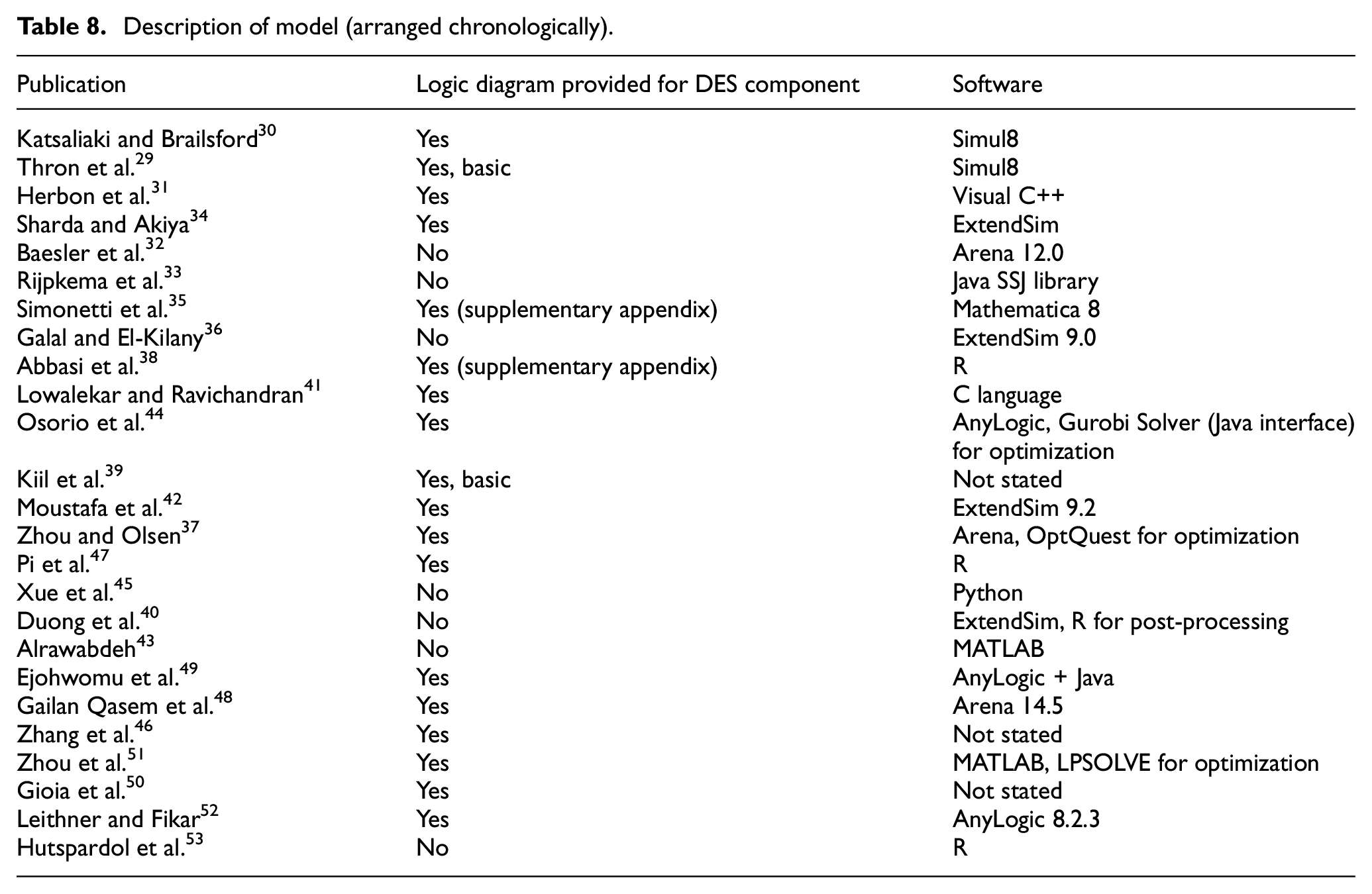
The software/language used to develop the DES model is stated in most of the studies (see Table 8). However, three studies39,46,50 omitted this information. The studies that did report the development environment of the model included a mix of commercial, off-the-shelf simulation (COTS) software, including those tailored to DES or broader simulation techniques. These software tools featured Simul8™ (n = 2), Arena™ (n = 3), ExtendSim™ (n = 4), and AnyLogic™ (n = 3). In addition, a single study used the COTS software Mathematica ®, which is predominantly aimed at mathematical and numerical modeling. Programming languages present in our analysis included C language (n = 1), C ++ (n = 1), Java (n = 1) and MATLAB ® (n = 2). Among the remaining studies, Free and Open-Source Software (FOSS) was used by three studies that developed R models and a single study using Python. Historically, studies predominantly reported using either COTS or programming languages, as shown in Figure 5, with some of these tools remaining present throughout the timeline of articles analyzed. In the late 2010s, there was a growing interest in developing computer models using FOSS; however, its adoption remains relatively limited. Interestingly, some of the most recent studies have omitted details about software used to develop their models (Table 8 for details), which contrasts with the increasing emphasis on transparency in research reporting. In addition, notably, within articles analyzed, none of the studies provided access to the model’s underlying code and only two studies41,43 included pseudocode for the optimization element of their integrated models, offering limited insight into the modeling process.
Description of model (arranged chronologically).
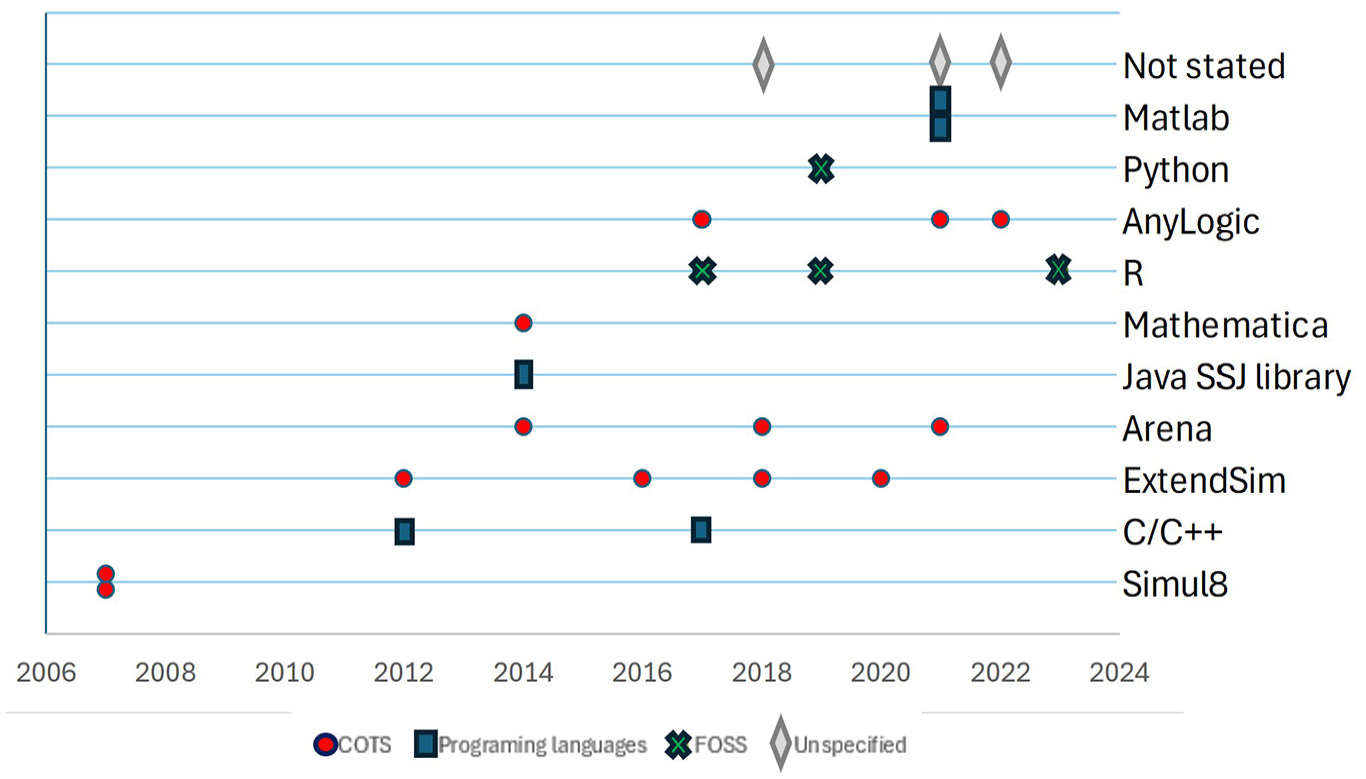
Timeline of employed software.
As recommended by STRESS, simulation studies should incorporate the use of visual diagrams, ideally adhering to recognized formats. This practice aims to enhance the detailed and descriptive communication of model designs elaborated within the STRESS framework. As assessing the ease of accessing information related to the model from textual descriptions can be highly subjective, we instead decided to examine visual aids in the form of appropriate diagrams. This approach is likely to be less affected by perception bias and provides a valuable test to apply to our sample.
Seven studies did not meet the standard for effectively sharing meaningful DES diagrams (see Figure 6 and Table 8 for specific studies). Among these, two studies lacked a logic model and/or did not include visual representations of DES and further five offered diagrams with no or very limited value in aiding the understanding of DES elements within the system modeled. Notably, two papers by Kiil et al. 39 and Thron et al. 29 used very simple visual depictions of their models. And even though both diagrams provided rather limited learning to the reader about their model, the diagram by Kiil et al. 39 was accompanied by a detailed description in the figure caption. In addition, the use of diagrams in the appendices, rather than in the main body, was present in two studies, by Abbasi et al. 38 and Simonetti et al. 35 Among the studies that shared a logic diagram, these have typically consisted of flowcharts or flow diagrams. However, none of the articles made use of formats recommended for software representation, which provide a greater depth of detail, such as IDEF or BPMN.
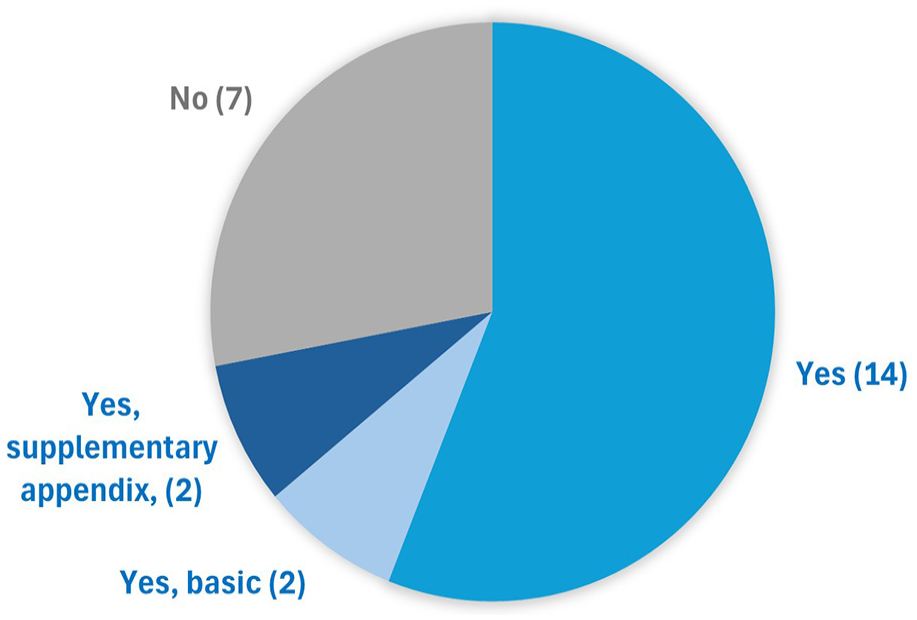
Frequency of diagrams used for visualization of DES model structure.
We also considered the reproducibility of the DES artifacts. For the studies that did not include sufficient details relating to the DES model and aspects of issuing logic or distributions of supply and demand, it is arguable that these models are not reproducible. However, for the remaining studies, we soon recognized that assessment of whether the studies are likely to be reproducible purely based on the description would likely introduce a high degree of subjectivity, and the undertaking of trying to rebuild the models and gain access to the required data sources would become a futile endeavor. As previously mentioned, we did, however, assess the provision of logic diagrams for the implemented models, as this is a more concrete aspect to evaluate.
4.3. Study outcome
Following the three-level scale implementation as defined in Brailsford et al., 8 we classified only a single study by Pi et al. 47 as “implemented.” The authors examined the impact of demand-driven inventory planning of RBCs through a case study of a large tertiary care hospital in British Columbia, Canada, where they successfully applied DES to optimize inventory levels. Through the data-driven strategy, the hospital achieved significant efficiency gains, including reduction of mean age of blood transfused, and reduction of O-negative blood type utilization. This case study highlights the real-world application of DES in healthcare, demonstrating its ability to improve decision-making in perishable inventory management. However, while Pi et al. 47 provide a clear example of DES-driven policy implementation, it remains unclear to what extent the initial modeling directly influenced the hospital’s decision to adopt a new inventory strategy. Further analysis of the decision-making process could provide deeper insight into practical challenges in translating simulation-based recommendations into operational realizations.
The remaining papers were assigned into the two remaining categories: “conceptualized,” denoting cases involving discussions with a client organization and “suggested,” which pertains to theoretical application. Among those, only two papers44,48 were classified as “conceptualized,” with all the remaining falling under the “suggested” category.
5. Discussion
Based on our research review, we identified certain areas that present opportunities for enhancing future studies, as well as areas offering exciting prospects for future research trajectories. Our findings are presented below, organized into key themes, with each section addressing different challenges and opportunities related to the use of DES in the management of perishable inventories, as identified in the literature.
5.1. The need to address the methodological gaps
Our analysis identifies opportunities for future research exploration within the realm of DES concerning perishable inventory. These opportunities focus on addressing methodological gaps that have been identified. Currently, limited attention to uncertainty on the supply-side is evident, with most studies assuming fixed lead times and supplier yields—an approach that is unrealistic in many situations, that might lead to overly simplifying the problem studies. We also notice that lifetime models are mostly fixed, with stochastic and/or variable lifetimes, for example, based on environmental factors within the supply chain, being under explored.
In addition, there is limited evidence for the use of hybrid simulation approaches, where a combination of different simulation techniques is used. This could be especially relevant in settings where there are possibly conflicting interests between perishable inventory management and demand characteristics. For example, in cases that customers would prefer to purchase the freshest items, rather than first to expire, which would represent the more optimal choice from the inventory management perspective. In such scenarios, ABS could be used to model customer behavior and preferences, while DES could capture inventory flows. Those areas clearly point to future opportunities that could lead to gaining a deeper understanding of the perishable inventory systems. By incorporating broader factors, such as variable lead times, stochastic supply conditions, and hybrid approaches, future studies should be better equipped to assess the effectiveness of management strategies under more realistic conditions.
5.2. The need for harmonization of the terminologies
The original PPMO framework study was on distributed approaches to supply chain simulation. 28 As such, a key variable identified in the framework was the number of supply chain echelons. However, despite the concept of multi-echelon supply chains, and the associated definitions thereof, having been present in the literature since the 1950s by Clark, 63 we noticed possible inconsistencies related to how the authors refer to the term “echelon.” Whereas Osorio et al. 44 indicate that four echelons are considered for their analysis when considering the blood supply chain, Abbasi et al. 38 considered a higher level when classifying what an echelon is, and describe the blood supply chain to be “a two-echelon inventory system of perishable items with ... the first echelon (the blood depot) and ... the second echelon (hospitals).” Initially, in our literature review, we intended to analyze the number of echelons used for DES modeling, as suggested in the Problem Definition and Context category of PPMO. However, we noted that the number of echelons stated by the authors in some cases related to the entire supply chain rather than the scope covered by DES model. In addition, there could be inconsistencies between what an echelon would be interpreted to be encompassing. For these reasons, it was considered that this would not lead to a like-for-like comparison, and we decided to omit the analysis of echelons from our review. Importantly, our observation is not new, as the problematic nature of the term “echelon” was noted as early as 1972 by Clark. 64 After Langenhoff and Zijm, 65 which draws from a notion presented by Clark, 64 let us consider a definition where echelon in a multi-echelon system gets defined by “echelon stock of a given installation as all stock at a given installation plus in transit to or on hand at any installation.” As this description points to the necessity of a supply chain stage to have an associated storage stage to be classified as an echelon, we are likely to arrive at the conclusion that the blood supply chain study by Osorio et al. 44 is more likely to be classified as a two-echelon system, unlike the author’s stated four-echelon system. This illustrates the lack of consensus within the literature. Clearly, multi-echelon supply chains represent an important study area; nevertheless, the inconsistency of how the term is used by researchers persists. Hence, we would recommend that authors at least specify how they define the term “echelon” and ideally converge toward a common definition over time.
5.3. The need to broaden the area of application
The initial concepts of DES were developed as early as the 1950s and were followed by what Robinson referred to as a “period of innovation” in the 1970s. 5 However, we observe the relatively limited breadth of perishable inventory application areas covered in the existing literature. In addition, we find that publications on DES for perishable inventories only began to appear in the 2000s. Despite the potential versatility of DES, its application has been heavily concentrated in areas such as inventory management of blood products, while leaving other crucial sectors, such as pharmaceutical perishable supplies, cosmetics and personal care, floral and horticultural, organs for transplantation, and so on, largely unexplored.
5.4. The need to enhance model description and sharing of modeling artifacts
In our literature review, we observed that the components of the DES model were often inadequately described, particularly concerning elements such as entities, activities, and resources. In most studies, only queues were discussed in greater depth. However, this finding is not entirely surprising, given that the organization of inventory processes and associated strategies for issuing inventory are of utmost importance within perishable inventory systems. Beyond that, and possibly with the exception of the study by Katsaliaki and Brailsford, 30 who describe entities at a greater depth, we found there is a significant scope for improvement in how future DES modeling studies describe these key elements. In addition, when considering how understandable a model is, we assessed the provision of logic diagrams (flow charts, state diagrams, etc.) for the implemented models, as well as code availability, as we believe that the act of sharing the diagrams and modeling artifacts would greatly facilitate understanding of the models. Furthermore, these arguably represent more concrete aspects to evaluate, relative to more subjective evaluations of the textual descriptions of models. As evidenced in our set of underlying papers for this review, neither aforementioned feature received sufficient attention, particularly the aspect of code availability, which was not evident for any article that was part of the literature review. Our analyses point to the need for more detailed descriptions of model elements and the increased use of visual representations to help better grasp and evaluate the reported findings.
5.5. The need for improved implementation of the results of a simulation study and closer stakeholder engagement
While the low rate of implementation of OR projects, including simulation studies, has been widely reported, particularly in the healthcare field,66,67 Lagergren 68 indicates that the rate of implementation of M&S studies in health services has improved considerably in the 90s. However, this improved trend does not seem to translate to simulation studies as reported in more recent larger-scale surveys of simulation modeling in healthcare undertaken by Brailsford et al., 8 Katsaliaki and Mustafee, 9 and in a review of hybrid simulation by Brailsford et al. 69 This is also the case for studies included in this review, where implementation is rarely reported, leaving the reasons largely unexplained.
Among the early explanations for this low implementation, as suggested by Tunnicliffe Wilson, are factors such as empirical data availability and stakeholder engagement. 67 In our review, out of 17 studies that used empirical data, 10 also reported stakeholder involvement, yet only a single study by Pi et al. 47 reported implementation (see Figure 4). Yet another reason for low implementation could be, “where the need for change is not accepted as urgent by the decision-makers.” 67 The sense of urgency is difficult to assess and thus could still contribute toward low implementation rates, despite reported stakeholder involvement in some of the studies analyzed.
In addition, for the remaining seven studies (left side of Figure 4), with a real nature of problem/empirical data, but falling outside of the overlapping area (so without stakeholder involvement), a disconnect is apparent. This raises questions about the depth of collaboration in these studies, suggesting that empirical data may have been accessed independently of direct stakeholder involvement. It is possible that some studies utilized secondary data, such as publicly available datasets from organizations like (in the case of the United Kingdom) National Health Service (NHS) Trusts, Office for National Statistics, or similar sources, where data access may be open. A deeper investigation—such as examining whether at least one author was affiliated with the relevant institution, outside academia, could provide more insights into how data access was obtained and whether stakeholder engagement perhaps occurred informally or was simply underreported. Furthermore, this type of involvement was reported to enhance the chances of implementation success. 67
As Brailsford et al. 8 suggest, the fast-paced academic culture of “publish or perish” is likely to be a contributing factor, as it does not incentivize the longer timescales required to witness the implementation of the simulation studies.
To improve implementation, M&S studies should focus on engagement with decision-makers from the early onset of the project to ensure alignment of the model’s goals and organizational priorities. In addition, more attention to the applicability of studies and their value beyond academic focus (e.g., research impact is increasingly gaining prominence in research and educational institutions) could facilitate the transition toward reporting of longer-term studies. By developing the models with actionable outcomes and involving key stakeholders throughout the process, the gap between simulation studies and practical implementation can be narrowed.
6. Conclusion
As expired products, such as foods and medical supplies, are likely to become unsafe, and hence require discarding, the need to study the perishable inventory is far from trivial. The potential of DES to enhance our understanding of systems involving perishable goods is considerable, especially since minimizing waste is a central challenge in managing inventory defined by shelf-life constraints. DES, both as a standalone tool, and when combined with other OR/MS methods, offers a mechanism for enhancing decision-making and improving process efficiency.
This paper presents a review of DES for the management of perishable inventory. Articles were identified using the WoS, Scopus, and IEEE Xplore databases of scholarly articles, followed by screening and eligibility assessments, as described using a modified PRISMA flow chart (Figure 2), resulting in an underlying dataset for the review of 25 papers. The literature synthesis is presented using the PPMO framework, 28 which provided us with a structured approach to evaluate research profiling, problem definition and context, model development and implementation, and study outcome. We extended the PPMO framework to include additional aspects relevant for the study of perishable inventory systems, such as modeling uncertainty.
As a result of our review, we identified five research gaps: limited integration of uncertainty and underrepresentation of hybrid approaches; the use of inconsistent terminology; a narrow focus on application areas; insufficient detail in the description of modeling artifacts (such as the logic model) and sharing of DES models; and continued need for improved implementation, closer stakeholder engagement and more comprehensive reporting with detailed descriptions in simulation studies. Together, these gaps highlight key opportunities for methodological advances, enhanced transparency, applicability, and impact within the field of studies.
By investing research efforts into optimizing perishable inventory systems through a mix of OR/MS methods, including DES, future studies can contribute to advancing global sustainable objectives, with the most evident candidates being the Zero Hunger Sustainable Development Goal (SDG) 2, Good Health and Well-being SDG 3, and Responsible Consumption and Production SDG 12. However, while the potential is clear, our literature review revealed a gap in translating and applying research findings to real-world settings. In our data set for the literature review, only a single study reported an actual implementation, echoing past criticisms regarding the return on investment in simulation studies 70 and the broader issue of academic research not being sufficiently integrated with practical, real-life applications. We believe that the issues highlighted can serve as valuable insights for improving future studies. By addressing the aforementioned gaps, future studies can focus on ensuring greater applicability and relevance of DES models related to perishable inventory in real-world settings.
While a strength of our review lies in the fact that our methodological review of the literature allowed for an in-depth assessment and reporting of the key variables in the articles, we also acknowledge the decision not to expand the search into other databases, which could have yielded further articles, constitutes a limitation of our review. Another limitation in our current approach is our sole focus on DES, as we recognize that other simulation methods, such as ABS, also rely on discrete time. However, it is important to note that research utilizing the ABS methodology, with its ability to capture a granular representation of individual agents within the system, could provide valuable insights to understanding aspects related to decentralized decision-making and agent interactions, therefore providing a distinctly different modeling paradigm. On the contrary, System Dynamics (SD) captures a high-level, system-wide perspective, making it particularly useful for understanding long-term trends and feedback mechanisms within the supply chains. SD is better suited for analyzing aggregate efficiencies realized across the supply chain, rather than evaluating individual policy changes at the organizational level that influence day-to-day operations. While these alternative methodologies present promising trajectories for exploration of the current state of the art in research of perishable inventory management systems, due to the depths and comprehensiveness of this review, further incorporation of alternative methodologies extends beyond the scope and pragmatic feasibility of this review. Broadening the focus risks compromising depth and coherence, potentially leading to a more superficial final product. Therefore, future work may consider dedicated studies that integrate multiple simulation paradigms to deepen the understanding of simulation strategies employed in perishable inventory research.
In conclusion, DES for inventory management of perishable goods presents an exciting research opportunity with multiple avenues of exploration. Such research will allow for an improved understanding of system behavior, especially in areas related to uncertainty and perishability, with consequent implications on sustainability and resilience, both key considerations in the modern world. The authors are currently using DES to study the human donor milk system and associated perishable inventories in milk banks, including aspects related to the identified research gaps.
Footnotes
Funding
This work was supported by the ESRC under a scholarship awarded by the South-West Doctoral Training Partnership (ES/P000630/1).
Ethical considerations
Ethical approval was not required.
Consent to participate
Not applicable.
Consent for publication
Not applicable.
Data Access Statement
This study did not generate any new data.
