



Abstract
Nonanimal biomedical research methods have advanced rapidly over the last decade making them the first-choice model for many researchers due to improved translatability and avoidance of ethical concerns. Yet confidence in novel nonanimal methods is still being established and they remain a small portion of nonclinical biomedical research, which can lead peer reviewers to evaluate animal-free studies or grant proposals in a biased manner. This “animal methods bias” is the preference for animal-based research methods where they are not necessary or where nonanimal-based methods are suitable. It affects the fair consideration of animal-free biomedical research, hampering the uptake and dissemination of these approaches by putting pressure on researchers to conduct animal experiments and potentially perpetuating the use of poorly translatable model systems. An international team of researchers and advocates called the Coalition to Illuminate and Address Animal Methods Bias (COLAAB) aims to provide concrete evidence of the existence and consequences of this bias and to develop and implement solutions towards overcoming it. The COLAAB recently developed the first of several mitigation tools: the Author Guide for Addressing Animal Methods Bias in Publishing, which is described herein along with broader implications and future directions of this work.
An international team of researchers and advocates called the Coalition to Illuminate and Address Animal Methods Bias (COLAAB) has recently developed the first of several animal methods bias mitigation tools, the Author Guide for Addressing Animal Methods Bias in Publishing. 1 Animal methods bias is the preference for animal-based research methods where they are not necessary or where nonanimal-based methods are suitable, which affects the fair assessment of animal-free research. 2 The COLAAB aims to provide concrete evidence of the existence and consequences of animal methods bias and to develop and implement solutions for overcoming it. Although many potential solutions fall on major biomedical power players like lawmakers, federal agencies, and the biotech industry, 3 individual scientists can play an important role in preventing and addressing animal methods bias. The Author Guide is a tool that life scientists and biomedical researchers employing nonanimal, human-specific, in vitro, or in silico methods can use to ensure the fair dissemination of their work and prevent unnecessary experiments on animals.
Nonanimal experimental models like microphysiological systems, also sometimes termed novel alternative methods or new approach methods, have advanced rapidly over the last decade making them the first-choice model for many biomedical researchers for a variety of reasons. They can reliably mimic human biology and predict clinically relevant responses to treatments, facilitating the translation of preclinical findings into safe and effective treatments.4–6 Accordingly, there is increasing recognition among government, academic, and industry scientists that nonanimal methods have the potential to overcome some of the scientific limitations of animal-based methods.7–9 They also avoid the ethical and emotional burden of experimenting on animals. 10 Despite these advantages, confidence in novel nonanimal methods is still being established 11 and they remain a small portion of nonclinical biomedical research. 12 Peer reviewers may thus evaluate animal-free studies or grant proposals in a biased manner by expecting or requesting animal experiments when more translatable nonanimal methods are suitable or by simply lacking the expertise to adequately evaluate these relatively new methods.
Broader peer review biases are widely acknowledged and constitute an entire field of meta-research. 13 The pressure that researchers face to obtain funding and publish their work can incentivize them to capitulate to unjustified reviewer expectations or requests. Indeed, we found that when confronted with reviewer requests to add animal experiments to a study that was otherwise animal-free, some researchers complied with requests despite deeming them unjustified. 2 In many cases though, researchers refused to comply with such requests, which can cause delays in publication or sometimes even rejection. Anecdotally, refusal to comply with reviewer requests for animal experiments may also cost some researchers publication in higher impact journals.
More empirical evidence of animal methods bias is needed beyond these preliminary and anecdotal findings. The prevalence of reviewer requests for animal experiments in otherwise nonanimal studies is not yet known, and more (especially nonself-reported) evidence is needed to show whether papers without animal experiments are more likely to be rejected or subjected to a longer review process. The relationship of animal methods bias experiences with researcher demographic characteristics, journal impact factor, and area of research (i.e., toxicology, neuroscience, etc.) will also be crucial for further understanding this phenomenon. The COLAAB is currently conducting a follow-up survey study aimed at calculating the prevalence of reviewer requests, as well as an analysis of publications characterizing the relationship between animal use, impact factor, and area of research. We encourage other meta-researchers to investigate these and other aspects of animal methods bias.
Whereas the more established phenomenon of publication bias is characterized as “when the likelihood of a study being published is affected by the findings of the study,” 14 we can characterize animal methods bias in publishing as when the likelihood of a study being published is affected by the methods of the study—animal versus nonanimal methods. We suspect that animal methods bias can affect any number of scenarios in which biomedical research projects and initiatives are subjectively assessed; not just manuscript review but also grant review, hiring and tenure decisions, and possibly even the determination of agency funding priorities and opportunities. This issue is not limited to individual research assessments—there is a much broader context here related to the systemic resistance to the reduction and replacement of animals in biomedical research. Scientific inertia—a certain degree of conservatism in scientific practice—may play a role in this resistance.2,15 Financial incentives certainly do: the U.S. animal model industry is growing and forecasted to surpass $1.48 billion by 2033. 16
A researcher's choice of model should be evaluated objectively, free from a reviewer's personal methodological preferences or lack of awareness. Frameworks for evaluating nonanimal methods for toxicological assessments highlight potentially useful reviewer criteria, like the need for methods to be fit for purpose, reliable, and relevant to human biology.11,17 It is perfectly reasonable for a reviewer to suggest additional experiments to provide validation or additional lines of evidence; but if a reviewer suggests scientifically unjustified animal experiments (such as in lieu of one of the many nonanimal experiments highlighted by Ingber in his 2020, “Is it Time for Reviewer 3 to Request Human Organ Chip Experiments Instead of Animal Validation Studies” 18 ), researchers may comply due to publish-or-perish pressure and ethics approvals may be expedited or rubber stamped, 19 potentially culminating in the conduct of unnecessary animal experiments.
By impacting the fair assessment of animal-free methods, animal methods bias can therefore be a barrier to the dissemination and uptake of these methods that hold great promise for improving biomedical translation. In turn, it can pad the scientific record with potentially poorly translatable animal research, although more evidence of the translational value of animal- and nonanimal-based methods is needed (e.g., through systematic reviews or performance assessments).5,20–23 It also has serious implications for the progress of researchers’ careers and for animal research ethics considerations.
The Author Guide contains many useful resources and recommendations to help researchers using nonanimal methods avoid biased assessments of their manuscripts and empower them to push back against unnecessary experiments on animals (Table 1). Currently formatted as a resource article, the Author Guide will soon be available online at animalmethodsbias.org where it will continue to be updated as nonanimal experimental approaches advance and as the COLAAB further explores this important issue. Researchers and advocates with suggested additions or amendments to the Author Guide are encouraged to contact the corresponding author.
A summary of the resources and recommendations provided in the Author Guide for Addressing Animal Methods Bias in Publishing.
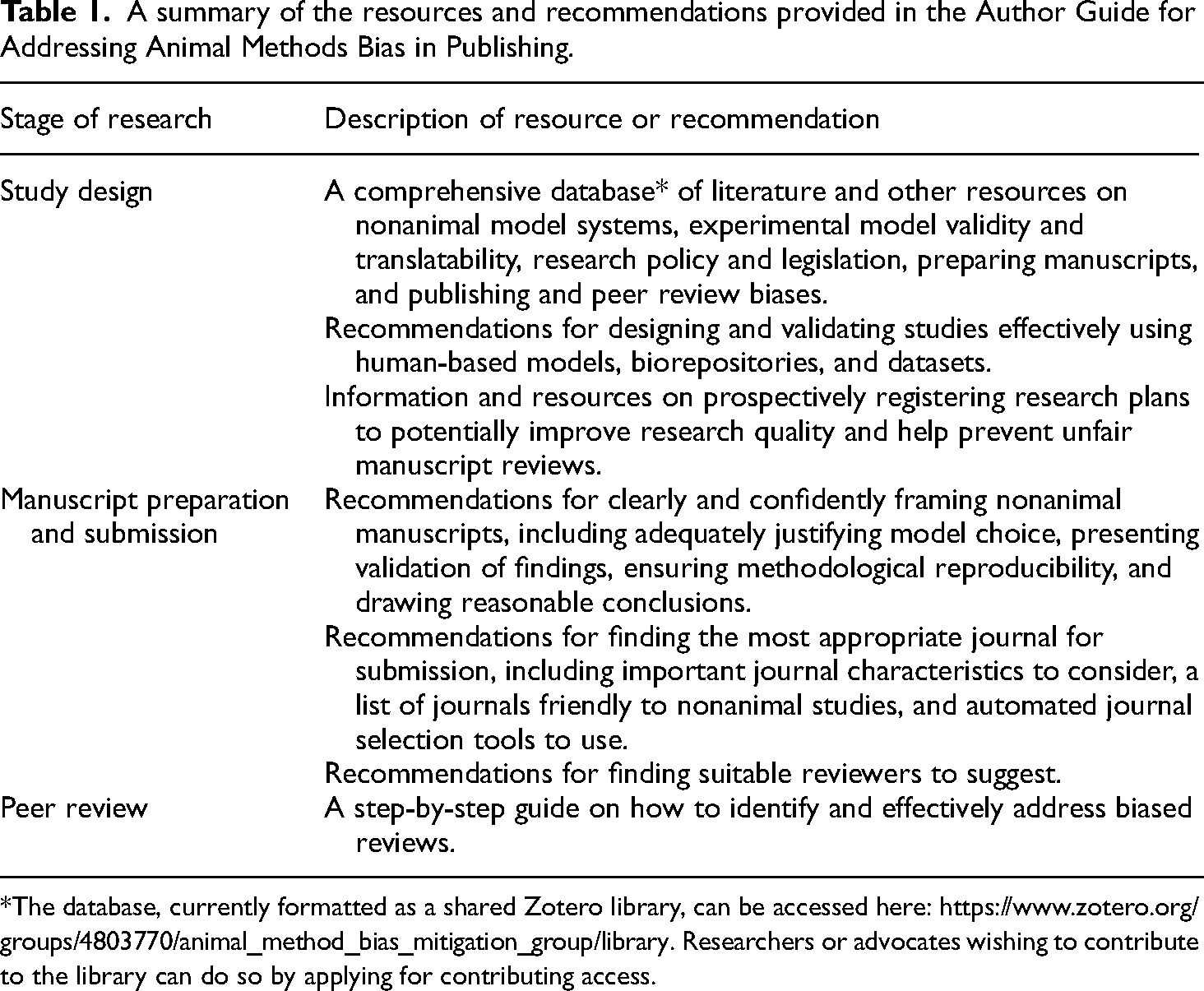
The database, currently formatted as a shared Zotero library, can be accessed here: https://www.zotero.org/groups/4803770/animal_method_bias_mitigation_group/library. Researchers or advocates wishing to contribute to the library can do so by applying for contributing access.
Many solutions for mitigating animal methods bias in publishing are beyond the scope of individual researchers. Publishers may need to implement journal policy or practice changes to ensure that animal-free studies get a fair shake, such as the following. Removing explicit requirements for in vivo validation experiments in journal author guidelines would allow researchers to choose appropriate validation methods themselves, including advanced 3D in vitro models like organ chips.24,25 Open peer review may improve research and review quality, but whether it can mitigate or even introduce biases remains to be definitively determined. 26 Bias mitigation training may help editors and reviewers identify their own unconscious biases against particular methodologies and prevent biased assessments. Amended reviewer guidelines incorporating best practices for evaluating animal-free studies (such as the PRIVAT tool 27 ) may be similarly effective. Lastly, offering registered report article types and requiring authors to follow experimental reporting standards can ensure rigor and transparency and help establish confidence in nonanimal experimental approaches. Future aims of the COLAAB may include working with publishing stakeholders to explore the evidence-based efficacy or these or other potential solutions and to implement the most promising and practical changes.
Publishing is certainly not the only area of research where animal methods bias manifests. In 2024, the COLAAB will prioritize exploring the ways that animal methods bias impacts funding decisions. We urge publishers and funders to invest in gathering evidence of animal methods bias and of the effectiveness of various mitigation measures. Pressure within the scientific community will need to build to move major stakeholders from their status quo positions. These and other mechanisms of change are crucial for reducing barriers to the uptake and dissemination of ethical and translatable animal-free research.
Conclusion
Animal methods bias is a potentially formidable barrier to the broader use of nonanimal research approaches, including those like organ chips, which hold great promise to advance our understanding of human biology, health, and disease, improve biomedical translation, and reduce and replace the use of animals. The Author Guide for Addressing Animal Methods Bias in Publishing 1 may be a useful tool for researchers conducting and publishing nonanimal studies to help establish confidence in these novel methodologies and prevent or address biased assessments. The COLAAB is gathering more evidence of animal methods bias and more deeply characterizing its relationship with researcher demographics, journal impact factors, and research fields. We are also exploring other scenarios where animal methods bias may manifest, such as the evaluation of grant proposals, and other potentially effective mitigation strategies, such as working with publishers to change journal policies or practices. Lastly, we make a call to action to other biomedical stakeholders, especially publishers, funders, and meta-researchers, to explore this issue independently.
Footnotes
Acknowledgments
Thank you to COLAAB members Celean Camp, Shaarika Sarasija, and Emily Trunnell, as well as Elizabeth Baker and peer reviewers for their thoughtful feedback on this manuscript.
Declaration of conflicting interests
The authors declared no potential conflicts of interest with respect to the research, authorship, and/or publication of this article.
Funding
The authors disclosed receipt of the following financial support for the research, authorship, and/or publication of this article: This research is supported in part by Lush Handmade Cosmetics Ltd.

Author biographies
Owen Kavanagh is a Senior Lecturer in Biomedical Science at York St John University and a founding member of the Coalition to Illuminate and Address Animal Methods Bias. He has published over 30 immunology-based papers in biomedical research and serves on the Editorial board for the British Journal of Biomedical Science.
Catharine E. Krebs is a medical research program manager at the Physicians Committee for Responsible Medicine and lead coordinator of the Coalition to Illuminate and Address Animal Methods Bias. She is a Fellow of the Oxford Centre for Animal Ethics and has co-authored 15 peer-reviewed publications, including 8 as first author.