



Abstract
In order to improve the drilling performance of polycrystalline diamond compact bit and prolong its service life during drilling in coal rock under the action of wind cycle, the theoretical calculation model of polycrystalline diamond compact bit cutting teeth temperature was derived based on the theory of tribology and heat transfer. The theoretical temperature field of polycrystalline diamond compact bit-cutting teeth was analyzed. Using the joint simulation of EDEM–FLUENT, the temperature variation law of polycrystalline diamond compact bit cutting teeth under the thermo-fluid–solid coupling was analyzed to verify the validity of the theoretical calculation model of polycrystalline diamond compact bit cutting teeth temperature. By building a rotary drilling test platform and conducting drilling experiments on polycrystalline diamond compact bit under different drilling parameters respectively, the correctness of the theoretical model and the simulation data were verified. In addition, a response surface analysis model was established to study the influence of different drilling parameters on the polycrystalline diamond compact bit cutting teeth temperature during drilling in coal rock. The analysis results show that the influence degree of various drilling parameters on the polycrystalline diamond compact bit cutting teeth temperature from large to small is drilling pressure, drilling speed, coal rock properties, and wind speed. Compared with the working condition without wind cycle, the drilling efficiency of polycrystalline diamond compact bit can be increased by 14.38% and the temperature is reduced by 8% when it drills in coal. The drilling efficiency of polycrystalline diamond compact bit can be increased by 17.79% and the temperature is reduced by 10.5% when it drills in coal gangue.
Keywords
Introduction
Polycrystalline diamond compact (PDC) is a special super-hard material synthesized by artificial diamond and cemented carbide in one-time synthesis under high-temperature conditions, 1 which not only has the advantages of high hardness and wear resistance of diamond, but also has the characteristics of strong impact resistance and large blade emergence. Using it as the bit cutting teeth can improve the drilling efficiency. 2 Nowadays, PDC bits are widely used in coalfield drilling and mining, petroleum drilling, geological exploration, and other industries.3–5 In order to determine the effect of tilt angle on the frictional force on the cutting surface of a single cutting tooth within a certain depth of cut, Rostamsowlat conducted cutting experiments on two different rock samples by using state-of-the-art rock cutting equipment and a unique tool holder and concluded that the normal contact stress on the contact surface between the cutting surface and the rock depends on the depth of cut, but in the region of elastic contact, the contact stress changes as the depth of cut increases. 6 Zhou et al. 7 considered the wear process of circular tools and derived a simple model for the relationship between depth of cut and mechanical specific energy, and found that the wear of cutting teeth usually leads to lower efficiency, increased mechanical specific energy, or lower drilling speed. Li et al. 8 used ABAQUS software to establish a numerical model of single tooth-rock interaction of PDC bit, the cohesive force and compressive stress of rock material are alternately distributed in the damage area, and the highest rock breaking efficiency is obtained when the impact conditions are the same and the axial impact frequency is 1/2 of the torsional impact frequency; if the impact frequency is too small, the rock cannot be broken effectively and the drilling process will occur viscous slip vibration.
The tool wear rate is highly influenced by the temperature distribution.9,10 In bit drilling, Han et al. 11 established a mathematical model of bit-cutting force based on the principle of coal rock cutting and conducted drilling experiments under different drilling conditions. The results showed that the rotational speed was inversely proportional to the feed resistance. The drilling torque and feed resistance were the lowest when the coal rock surrounding pressure was 7 MPa. 12 At the same time, the drilling temperature has been studied.13,14
More than 70% of PDC drill failures are caused by damage to the PDC cutting teeth, mainly in the appearance of wear and fracture of the cutting teeth. Glowka et al.15,16 developed a model to predict the average wear temperature of the PDC bit by simulating the working conditions of the PDC bit under steady-state as well as transient operating conditions and concluded that the wear rate of the PDC bit will increase significantly when the drilling temperature is higher than 350 °C. What's more, a numerical analysis model was established for predicting the temperature of the PDC bit under drilling with fluid flow. Appl et al. 17 used thermocouples to measure the temperature of water and air jet-assisted cooling tools cutting the granite separately. A tool wear model was established, and to the conclusion was drawn that as the tool temperature increases, the tool wear rate gradually increases and the tool will be born out quickly when the critical temperature (700 °C) is reached. Li et al. 18 established a temperature field model and a thermal stress calculation model for water jet-assisted rock drilling in combination with the boundary conditions such as heat flow density and interface temperature, and concluded that thermal stress was the main reason for tool failure and that thermal stress was related to parameters such as tool and rock material properties, geometric dimensions, cutting parameters and jet pressure. Gao et al. 19 established a temperature calculation model in order to study the influence of parameters and rock type on the temperature of the bit in drilling. The temperature of PDC cutting teeth under different parameter combinations was qualitatively analyzed with temperature tests, the experimental results were obtained to be in good agreement with the simulation results, in which the drilling speed would increase the temperature of cutting teeth. Under the same working parameters, the cutting teeth temperature is highly correlated with the type of rock drilled and the value of drilling speed. Yang et al. 20 established an equation of temperature variation during the drilling process of a drill bit into rocks and concluded that the drilling temperature of the bit is affected by geometric conditions, thermo-physical properties, and drilling parameters. The average temperature of bit is positively proportional to the square of bit feed speed. Li et al. 21 established a temperature field model and a thermal stress calculation model for water jet-assisted rock drilling in combination with the boundary conditions such as heat flow density and interface temperature, and concluded that thermal stress was the main reason for tool failure and that thermal stress was related to parameters such as tool and rock material properties, geometric dimensions, cutting parameters and jet pressure. Li et al. 22 simulated the temperature field of PDC bit cutting teeth during the cutting process based on the finite element analysis software and discussed the temperature distribution of cutting teeth during the cutting process to provide an effective basis for the future design of PDC bits. Zhang et al. 23 used the finite element method to simulate the temperature field of the PDC bit during rock breaking by thermo-solid coupling, and concluded that the main failure part of the cutting teeth was concentrated on the top of the crown of the cutting teeth; and the temperature of the cutting teeth of granite was found to be about two times that of marble and three times that of sandstone under the verification of experiments. Beaton et al. 24 proposed a new technique that can eliminate bit wear and improve the drilling ability as well as the drilling life when compared with the wear of conventional bits. Karasawa et al. 25 proposed a calculation model for estimating cutting teeth wear, conducted room experiments using different types of bits, and proposed a method for measuring wear on cutting teeth surfaces based on the experimental results. Based on this, Karasawa et al. 26 conducted drilling experiments using three bits on various types of rock samples and found that the wear of each bit was torque-dependent. Kazi et al. 27 used two different methods to estimate the cutting-specific energy, and the results of the study found that the higher the rock strength, the greater the wear of the PDC bit, the drilling efficiency will be reduced, the drilling cycle will be prolonged, and the drilling cost will increase. 28
In recent years, driven by computing power, response surface analysis has been widely used in various industries at home and abroad.29–32 Liu et al. used the discrete element method to study the wear behavior of auger bit picks and conducted the response surface analysis on ribbed picks. 33 Zhang proposed a method that combined the numerical computational model with the response surface method. This method can optimize the model of blade-type forgings and construct the strain and temperature functions that characterize each part of the blade. So, the optimal shape of the forging blank can be determined to obtain satisfactory forming results. 34
If the thermal stress exceeds the allowable strength of the bit material, the bit deformation, wear, and failure will occur, which not only affects the drilling efficiency, but also greatly affects the lifetime of the bit. Researchers at home and abroad have conducted in-depth research on the temperature of the drill bits during operation and the methods to reduce the bit temperature. However, few people have participated in the calculation of the temperature of bit-cutting teeth using the discrete element method. Previous research has not considered the effect of the wind cycle on bit temperature. In this article, a temperature calculation model of PDC bit based on wind cycle is established based on wind cycle, which not only improves the calculation model of PDC bit drilling temperature, but also improves the prediction accuracy of PDC bit drilling temperature. Based on the research of the bit temperature field, this paper will further analyze the temperature rise mechanism of PDC bit during drilling under wind circulation, and use the response surface analysis method to study and predict the relationship between factors such as drilling speed, drilling pressure, wind speed coal rock properties and the cutting teeth temperature during working.
Temperature model of PDC bit cutting teeth
During the drilling process of PDC bit in coal rock, the bit-cutting teeth are easy to be damaged, which will determine the working efficiency of the bit. The tri-wing PDC bit is mainly composed of the bit body, composite cutting teeth, air hole, chip removal groove, and diameter maintaining bar which is shown in Figure 1. The diameter and thickness of composite cutting teeth are 13.4 and 3 mm, respectively. The thickness of polycrystalline diamond is 0.5 mm. The outer diameter of the bit body is 72 mm and the inner hole diameter is 62 mm.

Structure of polycrystalline diamond compact (PDC) bit.
The cutting heat of the PDC bit when drilling in coal rock mainly comes from the friction between the bit and the coal rock in the deformation zones during drilling. As shown in Figure 2, the heat generation zones are mainly in the three cutting deformation zones near the cutting teeth which are the shear deformation zone I, teeth front end deformation zone II, and teeth lower end deformation zone III.

Cutting deformation zones.
The forces on the single cutting tooth when cutting coal rock is analyzed and the mechanical and velocity relationship equations are established.
The speed of cutting V is

The friction velocity between coal rock and cutting tooth

The shear speed of cutting tooth and coal rock





The heat generated on the shear surface can be expressed as

The proportion of heat transmitted from the shear surface to the bit is

The temperature rise of the shear surface can be expressed as


The proportion of heat transferred to coal rock can be expressed as

The temperature rise of the teeth front angle end face can be expressed as



The process of wind force passing through the interior of the PDC bit to the cutting teeth can be regarded as the outward swept flat plate convection heat exchange:
From Newton's cooling equation, the heat flow from the bit to the wind cycle q is


The wind fluid absorbs the temperature



After ensuring the steady-state temperature of the bit, the temperature of the PDC bit cutting teeth at any distance from the interface at any time can be expressed as:
36

Theoretical model solution
To simplify the calculation, the relevant parameters are shown in Table 1. This section may be divided by subheadings. It should provide a concise and precise description of the experimental results, their interpretation, as well as the experimental conclusions that can be drawn. The temperature calculation flow of the bit during drilling under the wind cycle is shown in Figure 3, and the numerical calculation software MATLAB is applied to create the program to calculate the temperature field of the bit.

Calculation flowchart.
Related parameters of model calculation. 37

Figure 4 shows the theoretical temperature of PDC bit cutting teeth for drilling coal rock, gangue, and coal-gangue model when the drilling pressure is 4 kN, wind speed is 0 m/s, and drilling speed is 100, 300, and 500 r/min, respectively. It can be seen that the temperature of bit-cutting teeth will increase with the increase of time. The higher the drilling speed, the higher the temperature of PDC bit cutting teeth. Because of the different properties of coal rock, the rate of temperature rise will also change. Under the same drilling conditions, when drilling in the gangue, the temperature rise is the fastest, followed by the coal-gangue model, and the temperature rise drilling in the coal-rock model is the slowest.

The theoretical temperature of cutting teeth under windless conditions (
Figure 5 shows the theoretical temperature of PDC bit cutting teeth for drilling the coal rock, gangue, and coal-gangue model when the drilling pressure is 4 kN, wind speed is 20 m/s and drilling speed is 100, 300, and 500 r/min, respectively. Under the same drilling parameters, the temperature rise trend is the same as that when the wind speed is 0 m/s. At the same time, the temperature of PDC bit cutting teeth under the wind cycle condition is lower than that under the no-wind cycle condition. So, the temperature rise rate of PDC bit cutting teeth under the wind cycle conditions is lower than that of PDC bit cutting teeth under the no-wind cycle condition.

The theoretical temperature of cutting teeth under wind conditions (
Simulation model analyze
In order to verify the accuracy of the theoretical model of PDC bit cutting teeth temperature, the Executive Diploma in Export Management (EDEM) and FLUENT software are used to jointly simulate the temperature rise process of PDC bit drilling different coal rock under the condition of wind cycle. In EDEM, the principle of frictional heat transfer between the bit and coal chips follows the Hertzian contact theory. The source of heat is mainly the friction heat between the particles and between the particles and bit:
38

Firstly, EDEM is used to calculate the temperature data generated by drilling the bit with different groups of working parameters to obtain the temperature rise curves of the bit during the working time. The curve functions are transformed into heat flow density-related functions, and the temperature information is organized and input into FLUENT, which calculates the bit temperature under different wind cycle speeds according to the input heat flow density functions and the wind speed. The calculation process is shown in Figure 6.

Simulation flowchart.
EDEM calculation settings
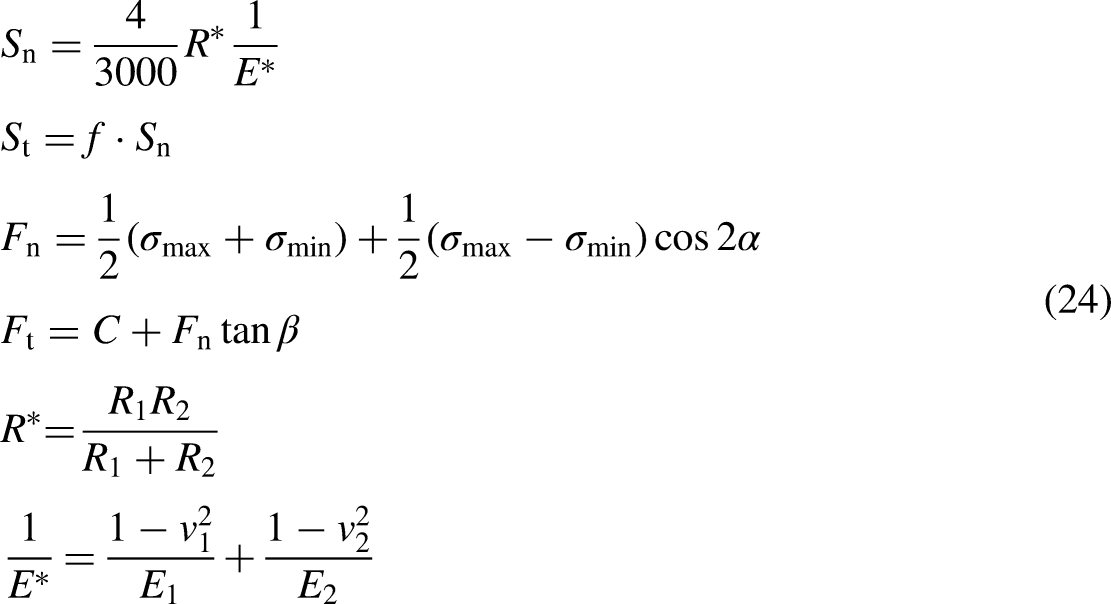
The coal rock and gangue models are created by using spherical particles with a diameter of 6 mm which are shown in Figure 7. In EDEM, the Hertz-Mindlin bonding model is adopted as the bonding contact model between coal rock or gangue particles, which is mainly defined by normal stiffness, shear stiffness, critical normal stress, critical shear stress as well and bonded disk radius. The calculation equations are as follows:
39

Different coal rock models in the Executive Diploma in Export Management (EDEM), should be listed as (a) a description of gangue; (b) a description of coal; and (c) a description of coal-gangue.
Import the 3D model of the bit into the EDEM and set the API contact model which is regenerated based on the changing physical properties of the coal or gangue particles within the EDEM. The simulation RayLeigh step is set to 20% and the overall simulation motion time is 1 s.
FLUENT calculation settings
The tetrahedral structured grid is used to mesh the bit model and divide the flow field calculation domain. The model is shown in Figure 8. To improve the mesh quality, the cutting teeth is approximated from cylinder to cuboid. The wind enters through the hole in the lower part of the bit and flows out through the air hole to complete the heat dissipation by air. In FLUENT, the turbulence model adopts the standard

Bit three-dimensional (3D) model and wind cycle flow field diagram, should be listed as (a) a description of bit meshing; and (b) a description of a schematic diagram of wind circulation flow field of bit.
Simulation results and discussion
The simulation results are shown in Figures 9 and 10. After comparing with the theoretical calculation results in Figures 4 and 5, it can be seen that the starting time of the rapid rise of simulation temperature is slightly later than the theoretical value under the same drilling parameters. This is because there is a certain gap between the initial position of the bit and coal rock in the simulation setting. However, the overall temperature rise trend is more consistent with that of the theoretical value.

Simulation temperature of cutting teeth under windless conditions (

Simulation temperature of cutting teeth under wind cycle (
The graph shows the temperature cloud expression of the bit when the wind circulation speed is 0 m/s and the drilling pressure is 4 kN. From Figure 11, it can be seen that the main area of the highest temperature region is concentrated in the part, of the cutting teeth at the bottom of the bit and the head of the bit retaining bar which are in contact with the coal rock. Due to the particle model in the discrete element model being composed of small particles, the display area of drilling temperature is striped, and as the temperature increases, the wear rate also increases.

The temperature cloud of the bit (
Different from Figure 11, the cloud maps in Figure 12 were taken at a wind cycling speed of 20 m/s. Then the temperature difference can be seen with the same drilling parameters at different wind cycle speeds. When the wind speed increases, the temperature decrease is obvious in the base part of the bit. The highest temperature region remains in the cutting teeth part of the bit, which is also the reason why the cutting teeth of the bit are most prone to wear.
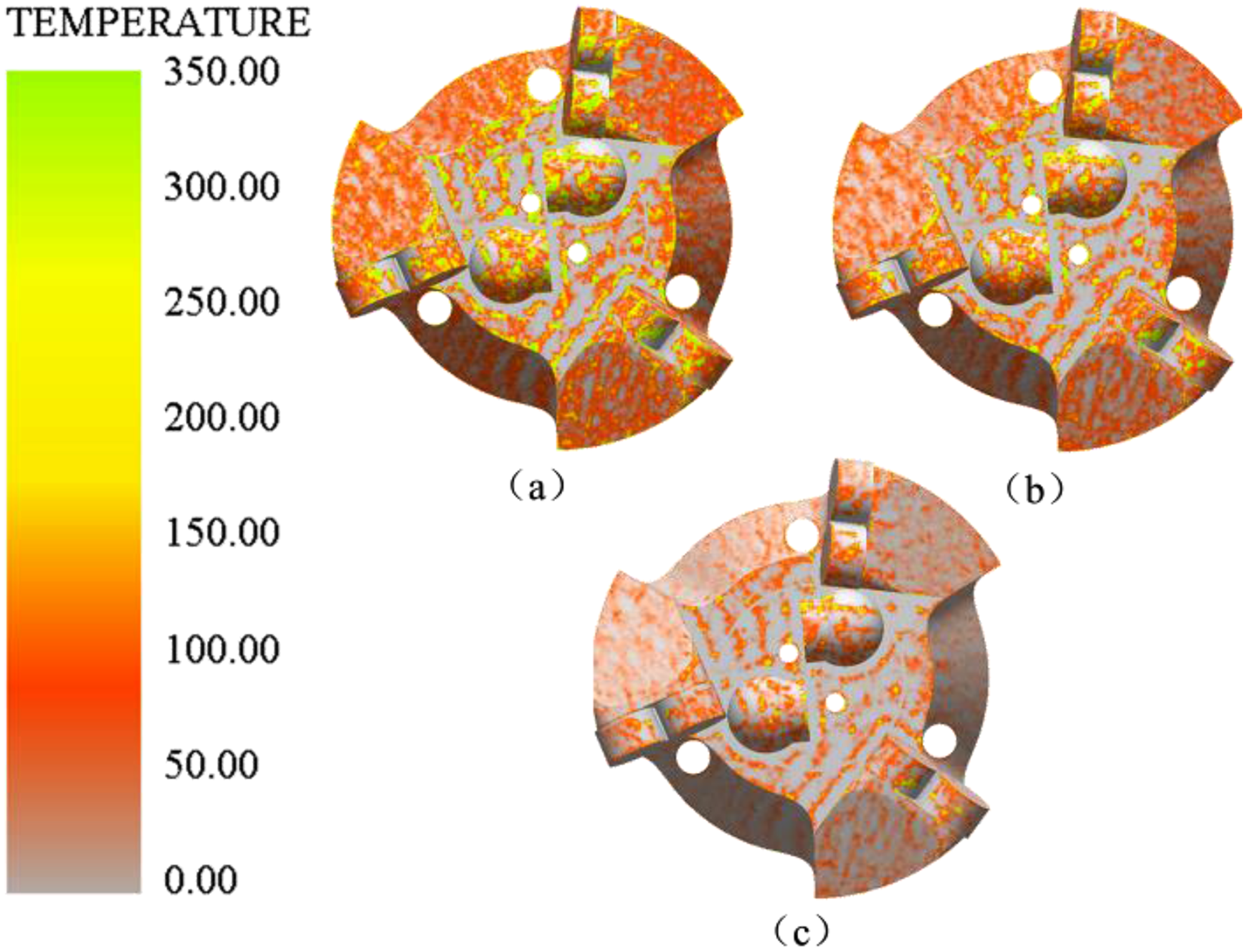
The temperature cloud of the bit (
Experimental verification
In order to verify the theoretical and the simulation calculation results, an experimental platform is built, which consists of a drilling system, a screw feeding system, and a data acquisition system. It is shown in Figure 13.

Schematic diagram of the overall structure of the test and experiment platform. 1—Experimental control panel; 2—three-phase asynchronous motor; 3—coupling; 4—bearing support; 5—drill rod; 6—conductive slip ring; 7—PDC (polycrystalline diamond compact) bit; 8—coal rock box; 9—lead screw feed device; 10—stepping motor; 11—air compressor; 12—signal test and analysis system; 13—thermocouple; and 14—computer.
The variable frequency motor drives the drilling rod and bit to rotate through a coupling. The coal rock box is fixed on the sliding table of the screw feeding device which is fixed on the fixed bracket and operated by a stepping motor type of
The cutting temperature generated during the cutting process was measured empirically to explore the effect of drilling parameters such as wind cycle, feeding rate, and drilling speed on the generation of cutting heat.
The drilling speed was set as 1, 2, 3, and 4 mm/s, the speed was 100 r/min, and the drilling time was controlled within 100 s to investigate the effect of different drilling speeds on the bit temperature. From the data in Table 2, it can be seen that the temperature of the PDC bit is easily affected by the drilling speed, and the temperature of the bit is positively correlated with the drilling speed.
Temperature of polycrystalline diamond compact (PDC) bit at different feeding rates.

The test data were fitted to obtain equation (25) for the temperature variation with feeding rate.
The drilling speed was set to 100, 200, and 300 r/min, the feeding rate was 1 mm/s, and the drilling time was controlled within 100 s to investigate the effect of different drilling speeds on the temperature of the bit. The relationship between the drilling speed and the maximum temperature of the bit can be derived from Figure 14. The drilling speed also shows a positive correlation with the temperature rise of the bit.
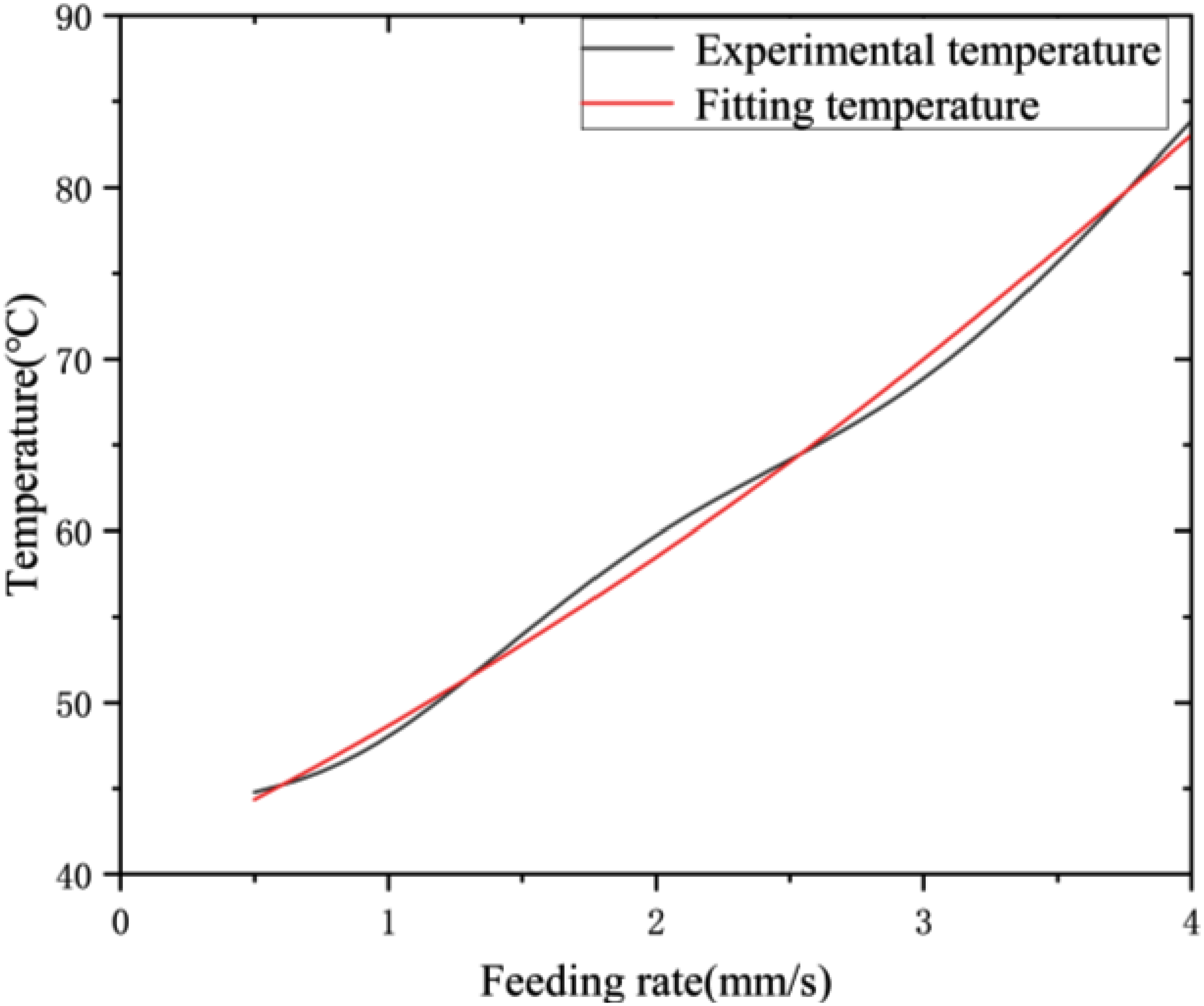
Temperature variation of polycrystalline diamond compact (PDC) bit at different feeding rates.
The data from Figure 15 were fitted to obtain equation (26) for the temperature variation with drilling speed.
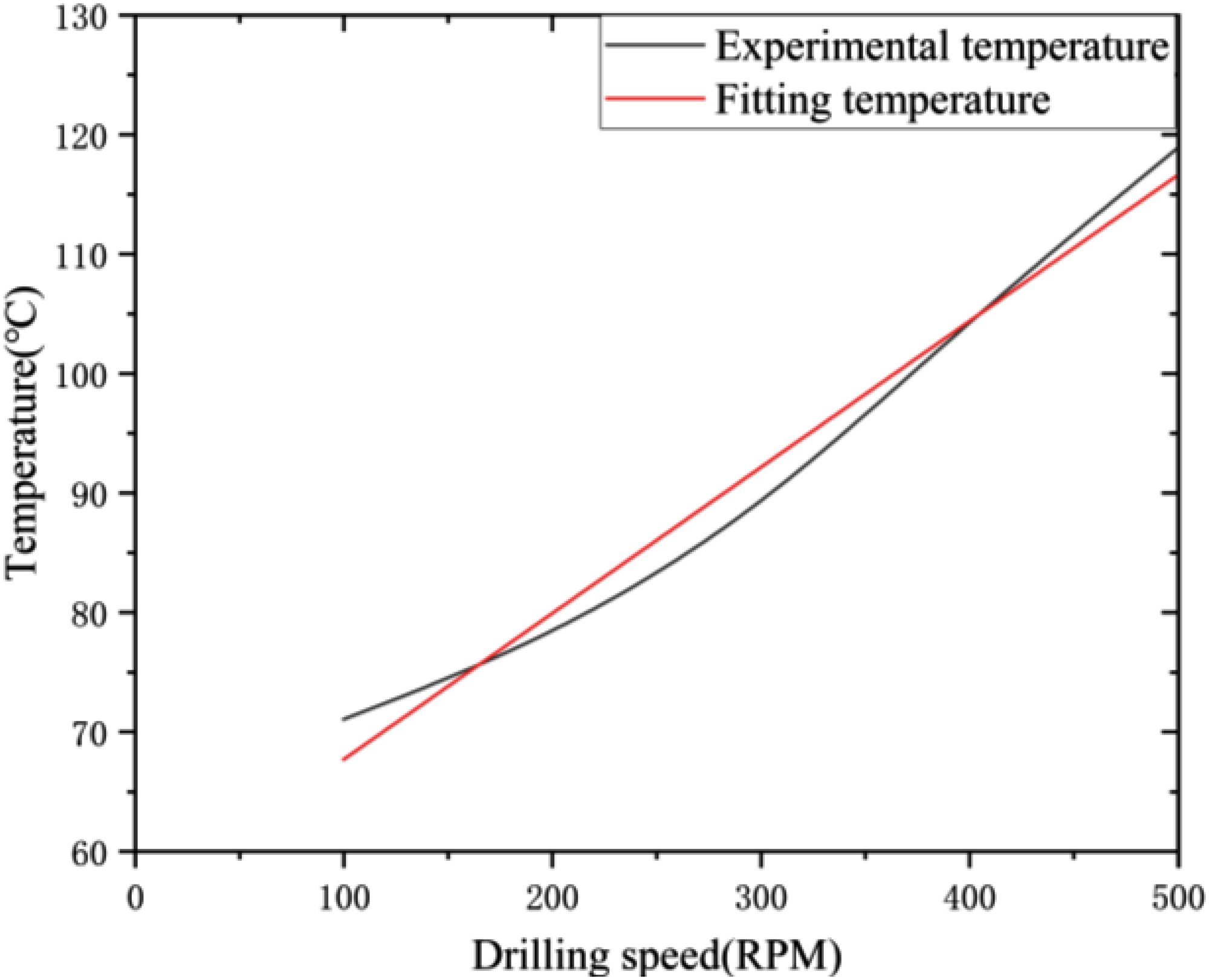
Temperature variation of polycrystalline diamond compact (PDC) bit at different drilling speeds.
The drilling speed was set to 200 r/min and the feeding rate was set to 3 mm/s. The temperature of the bit was measured when the wind speed was 0, 10, and 20 m/s, respectively. It can be noted that as the wind speed increases, the temperature of the bit decreases. This is due to the fact that as the wind speed increases, the amount of heat exchange with the bit increases, resulting in less heat in the bit and a lower temperature.
The data from Figure 16 were fitted to obtain equation (27) for the temperature variation with wind speed
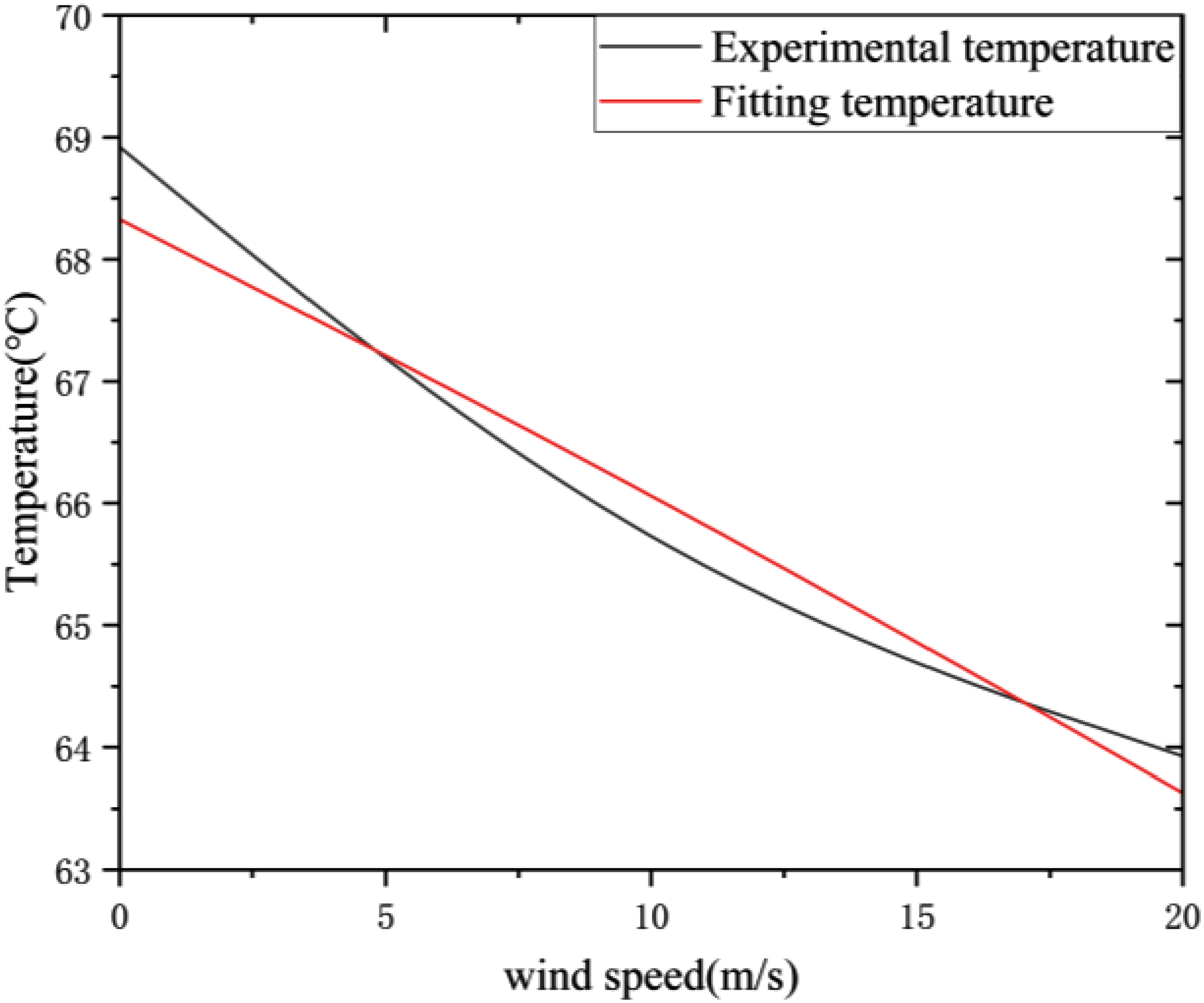
Temperature variation of polycrystalline diamond compact (PDC) bit with different wind speeds.
The theoretical and simulated values were compared with the fitted experimental data respectively. As shown in Table 3, the results show that the error between the theoretical values calculated by the developed theoretical model of cutting tooth temperature and the simulation results is < 10%. Therefore, the theoretical model of the cutting tooth temperature of the drill bit can be effectively used to calculate the temperature of the cutting tooth of the PDC drill bit during coal rock drilling.
Maximum error between theoretical and simulation temperature at 1 s.

Response surface analysis
Response surface analysis plan and variance simulation
Response surface analysis is a method to simulate the experimental results under limited state conditions based on a series of experiments with multiple variables and different response values. It is possible to study the interaction of several factors and has a good predictive performance. The Box-Benhnken principle is used to analyze the effects of cutting parameters and coal rock materials on the cutting temperature of the bit under wind circulation. In this analysis, factors such as drilling pressure, drilling speed, material, and wind circulation speed are taken as the independent variables in the experiment, and the temperature of the bit is the response value. The quadratic regression equation is used to fit the functional relationship between the independent variables and the response value. This functional relationship is represented by analyzing the regression equations and through the use of graphical techniques.
The design values and the coded values are shown in Table 4.
Design factor codes and levels.

The theoretical model of PDC bit cutting teeth temperature is used to calculate the theoretical temperature when drilling with different working parameters, as shown in Table 5.
Temperature of drill cutting teeth under different working conditions.

Based on the regression analysis of the quadratic response surface, the multiple quadratic response surface fitting regression equation of drilling speed, coal rock properties, drilling pressure, and wind speed on the PDC bit cutting teeth temperature is established. It is shown as
The variance analysis of the regression equation related to theoretical temperature is shown in Table 6. Among them, the larger the F-value and the smaller the P-value in the table represent the more significance of the correlation coefficient. So, the P-value of the model is < 0.0001, and the model F-value is required to be < 0.01 in the table of the regression equations, which indicates that the response surface regression model reaches a highly significant level. The fitting accuracy is good enough and the response surface approximation model can be used in the subsequent research. It can be seen that A, B, C, and D are significant in the temperature of bit-cutting teeth, and there is a relationship between the factors. According to the magnitude of the F-value, it is known that the influence degree of the above factors on the temperature of the bit-cutting teeth from large to small is drilling pressure, drilling speed, coal rock properties, and wind speed.
Variance analysis table for regression equations.

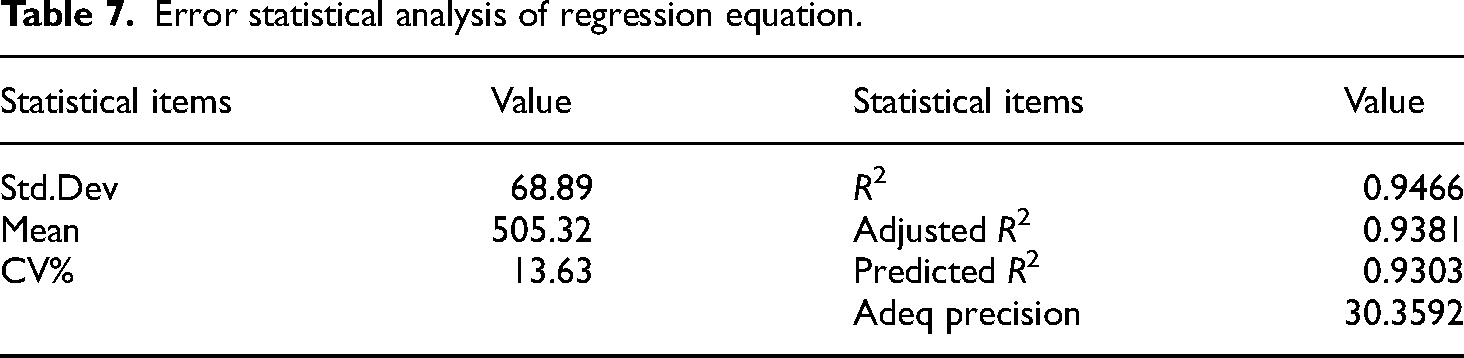
Further, the error statistical analysis of the regression equation is presented in Table 7. The larger the multiple correlation coefficient, the better the correlation. The predicted R2 is 0.9303 while the adjusted R2 is 0.9381. The difference is < 0.2, indicating that the model can fully reflect the drilling process. The adeq precision is 30.3592, which is > 4. So, the model has good adaptability and can be used to analyze and predict the bit-cutting teeth temperature.
Error statistical analysis of regression equation.
Glowka et al. 16 using the same methodology found that the wear rate of PDC bits increased significantly when drilling temperatures were higher than 350 °C. Based on the above response surface analysis, the results are shown in Table 8. For coal, it is seen that the drilling pressure (N) increases at the rate of 14.38% due to increasing VF. As the magnitude of VF increases for coal language, the drilling pressure (N) increases at the rate of 17.79%. For coal, it is worth observing that the temperature decreases at the rate of 8% due to higher VF and decreases at the rate of 10.5% due to higher VF for ganguage. When the bit is drilling the coal rock, the upper-temperature limit is set to 350 °C. Under the same drilling speed, the increase of drilling pressure further can effectively improve the drilling efficiency when there is wind circulation.
Drilling parameters below 350 °C.

Discussion
Taking the parameters of drilling pressure, drilling speed, and coal rock properties as the influencing factors, the response diagram of bit cutting teeth temperature is drawn according to the response surface fitting regression equation, which can visually reflect the influence of each cutting parameter on the bit cutting teeth temperature.
As shown in Figure 17, the influence of drilling speed and drilling pressure on bit-cutting teeth temperature is greater than that of coal rock properties. At the same time, the wind cycle can effectively reduce the steady-state convergence temperature of bit drilling in coal rock, which can effectively improve the drilling efficiency of bit-cutting teeth.

Response surface diagram analysis; should be listed as (a) a description of when
Conclusions
Based on the theory of tribology and heat transfer, the theoretical calculation model of PDC bit cutting teeth temperature was derived and the theoretical temperature field was analyzed. The temperature variation law of PDC bit cutting teeth under the thermal-fluid–solid coupling effect was analyzed by using the joint simulation of EDEM–FLUENT. The validity of the theoretical calculation model of bit-cutting teeth temperature was further verified by test. By establishing the response surface analysis model, the influence law of different drilling parameters on the temperature of PDC bit cutting teeth during drilling coal rock was studied. The results show that:
The error between the theoretical calculation results and the simulation calculation results and the experimental values is within 10%, which indicates that the theoretical model of the temperature of the cutting teeth of the PDC bit can be effectively used to calculate the temperature change of the cutting teeth of the PDC bit during the coal rock drilling process. Based on the response surface analysis, a multivariate quadratic response surface fitting regression equation is established for the effects of drilling speed, coal rock properties, drilling pressure, and wind speed on the temperature of the cutter teeth of the PDC bit. The final results of the analysis show that the factors affecting the temperature of the bit cutter teeth in the process of coal rock drilling are drilling pressure, drilling speed, nature of coal rock, and wind speed in descending order. With the regression equation and visualization analysis, the drilling efficiency increases by 14.38% and the temperature decreases by 8% for coal while the drilling efficiency increases by 17.79% and the temperature decreases by 10.5% for coal gangue when the critical temperature of cutting teeth is 350 °C, the drilling speed of bit is 400 r/min and the wind speed is 20 m/s. The maximum drilling pressures are 3580, 2980, and 2350 N, respectively.
In the future, we will further investigate the influence of the angle between the coal seam and the drilling direction of the bit on the drilling performance and the temperature of the bit when the bit is inclined to drill into the composite coal seam containing the gangue.
Footnotes
Declaration of conflicting interests
The author(s) declared no potential conflicts of interest with respect to the research, authorship, and/or publication of this article.
Funding
The author(s) disclosed receipt of the following financial support for the research, authorship, and/or publication of this article: This research was funded by the Key Discipline of Mechanical Engineering in Henan Polytechnic University, the Key Research Projects of Colleges and Universities in Henan Province (grant number 22A440013) and Henan Province Science and Technology Project (grant number 232102320341).

Author biographies
Xiaoming Han was graduated from China University of Mining Technology, majoring in the Mechanical Engineering. Now, Han is an associate professor at Henan Polytechnic University.
Liubing Xue is a postgraduate under the guidance of Professor Xiaoming Han. Xue's research interest is gas extraction technology and equipment in coal mines.
Jin Xu is a postgraduate under the guidance of Professor Xiaoming Han. Xu's research interest is gas extraction technology and equipment in coal mines.