



Abstract
Horizontal logistics collaboration is characterized by the highly professional cooperation of logistics service providers at the same level of the supply chain, which is an effective way to optimize the development and sustainability of modern logistics. Conducting a coding analysis of data from 41 in-depth interviews, this study constructs a theoretical framework of the driving force of horizontal logistics collaboration among Chinese logistics service providers to synchronously improve service, market, efficiency, and emergency competitiveness through cooperation with peer competitors to enhance sustainable comprehensive competitiveness. The four driving forces encourage logistics service providers to adjust their thoughts in the planning stage, change their behavior in the implementation stage, and transform their strategy in the evaluation stage. The results also indicate differences between China and other countries in the driving force, effective utilization of logistics workers, cross-institutional collaboration of state-owned enterprises, and integration of artificial intelligence technology. Finally, we propose relevant recommendations for managers.
Keywords
Introduction
Collaboration is a prominent theme in logistics, innovation, and sustainability.1,2 Professional Logistics Service Providers (LSPs) are motivated to form continuous horizontal cooperation in order to adapt to the new technological environment and maintain sustainable competitiveness.3,4 The latest research proposes that cross-chain collaboration is an effective way to deal with the progress of artificial intelligence (AI) technologies and the destruction caused by the COVID-19 pandemic.1,5–8 In essence, cross-chain collaboration involves horizontal collaboration among competing LSPs at the same level of the supply chain.1,5,6 It can effectively improve the quality and efficiency of logistics services, reduce costs, improve enterprise performance,6,7 and promote the sustainable development of the logistics industry to encourage economic growth.9–13 Logistics business cooperation between competitors is called Horizontal Logistics Collaboration (HLC), which has gradually attracted the attention of the academic community.2,3,6–17
Generally speaking, enterprises typically avoid cooperation with competitors,1,2,18 because the competitiveness of their peers will increase the threat of speculation, resulting in a high failure rate of HLC.16–22
However, in recent years, enterprises in Europe and the United States have shown a significant divergence from this norm. LSPs, which are competitors, often apply HLC in transportation alliances3,5,6,8,14,19,23 such as conference alliances1,10,19 and aviation alliances.1,14,23 European government agencies and industry associations spent tens of millions of dollars promoting the development of HLC projects between 2015 and 2020,1,23 and even more, under the development of big data and AI technology.1,2,5,12,24
Overall, LSPs in China function at a smaller scale are weaker and have a lower service capacity. They mainly acquire markets through price competition, 25 and it is urgent to improve their performance.26,27 The development of AI technology has made the optimal allocation of resources feasible, and the COVID-19 pandemic has aggravated the operational crisis of LSPs. Small and medium-sized enterprises are encouraged to gather, introduce new technology and equipment,9,28 establish and improve the cold chain logistics public platform,20,25 and explore joint distribution.9,26 For this reason, the 14th Five-Year Plan for the Development of China's Comprehensive Transportation Services pointed out the necessity of cultivating new growth points of digital intelligence logistics, which are embodied in encouraging different modes of HLC. 27 The plan has promoted the aggregate operation trends of LSPs; they carry out HLC in various logistics functional dimensions.25–28
In fact, the transition from competition to cooperation is very difficult for enterprises, 7 because all of the changes in concept, culture, and action take time and require opportunities.2,19,21,29 It is thus important to understand what drives LSPs to overcome the fear of opportunism and switch to HLC. However, we have not seen a systematic study of the driving force of HLC and its mechanism in China. To fill this gap, 41 government officials, LSPs leaders, scholars, and logistics consultants who were closely related to LSPs in six provinces in China were interviewed for this study. The Grounded Theory (GT) approach was used to carry out the coding analysis, construct the theoretical framework of the driving force of HLC in China, and analyze the operational mechanism to provide a reference for enterprises. This study was conducted with a focus on the following questions: (1) What drives LSPs to carry out HLC? (2) How do these driving forces play roles in each collaboration step? (3) What innovations are related to the driving forces of HLC in China?
The remainder of this paper is structured as follows. The section of literature review summarizes the definition and influencing factors of HLC. Then, the section of methods introduces the data collection, coding, and model construction. Then, we present the action path of different driving forces in the three stages of HLC in the section of driving force mechanism of HLC. Finally, we conclude and discuss the academic contributions and managerial implications are presented in the last section.
Literature review
Horizontal logistics collaboration
Logistics collaboration in the supply chain can be divided into Vertical Logistics Collaboration (VLC) and HLC. VLC and HLC help promote the development and success of supply chains.6,7,11,12,15,16,30 Many studies have been conducted on VLC, which refers to coordination between companies at different levels of the supply chain (upstream and downstream) and manifests in logistics service coordination between suppliers, customers, and LSPs.1,2,5,8,9,22
Research focused on HLC is still in its infancy.1,7 Cruijssen 19 first proposed a model of horizontal transport cooperation between logistics enterprises. Since then, Vanovermeire et al. 6 Ankersmit, 14 the EU, 29 and Pan et al. 31 have strengthened the definition of transportation. Vanovermeire et al. 6 created the term “Horizontal Logistics Collaboration.” Rodrigues and Irina 12 further pointed out that HLC should include cooperation in transportation, warehousing, distribution, and other logistics activities. Transportation cooperation is one of the most important forms of HLC.1,2,5,7,28 Some scholars have also proposed that HLC is characterized by cooperation between LSPs that specialize in logistics services.12,16 In general, HLC is understood as a logistics activity cooperation between LSPs who are on the same level of the supply chain in order to pursue greater synergy.1,17
In addition, some studies have revealed the specific developmental patterns of HLC. It is often shown as a transportation alliance,3,4,6,14,19,28 collaborative inventory,7,21 strategic and tactical data sharing,1,2,8,12,22 goods consolidation,6,7,15 logistics order sharing,4,5,12,16 facility sharing,5,6,21,32 human resource sharing,1,7,21,32 and synchronous logistics.1,21,22,32
Influencing factors of logistics collaboration
The factors influencing HLC are scattered in various studies.1,2,4,8,9,12,17,19,21,32 Scholars often term them as motives/motivations, 17 driving force, 19 enabling,8,11 influence (success/consideration) factors, 12 and facilitators, 19 and they can be roughly divided into endogenous and exogenous powers.1,4,21,32–35
Endogenous power originates from the pursuit of synergy.18,32–35 It is a spontaneous internal power, mainly manifested in reducing transaction costs,1,6 realizing resource sharing,9,11 establishing enterprise legitimacy,12,36 and improving competitive advantage.15,16 It is generally agreed that endogenous force increases willingness to participate in HLC and plays a decisive role. 34 The pursuit of cost reduction makes LSPs naturally unite to lobby the government for infrastructure, and educational support, set common procurement strategies, marketing and branding, and share maintenance equipment.15,21,32 The sharing of tangible and intangible resources increases LSPs’ willingness to share facilities and equipment with competitors. The effect of resource sharing is most evident when customers transfer logistics contracts.29,32,35 LSPs, especially new entrants, also hope to obtain “organizational legitimacy” in the industry through collaboration.36 New entrants face various “newcomer disadvantages”: a lack of industrial experience, tacit knowledge (such as understanding the rules of the game), resources, trust, and influence.32,36 However, they can obtain legitimacy through HLC with competitors. 34 The pursuit of a greater competitive advantage is also important. As shown in the diamond model, 37 collaborative strategies and factor support play an important role in enhancing an enterprise's competitive advantage and industrial competitiveness. Schwind et al. 38 believed that horizontal coordination helps enterprises overcome difficulties and achieve common goals. Currently, the development of AI technology requires greater cooperation to complete deep learning and technology upgrading.1,4,24,39,40
Meanwhile, exogenous driving forces, such as the division of labor, the business environment, and competitive pressure, create a business atmosphere. The division of labor is the premise and basis of cooperation.21,32 Logistics enterprises continue to adjust their roles and peer relationships based on labor divisions during the period of industrial evolution.1,35,37 Especially in logistics clusters, logistics infrastructure and regulations for investment, information, finance, labor pools, cultural traditions, and new technical assistance constitute business environmental elements.21,32 The more concentrated the shipper and volume of goods, the higher the level of big data, the better the business environment, and the easier it is to collaborate among LSPs.39,40 Finally, fierce competition will lead to the emergence of the “Silicon Valley paradox.” 41 The main reason for this is the pressure to improve market position and corporate image.18,19,38,39
In summary, studies have mainly focused on the driving factors of HLC from the perspective of the power source, but most of them scatter and fail to analyze the synergy process. In addition, they rarely focus on the Chinese scenario; in fact, the willingness and driving force of HLC may be different due to different regions and environments, providing space for further research.
Methods
Research methods
Grounded Theory is a qualitative research method that is suitable for the study of social organizations and their internal structures and external relationships,42–44 especially for explaining the success of collaborative relationships among members of a business ecosystem. 45 GT has been widely used in the fields of logistics and supply chain management.42–44
GT can construct theory in vertical or horizontal modes based on a chronological sequence of events. 45 Researchers use “vertical theoretical construction” when it is necessary to review events that have occurred in chronological order and show causality. “Horizontal theoretical construction” can be employed when it is not necessary to consider the time sequence, but only to put forward the theoretical concept based on the phenomenon and determine the connotation and extension of the concept from practice. In this study, the data analysis and coding of the sampled interviews were relatively objective and independent of time and could be carried out in parallel. However, the construction and interpretation of the theoretical framework are subjective and must follow a certain time and logical sequence. Considering reality, in this paper, we construct the theoretical framework in a horizontal manner and explain it in a vertical manner. This is illustrated in Figure 1.

Major steps in Grounded Theory (GT) research.
There are three important factors in the process of GT called “3C,” 45 which stands for “Cognitive Process,” “Coding,” and “Continuous comparison.” “Cognitive Process” is the process of forming concepts from data; “Coding” is the process of constructing theories step by step.42–44 “Continuous comparison” is an iterative process of analyzing data and refining the relevant categories and their properties through a comparison between data and theories. 45
Based on the major steps of Programmed GT, 45 in this paper, we construct a theoretical framework beginning with open coding to name phenomena and form categories, carrying out axis coding to identify and establish the relationship between various categories, and selective coding to integrate and refine the theory. In addition, “continuous comparison” is applied to search for new codes, new genera, and new relationships until the theory is saturated.
Data collection
The GT gradually forms a theoretical framework through in-depth data analysis. There is a wide range of data sources including field research, observation, interviews, discussions, and meeting minutes.42–45 In this study, we used in-depth interviews as the main data, which were supplemented by other materials.
Initial sampling
The initial sampling process selected the samples. Researchers first mastered representative LSPs in Gansu, Qinghai, Sichuan, Chongqing, Ningxia, and Shanxi provinces in western China. Owing to resource acquisition, these provinces represent different levels of economic development in China.25,46 Most LSPs are agglomerated in local logistics hubs, parks, and centers. Researchers then access the scale of enterprises, development history, and other information online, visit and make observations on the spot, or email and call enterprises to determine the extent of HLC between them. Finally, the researchers selected 41 interviewees.
Data collection
Two-stage interviews were conducted to collect the data. Informal interviews were conducted only for the responsible persons of individual enterprises (mainly in Gansu Province) to preliminarily test the effect and revise the outline of the protocol. Formal interviews were conducted in accordance with the revised outline and lasted more than 60 min for each interviewee.
For different interviewees, the interview outlines (the focus of the question) were not exactly the same, but all of the outlines could be divided into three parts. First, the general information of the interviewee, which helps to understand their occupation (position, responsibilities, years of work, logistics experience), focused on their familiarity with the industry and enterprises; second, information on the company's location and development of the logistics industry, which is aimed at the current status of the logistics industry, the scale and strategic business unit of LSPs; and third, the standard of cooperating partners, the situation, restraint mechanisms, effects, methods, and models of cooperation, which focuses on examining the willingness and reasons for HLC between enterprises.
To ensure an accurate understanding and mastery of the material, the researchers communicated with some interviewees about any unclear or ambiguous interview content by e-mail, phone, WeChat, and other means until they fully understood the interviewees.
Theoretical sampling
To ensure theoretical saturation, reliability, and validity,42–45 the researchers identified 41 interviewees, including 4 government officials (9.7%), 10 principals of the logistics park management committee (about 24.4%), 16 heads of LSPs (39.1%), 7 professors and scholars in universities who have long been engaged in logistics cooperation research (about 17.1%), and 4 logistics consultants (9.7%). The study involved 480 LSPs, of which state-owned enterprises accounted for 5%, and the remainder were private enterprises. Further, 25% of LSPs provided services for means of production, 50% for means of subsistence, and the rest provided both. All 480 LSPs provided multiple logistics service functions, but most of them provided highway transportation and warehousing services. Data collection was an iterative process, and nearly 600,000 words of descriptions were collected.
Coding and model construction
Researchers coded the preliminary data synchronously, which was input and sorted in NVIVO 13.0. Due to theoretical saturation, 34 interview data points were randomly selected for coding analysis, and seven data points were used for the saturation test,42–45 while memorandum and constant comparison helped make the coding more objective and accurate.
Open coding
Open coding is the process of dealing with original data. A “dispersion→ integration” dichotomy is more suitable for research with large-volume data and information. 45 Segmental coding helps to accurately locate and verify the driving force in all interview data because the descriptive original interview materials are widely related to the conditions, methods, models, and effects of HLC. First, it was necessary to lock the driving force.
The locked data were encoded on a sentence-by-sentence basis. Researchers removed “none” words and identified significant phenomena (reference point in NVIVO and marked by Ix, x starts with 1) in sentence coding. Coders designed a preliminary conceptualization in this study to condense each sentence and clarify the sequential relationship, and the original coding principle was applied in the period, that is, quoting the necessary words from the original data rather than the researchers. The preliminary concept was annotated by IIy (y starts with 1 and continues sequentially but keeps the existing number when repetition). Furthermore, coders merged interrelated concepts and naming (free nodes in NVIVO, IIIz) and classified the free nodes to form specific categories (tree nodes in NVIVO, Cm).
Table 1 presents a sample of the open-coding process. A total of 21 phenomena were identified in the open coding of representative interview data and summarized as 20 preliminary concepts, eight named concepts, and coded into six categories.
Sample of open coding.
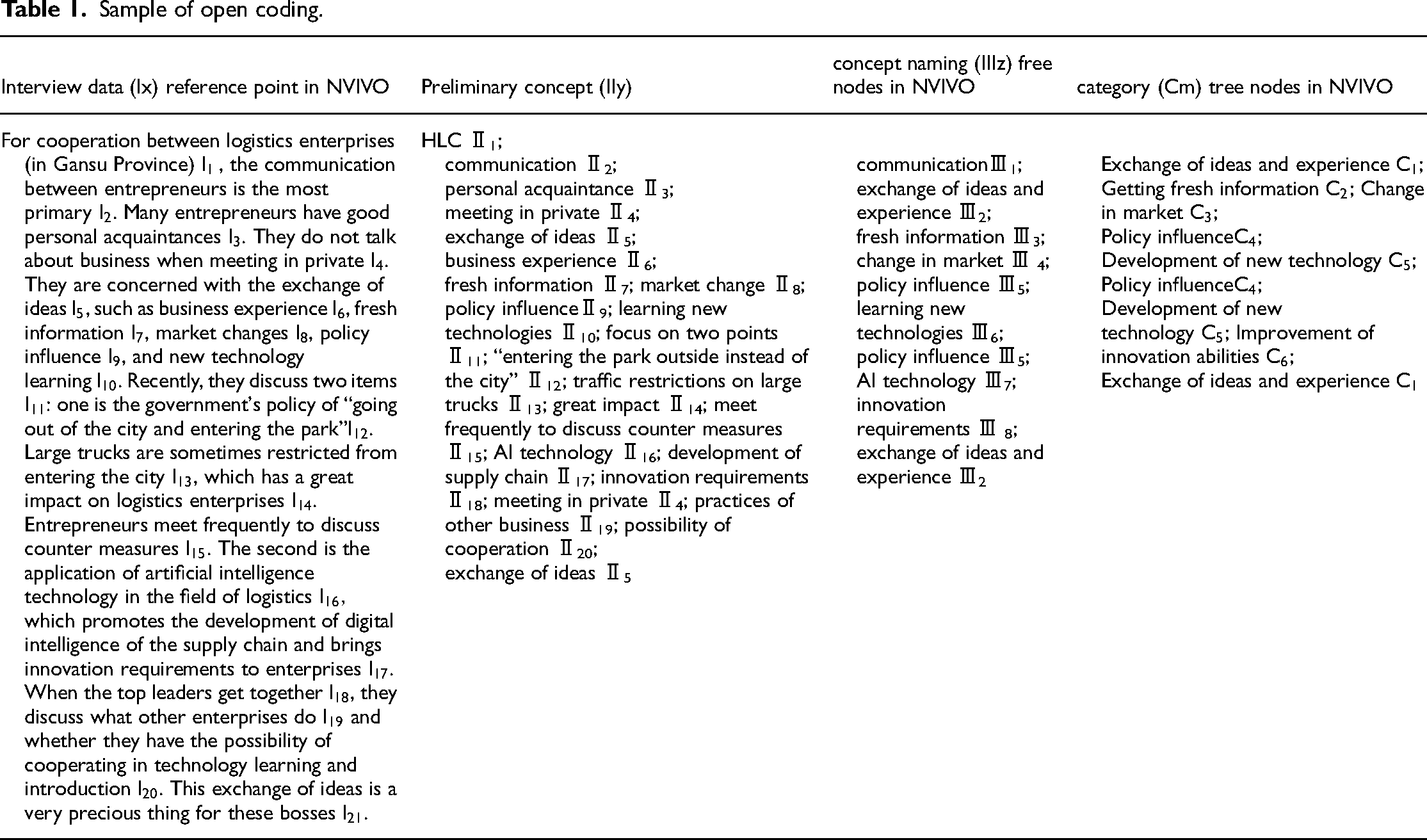
For the need for theoretical saturation, 45 34 out of 41 interview data were selected for coding analysis, with a total of 9804 reference points and 1658 free nodes in NVIVO. To improve reliability, the study only retains concepts (free nodes) that appear more than five times and excludes others. Finally, 193 concepts were obtained and summarized into 52 categories.
Axis coding
Axis coding is a subjective process that integrates and classifies seemingly fragmented and scattered categories (IIIz) into main codes (marked by An). Further refinement of the categories is required to identify and establish the master–slave relationship between categories. 45
Researchers refined 52 categories in the first step and logically analyzed them according to the model of the “condition →actions/interactive strategies →result” to form “the driving forces of HLC in China.”42–44 The condition is the situation or cause, the action is the management means and treatment strategy adopted for the situation, and the result is the effect of implementation. Sixteen relational categories were formed to illustrate the internal connection and overlap between the 52 categories.
Analyzing the inherent logic and relationships of 16 relational categories, researchers summarized them into four principal axis codes – service, market, efficiency, and emergency – to explain the driving force of HLC in China from different perspectives. The axis coding is presented in Table 2.
Axis coding.

 Condition
Selective coding
Selective coding identified the “core” category, explored the internal relationship between the core and other categories, and formed a framework. The main task of selective coding is to develop a clue and perfect the logical relationship between the axis codes. This clue explains all phenomena and highlights the leading role of core categories, and the logical relationship makes more detailed comparisons and corrections between categories.
Finally, “sustainable comprehensive competitiveness” was identified as the core code composed of four main categories: service, market, efficiency, and emergency. A clear clue was presented: in China, the ultimate driving force of HLC between LSPs is to enhance sustainable competitiveness through cooperation, that is, the simultaneous improvement of service, market, efficiency, and emergency competitiveness. They explained the driving force from two perspectives: source (endogenous and exogenous) and role (image and operation), as shown in Figure 2.
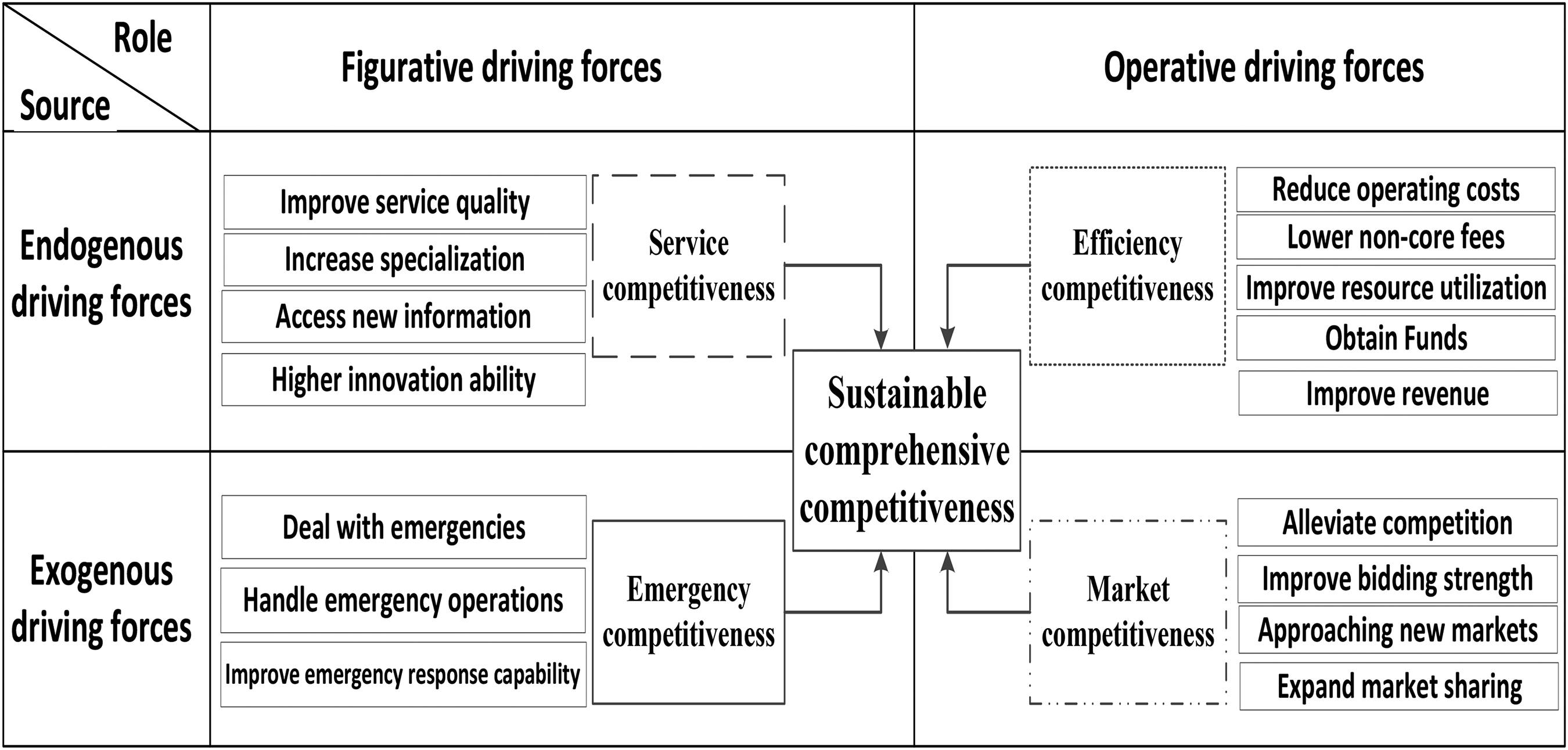
Driving force model of Horizontal Logistics Collaboration (HLC) between LSPs in China.
Reliability and validity
This study ensures the reliability and validity of theoretical saturation, internal diversification of methods, and practitioner test.42–45 First, researchers coded 34 data independently and compared them in three stages, then recoded and analyzed the seven reserved data and did not find any other new categories and relationships. This means that the research obtained theoretical saturation. Second, the interview data cover diverse sources, such as interview data, network materials, and enterprise documents. 45 All interviewees provided rich information on HLC, and the researchers had coding experience to ensure the diversification of methods. Third, the team submitted the results to entrepreneurs and government officials with practical experience in the inspection; some of the inspectors were interviewees, while others were not. The former mainly tests the accuracy and authenticity of the code, and the latter mainly tests theoretical saturation. 45
Model construction
This study proposes the core internal driving force of HLC in China, which is to achieve “sustainable comprehensive competitiveness” through continuous cooperation with competitors and is embodied in the synchronous improvement of service, market, efficiency, and emergency competitiveness. The driving-force model is shown in Figure 2.
The model shows four driving forces to achieve “sustainable comprehensive competitiveness” in two dimensions. From the initial source of power, the improvement of service capability and efficiency comes from the internal development demand of the LSPs and belongs to endogenous power. The improvement in emergency response and market competitiveness comes from external pressure and belongs to the exogenous power category. Meanwhile, from the perspective of the role played by the driving force, service and emergency competitiveness establish the figure of the enterprises’ external service, efficiency, and market competitiveness show enterprises’ operational goals.
Service competitiveness
Logistics services are strongly customized.1,7,21 To meet customers’ needs, LSPs should conduct collaborative services and operations.13,19 Based on professional information platforms and technical teams, LSPs can realize information transmission, improve the completion rate and punctuality of orders, and quickly respond to personalized needs. 12 Further, cooperation is important to technological innovation in the logistics service ecosystem.2,9 Currently, AI technology is increasingly being used in logistics. Entrepreneurs (top leaders) work together to exchange ideas and experiences and acquire new knowledge to improve the learning ability of enterprises.4,5,7,9,24,39,40 New technology and ability are the commitment and guarantee to meet needs.
Market competitiveness
Many aspects of the Chinese logistics industry have gradually shifted from rapid development to the initial maturity stage.3,8,9,25–27 The relationship between enterprises has gradually transformed into cooperation to expand the total market volume and create co-value. 5 By sharing resources and information, peer enterprises can not only improve their bargaining power in business negotiations15,22 but also jointly shape a better public image32,33 and overcome new market entry barriers, 36 further improving the market share of enterprises in a wider geographical range. Generally, improving the overall market competitiveness of enterprises is a return and commitment to their shareholders.
Efficiency competitiveness
Improving efficiency and competitiveness is enterprises’ most urgent goal. HLC helps enterprises reduce operation and non-core business costs, 1 revitalize assets, make good use of human resources, and expand profit space. 29 Especially for state-owned enterprises, it is vital to make the best use of idle land, facilities, and other resources, reduce waste, and convert assets into funds and profits by implementing HLC and breaking institutional boundaries.8,28
Emergency competitiveness
The primary intention of logistics services is to solve the space-time contradiction between supply and demand to quickly respond to market changes. 12 The emergency capacity of LSPs mainly manifests as a rapid response to market changes. In the emergency business, LSPs adopt flexible emergency operations, transfer service capacity to peers, and organize workers to carry out emergency operations.3,8 When policy changes occur, the heads of LSPs urgently meet to discuss various countermeasures and make suggestions with industry associations and intermediary institutions. In HLC, LSPs can greatly enhance their flexible response capacity, which is also one of the embodiments of improving the comprehensive competitiveness of enterprises.
Driving force mechanism of HLC
The process of HLC could be divided into three stages based on the logic of “condition →actions/interactive strategies →result” the same as the axis coding.42–45 The planning stage, namely “conditions,” mainly examines the forces that drive the ideological transformation of LSPs, which is the process through which the decision to try HLC is made. The implementation stage, namely “action/interactive strategies,” mainly examines the forces that drive the behavior transformation of LSPs, which is the process of taking actions. The evaluation stage is the “result” and examines the power that drives the strategic transformation of LSPs and decides to carry out repeated coordination. This is the process through which enterprises examine whether the synergy effect is satisfied. The corresponding categories of the four driving forces play their respective roles at each stage, reflecting the internal relationship and interaction of each category in the three stages of planning, implementation, and evaluation, as shown in Figure 3.

The process of Horizontal Logistics Collaboration (HLC).
Mechanism of driving force in the planning phase
The planning stage of the HLC is the period of ideological transformation. LSPs take adventures based on endogenous forces and are determined by exogenous forces, and the external driving force is the fundamental determinant, as shown in Figure 4.

Driving force mechanism of Horizontal Logistics Collaboration (HLC) in the planning phase.
HLC is the essence of cooperation between competitive enterprises. In general, it is the instinctive reaction of enterprises to resist coordination with their direct competitors because of concerns about opportunistic behavior. In the planning stage, LSPs need to overcome concerns about opportunism and ideologically accept the establishment of new relationships. Thought change is first based on the internal driving force because regardless of cooperation, LSPs must try to improve service quality and reduce logistics costs.
However, in contrast to the general understanding, the exogenous driving force is the fundamental determinant in the planning stage because environmental changes force enterprises to consider the necessity and urgency of collaboration; emergencies and competition encourage enterprises to actively form a community of common destiny to jointly respond to changes. At present, the COVID-19 pandemic has brought about a changing environment. Accordingly, the Chinese government has introduced measures to ensure the service quality of cold chains and establish a traceability system.26,27 It is difficult for LSPs to satisfy the requirements of the government and customers. Meanwhile, many business units in the logistics industry have grown into a “Red Sea” and are facing fierce price competition. LSPs had to reach a consensus with competitors, prevent malicious price reductions from seizing the market, conduct information communication, and share resources to form a win–win situation and ease competition. Therefore, the exogenous driving force is the decisive factor in ideological transformation.
Mechanism of driving force in the implementation phase
In the implementation stage of HLC, LSPs put collaborative ideas into action. The operating driving force plays a decisive role, and the figurative driving force of the LSPs strengthens the decisive role of the operative driving force, as shown in Figure 5.
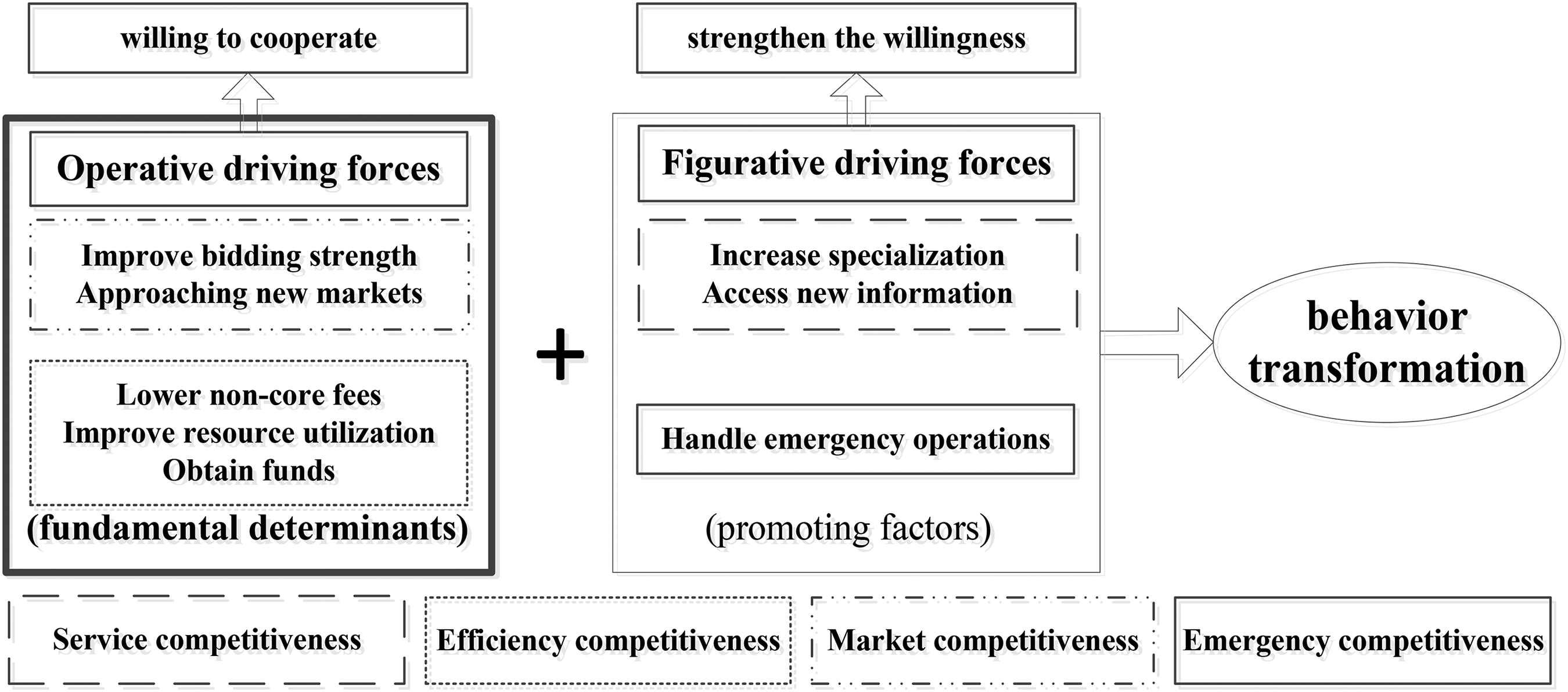
Driving force mechanism of Horizontal Logistics Collaboration (HLC) in the implementation phase.
The operating driving force determines the implementation. On the one hand, LSPs should open new routes and develop new customers to explore new markets and obtain greater development space. In this process, enterprises conduct cooperative bidding, joint procurement, and market negotiations through HLC, showing higher comprehensive competitiveness. On the other hand, LSPs can reduce their non-core costs and obtain funds by sharing labor and providing external facilities and services. The common use of equipment can also help improve utilization and reduce asset wastage.
Meanwhile, the figurative driving force strengthens the willingness of HLC. Cooperation improves emergency operation abilities and helps build a good image and commitment performance.
The behavior transformation of the LSPs contributes to the landing and implementation of the HLC. It may further promote strategic transformation and transform one-off collaborations among enterprises into long-term repetitive strategic actions.
Mechanism of driving force in the evaluation phase
The evaluation reflects and reviews the synergies of all participating enterprises. LSPs investigate the improvement status and degree of innovation, market sharing, profitability, and emergency response abilities to evaluate the effect of collaboration and decide whether to strengthen their cooperation with competitive partners through long-term and repetitive strategic collaboration, as shown in Figure 6.

Driving force mechanism of Horizontal Logistics Collaboration (HLC) in the evaluation phase.
Enterprises evaluated the performance improvement of HLC during the evaluation stage. Only when efficiency, service, marketing, and emergency capabilities have all improved can the enterprise firmly repeat the confidence in collaboration and implement strategic change.
For Chinese LSPs, improving revenue is the fundamental driving factor in the evaluation stage, which reflects the direct role of HLC and the short-term effect of a one-time synergy. The improvement of market sharing, innovation ability, and emergency response ability is the pursuit of sustainable development and long-term effects. In particular, the development of new technologies, such as AI technology and deep learning abilities, enables LSPs to delegate simple programmed work to machines, reduces human resource costs, improves innovation capabilities, and promotes the dissemination of static and dynamic knowledge among enterprises.1,24,40 This increases the possibility of repetitive cooperation. The evaluation of the HLC effect will directly determine whether LSPs will conduct strategic transformations and promote changes from happenstance to repetition.
Innovation of driving force model
Compared with existing research in other countries,1,2,4,12,16,17,19,29–34 the driving force shows the identity of profit-making organizations in the pursuit of economic effects. However, some differences in the Chinese LSPs were also identified in this study.
Differences in driving forces
The Chinese logistics industry develops with weaker capacity, fewer value-added services, slightly chaotic market order, more intense enterprise competition, and lower overall logistics operation level, which makes the HLC motivation of Chinese LSPs different from that of existing research.1,2,4,12,16,17,19,29–34
First, for service improvement, Chinese enterprises should pay special attention to the acquisition of fresh information. Especially in logistics clusters, LSPs realize the external economy of knowledge through collaboration and multiply the knowledge spillover effect, which stems from awareness improvement in collective learning and knowledge sharing. At the same time, cooperation between AI and deep learning is particularly important because it can greatly improve enterprises’ service innovation capabilities.
Second, in terms of market expansion, Chinese LSPs hope to ease the competition and approach new markets. They expect to enhance their negotiation abilities and become close to new markets through cooperation. This is slightly different from the attention paid by LSPs in other countries to market penetration rates.29–34
To promote efficiency, all enterprises hope to reduce their operating costs through HLC; however, Chinese LSPs pay more attention to non-core costs, pursue more comprehensive and detailed resource utilization, and focus on revitalizing assets. This can be attributed to the fact that the Chinese government has focused on cost reduction and efficiency increases in both macro and micro policies in recent years.
Finally, Chinese LSPs are more concerned about the improvement of emergency response capabilities. Due to drastic changes in the market, the Chinese government makes more adjustments to policies, and enterprises take measures to adapt to emergencies and urgent orders, which not only shows a lack of logistics operation capability in China but also reflects the urgent hope of enterprises to improve their emergency response capabilities.
Effective utilization of logistics labor
In China, enterprises often divide workers into regular and temporary groups. Regular employees are full-time personnel employed by LSPs throughout their careers. They are mainly engaged in daily operations and paid hours or piece work. Temporary employees are informal; they only operate when the enterprise has emergency orders and engages in paid piecework.
Existing research regards resource sharing as one of the motivations for HLC.1,2,7,19,21,32 They believe that human resource sharing is more about managers than operators because the experience, business ability, and tacit knowledge of managers are important assistance in cooperation. 39 However, this was slightly different in China. LSPs more often exchange and share workers, enterprises arrange “daily work of full-time staff” and “temporary work of temporary staff” to lower non-core fees; “temporary external service of full-time staff” to obtain funds, and “emergency operation of temporary staff” to carry out emergency operations. Human resource sharing aims to reduce operating costs and improve operational efficiency and develop the ability to respond quickly to the market and its changes to meet customer needs and improve comprehensive competitiveness.
Cross-institutional collaboration of state-owned enterprises
Because of their distinctiveness, state-owned enterprises in China generally do not break institutional boundaries and carry out HLC with their competitors, especially non-state-owned enterprises.
However, GT research reflects how some open-minded state-owned LSPs break system boundaries and cooperate with private enterprises. Some try to carry out short-term cooperation, such as regional market development and transportation route extension, while others dare to implement long-term cooperation strategies. Based on the separation of heavy and light assets, they invested independently in fixed assets and cooperated with light assets. Cross-system HLC is an important attempt by Chinese state-owned logistics enterprises to improve their sustainable competitiveness.
A representative example is a cooperation between M and C. M is a large state-owned logistics enterprise in Gansu Province and C is a famous private enterprise in China. They jointly built an inland port in Lanzhou City, with a total investment of 1.308 billion RMB. The two companies adopt the mode of separation of light and heavy assets; M invested 100% in land acquisition and the construction, maintenance, and sale of property assets of the inland port. Meanwhile, M and C jointly established asset management companies with registered capital of 20 million RMB in proportions of 40% and 60%, respectively. Since then, M has cooperated with other state-owned enterprises to carry out logistics projects many times and has achieved rich experience and good results. At present, inland port and asset management companies operate well, M has become the largest logistics group in Gansu province, and C has become a larger market share in western China.
Integration of AI technology abilities
The application of AI in logistics is still being explored, 1 and Chinese LSPs’ understanding of AI mostly comes from government policies to promote intelligent supply chains.24–27,40
AI technology in the Chinese logistics industry can be roughly divided into two types. One is the replacement of labor by intelligent devices. Hardware facilities such as unmanned trucks, AMR, unmanned delivery vehicles, drones, and customer service robots are mainly powered by AI technologies.46–48 The other is that the Logistics Management System is driven by computer vision, machine learning, operation optimization, and other technologies or algorithms to improve artificial efficiency.24,40 In China, LSPs purchase and apply smart hardware devices independently while integrating software systems.25,46,47 Popular transport alliances include DEKUN, 49 TRANSFAR, 50 and ANTCHAIN. 51 All franchisees operate their own hardware devices for independent transportation based on unified route planning, financial payments, and order distribution in the alliance. Similarly, in the warehousing alliance, the platform distributes orders corresponding to customer needs, although participants provide independent intelligent storage services, such as warehouses in the cloud 52 and OYM56LM. 53
With rapid developments in big data analytics, AI applications have broad prospects.24,40 However, they require long cultivation time due to technical levels and policy restrictions. LSPs often lobby the government for policy guarantees and financial support through the HLC. AI technology in the logistics industry mainly relies on deep learning, computer vision, autopilots, and natural language understanding. The market size of “Artificial Intelligence + Logistics” was 1.59 billion RMB in 2019 and is expected to be close to 10 billion by 2025, with the improvement of technical capability and the deepening of industry understanding.46,47
Conclusions and discussions
Research conclusions
Based on GT, this study analyzes data from 41 interviews from six representative provinces in China, constructs the HLC driving force model in China, and draws conclusions to respond to the research questions set forth in the introduction.
First, what drives LSPs to perform HLC? The core internal driving force for HLC in China is the hope to achieve “sustainable comprehensive competitiveness.” This is embodied in the synchronous improvement in services, markets, efficiency, and emergency competitiveness.
Second, how do these driving forces play a role in each collaboration step? All four motivations can be divided into endogenous and exogenous driving forces according to their sources, operations, and image according to their functions. All of them can play different roles in three different stages of planning, implementation, and evaluation and promote the transformation of LSPs through the channel of “resistance → thought change →behavior change →strategy change.”
Finally, what innovations are related to the driving forces of HLC in China? New findings have emerged regarding differences in the driving forces, effective utilization of logistics workers, a cross-institutional collaboration of state-owned enterprises, and integration of AI technology among LSPs in China.
Academic contributions
This study makes some theoretical contributions to research on HLC in China. On the one hand, this paper applies GT to analyze interview data from China. In contrast to other studies,42–44 we used “horizontal theoretical construction” to build a driving force model and “vertical theoretical construction” to interpret the operation mechanism of the HLC driving force in the plan, implementation, and evaluation stages. This makes the study closer to reality and conclusions more scientific. This is an in-depth application of the GT in the Chinese context.
On the other hand, the results indicate that innovations are the driving forces of HLC in China and point out some differences between Chinese LSPs in terms of driving forces,1,2,4,8,9,12,17,19,21,32 labor utilization,1,2,7–9,21,32 cross-institutional collaboration, and AI technology integration and learning,1,2,24–27,40 which is an in-depth interpretation of China's phenomenon.
Practical implications
This study provides the following implications for enterprise managers, especially those located in underdeveloped areas. First, HLC is an effective way for LSPs to improve their sustainable comprehensive competitiveness. The external environment and the occurrence of emergencies will become important exogenous forces driving enterprises to engage in horizontal cooperation. In particular, the development of new political, economic, and AI technologies may provide new opportunities for LSPs in economically underdeveloped areas, but it is difficult for a single enterprise to obtain such opportunities, and enterprises need to work together because “fighting alone” can no longer adapt to the increasingly complex international logistics environment.
Second, the driving force of the HLC implies the implementation of measures. When selecting partners for HLC, enterprises can focus on the driving force of partners and propose targeted suggestions to directly and efficiently promote the occurrence and development of cooperation.
Third, the recurrence of HLC requires the joint action of long- and short-term driving forces. LSPs in economically underdeveloped areas consider the factors of sustainable development but pay more attention to the improvement of short-term benefits. Therefore, collaborative allocation needs to rationalize the cost allocation and profit distribution in the short term.
Lastly, the uptake and applications of new technologies, especially AI, are important for HLC but are lagging. LSPs should increase their connectivity ability based on platforms or alliances to develop new technologies and improve innovation.
Limitations and prospects
Although this study puts forward some new findings about HLC in China, limitations remain. First, this study applied GT to conduct research based on interview data. Although the continuous comparison is used to ensure objectivity, it is difficult to completely avoid subjective influence; second, due to limited space, the study failed to carry out empirical verification; third, the study does not show that Chinese enterprises pay too much attention to carbon emissions, which may be influenced by the time of the interview. During this period, the Chinese government did not promote the realization of “carbon peaking and carbon neutrality goals” through policy.
Therefore, future studies should apply research data to verify the conclusions of this study. Future work should also focus on the impact of dual carbon targets on HLC and consider the impact of the action mechanism of the driving force on HLC.
Footnotes
Author contributions
Xiaoyan Zhang contributed to the conception and design of the work. Zhizhong Sun contributed to drafting the work and model construction. Wei Zhang, Xin Li, and Juan Hu revised the manuscript. All of the authors coded separately, compared constantly, and approved its final publication.
Declaration of conflicting interests
The author(s) declared no potential conflicts of interest with respect to the research, authorship, and/or publication of this article.
Funding
The author(s) disclosed receipt of the following financial support for the research, authorship, and/or publication of this article: This research has been supported by “The Humanities and Social Science Project of the Ministry of Education,” NO: 18YJC630047, “Higher Colleges Innovation Fund Project of Gansu in 2022,” NO: 2022A-005, “Project of Young Teachers' Scientific Research Ability Improvement of Northwest Normal University in 2022,” NO: NWNU-SKQN2022-34.
