



Abstract
The rapid growth of hybrid renewable Distributed Energy Resources (DERs) generation possess various challenges with inaccurate forecast models in stochastic power systems. The prime objective of this research is to maximum utilization of scheduled power from hybrid renewable based DERs to maintain the load-demand profile with reduce distributed grid burden. The proposed mixed input-based cascaded artificial neural network
Keywords
Introduction
Today's load-demand imbalance issues are being concerned due to the uncertainty and intermittent nature of distributed energy resources (DERs). 1 To accomplish the global energy demand, there is a necessity for conventional and non-conventional resources to be estimated in a more efficient manner using intelligent techniques for maintaining the load-demand profile. 2 Previously, most of the forecasting techniques are primarily based on econometric generation forecasts for load flow estimation analysis. In the early 20's century, conventional techniques were used such as data mining analysis, which was very difficult for load-demand prediction in complex power systems. In the last two decades, intelligent-based load demand estimation has been a significant field to permit power generation planning and power demand control in an efficient manner. 3 To increase the accuracy of the power generation prediction model, designed a correlation between the training data and the desired forecast output through a deep learning algorithm, and further through validation of real-time data set. 4
In recent times the major concern has emerged for the development of smart energy systems like dynamic energy devices, multi microgrids, and nonlinear based loads in restructured power systems. 5 Later, the forecasting techniques mostly comprise deep learning analysis, evolutionary techniques, computational intelligence, etc. These technological advancements enhance the prediction of electric demand at regular intervals to ensure a better power system's reliability. Apart from renewable energy resources forecasting, also huge attention towards intelligent based forecast because of unpredictable variation in several environmental parameters like solar irradiance, ambient temperature, wind flow direction, etc. 6 Mostly, real-time energy management systems have non-linear dynamic systems, so real-time energy demand management is a complex task. The real-time forecasting of renewable resources inherently controls the power demands, which is varying with respect to time seasonal variation, and environmental factors. Various methods have been suggested in, 7 for real-time demand management which is divided into two major categories. Such categories are non-parametric and model-based methods, respectively. The non-parametric method is more economical than the model-based method. 8 Generally, intelligent-based methods have been employed to forecast generation as well as for power demand control. Thus, real-time monitoring can be implemented for an independent system operator (ISO). 9 ANN-based time-series forecast model has less accuracy, but it provides predictable consequences from seconds to a couple of hours, also it is found that the time series technique is capable of monthly solar irradiance and wind speed forecast
The forecasting models are designed for single or multiples transactions, these models have specific applications based on forecast horizons such as ultra/very short-term load forecast (U/VSTLF). The prediction of various parameters such as short-term load profile, peak load, contingency during transients, etc. using the U/VSTLF approach. 10 The classification of various forecasting techniques is shown in Figure 1, short-term load forecast (STLF) technique uses for short-term weather parameters such as ambient temperature, wind speed, humidity, solar irradiance, etc. Further approaches were based on the auto-regressive integrated average model such as the support vector machine (SVM) model offers the forecast of short-term solar irradiance using practically measurement of short-term recorded data. 11 The medium-term load forecast (MTLF) prediction model is implemented for optimization and economic dispatch model 12 and the long-term load forecast (LTLF) model for the power scheduling management, real-time demand monitoring, estimation of available power transfer capabilities, etc. Table 1 is depicting the overview of the literature review in order to precise comparative analysis with various features of existing forecasting approaches and advanced techniques.
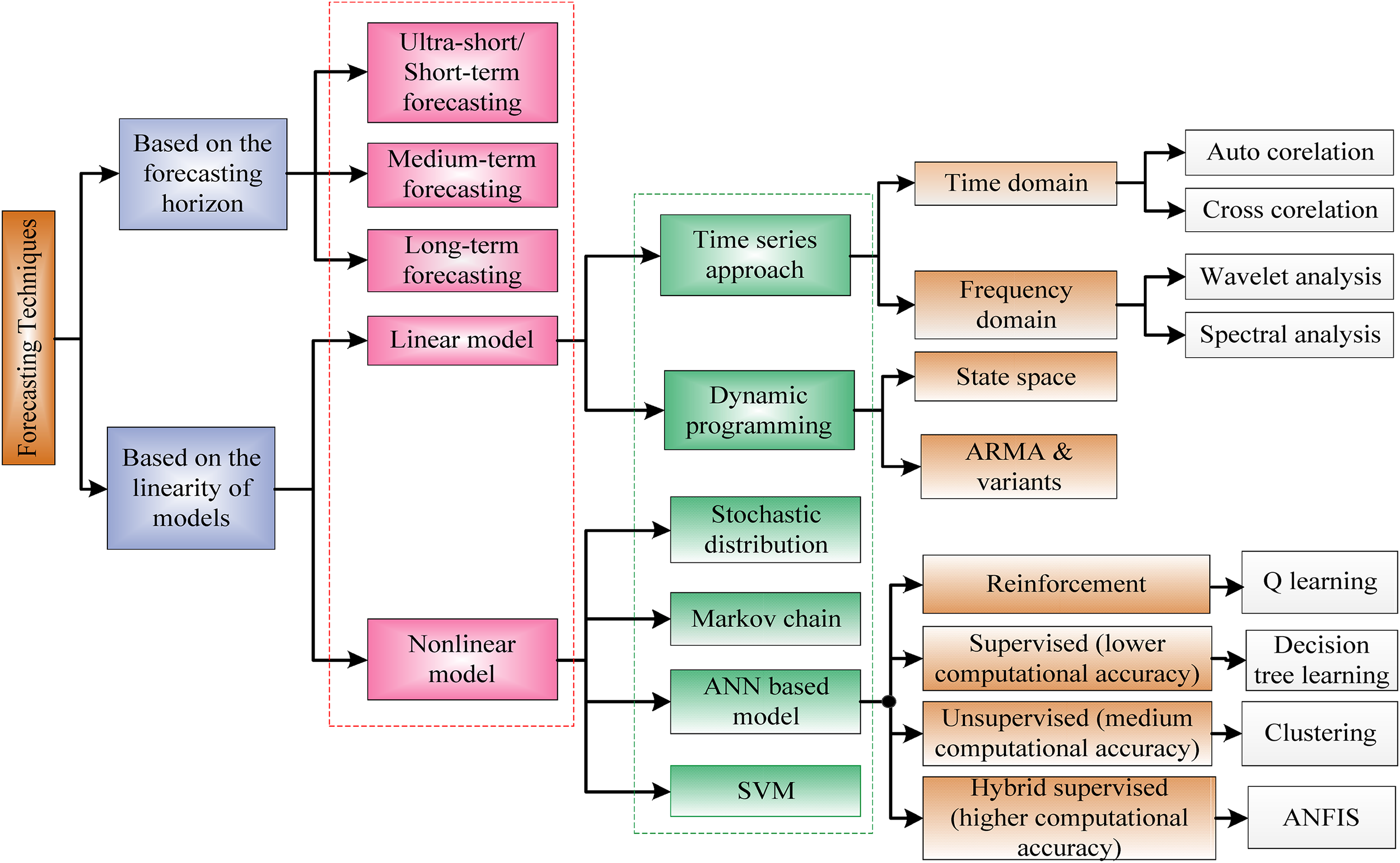
Classification of various forecasting models based on the type of time horizon with their learning capabilities.
Literature review of existing forecasting approaches with advanced techniques.

From Table 1, the performance of forecasting techniques can be evaluated for optimal DERs prediction for different time horizons. Also, comparative results of different time horizon metrics obtained the fitting algorithms such as linear regression during the next hour forecasting accuracy. In this paper, these results are compared and verified with the multi-layer perceptron (MLP) based short-term forecasting method. A recent study
37
has shown that intelligent-based forecasting of hybrid renewable energy resources for the prediction of dynamic energy generation. Short-term prediction of daily energy generation profile provides more accurate prediction based on predicted DERs value to ensure the real-time demand control.
38
In this paper, the main contribution is to design a high-accuracy framework based on the STLF for real-time electrical demand estimation and then validated the real-time data for the enhancement of the proposed intelligent framework. Further studies have shown in,
39
that the real-time hourly based STLF model is effectively employed in 20 zonal areas in the USA. The intelligent-based short-term forecast approach rapidly increasing in industries as well as the electrical power market because of the high system reliability and accuracy. The key contributions of the intelligent-based hybrid renewable resources forecasting, and real-time power demand management system are as follows:
Design the multi-input layer based To demonstrate an ANFIS-based model having better learning capability for the development of a real-time load power management system. The advantages of the proposed methodology are described in the optimal power scheduling framework and developed for the centralized optimal real-time load-demand management system.
The rest of this manuscript is organized as follows. Section II discusses the modelling of the mixed input-based ANN model, ANFIS, and the proposed framework for a real-time power demand management system. In Section III, data collection and normalization in order to train the real-time short-term forecasting system. Section IV demonstrates the simulation results of the ANN-based technique for the proposed site (Mahidad, Gujrat, India). In the last Section V, comparative performance analysis and error evaluation during testing as well as validation period. Section VI is concluding with key findings as well as the future scope of the proposed forecasting system.
Forecasting models and power demand management system
In the modern stochastic power system, forecasts of DERs are an indispensable tool for increasing system reliability and real-time power demand planning and control. As the power system networks grow larger, consequently the uncertainty of various loads also increases which directly changes the total load-demand profile drastically. As a result, it began to be extremely hard to forecast the unpredictable load-generation management. The forecasting of solar irradiance and wind speed is vital for the effective usage of hybrid renewable energy resources. Nowadays, the exponential rise of smart energy systems, which are intelligent based control frameworks such as smart scheduling of distributed energy resources (DERs), 40 stochastic electrified transportation, 41 smart energy distribution systems, etc. 42 This research explained the computational intelligence-based forecasting opportunities for the development of resilient energy systems. In the present scenario, artificial intelligence-based microgrid development is an emerging model. 43 Also, the ANFIS technique is employed for real-time short-term forecasting, in which the training is based on ambient temperature data and variations in dynamic load. 44 The designed hybrid ANN model has better efficiency with a correlation coefficient of around 97 percent for short-term forecasting based on daily data, but that forecast model was too complex. Later on, several researchers demonstrated a comprehensive case study for the short-term solar power prediction and DERs generation control strategies based on a variation of several inputs parameters such as irradiance, aerosol content, humidity, temperature, etc. 45 Further evolution of intelligent scheduling techniques directly helped to balance power requirements with a more intelligent electrical power grid. 32 Still, the major challenge is the dynamic stability of the power grid due to uncertainties in renewable energy resources which are directly associated with several environmental changes and load variation. Unexpected variation in load-demand profile causes various power quality issues and power system stability degradation. 46 Thus, the future growth of the energy sector directly depends on effective and reliable forecasting operations for power generation entities as well as end-user customers.
In this paper, the main attention towards the restructuring of generation electricity companies (GENCOs) to develop the intelligent based DERs scheduling and further order to provide real-time information for generation side management as well as end customers. In 47 research has described the intelligence-based approach to mitigate real-time energy management issues for the development of optimal energy scheduling. On the other hand, several research works were carried out in order to describe the problem associated with the inaccuracy of forecasting techniques as well as load-demand balance. The annual energy outlook report (2021) has demonstrated the feasibility analysis of intelligent-based long-term forecasts. 48 The report shows the projections of electric power consumption to 2050 for G-7 countries (USA, UK, Japan, France, Canada, and other countries). 49 In, 50 presented the improved feed forward-based ANN architecture and design of their training algorithms. The testing result shows that the LM model accomplished a better prediction with minimum mean error. Therefore, the main reason behind his research is using the cascaded-based neural network technique because that system gets better learning capability to adjustable weight function during the training and validation dataset. To maintain the load demand continuously for a specific region, short-term forecasting using the ANFIS model with the uncertainty of several metrological parameters. Research in, 51 demonstrated that the ANFIS technique has a better capability of electricity forecast demand than the conventional autoregression technique. Further in, 52 research presented for real-time study of ANFIS-based load prediction using constant output function by utilizing comparative analysis of hybrid and cross-entropy techniques. Later in, 53 a case study of a large number of physical variables is fed into a hybrid neuro-fuzzy system and training was performed based on 23 years of previous data (1980–2003). Further, the validation phase was taken for the year of three-year data (2004–07). The major drawback of this forecasted system is that there was a very large number of training as well as long-term testing data required. The neuro-fuzzy model constraints are too complex, and the system may lead to inaccuracy. Recent research,54,55 demonstrated the evaluation of deep learning in forecasting the wind speed for 30 min time resolution for London (UK), and Shiraz (Iran) case studies. The system validated the data set and achieved less accuracy than hybrid deep learning techniques in mean error results. Based on the outcome of these problems formulation, this paper implements the training data set of the solar irradiance/wind speed and further utilizes these energy resources in the power scheduling.
The forecasting of short-term renewable energy resources plays a vital role in the real-time DERs monitor for reliable and cost-effective microgrid operation. Intelligent-based real-time forecasting is a significant tool for daily peak load monitoring systems using short-term power demand prediction with time-varying from a minute to several hours. 56 This proposed system is suitable for hybrid (solar and wind) renewable energy-based micro-grid development, which comprehends the use of cascaded based short-term forecast of generation parameters and for the power-demand control using analysis of ANFIS technique. Alternatively, the wavelet neural network technique (WNN) can be implemented with either LM or GM models. But the outstrip of the WNN model needs modification for solar irradiance as well as wind speed forecasting. Therefore, the main reason behind utilizing the proposed cascaded technique is that it has a better and more flexible learning capability to adjustment in weight functions. However, the cascaded forward neural network architecture has dynamic flexibility during the training and validation period. 57 The efficiency analysis of both ANN and ANFIS models provides real-time demand distribution generation prediction for the generation. In the distribution generation site, a set of training data feed to the forecasted system. This data set is obtained from the testing site, which is based on several weather conditions and variations in environmental factors. The consideration of various environmental factors is very effective for accurate and long-term forecasting over a month as well as the prediction of a specific day.
Mixed input-based cascaded ANN network
In this section, a multiple-layer ANN is implemented based on supervised learning because it has the potential to characterize entire input data for forecasted data sets with output relationships. Also, if a large number of neurons is assigned in the hidden layer, then there will be a chance of a finite number of discontinuities. Generally, based on the learning horizon there are two types of ANN network flow i.e., feedforward or backward. A generalized and effective feedforward-based ANN is implemented with 2 hidden layers and each layer associating 10 hidden neurons to efficiently handle the correlated relationship between solar irradiance as well as other environmental variables such as ambient temperature, wind direction, pressure, humidity factor, cloud type, etc. Thus, the number of hidden layers, as well as neurons, were chosen by the trial-and-error evaluation approach to be tested. In this comprehensive study, the ANN with 2 hidden layers and each one having 10 hidden as the main structure of the existing MLP network with the initial layer estimator of the mixed input-based cascades artificial neural network
In Figure 2, the generalized inputs are fed through a certain weight limit in ANN architecture. The first layer signifies as 
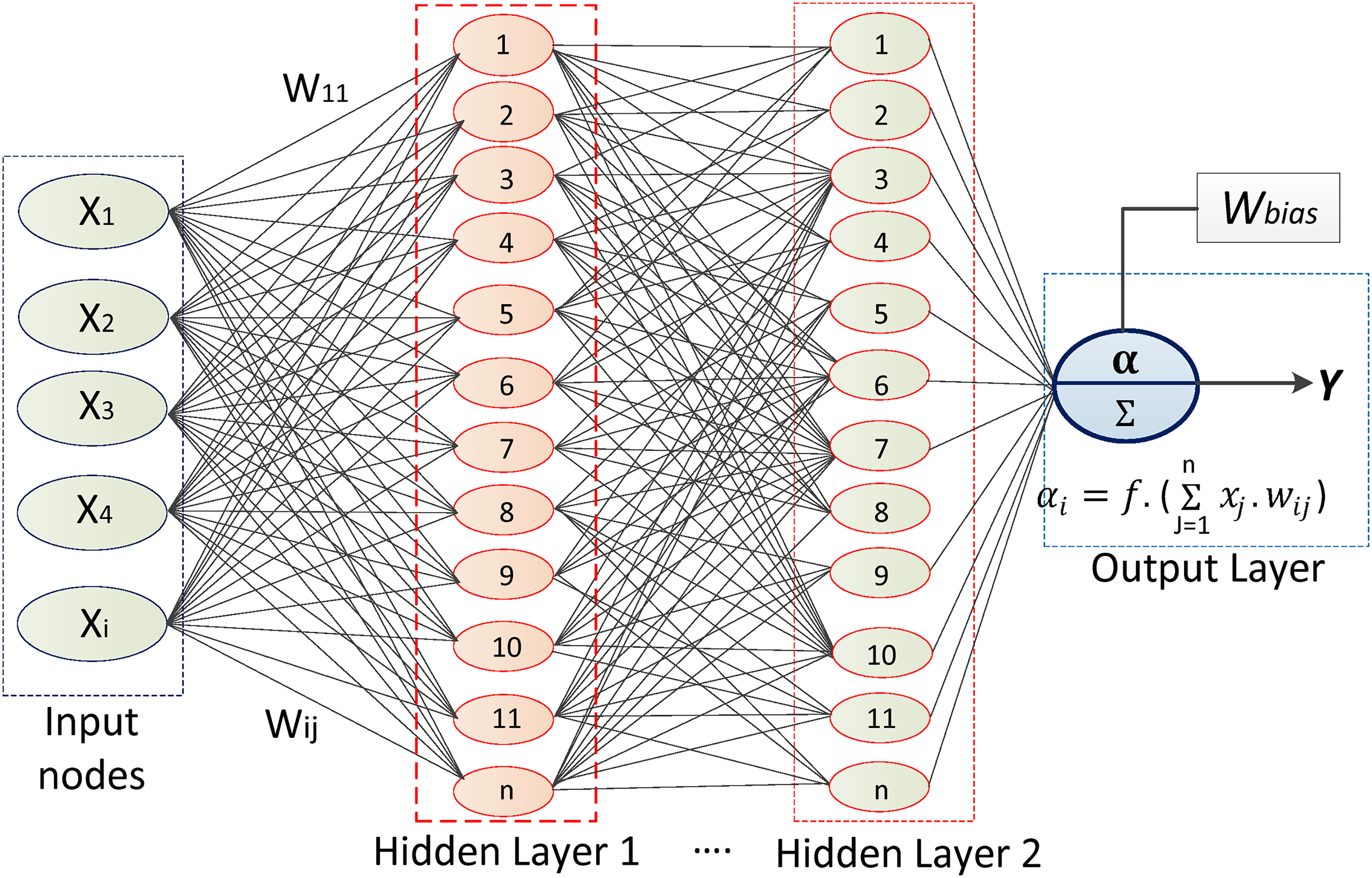
Architecture of feedforward ANN network with 2 hidden layers.
From Eq. 1, X is a training weight, d is the damping factor, 




ANFIS based power-demand cross-entropy model
The ANFIS has utilized the various features of a hybrid neuro-fuzzy-based FIS system that comprises the parallel computation of ANN with their controlled learning capabilities. In, 59 the ANFIS model is effectively utilized for short-term load demand forecasting under various factors that affect the generation in grid-connected systems. These factors are based on time and random effects, respectively. Thus, the cumulative load-demand characteristics are dynamic varying in nature.
The ANFIS model signifies the probabilistic-based approach which is employed for the prediction of various uncertain variables that comprises the overall system's performance.
60
Here, Sugeno is considered for Fuzzy Inference Systems (FIS), which has the capability to recognize the various non-linear system response characteristics. From Figure 3, the adaptive node output of the first layer (fuzzification layer) depends on several evaluation parameters such as 


Proposed ANFIS architecture.
The third layer is associated with a normalized value 


Objective functions and system constraints
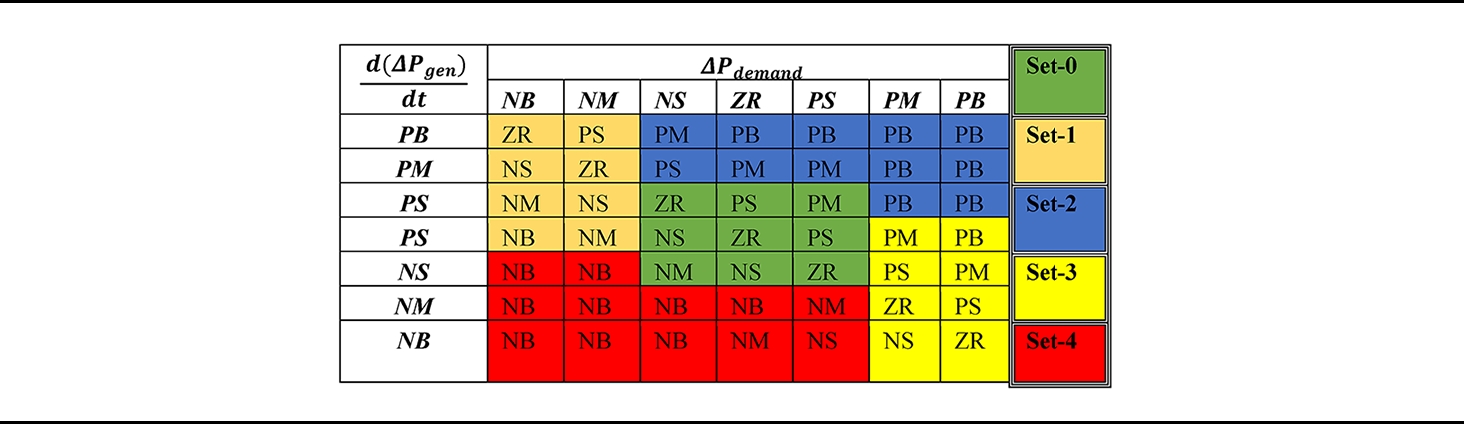
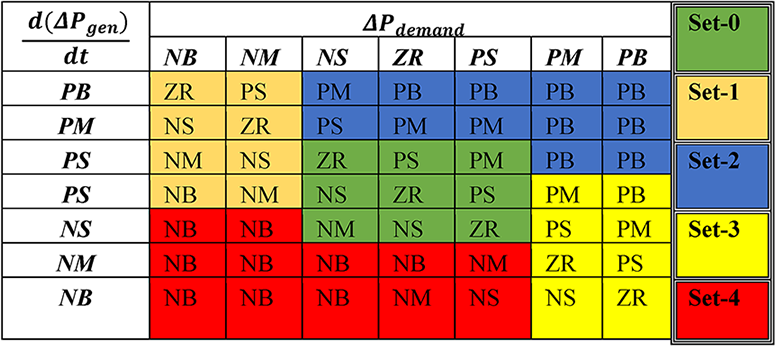
Due to changes in the metrological dataset, the adaptive system is providing the distinct capability to influence the execution of MFs for fuzzy controllers. As a result, the proposed FIS system is employed for enhancing the standard rules base. So that the control of real-time load-demand variations is achieved to increase the designed system performance. But the real-time data set are fluctuating regularly, which is further changed into the two additional parameters (peak power demand and available generation). In Table 2, the adjustment in rules bases is classified into the five sets (0–4) using the assumptions of generalized rule. Minimizing the 
Proposed FIS logic rule base.
This real-time-optimal system model satisfies the entire constraints. These optimal solutions are achieved by the coefficient's functions for demand, generation, and controlled power in Eq. 13.


Membership function of FLC.
In Table 2, the fuzzy rule base variables within the range of [-1, 1], which signify as Negative-Big (NB), Negative-Medium (NM), Negative-Small (NS), Zero (Z), Positive-Small (PS), Positive-Medium (PM), and Positive-Big (PB). Generally, power demand control provides enhanced results for non-linear systems and also delivers the system instinctive from the fuzzy rule base.
63
If
In Table 2, the Set-0 demand power variation
Description of proposed fuzzy inference system.

A proposed framework of real-time demand management
In, 64 a comprehensive analysis of a neuro-fuzzy adaptive algorithm is presented for the hourly basis forecasting of energy management using short sample time-series data. That has a specific FIS rule base on real-time demand management. On the other hand, due to a small variation in the generation side, STLF forecasting accuracy reduces under the implementation of multi-layer sub-processing units. The Intelligent based forecasting of DERs (solar irradiance and wind speed) is the furthermost cost-effective as well as positive means of assimilating the utilization of clean energy into the utility. The forecasting of solar irradiance, as well as wind speed, is essential for ensuring consistency in hybrid restructured power systems operational because these resources are associated with an appreciable degree of meteorological penetration. The proposed framework can be compatible with Distribution Electricity Companies (DISCOs) to enhance their monitoring ability during peak demand. As a result, the effective usage of renewable energy-based power generation (solar and wind power) can be enhanced for the shift of peak load demand to a significant level. Therefore, the real-time demand management system is more compatible rather than conventional independent system operator (ISO) control.
The real-time power management system is subdivided into three major processing units, which are referred to in Figure 5. The first stage is the data collection unit for DERs forecast, which is an initial processing unit. Generally, short-term forecasting of solar irradiance and wind speed are analogous phenomena. Several variable factors are dependent on the metrological as well as environmental factors such as cloud formation, aerosol content, etc. But here assuming only the ambient temperature, humidity, and specific daytime as a training data set for further execution of data into mixed input-based cascades artificial neural network model. The time-series approach represents the estimation of electricity generation from the PV/wind generation system over a specific time slap. In the training stage, the DERs data set is transferred as the input values to
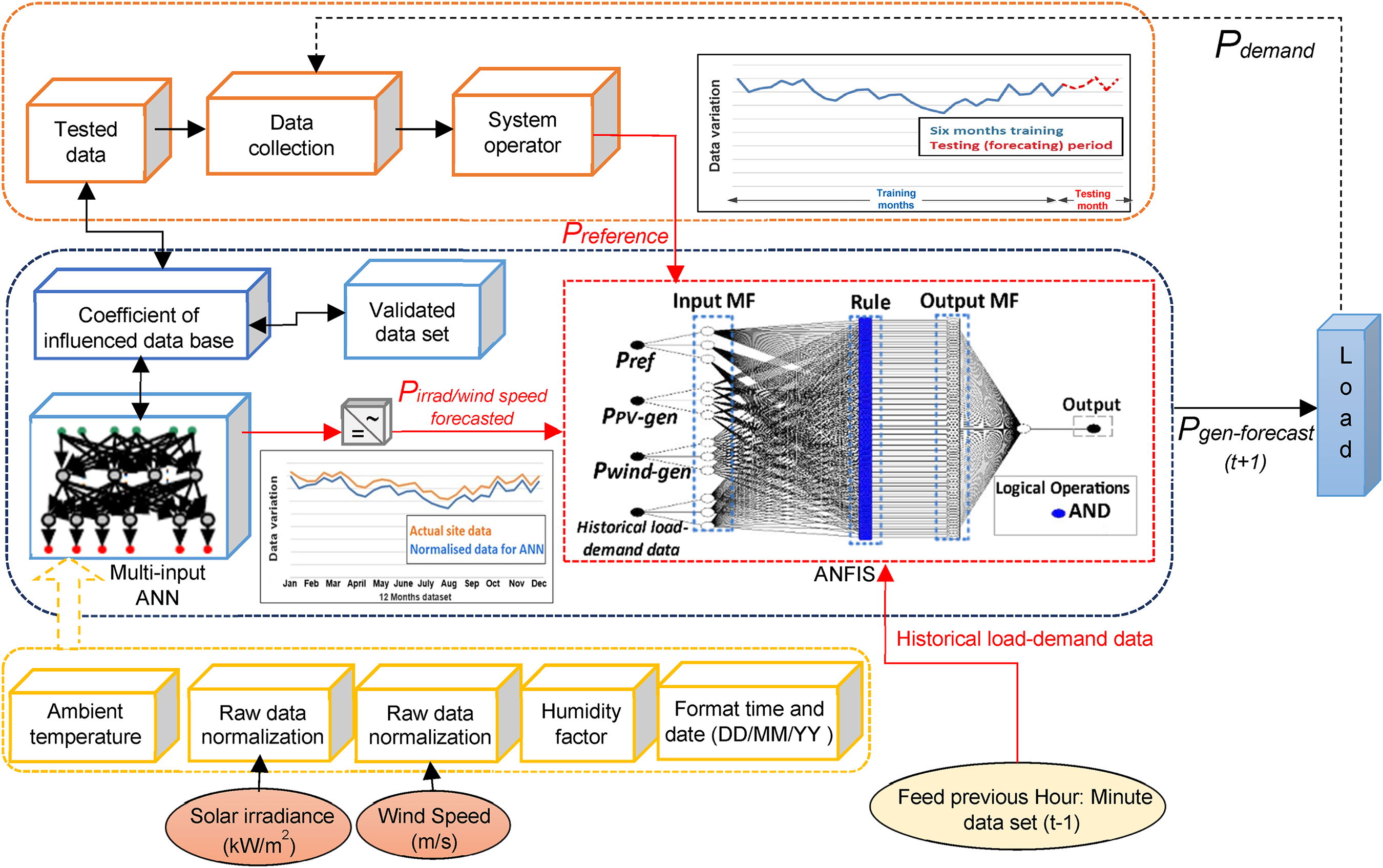
An external framework of ANN-based DERs forecast model and ANFIS for real-time power-demand management.
The second layer has two segments, the first one is the data learning that provides self-learning capability under different metrological input data and uncertainties of the generated power forecast followed by a regression plot. In the last layer, there is the feeding of the data set into a data storage unit and further use of this information in ISO units. This centralized processing unit is based on real-time demand predictive control scheme, which is capable of exactly mimicking the reference demand power values based on the corresponding load-demand variation. Typically, we use it to obtain the Euclidean distance of the vector equal to a certain predetermined value, through the transformation below, called min-max normalization:
Data collection and training approach
The ANN-based short-term forecast provides an effective analogous prediction phenomena as of the time series approach.
65
Here, training of irradiance and wind speed is carried out using the short-term ahead predicted value. For smooth and reliable power system operation, short-term forecasted data sets relied on several aspects such as load variation prediction, line status, power generation status, etc. The DERs information directly helps us in pre-planning and post-management of power demand against various uncertainty in grid systems. However, the designed forecasting model of wind speed is like solar irradiance forecasting due to almost similar environmental dependencies such as time of day, ambient temperature difference, cloud motion, humidity, etc. The Experimental Weather Prediction (EWP) is a physical system operator, which is implemented for efficient forecasting with respect to the time-series horizon over the desired test period. The EWP model is based on each hour time resolution, which realizes the forecasting of solar irradiance based on the spatial resolution for a specific data set. This approach provides precise prediction by system outcome up to the day ahead of time. In the EWP model, the satellite viewer function works based on the cloud images for predicting cloud movements and sky imagers are installed on the forecasting sites. So that it can be developed an efficient way of predicting the next month's data based on several meteorological factor variations. The variations in renewable energy resources also depend on several environmental factors such as time of the day, cloud formation, aerosol content, humidity, etc. These forecasted short-term data also depend on various variable factors such as time effects (atmospheric, seasonal changes, sudden contingency, storms, etc.). So, it is very difficult to forecast the DERs corresponding to the load variation. In this study, the
Demonstration of 12 h of data classification at mahidad, India, forecasting site. 66
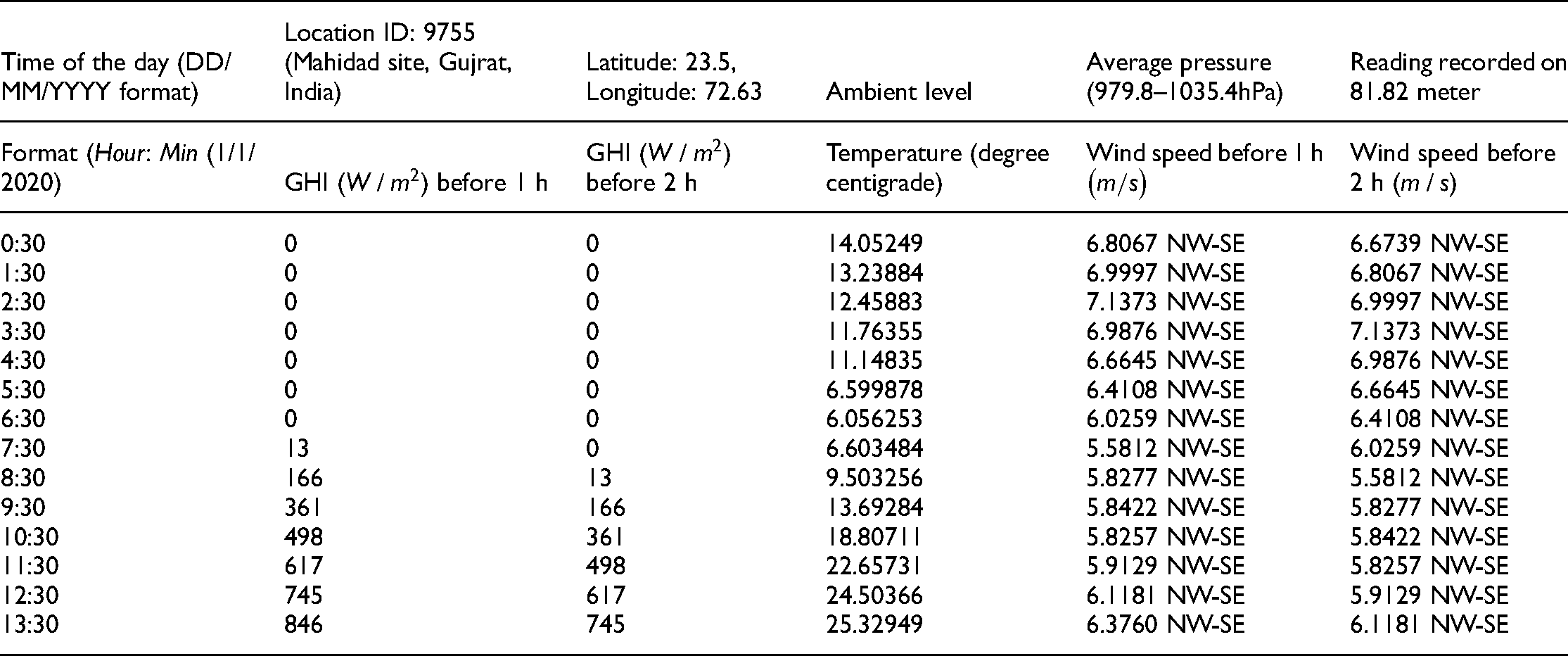
The practical real data set of the proposed site consists of 36730 samples for solar irradiance forecasting and 36730 samples for wind speed forecasting (historical data from 1 Jan 2020 to 31 July 2020) which is divided into the subsamples of training, validation, and testing. A simulation study is shown in Figure 6, the hourly average speed is 6.811 (m/s) recorded at the height of 81.82 meters in the proposed site. The data set for the month of June 2020 was used as the testing data set. The average pressure (979.8–1035.4hPa) and air density (1.2–1.4kg/m3). For solar irradiance and wind speed forecasting, the input data set are taken as a 36730 × 1, which signifies the data normalization of each input variable. While the targeted data set is taken as 5510, which signifies the function fit for forecasting components. These 36730 samples were divided in such a manner that the training data set was taken as 25710 samples which are about 70% of the total data. On the other hand, the validation (15%) and testing (15%) data sets are taken as 5510 samples of the total data set, respectively. This data set of average wind speed
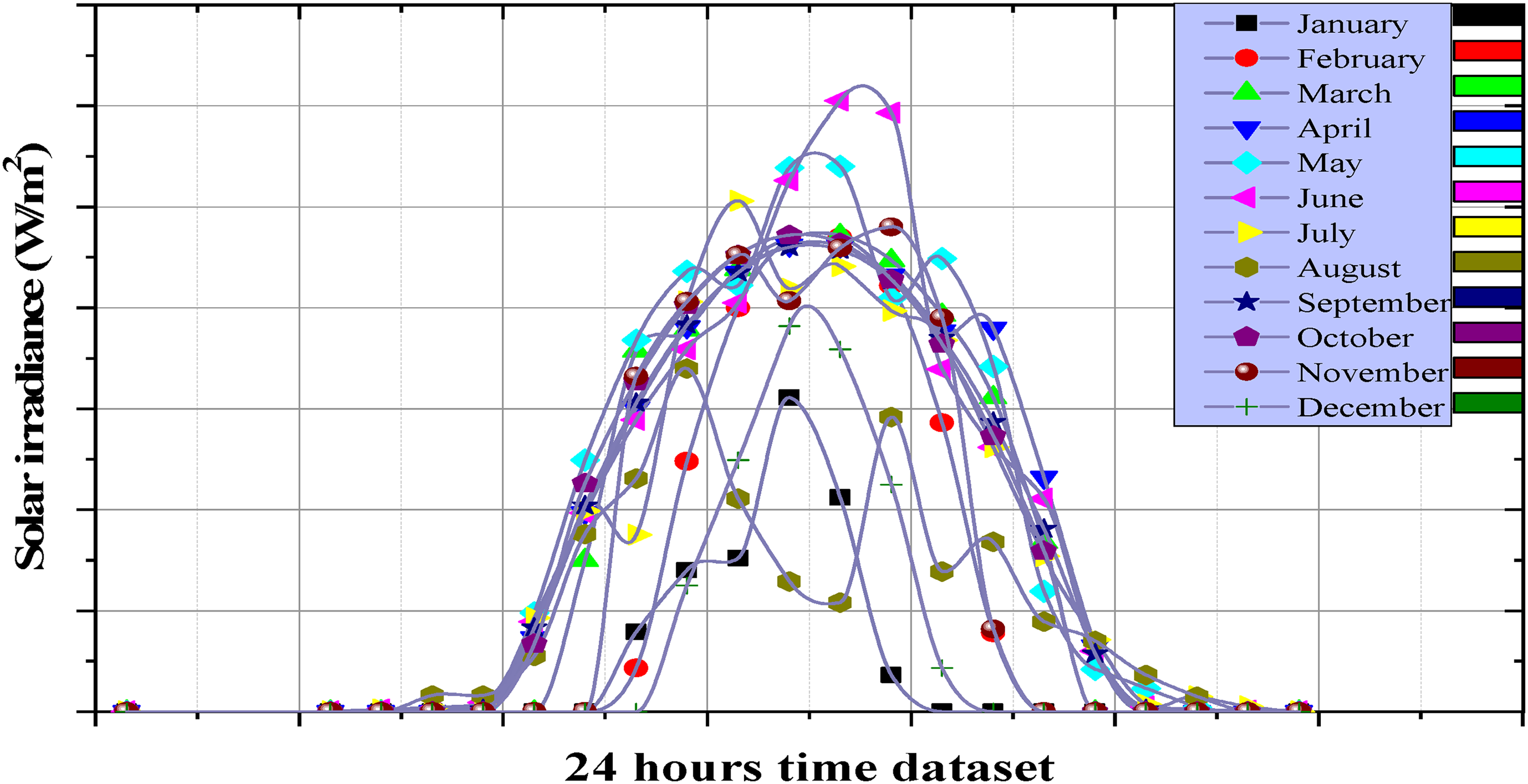
Executed irradiance data set (referred from Table 4).
The yearly based normalized data sets are divided into daily possible mean irradiance and wind speed variation. A similar calculation can be employed for both wind speed and solar forecasting. A single algorithm is designed for both forecasting parameters because of analogous behavior. For the forecasting of GHI and its real-time data execution, all dependent parameters should be considered. These factors are dependent on cloud fraction (

Figure 7 shows the training state of
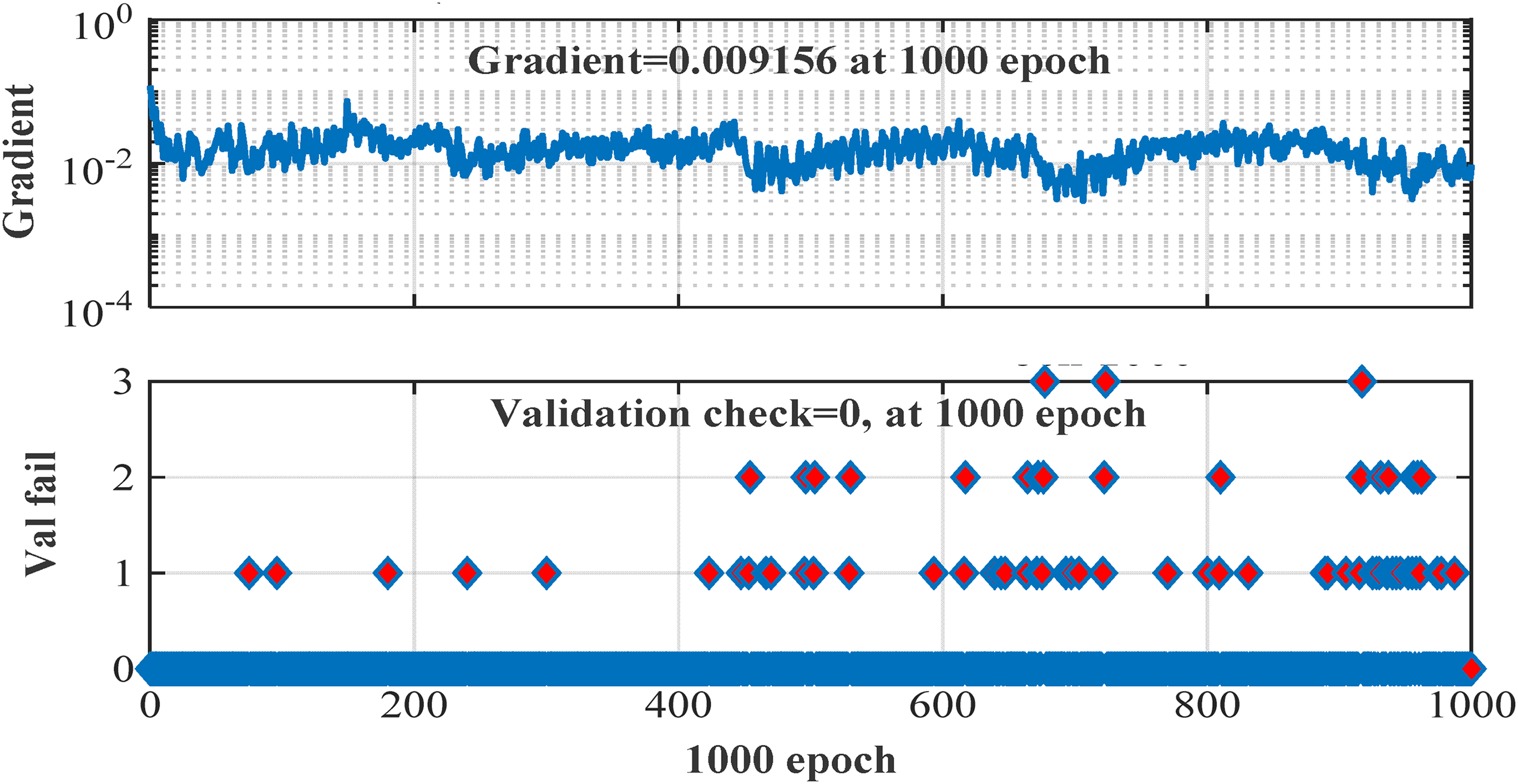
Training state of
The output characteristics of solar-generated output power (
Where

Simulation characteristics of data considered in the proposed location for the solar irradiance prediction. (a) Solar irradiation. (b) Solar temperature.
Simulation results
The proposed methodology used a very short-term series data set in,
66
which is implemented in the MATLAB fitting toolbox. The normalized irradiance amplitude is being measured as [0–1000]
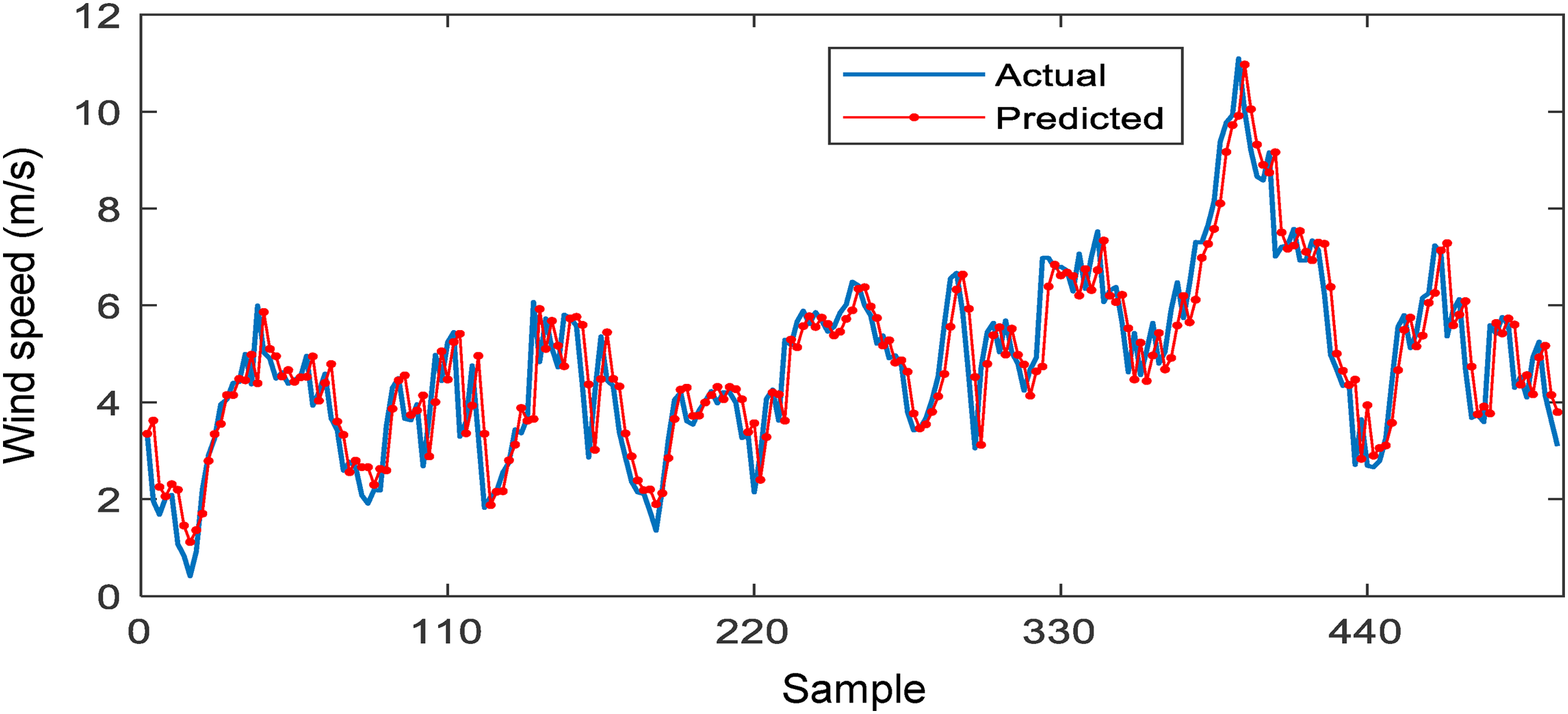
Validation of actual wind speed vs forecasted
Normalized input data set is taken for training to forecasting wind speed

Load power forecasted variation with respect to actual values.
To validate the forecasted data set, the implementation of the proposed methodology is analyzed on a fluctuating load site. Thus, the real-time data set of renewable energy resources was implemented from the Mahidad site in Gujrat state, India.
66
While the load-demand management is carried out by the ANFIS-based model in the proposed site. To study the model performance based on seasonal variations, our proposed case study is a demonstration of one-hour-ahead load forecasted demand for the summer season (in the second week of July) of the year 2020. the input data is taken as a time series graph for the load variation with respect to demand. From Figure 11, the maximum load was observed as
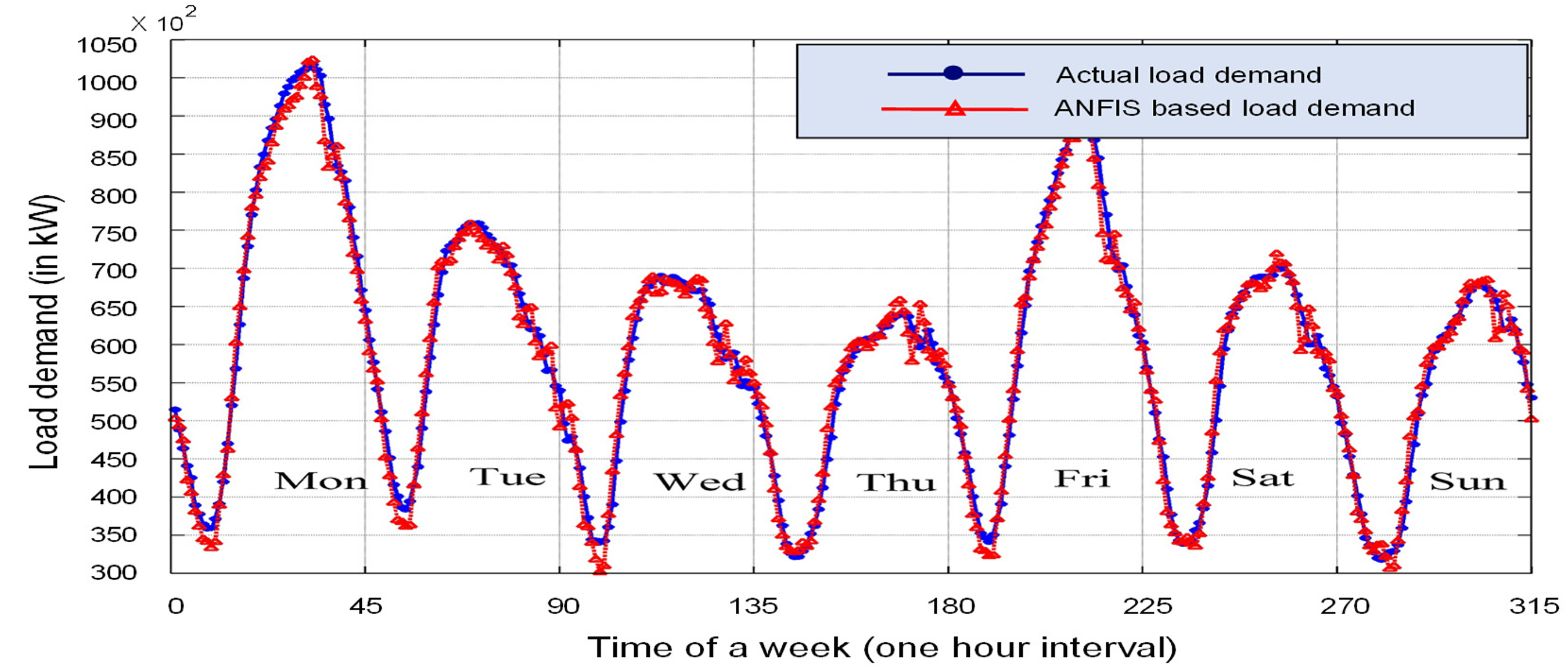
Average weekly power response results from 13 to 19 July 2020 data set.
In the proposed site, the maximum residential load-demand is approximately
Error evaluation and performance analysis
The real-time forecasting analysis is significant for the load-demand validation at regular instants. The error must be checked continuously at regular intervals until the training mechanisms stop. Usually, the maximum learning rate of the ANN model is in between the ranges of 0 to 10. If variation occurs in weight functions, then the learning rate appears as a quantifier followed by data acceleration. If the learning rate depicts the low forecasted value that means changes occurring in the weight vector so that one epoch changes to the next epoch. If the learning rate specifies a high value that means it is undesirable to the network, which may lead to the risk of overshooting.
68
Thus, the proposed ANN network is associated with a slow learning rate that takes more operational time. Figure 12 describes the error histogram plot during the training process. Here, the overall error ranges of the
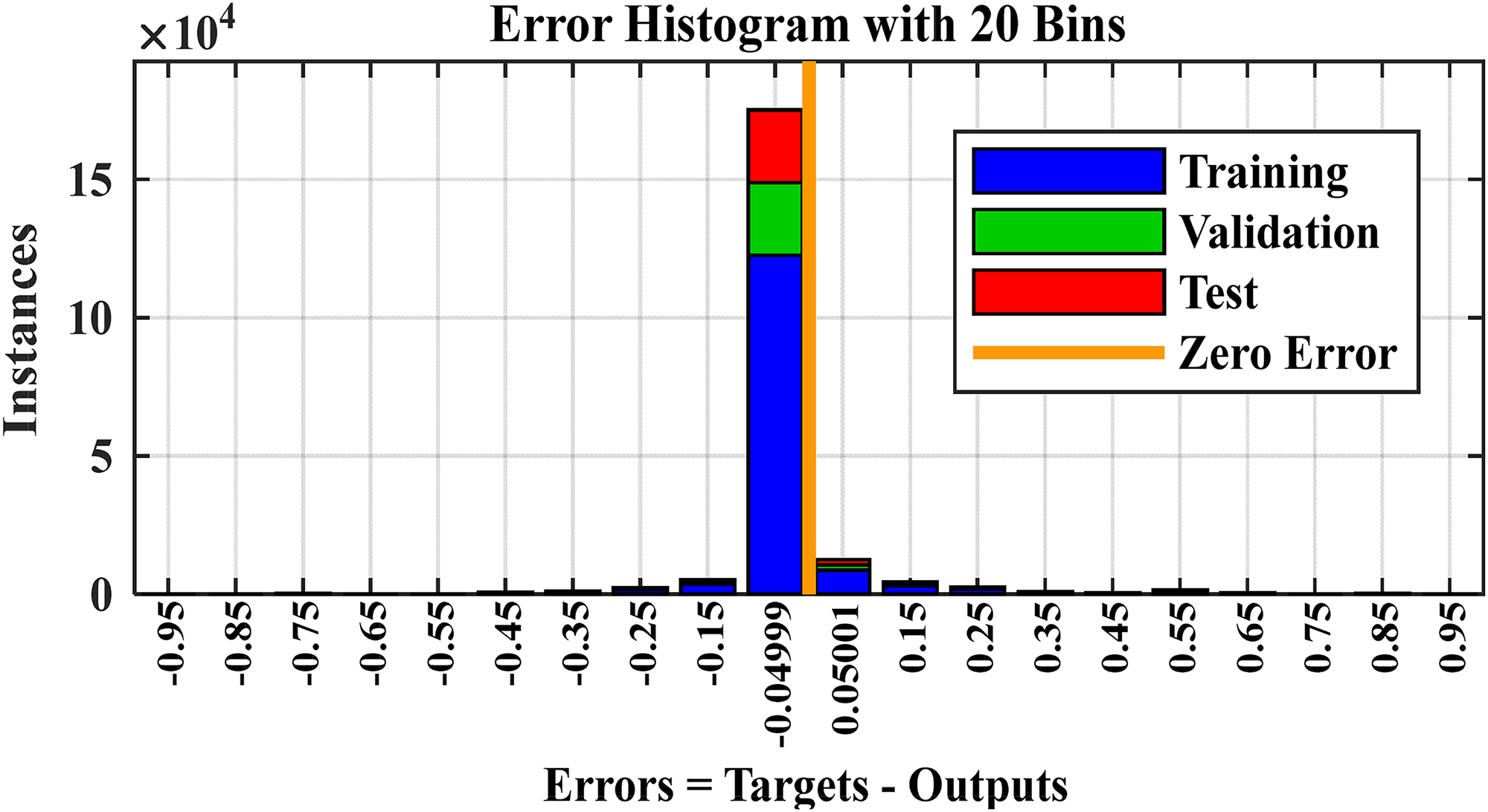
Error histogram of
Here, the LM-based ANN model plot provides the overall optimal prediction. Also, a similar algorithm is designed for short-term solar irradiance as well as wind speed as input variables.
66
Since, the forecasted plot of short-term solar irradiance is analogous to short-term wind speed forecasting, which is based on environmental variation and dynamic nature. In the case of extreme penetration of metrological factors (cloud level, aerosol content, etc.) in which the characteristic of short-term irradiance and wind speed is predicted. From Figure 13, the best validation performance is at 992 epochs for the effective operation of forecasted systems. The

Best validation performance of
Figure 13 shows the best validation performance plot of the trained datasets for further testing as well as validating the proposed system performance. Here, it is depicted that when the epochs are increasing, then the error
In this study two dependent variables (
Here, the value of
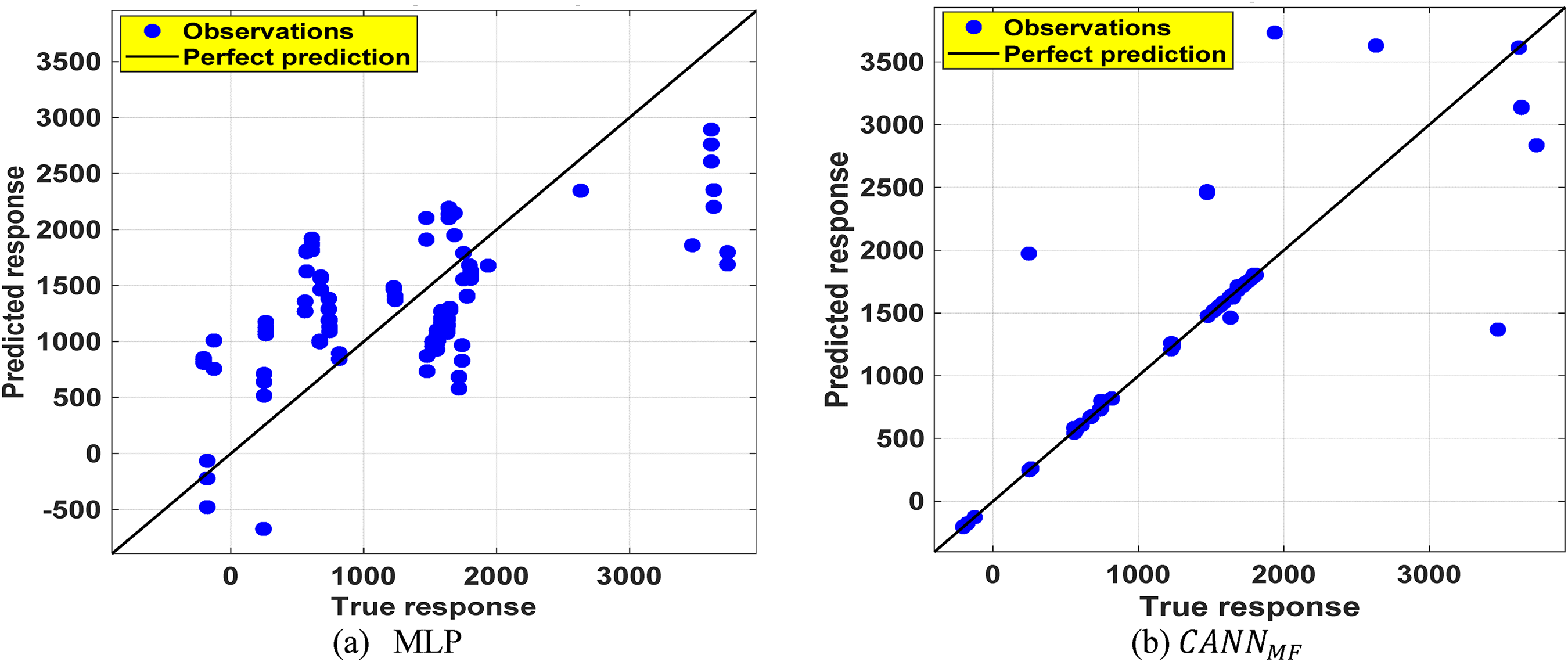
Plot fitting of regression plot for 36730 recorded samples (183 solar days). (a) MLP. (b)
Table 5 shows the range of regression values in all these three phases (training, testing, and validation). So, the value of R is within 1. The forecasting accuracy was estimated by computing the MSE between the actual and forecast values. The MSE and RMSE of the proposed methodology using ANN as well as ANFIS-based real-time model that can accomplish better prediction with minimum error. Furthermore, this proposed intelligent-based hybrid renewable energy system implements the extension of these Simulink results, which are obtained from real-time operational and performance analysis. To evaluate the forecasting efficiency of the proposed ANN model, similar features of the input data set is used for training purpose with the MLP model MATLAB Simulink tool. From Table 5, the forecasting results are depicted that the designed
Error analysis of proposed forecasted system.
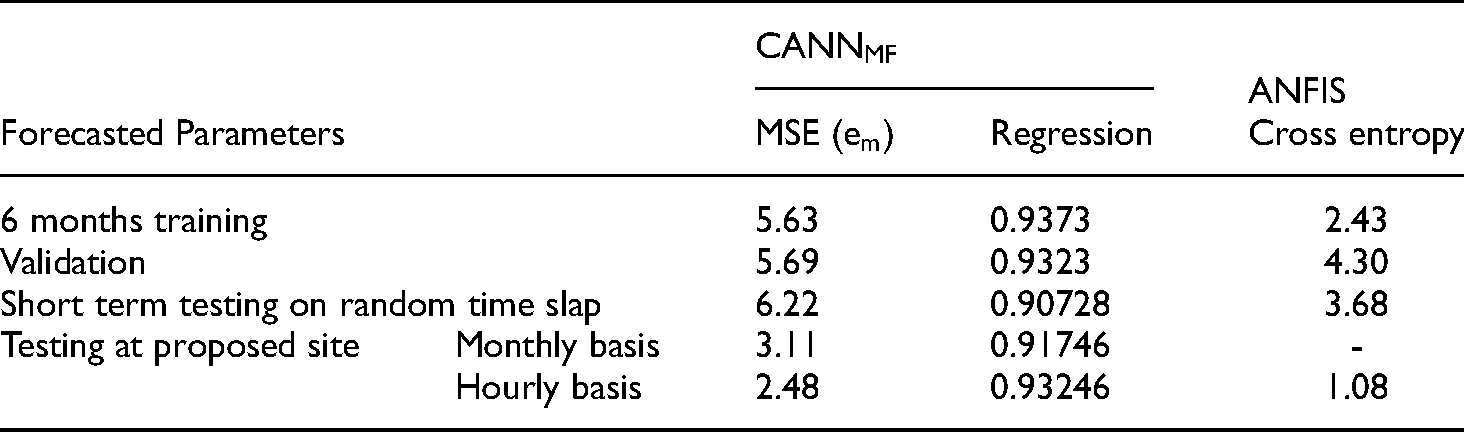
As concluded in Table 6, the designed
Quantitative analysis of the proposed system with another intelligent technique.

Conclusions
The ANFIS model demonstrated a better approach for the effective utilization of hybrid renewable energy resources with an enhanced forecasting accuracy. The testing results of the mean error and cross-entropy is less than 5% under a specific slap of the day at the proposed site. The proposed real-time power demand management approach has been optimally designed by the ANN-based DERs forecast model for optimally utilizing the solar and wind-generated power under different environmental variations. Also, the proposed methodology shows that
Future work will be developed optimal control strategies with the consideration of several input metrological parameters such as aerosol content, humidity, and air density for the feasible operation of resilient energy systems. The future study will be comprising the real-time hardware setup with the existing one and testing on the multi-microgrid system. The simulation results can also be incorporated with time horizon forecasting under several environmental factors such as peak demand periods of the day, cloud formation, aerosol content, etc. in order to achieve the real-time long-term forecast Here, the real-time power management system is implemented in a multi-agent-based independent system controller that regulated several aspects of grid parameters to resolve the peak demand imbalance issue.
Footnotes
Nomenclature
Indices and parameters
Acronyms and abbreviations
Declaration of conflicting interests
The author(s) declared no potential conflicts of interest with respect to the research, authorship, and/or publication of this article.
Funding
The author(s) received no financial support for the research, authorship, and/or publication of this article.

Author biographies
Mohammad Amir, received a B.Tech. degree in Electrical Engineering from Integral University, Lucknow, India, in 2015, and an M.Tech. degree in specialization of Power Electronics and Drives from the Madan Mohan Malaviya University of Technology (MMMUT), Gorakhpur, India, in 2018. Currently he is a researcher in the Department of Electrical Engineering, Faculty of Engineering & Technology, Jamia Millia Islamia (A Central University), New Delhi India. Amir was a recipient of Ministry of Human Resource Development (MHRD) fellowship. He was Graduate Aptitude Test in Engineering (GATE) fellow in specialization of electrical engineering from 2016 to 2019 and qualified of Faculty Aptitude Test of Engineering (FATE) conducted by AKTU in 2018. He has published many journal articles and book chapters, and presented papers in international conferences. Amir is an active IEEE young professional of Asia pacific in 2021-2022. He is a Research and Academic Coordinator, IEEE Delhi Section, India, Region-10, associate member of the International Society of Energy and Built Environment, Australia, and a member of Autonomous Vehicles and Systems, ASME, USA. Also, he is an associate member of the International Society for Energy Transition Studies. He is a reviewer of many prestigious journals and conferences. His current research interest includes intelligent optimization techniques, renewable energy, energy management, electric vehicle, energy storage, and smart grid.
Zaheeruddin, is currently a professor in the Department of Electrical Engineering, Faculty of Engineering & Technology, Jamia Millia Islamia (A Central University), New Delhi India, since 2003. He received a B.Sc. Engineering Degree in Electrical and M.Sc. Engineering Degree in Electronics & Communication from Aligarh Muslim University (AMU), Aligarh (UP) in 1982 and 1988 respectively, and a Ph.D. Degree in Computer Science and Technology from Jawaharlal Nehru University (JNU), New Delhi in 2002. He attended Welex Engineers Development Course at Duncan, Oklahoma, USA from March 5, 1984, to May 25, 1984. He was Visiting Researcher at the University of Missouri-Columbia, USA, in 2003. Zaheeruddin is a Fellow of IETE (India) and Life Member of World Federation of Soft Computing (USA), The Institution of Engineers (IE, India), Computer Society of India (CSI), Indian Society for Technical Education (ISTE), The Indian Science Congress Association (ISCA), and Indian Chapter of The International Centre for Theoretical Physics (Indian Chapter of ICTP). Zaheeruddin has published several research papers in International Journals and Conferences in the areas of Artificial Intelligence, IoT, Soft Computing, Noise Pollution, Wireless Sensor Networks, Optimization Techniques, and Smart Grid. He is a reviewer of many international journals of IEEE, Elsevier, Springer, and ACTA Press etc.
Ahteshamul Haque, received a B.Tech. degree in electrical engineering from Aligarh Muslim University, Aligarh, India, in 1999, a master’s degree in electrical engineering from IIT Delhi, New Delhi, India, in 2000, and a Ph.D. degree in electrical engineering from the Department of Electrical Engineering, Jamia Millia Islamia University, New Delhi, India, in 2015. Prior to academics, he was working in the research and development unit of world-reputed multinational industries, and his work is patented in the USA and Europe. He is currently an associate professor with the Department of Electrical Engineering, Jamia Millia Islamia University. He has established Advance Power Electronics Research Laboratory, Department of Electrical Engineering, Jamia Millia Islamia. He is working as a Principal Investigator of the MHRD-SPARC project and other research and development projects. He is the recipient of IEEE PES Outstanding Engineer Award for the year 2019. He has authored or co-authored more than 100 publications in international journals and conference proceedings. He is a senior Member of IEEE. His current research interests include power converter topologies, control of power converters, renewable energy, and energy efficiency, reliability analysis, and electric vehicle operations.