



Abstract
Polymerase chain reaction (PCR) inspection of salivary analyte is performed by pretreatment, RNA extraction setup, RNA extraction, PCR setup, and the PCR process. However, the pretreatment process is conducted manually, and it is a bottleneck to the overall process. The author created automatic preprocessing logistics and prototypes using robotic technology for the pretreatment process. A dissolving agent of saliva is poured into the salivary container, the transfer syringe is automated, and a transfer robot injects an inactivating solubilizer using a robotic hand. Ninety-six inactivated vessel units are processed for the next RNA extraction process. The automatic preprocessing equipment is successfully developed and used in the inspection at a hospital. Pretreatment efficiency is up to eight times greater compared to that with the conventional manual process. The 96 units/h inspection is made possible by a single of equipment. The developed automatic preprocessing method assures high efficiency, standardization, and safety for coronavirus inspection.
Introduction
Coronavirus is spreading throughout the world. Currently, large numbers of positive and negative discriminations for coronavirus infection need to be provided in a short time using saliva inspection analytes. It is necessary to carry out polymerase chain reaction (PCR) inspection of the salivary analyte. This is performed by an analyte pretreatment process, where a dissolving agent of saliva and inactivating solubilizer is poured into an inspection container.1–16 However, the pretreatment process is conducted manually, which causes a bottleneck to the overall procedure. Process automation is required from the perspective that it impacts efficiency, standardization, and safety for coronavirus inspection. The author designed and developed a new automatic preprocessing equipment to process salivary analyte for PCR inspection of coronavirus.
Developed equipment
PCR inspection of salivary analyte is performed by pretreatment, RNA extraction setup, RNA extraction, PCR setup, and the PCR process. PCR priming for analysis requires saliva lysing; this involves inactivation by the addition of a solution to the PCR vial. Extracting the RNA purifies the sample biologically, retaining only the RNA. Ribonuclease enzymes, inherently present in cellular and tissue structures, tend to damage RNA very quickly, thus necessitating a fast and efficient process. This process is initiated by the PCR DNA segment injected into an appropriate vial and the correct chemical reagent. 17 It is important to note that the pretreatment process is conducted manually, and it causes a bottleneck to the overall method. However, after the RNA extraction setup process, the additional following processes are automated. The efficiency of the pretreatment process is eight times greater compared to that of the other processes. The author creates automatic preprocessing logistics and prototype equipment using robotic technology. The developed equipment is shown in Figure 1. An illustration and the basic design were made using computer-aided design (CAD), which is the Design spark mechanical 3D CAD software as shown in Figure 2. The dissolving agent of saliva is poured into a salivary container, and an automated syringe is used to transfer the inactivating solubilizer using a robotic hand. The control logistics are based on sequential control, shown in Figure 3, and installed in the control device. The reactive liquid is poured automatically by the white tube on the upper right in Figure 1. The syringe position is at the Transfer syringe (use-and-dispose) circle on the left side, the test tube position is at the Inspection container circle on the right side, and the container circle is at the Salivary container circle in the middle of Figure 2. The time for the pretreatment PCR inspection per vessel is 37 s, which means the inspection of the 96 units is completed within 1 h by the mechatronics and logistics. The 96 inactivated vessel units are processed and ready for the next RNA extraction process.

The developed automatic preprocessing equipment.

Computer-aided design (CAD) of the pretreatment process.

The control logistics.
The pretreatment PCR inspection test using this equipment was conducted from May to July 2020 for the first time.
Trial test of preprocessing equipment in the hospital
The automatic preprocessing equipment is successfully developed and the basic logistics of the process were tested at Nagasaki University. Pretreatment efficiency is up to eight times greater compared to that of the conventional manual method. The 96 units/h inspection is possible using a single piece of equipment. The developed automatic preprocessing process assures high efficiency, standardization, and safety for coronavirus inspection. The equipment system is the first invention of its kind in the world. 18
Improvement of analyte container and robotic hand
To operate the PCR inspection device using a salivary analyte, various shapes of analyte containers from clinics need to be set up automatically using a flexible gripping robotic hand device. Typical analyte containers are newly developed cup-shaped containers (40 mm in diameter) shown in Figure 4 and cylindrical shape containers (20 mm in diameter) shown in Figure 5.18,19 The material of the container is plastic; however, replacement of the plastic with a reusable ceramic type would be more environmentally friendly. The grip of the robotic hand is configured based on an elastic oscillating fin mechanism20–24 used for the robotic fish fin shown in Figure 6. The author plans to use a magnetic fluid sheet inside the gripping part shown in Figure 7 to provide a more reliable and delicate grip. Also, the author intends to reduce delay time intervals by improvement of robotic control systems. 25
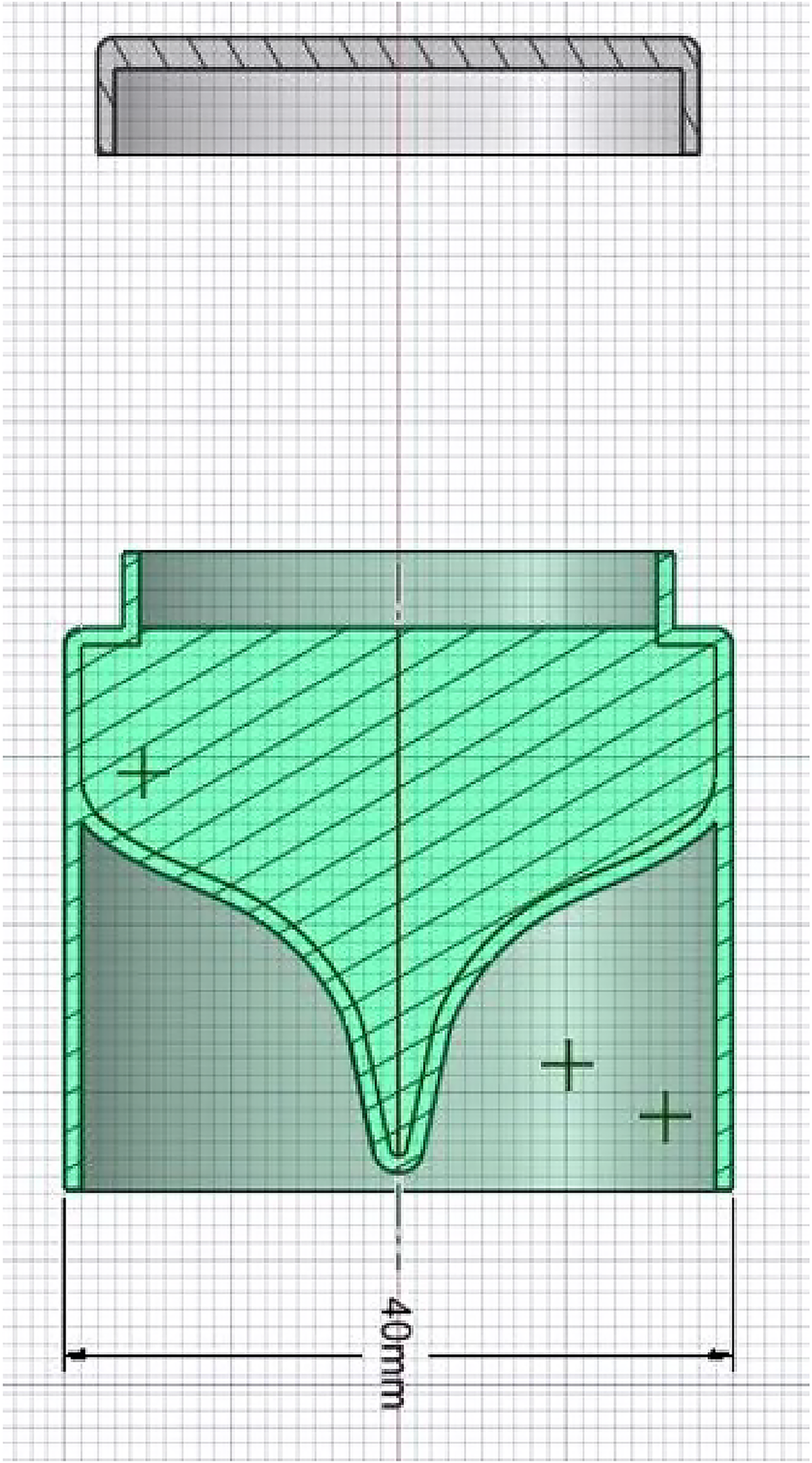
Cup shape container.

Cylindrical shape container.

Robotic hand.

Magnetic fluid sheet.
Conclusion
The automatic preprocessing equipment of salivary analyte for inspection of coronavirus based on the developed system is prototyped and successfully operated in a hospital. The 96 units/h inspection is possible using this single equipment. This developed automatic preprocessing method assures higher efficiency, standardization, and safety for coronavirus inspection.
Footnotes
Acknowledgments
Finally, the author would like to thank members of Nagasaki University (President Shigeru Kohno, Prof. Katsunori Yanagihara, etc.) and Mr Akira Takata, Japanet Takata Co., Ltd, for their support in this research.
Declaration of conflicting interests
The author(s) declared no potential conflicts of interest with respect to the research, authorship, and/or publication of this article.
Funding
Also, a part of the research was supported by JSPS KAKENHI Grant Number JP 21K12753.

Author biography
Appendix
The detailed process is broadcasted by many televisions in 2020. For example, kindly refer to the following websites.