



Abstract
Heterostructure Ag-AgVO3/Cu2O photocatalyst was prepared by the hydrothermal procedure. The prepared photocatalysts were characterized by different physico-chemical techniques. For Ag-AgVO3/Cu2O composites, AgVO3 shows the monoclinic phase whereas Ag and Cu2O show a cubic phase. SEM images of Ag-AgVO3/Cu2O composites illustrated that the surface of AgVO3 nanorods was covered by Ag and Cu2O nanoparticles. Ultra violet − visible diffuse reflectance spectra revealed that the calculated optical response of Ag-AgVO3/Cu2O composite was found to be 2.24 eV. Additionally, the composite catalyst demonstrated improved photo-efficiency for the decolorization of methylene blue dye compared to that of pristine AgVO3. The better performance of the composite sample can be ascribed to its high charge separation and inhibition in recombination of charges in Ag-AgVO3/Cu2O catalyst Finally, this heterostructure Ag-AgVO3/Cu2O catalyst demonstrated good stability which simply can be recycled a number of times with steadiness; thus, unwraps new possibilities for applications as innovative photocatalyst
Introduction
Dyes include a significant part of water wastes that are released in large amounts by manufacturing industries. Because of the widespread use of organic dyes, an excessive quantity of potentially cancer-causing compounds enters our water supplies. Numerous methods like adsorption, 1 micellar-enhanced ultrafiltration, 2 nanofiltration 3 and sedimentation 4 are being used to degrade these compounds. Although these techniques are convenient and valuable, they produce secondary waste products which require further treatment. A novel, innovative and more efficient method known as advanced oxidation processes (AOPs) has been used for the decontamination of wastewater effluents. Among the various approaches being used in the AOP method,5–12 the photodegradation technique using semiconductors received significant consideration due to the clean, economic, sun energy consumption, and non-polluting approach.13–15 Titania has already been established as the most widely used photocatalyst owing to its stability, cheap and superior photocatalytic activity but it responds only to UV light because of its high band gap. 16
Hence, designing of visible light active photocatalyst is always being the focus of current research. Till now, various effective heterojunction photocatalysts have been reported which demonstrated enhanced visible light photocatalytic activity.17–28 In this regard, the Ag-based semiconductors have been used in various applications.29–31 But due to the quick recombination of photo-excited charge carriers, it ultimately leads to comparatively low photocatalytic efficiency. One of the promising methods to enhance photocatalytic activity is by doping the semiconductor with noble metallic elements (for instance Au, Ag and Pt). 32 Noble metal possesses high conductivity and stability in trapping and transfer of electrons. Peng et al. synthesized AgVO3 nanowires loaded with Ag NPs, showed strong photocatalytic ability in degrading bisphenol-A. 33 AgVO3 is a p-type semiconductor that has been extensively used owing to its outstanding photoelectrochemical and catalytic characteristics, 34 AgVO3 is a commonly used photocatalyst in the degradation of pollutants, 35 lithium batteries, 36 as a sensor 30 etc. Although, fast recombination of charge carriers and photocorrosion issues lead to limit its photoactivity. Combining AgVO3 with other semiconductors may be an efficient approach to decrease the recombination of photoinduced charge carriers. Furthermore; Cu2O, with band gap energy in the range of 1.9 to 2.2 eV, is also known as an efficient photocatalyst.37,38 It is a cheap semiconductor having a visible light response with novel photophysical properties. It shows outstanding photocatalytic activity and have high absorption coefficient, chemical selectivity, and conductivity.39,40 Although Cu2O has outstanding visible light absorption capability it has the drawback of low photostability and moderate activity.
From the studies mentioned above, it is reasonable to predict that the photo-efficiency of AgVO3 can be enhanced by blending with Ag and Cu2O. Therefore, in the present research, Ag-AgVO3/Cu2O composite heterostructure was successfully prepared by a straight forward hydrothermal method. The hydrothermal method of synthesis has many advantages in terms of high reactivity of reactants, easy control of solution, formation of metastable and unique condensed phases, less air pollution, and low energy consumption. The method is suitable for growing large, good quality crystals while maintaining control over their composition.
The as-prepared Ag-AgVO3-Cu2O composite was characterized in detail by various sophisticated techniques. The composite exhibited improved photodegradation efficiency for MB dye. Interestingly, the photodegradation efficacy of the Ag-AgVO3/Cu2O heterostructure for five cycles was sustained. Besides, we also hypothesized the possible photocatalytic mechanisms of Ag-AgVO3-Cu2O composites for dye degradation in visible light.
Experimental
Synthesis of AgVO3 and Ag-AgVO3-Cu2O composite
For the synthesis of AgVO3, 1 mole of NH4VO3 (Ammonium Vanadate) was made in 80 ml of deionized water with stirring. Then in the same solution, 1 mole AgNO3 (Silver nitrate) was added slowly. The pH was adjusted to 8 with an ammonia solution (total volume of reaction solution was around 90 mL). The homogeneous mixture was transferred to a hydrothermal reactor (capacity 100 mL) at 180 °C for 12 h. Subsequent cooling at room temperature, residue was attained by filtration and rinsed thrice by distilled water (DW) and once with ethanol; finally dried at 80 °C for overnight.
For the synthesis of Ag-AgVO3-Cu2O, 0.3 g of the synthesized AgVO3 was mixed in 30 mL of water and sonicated for 10 min to obtain a homogeneous mixture. AgNO3 (1% molar ratio of AgVO3) was dissolved into the same solution in dark. 1 g of copper acetate was dissolved in 50 ml of water in a separate beaker and 1.5 mL of acetic acid was added dropwise to it. Afterward, both the solutions were blended and stirred for 10 min and then shifted to autoclave at 200 °C for 12 h. After being cooled at room temperature, the final material was obtained by filtration and rinsed three times each by DW and ethanol, then kept in the oven for 12 h at 80 °C. Here, acetic acid also acts as a reducing agent in the formation of metallic Ag.33,41
Characterization
The crystalline phase, surface structure and chemical compositions of the synthesized samples were characterized by X-ray diffraction (XRD, Rigaku, Cu Kα radiation, λ = 1.540 Å), To examine the microstructure, the powder sample was uniformly sprayed on carbon tape, Pt coating was applied for 10 s onto the synthesized powder, and images were acquired at various magnifications via scanning electron microscopy (SEM, JSM6700, JEOL, Japan), energy dispersive X-ray spectroscopy (EDS), transmission electron microscopy (TEM) and selected area electron diffraction (SAED), respectively. The optical absorption characterization of the samples was examined through UV–visible diffuse reflectance spectra (UV-DRS, 525 Shimadzu). Photoluminescence (PL) of the materials was acquired utilizing a fluorescence spectrometer (FLS-920) at 293 K, having Xe lamp as a source of light.
The photocatalytic degradation experiment was performed by monitoring the degradation of MB dye using visible light. For decolorization of MB, in a triple jacketed glass reactor of capacity 500 mL, 0.1 g of photocatalyst was mixed to 250 mL of MB solution (20 ppm) at pH ∼7 and stir up for 1 h before illumination to get adsorption–desorption equilibrium among dye and the catalyst A 450 W Xe lamp was employed as a source of visible light. Upon visible-light illumination, at a 20 min interval, 3 mL of aliquot solution was pulled out in an Eppendorf and separated after centrifugation. The dye concentration was measured using UV–Vis spectrometer (Thermo Fisher Scientific).
Results and discussions
XRD was employed to structurally characterize the AgVO3 and Ag-AgVO3-Cu2O samples. For pristine AgVO3, all major peaks can clearly be matched with the monoclinic phase β-AgVO3 (JCPDS No. 29–1154) (Figure 1(a)). For Ag-AgVO3/Cu2O composites, the diffraction peaks at 29.6° (110), 36.4° (111), 42.3° (200) and 61.3° (220) correspond well with Cu2O cubic phase (JCPDS No. 05-0667). The diffraction peak depicts the existence of cubic phase Ag (JCPDS No. 04-0783) in addition to peaks of AgVO3. So, we can interpret that the composites comprising of Ag, AgVO3 and Cu2O were effectively synthesized by the hydrothermal method.
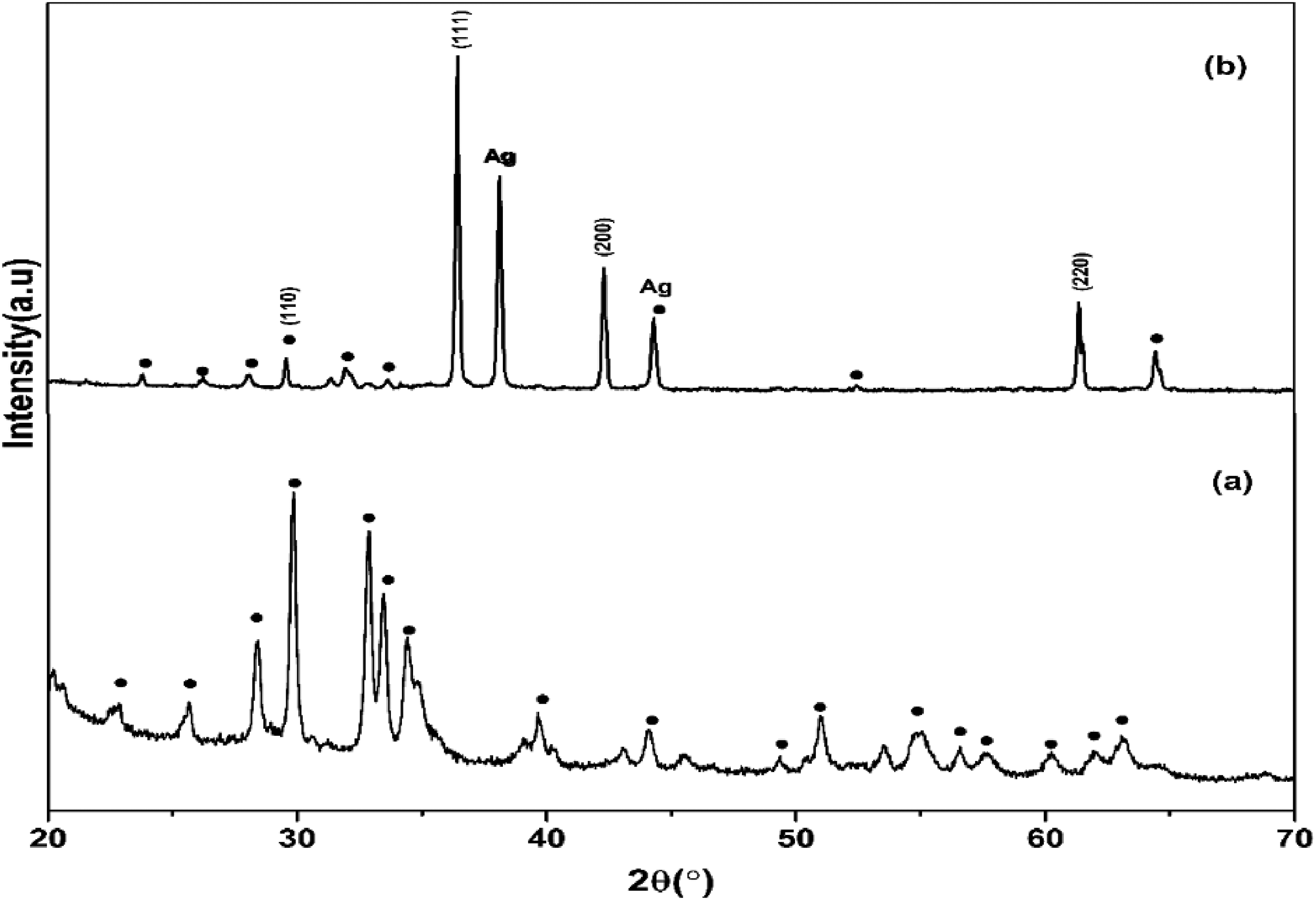
XRD spectra of (a) AgVO3 and (b) Ag-AgVO3/Cu2O composite.
The surface structure of prepared AgVO3 and Ag-AgVO3/Cu2O samples was observed by SEM. The SEM image of the AgVO3 demonstrated nanorods morphology having a diameter in the range of 100–600 nm as shown in Figure 2(a, b). The surface of AgVO3 nanorods was rather smooth without any lumps. In Figure 2(c, d), the synthesized Ag-AgVO3/Cu2O sample was composed of many nanoparticles with agglomeration. The SEM images of Ag-AgVO3/Cu2O composites illustrated that the surface of AgVO3 nanorods was covered by Ag and Cu2O nanoparticles.
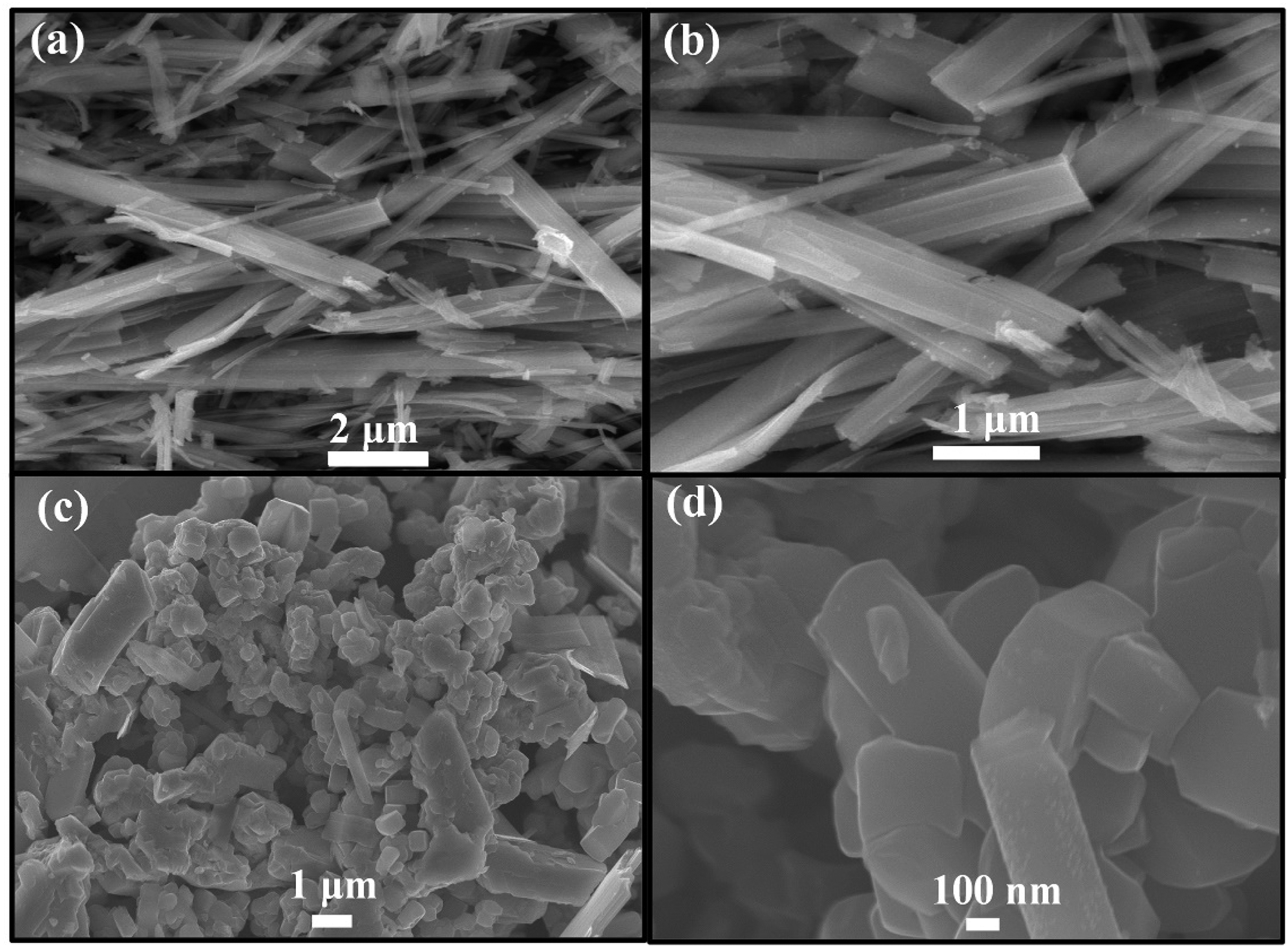
SEM images of (a, b) AgVO3 and (c. d) Ag-AgVO3/Cu2O composite.
Figure 3 demonstrates TEM and HR-TEM images of Ag-AgVO3/Cu2O composites. As shown in Figure 3(a), different size nanorod with a diameter of 100–600 nm for the Ag-AgVO3/Cu2O composite could be found, which was consistent with the SEM results. The presence of dispersed dark spots in the magnified image (Figure 3(b)) confirmed the presence of Ag nanoparticles having a size less than 10 nm. Figure 3(c) confirmed the formation of AgVO3 and Cu2O composites having d-spacing of 0.295 and 0.214 nm, which corresponded to (211) and (200) planes. The SAED pattern (Figure 3(d)) again confirms the multi-crystalline phase of the Ag-AgVO3/Cu2O composite. EDX was used to confirm the chemical composition of composite samples as shown in Figure 4. All elements Ag, V, O, and Cu were detected in Ag-AgVO3/Cu2O composites (Figure 4); whereas the inset shows that all these (Ag, V, O and Cu) elements are evenly distributed in the composite.

(a, b) TEM (c) HR-TEM image and (d) SAED pattern of Ag-AgVO3/Cu2O composite.
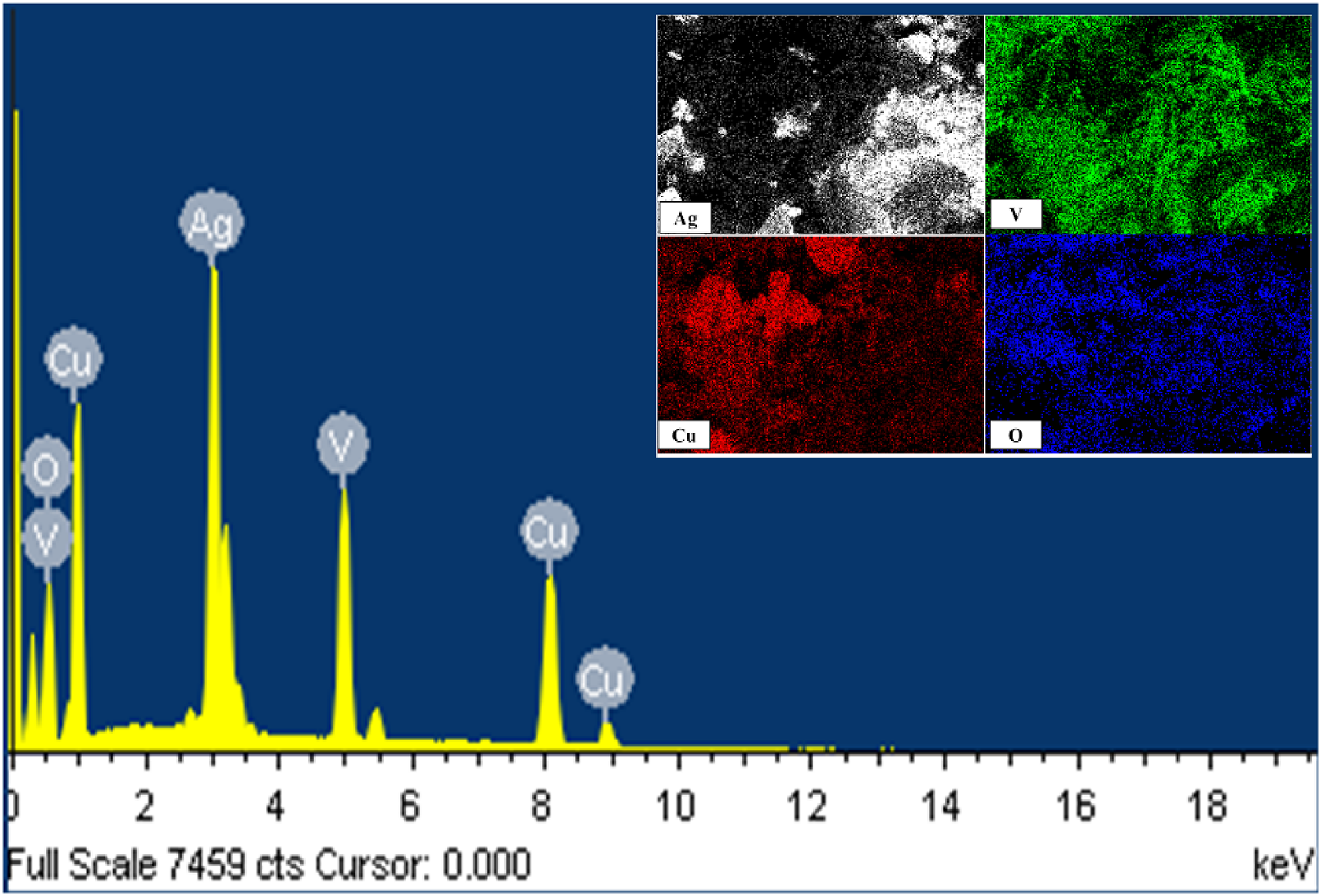
EDS spectrum of Ag-AgVO3/Cu2O composite (inset shows the elemental mapping).
The optical nature of AgVO3 and Ag-AgVO3/Cu2O composites was evaluated by UV-Vis-DRS (Figure 5A). AgVO3 shows an intense absorption in the visible area having an absorption edge at ∼527 nm (Figure 5(a)). The band gap energy (Eg) was estimated using the formula Eg = 1240/λAbsorp. Edge. The calculated band gap energy of AgVO3 was found to be 2.35 eV. In comparison to pristine AgVO3, the absorption edge of Ag-AgVO3/Cu2O composite displays a red-shift owing to the presence of Ag and Cu2O in the heterostructure (Figure 5(b)). The absorption intensity edge at around 553 nm for the composite shows band gap energy of 2.24 eV.

Photoluminescence is an efficient technique to evaluate the separation and transfer ability of photo-excited charge carriers. 42 Figure 5B, reveals the PL spectra of pure AgVO3 and Ag-AgVO3/Cu2O composite, respectively. Pure AgVO3 displays a major fluorescence peak at around 365 nm in Figure 5B(a). Whereas Ag-AgVO3/Cu2O reveals a minor emission peak than AgVO3, signifying that the establishment of heterostructure among AgVO3, Cu2O and Ag significantly decrease the recombination of photo-excited electron-hole pairs as shown in Figure 5B(b). This clearly proves that the rate of recombination of charge carriers is drastically restricted by blending AgVO3, Cu2O and Ag semiconductor.
To verify the photocatalytic efficacy of prepared Ag-AgVO3/Cu2O composite, photodegradation of dye was done at room temperature. As observed in Figure 6A, the major absorption peak around 664 nm shows a gradual reduction in visible light illumination within 160 min after treatment with Ag-AgVO3/Cu2O composite. Furthermore, by comparing, Ag-AgVO3/Cu2O composite exhibited better (93%) degradation efficiency than pure AgVO3 (52%) (Figure 6B). This increase in photocatalytic activity may be attributed to the development of a stable heterojunction, assisting the separation of photo-excited electrons and holes (ē-h+). Additionally, this photocatalyst may be recycled and reused a number of times without a substantial decrease in efficiency, which is a key criterion for potential industrial use. In the present study, the photodegradation efficacy of the Ag-AgVO3/Cu2O heterostructure for five cycles was 93, 92, 92, 91 and 89% after 160 min of time duration, respectively (Figure 6C).
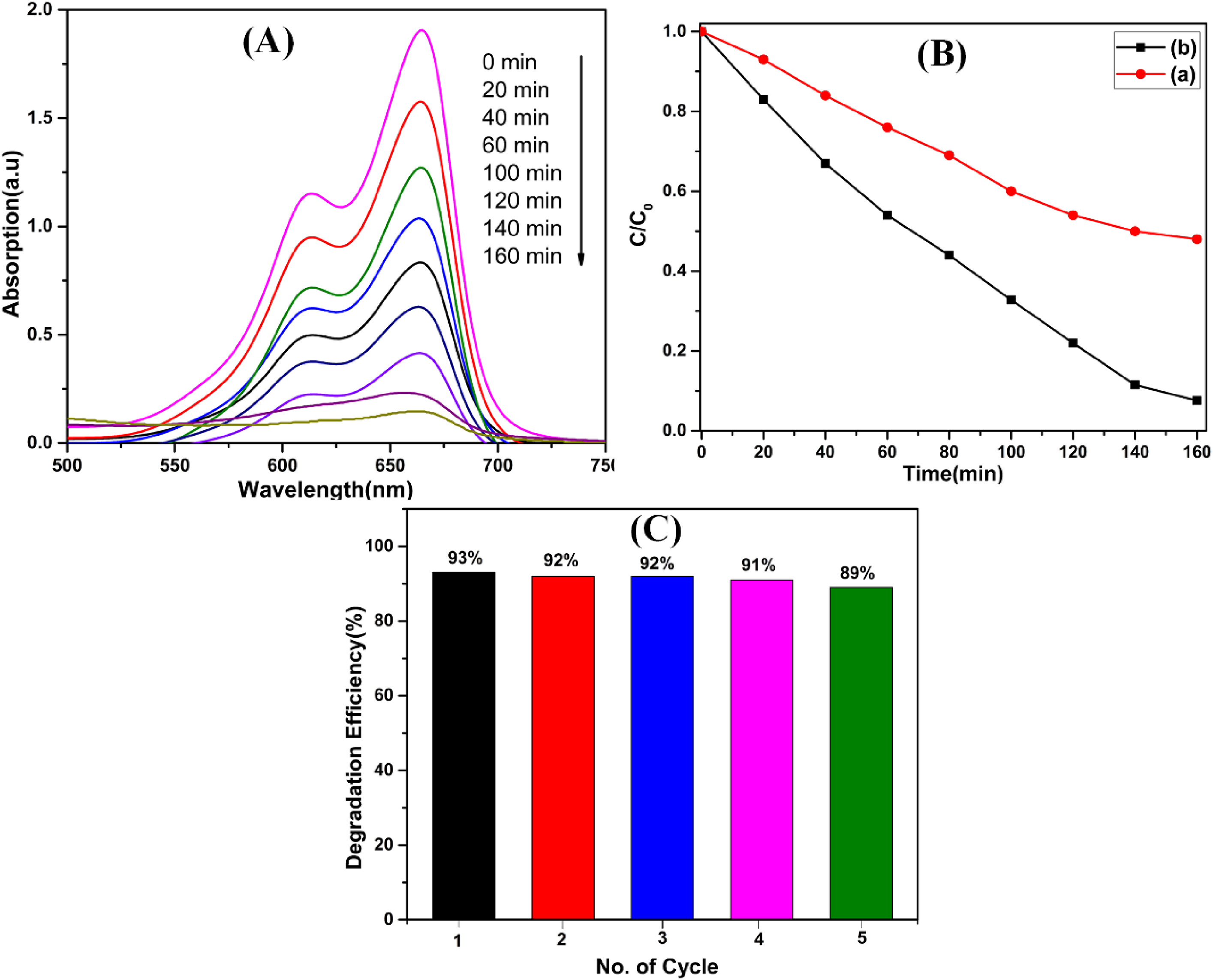
(A) aabsorption spectra of the MB solution over Ag-AgVO3/Cu2O composite under visible-light
We know that a photoexcited charge carrier separation and transfer method can significantly affect the photocatalytic efficiency; therefore, it is essential to show the photoexcited electron hole separation and transfer method of Ag-AgVO3/Cu2O heterostructure. A possible Z-scheme and MB dye degradation process in presence of Ag-AgVO3/Cu2O photocatalyst have been proposed in Figure 7. The valence band (VB) and conduction band (CB) potentials of pristine AgVO3 were found to be 2.54 and 0.19 eV as calculated from Mulliken electronegative formula, 43 whereas, the VB and CB potentials of the Cu2O are 1.0 and −1.1 eV. 44 When visible light is irradiated, Ag, AgVO3 and Cu2O were excited simultaneously. The electrons in VB were jumped to CB, left behind the equal number of holes on VB in AgVO3 and Cu2O, respectively. The photoexcited electrons from CB of AgVO3 will get transferred to VB of the Cu2O photocatalyst through Ag NPs via the Schottky barrier. The transferred photoexcited electrons will be accumulated at the lowest unoccupied orbital of Ag, resulting in the elevation of Fermi level of the Ag nanoparticles. To retain the equilibrium of Ag nanoparticles Fermi level, the holes at VB of Cu2O can be transferred and annihilated at Ag nanoparticles. 45 This procedure will result in the collection of excited electrons at Cu2O CB, while the VB of AgVO3 would be rich with the holes. Both of the photoexcited electrons and holes will further react with the available O2 and H2O, leading to the generation of the •O2- and •OH radicals. The formation of radicals will immediately degrade MB dye to smaller molecules.

Photocatalytic mechanism of the Ag-AgVO3/ Cu2O photocatalyst under visible-light-irradiation.
Conclusions
Conclusively, Ag-AgVO3/Cu2O composite was prepared by hydrothermal method. The compositions and structures of samples were identified by XRD, SEM, EDX, TEM, PL, and UV-DRS. DRS spectra displayed that the band energy of Ag-AgVO3/Cu2O composite was red-shifted compared to pristine AgVO3. The Ag-AgVO3/Cu2O composites exhibited better photocatalytic efficiency than pristine AgVO3 for degradation of MB under visible light illumination. The effective photodegradation efficiency displayed by the composite is because of the effective separation and suppression in the recombination of electrons and holes. This study is valuable for the development of heterojunction photocatalysts and will be of immense significance to achieve the positive environmental challenges soon.
Footnotes
Declaration of conflicting interests
The author(s) declared no potential conflicts of interest with respect to the research, authorship, and/or publication of this article.
Funding
This research was funded by Deanship of Scientific Research at Albaha University, grant number 1441/3.
