




Abstract
Strategic positioning, in terms of the regional economic structure, is necessary to fully consider regional economic benefit in developing areas surrounding the airport. We propose a novel strategy formulation for an airport surrounding area development that moves the focus away from an approach focused on the airport toward an approach based on regional economic structure. The concept of comparative advantage and SWOT analysis was introduced by utilizing quantitative indices looking at the regional industrial ecosystem to enhance scientific analysis progress from the strategy building prospective. The proportion of inter-industry transactions, the degree of dispersion of inter-industry transactions, and the spill-over characteristics of local industries were developed into indices. Through the case study, we could systematically show that Incheon has both strengths and weaknesses in terms of the current absolute volume of transactions, opportunities in terms of demand factors and spill-over effect, but faces threats with regards to the regional industrial structure. The availability of the methodology was verified and a new concept of the airport economic impact zone has been proposed.
Keywords
Introduction
We propose a system of strategy formulation based on assessments of comparative advantage that considers regional economic structures by using multi-regional input-output table for development of industry clusters in areas surrounding an airport. Various models such as “airport city” 1 and “aerotropolis” 2 have been continuously developed in the past. Within this discourse, we propose a novel strategy formulation for the development of areas surrounding an airport focused on the economic potential of the connectivity of the airport and its surroundings which will serve as one of the four key factors for developing an “airport city” as described. 3 Prior studies have discussed the connection between the airport and economic activity within aerotropolis model,2,4,5 but these studies were limited to explain and include regional economic structure from the perspective of developing areas surrounding an airport.
Beyond the inherent function of the airport, in order to maximize additional benefits, it is necessary to find a comparative advantage in terms of the inter-regional industrial structure. In particular, previous studies primarily worked under the premise that an airport helps the regional economy.6–9 There are empirical studies claiming that the economic benefits of an airport arise in urban areas other than those surrounding the airport.10,11 Based on these studies, we claim that it is necessary to devise a comprehensive approach for the areas surrounding an airport that considers the entire regional economy, rather than simply focusing on the urban areas surrounding the airport.
We suggested that strategic positioning, in terms of the regional economic structure in which the airport is located, is necessary to fully consider regional economic benefit in developing areas surrounding the airport. Furthermore, according to the cluster strategy based outside-in-planning model, 12 the areas surrounding an airport should be developed as part of a regional economic cluster that significantly reflects the comparative advantages of the regional economy. To verify this, inter-regional and inter-industry linkages within the regional economic structure should be reviewed in conjunction with the economy’s dynamic structure.
Indices that analyze the regional economy structure and forward and backward linkages from the perspective of regional industrial spill-over effects were developed and they have been applied to South Korea cases. Based on a multi-regional input-output table, indices for analysis of regional economic structures have been constructed to ensure that the structures of the industries in the region, the degree of industrial concentration between different regions, and the inter-regional and inter-industry forward and backward linkage effects are reflected. Then, a novel SWOT strategy formulation is offered based on these indices. In addition, an analysis tool was applied to Incheon Metropolitan City, where Incheon International Airport is located, and implications for the development of areas surrounding the airport were presented with considerations for the future of the regional economy.
Literature review
This section reviews the following topics: the relationship between the areas surrounding an airport and the regional economy, such as the ripple effects of airports on regional economies due to development of the airport surrounding areas; and the studies in deriving strategies on the development of the areas surrounding an airport.
Xia and Li 13 identified six major characteristics of an airport city, which are that it is airport-oriented; an industrial cluster; and that it has a space gradient, market efficiency, and global accessibility. Peneda et al. 3 suggested four major characteristics for the development of an airport city, which are the connectivity of the airport and its surroundings, the economic potential of the surrounding area, a sustainable development context, and a commercial attitude by the airport operator. Salewski et al. 14 suggests that the effects of an airport city are territorial effects (0–4 km), aviation effects (0–10 km), flow effects (0-several hundreds of kilometers), allocation effects (up to 3 h of commuting), urbanization effects (up to 3 h plus approx. 40 min of commuting).
Rosenthal and Strange 15 argued that positive externalities play an important role in increasing local economic productivity. Blonigen and Cristea 16 and Florida et al. 17 suggested that airport operations have a significant positive impact on the regional economy. Zak and Getzner 18 found that many studies have reported meaningful positive economic effects of airports in Central Europe. As such, studies on the development or effectiveness of airport cities suggest that aspects of the regional economy play an important role. This study seeks to approach this regional economic angle from the perspective of the regional industry structure, based on inter-industry transactions.
SWOT analyses are known as an appropriate methodology for building strategies. 19 SWOT analysis has been widely used in the aviation sector.20–22 In relation to the concept of the airport city, Wang and Hong 23 presented a comparative advantages analysis and strategies for the development of an airport city by providing examples of Taiwanese airports and utilizing SWOT analyses based on their literature review and focus group interviews. This study bears similarities in that a SWOT analysis focused on comparative advantages is conducted, but is distinct in that the SWOT analysis is based on developing quantitative indices using a regional inter-industry relation table from the perspective of the regional industrial structures and a basis on the municipal administrative units in which airports are located, rather than using the entire state for that role.
There have been a wide variety of studies on the numerous ripple effects of airports on local economies.24–33 Oosterhaven et al. 34 analyzed the regional inter-industry relations between urban areas and rural areas where two Dutch mainports (Rotterdam Harbour and Schiphol Airport) are located by utilizing the Input Output analysis methodology. They examined the relationship between an airport and the local economies. They developed indices based on the inter-industry cluster and linkage analysis methodology suggested in Oosterhaven et al. 34 The distinctiveness of this study lies in developing indices based on the analysis methodology and in the application of those indices to create a SWOT analysis in terms of comparative advantages, which is then applied to the state-level airport system.
Methodology
Concept
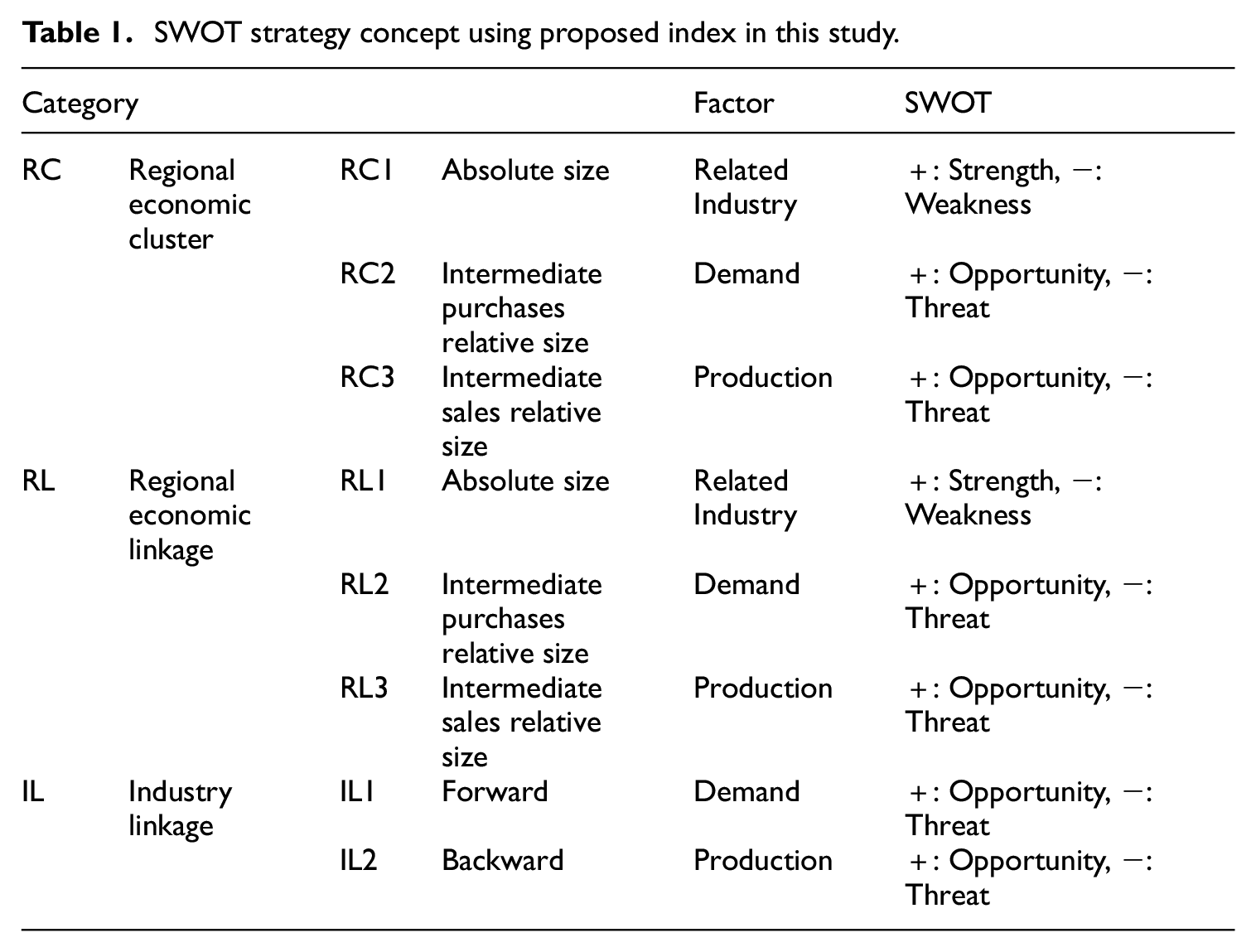
We develop evaluation indices in order to derive a novel strategy formulation for developing areas surrounding an airport from the perspective of the regional economic structure (Table 1 & Figure 1). The indices are comprised of the Regional Economic Cluster Index (hereinafter, RC), Regional Economic Linkage Index (hereinafter, RL), and the Industry Linkage Index (hereinafter, IL). Based on these indices, we present a SWOT analysis for the development of airport industry clusters in terms of production conditions, demand conditions, and related industries, with the comparative advantage concept. The RC index looks at the industrial structure within the region, while the RL index examines the degree of inter-regional competition. The IL index reflects inter-regional and inter-industry forward and backward linkages. Considering the most detailed available data and comprehensive interpretation, we assume that analysis area unit between airport-related and general economic activity is same at the comprehensive city and provincial level.
SWOT strategy concept using proposed index in this study.

Strategy formulation concept for airport surrounding urban development.
The RC index consists of an index based on the absolute size of the inter-industry volume (hereinafter, RC1), an index based on intermediate purchases relative size (hereinafter, RC2), and an index based on intermediate sales relative size (hereinafter, RC3). RC1 refers to the ratio of industries demonstrate an absolute value of inter-industry volume within the region where an airport is located that is higher than the average inter-industry volume outside the region, when comparing all industries. This indicates that there is a relatively high volume of inter-industry transactions in the region, so that an industry of a certain size or larger located near an airport has a comparative advantage related to the location of the relevant industry in the region. The higher the concentration of inter-industry transactions in the region, the greater the importance of the industry in question compared to other regions, which means that it has a comparative advantage in terms of its location. In the SWOT analysis framework, the indices have been formulated to be displayed, when it is deemed a strength, as having a positive value, the national average is set to zero, and weaknesses are assigned negative values.
RC2 is an index for assessing comparative advantage in terms of the demand factor of industries of a certain size or larger within the regional economic structure from an intermediate purchase perspective. This index indicates whether a regional economic structure has high purchasing power, and shows that the demand conditions are excellent in relation to the development of areas surrounding the airport. RC3 is meant to assess comparative advantage in terms of production factors, from an intermediate sales perspective. In contrast to RC2, RC3 indicates that a regional economic structure has a comparative advantage over other regions in terms of productivity. These two indices show positive values when indicating an opportunity and negative values when indicating a threat, while the national average is set to zero.
The RL index proposes an indicator based on Herfindahl-Hirschman Index (HHI) to reflect the extent of industrial concentration of the region related with other regions. It consists of an HHI index based on the absolute size (hereinafter, RL1), an HHI index based on the intermediate purchases relative size (hereinafter, RL2), and an HHI index based on the intermediate sales relative size (hereinafter, RL3). The RL index is used as an indicator for SWOT analysis related to building an industrial cluster in the area surrounding an airport, and it depends on the degree of distribution of inter-regional industrial linkages. In this process, an HHI index of 0.18 serves as a reference point,35,37 and this was divided into opportunities and threats through positive and negative signs.
RL1 was used to represent the degree of distribution of inter-regional industrial linkages on a regional basis based on absolute inter-industry volume. It was presumed that the more distributed the volume of inter-regional absolute transactions the more advantageous it would be for the development of areas surrounding an airport. The RL2 index is an indicator that represents the degree to which the volume of purchases of local intermediate goods are distributed in the region based on the intermediate purchases relative size, which can be interpreted as an opportunity for developing in the areas surrounding an airport in terms of the demand factor. Similarly, the RL3 index assesses the degree of opportunities in terms of the production factor with regards to the development of areas surrounding an airport in the region based on the intermediate sales relative size.
The IL index was introduced to express inter-industry forward and backward linkages. The IL1 and IL2 each evaluate the opportunity factors of the industrial structure within a region relative to the national average in terms of their demand factor and production factor, respectively. The higher the index value in a region, when compared to the national average, the more advantageous the development of the areas surrounding an airport, and the positive and negative signs were used to express the opportunities and threats based on the national average.
Formulations of indexes
The absolute size index (RC1) refers to the ratio in which the absolute volume of transactions within the region are above or below the average with reference to inter-industry transactions. Equations (1-1) and (1-2) identify and integrate industries with an inter-industry volume of transactions within the selected region for which a specific standard is exceeded. Equation (1-3) derives the concentration within the region, and Formula 1-4 is used to interpret the results. Hereinafter, details of variables are presented in Appendix 1.


Intermediate purchases relative size Index (RC2) indicates the ratio at which an intermediate input coefficient exceeds a certain range in terms of inter-industry purchases among the inter-industry transactions. Equations (2-1) and (2-2) identify and integrate industries for which the inter-industry purchasing power in the selected region exceeds a certain threshold. Equation (2-3) derives the concentration within the region, and equation (2-4) is used to rearrange the index for better result analysis.





Intermediate sales relative size index (RC3) refers to the ratio at which an intermediate output coefficient exceeds a certain range in terms of inter-industry production among inter-industry transactions. Equations (3-1) and (3-2) identify and integrate industries for which inter-industry productive capacity in the selected region exceeds a specific standard. Equation (3-3) derives their concentration in the region, and equation (3-4) is used to rearrange the index for better result analysis.




Linkage index in absolute size (RL1) is an HHI index that refers to the degree of distribution of absolute volume of inter-industry transactions between the selected region and other regions based on the regional category. Equations (4-1) and (4-2) distinguish the industries for which the inter-industry volume of transactions within the selected region exceeds a certain threshold. Equations (4-3) and (4-4) estimate and rearrange the HHI index. Here, the RL index has its sign reversed during the final calculation to ensure consistency with other indicators.


The linkage index in intermediate prices relative size (RL2) is an HHI index that refers to the level at which the volume of purchases in the selected region is distributed in other regions based on the category of the region. Equations (5-1) and (5-2) distinguish the industries for which the volume of inter-industry transactions within the region exceeds a certain threshold. Equations (5-3) and (5-4) estimate the HHI index.


The linkage index in intermediate purchases relative size (RL3) is an HHI index that indicates the level at which the sales in the selected region are distributed to other regions based on the regional category. Equations (6-1) and (6-2) distinguish the industries for which the volume of inter-industry transactions within the region exceeds a certain threshold. Equations (6-3) and (6-4) estimate the HHI index.




Based on the Leontief Matrix, this study adopted the sensitivity and influence coefficients as inter-industry linkage indices. The sensitivity coefficient (IL 1) indicates the impact on an industry when the final demand for products for all industrial categories increases by a unit. The influence coefficient (IL 2) is a coefficient that shows the effect on all industrial sectors when the final demand for a product in an industrial sector increases by one unit. Equations (7-1) and (7-9) demonstrate this process.









Availability test
Input-output (IO) analysis, which is used as a basis for deriving indices, is known as an effective tool for analyzing local economies. 36 The Bank of Korea provides nationwide and the multi-regional input-output tables (MRIO) via the Economic Statistics System online. This most recently published data consists of a table created with 82 industrial classifications and 16 local governments based on the basic price (Detailed criteria for classification are shown in Appendixes 2 and 3).
Figure 2 shows the results of the RC index sensitivity analysis on the threshold reference
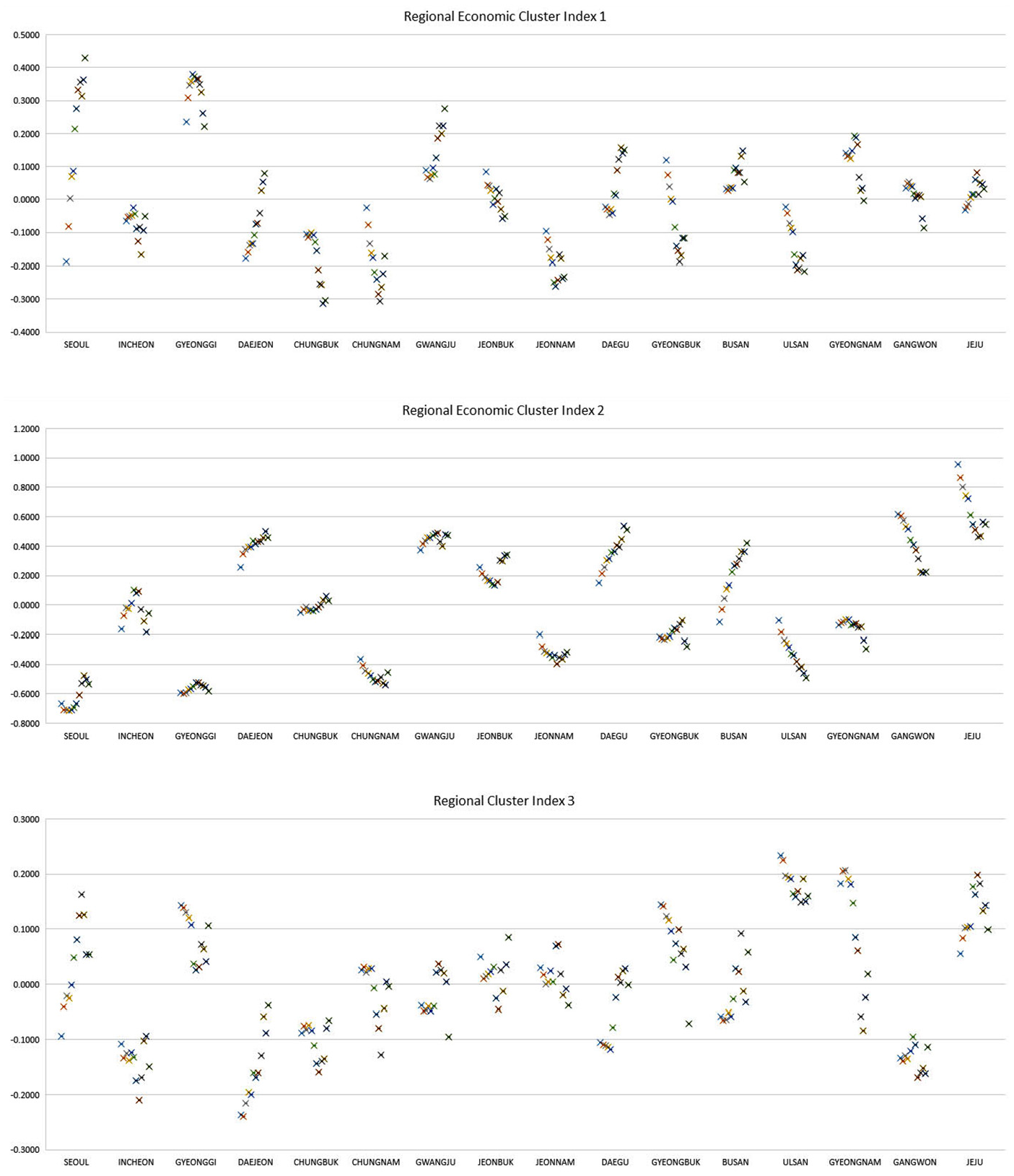
RC index calculation result by sub-region and criteria
While the RC index determines the comparative advantages of regional industrial structures, the RL index uses HHI to determine the extent to which regional industries and transaction levels are concentrated by region throughout the country. This means that the lower the index value, the greater the degree of dispersion of transactions in the region. The airport is a transportation hub with developed traffic connections all around the airport, and, in terms of developing the area around the airport, it is believed that the inter-industry transactions dispersed by region index provides an advantage in the development of the areas surrounding an airport. Based on the value of 0.18 which is generally considered to be competitive, the RL index allowed all indices to be positive or negative depending on their specific circumstances. The RL index was also analyzed to have no issues in identifying differentiating aspects according to changes in
Figure 3 shows the RL index estimation results (Appendix 5). The results of the RL1 index show a concentration tendency to increase in all regions as
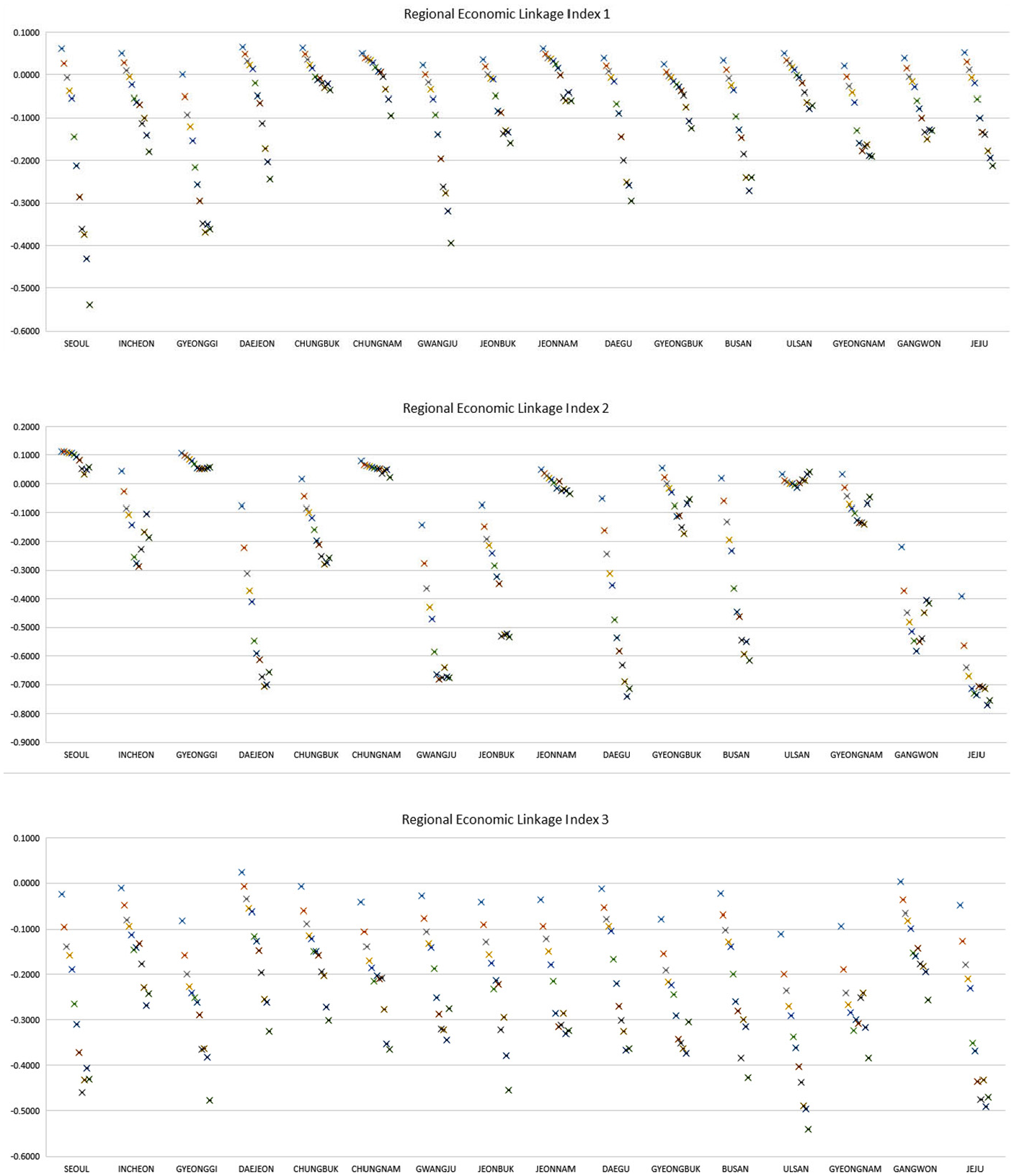
RL index calculation result by sub-region and criteria
The IL index is an indicator that evaluates the spill-over of the regional industrial structure relative to the national average, and its purpose is to determine the comparative advantages of the forward and backward linkage effects of industries in the region. The IL index results (Appendix 6) are differentiated by region, these relationships are shown in the IL index quadrant (Figure 4). The first quadrant is an area where the linkages of the industrial structure within the region is considered an opportunity for the development plan of the area surrounding an airport. The second quadrant is where it is difficult to determine if it has a comparative advantage over other regions in developing the areas surrounding an airport in terms of production, though its industry-linked networks within the region are advantageous in developing the areas surrounding an airport in terms of consumption. The third quadrant appears to have limitations in terms of industry linkages in the region to develop the areas surrounding an airport in terms of both consumption and production. The fourth quadrant indicates that they are areas where it is difficult to determine if it is advantageous to develop areas surrounding an airport in terms of consumption, while it is advantageous in terms of production.

IL index quadrant.
Case study: Incheon airport study
This section presents future strategic implications in terms of the industrial structure of Incheon on the development of the areas surrounding Incheon International Airport. Incheon, where Incheon International Airport is located, is a gateway to Korea with both Incheon Harbor and Incheon International Airport. The city has 17 industrial complexes as of 2020, including six industrial complexes that are under way. The Songdo New Town Development and Free Economic Zone projects were carried out along with the Incheon Free Economic Zone (IFEZ) project to transform the Songdo, Yeongjong, and Cheongna areas into global business cities around Incheon International Airport (Figure 5).

IFEZ (Incheon free economic zone) concept.
According to RC1, Incheon has a weakness owing to the weight that the region accounts for in the absolute inter-regional volume of transactions. On the other hand, the RL1 shows that, in terms of the degree of dispersion of the absolute volume of transactions, the development of the areas around the airport has a strength. Therefore, in creating a regional industrial cluster that is linked to or otherwise located around an airport, a strategy is required to supplement sectors with low industrial concentrations in the region in terms of the regional industrial structure by utilizing the concentration of transactions with other regions.
In terms of regional industrial demand factors, all indices have been derived as being positive. Thus, the regional industrial structure of Incheon appears to be an opportunity to develop the areas surrounding the airport. Incheon will require a strategy to actively expand and utilize demand factors within its regional industrial structure. RC3 was ranked 15th out of 16 local governments and this was found to be a threat. In terms of production factors and considering the concentration of industries in the Incheon area, the development of areas surrounding the airport appears to be more disadvantageous compared to other local governments.
In addition RL3 also showed a threat, as it ranked 13th, indicating that in terms of production conditions the degree of dispersion of inter-regional transactions is also disadvantageous compared to other regions. From the regional industry spill-over respective, the fourth highest rank in IL means an opportunity, and a strategic approach focused on the industries with strong spill-over effects might be considered rather than inter-regional transactions in terms of its production conditions.
In fact, the sum of the intermediate demands of Incheon shows that the air transport industry is ranked third in the industries with the highest demand, and the industries which are inferred to be related, such as wholesale and retail trade and petroleum and coal product manufacturing are ranked fifth and sixth, respectively, showing that many sectors are related with aviation. In this regard, regional development plans centered on the aviation industry are appropriate. However, in terms of high-tech knowledge-based services confined to global connectivity alone, sectors that effectively combine industries, such as those with strengths like financial services, which is ranked 18th, and those with insufficient infrastructure like information service which is ranked 65th, they require strategical supplementation.
In summary, Incheon has both strengths and weaknesses in terms of the current absolute volume of transactions, opportunities in terms of demand factors and spill-over effect, but faces threats with regards to the regional industrial structure (Table 2 & Figure 6). For the future development of areas surrounding an airport, a strategy is required to actively utilize the trade-offs between the strengths and weaknesses of the regional industrial structure, and demand factors, while simultaneously utilizing the spill-over effect opportunities rather than regional industrial structures itself. For demand conditions, measures may be presented to integrate and create demand in the region while relocating related industries to the areas surrounding or under the influence of an airport based on the industries that have an average regional volume of transactions that is 10 times higher than the average. With regards to production conditions, it may be necessary to consider increasing the accessibility of industries with an average volume of transaction that is 20 times higher than average in terms of spill-over effect of industries within the region towards the demand-creating regions.
SWOT analysis result.


SWOT-Index quadrant.
Conclusion
In order to successfully develop areas surrounding an airport, strategic consideration of strengths and weaknesses as well as the opportunities and threats of the supply chain or value chain within the region as well as other regions is needed from the perspective of regional industrial ecosystem. As the industrial structure essentially creates inter-industry network flows and serves as the basis for supply chains or value chains, considering only static factors such as industrial spatial distribution in the region and sales by industry in the development of the urban areas surrounding an airport should be supplemented. As the target region has the strength of having high sales in the high-tech parts industry for exports, the strategy of relocating high-tech industrial zones near the airport may appear appropriate. However, if the high-tech parts industry fails to take into account the comparative advantage of the regional industrial ecosystem and the degree of connectivity with other regions in terms of intermediate goods purchases and sales, and the backward and forward linkages of the industry, this strategy will be less effective. This study is expected to provide for more adequate strategy formation in order to overcome these limitations.
As we utilized the multi-regional input-output table officially created by the state, it can be effectively applied within the field. As the industrial structure varies by region depending on where the airport is located, there are limitations in reviewing strategies using only the figures of the production inducement effect and value-added inducement effect arising from the development of areas surrounding an airport. Furthermore, because the periodically constructed input-output table was used, the strategy formulation presented under this study may serve as an analysis tool for evaluating the developmental effect of areas surrounding an airport.
We provide a theoretical contribution by introducing a comparative advantage perspective to the development of areas surrounding an airport. Since an airport is a major node in the national transportation system, decisions related to the selection and concentration of resources for the nationwide airport system need be made from a comparative advantage perspective. Even if a region leads the development of airports, identifying the comparative advantages in industrial structures compared with other regions should be an important consideration for the region. In fact, the indices derived based on the regional local governments of Korea in this study show that regional comparative advantages are evident but complex.
Such a strategic mindset was applied to the development of the areas surrounding Incheon International Airport. In addition to direct strategic implications, we proposes that the sectors need to consider the economic bloc of the airport based on the inter-regional and inter-industry supply chains. Based on the regional local government where the airport is located, we suggested the strategy formulation, and the linkages to adjacent regions are expected to play a complementary role. For example, linking the IL index, a backward and forward linkage index for Incheon International Airport, Gimhae International Airport, Cheongju International Airport, or their adjacent regions, enables the deduction of complementary combinations as seen in Figure 7. The airport-oriented formulation (individual triangles in Figure 7) revealed that different airports also had different characteristics, thereby requiring different approaches to different airports. In other words each “airport-oriented triangle” in Figure 7 means clustering related airports in terms of regional industry relation between them.

Concept of airport-region spheres.
The proposed model is dependent on the assumption between airport development and regional industry structure. Literature review in this paper showed the strong relationship between them, but it is difficult to find researches on the mutual causality direction from the regional industry structure perspective. In order to improve this limit, we expect further studies test assumptions and investigate supporting cases for the suggested method.
Data availability based on regional economic structure and interdependencies is important to produce the proposed index. However, detailed data would be sometimes limited due to survey and analysis cost. In this case, we suggest two options such as multi-regional input-output table estimation and direct index estimation method. The first methodology could be produced based on national input-output table and regional related economic index, and post process of the developed methodology in this paper could be applied. The other option means the black box approach that the index is induced directly from input data through calibrated estimation model based on previous results, assuming that relationship between factors are not changed in short term. Moreover we expect various further studies stem from the proposed framework, which could consider this data availability limit.
We suggest the need to develop an airport economic impact zone. We propose expanding the target scope of airport-centric development based on the prosed method from only airport-related to indirect and long-term regional industry structure with airport development and operation. As a result of applying the indices proposed in this study to the airports in Korea, we found an indirect empirical case to support the argument that identifying the comparative advantages in the supply chain or value chain of the regional industrial ecosystem is effective for the strategy formulation for the development of the areas surrounding an airport, and that the resulting solidarity among these airport-oriented regions is necessary. Even though an airport economic impact zone is concept level yet at this stage, we hope the developed strategy formulation could be a motive for this concept.
We expect this study would serve a milestone to formulate successful strategies for airport surrounding area development. We look forward to seeing further empirical studies based on the outcomes of this study and studies that materialize the concept of the airport economic impact zone.
Footnotes
Appendix 1
Declaration of conflicting interests
The author(s) declared no potential conflicts of interest with respect to the research, authorship, and/or publication of this article.
Funding
The author(s) disclosed receipt of the following financial support for the research, authorship, and/or publication of this article: This study was funded by Korea Transport Institute for its task to 2020 Airport Competitive Enhancement and Regional Development Support, grant number General-AR-20-14 And The APC was funded by Korea Transport Institute.
