



Abstract
The new Cuban chondrite, Viñales, fell on February first, 2019 at Pinar del Rio, northwest of Cuba (22°37′10″N, 83°44′34″W). A total of about 50–100 kg of the meteorite were collected and the masses of individual samples are in a range 2–1100 g. Two polished thin sections were studied by optical microscope, Raman spectroscopy and electron microprobe analysis in this study. The meteorite mainly consists of olivine (Fa24.6), low-Ca pyroxene (Fs20.5), and troilite and Fe-Ni metal, with minor amounts of feldspar (Ab82.4-84.7). Three poorly metamorphosed porphyritic olivine-pyroxene and barred olivine chondrules are observed. The homogeneous chemical compositions and petrographic textures indicate that Viñales is a L6 chondrite. The Viñales has fresh black fusion crust with layered structure, indicating it experienced a high temperature of ∼1650°C during atmospheric entry. Black shock melt veins with width of 100–600 μm are pervasive in the Viñales and olivine, bronzite, and metal phases are dominate minerals of the shock melt vein. The shock features of major silicate minerals suggest a shock stage S3, partly S4, and the shock pressure could be >10 GPa.
Introduction
A meteorites shower happened at Viñales, Pinar del Rio, northwest of Cuba at 1:17 pm local time on February first, 2019. The geographic coordinates of meteorites falling area are 22°37′10″N, 83°44′34″W. Hundreds of individual samples with masses of 2–1100 g were discovered in and around Viñales and a total of about 50–100 kg of the meteorite were collected by local residents. Meteorites are “fossils” that recorded the origin and evolution of the solar system. 1 At present, more than 70,000 meteorites were collected by humans and about 90% of them are chondrites (Meteoritical Bulletin Database 2 ). Chondrites are considered to be the most primitive materials in the solar system and are formed by direct condensation of solar nebula. 3 Compared with the find meteorites, the fall meteorites are recovered shortly after they landed on earth and always do not be weathered and therefore have higher scientific values. Here, we present a detailed preliminary petrographic, chemical and shock metamorphic study of this new fall meteorite that experienced extreme conditions.
Samples and methods
A ∼69 g fragment (V-1) with fresh fusion crust and a ∼26 g piece (V-2) of Viñales meteorite were bought from meteorite dealers. Two thin sections made from V-2 were prepared for this study. Thin sections were examined by optical microscopy using Leica DM2700P microscope at Hunan University of Science and Technology. Raman spectroscopy and electron microprobe analysis (EPMA) at Guangzhou Institute of Geochemistry, Chinese Academy of Sciences were applied to identify the high-pressure phases and acquire the chemical compositions of major silicate minerals, respectively. Raman spectra of minerals were measured in the range of 200–1200 cm−1 by a Renishaw RM-2000 instrument (Ar+ laser, 514nm line) with a 20 s acquisition time. Backscattered electron (BSE) images and quantitative analyses of minerals were undergone using a JEOL JXA-8100 EPMA. The analyses were conducted with an acceleration voltage of 15 kV, a beam current of 10 nA, and a peak counting time of 10–20 s. The quantitative data obtained was in weight percentage of oxides (wt %).
Results
Petrography
In the hand specimens, the Viñales meteorites are covered by black fusion crust with a thickness of <1 mm. Some of the surface have broken and the interior substance show gray color with few dispersed metal grains (Figure 1(a)). Shock veins with width <3 mm are well developed in the Viñales meteorites and the light lithology is interspersed with randomly oriented black shock veins (Figure 1(b)).

(a) The Viñales specimen has a black fusion crust and the interior lithology show gray color. (b) A piece of Viñales meteorite is interspersed by many black shock veins.
Optical microscopy shows that Viñales is mainly composed of olivine, pyroxene, Fe-Ni metal and troilite as well as minor amount of feldspar, chromite and phosphate (Figure 2(a) and (b)). Chondrule margins are difficult to discern in the sample and only three chondrules with diameter ranging up to ∼1 mm are recognizable under optical microscope (Figure 2(c) and (d)). The chondrule types include porphyritic olivine-pyroxene chondrules and barred olivine chondrule.

(a, b) Viñales meteorite mainly consists of olivine (Ol), pyroxene (Py), and troilite and Fe-Ni metal (Tr-M). a-plane polarized light (PPL), b-cross polarized light (CPL). (c, d) Porphyritic olivine-pyroxene and barred olivine chondrules in Viñales, CPL.
Chemical composition of major silicate minerals
The representative EPMA analyses of the chemical compositions of major silicate minerals in host rock and shock veins are given in Table 1. Silicate minerals from host show homogeneous chemical composition. The Fa values of olivine are between 24.4 and 25.1 and a mean value is 24.6. The chemical composition of pyroxene shows low-Ca pyroxene (Wo < 2.0) composition, in which the Fs values are between 20.2 and 20.8 and a mean value is 20.5, and the En values are 77.7–78.3 and a mean value is 77.9, which corresponds to bronzite. The An, Ab, and Or values of feldspar are 1.9–7.7, 82.4–84.7, and 7.8–14.9, respectively, which indicates albite and anorthoclase. Olivine, low-Ca pyroxene, feldspar in the shock melt veins have the similar chemical compositions of these in chondritic portion except the feldspars are a little depletion of albite component (Ab75.6-76.1) (the last two columns of Table 1).
Representative EPMA analyses of olivine, pyroxene and plagioclase in the Vinales meteorite (wt%).

Shock effects
Most olivine and low-Ca pyroxene in the Viñales exhibit irregular fractures (Figure 3(a) and (b)). Shock melt veins are well developed and the width of them are 100–600 μm (Figure 1(b)). The shock melt vein consists of fragments and matrix (Figure 3(c)). The fragments are composed of chondritic clasts and mineral clasts of olivine, low-Ca pyroxene, feldspar, troilite and chromite. Olivine and low-Ca pyroxene clasts in the shock vein are smooth, in contrast to irregular fractures are well developed in these minerals in host rock of the meteorite (Figure 3(d)). Some feldspar grains (<30%) in and adjacent to the shock melt vein are transformed to makelynite and some mineral fragments are embedded in them (Figure 3(e)). The matrix is composed of pyroxene, olivine and troilite with diameter <10 μm and the troilite always occur as sphere (Figure 3(d)). Raman spectrum also confirm the matrix consists of olivine and bronzite 4 (Figure 3(f)). In addition, more than 30 mineral grains in the shock veins were analysed by Raman spectroscopy, but no high-pressure phases were found.

(a, b) Olivine and low-Ca pyroxene in the Viñales always display irregular fractures. a-PPL, b-CPL. (c) BSE image of a shock vein in the Viñales. (d) Mineral fragments in the shock vein are smooth. (e) Some mineral fragments are embedded in maskelynite adjacent to shock vein. (f) Raman spectrum of the matrix of shock vein.
Fusion crust
The Viñales meteorite’s obvious black fusion crust show layered structure under optical and electronic microscope. The fusion crust can be divided into two layers from the surface to the interior (Figure 4). The Layer I is totally opaque under transmission light and has a width from 50 to 200 μm (Figure 4(a)). Many tiny minerals are dispersed in the out rim of Layer I. These minerals occur as dendrite and skeleton crystals with less than 10 μm (Figure 4(b)) and Raman spectroscopy analysis results indicate most of them are pyroxene and olivine (Figure 4(d)). Many vesicles are observed in the Layer I, especially in the area adjacent to the Layer II, and the diameters of them are always less than 20 μm (Figure 4(b) and (c)). Chemical compositions of Layer I (Table 2) show it mainly consists of SiO2 (35.84–43.23 wt%), FeO (15.56–30.68 wt%) and MgO (25.68–34.47 wt%), as well as minor components of Al2O3 (1.54–2.30 wt%), CaO (1.00–2.20 wt%) and Na2O (0.66–0.87 wt%). The Layer II is semi-transparent in transmitted light and the width of it is 100–300 μm. The fractures in and between mineral grains in the Layer II are full of metal phases, whereas the adjacent chondritic portion remains intact (Figure 4(c)).

(a–c) Layered structure of fusion crust under microscope. Layer I is opaque under transmission PPL, whereas the Layer II is semi-opaque. a-transmission PPL, b-reflected PPL, c-BSE image. (d) Raman spectrum of Layer I show the tiny crystals are mainly pyroxene and olivine.
EPMA analyses of Layer I fusion crust of the Vinales (wt%).

Discussion and conclusions
Major silicate minerals in Viñales are chemically homogeneous (Table 1). Considering the average Fa value of olivine is 24.6 and the average Fs value of pyroxene is 20.5, the Viñales can be classified as L chondrite 5 (Figure 5). The petrographic textures show little poorly metamorphosed chondrules indicating a petrologic type 6. Our classification result accords with the result in Meteoritical Bulletin Database. 2
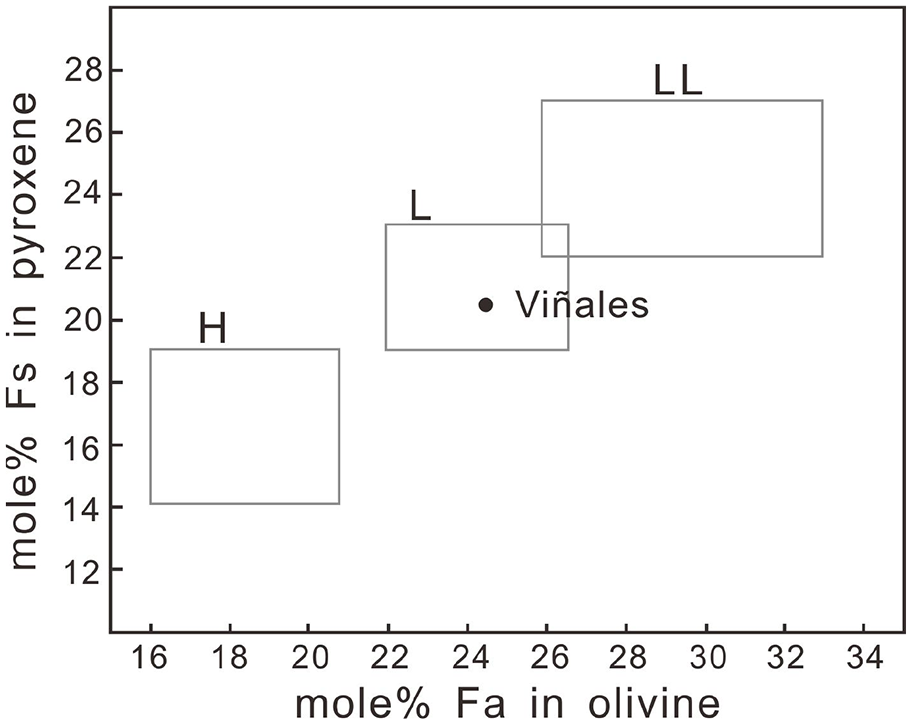
Classification of Viñales (solid circle) considering the Fs versus Fa contents of pyroxene and olivine. Ordinary chondrites fields from Grossman and Rubin. 5
Shock pressures of meteorites suffered impact events can be constrained from solid-state transformations of minerals and melt-vein crystallization. 6 Viñales shows many obvious shock-metamorphic features, such as irregular fractures in olivine and pyroxene, transformation of plagioclase to maskelynite, recrystallized Fe-Ni metal and troilite, and pervasive opaque shock veins. According to the updated classification system of shock metamorphism of chondrite by Stöffler et al., 7 irregular fractures in olivine indicate a maximum shock stage of S3, whereas maskelynite combined with pervasive opaque shock veins correspond to the S5 shock stage. At the shock stage of S5, high pressure phases may be present in the shock melt vein. However, in this study, the olivine and bronzite are dominant phases in the matrix of shock vein. According to the phase diagram of Allende CV3 chondrite after Agee et al., 8 the melt crystallization assemblage of olivine and low-Ca pyroxene in the matrix is only consistent with a shock pressure of ∼10 GPa, which is significantly lower than 30–35 GPa (shock pressure of S5). There are two possible reasons for the difference of shock pressure estimation. First, the shock pressures deduced from the solid-state transformation of minerals are always overestimated due to large kinetic barriers between minerals and their high-pressure phases. 9 In addition, Bischoff et al. 10 studied shock stage distribution of 2280 ordinary chondrites and concluded that high-pressure minerals cannot be taken as an automatic criterion for a S6 classification and most S6 chondrites do not even fulfill the S5 criterion and have to be classified as S4. Considering that <30% feldspar has been transformed into maskelynite and >50% olivine shows irregular fractures in our study, the reasonable shock stage of Viñales would be S3, partly S4, which indicates shock pressure of >5–10 GPa. Second, the melt crystallization assemblage in the matrix could be formed by back transformation from their high-pressure phases. Similar shock features are also observed in the Mbale L5/6 chondrite, 11 in which a higher post-shock temperature combined with slower cooling result in complete back-transformation of high-pressure minerals. The sooth and rounded shape of silicate minerals in the shock vein indicate they experienced a recrystallization process. On the basis of the above two reasons, although shock veins are pervasive in the Viñales, no high-pressure phases except maskelynite are observed.
Fusion crust is the result of heating on meteorite during atmospheric entry. 12 The fusion crust of Viñales develops two layers structure due to temperature gradient from the surface to the interior (Figure 4). Layer I experienced high temperature and was totally melted. The chemical compositions of Layer I have lower SiO2 component and higher FeO and MgO component (Table 2), which is corresponding to the main mineral composition of the Viñales chondrite. Chemical compositions of olivine and low-Ca pyroxene in Viñales are homogeneous and therefore the melt temperature of Layer I can be estimated from the temperature-composition phase diagram for minerals in the host rock of Viñales. According to the phase diagram for the system forsterite-enstatite, 13 the liquidus of olivine (Fa 24.6) and low-Ca pyroxene (Fs 20.5) at 1 atm is about 1650°C. Crystallization of a melt results in crystals of various sizes and shapes, depending on the cooling rate and degree of undercooling.14,15 Therefore, a very fast cooling process, which make a high degree of undercooling and the formation of many small skeletal and dendritic crystals, must be acquired by the melted Layer I. Vesicles in the Layer I are the result of degassing and are quenched and stop migrating relatively soon after formation. 16 The Layer II is definitely affected by the high temperature of Layer I, in which troilite and Fe-Ni metal are melted and fill the cracks in and between silicate minerals, which causes the Layer II are semi-transparent under transmission light of optical microscope. According to the melted troilite and Fe-Ni metal eutectite, the temperature is higher than ∼950°C. 17 Layered structure of the fusion crust is also observed in other stony meteorites. Genge and Grady 12 demonstrated ordinary chondrites have fusion crusts with an outer melted crust underlain by an outer substrate and an inner substrate. The outer melted crust and the inner substrate correspond to Layer I and II in this study, respectively. Alternatively, the fusion crust of Viñales lacks the outer substrate containing droplets of troilite and Fe-Ni metal due to the rapid decrease of temperature from Layer I to II.
Footnotes
Declaration of conflicting interests
The author(s) declared no potential conflicts of interest with respect to the research, authorship, and/or publication of this article.
Funding
The author(s) disclosed receipt of the following financial support for the research, authorship, and/or publication of this article: This work was jointly funded by the National Natural Science Foundation of China (41503062) and Natural Science Foundation of Hunan Province (2020JJ5166).
