



Abstract
In several parts of the world, Boswellia sacra Fluck. is one of the most commonly used herbs for the treatment of arthritis. Its usage should be validated in light of recent findings of haematotoxicity. This study was aimed to determine the effect of chronic administration of standardized methanolic extract of frankincense on blood cell count in experimental animals. Using high-performance liquid chromatography, the active constituents of B. sacra extract; boswellic acids were analyzed. The effect of three different doses of the extract (250, 500, and 1000 mg/kg) on different blood cells and associated parameters was investigated. The behavior, food, and water consumption of the rats were recorded. Boswellic acids were present in varying amounts with α-boswellic acid and β-boswellic acid present in more amounts compared to other boswellic acids in the extract. All three doses tested had no effect on the animals’ behavior, food consumption, or weight gain. The administration of a low (500 mg/kg) and high (1000 mg/kg) dose of the extract resulted in a non-dose dependent reduction in MCH (p < 0.01 and p < 0.05, respectively), but no other blood parameters were significantly affected. The B. sacra extract produces hypochromic normocytic anemia in rats at higher doses of 500 and 1000 mg/kg and this effect was not dose-dependent.
Introduction
Haematotoxicity is one of the serious adverse effects produced by several drugs. The haematopoietic system is susceptible to drug toxicity due to its characteristic rapid rate of cell renewal and differentiation. Haematotoxicity is manifested as abnormal blood cell counts and/or abnormal function of blood cells. The abnormal blood cell function may be due to either increased destruction of blood cells or due to insufficient production. 1
Boswellia species (Burseraceae) are herbal medicine that is widely used worldwide. Boswellia serrata Roxb. ex Colebr. (Indian frankincense), Boswellia sacra Fluck. (Omani frankincense), and Boswellia carterii Birdw (Sudani frankincense) 2 are most widely used and they have been evaluated for various pharmacological activities. Boswellic acid is attributed to several pharmacological properties of boswellia species. 3 The oleo gum resin of Boswellia sacra (called Omani Lubban) and Boswellia carterii (called Sudani Lubban) are used as household medicines in many middle eastern and Afro-Arabian countries. The Omani Lubban is believed traditionally to be of good quality compared to the Sudani Lubban. In folklore, Boswellia is used in different forms ranging from smoke that is obtained by burning it to different types of extract. The water extract 4 is used as an antibacterial agent while raw frankincense is used as aromatherapy by burning it to obtain essence in some Arabian countries. 5 Apart from this, frankincense is also chewed for its flavor and the essential oils obtained from this resin are reported to causes diuresis. 6 Other uses of oleo gum resin include treatment of painful menstruation, wounds, inflammation, and gingivitis. 2 In a previous study, 7 the water extract of B. sacra oleo gum resin showed aggravation of gastric ulcers, suggesting toxicity, while the boswellic acid-rich methanolic extract showed no toxicity on the liver, kidney, or reproductive systems.8,9 Continuing our efforts to determine the toxicity of Boswellia sacra oleo gum resin, the present study determines the effect of 28 days of administration of standardized boswellia oleo gum resin extract on the haematopoietic system in experimental rats.
Materials and methods
Animals
Inbred Sprague-Dawley rats with a weight range from 175 to 198 g were used. Rats were maintained under controlled temperature and humidity and were provided with water ad libitum and commercially available rat feed. Institutional ethical committee approval (SU/COAMS/EC/53/2019) was obtained to carry out this study.
Preparation and standardization of the extract
B. sacra oleo gum resin available locally purchased and identified through a departmental voucher specimen (SU/CAMS/3/2018). Since this oleo gum resin was imported from Oman, it was difficult to determine the date and collection. As a result, the extract was standardized to ensure that the most active chemical constituents, boswellic acids, were present. The extract was prepared after powdering it. The powdered sample was extracted with methanol in a Soxhlet extractor, and the resulting extract was dried with a rotavapor after solvent recovery. The yield of the extract was 15.23% (w/w).
Boswellic acid quantification
The concentration of boswellic acid of the extract was estimated by high-performance liquid chromatography (HPLC). 8 Methanol was used as a solvent for dissolving extract and standard chemicals. Both boswellic acid (α+β) and acetyl-boswellic acid (α+β) was detected at 210 nm whereas 11-keto-β-boswellic acid and acetyl-11-keto-β-boswellic acid was found at 247 nm.
Drug administration
All experimental animals used in this study were distributed into four groups (n = 6) and received respective treatment by oral route at a specific time once a day for 28 days. Vehicle (sodium carboxymethyl cellulose 1% w/v; 1 ml/kg) was administered to group I while the second to the fourth group were administered with Boswellia extract suspension at 250, 500, or 1000 mg/kg respectively.8,9 Changes in behavior, weight, and consumption of food and water were noted every day throughout the treatment period. After 28-day treatment, blood was withdrawn and used for estimation of several parameters. The blood cell count was done manually because the shape of rat’s blood cells are different from human blood cells and the automated cell counters may not give accurate results.10,11
The following blood profile parameters were determined; hemoglobin level, total leucocyte count, differential leucocyte count, platelet count, total erythrocyte count, packed cell volume (PCV), mean corpuscular volume (MCV), mean cellular hemoglobin (MCH), and mean corpuscular haemoglobin concentration (MCHC).
The PCV was calculated using the formula

The MCH was calculated using the formula

The MCV was calculated using the formula

The MCHC was calculated using the formula

Statistics
The results are shown as mean ± SEM. Comparison of groups was done using analysis of variance followed by Tukey’s test to determine statistical significance. Graphpad Instat software was used to perform the statistical analysis.
Results
Chemical constituents
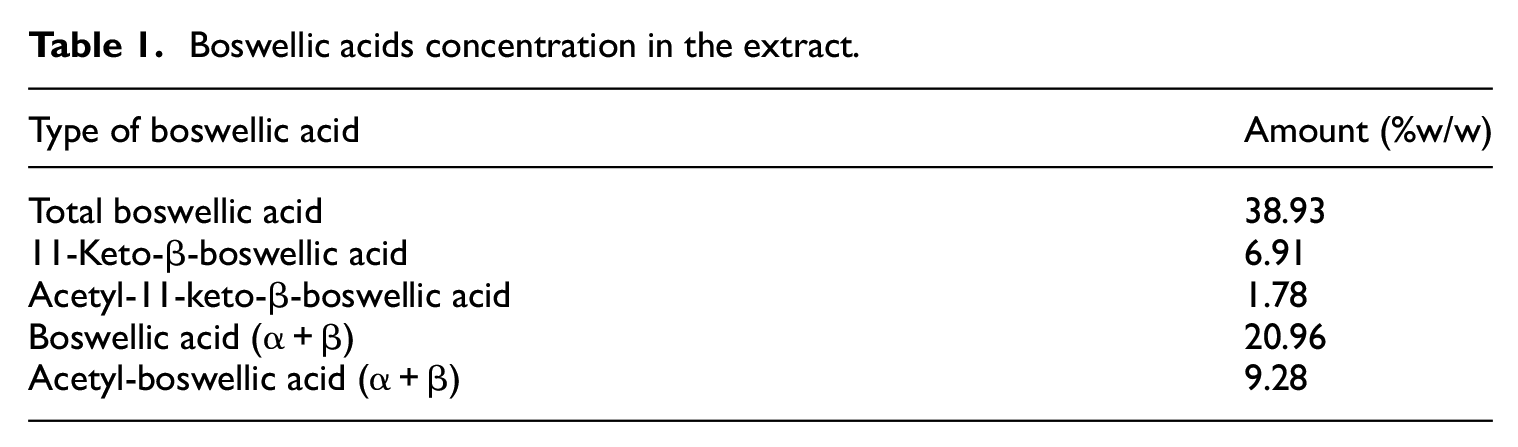
The total boswellic acids in the extract was 38.93%. The extract had different amounts of various boswellic acids (Table 1).
Boswellic acids concentration in the extract.
Behavior, food consumption, water consumption, weight, and blood parameters
Administration of Boswellia extract neither affects the food nor water consumption in animals and did not cause a significant weight change. There was no noticeable change in the behavior of the animals such as grooming, movement, etc., after administration of the extract. The administration of Boswellia sacra oleo gum resin did not affect most of the blood parameters studied. However, the MCH was significantly reduced by medium (500 mg/kg) and high dose (1000 mg/kg) of the extract and this decrease was not dose-dependent (p < 0.01 and p < 0.05 respectively). Important parameters such as RBC count, hemoglobin levels, platelet count, and differential leukocyte and total leukocyte count were not changed significantly by chronic administration of the extract (Table 2).
Effect on blood constituents.

All values are mean ± SEM, n = 6.
p < 0.05. **p < 0.01 compared to control.
Discussion
The current study determined the effect of B. sacra on a number of haematological parameters to detect all possible changes in the blood. This study is a part of large toxicological studies being undertaken to determine the safety of B. sacra on different organs and systems. As previously mentioned, this herb is considered safe and is used both traditionally and scientifically to treat a number of diseases and disorders, but its toxicity has not been thoroughly investigated. The extract is reported to scavenge oxygen free radicals in several studies12,13 and we had reported earlier that it may protect testes against the endogenous free radicals through an increase in the expression of antioxidant proteins in the body. Hence, the markers of oxidative stress in the blood were not determined. 9
The oleo gum resin of B. sacra oleo is used in different forms that include chewing and consumption of its raw form, smoke inhaled from burning it, as volatile oil extracted from it, and also as water extract obtained after soaking it overnight to name few forms. 6 The methanol was used as an extraction solvent in this study because it can extract both polar and nonpolar constituents and thus help in determining the overall action of B. sacra on the blood. Furthermore, several studies have stated that boswellic acids are primarily responsible for most of the biological activities of Boswellia, except the extract’s ulcer-promoting property due to volatile constituents. 7 Methanol is an excellent solvent for extracting volatile constituents, boswellic acids, and other polar and non-polar components.
The PCV measures cellular volume in the blood, while the MCV analyses cellular size and is used to diagnose diseases that affect cells (example- megaloblastic anemia). The RBCs’ status is determined using the MHC and MCHC. They are hypochromic when the MCH is abnormally low, and hyperchromic when the MCH is abnormally high. 14 While boswellia extract treatment reduced MCH, it had no effect on total hemoglobin concentration. This means that some RBCs have less hemoglobin than others. Hypochromic normocytic anemia may have been caused by the boswellia. The effect on MCH was not dose-dependent.
Conclusions
The findings of this study contradict our previous research on the protection of oral boswellia administration up to 1000 mg/kg. At doses of 500 and 1000 mg/kg, a decrease in MCH indicated hypochromic normocytic anemia, suggesting that the extract may not be safe to use. However, we would like to emphasize that this is preliminary research, and studies on the long-term effects of boswellia must be performed by administering the extract for three months or by performing a chronic toxicity analysis after 9 months of the administration. Besides that, the effect of other extracts, such as water extract (without boswellic acids), could reveal the constituent(s) responsible for the MCH decrease.
Footnotes
Acknowledgements
The authors are grateful to the Deanship of Scientific Research, Shaqra University for financial support. The authors are also thankful to AlMaarefa University, Riyadh for providing support to do this research.
Declaration of conflicting interests
The author(s) declared no potential conflicts of interest with respect to the research, authorship, and/or publication of this article.
Funding
The author(s) disclosed receipt of the following financial support for the research, authorship, and/or publication of this article: The authors would like to thank the Research Center at King Fahd Medical City, Riyadh, for their financial support provided for the manuscript.
