



Abstract
The seepage properties of natural gravel are one of the problems to be considered in seepage project designs. In this paper, the seepage properties of the natural gravel with particle sizes of 5, 20 and 60 mm were investigated under different laying conditions. The effect of the particle size, laying depth, bulk density and pressurized head on the seepage properties of the natural gravel was analyzed by using the combined methods of theoretical analysis with physical model test. The results showed that the seepage flow in the natural gravel was non-laminar flow in the test conditions described in this paper. Meanwhile, the relationship between particle size, laying depth, bulk density, pressurized heads and seepage property was established. The seepage discharge increased with the increase of the pressurized head and particle size, and decreased with the increasing of laying depth and bulk density. The critical laying depth and bulk density can be obtained when the seepage discharge becomes zero. The empirical formula of the seepage discharge of natural gravel with different particle sizes, laying depths, bulk densities and pressurized heads was obtained with the method of nonlinear regression, which can be expressed as:
Introduction
Natural gravel are a granular material with relatively uniform particle size, which is made from natural rock or ore by mechanical crushing and screening.1,2 As a porous media, there is a random distribution of pores in the natural gravel and pores of different shapes and size connect to each other.3,4 The ability of the flow through the pores is called the seepage properties of the natural gravel.5,6 With the development of the geotechnical engineering, natural gravel is widely used in the industrial and agricultural production and life applications. According to statistics, the amount of natural gravel account for more than 50% of the total construction earthwork in various construction projects. 7
Compared with the fine-grained soil, natural gravel, as a cohesionless coarse-grained soils, has been widely used in industrial and agricultural production and life, such as infiltration ditch water diversion and earth-rock dam project, due to its advantages of strong perviousness, low compressibility, high shear strength, small settlement deformation and high bearing power.8,9 Many scholars have conducted research on the seepage properties of the natural gravel. Shafiee 10 studied the seepage characteristics of the gravel and clay mixture of the earth-rock dam, and believed that the permeability of the soil layer would decrease as the size of the gravel decreases. Tsang 11 used a theoretical conceptual model to explain the coupling law of seepage and stress, and concluded that the roughness of the rock fracture surface under the coupling of seepage and stress is greater than that under a single action. Jie and Dingsong 12 believes that the main factor for determining the permeability stability of gravel soil is the content of fine particles, and proposed methods to determine the distinguishing particle size of coarse and fine particles, calculate the optimal content of fine materials, and use the content of fine materials to determine seepage stability. Zhibo et al. 13 carried out compaction tests on gravel soils with different amounts of gravel, studied the compaction characteristics of gravel soils with different coarse-grained mass fractions and different structures, and analyzed the particle breaking law under compaction. Xibao et al. 14 combined with the Shuibuya Project actually studied the influence of the coarse-grained mass fraction on the compactness, permeability, compressibility, and stress-strain relationship parameters of gravel soil. He believed that the compaction and permeability of gravel soil were related to the coarse-grained mass fraction, but also related to the characteristics of fine materials. In order to study the compaction characteristics of the gravel soil impermeable material, Yi et al. 15 used two methods, convex rolling and scouring rolling, to conduct large-scale rolling tests on three different grades of gravel soils selected in the indoor compaction test. Shengshui et al. 16 conducted a systematic experimental study on the seepage characteristics, seepage failure mechanism and influencing factors of the sand and gravel materials of the Dashixia super high face-face dam, and proposed corresponding dam seepage safety control measures. Jianxiu 17 took the sand and gravel foundation of the Uluwati Reservoir in Xinjiang as the main research object, and conducted three related permeability tests with the water flow direction being vertical from top to bottom, from bottom to top and the water flow direction being horizontal. The results show that the sand and gravel. The results show that the permeability coefficient value of sand and gravel foundation in the longitudinal direction of water flow is significantly smaller than that in the horizontal direction. Zhongming et al. 18 completed the penetration and deformation test of sandy gravel soil under vertical stress by developing a large-diameter infiltration deformer loading system. Experimental results and theoretical studies have shown that the critical hydraulic gradient of sandy gravel soil permeability and deformation increases with the increase in stress state, and there seems to be a linear increase and increase relationship between the two. However, in the construction process of natural gravel laying, it is mostly used to improve the foundation strength, drain out groundwater, and reduce the damage caused by groundwater to the upper structure. 19 In addition, the particle composition of the natural gravel is coarse and uneven, and the cohesive force between the particles is small.20,21 Many hydraulic characteristics under the action of water have not been grasped by people, especially the lack of research on the characteristics of seepage, which leads to a series of engineering accidents, such as the leakage of dam foundation at Yazui river mouth, the leakage of Lincheng reservoir, the damage of sand foundation dike piping in Huarong County and the damage of the Yangtze River dike piping. 22 Therefore, how to make the laid natural gravel reach the designed permeability is a problem that must be solved in engineering design.
Percolation theory is mainly to study the movement of fluid in porous media system. Percolation theory started from the famous Darcy percolation theory proposed by French engineer h. Darcy in 1856. 23 After years of development, especially the rapid development in recent years, the research scope of percolation theory is expanding, and the research methods of percolation theory tend to modernization. The theory of seepage mechanics 24 also develops from Darcy seepage to non-Darcy seepage, Newtonian fluid seepage to non-Newtonian fluid seepage, and classical seepage mechanics to modern seepage mechanics. Katz Thompson 25 obtained the theoretical solution of water permeability coefficient of saturated rock by measuring the relative conductivity and critical pore diameter of rock and according to the Katz Thompson or and its assumptions. Xiushan et al. 26 studied the influence of different aggregate groups on the mechanical properties of concrete, and obtained that the aggregate with different quantity and gradation had a greater impact on the physical and mechanical properties of concrete. Hongyan et al. 27 studied the influence of aggregate distribution on the permeability of concrete, and obtained that the arrangement of aggregate was an important factor affecting the permeability of concrete. Aiping et al. 28 studied the influence of aggregate and interface area on the permeability of concrete, and obtained that aggregate had a great influence on the permeability of concrete. However, the above studies focused on the permeability characteristics of fine aggregate, while there are relatively few studies on the permeability characteristics of coarse aggregate. In this paper, the permeability characteristics of natural gravel with different physical parameters in pressure water flow were studied to provide evidence for applying the natural gravel in the seepage projects.
Experimental device design
The experimental device consists of four parts: water supply equipment, experimental container, experimental pipeline and drainage canal.29,30 In the device, water pump in the water supply equipment was used to supply water and the experimental container was used to fill with natural gravel and of which side is 0.6 m long, 0.5 m wide and 2.7 m high. During the experiment submersible pump was used to pump the water from a reservoir to the water tank, and then centrifugal pump was used to pump the water from the water tank to the top of experimental container through the pipeline. After water flowed through natural gravel, the water flow out of the box culvert, which was in the lower part of the experimental container and flow back to the reservoir through the drainage canal. The schematic diagram of the experiment system was shown in Figure 1.

The schematic diagram of the experimental system.
Test scheme
The factors that influenced the seepage properties of natural gravel mainly included the particle size of natural gravel, laying depth of natural gravel, bulk density of natural gravel and pressurized head. Thus, the seepage properties of the natural gravel were discussed in this paper by the influencing factors as the control factor. Specific test scheme was shown in the Table 1:
Specific test scheme.

There are many factors influencing the experiment, and each time a single variable is controlled for experimentation. In this paper, a total of 480 experiments were carried out using the orthogonal experiment method.
Results and discussion
Discrimination of seepage flow patterns
The seepage flow patterns mainly included the laminar flow and turbulent flow. It was usually determined according to the Reynolds number Re. The Reynolds number Re can be calculated by the formula (1):

where v was the average flow velocity of seepage flow; d was the effective particle size of the natural gravel and υ was the kinematic viscosity coefficient of seepage flow that was related to the water temperature. The water temperature t = 20°C, so υ = 0.01010 cm2/s in this study.
If Re < Rek was obtained, the seepage movement was in the state of the laminar flow, and the seepage movement follows Darcy’s law. If Re > Rek was obtained, the seepage movement was in the state of the non-laminar flow, and the seepage movement no longer followed Darcy’s law. Rek was the critical Reynolds number, about 1–10.
Under the test conditions described in this paper, according to the Reynolds number calculation formula, the Reynolds numbers under different pressurized head conditions were obtained when the bulk density of natural gravel was 18.62 g/cm3, the particle size d of natural gravel was 5, 20 and 60, the laying depth of natural gravel was 30, 50 and 70 cm. The results were shown in Figure 2.

The Reynolds numbers under different pressurized head conditions: (a) d = 5 mm, (b) d = 20 mm, and (c) d = 60 mm.
It can be seen from Figure 2 that the Reynolds number calculated by the Reynolds number formula was larger than the critical Reynolds number under the experimental conditions described in this paper, which indicated that the seepage flow studied in this paper was non-laminar flow and the seepage movement no longer followed Darcy’s law.
The relationship between seepage discharge of natural gravel and pressurized head
Taking natural gravel, the particle size d was 5 and 20 respectively, as an example, when the laying depth L = 50 cm and L = 70 cm, changes of seepage discharge of natural gravel were analyzed under different pressurized heads. The results were shown in Figure 3.

The relationship between seepage discharge and pressurized head: (a) d = 5 mm and (b) d = 20 mm.
Figure 3 showed the seepage discharge of natural gravel increased with the increasing of pressurized head to the same laying depth of natural gravel at an identical particle size. The main reason was due to hydraulic slope (J = △H/L) increases with the increasing pressurized head. Relationship between the seepage discharge and hydraulic slope of natural gravel was proportional. Thus, the seepage discharge of natural gravel increased with the increasing of pressurized head. Under certain conditions of the pressurized head and laying depth of natural gravel, the seepage discharge of natural gravel increased with the increasing of the particle size of natural gravel. And the seepage discharge decreased with the increasing of laying depth for the same pressurized head and particle size of natural gravel. It can be known from the hydraulics theory that the seepage rule can be shown by the formula (2) for non-laminar seepage flow.

In the formula (2), when m = 1, it was the laminar flow; when 0 < m ≤ 0.5, it was the turbulent flow; when 0.5 < m < 1, it was the transition zone from the laminar flow to the turbulent flow. 31 According to the fitting relationship between the seepage discharge and the pressurized head (Figure 3), it can be seen that there was a power function relationship between the seepage discharge and the pressurized head, and that the power exponent interval was (0.5,1). And thus it can be known that the flow was in the transition zone from the laminar flow to the turbulent flow when the water flowed in the natural gravel with d = 5 mm and d = 20 mm. The relationship can be expressed by the following formula

where a0 was coefficient related to the seepage properties, b0 was seepage index.
When the particle size of natural gravel was a certain value, the seepage coefficient a0 decreased with the increasing of laying depth of natural gravel, and the seepage index b0 increased with the increasing of laying depth of natural gravel. When the laying depth of natural gravel was a certain value, the seepage coefficient a0 increased with the increasing of particle size of natural gravel, and the seepage index b0 decreased with the increasing of particle size of natural gravel.
The relationship between the seepage discharge of natural gravel and the particle size of natural gravel
The seepage discharge of natural gravel with various particle sizes was shown in the Figure 4, where the laying depth of natural gravel L was 30 cm or 70 cm, the pressurized head H was 5 m or 8 m.
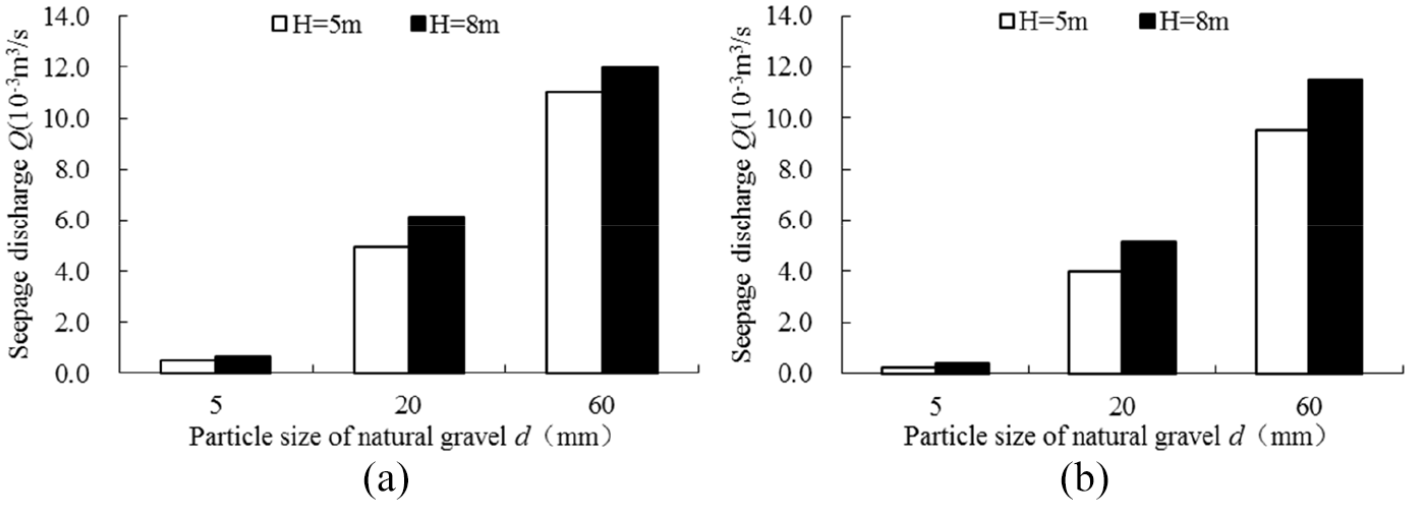
The relationship between the seepage discharge and the particle size: (a) L = 30 cm and (b) L = 70 cm.
Figure 4 showed the particle size of natural gravel was a vital factor affecting seepage discharge. If the laying depth of natural gravel was not change, the depth-to-particle size ratio of natural gravel defined as L/d decreased with the increasing of the particle size of natural gravel. The total surface area formula is as follows:

Where: f is Dimensionless coefficient, n is the porosity.
According to the analysis of total surface area, the decrease of depth-to-particle size ratio of natural gravel caused the decrease of the total surface area of the natural gravel, which made the viscous resistance and friction between the water flow and natural gravel decrease. Thus, the seepage discharge of natural gravel significantly increased in a given pressurized head within the unit time. Similarly, when the particle size of natural gravel was a certain value, the increase of laying depth would lead to an increase in L/d, and the total surface area increased, which caused the viscous resistance and friction to increase. Then, within the unite time seepage discharge of natural gravel was reduced. However, compared with the change of seepage discharge of natural gravel caused by the particle size and laying depth of natural gravel, the seepage discharge changes of natural gravel caused by the influence of the laying depth of natural gravel was not obvious. Moreover, no matter the depth-to-particle size ratio how to change, the seepage discharge of natural gravel increased with the increasing of the pressurized head. Meanwhile, it can also be seen from Figure 4 that the seepage discharge of natural gravel with the particle size (d) of 20 mm was about 11 times larger than that of natural gravel with the particle size (d) of 5 mm; the seepage discharge of natural gravel with the particle size (d) of 60 mm was about 26 times larger than that of natural gravel with the particle size (d) of 5 mm.
The relationship between the seepage discharge of natural gravel and the laying depth of natural gravel
The relation between the seepage discharge of natural gravel and different laying depth at the pressurized head (H) of 5 and 7 m were shown in Figure 5, which the particle size of natural gravel were 5 and 20 mm, respectively.

The relationship between the seepage discharge and the laying depth: (a) d = 5 mm and (b) d = 20 mm.
For Figure 5, the seepage discharge of natural gravel decreased with the increasing of the laying depth of natural gravel, the same pressurized head, for the same particle size of natural gravel. There was a significant negative linear relationship between the two. It was mainly due to the hydraulic gradient of seepage J = △H/L decreased with the increasing of the laying depth of natural gravel, resulting in the decreasing of seepage discharge per unit area. The change of particle size of natural gravel made seepage discharge per unit time increase at a rate 10 times. To analyze the linear relationship of the Figure 5, for the same particle size and laying depth of natural gravel, the increase of pressurized head only changed the intercept of seepage discharge, but no change in slope. If a straight line and the X-axis intersected or infinitely closed, the seepage discharge of natural gravel Q was zero, and the laying depth was the critical laying depth
In the same way, the relationship between the pressurized head and the critical laying depth of the natural gravel with the particle size (d) of 5 and 20 mm was shown in Figure 6.

The relationship of the critical laying depth and the pressurized head: (a) d = 5 mm and (b) d = 20 mm.
The relationships between the critical laying depth and the pressurized head were of great significance in the practical seepage project, when the particle size of natural gravel was 5 and 20 mm, respectively.
The relationship between the seepage discharge of natural gravel and the bulk density of natural gravel
The relation between seepage discharge of natural gravel and different bulk density of natural gravel at the pressurized head (H) of 5 and 8 m were shown in Figure 7, which the particle size of natural gravel was 5 mm.

The relations between seepage discharge and bulk density.
As can be seen from Figure 7, the seepage discharges of natural gravel decreased with the increasing of bulk density of natural gravel, which had negatively linear relationship under the same pressurized head. The reason was mainly due to that the bulk density of natural gravel was relying on vibrating frequency. During the vibration process, pore structure of natural gravel changed, porosity reduced and effective cross sectional area reduced, which led to the decreasing of seepage discharge per unit area. In this experiment, the increasing of the bulk density of natural gravel meant gradually decrease of the porosity. Figure 7 also showed the change of seepage discharge per unit time gradually decreased with the increasing of bulk destiny of the natural gravel under the different pressurized head. It indicated that the bulk destiny had a greater impact than the pressurized head on the seepage discharge when bulk destiny reached a certain value. If a straight line intersected or infinite closed to the X-axis, then the seepage discharge of natural gravel Q was zero, and the bulk density was the critical bulk density
Similarly, the relationship between the pressurized head and the critical bulk density
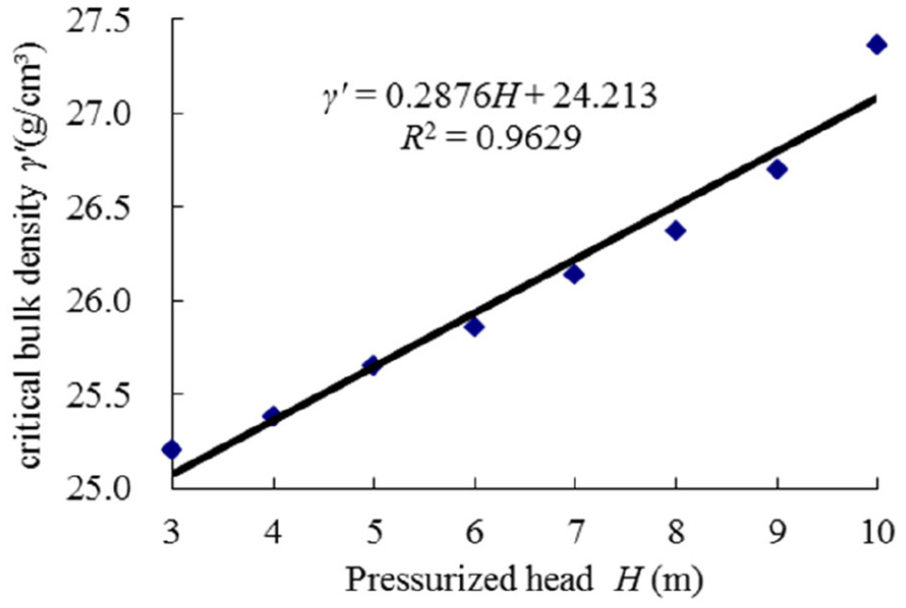
The relationship of critical bulk density and pressurized head.
The relationship between the critical bulk density and the pressurized head had important significance in the practical seepage project, when the particle size of natural gravel was 5 mm.
The empirical formula for the seepage discharge of natural gravel
According to the experimental results of the seepage discharge of natural gravel with different particle sizes, laying depths, bulk densities and pressurized heads, the seepage discharges of natural gravel were fit with the method of nonlinear regression. Therefore, the empirical formula of the seepage discharge of natural gravel was obtained, which can be expressed as:

where Q was the seepage discharge of natural gravel (10−3m3/s); d was the particle sizes of natural gravel (mm);γ was the bulk density of natural gravel (g/cm3); L was the laying depth of natural gravel (m); H was pressurized head (m).
The comparison between the seepage discharge of natural gravel calculated according to equation (1) and the seepage discharge of natural gravel obtained from the test listed in Table 2 indicated good agreement between the calculated value of the seepage discharge of natural gravel with the experimental value, and the maximum relative error did not exceed 6.73%, confirming that the empirical formula of the seepage discharge of natural gravel obtained from the test fitting was feasible.
Comparison of the calculated and experimental values of the seepage discharge of natural gravel.

Conclusion
In this study, the seepage flow patterns of the natural gravel were determined by the Reynolds number and it was found that the Reynolds number of the seepage flow in the natural gravel was greater than the critical Reynolds number, indicating that the seepage flow in the natural gravel was non-laminar flow in the test conditions described in this paper.
The power function relationship between the seepage discharge of natural gravel and the pressurized head was positively correlated. According to the fitting relationship between the seepage discharge of natural gravel and the pressurized head, it can be known that the power exponent fell into the interval (0.5,1). Therefore it can be concluded that the seepage flow belonged to the transition from laminar to turbulent flow in the natural gravel with the particle size (d) of 5 and 20 mm when the laying depth L = 50 cm and L = 70 cm.
The seepage discharge of natural gravel increased with the increasing of the particle size of natural gravel. The seepage discharge of natural gravel with the particle size (d) of 20 mm was about 11 times larger than that of natural gravel with the particle size (d) of 5 mm; the seepage discharge of natural gravel with the particle size (d) of 60 mm was about 26 times larger than that of natural gravel with the particle size (d) of 5 mm.
The linear relationship between the seepage discharge of natural gravel and the laying depth of natural gravel was negatively correlated. According to the fitting relationship between the seepage discharge and the laying depth, the critical laying depths under different pressurized heads were obtained when the seepage discharge of natural gravel with the particle size (d) of 5 and 20 mm was zero. That was, for the natural gravel with the particle size (d) of 5 mm, the relationship between the critical laying depth
The linear relationship between the seepage discharge of natural gravel and the bulk density of natural gravel was negatively correlated. According to the fitting relationship between the seepage discharge and the bulk density of natural gravel, the critical bulk densities under different pressurized heads were obtained when the seepage discharge of natural gravel with the particle size (d) of 5 mm was zero. That was, for the natural gravel with (d) of 5 mm, the relationship between the critical bulk density and pressurized head H was
The empirical formula of the seepage discharge of natural gravel with different particle sizes, laying depths, bulk densities and pressurized heads was obtained with the method of nonlinear regression. The empirical formula was validated by experiments. The maximum relative error did not exceed 6.73%, proving that the empirical formula is feasible.
Footnotes
Declaration of conflicting interests
The author(s) declared no potential conflicts of interest with respect to the research, authorship, and/or publication of this article.
Funding
The author(s) disclosed receipt of the following financial support for the research, authorship, and/or publication of this article: This research is supported by both the National Natural Science Foundation of China (51179116, 51109155) and the Natural Science Foundation of Shanxi Province (201701D221137).
