



Abstract
Vibration analysis of the classical elastic structures is not only essential for the study of vibration reduction by predicting the dynamic behavior, but also important to ensure a reliable, safe, and lasting structural performance through the proper design procedure. In this paper, the influence of boundary conditions on the free and forced three-dimensional vibration analysis of thick rectangular plates has been performed using the improved Fourier series method. For the elastically restrained thick rectangular plate, the three-dimensional improved Fourier series displacement forms are used to model the vibration field. The energy formula is employed to describe the three-dimensional dynamics of the plate. All the unknown Fourier series coefficients are then solved by the Rayleigh-Ritz method. In order to validate the proposed model, several numerical examples are provided and compared against the results from the literature and Finite Element Analysis (FEA). In addition, the effects of the boundary restraining spring stiffness and the thickness ratios of thick rectangular plates are analyzed under elastically restrained boundary conditions to develop an in-depth understanding of the three-dimensional vibration characteristics of thick rectangular plates.
Keywords
Introduction
Vibration analysis of the rectangular plate is one of the most general and important problems in engineering applications. It is well defined and has been understood by many researchers for a long history. Most of the modeling approaches are developed by using the classical or approximate plate theories, such as the classical thin plate theory (CPT), the first-order shear deformable plate theory (FSDPT), and the higher-order shear deformable plate theories (HSDPT’s).
The vibration characteristics of thin plates have been widely investigated in the literature for decades, as comprehensively reviewed by Leissa,1–6 in which the effect of shear deformation has been neglected. However, these methods are not always reliable to offer accurate solutions when the plate is relatively thick. If the shear effect is ignored, the predicted eigen-frequency solutions for thick plates will be higher than the exact solutions. To compensate for this problem, a variety of developing plate theory that introduces correction factors to assume the shear strain distribution through the plate thickness was proposed for the three-dimensional analysis of plates.7–14 However, these results didn’t contain the symmetric modes in the thickness direction, which means the dimensions of the methods were reduced from three to two, which limits the application of these correction factors to plates of moderate thickness.
Since then, the three-dimensional elastic theory attracts the researchers’ attention. Leissa et al.15,16 employed the associated periodic functions as admissible functions in the Ritz method to develop a solution procedure for the vibration of FFFF and CFFF plates. Malik and Bert 17 then proposed three-dimensional elasticity solutions for vibration analysis of plate configurations having two opposite (vertical) sides simply supported and general boundary conditions at the other two sides by using the differential quadrature method. They offered the numerical data including the first nine vibration frequencies of the six plate configurations for combinations of three aspect ratios and two thickness ratios. Liew et al.18,19 obtained the normal mode characteristics of thick plates with simply supported boundary conditions by using three-dimensional Ritz formulation with orthogonal polynomials, in which the convergence analysis was also conducted. Then, the method was applied specifically to investigate the effects of the thickness ratio on the vibration responses of SSSS and SFSF plate. 20 Lim et al.21,22 studied the vibration behavior of rectangular thick plates (relative the thickness ratio t/b > 0.2) with combinations of free, simply supported, and clamped boundary conditions. The effect of transverse shear strain had been considered using an energy-based higher-order plate theory without the shear correction factor. Further three-dimensional vibration analyses for plates and shells considered the inclusion of functionally graded material (FGM) layers,23–26 the three-dimensional exact formulation could be used for the free vibration analysis of plates and shell panels. However, the boundary conditions of the structures are limited only to simply supported.
During recent years, the research works focused on the three-dimensional vibration analysis of plate and shell structures with different boundary conditions. Zhou et al. 27 presented the vibration analysis of thick rectangular plates by using Chebyshev polynomials multiplied by a boundary function as the admissible functions in the Ritz method. The different boundary functions were chosen to satisfy the different essential geometric boundary conditions of the plate. Cupiał 28 analyzed the piezoelectric plates that modeled as a three-dimensional body. The natural frequencies and mode shapes of piezoelectric rectangular plates are obtained by the perturbation method. Nevertheless, the displacement functions of the plates had been constructed to satisfy special types of boundary conditions in most of the previous investigations. Furthermore, modifications to the theoretical formulation and simulation codes are necessary when the boundary conditions changed.
More recently, the improved Fourier series method was proposed to determine the transverse and in-plane vibration analysis of rectangular plates.29,30 Then the method was further exploited for the acoustic analysis of a three-dimensional rectangular cavity with a general impedance boundary by Du et al. 31 in which the excellent performance of the proposed series description for three-dimensional sound pressure distribution had been validated through the comparison with the available data in the literature.
In the present analysis, the improved Fourier series method is employed to perform the three-dimensional vibration analysis of thick rectangular plates. The dynamic performance of thick rectangular plates is solved by the energy functional of the plate using the Rayleigh-Ritz procedure. The numerical results are then presented by comparing with those results from other approaches and/or commercial Finite Element Analysis (FEA) software using NASTRAN. Three-dimensional elastic method is an important vibration analytical method in practice. It can be a more objective response to the actual vibration of thick plates. The main advantage of the present theoretical model derives from the fact that this method is possible to cover different theoretical boundary conditions and thickness ratios through modify the boundary and thickness parameters in the numerical calculations conveniently. Therefore, the influence of boundary conditions and thickness ratios is future discussed by analyzing the free and forced vibration of the thick plate with various boundary conditions.
Theoretical formulations
Problem description
Illustrated in Figure 1 is a three-dimensional thick rectangular plate of length a along the x-axis, width b across the y-axis, and thickness c across the z-axis. The three displacements along the x, y, z directions are denoted by u(x, y, z), v(x, y, z), and z(x, y, z), respectively. The general boundary conditions were simulated in the work of transverse and in-plane vibration analysis of thin plates by setting the stiffness of springs attached to the structural edges.29,30 In a similar way, the general boundary conditions for three-dimensional vibration analysis of thick plates are realized through the introduction of artificial springs uniformly distributed on each side surface. The classical edge supports as well as any combinations can be readily simulated by setting the stiffness coefficient into zero or infinity.
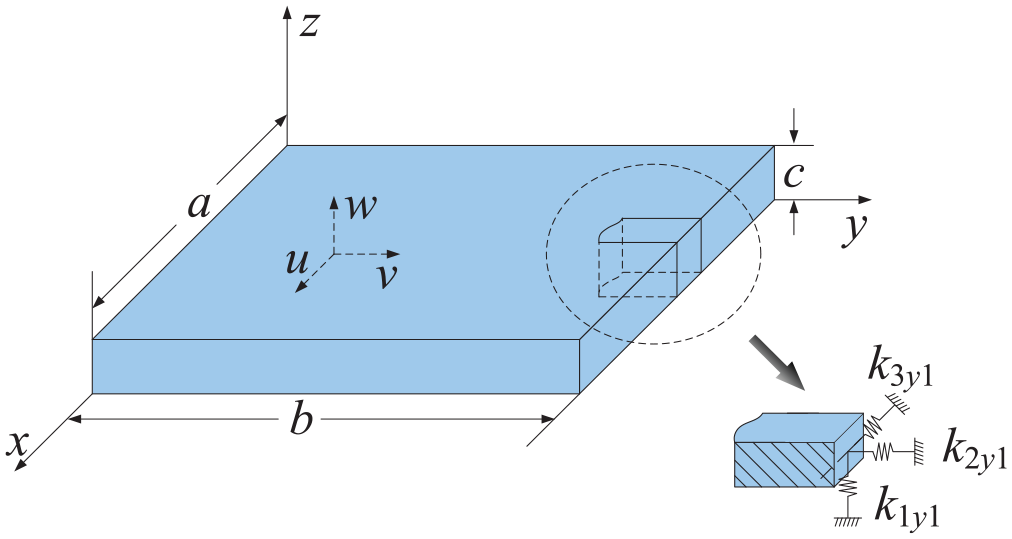
Three-dimensional thick plate structure and the coordinates system.
According to three-dimensional elasticity theory, the stress-displacement relations of the plates in Cartesian coordinates are given as:

where (σx, σy, σz, τxy, τxz, τyz,) are the normal and shear stress components; G is the shear modulus; μ is the Poisson’s ratio; Symbol ∂ indicates the partial derivatives.
In the three-dimensional vibration analysis of rectangular plates, the structure is usually restrained on x = 0, a and y = 0, b four surfaces, and released on other surfaces. The following are the specifications of each support boundary condition on the edge of y = b.



As shown in Figure 1, every generic point on each restrained surface has three restrained springs in the direction of x-, y- and z-axis, respectively. For example, k1y1 and k3y1 represent the stiffness for the tangential springs on the surface y = b, meanwhile, k2y1 is the stiffness for the normal springs. As mentioned earlier, the classical boundary conditions can be achieved in the following ways:



Improved Fourier series representation of three displacement fields
In this work, the three-dimensional vibration displacement field of the thick rectangular plate with various boundary conditions is modeled by the three-dimensional improved Fourier series method. The displacement components are given as follows,

in which,



Take ξ1a(x) and ξ2a(x) as an example, it is easy to verify that


Similar conditions exist for the y- and z-related polynomials, ξ1b, ξ2b, ξ1c, and ξ2c, it should be noted that these six supplemental functions aim to overcome the discontinuities on the six surfaces of the three-dimensional vibrating plate structure, thus, the displacement functions can exactly satisfy various boundary conditions and the convergence can be greatly improved.
Solution of the three-dimensional plate structure
Now, solving the three-dimensional plate vibration problem means the determination of all the unknown coefficients in the improved Fourier series representations equation (4). As pointed out above, the constructed Fourier series expansions are sufficiently smooth in the whole solving domain including the edge surfaces. Therefore, the energy formulation can give reasonably accurate solutions of the three-dimensional plate vibration problem.
The Lagrangian’s function of three-dimensional vibrating structure can be expressed by the potential energy V and the kinetic energy T as follows:

In the three-dimensional elasticity theory, the total potential energy is given by

The terms in the last two lines mean the potential energy stored in the artificial edge restraining springs distributed on the edge surfaces.
The kinetic energy for the vibrating plate structure is

in which, ρ is the mass per unit volume, and ω is the angular frequency of the vibration.
Twenty-one linear equations can be obtained by submitting the displacement functions equation (4) into the Lagrangian’s functions equation (7), and applying the Rayleigh-Ritz procedure with respect to each unknown Fourier series coefficient. The final system equation for the free vibration of plates can be further written in the matrix form:

where



The modal information including the natural frequencies and mode shapes of the three-dimensional rectangular plate can be obtained by solving the matrix eigenvalue problem. Meanwhile, solving equation (10) directly can identify all the unknown Fourier coefficients. The forced response can be exactly described by substituting the Fourier coefficients into the displacement components of the rectangular plate.
Numerical results and discussions
In this section, the proposed method will be employed for the three-dimensional vibration analysis of thick rectangular plates. In the following numerical examples, the plate has length a in x-direction, width b in y-direction, and thickness c in z-direction, with the material parameters as Young’s modulus of 7 × 10¹⁰ N/m2; density of 2700 kg/m3 and Poisson ratio of 0.3.
Convergence and validation
To study the convergence of the current method, a square SSSS plate with the different types of thickness ratios will be considered firstly. As mentioned in equation (3), the simply supported boundary condition can be obtained by setting the normal spring constant equal to zero, and the shear spring constants equal to an extremely large number which is actually represented by 1018 in the numerical calculations.
The convergence and comparison of the frequency parameters for an SSSS square plate of different thickness ratios are tabulated in Table 1. The three-dimensional exact solutions in Ref., 10 three-dimensional DQ solutions in Ref., 17 three-dimensional Ritz solutions in Ref. 27 and higher-order deformable solutions in Ref. 21 are given for the comparison purpose.
Frequency parameters for a square SSSS plate of different thickness ratios.

It can be seen that the proposed method has good precision and convergence speed for a square SSSS plate with different thickness ratios. The correctness and reliability of the proposed model can be verified. Given the excellent numerical behavior of the current solution, the setting Mx=My=Mz =12 will be used in all the subsequent calculations.
Results for the unsymmetrical boundary conditions
In the current literature, the majority of three-dimensional vibration analysis of thick rectangular plates focuses on the symmetric boundary conditions. Usually, the additional modification on the displacement functions or theoretical formulations is required when the boundary conditions changed. In this study, all boundary conditions can be readily simulated and treated in a unified pattern by introducing three types of restraining springs that are introduced on each edge surface. In this section, a type of unsymmetrical boundary condition FSCS will be taken into account. The results outlined in Table 2 are the first six natural frequency parameters for a square FSCS plate of different thickness ratios. The comparison results are calculated by FEA software, in which the finite element model has been made of a uniform element division of 10 mm×10 mm×10 mm elements for a total number of 239,665 degrees of freedom. From the results, an excellent agreement can be observed, which means that the accuracy and reliability of the current method are verified again for the unsymmetrical boundary conditions.
Frequency parameters for a square FSCS plate of different thickness ratios.

Figure 2 shows the first six mode shapes for the square FSCS plate of the thickness ratio c/b = 0.3. It is shown that the first, fourth and fifth mode have different degrees of deformation in thickness direction while deformation of the second, third and sixth mode is mainly parallel to the neutral-surface of the plate. Therefore, only three-dimensional elasticity theory could obtain the accurate prediction of vibration characteristics of thick plate structure by considering the effect of shear deformation.

The first six mode shapes for the square FSCS plate of the thickness ratio c/b = 0.3: (a) the first mode, (b) second, (c) third, (d) fourth, (e) fifth, and (f) sixth.
Results for the elastically restrained boundary conditions
To analyze the three-dimensional vibration of the rectangular plate structure deeply, the effect of elastically restrained boundary conditions will be considered afterwards. The elastically restrained boundary condition, which represented by the symbol S(k), is simulated by setting the normal boundary stiffness equal to zero and the tangential boundary stiffness equal to k.
Figure 3 shows the first six natural frequencies for a square SSSS(k) plate with the thickness ratio c/b = 0.3. It can be found that the natural frequencies of the plate show different tendencies with the stiffness of the restraining spring increased. As the figure shown, the boundary condition of the plate is close to the F boundary condition with smaller stiffness of restraining spring when k = 0 N/m and k = 109N/m. The first six modal frequencies were abandoned due to the rigid mode. With the increasing stiffness, the rigid mode is progressively turned into flexible mode until the boundary condition close to the S boundary condition when k = 1013 N/m and k = 1015N/m.

Natural frequencies for a square SSSS(k) plate of different boundary restrained stiffness, c/b = 0.3.
To predict the forced vibration response of a rectangular plate with elastically restrained boundary condition, the external excitation as a one-dimensional force vector is applied to the plate at the position of (xe, ye, ze) in x-axis direction. In order to avoid numerical instability at the resonant frequencies, structural damping is introduced in the form of complex Young’s modulus, namely Ê = E(1+jη) with the structural loss factor η = 0.01. Consider a square SSSS(k) plate with the thickness ratio c/b = 0.3, in which the stiffness of boundary restraining springs k = 1011 N/m, the excitation position at (3a/10, 3b/10, 0) and the observation position at (9a/10, 9b/10, c).
Plotted in Figure 4 is the comparisons of vibration acceleration response for the square SSSS(k) plate. It is observed that two curves of the proposed method and FEA match very well under 1500 Hz and have a little different on the resonant peaks in the high frequency range. This is due to the effects of mesh size of finite elements and frequency step length on numerical accuracy. The difference can be reduced by increasing the mesh density and decreasing the frequency step length as the frequency increases, but with the cost of calculation time. Moreover, the comparison results can also be calculated by using other more accurate numerical solutions.

Vibration acceleration response for the square SSSS(k) plate of the thickness ratio c/b = 0.3, boundary restrained stiffness k = 1011 N/m.
Figure 5 demonstrates the vibration acceleration response for the plate of different boundary restrained stiffness. The influence of the elastically restrained boundary condition of plates on the three-dimensional vibration characteristics can be clearly seen from the figure. The natural frequencies of the plate increase with higher stiffness of boundary restraining springs. There appear three resonant peaks under 300 Hz frequency when k = 109 N/m; this is the result of the vibration of boundary restraining springs, corresponding to the flexible mode that changed from the rigid mode.

Vibration acceleration response for the square SSSS(k) plate of different boundary restrained stiffness, c/b = 0.3.
The thickness of the plate structure is another major influence factor of a three-dimensional vibration analysis procedure. The influence of thickness on vibration characteristics of the three-dimensional plate structure will be studied next. Tabulated in Figure 6 is the first six natural frequencies for the square SSSS(k) plate under different thickness ratios. It can be observed that the natural frequencies of plate structure increase with the thickness. For some special modes, the natural frequencies of the plate with different thicknesses are the same. This is because the particle motion direction is mainly parallel to the neutral surface of the plate, which is actually in-plane vibration modes. Moreover, Figure 7 shows the vibration acceleration response of the plate with different thicknesses. The same resonant peaks of the different plate are existed in the special modes.
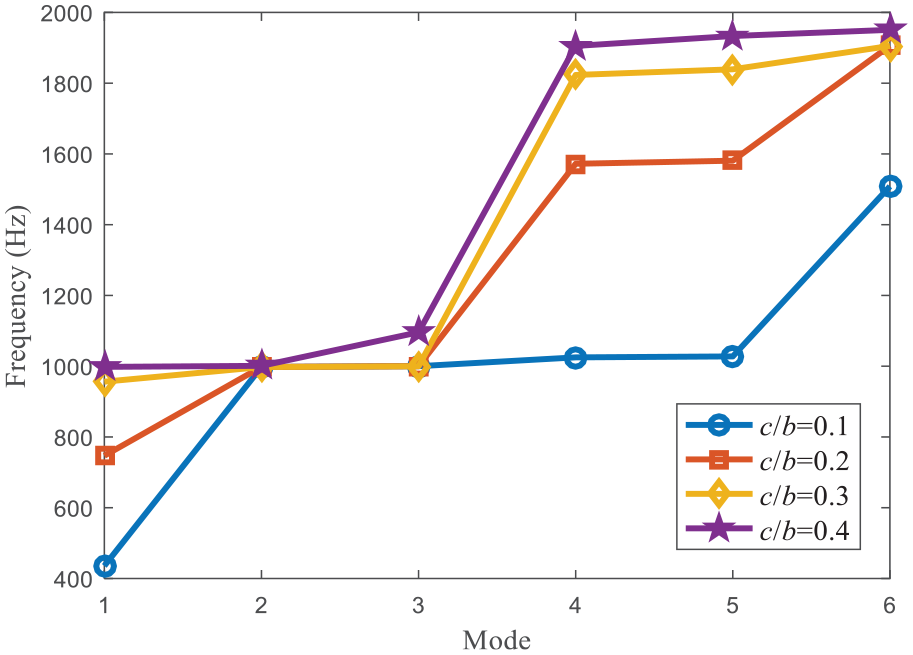
Natural frequencies for the square SSSS(k) plate of different thickness ratios, k = 1011 N/m.

Vibration acceleration response for the SSSS(k) square plate of different thickness ratios, k = 1011 N/m.
Conclusion
The three-dimensional improved Fourier series method is adopted as an analytical method to develop the three-dimensional elasticity solution for the vibration analysis of thick rectangular plates in this paper. In combination with the Rayleigh-Ritz procedure, the theoretical formulations are implemented based on the energy principle. Numerical examples are then presented to validate the reliability and efficiency of the current method according to the comparison with the results predicted by other approaches. In addition, the influences of boundary conditions and thickness ratios on the free and forced vibration characteristics of thick plate structures are analyzed and discussed.
The major conclusions drawn from the present study are summarized as follows:
The general boundary conditions of three-dimensional thick plates are simulated by introducing three types of restraining springs on each edge surface. All the boundary conditions can be covered without modifications or reformulations using the proposed method by adjusting the spring parameters.
Since there are no assumptions about the shear deformation of plate structure compared with the classical plate theory or other high-order approximation theories, the good agreement of frequency parameters between the present results and comparison results proves that a high accuracy and rapid convergence can be achieved by the method proposed in the present study.
The numerical results show that the boundary restraining stiffness and thickness ratios have significant effects on the dynamic performance of thick plates. A proper selection of the parameters could achieve a better effect on the vibration reduction of three-dimensional structures in engineering applications.
Footnotes
Declaration of conflicting interests
The author(s) declared no potential conflicts of interest with respect to the research, authorship, and/or publication of this article.
Funding
The author(s) disclosed receipt of the following financial support for the research, authorship, and/or publication of this article: This work is financially supported by the National Natural Science Foundation of China (Grant no. 51809027) and the Fundamental Research Funds for the Central Universities (Grant no. 3132019199).
