



Abstract
This article examines how Catholics form their consciences together in parishes particularly on topics of gender and sexuality. The data for this project stems from ethnographic observations and forty interviews from a 2010 to 2012 study of two Catholic parishes in Chicago. The first is a progressive parish promoting inclusion of gay and lesbians as well as women’s ordination. The second had a small but active Respect Life group attempting to change their parish culture to be more committed to Respect Life issues. The paper suggests that cultural inertia (or lack there of) is one mechanism that drives or halts conscience formation. These collective consciences lead to differing understandings of what it means to be Church and to be a person, and they may motivate actions to change the Catholic Church hierarchy or local parish. Forming consciences together has implications for understanding the role of culture and structure in the Catholic Church. Specifically, these formed consciences, parish cultures, and actions produce different boundaries and partnerships with the Archdiocese which determines what actions are legitimate by setting the conditions for parish actions and constraining parish actions with threats of sanction.
Introduction
Sociological studies of American Catholicism have consistently documented how post-Vatican II Catholics form their individual consciences with and against institutional teachings (Clements and Bullivant 2021; D’Antonio, Dillon, and Gautier 2013; D’Antonio et al. 2007; Williams and Davidson 1996). Most Catholics form their consciences within the context of their local Catholic parish where they experience and live their faith (Baggett 2009; Bruce 2017; Konieczny 2013). These parishes form specific cultures where shared values, norms, and ideas about what it means to be Catholic are held in common by at least some parishioners (Edgell Becker 1999). However, cultural understandings among Catholic groups are constrained by Church authority (Bruce 2017).
The Second Vatican Council called Catholics to increased participation in the life of the Church and to form their own consciences (Wilde 2007). Consciences are considered by the Church to be the internal moral guide for one’s life, in part formed by Church teaching (Dillon 1999). Catholics then bring their consciences into the civic sphere (Day 2020). Taking their consciences seriously, lay Catholics have attempted to influence the discourse of the Church itself, challenging the Church to change (Bruce 2011; Dillon 1999). This is often met with resistance by the Church structure which attempts to limit individual agency (Bruce 2017).
Less understood is how conscience formation occurs in Catholic parishes. Through an ethnographic study of two Catholic parishes in the Archdiocese of Chicago, I examine how the respective Catholic parishes and groups within them act together to do the work of conscience formation. Accordingly, the parishes then attempt to influence the local Catholic Church either at the parochial or diocesan level. The first parish is a self-proclaimed liberal parish that advocates to the local hierarchy the need to change the Church’s teaching on same-sex relationships and women’s ordination. The second parish featured a small but vibrant Respect Life group trying to make their local parish more committed to a “culture of life” as defined by the institutional Church. Following the findings, I turn to Cultural Inertia Theory (Zarate et al. 2012) as it helps explain how consciences are formed and the collective action that may occur consequently.
Additionally, this article shows how forming consciences (1) challenges the Church to change internally and (2) shapes undergirding understandings of what it means to be “Church” as well as conceptions of the human person. In each parish, forming consciences together led to a distinctive relationship to the Archdiocese which made possible some projects and set the limits of others. I conclude by speculating on how a decade later, each parish’s level of cultural inertia accounts for who it is today.
Catholic Beliefs and Consciences
Conceptions of Catholic faith have shifted from a collective, institutional one for Catholics coming of age in the 1930s and 1940s to an actively negotiated, diverse individually constructed faith post 1970s. Prior to Vatican II, Catholics saw the Church as “mediating the relationship between God and an individual; they defined the institutional church as essential to one’s relationship with God” (Williams and Davidson 1996:274). Vatican II called for greater lay participation and involvement in the Church and Catholics who came of age during and after the Council increasingly emphasized one’s personal relationship with God and in being “a good person” (Williams and Davidson 1996:284).
Further studies continue to document this trend including recent research on millennial Catholics (D’Antonio et al. 2013; Smith et al. 2014; Zech et al. 2017). Understandings of faith follow patterns better understood in terms of core and periphery beliefs (Baggett 2009; D’Antonio et al. 2007). Included in the core are creedal beliefs such as Jesus’ resurrection and doctrine while sexual morality teachings and Mass attendance fall to the periphery (Hoge 2002; D’Antonio et al. 2007). Laity sort themselves by categories such as traditional—focused on boundaries—and liberal—focused on inclusion (Starks 2013).
These patterned attitudes are a consequence of the institutional Church’s call to greater participation and the call to form one’s individual conscience, understood by the United States Conference of Catholic Bishops (2011:7) to be “the voice of God resounding in the human heart, revealing the truth to us and calling us to do what is good while shunning what is evil. Conscience always requires serious attempts to make sound moral judgments based on the truths of our faith.” Fostering consciences has been part of Catholic theology since at least the fifth century C.E. (Dillon 1999:14). Individuals cultivate a well-formed conscience by turning to prayer, personal experience, Church teaching, Scripture, and community. Even if this conscience disagrees with the Church’s teaching, it serves as the individual’s primary guide. In the United States, most Catholics today rely on their conscience when grappling with moral questions (Gecewicz 2016).
Parish priests also form their consciences, leading to a diversity of attitudes and beliefs. This diversity, documented in sociological literature, is a direct result of Vatican II (Greeley 1972). This variation includes attitudes on sexual sins, though many studies report that priests are becoming increasingly conservative over time (Vermurlen, Regnerus, and Cranney 2023). Additionally, most priests still consider homosexuality, premarital sex, and masturbation to be always a sin. Priests influence how parishioners think about their religious beliefs which in turn has the power to shape how they think about politics (Smith 2008). While they play a role in shaping laity’s consciences, they do not have a monopoly, and they add to the diversity of parish culture.
Individual Conscience Formation in Catholic Parish Cultures
Catholicism, like other religious traditions, is a cultural system with a common language, identity, and symbols (Burns 1996). While Catholics learn about their faith as well as different perspectives about Catholicism through diverse routes including college campus ministry (Day and Kawentel 2021) and television advertising campaigns (Cieslak 2012), the vast majority experience and practice their faith in the context of the local parish (Konieczny 2013). Parishes allow parishioners to deepen that faith, find friendships, pray, and do parish activities together (Cavendish 2018). Conflict may emerge as evidenced by the arrival of new immigrants (Hoover 2014) or when parishes are asked to merge (Herzog and Vaidyanathan 2015). The local parish mediates the individual’s conception of Catholicism by providing specific versions of the broader Catholic cultural system—for example, an embrace and welcome of LGBTQ Catholics even as the Church continues to teach same-sex behavior is sinful (Baggett 2009).
This is because parishes, like other congregations, form particular cultures, “local understandings of identity and mission” (Edgell Becker 1999:7) that “communicate to itself and others what it is about” (Ammerman 1997:57). Cultures in parishes matter because they are the places where “persons are thereby formed and transformed” (Ammerman 1997:354). Parishes can silence or produce civic engagement or projects for cultural change (Baggett 2009; Day 2020), increase polarization within the Church (Konieczny 2013), and create spaces of welcome or unwelcome (Hoover 2014). Groups like adult religious education programs may create micro interactional norms that “cultivated an atmosphere of silence surrounding potentially contentious issues” (Ellis 2017:389). These norms foster interactional solidarity, allowing Catholic to accommodate diverse positions on “official” teachings (385).
Parish cultures and the Catholics they form do not have carte blanche to develop shared meanings but are instead constrained by the institution Church (Bruce 2011; Burns 1996). While “pro-change” Catholics are “transforming the church’s institutional conversations and destabilizing some of the taken-for-granted meanings of Catholicism” (Dillon 1999:30), they are limited by the vocabulary provided by the Church. Many groups trying to think in pro-LGBTQ ways spend the bulk of their time responding to institutional messaging which curbs the potential for new understanding of sexuality in Catholicism (Jordan 2000).
Whether documenting patterns in attitudes (D’Antonio et al. 2013), contemporary parish life (Baggett 2009; Bruce 2017; Zech et al. 2017), or tensions and dissent concerning institutional teachings or procedures (Bruce 2011; Dillon 1999), the model of “pray, pay, obey” is no longer the modus operandi for the majority of American Catholics. This is seen clearly in Loveland and Ksander’s (2014) case study of lay dissent to church mergers. Thus, “Catholics strongly subscribe to the principles of religious freedom and conscience… [they] are open to taking account of church teachings and the views of church leaders, but the majority reserve for themselves the responsibility to be the final arbiter of right and wrong” (D’Antonio et al. 2013:86). Consequently, Catholics’ religious agency and conscience formation limits the ability of the Church to shape belief uniformly.
Vatican II as Endogenous Shock
Vatican II served as an endogenous shock, prompting the global Church to reassess its relationship to modernity. The Council called for aggiornamento, metaphorical opening of the windows to facilitate dialogue with the Church and the world; notably, the Church urged the laity to manifest their vocation through secular work to build the kingdom of God (Wilde 2007). This reflects the conscience work done by Catholics in their parishes (Baggett 2009).
Consequentially, Catholics began to influence not only civil life but also the Church itself (Dillon 1999). Responding to the clergy sex abuse crisis, they formed an intradenominational movement called Voice of the Faithful to hold the Church accountable (Bruce 2011; Ewing and Steinberg 2019). Other pro-change Catholics have remained within the Church by contesting teachings on homosexuality and women’s ordinations (Dillon 1999). Some even claim the name “Catholic” while standing formally outside the Church which challenges the Church’s monopoly on the definition of what it means to be a Catholic (Dillon 1999).
This article contributes to the sociology of Catholicism by further exploring the tension between conscience formation and institutional authority in local parishes. Parishes serve as “‘in between’ spaces located in the middle of the hierarchical authority structure of the Catholic Church… [They are] sites where sociologists can observe, through carefully designed studies, whether and how church teachings are transmitted to parishioners, and to what consequence” (Cavendish 2018:7–8). In this article, I observe how parishes and groups within them do conscience formation, sometimes with some tension internally, and how this conscience work impacts subsequent relationships with the institutional Church.
Data and Methods
This article emerges out of a study of two Catholic parish cultures in the Archdiocese of Chicago between January 2011 and March 2012, including ethnographic observations and 40 interviews with parish clergy and lay leaders. The Archdiocese of Chicago is one of the largest diocese in the country and typically has a Cardinal as an Archbishop. At the time of the study, there were 356 parishes and 2.2 million Catholics (Archdiocese of Chicago Office of Research and Planning 2013). Thus, in terms of Catholic life in the United States, the Archdiocese of Chicago historically has been and is an important diocese for Catholicism.
Following Konieczny (2013), I intentionally chose parishes that initially appeared to represent polar expressions of American Catholicism. I first identified a parish that, by website and reputation in the Archdiocese, purported to have a progressive and welcoming culture. For a second parish, I contacted the Archdiocese of Chicago Respect Life Office to identify the most active Respect Life parishes in Chicago. Both parishes consisted of many parishioners who had been members of each respective parish for generations.
I approached each pastor to obtain consent to study the parish. To ensure confidentiality for parishioners, I said I would use pseudonyms for both parishes and all participants. I began attending Masses, meetings, and other events to become immersed in each parish. Neither pastor publicly announced I was studying the parish so I could seamlessly enter each parish. I did, however, tell parishioners I was doing a study of parish life. Parishioners were enthusiastic to discuss their involvement and frequently introduced me to other parishioners.
As there are often a small number of parishioners who set a parish’s agenda (Chaves 2004), my goal was to identify active parish leaders. Once identified, I conducted twenty interviews with parish lay leadership, staff, and priests at each parish. These interviews were semi-structured and aimed to understand the participant’s faith life, parish involvement, and sense of what made the parish distinctive. Interviews were between 45 minutes and 2 hours with a majority lasting approximately 1 hour. The location of the interviews ranged from the parish offices to coffee shops and parishioners’ personal homes. Given that women are often more involved in parishes than men (Leege 1988), and some label the “typical” parishioner to be a middle-aged, white woman (Zech et al. 2017), I conducted more interviews with women.
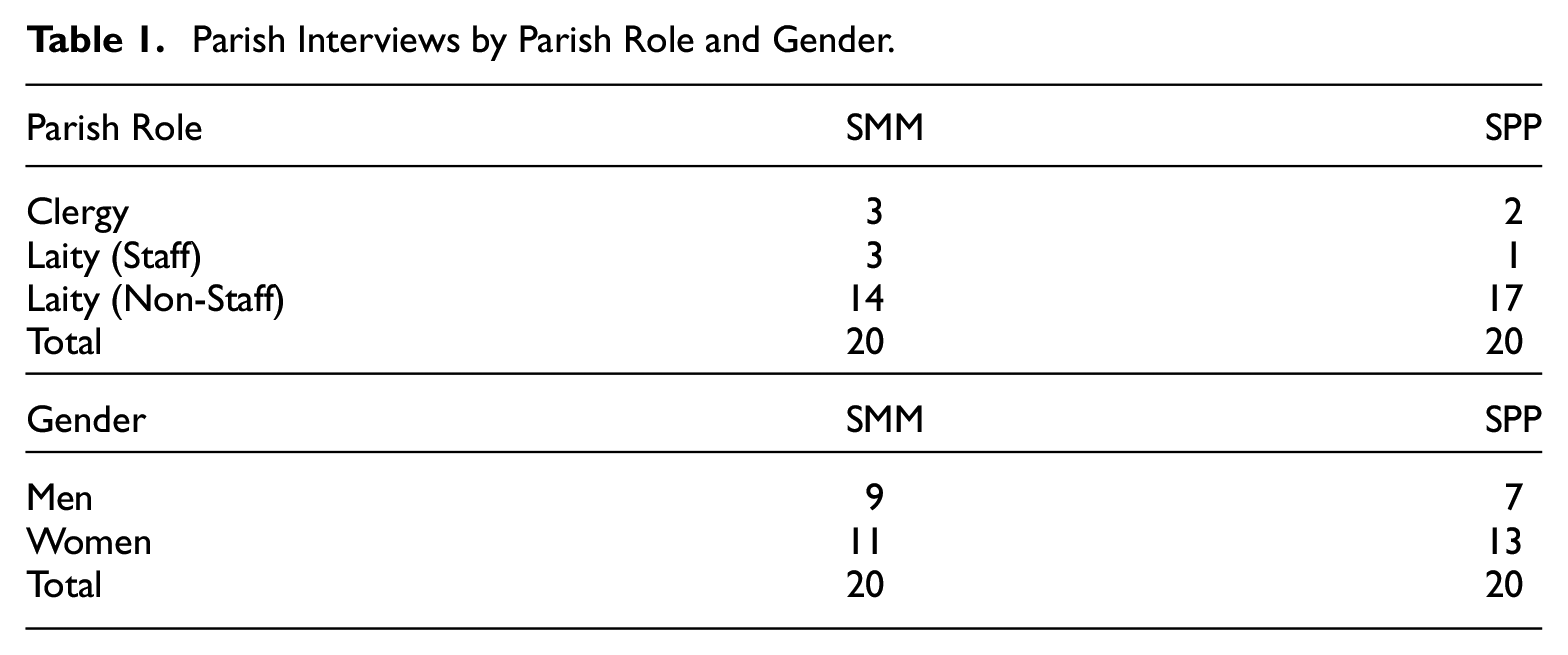
The first parish, St. Mary Magdalene Parish, described itself as an inclusive parish where they desired to make all feel welcomed. Most parishioners identified as progressive Catholics who disagreed with official Church teachings. St. Mary Magdalene Parish was similar to Dillon’s (1999) pro-change Catholics in that they constructed a Catholic identity that pushed against Church teachings. Parishioners cultivated and embraced this identity as early as the 1980s and reproduce it in their materials, homilies, and parish programs. I conducted fieldwork from January to August 2011. I interviewed 3 clergy including a former pastor, 3 staff members, and 14 lay leaders. Parishioners tended to have professional jobs including doctors, social workers, attorneys, and professors. There were 9 men and 11 women ranging from 30 to 80 years old. While most parishioners were White, the parish is in a very diverse Chicago neighborhood, and consequently, there were some racial and ethnic minorities.
The second parish, St. Pius Parish, was among the five most active Respect Life groups in the Archdiocese, though as I show below, this consisted of a small minority of parishioners in a parish that focused on “typical” parish ministry activities such as the Sacraments, religious education, and community-building activities (Zech et al. 2017). The ethnography was conducted between November 2011 and March 2012. Parishioners had working-class to middle-class backgrounds and were less likely to work in jobs that needed college or graduate education. I interviewed 2 clergy, 1 staff member, and 13 lay leaders. Seven were men and thirteen were women. Fewer staff were interviewed due to its smaller team (Table 1).
Parish Interviews by Parish Role and Gender.
Following Emerson, Fretz, and Shaw (1995), I inductively coded line-by-line my field notes and transcripts looking for themes across the two parishes. To help explain the variation, I then conducted focused coding to explore themes of parish culture, group formation, relationship with the Archdiocese, and conscience formation. To make sense of how conscience formation and organizational change happened across one parish but not the other, I returned to the existing literature and found that Cultural Inertia Theory’s mechanisms of cultural change provided an illustrative explanation (Zarate et al. 2012). In what follows, I show how cultural inertia operates at the parish and group levels.
Findings
In this section, I describe the relationship between each parish culture and the Archdiocese of Chicago, one of the largest in the United States. I explain the history of each parish relevant to its relationship with the Archdiocese. I then discuss how this relationship led that parish to construct boundaries against the Archdiocese or against greater American society. This relationship also shaped outreach and partnering with other neighborhood organizations.
St. Mary Magdalene Parish
St. Mary Magdalene parishioners understood themselves as progressive Catholics. Many attributed this to Vatican II which endorsed the increased lay involvement they had desired and called for Catholics to form their consciences rather than rely solely on the priests. Parishioners, young and old, shared a common understanding of parish history and professed a cultural narrative reinforced by parish leaders. For example, in an added reading to the Easter Vigil liturgy, parishioners recounted Vatican II’s impact on the parish:
In the mid 1960s, the reforms of the Second Vatican Council rocked the Church establishment, ushering in sweeping changes to the liturgy and inviting the laity to a whole new level of involvement. Pastors [names omitted] helped guide the parish into this new era, establishing the foundations for a lay-led pastoral council.
When the Archdiocese sent a representative to inquire about what type of pastor parishioners wanted, Reynolds notes that “we asked for an open pastor. The old priest that was retired living here, he was super conservative—just an old man. And the one that followed him was pretty conservative. We as a parish had started to become more open so that is why we as a parish were seeking an open priest.” The priest they received—Fr. Sean Kavanaugh—remembers the story similarly:
The people, when they heard I was going to be appointed as pastor, they contacted me and I went to their houses to listen. They said, we’ll get a bunch of people together and we’ll talk about our interests in the parish. They kept saying “we are ready. There could be a renaissance of some sort.” They were interested in participation, a more interesting liturgy, and a remaking of the liturgy. They though there should be more communication between the priest and the people, a sort of democratization.
The parish strongly identifies with the Catholic folk hymn “All Are Welcome,” proclaiming their parish to be a place where all people feel welcomed, included, and accepted as they are. New parishioners are socialized into this message with welcome kits, regular inclusive language in the bulletin, and the frequent singing of songs that describe God as embracing all people. While not defined explicitly with this language until the late 2000s, parishioners conceived of themselves as a space to let all Catholics experience welcome and acceptance. For example, during the 1990s, gay and lesbian members increasingly began to move into the neighborhood. Adam Wilson recounts his experience joining the parish:
It goes back to 1994. My partner and I were out, and we had an adopted son. We decided it was time to move and were concerned about moving into the right parish. We heard that St. Mary Magdalene was a good parish to be a member of. So, I called the parish school principal and said, “We have seen this house, and this is a nice neighborhood. We are a gay couple, we have an adopted son, and we don’t want to buy the house, become members of the parish and have our son go to school and become an object of ridicule.” And she said that would be no problem. The same year, Fr. Kavanaugh asked me to be a member of the parish council. We were told the parish would be accepting and it would be okay. And it was true.
In 2006 the U.S. Bishops released a document reaffirming the Church’s stance against same-sex behavior. The parish was dismayed: Dixie Walker describes how the parish held a town hall-type conversation to talk about the Church’s stance on homosexuality:
There was some re-deliberation of how depraved I and all the gays are by the institutional church. Here at the parish, we had a conversation, and people, I would say there were 150 people there, 200 people there. Largely supporters of gays and lesbians in the church, and so people, point after point, sort of responded to what it means to them to authentically be who they are as Catholic. The tone of the conversation was love.
Tensions escalate with “downtown”
Doing conscience formation work in a way that allows for dissent created tension with the Archdiocese. Parishioners, staff, and priests referred to the Archdiocese and Cardinal George as “downtown,” as the Archdiocese office is in downtown Chicago. This tension included sanctions against the parish’s lay preaching team and parishioners support of women’s ordination.
In the mid ‘90s, the former pastor Fr. Kavanaugh realized the parish had five or six former priests. Together with the pastoral leadership, he decided that he would have ex-priests celebrate Masses at the parish. He reports a meeting with Cardinal Bernardin who had heard rumors of this and pulled him aside at an event to address the rumors:
I went to a Confirmation at the neighboring parish and sat down at the only seat available which was next to Cardinal Bernardin. And he said to me, “I heard an absolutely ridiculous rumor that you are going to have Aidan Kelly say Mass in two days.” And I said that was going to happen. He said, “oh no, it cannot.” And I said, “okay I understand you have to say that.” So he said we would talk after the Confirmation. I went upstairs in the rectory with him and he said to me, “I am telling you—you are suspended if you allow that to happen.” I said, “I know you have to say that, you would but you won’t suspend me.” But he said he would suspend me. I didn’t sleep that night because I was thinking I promised everybody this thing. So I went to breakfast with Aidan and Liam (another parishioner) and they told me that Bernardin meant it.
In both cases, St. Mary Magdalene Parish responded creatively to parishioners’ pastoral needs. However, their cultural innovations took place within the larger Catholic Church and was subject to institutional scrutiny. To introduce less-than-orthodox ideas ran the risk of sanction by the Archdiocese. As such, the institutional structure could and did regulate the attempts St. Mary Magdalene parishioners took to realize their own consciences and shared parish culture.
Lay preaching on Wednesday nights
One of the parish’s best lay preachers, Sabrina Nottingham, discerned a vocation to the priesthood; however, as a woman, she was forbidden to be a priest. She decided to pursue ordination in the Women’s Priest Movement and was ordained. At the same time, she developed terminal cancer and soon after died. The Archdiocese firmly stated that because she had been ordained, she could not have the funeral Mass at the parish. Furthermore, the Archdiocese suggested that the current priest Fr. Dennis would be removed should he allow the funeral to proceed. Hurt by the Archdiocese, parishioners found a Protestant church willing to host the funeral. Parishioner Adam Wilson notes how the parish strategized about a response:
After the funeral, we are hurt, we are tired of this nonsense with the Archdiocese, so I am like, we can’t let her die in vain. We started to meet to figure out what are the things we are going to do. One, we met with the Cardinal to tell him what we think. Two, we are going to somehow get this preaching back up and running. If the Archdiocese won’t let us do it on a Sunday, then we are going to do it during the week. So that is what we do now. It is an opportunity for lay preaching—you hear the word, beautiful music, there is a communion service. Is it ideal? No. I’d rather have the lay preaching team back.
Boundary development at St. Mary Magdalene
These and other examples point to a tension-filled relationship between the Archdiocese and the parish. St. Mary Magdalene exists in a precarious situation. Parishioners reported fear of a reaction from “downtown” and recognized that replacing their current pastor with a new conservative priest or an enforcement of strict orthodoxy would derail the all are welcome culture they had worked to build. Furthermore, they knew that parishioners or visitors to the parish could call the Archdiocese. This limited their desired interaction with the Archdiocesan office and influenced the relationships they formed.
Doing conscience formation work involves creating symbolic boundaries, “conceptual distinctions made by social actors to categorize objects, people, practices, and even time and space. They are tools by which individuals and groups struggle over and come to agree upon definitions of reality” (Lamont and Molnar 2002:168). The relationship tensions at St. Mary Magdalene represent symbolic boundary work on the part of the parish against the larger Church. While the parish was still within the bounds of the institutional structure, because they saw the institutional Church as excluding gays and lesbians, and women’s leadership, they positioned themselves against the institution. They took solace in believing that their vision of Catholicism was true and actualized in their parish.
This distrust led St. Mary Magdalene to form ties in their local community with non-Catholic organizations. They co-founded an interfaith network of religious congregations in their community. They were especially proud of their annual Thanksgiving meal which rotated between faith communities, and their work with a local community organizing nonprofit that worked with seven neighborhoods. This was consistent with the parish cultural narrative—that here, at St. Mary Magdalene, all are welcome, including those of non-Christian faiths.
St. Pius Parish
Most parishioners at St. Pius Parish described their parish as “normal and taken-for-granted.” Like St. Mary Magdalene, parishioners noted how their families had lived in the parish for more than a generation and parishioners interviewed described their parish as a stable community. Ministries from the Altar Society to the Men’s Group to the Prayer Shawl Ministry flourished and parishioners were proud of the upcoming centennial anniversary.
In 2005, Fr. David Spencer, a moderate-to-left-of-center priest was made pastor of the parish. Unlike St. Mary Magdalene, Fr. David was appointed by the Archdiocese without local consultation, something that did not seem to bother any parishioners. At the same time, the Archdiocese asked parishes across the region to start local Respect Life groups within parishes if one was not already established. Though Fr. David had low interest in the group, he queried the parish to see if there might be interest. His timing was perfect. 2005 marked the year of the controversial “Terri Schiavo” case in which husband and parents fought each other over whether to end the life of Schiavo who was being kept alive artificially via life support (Haberman 2014).
Parishioners Vickie Lord and JR Richardson decided to take on the ministry which began the parish’s conscience formation work, firstly within this smaller group. Richardson notes that he got involved because “Fr. David wanted to get a group going and he asked me because he was looking for people to run it.” In contrast, Bianca Montgomery, a lifelong parishioner in her fifties, recounts that she had a conversion experience on the topics of abortion and euthanasia in 2005. Her daughter brought home paperwork from her Catholic high school discussing the ways abortions are conducted. At the same time, Montgomery was tuned into the media coverage of Terri Schiavo. Consequently, she decided to get involved with Respect Life: “One day I went to Mass and they had a little thing to fill out to get involved in different ministries. I looked down the list and saw Respect Life, and thought, when did this happen?” Other Respect Life members shared that their own experiences with “respect life” issues prompted them to join the group. These experiences were catalysts to break out of complicity and form their consciences with other members committed to learning about Catholic teachings on Respect Life issues.
Working together in the early months, the group designed a logo, made a banner, created brochures to advertise their ministry, and drafted their mission statement:
The Respect Life Committee of St. Pius Parish is resolved to serve the people of God by working to promote a respect for all human life from conception to a natural death. We are dedicated to speaking the truth in love through both education and action. We support and welcome the work of the [Archdiocese] Respect Life Office and bring its initiative of prayer, education, legislative action, and ministerial outreach to St. Pius.
Since their inception, the group has consistently engaged in approximately twenty projects yearly to meet the four initiatives. They write letters and emails to local and national legislators, educate parishioners with a weekly bulletin column, hold prayer vigils outside of an abortion clinic, and sponsor a Women’s Pregnancy Center. This last project combines three initiatives into a single ongoing project. As Bo Buchannan describes it, the program “gives an opportunity for clergy to preach about the truth of human life around March 25th, the Annunciation. It engages the community by bringing the Annunciation to life, and it is very pragmatic.” Around March 25th each year, the date the Church celebrates the conception of Jesus, parishioners are invited to “adopt” a baby from the women’s center and pray for the baby and mother through the term of the pregnancy. Weekly bulletin columns featuring an unborn child in the womb serve as persistent calls for prayer. This education campaign serves to invite parishioners to do conscience formation with the group around topics of Respect Life.
The project culminates in December when the group holds a parish baby shower. Respect Life members invite parishioners to bring items for the women’s center. During the 2011 baby shower, committee members displayed prayer shawls given to persons in trauma or with health problems as well as brochures about the ministry and life issues including contraception and natural family planning, and provided cake and punch. They were able to purchase about 800 diapers from the monetary contribution and were impressed with the quantity of donations. From their vantage point, this project engages parishioners in long-term prayer, education, and ministerial outreach.
The Respect Life group aims most fundamentally to transform what they perceive to be a mainstream “culture of death” into a “culture of life.” They understand the “culture of death” to be the dominant frame of Western society—one that promotes abortion, artificial contraception, euthanasia, and the death penalty. Transforming this culture starts with conscience formation and self-conversion. All the members had conscience formation experiences like Bianca Montgomery:
You know I had to research the death penalty and the Church’s position on it because I always thought that if you were tried and found guilty, you deserve death. Then I read the Catechism and that John Paul II was against the death penalty but only in cases where we would be able to protect society. Well, we put somebody in high security, we have technology, so there is no reason for the death penalty these days. I then thought, Respect Life, conception to natural death, we have to give these people the chance to reconcile, repent, and be reconciled. That turned my thinking around.
The institutional Church, then, impacts the ways Respect Life members define what counts as its issues. Members acknowledge their greater reliance on the Archdiocese and United States Conference of Catholic Bishops (USCCB) to do these projects. Montgomery orders USCCB Respect Life brochures to give to parishioners. Lord attends meetings with Archdiocesan Respect Life coordinators to network and share ideas. During the interview, she even pulled out her Archdiocesan Respect Life binder to show her reliance on them.
Boundaries at St. Pius Parish Respect Life
Respect Life members note that the Archdiocese provides resources and is a model for genuine Catholic faith. Influenced by their collective conscience formation, this has led them to align themselves with the broader Catholic community and distinguish themselves from society at large’s which perpetuates a culture of death, as articulated by JR Richardson:
the materialistic and deep utilitarian devaluing of human dignity by one person or a group of people towards one another. We are so caught up in material gain and pleasure. The challenge for the Church is to live in a Christ-like way that will engage people to turn towards him rather than seeking the material and the pleasure.
Members drew a second boundary between what they considered those who embraced the “culture of life” and the remaining, unaware parishioners who had not properly formed their consciences yet. Bo Buchannan defined the culture of death as “the materialistic and utilitarian devaluing of human dignity, in contrast to the culture of life from the teachings of John Paul II.” Saved from the culture of death, members are now representatives for the true Catholic faith. Buchannan wrote educational pamphlets about the value of life and the sanctity of marriage so that parishioners, and especially the youth, could form their consciences toward life.
Congregations can be slow to change because they have comfortable church cultures that are often individualistic in nature leading to “a discursive conflict between competing visions of religious life” (Delehanty 2016:37). Consequently, few people adopt the new visions presented or do outreach and activism. This was true at St. Pius Parish: the group recognized that some parishioners (even ones in the group) are apathetic or actively resisting the Respect Life messages. Nora Buchannan, for example, suggested that “there’s a limit on what you can do to educate people at our parish… it’s really tricky, how to educate them besides given them pamphlets.” Bianca Montgomery concurred, saying “little by little, people are getting involved at their own time, you know, you can’t just pull people in and say, do it. But I think in their own time more people are getting involved.” Amidst this apathy, members see themselves as planting seeds that hopefully will reform parishioners’ consciences toward Respect Life issues.
Apathy was substantiated too in interviews with other parish leaders. When asked about the Respect Life group, Tad Johnson noted “There is some center that hands out baby bottles and that has been going on for a few years, but quite honestly, I don’t pay a lot of attention to that. I don’t know, has your research found that it is very strong here?” Similarly, Amanda Simpson, an active parishioner in her thirties, recalled that the Respect Life group has grown since Fr. David arrived and knows that the Buchannans are on the committee but that is it. Even Fr. David sees it as limited: when I told him I planned to attend a Respect Life Holy Hour prayer service, he told me not to expect more than 20 people and said that the group has limited appeal in the parish. In the eyes of Respect Life members, that people are unclear about the work of the committee reinforces both their beliefs that the culture of death is operational and their “countercultural” opposition in favor of the vision of the Archdiocese.
Group members contend that most Catholics subscribe to a watered-down version of Catholicism, swayed by the culture of death and parish cultures that do not promote the culture of life or Pope John Paul II’s teachings. Many members recounted stories of their return to Catholicism and finding the truths of the Church, the litmus test for what counts as orthodox belief. Because the group perceives themselves to be the holders of truth, they partnered readily with the institutional Church. Noted above, Vickie Lord, attends meetings with other Archdiocesan Respect Life leaders. Other parish leaders partnered with neighboring Catholic parishes to hold a parish mission (multi-day prayer service) to inspire parish renewal. They also host a similar rotating neighboring parish Thanksgiving dinner.
The Respect Life group turns to the Archdiocese for guidance for their conscience formation work and in other areas as well for help to promote a wholesale culture of life, not one limited to abortion. Archdiocesan brochures in the back of the church include topics such as birth control, euthanasia, and the death penalty. During a Respect Life meeting, members spoke about what they had learned from the Archdiocese about policies in the news at the time from Obama Administration Health and Human Services Department to require contraception coverage.
The Archdiocese appears to respond positively to the parish culture at large and the Respect Life group: the Archdiocese provided financial assistance via the Annual Catholic Appeal to retire an outstanding parish debt. Additionally, Cardinal George came to celebrate Mass at the parish and parishioners were excited for weeks before and after the event; parishioner Laura Smith said that hosting the Cardinal was one of the moments she felt proudest to be a parishioner. Additionally, the Respect Life group found the Archdiocese to be endorsing their work. This was confirmed to me in how I found the parish: the Archdiocese named St. Pius as a good and model parish.
Discussion
Parish conscience formation and work operated differently in each parish partially due to the presence of cultural inertia. Cultural Inertia Theory proposes that change occurs based on the level of inertia present in a group or organization: if there is no current change, the lack of inertia will resist any movement. However, once the forces of cultural change are in motion, they will continue in motion until stopped (Zarate et al. 2012). This was true in the cases of St. Mary Magdalene Parish and St. Pius Parish.
Vatican II was an endogenous shock that created the inertia for cultural change across the global Catholic Church. St. Mary Magdalene parishioners felt the cultural inertia of Vatican II in their parish as memorialized in their Easter Vigil reading and in the faith sharing groups that emerged in the 1970s. They continued to make changes with the arrival of Fr. Sean in the 1980s as well as Fr. Dennis at the time of the study. Despite attempts from the Archdiocese under Cardinal George to clamp down and halt the inertia, they nevertheless persisted through the lay preaching team and “All are Welcome” culture. This inertia allowed parishioners to engage in collective conscience work around topics such as homosexuality and women’s ordination. Evoking their participation in Vatican II’s spirit helped sustain the inertia when sanctions were thrown at them.
St. Pius Parish Respect Life group members certainly experienced a shock to their own consciences and came together in the group to form their consciences. However, the larger parish community did not perceive the need to transform their parish culture. Rather, when prompted to think about the Respect Life group, parishioners not involved in the group expressed apathy toward the group. They lacked a dramatic endogenous shock like Vatican II to elicit the impetus for change. While the Respect Life group engaged in substantive conscience work that conformed their consciences to the Church’s teaching on life issues, the larger parish remained static including the pastor.
Parishioners, whether in the St. Pius Parish Respect Life group or across the community at St. Mary Magdalene Parish, formed their consciences together leading them to advocate for change within the Catholic Church. Despite undertaking distinct projects and experiencing varying degrees of cultural inertia, their collective parish conscience formation was guided by differing interpretations of what it means to be human and what it means to be Church. These interpretations, in turn, impacted which level of the institutional Church they sought to change.
Undergirding Understanding of Church and of Humanity
As a result of their conscience formation work, each parish group or culture, through their consciences, develops an understanding of what it means to be Church. They also gain an understanding of what it means to be a human. Even if they are unspoken by the group members, they guide their actions and unify them, serving as their orienting worldviews or paradigms.
St. Mary Magdalene Parish parishioners operated with a people of God understanding of church meaning they believe the Catholic Church is called to walk with all people, accompanying them as they are. This reflects their understanding that all persons are created “very good” and in God’s image as the book of Genesis describes (Genesis 1:31). People cannot be “depraved,” and thus the Church must open the doors to accept and welcome people as they are. Unlike Krull (2020:90) who in her study of liberal churches found that inclusion “limits [congregants’] ability to connect their participation to their liberal religious voice,” parishioners internalized Vatican II’s spirit which compelled them to advocate on behalf of gay and lesbian issues and women’s ordination. Their inclusivity allowed them to include dissenting voices including those that agree with the Church teaching on homosexuality.
St. Pius Parish Respect Life group held a hierarchical understanding of church meaning they first and foremost saw the Church as moral authority. They felt they were not just obligated to but actually strengthened by turning to the Church to direct their lives. Thus, they accepted the Church’s teachings on sexuality because it offered them the path to God. While their understanding of the human person began with a sense that humans are very good as well, their emphasis was on how humans had turned away from God to sin (Genesis 3). In their eyes, secular society continued to be allured into false conceptions of human sexuality which in turn leads people to the discarding of life through abortion and contraception. Thus, the call was clear to turn away from the culture of death of society toward a culture of life.
Changing Various Levels of the Institutional Church
Each group’s understanding of humanity and the church influenced which level of the Catholic Church they intended change. St. Mary Magdalene parishioners asked whether their local parish and greater Catholic Church was truly inclusive toward women and gay and lesbian Catholics. Their advocacy channeled upwards to the Archdiocese. Knowing their gay and lesbian parishioners were not “depraved” as the Church might describe them, they turned to change Cardinal George’s perspective with the hope that he might create a more welcoming message across the Archdiocese. Thus, for St. Mary Magdalene, the direction was hierarchical in nature.
In contrast, St. Pius Parish’s Respect Life advocacy was internal or parish centric. Because they thought the Church offered Truth, they worked to change the hearts and minds of their fellow parishioners. Like Bianca who had a transformation in her understanding when she connected the media coverage of Terri Schiavo with her Catholic faith, so too parishioners needed to do that so that their eyes could awaken to the deep truths Catholicism had to offer on sexuality. Thus, Respect Life efforts were channeled internally towards their fellow parishioners.
Both the St. Pius Respect Life group and the larger community at St. Mary Magdalene Parish did not achieve the change in the Catholic Church for which they worked. Yet, it was their cultural inertia that compelled them forward and kept them doing their best to effect change. St. Mary Magdalene continued to try new projects in their parish and St. Pius Parish persevered in their respective projects. That inertia gave them continued hope and sustained them in their conscience work, even if it was not as efficacious as desired.
Conclusion and Implications
As this article has argued, the Second Vatican Council was an endogenous shock to the Catholic Church prompting individuals to form their consciences with and sometimes in conflict with Catholic Church teachings (Wilde 2007). Understood through Cultural Inertia Theory, Vatican II served as the impetus for change across the global Church. In the decades following the Council including up until now, many Catholics formed their consciences which prompted them to work to change facets of the Church itself. However, as Bruce (2017:197) has argued, institutional “structure circumvents agency” often when groups work to change the Church. This can both constrain agency but also allow it to flourish. Groups in parishes too can push back against the institutional Church albeit with varying degrees of success.
St. Mary Magdalene parishioners developed their progressive inclusive culture due to their faith following Vatican II which opened a moment for cultural innovation and Council integration for parish life. This became a cultural inertia that propelled the parish into conscience formation and cultural change: in the decade that followed, parishioners formed a much more complex faith and were ready to take it to another level of maturity. This occurred because the Archdiocese sent a progressive young dynamic pastor. Yet, the Archdiocese also authoritatively set the limit for cultural innovation: it was Cardinal Bernardin who threatened sanction if the parish allowed former priests to celebrate Mass and it was Cardinal George who mandated the end of the lay preaching team. As much as parishioners pushed Catholicism to be more inclusive with regards to lay involvement, gender, and sexuality, the Archdiocese inhibited such dissent.
When disciplined by the Church they responded by forming an oppositional boundary to the Archdiocese: they took a public stance against Church teachings on gender and sexuality, risking sanction from the Archdiocese. For Baggett’s (2009:194) parishes, Catholics’ conscience formation “deprived them of a shared moral language for deliberating upon social problems,” and thus silenced parish discourse and subsequent social action informed by faith. At St. Mary Magdalene, however, the cultural inertia present allowed them to continue to challenge the Archdiocese. By using the hierarchical structure as a rhetorical strategy (Ellis 2017), they placed responsibility for what they perceived as problematic sexual teachings onto the hierarchy, and thus refused to be scared into wholesale outward conformity and inward dissent. When sanctioned, their creativity reaffirmed their parish identity. Yet, the Archdiocese had the final say: just like the Archdiocese ultimately decided whether to open a new parish (Bruce 2017), so too that the Archdiocese decides who would be their pastor acts as the ultimate upper hand.
St. Pius Parish, too, wanted their group to expand into parish-wide conscience formation around Respect Life issues. They worked to change the church albeit in partnership with the Archdiocese and with less explicit success in their larger parish. A small group of twenty parishioners started a Respect Life group because the Archdiocese made it a priority. The Archdiocese provided them resources, ideas for projects, brochures, and named them a top five Respect Life parish in Chicago.
The Respect Life group highlights the tension between culture and structure. While Church structure made the conditions favorable for an increased parish “culture of life,” it could not guarantee it. As much as they tried, the Respect Life group struggled to expand their efforts across the entire parish. Though the Archdiocese celebrated the Respect Life efforts, which galvanized the group, they made little headway in their parish goals. Thus, while structure can circumvent agency, so too can individual agency and parish culture limit the goals of the Archdiocesan structure itself. In cultural inertia terms, the parish was in a static and lacked the “shock” that caused the Respect Life members to get involved themselves; thus, they could not convince parishioners’ consciences that the Theology of the Body and “culture of life” were true. The Respect Life group struggled, borrowing Delehanty’s (2016:38) words, to “replace this comfortable church culture with a culture that encouraged activism.” This is because most parishioners of St. Pius Parish were “comfortable” with and even proud of their parish as it was.
St. Pius Parish and St. Mary Magdalene Parish highlight how institutional Catholicism can constrain or enable parish cultural change. Parish culture is a hybrid of agency and structure. It is a site where collective conscience formation work is done and is sustained by the creation of shared meaning via common projects and narratives and is propelled forward or remains static based on the level of cultural inertia. Yet, parishes exist in networks of structures at regional, national, and international levels. These Church structures legitimate some parish cultures and condemn others: while parish cultural innovation is possible locally, the Church’s official endorsement or sanction constrains what parish cultures can legitimately form and flourish. At the same time, the Church structure can only facilitate change to the extent that the parish is willing to enact that change: without the cultural inertia needed to initiate and sustain cultural change and innovation, a parish may remain static and recalcitrant to the newly formed consciences of others.
The Parishes Ten Years Later
Over the past decade, the United States has experienced rapid increases in secularization (Pew Research Center 2019). Approximately one third of American cradle Catholics are now unaffiliated (Bullivant 2019:227). Disaffiliation from Catholicism is even more pronounced for younger cohorts (Bullivant 2019:45). Younger Catholics likely are not forming their consciences at all but instead walking out of the Church completely. The lack of ability to comment on how parish conscience formation and cultural inertia play out for younger Catholics today is a limitation of this study, one of which should be explored in future research.
With regard to the two parishes, speculation from their parish websites using Cultural Inertia Theory suggests the conscience work is continuing according to the framework’s expectations. In Chicago, both the Cardinal Archbishop and Pope have changed since the study was completed. Pope Francis and Cardinal Cupich are known for their pastoral and dialogical leadership. The Archdiocese of Chicago (2023) Data Composite shows that parishes have faced closures and mergers given the decreased number of priests: there are just under 2.1 million Catholics, 221 parishes (down 135 from 356), and 124 less diocesan priests.
St. Mary Magdalene has a new pastor and priest in residence, but its inertia has continued its conscience work into new topics of sexuality: recently, the parish hosted a conversation about how to understand transgender people's experiences in the Church today. The Vatican II cultural inertia appears to continue to influence their justice ministries and their desire to be as inclusive as possible. St. Pius Parish began from stasis when the Respect Life group emerged, and thus, they were not able at the time of the study to get parish conscience formation moving outside of their group. A decade later, their parish was merged with another and renamed into a new parish with two locations. Thus, while the church building name remains St. Pius Church, the parish no longer exists. The website reports a Respect Life ministry, but there is no way to contact the group or see when it meets. While St. Mary Magdalene was also merged with two other parishes, the Archdiocese chose to keep this parish open and close another citing that St. Mary Magdalene and the second parish were more financially stable than the third.
While it is hard to speculate the exact reason why St. Pius was merged with another parish and whether finances were the only reason St. Mary Magdalene remains open, one possible interpretation is that St. Mary Magdalene’s inertia led to be seen as more dynamic and necessary even if it straddled the edge of what deemed acceptable. This suggests that the cultural inertia that propels conscience formation (or not) also shapes the institutional Church’s reaction. This speculation sheds light into how parish culture and agency is not always circumvented by structure but may itself direct the structure to prioritize the dynamic over the static parish cultures.
Footnotes
Acknowledgements
The author thanks Jerome P. Baggett, Tricia C. Bruce, Courtney Ann Irby, Jodi O’Brien, Richard N. Pitt, Elfriede Wedam, and Rhys H. Williams and the anonymous reviewers for their helpful comments on previous drafts.
Declaration of Conflicting Interests
The author(s) declared no potential conflicts of interest with respect to the research, authorship, and/or publication of this article.
Funding
The author(s) received no financial support for the research, authorship, and/or publication of this article.
Statement on Replication
Because of ethical considerations and Institutional Review Board constraints, the data used in this study will not be made available.
