




Abstract
This analysis investigates favorable racial attitudes toward blacks. Blacks and educated politically progressive whites tend to have such favorable attitudes. Due to cultural polarization, the rejection of conservative Christians may be tied to favorable racial attitudes among educated progressive whites. This study examines the possibility that political identity and religious outgrouping are connected to favorable racial attitudes of educated progressive whites. The dataset is drawn from the 2020 American National Elections Survey, a nationally representative survey in the United States that asks about a range of political issues and attitudes (n = 8,178). The key construct of interest is racial attitudes, specifically favorable attitudes toward black Americans. This is measured as an index of five questions regarding survey respondent views of black hiring preferences, special favors, slavery difficulties, deservingness, and trying hard. Attitudes of warmth toward conservative Christians are inversely related to supporting favorable racial attitudes among educated white progressives. However, warmth toward conservative Christians are not related to favorable racial attitudes among black Americans. Favorable racial attitudes can result from outgrouping needs of perceived politically and religiously abhorrent social identities. Polarization may result in educated political progressives supporting blacks.
Keywords
Efforts to overcome the effects of historical racism and combat contemporary institutional racism are connected to efforts to take a proactive stance in combatting racism (Bonilla-Silva 2006; Nelson et al. 2009; Reed 2020; Stout 2020). Two groups known to be sympathetic to such efforts are black people (Kinder and Winter 2001; Krysan and Moberg 2016) and highly educated politically progressive white people (Eichstedt 2001; O’Brien 2001). Marginalized racial groups are likely to experience the effects of historical and contemporary racism more acutely than white progressives and possess a strong interest in minimizing the potential effects of racism that personally impact them. Given that they do not experience society as a person of color, dealing with personal racism is not likely to motivate white progressives to support racially progressive efforts. Exploring what may buttress favorable attitudes of white progressives despite their lack of experience as a person of color can inform researchers about how white people who do not experience racism sometimes become advocates for marginalized racial groups.
Racial minorities are likely to support a perspective on racial issues that potentially produces social, cultural, and economic resources for them or, at the very least, protects them from attempts to take those resources away. They can conceptualize aggressive attempts to eliminate institutional racism as necessary for legal, economic, and social protection. Since white progressives do not directly materially gain from reforms supported by racialized attitudes, it is not intuitively clear why they support favorable racial perspectives. However, supporting these attitudes may serve critical needs in a culturally polarized society. White political progressives may envision conservative Christians as members of their outgroups (Davidson 2016; Goldstein 2011; Hunter 1992). Cultural and religious polarization in the United States often pits white political progressives against conservative Christians (Chaves 2017; Hunter 1992), creating a desire for white progressives to distinguish themselves from conservative Christians. One of the stereotypes progressives have of conservative Christians is that they are racists (Yancey and Williamson 2012). To allow them to label conservative Christians as racists, white progressives may be motivated to define themselves as distinct from conservative Christians on racial issues by emphasizing acceptance of favorable racial perspectives. The antipathy that white progressives have for the racial conservativism that conservative Christians possess allows the progressives’ negative sentiment toward their outgroup to feel better about themselves or even deflect from their own potential racism.
I use social identity theory to understand legitimation of favorable racialized attitudes among progressives. I argue that the potential effects of cultural and religious polarization may impact the support of progressives for racial progressiveness as they use those racial attitudes to define themselves as distinct from conservative Christians. While other research documented various factors that help explain favorable racial perspectives (Katz 2013; Kluegel and Smith 2017; Schuman, Steeh and Bobo 1985), none account for potential cultural polarization effects. This research will extend understanding of social identity theory by examining if cultural polarization can create a stronger incentive for white progressives, relative to black people, to support a favorable racial agenda. However, black people do not rely upon cultural polarization as a source of favorable racial attitudes, since they can materially gain from the implementation of racially progressive measures. Regression analysis with data from the American National Elections Study (ANES) shows that cultural polarization is linked to racially progressive attitudes of white progressives but not to the racial attitudes of black people.
Black Racial Attitudes
While research documents the presence of racially conservative black people (Leslie, Stout and Tolbert 2019; Lewis 2013), generally, black people are more likely to support favorable racial perspectives than white Americans (Mangum and Block 2021; Vidal 2018). Racial issues can impact the well-being of black people as a group, and racial consciousness has a vital role in voter issue preference for black people (Clawson, Kegler and Waltenburg 2003). Black people experience pronounced effects of contemporary historical (Massey and Denton 1993; Oliver and Shapiro 2013) and institutional (Harris 2010; Mendez, Hogan and Culhane 2014) racism. Given their estranged racial position in the United States (Davis 2010; Flores and Lobo 2013; Sezgin 2012), concerns about the historical effects of slavery and contemporary attempts to correct historical injustices are more likely to motivate black people relative to other racial groups. Black people are one of the most loyal supporters of the Democratic Party (Frymer 2010; Hajnal and Lee 2011; Kidd et al. 2007), despite being relatively socially conservative (Carter, Carter and Dodge 2009; Sherkat, De Vries and Creek 2010). A significant reason for this loyalty is the willingness of the Democratic Party to endorse racial measures seeking to address their racialized concerns (Hajnal and Lee 2007; Mangum 2014; Overby and Cosgrove 1996).
It is interesting to note that Biblical literalism among black people moves their attitudes toward conservative social values and progressive economic values (McDaniel and Ellison 2008). Black people who have stronger evangelical identity are more structuralist in their approach to racial issues than those with lower levels of evangelical identity (Emerson and Smith 2001). It is even plausible that socially conservative religious black people have higher levels of racially favorable attitudes than other black people. Black people may be unlikely to envision conservative Christianity as a barrier to favorable racial attitudes.
Racial Attitudes in the United States
What has been called modern racism is centered on identifying attitudes not directly connected to overt racism but not supportive of progress for marginalized racial groups. The challenge for scholars looking at contemporary forms of racism is to understand how racism may impact marginalized racial groups even after a dramatic decline in acceptance of overt racism (Schuman et al. 1985). Modern racism concepts such as colorblind racism (Bonilla-Silva 2006; Carr 1997), aversive racism (Dovidio and Gaertner 2000), and symbolic racism (Sears 1988), are based on an assertion that racism in contemporary society has changed from focusing on individualized acts of racial hatred to support mechanisms that embed majority group racial advantages into social structures. Those with no overt racial animosity may believe that complaints of marginalized racial groups are efforts to gain unfair advantages, such as getting a better job or placement in an educational setting. Such assertions allow them to ignore institutional and structural sources of racial inequality (Ebert 2004; Kluegel and Bobo 1993).
Others possess racial attitudes encompassing both recognition of racially marginalized individuals’ challenges and willingness to take measures to remedy racial inequality (Hagerman 2017; Nelson et al. 2009). These racialized perspectives focus on aiding non-white people in their attempts to neutralize or eliminate inequalities linked to personal racism and structural inequalities. This racial perspective can include attempts to bolster opportunities and resources for racial minorities (Bonilla-Silva 2006; Garam and Brooks 2010; Turner 2012) and restitution for the harms racial minorities have historically suffered (Aiyetoro and Davis 2009). Accordingly, such individuals envision the source of racialized problems as the actions and values of majority group members (Hagerman 2017; Rich 2010). This resistance to modern forms of racism conceptualizes a more favorable perspective on racial issues for minoritized racial groups. Black people likely benefit from favorable racial attitudes as those attitudes are based on efforts to materially support or protect disenfranchised groups. However, educated white progressives may have motivations based on support for their social identity due to cultural and religious polarization in the United States. This social identity can help create a political identity tied to social conservatives’ rejection. Exploring the role social identity may play in the shaping of favorable racial attitudes requires some understanding of social identity theory.
Social Identity Theory and Outgrouping
Social identity theory is a social psychological interpretation of the role of self-understanding in group belonging, group procedures, and social exchanges among groups (Hogg 2006). Social identity is described as “the individual’s knowledge that he belongs to certain social groups together with some emotional and value significant to him of his group membership” (Tajfel et al. 1971). Social memberships embody cognitive social identities which in turn portray and build our characteristics as participants in groups (Hogg, Terry and White 1995). The idea of social comparison, developed by Tajfel and Turner (1979), relies on the individual internalizing his/her group membership; a situation allowing for the comparison of individuals or social groups, and for the outgroup to be relevant in proximity or characteristics for comparison (Hinkle and Brown 1990; Trepte 2006). Social identity depends on social comparison because individuals need to perceive themselves as having more similarities with their self-identified ingroup than with any outgroup (Tajfel and Turner 1979; Trepte 2006). In essence, the definition of an ingroup requires the existence of outgroups because individuals define, in part, their ingroup in relation to the definition of the outgroup (Yuki 2003).
A crucial element in understanding the formation and operation of social identities is identity salience. Identity salience refers to the active consciousness of an individual’s self-identified ingroup and the beliefs, values, and characteristics associated with that group (Haslam et al. 1999). Individuals evaluate the most readily available categories in terms of their suitability to explain specific situations they encounter (Hogg and Terry 2000). When a suitable identity-based value comes to be salient (Hogg and Terry 2000), there is a self-adjustment in a specific setting, where personal understanding and behavior are normalized to match one’s group-related stereotypes. Those belonging to outgroups are understood based on stereotypes of their groups, and relations between groups become antagonistic and prejudicial according to the character of their pre-existing relations (Hogg et al. 1995).
Outgroups do not emerge due to any differences with the ingroup. It is only on salient issues that groups are likely to differentiate themselves from other individuals in meaningful ways. It is through the processing of this type of differentiation that relevant outgroups are constructed. By those outgroups, individuals can, on issues salient to them, define themselves in opposition to their outgroup and reinforce the understood core values of their ingroup. Opposition to the outgroup serves to support the values that buttress individuals’ social identity and empower that identity to meet the needs of the individual. Therefore, understanding who is seen as an outgroup, and the salient issues by which that group is differentiated from the ingroup, informs people about the central values of a given group. Huddy (2001) has pointed out that explorations of political identity arise from social identity theory. Thus, groups that use political concerns in a salient manner to define themselves may rely on political identity to define their outgroups. Exploring a distinct subculture of white political progressives who may rely upon their political identity to formulate outgroups will provide information on these central values.
The Emergence of the Highly Educated White Progressives
Historically, issues of race (Hattery and Smith 2007; Spitz 2020) and class (De Souza Briggs 2005; Hamnett 2001) have been major components of social segregation. While education also mattered, historically the percentage of college-educated individuals remained relatively low (Cahalan et al. 2021), and thus relatively few individuals were in a position to use educational attainment to gain and maintain social power. As average educational attainment increased, the impact of education on an upper social class became more prominent. In time, educational attainment contributed to the development of a “new class” culture (Berger 1986; Ehrenreich and Ehrenreich 1979; Gouldner 1978; Kristol 1979) that focuses on accumulation of knowledge as a primary cultural value. “New class” individuals not only deal with the construction of culture and knowledge but also move away from traditional social values and attach themselves to a progressive ideology due to the economic interest that members of the new class have in progressive governmental philosophy (Gouldner 1978; Kristol 1979). They valued inclusion of alternative cultures while downplaying the centrality of traditional cultures and conventional norms. This progressive political ideology influences them to resist limitations placed upon society by traditional morality as for some progressives, rationality is a replacement of superstition (Yancey and Williamson 2012).
A confluence of factors combined to create the possibility of a highly educated white subculture with its own particular social identity. Educational attainment and political viewpoint, likely impact the desires of those with this identity. Recent research suggests that political commitments predate religious beliefs and belonging (Margolis 2018). Given this propensity, the development of progressive political ideology likely contributes to a rejection of religious-based morality within this subculture. The role of education in promoting the values of the new class can socially interact with a progressive political ideology that suppresses support for religious morality and values. Thus, white progressives are situated such that opposition to traditional morality and values would be a logical complement to the subculture’s social values of cultural inclusiveness and rationality. This unique combination of educational, and political characteristics can take shape in a subculture uniquely hostile to Christianity, the numerically dominant religion in the United States. This hostility would be most pronounced in an otherworldly manifestation of that faith, which is likely to reside among conservative Christians (Bolce and De Maio 1999; Yancey and Williamson 2014). Thus, highly educated white progressives may develop a political identity tied to rejection of Christian conservatives. This political identity, and the priority it places on rejecting conservative Christians, may impact the racial attitudes of educated white progressives.
Racial identity can have an important role in the formation of a new class subculture. White people are overall less religious than black people (Taylor, Mattis and Chatters 1999), a trend likely exacerbated among highly educated white progressives. White people in a highly educated, politically progressive culture should be more likely to envision their group identity in ways that position Christian conservatives as outgroup members and motivate progressives to work at limiting the influence of Christian conservatives. However, given their progressive political ideology, criticism of black spirituality is not likely to resonate among white progressives. To promote a social value of cultural inclusiveness, white progressives may be hesitant to criticize black Christian expression in the same manner by which they criticize conservatives tied to majority group culture. Acceptance of black culture, including the otherworldly beliefs that white progressives may reject, can provide white progressives confirmation that they have higher levels of cultural acceptance than conservatives.
Progressives and Racial Attitudes
Hunter’s (1992) book argued for the existence of a culture war that generally pits adherents of traditional and modern views of families, sexuality, and reproductive choices against each other. Social progressives generally support more access to abortion and alternative family structures, such as same-sex families. Cultural traditional generally oppose these social innovations and are seen as social conservatives. Given the powerful support among conservative Christianity for social conservativism (Durham 2000; Lewis 2017; Williams 2011), it is not surprising that social progressives have strong antipathy toward social conservatives (Hunter 1992; Yancey and Williamson 2012). While the culture war has primarily been fought based on disagreements about abortion and sexuality, it is plausible, as stated by Hunter (Stanton 2021), that the modern core culture war issue is a conflict on racial issues to define the meaning of America. A racial struggle may aid social progressives if they can stereotype their political outgroups as racists and disqualified from public discourse (Davidson 2016; Yancey and Williamson 2012). This stereotype may comport to the level of resistance Christians have in accepting the existence of modern forms of racism (Gurrentz 2014; Hearn 2009; Kim, Kendall and Bau 2021) and a tendency to support the dominant culture (Harris and Steiner 2018; Jones 2021; Weed 2017). On the other hand, white progressives tend to support efforts to overcome institutional racism (O’Brien 2001), challenge the values of the dominant culture (Eichstedt 2001; Hagerman 2017), and define themselves as antiracist (Perry, Frantz and Grubbs 2021).
If cultural polarization impacts racial attitudes, it is crucial to pay special attention to the general role of Christianity in the construction of racial attitudes. Although most denominations have condemned notions of racial superiority (Kelsey 1965), evidence still indicated historical Christian support for racism (Fletcher Hill 2017; Hollenweger and MacRobert 1988; Tisby 2019) and contemporary hesitancy to oppose racism (Applegate and Maples 2021; Moy 2000). In modern society, few individuals, Christian or otherwise, openly support overt racism, but conservatives promote colorblind racism that inhibits efforts to confront institutional racism (Curtis 2021; Hearn 2009). Evidence that conservative Christians prioritize elements of European and European-American culture over non-white cultures (Harris and Steiner 2018; Jones 2021; Weed 2017) also helps to account for Christians’ relative unwillingness to challenge majority group dominance (Edwards 2018; Norris 2020). The potential animosity conservatives may have toward marginalized racial groups violates the ideals that social progressives have concerning racial tolerance. Coupled with other reasons to reject conservatives, it is also plausible that in rejecting the racial animosity among conservative Christians, social progressives strengthen their definition as tolerant and inclusive. Such a desire to express tolerance to strengthen a progressive social identity may not apply to other white people, particularly those who are low-educated and politically conservative and may be unlikely to link their racial attitudes with their affinity toward conservative Christians.
Hypotheses
This research project examines the theoretical power of social and political identity in predicting favorable racialized attitudes. Previous literature suggests that attitudes toward Christian conservatives may indicate differential motivations for support of favorable racial issues as it concerns black people and white progressives. It is vital to assess whether the connection of racial attitudes and attitudes toward conservative Christians holds up within white progressive and black populations to see if the linkage in a general population is due to a comparison of a reference group. The social identity of white progressives can motivate a linking of conservative Christians with attitudes that can be described as racist. Racial attitudes become a salient element in how white progressives, particularly those who are highly educated, define themselves distinctly from conservative Christians. Due to the conflicts tied to the culture war, highly educated white progressives with lower levels of affinity toward conservative Christians should be more likely to support favorable racial attitudes. This allows for a testable hypothesis.
H1: Favorable racial attitudes will be higher for white highly educated political progressives who have low affinity with conservative Christians.
Given that black Christian religiosity is associated with high levels of social conservatism and support for favorable racial attitudes, it is unlikely that black people have a social identity that links opposition to conservative Christians with support for favorable racial attitudes. Given previous research (Emerson and Smith 2001; McDaniel and Ellison 2008), it is more likely the case that respect for Christian religiosity is linked to support for favorable racial perspectives. This leads to another testable hypothesis.
H2: Favorable racial attitudes will be higher for black people who have affinity with conservative Christians.
Methods
Data from the 2020 American National Elections Survey (ANES) was used in this research. The final post-weighted 1 sample is composed of 7,453 individuals. The survey is conducted during presidential years with eligible voters, and 2020 is the latest wave that can be used. Advantages of the ANES are that it assesses attitudes toward fundamentalist Christians with thermometer questions (explained below) and contains a wide variety of variables that assess racial attitudes and attitudes about immigration. Few, if any, other national probability samples have useful assessments of attitudes toward conservative Christians and an adequate number of racial variables to allow for this research.
Racial Attitudes
The dependent measure is racial attitudes for black people and is measured as an index of the following five indicators, such that higher values represent more favorable attitudes. Hiring Preference. Respondents were asked if they felt that preference should be provided to the hiring and promotion of black people due to past discrimination. This was measured on a 4-point scale with higher numbers indicating more black hiring preference. 2 Special Favors. Respondents were asked whether black people should have to work their way up without any special favors, measured on a 5-point scale with higher numbers indicating more support for black special favors. Slavery Difficulties. Respondents were asked whether slavery and discrimination have made it difficult for black people to work their way out of the lower class, measured on a 5-point scale with higher numbers indicating disagreement that slavery has made it harder for black people, which is then reverse coded such that higher values represent greater agreement with black slavery difficulties. More Deserving. Respondents were asked whether black people have gotten less than what they deserve, which is measured on a 5-point scale with higher numbers indicating less belief that black people have gotten less than what they deserve, reverse coded to more agreement. Trying Hard. Respondents were asked whether black people just have to try harder to get ahead, which was measured with a 5-point scale with higher number disagreeing that black people would be well off if they tried harder. 3
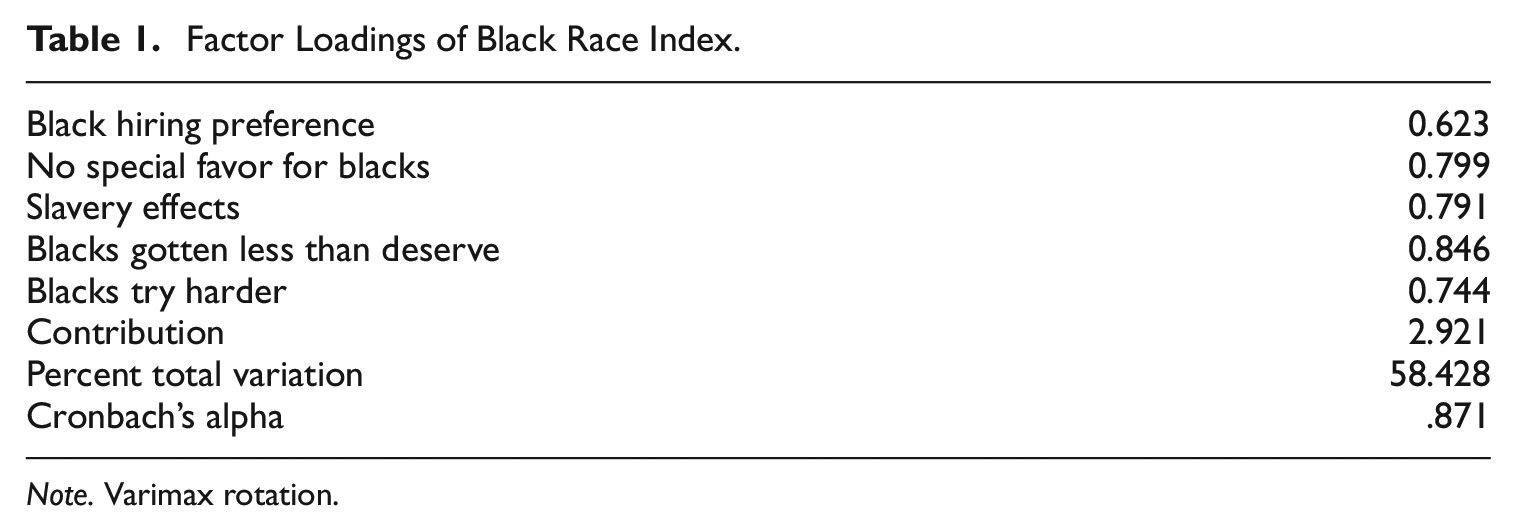
Black Race Index consists of these five variables with a range of 5 to 25. The information for this index can be seen in Table 1. Ideally, an index has a Cronbach’s alpha score of at least .8 and would construct a single factor that explains 50.0 percent of the variance. Cronbach’s alpha for those variables is .871. They loaded on a principal axis factor analysis which created a single factor explaining 58.428 percent of the variance. The five items in Black Race Index are included in different versions of the racial resentment scale. The racial resentment scale was designed to allow researchers to determine which white people are sympathetic or unsympathetic to black people (Kinder and Sanders 1996), so the inclusion of racial resentment questions fit with the purposes of this project. 4 Furthermore, in keeping with the idea that these issues measure concerns important to black people, it should be noted that all these attitude and preference questions include the term ``Blacks'' in the question, indicating that the respondent is being asked to comment on racialized issues that black people face.
Factor Loadings of Black Race Index.
Note. Varimax rotation.
Independent Variables
Key independent variables assess attitudes toward conservative Christians, racial identity, and whether an individual is a highly educated white progressive. To assess attitudes toward conservative Christians, the variable Christian Fundamentalist was constructed out of a feeling thermometer measuring how warmly or coldly respondents feel toward Christian fundamentalists. Respondents can determine how warmly or coldly they feel about Christian fundamentalists on a 0 to 100 scale, with higher numbers indicating more warmth. 5
The racial and ethnic breakdown of the sample is 4,853 white, non-Hispanic; 834 black or African American, non-Hispanic; 979 Hispanic, Latinx, or Spanish origin; 291 Asian, Native Hawaiian, or other Pacific Islander, non-Hispanic; 146 Native American, Alaska Native, or other race, non-Hispanic; and 282 multiple-races, non-Hispanic respondents. 6 A total of 67 respondents did not indicate a racial identity. The focus of this research is on whether a white subculture of highly educated political progressives ties their support of favorable racial attitudes to culture war concerns and an outgrouping of conservative Christians. To this end, a dummy variable of Educated White Progressive was created with white respondents with at least a bachelor’s degree who rated themselves as at least liberal 7 (1 or 2 on a 7-point scale with higher numbers indicating higher levels of political conservatism). This produced 491 respondents.
A variety of control variables are used in this study. The interviewer determined the respondent’s sex. If the interviewer could not tell the sex of the respondent, then the respondent was marked as DK. Those indicated to be female were designated as 1, and those indicated to be male were designated as 0, creating the variable Female. Age indicates the number of years the respondent reported to the interviewer. Political Conservatism was created by respondents rating themselves on a 1 to 7-point scale with higher numbers indicating higher levels of political conservatism. Respondents were asked about the highest level of school completed, and the results were placed on a 1 to 8 scale, creating Education. 8 Income was created by the respondent estimating the total combined income of all members of the family. The results were coded on a 22-point scale. Regional variables of Northeast, Northcentral, and South (West as the reference group) were determined by the state the respondent lives in using the regional categories set up in the ANES. Respondents indicated the major religion group they identified with creating the dummy variables of Protestant, Catholic, Other Christian, and Other Religion (Not Religious is the reference group). Church Attendance is a 1 to 5 scale with higher values indicating higher attendance. Bible Word of God is a dummy variable where those who believe that the Bible is to be taken literally are coded as 1 and all others are coded as 0.
Results
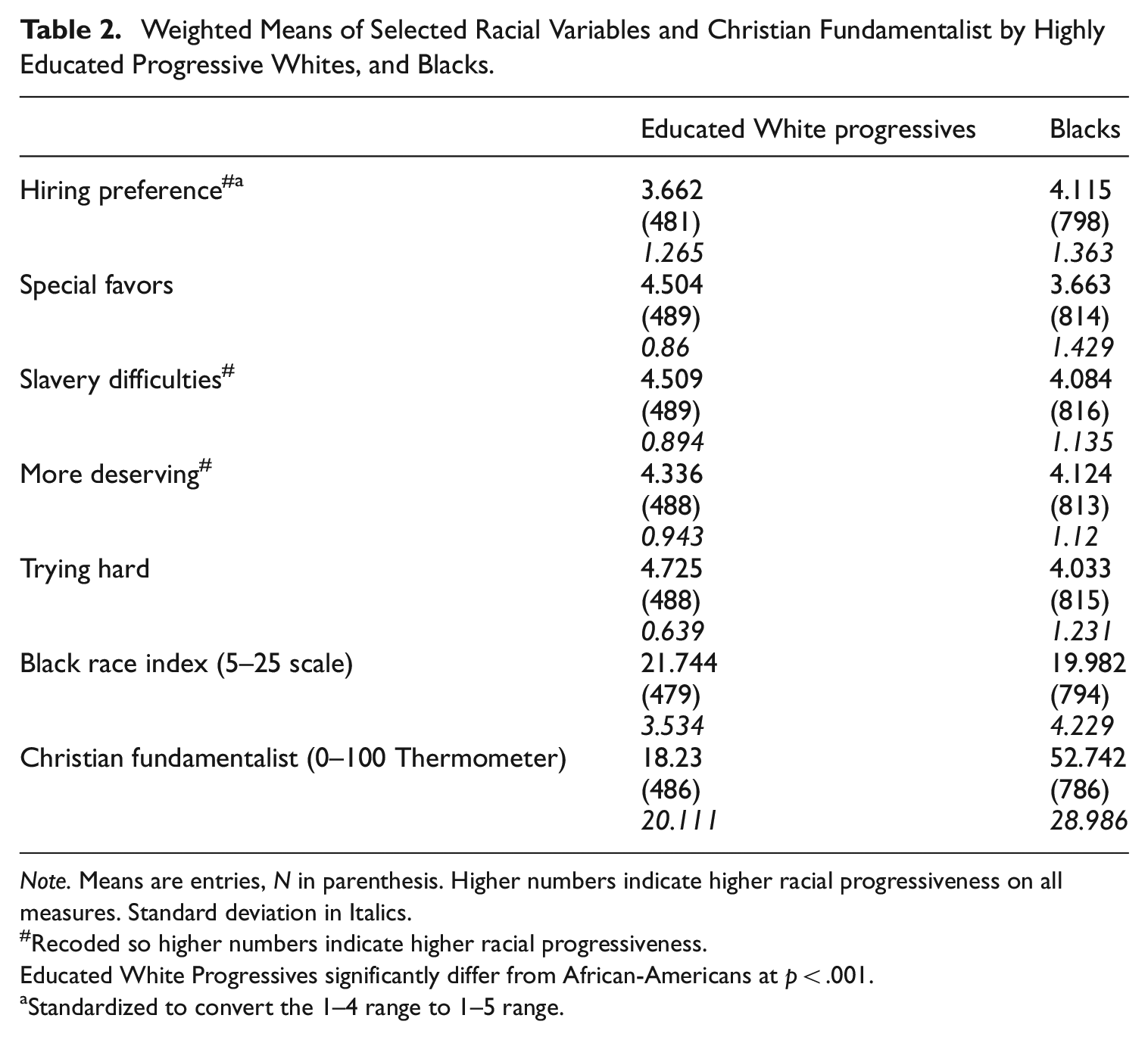
Table 2 compares weighted means between educated white progressives, and black people, for the racial variables and Christian Fundamentalist. Results, not shown in the table but availably from the author, show that both black people and educated white progressives are significantly more likely, at p < .001, to adopt favorable racial attitudes than other white people on all racial variables. Black people score higher than educated white progressives on Hiring Preference. However, educated white progressives have more racially favorable attitudes than black people on the remaining racial variables. Educated white progressives also have a significantly higher mean than black people on Black Race Index. It is reasonable to argue that white progressives are slightly more supportive of racially favorable attitudes than black people, given that they score statistically higher on all, but one of the racial issues in the Black Race Index. 9
Weighted Means of Selected Racial Variables and Christian Fundamentalist by Highly Educated Progressive Whites, and Blacks.
Note. Means are entries, N in parenthesis. Higher numbers indicate higher racial progressiveness on all measures. Standard deviation in Italics.
Recoded so higher numbers indicate higher racial progressiveness.
Educated White Progressives significantly differ from African-Americans at p < .001.
Standardized to convert the 1–4 range to 1–5 range.
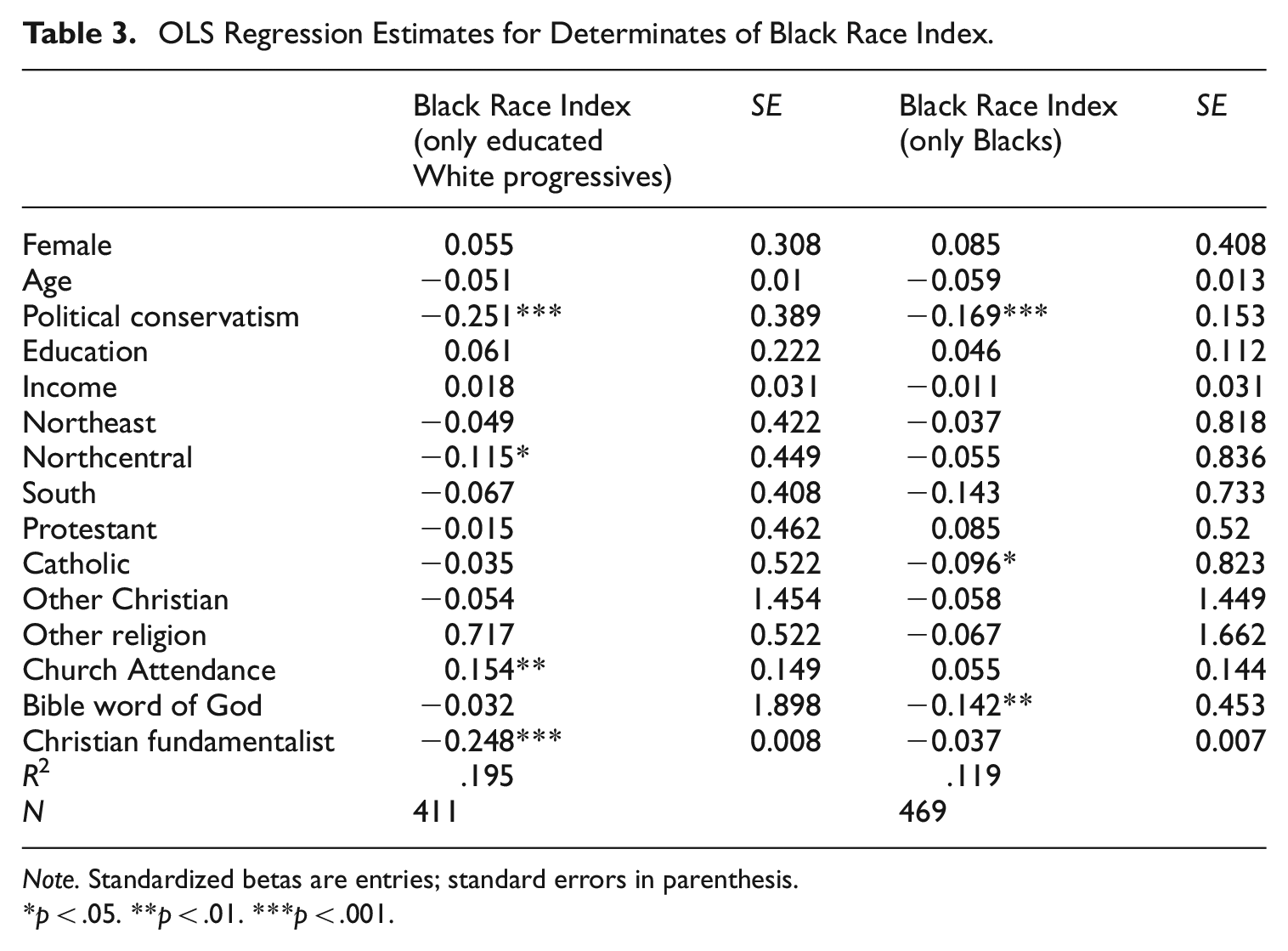
Black Race Index is the dependent variable in the regression models. Higher scores indicate greater adherence to favorable racial values. These results can be seen in Table 3 where two regression models are used to explore the effects of Christian Fundamentalist in impacting racial attitudes among educated white progressives and black people. In the first model, only educated white progressives are included and Christian Fundamentalist remains strongly significant after other social and demographic controls. The standardized beta of Christian Fundamentalist (B = −0.248) is similar in strength to the standardized beta of Political Conservatism (B = −0.251) indicating that these two variables offer the largest potential effect sizes on assessment of the attitudes toward racialized issues impacting black people. Among educated white progressives, attitudes toward conservative Christians are one of the most important factors in predicting the strength of support for favorable racial attitudes. H1 is substantiated, as attitudes toward conservative Christians are linked to favorable racial attitudes within the population of educated white progressives.
OLS Regression Estimates for Determinates of Black Race Index.
Note. Standardized betas are entries; standard errors in parenthesis.
p < .05. **p < .01. ***p < .001.
The effect of Christian Fundamentalists is different for black people. 10 In the second model, including only black people, Christian Fundamentalist is mediated by the other social and demographic variables. The only significant variables in that model are political orientation, whether the respondent is a Protestant or other Christian, and whether the respondent believes that the Bible is the literal word of God. H2 is not supported by this current data in that black people with higher affinity with conservative Christians are not found to be more likely to have favorable racial attitudes. However, while Christian Fundamentalist does not have a significantly positive effect on favorable black racial attitudes among black respondents, neither does it have a negative effect on progressive attitudes. Thus, while H2 is refuted, there is still strong evidence that attitudes toward conservative Christians have distinctive patterns on favorable racial attitudes that distinguish the pathway toward favorable racial attitudes for black people and educated white progressives.
An analysis comparing respondents included in the models to those dropped due to missing data indicated that respondents were more likely to be male, younger, politically progressive, Protestant, wealthy, and educated. Multiple imputation models were used to assess if excluding these cases alters these findings. Female, Age, Political Conservatism, Education, Church Attendance, and Bible Word of God were imputed. Due to too many parameters, Age, Education, and Political Conservatism were reduced to either three or four categories. This analysis, available in the Supplemental File, indicated the same key significant findings reported in the regression models in Table 3 in that Christian Fundamentalist is significant in the educated white progressive model but not the black model. While some of the control variables had distinct effects in the multiple imputation models 11 , none altered this finding. Results from the multiple imputation models indicated that the distinctive role that attitudes toward conservative Christians have on the racial attitudes of black people and educated white progressives are not impacted by accounting for missing data.
Discussion
Although both educated white progressives and black people are highly supportive of favorable racial issues, the motivation for that support likely differs. Issues of political identity may help to explain this difference. The results of this current study indicate that attitudes toward conservative Christians are predictive of the racial attitudes of educated white progressives. Among educated white progressives, attitudes toward conservative Christians are competitive with political orientation being the strongest predictor of racial attitudes impacting black people. Negative attitudes toward conservative Christians are connected to higher levels of favorable racial attitudes for educated white progressives. This suggests that political identity for educated white progressives ties together outgrouping of conservative Christians and support for favorable racial attitudes. Cultural polarization offers a powerful explanation for such linkage. However, within the population of black people, attitudes toward Christian conservatives do not have a significant effect upon racial attitudes. Unlike educated white progressives, attitudes toward conservative Christians are not strongly linked to the racial attitudes of black people.
Data in this current project does not allow for statistical verification of a causal path between favorable racial attitudes and attitudes toward conservative Christians. Social identity theory suggests that the respondents’ attitudes toward conservative Christians led them to shape their attitudes toward black people. However, the causality may run in the opposite direction. It may be that attitudes toward racial minorities help to shape attitudes toward conservative Christians. Since there is an image of conservative Christians having racial animosity toward non-white people, sympathy toward black people can provoke anger from white progressives toward conservatives. However, if this is the case, it is notable that among black people the analysis does show this link between attitudes toward conservative Christians and favorable racial attitudes. There is little reason to believe that sympathy for black people is less likely to generate anger at potential racists, or at least racially insensitive, conservatives among black people than among educated white progressives. Given the reality of the culture war in the United States, the social identity needs of progressives to outgroup conservative Christians are stronger than such social identity needs of black people. As such, the failure to find a link between attitudes toward conservative Christians, and favorable racial attitudes among black people, may suggest that the causal pathway of attitudes toward conservative Christians shaping favorable racial attitudes is more likely to be accurate. However, future research is needed to empirically verify this assertion.
Culture war issues may be impactful in shaping the racial attitudes of white progressives through the mechanism of political identity. However, the motivation of progressives to define themselves as distinct from social and religious conservatives may also be predictive of their social attitudes in other social dimensions. For example, research has indicated that attitudes toward sexual minorities are influenced by attitudes toward conservative Christians (Yancey 2018). Future work, especially qualitative work, can explore the saliency of the attitudes of progressives toward conservative Christians in the shaping of a wide range of other social attitudes. The propensity to allow antipathy of one’s opponents in the culture war to shape other social attitudes may not be limited to social progressives. It is also possible that conservatives also utilize their antipathy toward social and political progressives to shape their attitudes on other social and political issues. Future research should also explore that possibility.
At the bivariate level, support of favorable racial attitudes among black people is at least matched, if not surpassed, by educated white progressives. An important story emerging from this research endeavor is the potentially higher level of favorable racial attitudes of white progressives than black people on most racial issues. Such racial progressiveness occurs despite the relative lack of materialist motivation for progressives. Given that educated white progressives are often significantly more racially progressive than black people, except when asked whether black people should receive preferential treatment when hired, it is fair to ask which racial issues resonate so strongly for black people that they are even more supportive than educated white progressives. The political identity interest of progressives may also impact their relative support on specific racial issues but there may be other reasons, perhaps economic justifications, why they are not as progressive as black people on selected issues. For example, the idea of preferential treatment for black people may provide an advantage for non-white people in the work environment at the expense of white people. Educated white progressives may realize this disadvantage and be less supportive of that particular racial issue in comparison to other racial issues. Differing incentive structures for white progressives and racial minorities may persuade progressives to be less racially progressive on racial issues that imply direct economic costs for them. Future research may discover other ways that white progressives are less racially progressive than black people and explore potential reasons for disagreement.
Black people are likely more willing, relative to other racial groups, to adopt the idea of “racial realism,” promoted by Bell (1991), that society is set up so that even seemingly “fair” laws or institutions work against the interests of black people. A greater focus on structural elements of racism, and unwillingness to reduce racism to individualized acts of racism may provide this group with a vision that makes it easier to define social institutions as barriers to the advancement of black people. However, this research also suggests that educated white progressives exhibit concerns of structural racism and may be even more likely to develop favorable racial attitudes than black people. Perhaps the process by which educated white people became politically progressive also resulted in being more supportive of racial realism. This process may be tied to the degree to which cultural polarization has strengthened the support of educated white progressives of favorable racial attitudes. It is possible that as cultural polarization influences such individuals to seek to support black people that they learn, either through relationships with black people or reading material about the plight of black people, to develop racial realism to compliment the racial ideals developed to deliver that support. Exploring such possibilities can provide insight into motivations of white educated progressives and how such individuals may strengthen support of favorable racial attitudes.
It is noteworthy that while attitudes toward conservative Protestants did not impact the racial attitudes of black people, identifying as a Catholic Christian was negatively associated with favorable racial attitudes among black people. Furthermore, Bible Word of God was also negatively associated with favorable racial attitudes with a standard beta that is almost as strong as that of Political Conservatism (−0.142 vs. −0.169). Previous research has documented that Christian identity among black people is tied to a stronger adherence to structuralist, versus individualist, understandings of racial issues (Emerson and Smith 2001; Perry and Whitehead 2019). This structuralist approach would make black Christians more supportive of the favorable racial efforts to deal with structural, institutional racism. Much of this willingness to challenge institutional racism among black people may reside in the reality that historically the black church has been a center of resistance against colonialism and white supremacy (Douglas and Hopson 2000; Gates 2022; Spencer 2006). In contrast to white Christians, this research suggests that Christian faith may move black Christians toward activism and confrontation of racism. Yet these findings do not offer strong support for that assertion. Indeed, in a model of only black Christians, neither Church Attendance nor Bible Word of God were significant predictors of Black Race Index. However, future research may find better measurements of religiosity that may more accurately capture the political activism of religious black people than church attendance and beliefs in Biblical literalism.
This research indicates a potential culture war effect influencing the political identity of educated white progressives. A social identity justification for progressives may not only meet their socio-psychological needs but also aid them in political combat against conservative Christians. To the degree that they can paint conservatives as racist, progressives can minimize the political reach of their outgroup. A focus merely on issues linked to social identity may underestimate the strength and scope of how a failure to like conservative Christians can impact the racial attitudes of progressives. Motivations based upon social conflicts and battles for cultural and political resources in the United States may also strengthen the tie between attitudes toward conservative Christians and favorable racial attitudes among progressives. Future qualitative work may be able to tease out more precise explanations, such as the justification of progressives in their support of favorable racial issues, the role of attitudes toward conservative Christians, whether that connection is driven by social identity or political power needs, and the role those needs have in the shaping racial attitudes. In summary, this study advances research on the intersection of race, political identity, education, and religiosity in shaping racial attitudes.
Supplemental Material
sj-pdf-1-rrr-10.1177_0034673X241231280 – Supplemental material for Explaining Racial Attitudes: Race, Political Identity, Education, and Religious Outgrouping
Supplemental material, sj-pdf-1-rrr-10.1177_0034673X241231280 for Explaining Racial Attitudes: Race, Political Identity, Education, and Religious Outgrouping by George Yancey in Review of Religious Research
Footnotes
Declaration of Conflicting Interests
The author declared no potential conflicts of interest with respect to the research, authorship, and/or publication of this article.
Funding
The author received no financial support for the research, authorship, and/or publication of this article.
Supplemental Material
Supplemental material for this article is available online.
Notes
Author Biographies
References
Supplementary Material
Please find the following supplemental material available below.
For Open Access articles published under a Creative Commons License, all supplemental material carries the same license as the article it is associated with.
For non-Open Access articles published, all supplemental material carries a non-exclusive license, and permission requests for re-use of supplemental material or any part of supplemental material shall be sent directly to the copyright owner as specified in the copyright notice associated with the article.
