




Abstract
Historically, congregational leaders did the work of chaplaincy. In the past century, the professions have diverged and chaplaincy has diversified in form and function. We ask which congregational leaders currently also serve as chaplains to identify the extent of overlap between these two types of religious leaders in the contemporary United States. We analyze data from the National Survey of Religious Leaders (NSRL), a nationally representative sample of 1,600 clergy collected in 2019 to 2020, to determine how many congregational leaders are also working or volunteering as chaplains. Though some overlap exists between the occupational roles of chaplains and congregational leaders, our study shows that they are largely distinct professions, with only 17.1% of primary congregational leaders also working or volunteering as chaplains. Catholic primary leaders and Hispanic primary leaders are more likely than their peers to also work as chaplains. Researchers studying each group should be attentive to the ways these professional groups overlap and diverge, and the corresponding possible confusion among religious practitioners and the general public. Theological educators should consider the specific training and support needs of the portion of clergy who serve as chaplains alongside of their congregational positions.
Background
Chaplains in the United States today range from volunteers with limited formal training in religion to highly trained professionals with multiple degrees. A national survey conducted by the Gallup Organization in 2022 found that nearly one-in-five people in the United States has interacted with a chaplain outside of a place of worship (Gallup 2022). While chaplains have long been present in the military, prisons, healthcare, and higher education, the pandemic brought them into broader public view (Cadge 2020; Domaradzki 2022; Weiss 2020). Chaplains may be increasingly important as fewer people in the United States are affiliated with local religious organizations (Pew Research Center 2018). Chaplains may be the only professionals with theological education people come into contact with in end-of-life situations, around difficult decisions, or in crises (Cadge 2023; Stahl 2017; Sullivan 2014). Theological schools are rapidly expanding their training programs for chaplains (Cadge et al. 2020). Yet researchers find that chaplains as a distinct type of religious worker remain relatively unknown or poorly understood by the general public, with many people assuming chaplains and congregational leaders are identical groups. In fact, researchers do not know how many people currently work as chaplains in the United States, alone or in combination with other jobs.
Recent research into chaplaincy has uncovered the extent to which confusion exists about how chaplains do work distinct from that of congregational leaders. The general population survey conducted by the Chaplaincy Innovation Lab and the Gallup Organization in March 2022 found that, although 44% of survey respondents reported interacting with a chaplain, the majority of those encounters took place in churches and other places of worship (Lawton, Cadge, and Hamar Martinez, forthcoming). The definition used by the Gallup survey was crafted to exclude those encounters. It read, “By chaplains, we mean clergy or other religious guides or spiritual caregivers who serve people outside of churches or other houses of worship, in settings like hospitals, the military, prisons, or institutions of higher education, to name a few examples.”
In other words, many of the people surveyed assumed that chaplains and congregational leaders are entirely synonymous, with no difference between the two groups. Follow-up interviews with 15 people who reported an encounter in a place of worship confirmed that respondents who met chaplains there were generally thinking of someone they knew in the capacity of a congregational leader. Ultimately, only 18% of survey respondents had definitively interacted with a chaplain as defined by the Gallup survey.
There are many important similarities between chaplains and congregational leaders, 1 including a portion of congregational leaders who also work part-time as chaplains. 2 However, no nationally representative work to date has been able to account for the proportion of congregation leaders who also serve as chaplains. This research note analyzes data from the National Survey of Religious Leaders, collected in 2019 to 2020, to address this gap. By clarifying the extent of overlap between these two professional groups, we provide insight into the likelihood that any given congregational leader also works as a chaplain.
This research note is intended, first, to describe the current overlap between congregational leaders and chaplains; and second, to illustrate some of the demographic patterns among congregational leaders who also serve as chaplains. This is an important contribution because we have not yet had the opportunity to study chaplains at the national level. This research note is only a first step and provides information that has not yet been known about chaplains. These findings benefit future researchers and religious practitioners in distinguishing the occupational categories of chaplains and congregational leaders, and help theological educators train a diverse workforce.
Purpose
This article analyzes data from the National Survey of Religious Leaders, collected in 2019 to 2020, to ask how many leaders of local congregations also work or volunteer as chaplains. There is no commonly accepted definition of “chaplain” in American religious life or culture. The Oxford English Dictionary (OED) defines chaplain along very narrow, historical lines, calling a chaplain first “the priest, clergyman [sic] or minister of a chapel” and then: Clergyman [sic] who conducts religious services in the private chapel of a sovereign, lord or high official, of a castle, garrison, embassy, college, school, workhouse, prison, cemetery, or other institution, or in the household of a person of rank of quality in a legislative chamber, regime, ship, etc.
3
The word chaplain is connected historically to the original cappellani which described those “who had charge of the sacred cloak of St. Martin.” 4
Chaplaincy as full-time professional work is relatively new. In the past, much of this work was expected to be done by clergy who also led congregations. Military chaplaincy was the exception—a fully-fledged professional chaplaincy corps was in place by World War I (Stahl 2017). In healthcare organizations, chaplaincy as a profession distinct from the work of local clergy started in the 1920s and emerged through the twentieth century (Cadge 2012). Full-time positions for chaplains exist today in the military and healthcare as well as in higher education and corrections. Many chaplains also work part-time in these settings as well as in community, municipal, and business contexts.
Those who work as chaplains train alongside local clergy. Most attend seminary, rabbinical school, or divinity school and receive master’s degrees (Cadge et al. 2019). Since the late 1980s, more than 100 programs have started in theological schools specifically to train chaplains. Some programs offer classes dedicated to healthcare chaplaincy or military chaplaincy. The majority of these programs also require Clinical Pastoral Education (CPE), an experiential approach to training that takes place most commonly in healthcare organizations with a cohort of students and a teacher (Cadge et al. 2019; Clevenger et al. 2021). The specific credentials required to be hired as a chaplain vary by sector (Cadge, Tien, and Haythorn 2022). Many organizations require that their chaplains be endorsed by a religious organization, and the criteria for endorsement is often very similar to the criteria for ordination. The requirements for endorsement and ordination explain the some of the real and perceived overlap between the professions of chaplain and congregational clergy.
This article explores the demographics of congregational leaders who also work of volunteer as chaplains. We ask where they are working or volunteering, and how many hours per week they spend doing chaplaincy work. We find that the primary leaders of congregations who work as chaplains do so across many sectors, including in hospices, with disaster relief teams, and in K-12 schools, to name just a few examples. Catholic primary leaders and Hispanic primary leaders are more likely than their peers to also work as chaplains. White evangelical leaders and Black Protestant leaders who work or volunteer as chaplains work the highest average number of hours as a chaplain each week. This is the first nationally representative study to allow for an analysis of congregational leaders who also serve as chaplains are and where they serve.
Data and Methods
We analyze data from the National Survey of Religious Leaders (NSRL). 5 Religious leaders selected for inclusion in this sample were leaders of congregations that participated in the fourth wave of the National Congregations Study (NCS-IV) in 2018 to 2019. A congregation came to be in this fourth wave either because a respondent from the 2018 General Social Survey (GSS) named it as the place they attend religious services, or the congregation was in the third wave of the NCS conducted in 2012. 6 Because larger congregations were more likely than smaller congregations to be named, the NCS-IV and the NSRL are probability-proportional-to-size samples. See Chaves et al. (2020) for more methodological details about the NCS-IV and Chaves, Roso, and Holleman (2022) for more details about the NSRL.
In total, 1,600 religious leaders were surveyed as part of the NSRL including 890 primary leaders and 710 non-primary leaders. The NSRL instrument allowed respondents to self-select whether they were a primary leader of a congregation. 7 One (or occasionally two, as co-pastors were instructed to identify themselves as primary leaders) primary leaders were identified for each congregation and were distinct from non-primary leaders who tended to focus on religious education and in other areas. The response rate for primary leaders was 69.5%, and the response rate for non-primary leaders was 28.0%. This discrepancy is a result of the recruiting strategy of the NSRL, which prioritized maximizing the response rate of primary leaders (ibid.). The NSRL weights allow researchers to analyze the data examining only the primary leaders of congregations, only the secondary leaders of congregations, or all leaders. We conduct our analysis at two levels: the primary leader sample and the entire sample (primary and secondary leaders). Descriptive statistics for both samples (primary leaders and all leaders) are analyzed using either the WT_NSRL_ALL_DUP (for all leaders) or WT_NSRL_PRIMARY_DUP (for primary leaders) weights in order to undo the sample’s probability proportionate to size feature. Four non-primary leaders have very large weights (weighting the cases up by 20 times or more) which have an outsized impact on the results, and as such these cases are removed from all analyses using weighted data. Results including these cases are available upon request.
To determine which congregational leaders also work as chaplains, we used responses to the question, “Do you currently have an official role as a chaplain or minister in a hospital, nursing home, college, prison, or other kind of institution setting?” The term “official role” distinguishes respondents who serve as chaplains distinct from related work they might do—like visiting people in hospitals, nursing homes, or other settings—as part of their jobs as congregational leaders. Respondents who indicated that they do have an official role were then asked about the kind of institution or setting in which they serve and the number of hours in a typical week they spend “in activities related to your official role as a chaplain.”
Results
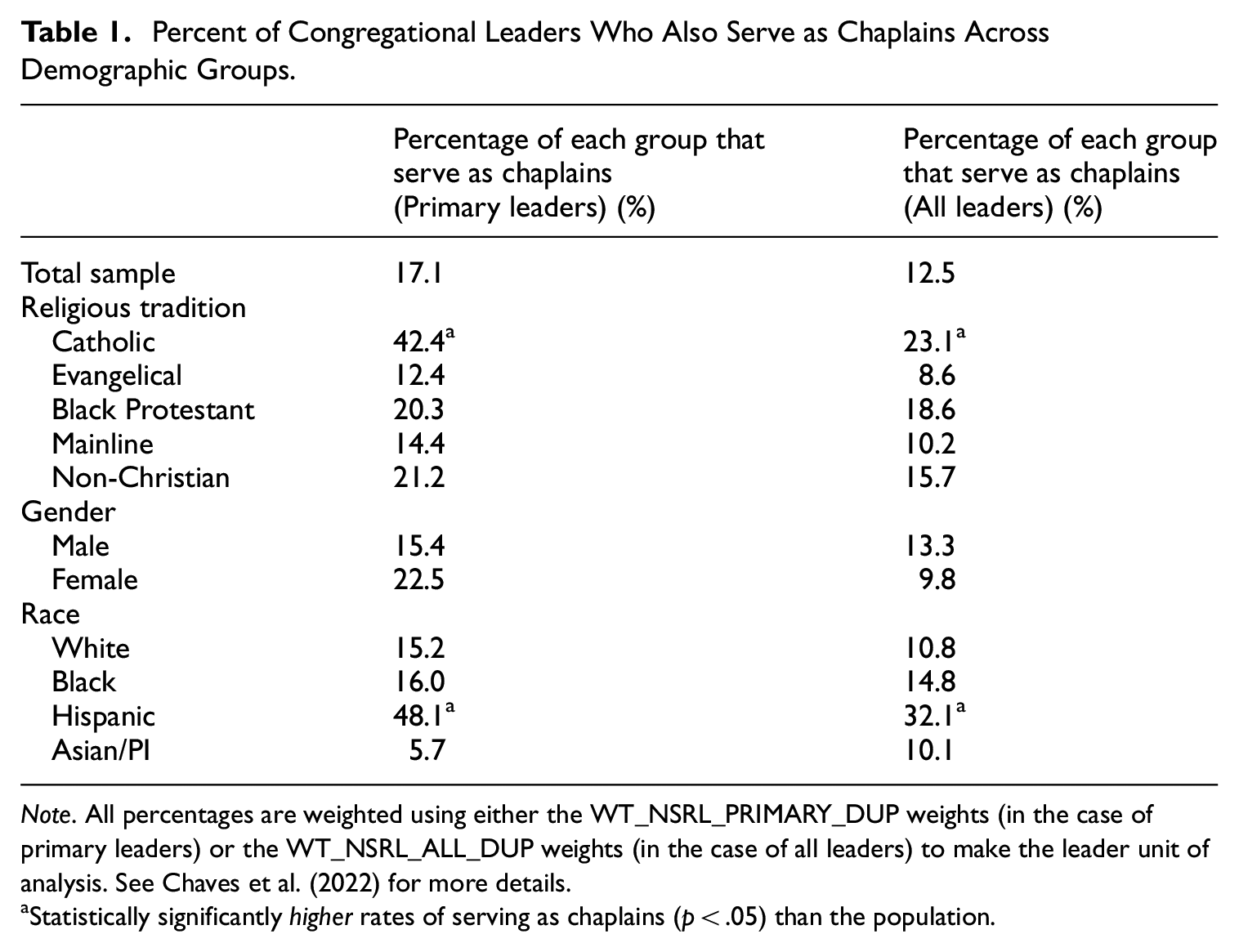
As shown in Table 1, 17.1% of primary leaders and 12.5% of all congregational leaders serve as chaplains. Among primary leaders, Catholics are twice as likely to be chaplains as leaders from any other tradition. Two out of every five Catholic primary leaders serve as chaplains, compared to at most one in five leaders from other traditions. However, among all leaders, there is not a single tradition that is clearly over-represented. We expect the discrepancy of chaplains between primary and all Catholic leaders primarily stems from the fact that almost all Catholic primary leaders are priests, and given the current priest shortages (Giangravé 2020), they would consistently be called upon to perform religious rites in institutions such as hospitals or prisons. In contrast, only 28.9% of Catholic non-primary leaders are priests, and thus these non-primary leaders would not be able to perform religious rites and thus largely not be required by institutions at the same rate.
Percent of Congregational Leaders Who Also Serve as Chaplains Across Demographic Groups.
Note. All percentages are weighted using either the WT_NSRL_PRIMARY_DUP weights (in the case of primary leaders) or the WT_NSRL_ALL_DUP weights (in the case of all leaders) to make the leader unit of analysis. See Chaves et al. (2022) for more details.
Statistically significantly higher rates of serving as chaplains (p < .05) than the population.
In terms of race, Hispanic clergy are particularly likely to serve as chaplains, with nearly half (48%) of all Hispanic primary leaders serving as a chaplain, compared to only 15% of non-Hispanic primary leaders. There were no statistically significant differences between male and female clergy in their likelihood of serving as a chaplain.
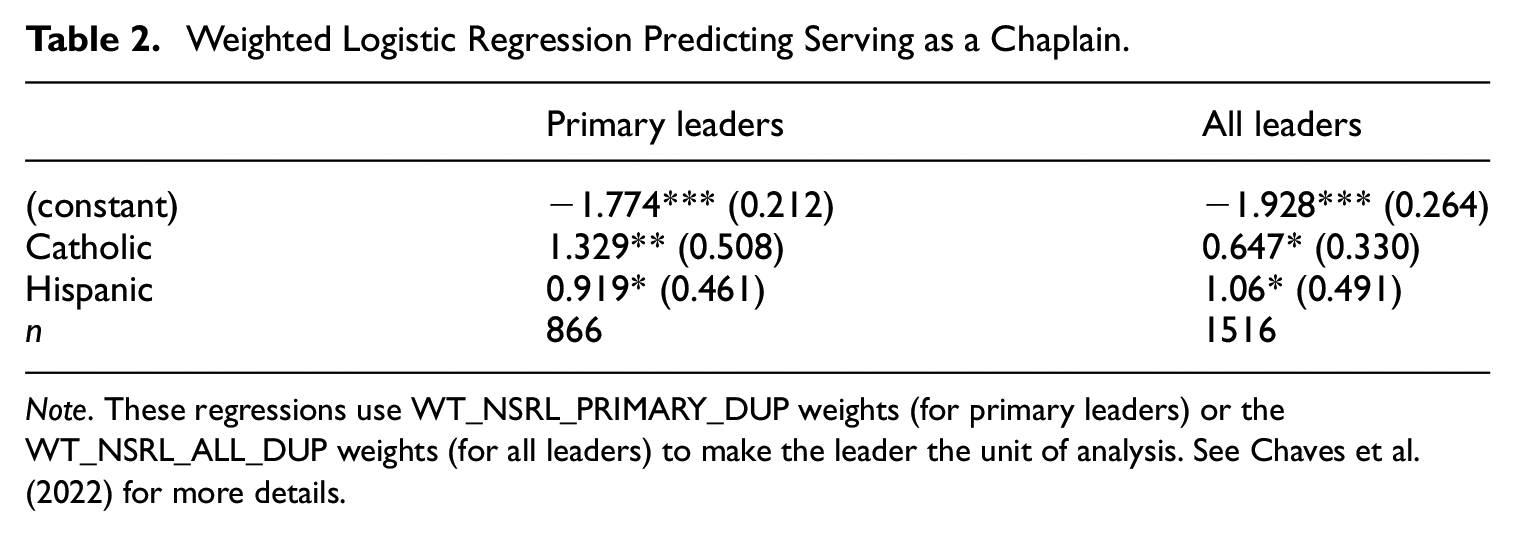
Because Hispanic leaders are more likely to be Catholic, we conducted logistic regression analysis to see if the over-representation of Hispanic leaders among Catholics is reduceable to religious tradition. The results of these regression models are reported in Table 2. The results show that ethnicity and religious affiliation are independently significant predictors. Among primary leaders, Catholic clergy are about 2.7 times more likely than non-Catholics to work as chaplains (controlling for Hispanic ethnicity), and Hispanic primary leaders are about twice as likely as non-Hispanics to work as chaplains (controlling for Catholic affiliation). These differences remain when expanding the sample to all leaders, though the difference between Catholics and non-Catholics does not appear to be as large among all leaders as it is among primary leaders.
Weighted Logistic Regression Predicting Serving as a Chaplain.
Note. These regressions use WT_NSRL_PRIMARY_DUP weights (for primary leaders) or the WT_NSRL_ALL_DUP weights (for all leaders) to make the leader the unit of analysis. See Chaves et al. (2022) for more details.
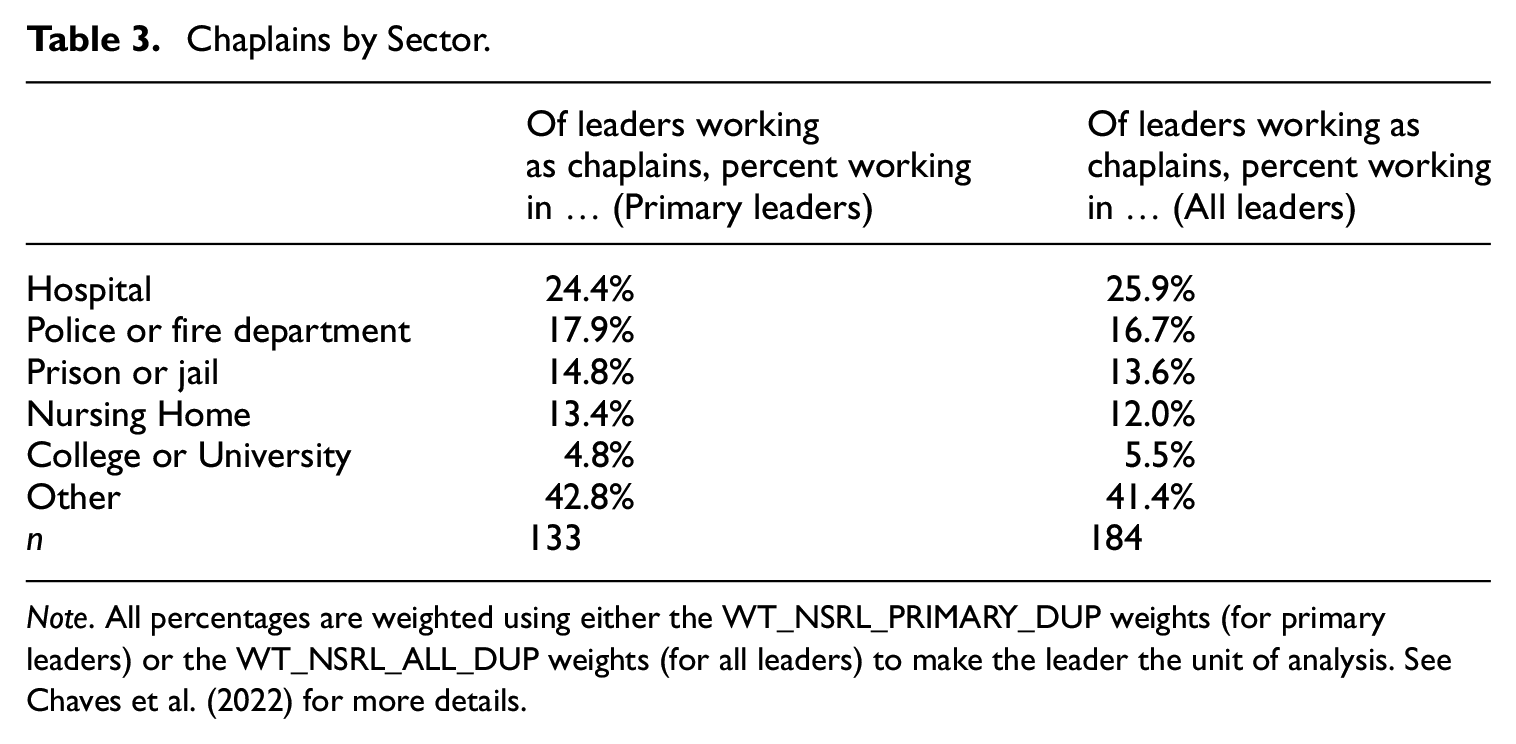
Congregational leaders work as chaplains in colleges and universities, hospitals, nursing homes, prisons or jails, police or fire departments, and other settings. Table 3 shows that the largest fraction of primary leaders who also work as chaplains work in “other” settings (42.8%) followed by hospitals (24.4%) and police or fire departments (17.9%). These “other” settings included K-12 schools, hospices, diocesan and denominational offices, the military, and disaster relief, among assorted others. Thus, while “other” is the largest sector, it is not at homogeneous. Given that most full-time chaplains work in healthcare (Cadge 2012), it is interesting to note that these part-time chaplains are not concentrated in the same sector.
Chaplains by Sector.
Note. All percentages are weighted using either the WT_NSRL_PRIMARY_DUP weights (for primary leaders) or the WT_NSRL_ALL_DUP weights (for all leaders) to make the leader the unit of analysis. See Chaves et al. (2022) for more details.
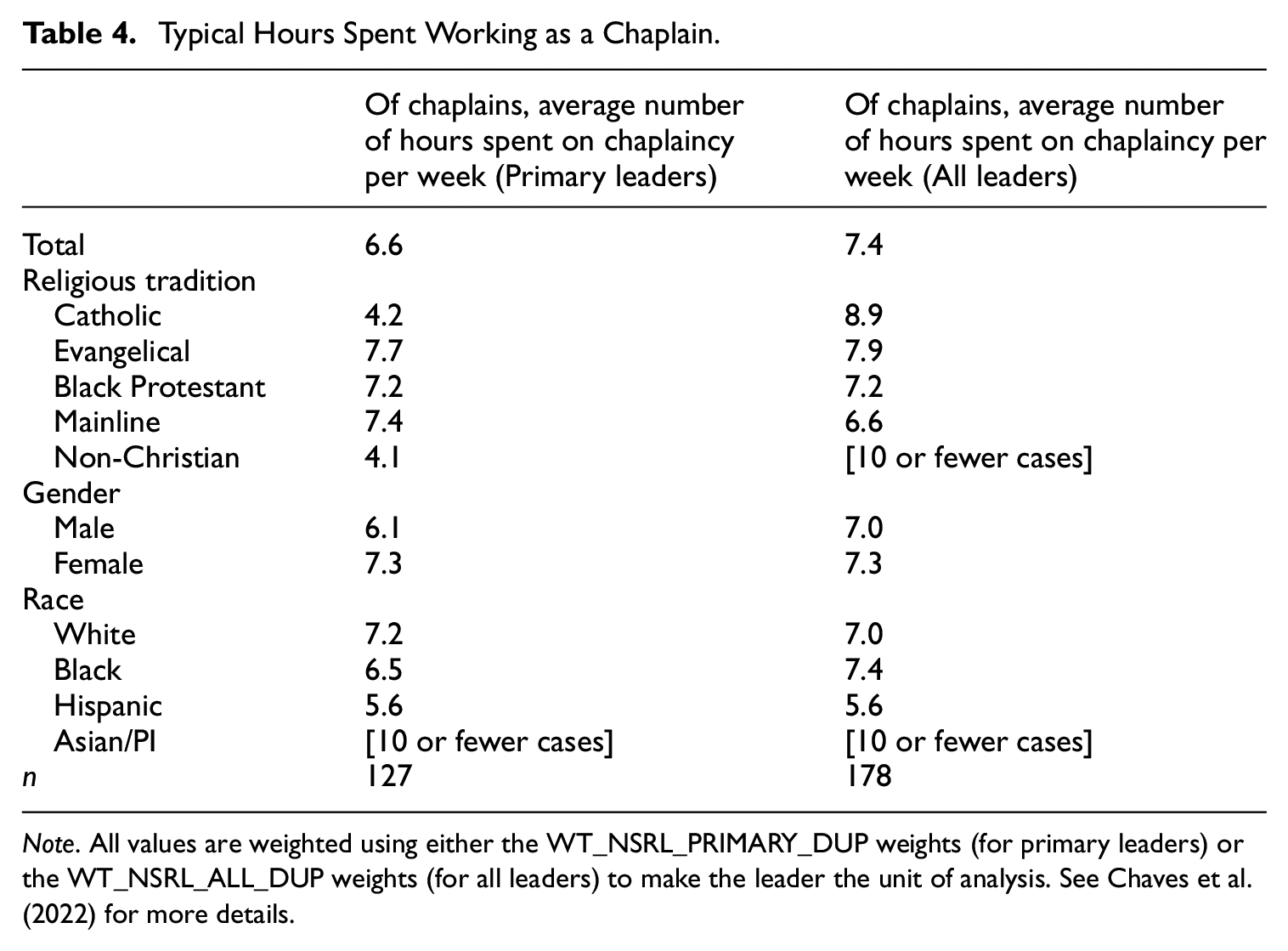
Table 4 shows the average number of hours worked as a chaplain, for primary leaders and for all leaders, excluding cells with 10 or fewer cases. On average, congregational leaders who also work as chaplains spend about seven hours per week on work related to chaplaincy, and this is not meaningfully different between primary and non-primary leaders. Though the small sample size makes it difficult to detect any meaningful differences in hours worked by religious tradition, gender, or race, there is some indication that Catholic primary leaders who serve as chaplains may work slightly fewer hours than non-Catholic leaders (p = .11). Though on the surface, seven hours a week on average may seem like fairly minimal involvement in chaplaincy, seven hours a week represents almost an entire business days’ worth of work in the standard forty-hour work week. In a profession marked by busy and ever-changing schedules, full of a diverse range of job responsibilities (Carroll 2006), a clergyperson devoting about one day a week to an official role outside of their position as a congregational leader represents a significant investment.
Typical Hours Spent Working as a Chaplain.
Note. All values are weighted using either the WT_NSRL_PRIMARY_DUP weights (for primary leaders) or the WT_NSRL_ALL_DUP weights (for all leaders) to make the leader the unit of analysis. See Chaves et al. (2022) for more details.
Conclusion and Implications
The religious and spiritual upheaval caused by the COVID-19 pandemic and the growing numbers of local congregations closing has brought renewed attention to the work of chaplains and spiritual care providers. As more theological schools shift their curriculum to better train chaplains, researchers and organizational leaders need more and better data about who chaplains are, where they work, and how, if at all, they combine the work of chaplaincy with other positions of religious leadership. Though a national survey of chaplains is yet to be conducted, making these kinds of analyses difficult, the National Survey of Religious Leaders (NSRL) offers a glimpse into the work of religious leaders who are combining work in a local congregation and work as a chaplain.
We find that almost one-in-five primary leaders of religious congregations also work as chaplains. They do this work in colleges and universities, hospitals, nursing homes, prisons and jails, police and fire departments, and other settings. Catholic primary congregational leaders and Hispanic primary congregational leaders are more likely than their counterparts to do this work, though differences on the bases of ethnicity and religious tradition are less pronounced among the combined population of congregational leaders, including primary and secondary leaders. Among congregational leaders who are also serving as a chaplain, the largest number reported working in the heterogeneous “other” sector that included a wide assortment of settings. Among the more clearly-defined sectors, there were clear concentrations of congregational leaders serving in hospitals and police and fire departments. On average, congregational leaders who also serve as chaplains work about seven hours a week on chaplaincy—nearly an entire day of a traditional 40-hour work week and a significant investment for clergy. This dedication of time is fairly consistent across ethnicity, gender, and religious tradition.
This research note betters our understanding of both congregational leadership and chaplaincy, and clarifies what the contemporary overlap is between these two professions. Given the existing confusion among the general public about the difference between congregational leaders and chaplains (Lawton et al. forthcoming), clarification about which congregational leaders work as chaplains will benefit researchers who study each group as a distinctive profession. Additionally, theological educators should consider the portion of congregational leaders who work as chaplains, and who may need training and support focused on this additional profession. Practitioners and educators alike may find insight into where and when chaplain competencies are important for congregational leaders.
This research is limited by the absence of other national studies of chaplaincy against which to gauge our results. A national survey of chaplains is needed. Future research may also wish to focus on how congregations support leaders who also work as chaplains.
In light of the changing nature of American religious life, including lower weekly church attendance and higher disaffiliation from organized religion, it is not surprising that some religious leaders are fulfilling their vocation both inside and outside of congregations. Yet the overlap between the distinct professions of congregational clergy and chaplain remains small, with full-time chaplains serving primarily in hospitals and with congregational clergy working part-time in a much wider variety of settings.
Footnotes
Declaration of Conflicting Interests
The author(s) declared no potential conflicts of interest with respect to the research, authorship, and/or publication of this article.
Funding
The author(s) received no financial support for the research, authorship, and/or publication of this article.
