




Abstract
In this presidential address, I discuss findings from a survey that was sent to all living past presidents (
Keywords
Introduction
Good evening, everyone. Thank you for joining me for tonight’s presidential address. I would like to start by thanking Hannah Hailemicael and Jadyn Jones for their research assistance in preparing this address. I thought I would kick this off by telling you how this address came about.
As I pondered what to discuss this evening, there were three potential topics that I could speak about. The first was on my research agenda in household finance and development, specifically topics such as migrant remittances, cash transfers, racial and ethnic disparities in retirement preparedness, and entrepreneurship. The second topic was me discussing how I got to this very unexpected point, that is, my career path, specifically in economics. Finally, the third topic was what I thought of as “something bigger than myself.” Eventually, I settled on the third topic, that is, something bigger than myself. But then the question became: What would that topic be?
At that stage, I thought, why not leverage my skills in primary data collection to capitalize on the extensive knowledge of the giants who have led the National Economic Association (NEA) over the years? It is then that I decided to send the following five questions to all living NEA presidents, about As we look forward at the next 55–100 years of the NEA,
What are your hopes and dreams for the organization? What are your hopes and dreams for Black America? What are your hopes and dreams for Black people in the economics profession? What are your hopes and dreams for other racial and ethnic minorities in America and/or the profession? Is there anything else?
So, this address will focus on (1) what “the giants” told us (by means of a set of word clouds and key themes) and (2) my view of the potential lay of the land (a recipe, if you will) for the next few years to come in terms of potential strategies and action items. I hope this will serve the next set of presidents, specifically, Nzinga and Robynn, well as they chart the path for the association in the coming years. This is why I have titled this talk “Let’s See Far by Standing on the Shoulders of Giants.” (In fact, if we collectively find this exercise useful, future presidents might wish to repeat some version of this survey every so many years.)
The Giants’ Shoulders
Question 1: Hopes and Dreams for NEA
So for the first question, which was on hopes and dreams for the NEA, Figure 1 displays the responses by means of a word cloud. What I want you to take away are a couple of things. The first one is that I am not highlighting words that are obvious in the responses, meaning words such as “Black,” “economic,” and “NEA,” because they were part of the question. The second one is that I instead want you to focus on the red, highlighted (circled) words because those are perhaps less obvious in the responses, but important.
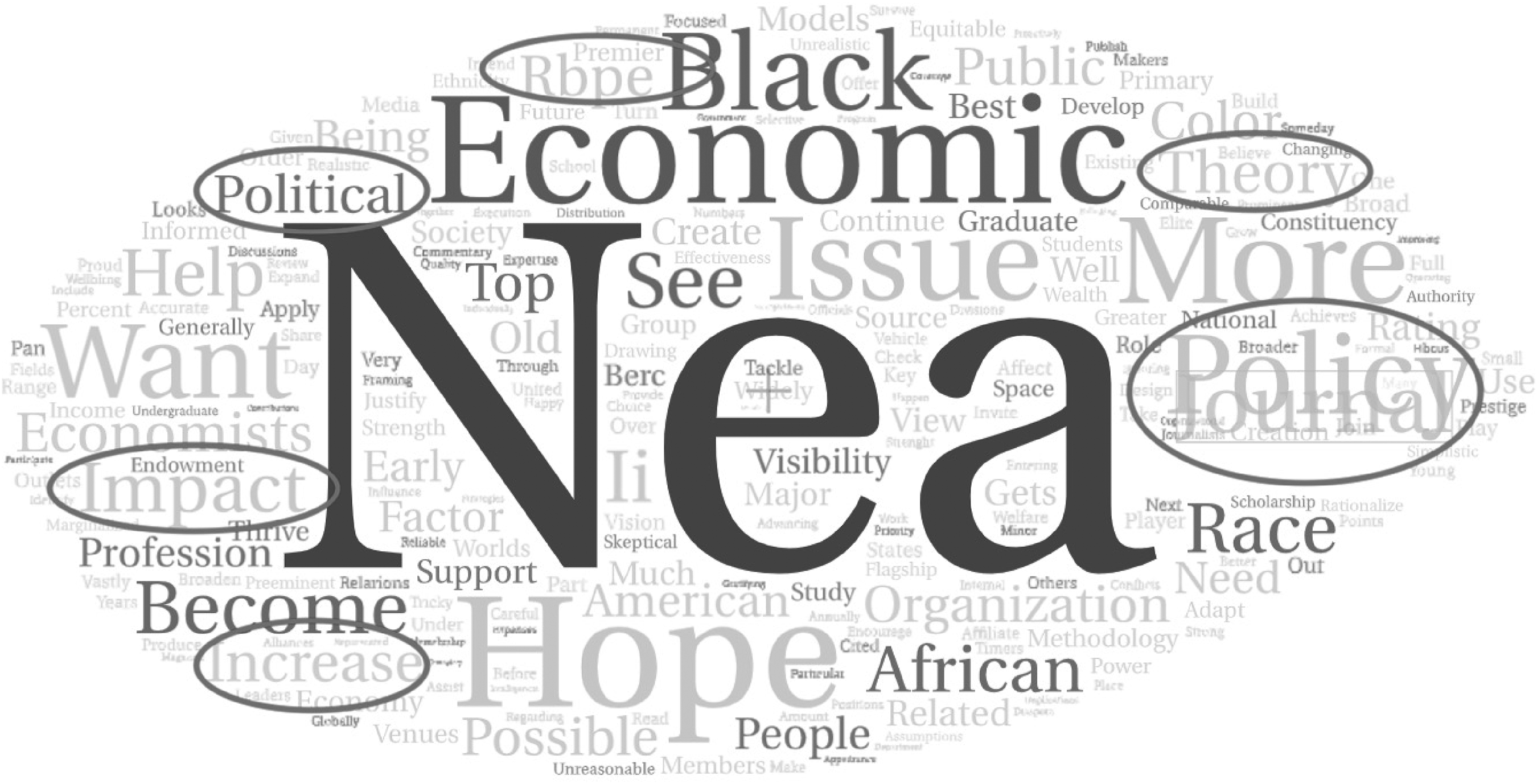
Word cloud for hopes and dreams for National Economic Association (NEA).
There are a few things to note. First, the word “political” as well as the word “policy” jump out. Second, words such as The “Review of Black Political Economy (RBPE),” “journal,” and “theory” seem to be relevant. Third, words such as “impact,” “increase,” and “endowment” also make an appearance. This list is not exhaustive of course. So, this seems to be saying that the presidents care that the Review, as the journal of the National Economic Association, feature prominently in the future of the association, but also that we become more policy-oriented, potentially even more political, in what the association does.
If we then pivot to the key themes, three main themes seem to come up in the responses. First, research. Second, policy. And, third, expansion.
On the research end, the presidents seemed to hope and dream that the NEA and its journal, The Review of Black Political Economy, are no longer marginalized venues in economics. They also hoped that the NEA create and advance more realistic economic theories and methodologies.
From the policy standpoint, they hoped that the association has increased policy influence, for example, by driving US and global policies that produce more equitable societies. And, that the NEA has increased visibility in media outlets.
On the expansion front, they hoped that the association:
Expand its outreach to Black economists and historically Black colleges and universities (HBCUs) at all levels, thus growing its membership. Create more alliances with non-Black minorities and other economists. Grow its financial capacity, for example, by establishing a permanent endowment (in the order of $100,000 to $1 million) to achieve its goals. As one respondent put it, the NEA is in their will, and they hope that others will do the same.
Question 2: Hopes and Dreams for Black America
As we advance to the second question, Figure 2 seems to reiterate some of the keywords that we saw before, such as “policy,” “political,” and “economic.” Moreover, presidents aspired for more “equality,” “wealth,” “wealth equality,” “community,” “acceptance,” and “power.” We also see words such as “racial” making an appearance.
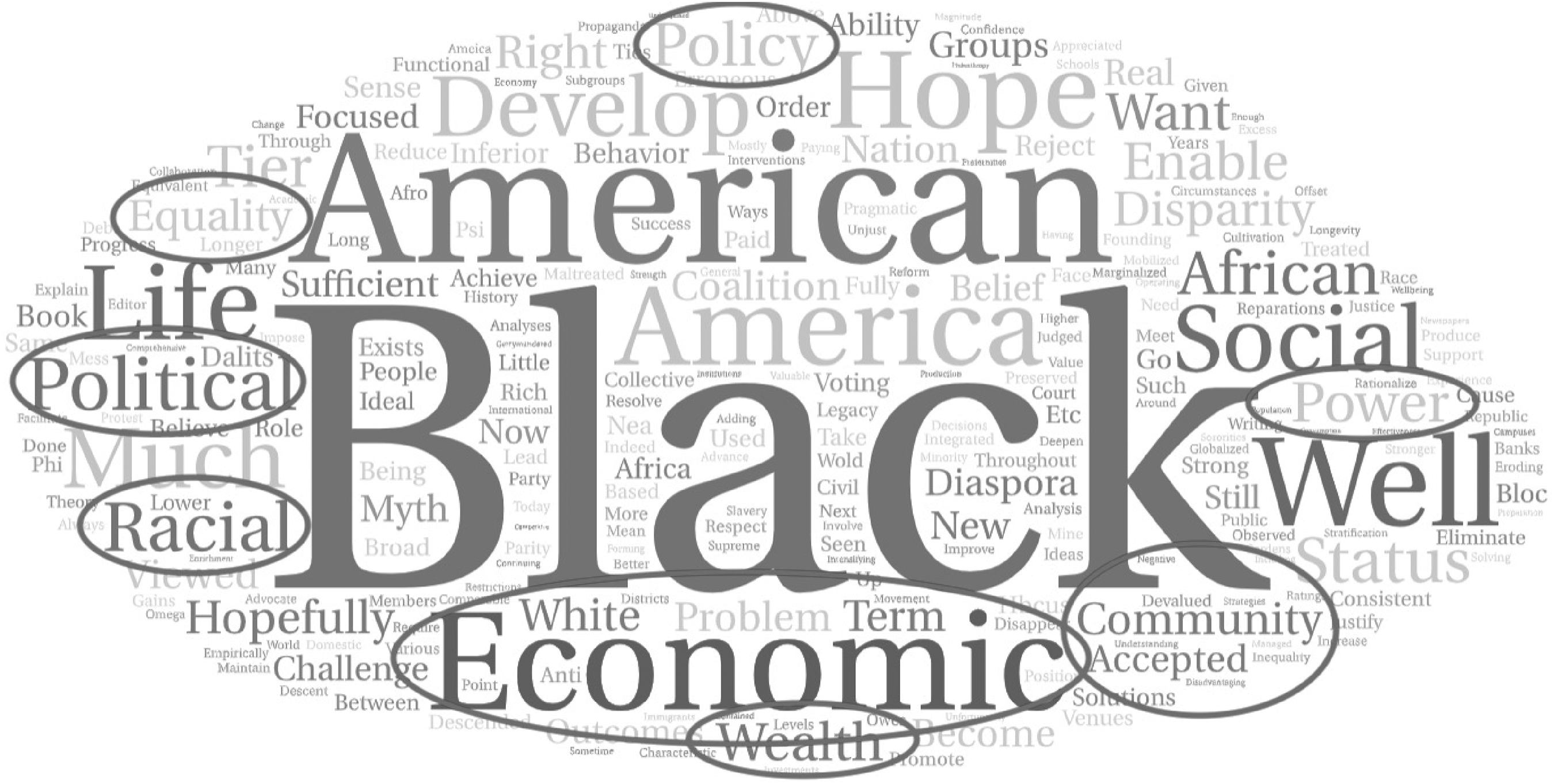
Word cloud for hopes and dreams for Black America.
When we combine these, there is pretty much a unanimous hope that Black Americans be seen as Americans, and be fully integrated into society. With this, then, came the hope for several other achievements, including but not limited to:
Economic, social, and political equality. Independence, in other words, that Black Americans develop their own long-term strategies to advance rights and well-being. That all HBCUs as well as Black fraternities and sororities be strong and competitive. That NEA build coalitions with African-descended immigrants, African diaspora, and Blacks in Africa to address common challenges. That comprehensive reparations be paid to Black American descendants of US slavery. As one respondent put it, to eliminate wealth and longevity disparities between Blacks and Whites. That the NEA take the lead in developing new ways of viewing and understanding economic life, rejecting the myth of “Black inferiority.” This would in turn impact how Black Americans are viewed and thus, their status in the United States.
Question 3: Hopes and Dreams for Blacks in Economics
Now, turning to the third question, which was for hopes and dreams for Blacks in economics, again, we see words such as “policy” and “research” popping up (Figure 3). But the overwhelming theme here seems to be one of increasing representation and supply. So, we see words such as “supply,” “representation,” “more,” “increase,” and “number.”
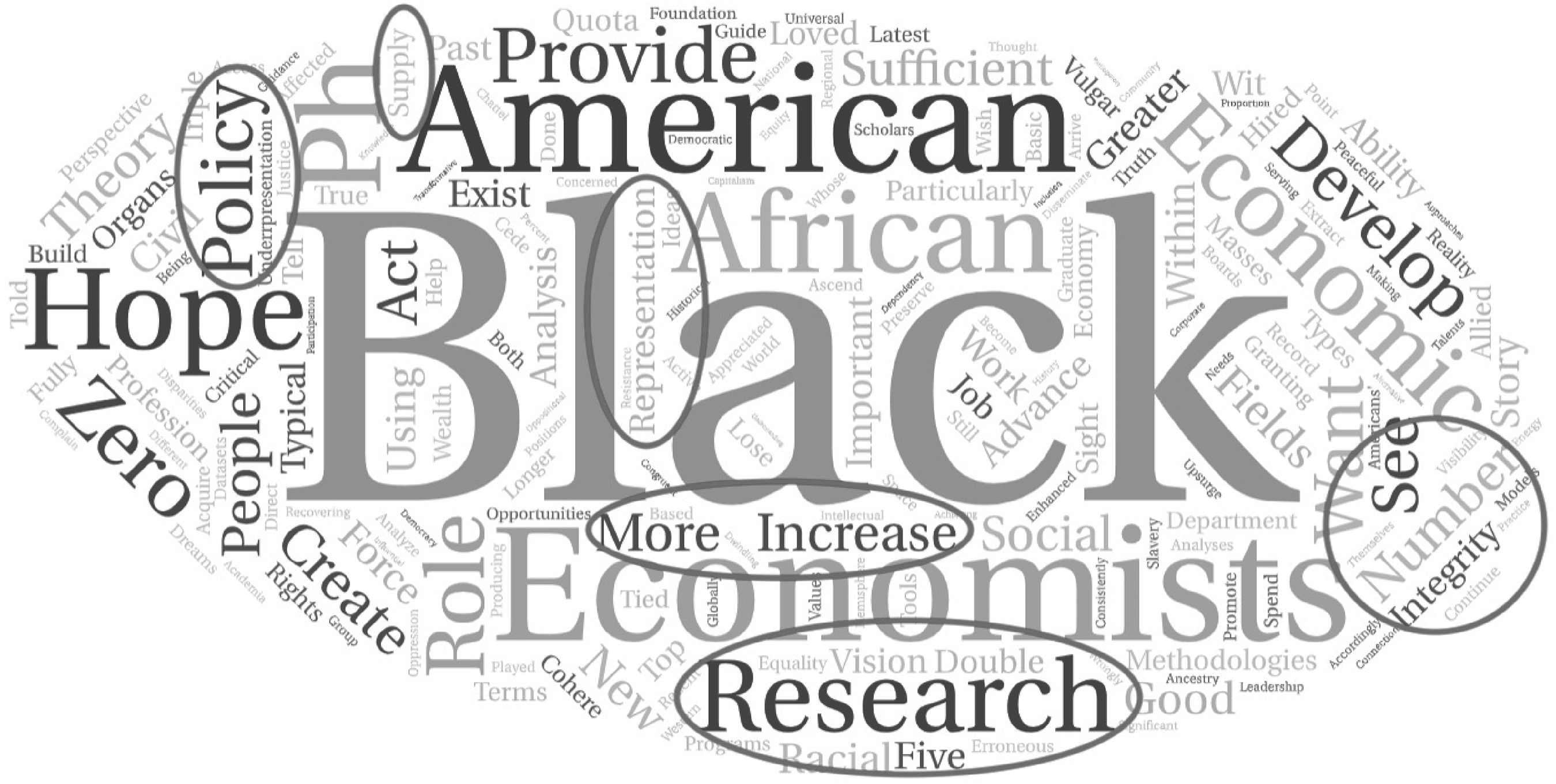
Word Cloud for Hopes and Dreams for Blacks in Economics.
If we then turn to the key themes, we see that the Presidents wanted a much greater supply of Black economists. They also wanted more demand for Black economists. Finally, they also expressed preferences over how Black economists spend their time and effort in the profession.
On the supply side, all Presidents seemed to, in some shape or form, desire a significant increase in the number of Black economists. One respondent indicated that they hope that there will still be African American and Black American economists given the downward or stagnant trends that have been seen in recent years.
On the demand side, they hoped for a critical mass of Black economists in at least five of the top 50 graduate programs in economics, policy analysis, and allied fields. One respondent said that they hoped that a quota of zero Black economists would no longer exist. The Presidents also wished that building on the recent surge, Black economists would continue to increase in key policy positions, corporate and foundation boards, and national and regional economic organizations.
Finally, on the time and effort front, there were hopes and dreams expressed for Black economists to build new theories and models to produce economic equality for the Black community. There was also a wish for Black economists to become more active in economics research, using the latest economic methodologies. As one respondent put it, it is important that we tell our own story rather than cede it to other people to do so and then complain about the story being told wrong.
Question 4: Hopes and Dreams for Other Racial and Ethnic Minorities
Now, turning to the hopes and dreams of other minorities in the economics profession. The overwhelming hope here was the same as that for Black Americans. So you will see words such as “same” highlighted but also “together,” “achievement,” “shared,” and “advances” (Figure 4). As one respondent put it, we hope that in the next 100 years every American will be seen as American, not Black, Hispanic, Asian or White; just American.
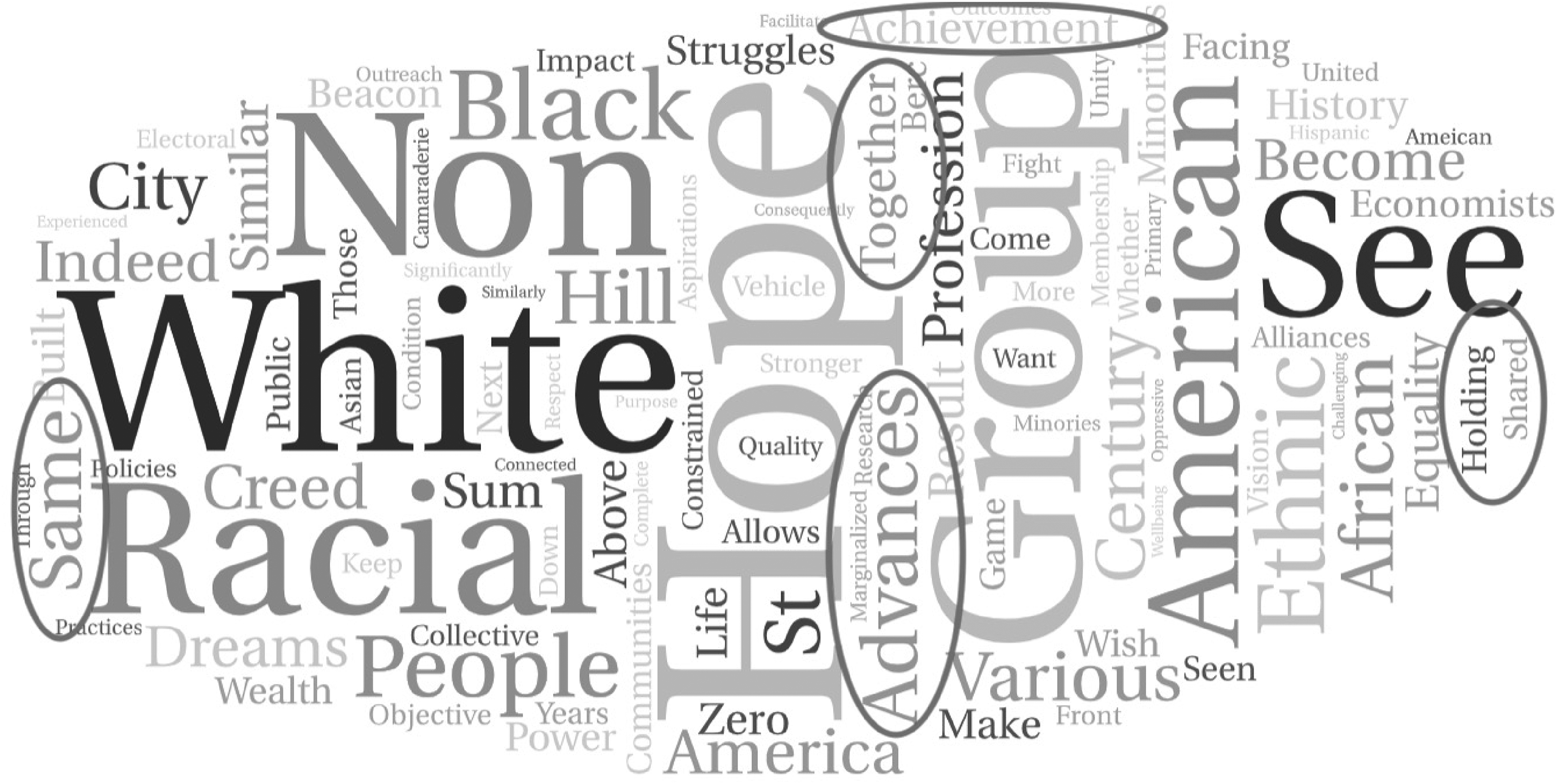
Word Cloud for Hopes and Dreams for Other Racial and Ethnic Minorities.
Lay of the Land for Years to Come
So, finally, I would like to spend some of the remaining time discussing what I call the potential lay of the land for the years to come. I have broken this down into three groups. The first set comprises existing initiatives that the NEA is already working on and that, therefore, need to be sustained and grown. The second set are initiatives that could exist with a bit more effort, because they are already inching in that direction. And then, there is a third set of initiatives that I believe require a bit more thought. So let us tackle these one by one and there will hopefully be a little bit of time for question and discussion at the end.
Existing Initiatives
The first one is on existing initiatives. If we think of one of the running themes across these responses as “expanding our base/the membership,” obviously, there is the American Economic Association Summer program housed at Howard University in collaboration with the Women’s Institute for Science, Equity and Race (WISER) and others. This is a significant component of expanding the base. Another key activity that we are undertaking to expand the base is the newly instituted student chapters that will take off in 2024. Then, there are other, if you will, more ad hoc initiatives that the NEA is involved with, one of which is the mentoring program where we are supporting minority-serving institution faculty to submit proposals, specifically to the National Science Foundation (NSF). (Again, these are existing initiatives. I will discuss potentially new initiatives in a moment.)
In terms of developing new economic paradigms and helping develop new economic theories and methodologies, obviously, our journal, The Review of Black Political Economy, has a prominent role to play here. Another initiative that we have been working on, specifically through the Black Economic Research Center for the 21st Century (BERC-21), is the Black Economics Textbook Project. Then, there is the New Economic Analysis Newsletter (NEAN), which also does some of this; the Freedom and Justice Conference, where people oftentimes discuss economic thought, how it came about, and where it might be headed both during formal presentations and casual discussions; and then, finally, the NEA webinar series, where people present newly developed work.
In terms of strengthening HBCU economics, the student chapters are a key avenue for trying to do that, but we also have a board subcommittee on HBCUs. Some of their work developed into the Minority Report piece for the NEA last year, but this subcommittee is pretty much a standing part of the board now, and I am sure that they will continue to put quite a bit of thought into the process of strengthening HBCU economics programs.
From the standpoint of solidifying finances, we have recently increased fees for our job vacancy ads, which tend to be one of our main revenue sources. (Again, these were existing initiatives. Let us now turn to initiatives that could exist with a bit more effort.)
Initiatives Requiring Some Effort
In terms of expanding the base, one thing we could do (which did exist at some point) is to conduct an annual membership drive. The issue is that this requires effort, and oftentimes the board is so busy with the day-to-day running of activities that it might not have the time to do so. So, one thing that I personally think can really help here is if we are able to hire a part-time admin support person, an issue we spent quite a bit of time working on last year, for example, developing a job description and thinking through the finances of how that would work. Again, if such a person were to come on board, they could certainly support this process.
One additional item I would like the Board to think more about is an initiative that Margaret Simms mentioned in the NEA at 50 piece (Simms, 2020). Apparently, there has been a running suggestion over the years for us to institute a high school outreach initiative, that is, reach out earlier in the process. What I am thinking is that maybe the student chapters can be an avenue for doing so. For example, at Spelman, some of the student clubs tend to go to high schools to do different types of activities. So, the student chapters might be a natural avenue for instituting a high school outreach initiative program.
In terms of developing new economic paradigms, here are some things we could do with a bit more effort. In some sense, BERC-21’s work more generally, not only the Black Economics textbook project, is already doing that. But we could potentially be more intentional. We could also imagine the Freedom and Justice Conference having specific roundtables or panels to discuss what a new economics paradigm could look like and then translating some of those into thought pieces that could end up anywhere from The Review of Black Political Economy to other economics journals to perhaps, more popular media outlets.
From the standpoint of strengthening HBCU economics, one thing that I think we can do is actually seek some funding, specifically from NSF, for an exploratory conference or workshop that can support some of this strategic reasoning and thinking around what should be done to strengthen HBCU economics programs.
From the standpoint of solidifying finances, I think we can be much more strategic in fundraising and donations. Also, there is an investment committee that is finally taking shape and can help us think through what we can do, within existing parameters, to grow our finances.
Now, in terms of themes that have not been mentioned yet. From the increasing media engagement standpoint, we can collect and advertise the media list of NEA members annually. We have certainly been collecting and keeping track of it, but we have not really been circulating it to the media, and we can be much more aggressive about that. Again, I think that an admin support person can really help move this along. We can also hold media skill webinars, that is, the type of webinar where our members engage with someone who has significant experience talking to the media so that they feel more adequately prepared when that time comes. That was the goal this year, but unfortunately, it did not happen.
From the standpoint of building a reputation in economics and gaining respect, it was recently suggested on the NEA listserv for people to create Google Scholar profiles, to create RePEc profiles, and we can even imagine going further by creating Wikipedia pages for our members. This could be another way to gain recognition in terms of what our members work on and possibly, could be accomplished through the student chapters or other avenues such as our web support team.
Finally, to turn to the potential initiatives that require more thought. And, I say this because I believe we need to be much more intentional and strategic about these.
Initiatives Requiring Significant Thought
Starting with “truly” building respect in economics, specifically for the NEA and the Review of Black Political Economy: It is no secret that the economics profession suffers from quite a bit of elitism and clubbiness. And, it is not clear to me how exactly to tackle that component. So, I think a few minds need to come together and think much more strategically than I can, by casually throwing out suggestions right here right now. But it is a very important issue to think about.
From the standpoint of influence and policy, I think we currently do it through our day-to-day activities, including initiatives such as the NEAN and periodic statements such as the ones in support of the candidates for Federal Reserve Governor who were past presidents of the NEA, specifically Lisa Cook and Phil Jefferson. But, we are not an advocacy organization. It is not part of the NEA mandate. So, there have been requests for us to issue statements on a range of topics over the last few years, and the Board has declined to do so, because again, we are a 501c3, and a lot of things will veer on being much more political than we are comfortable doing. If this is a direction that the Association would like to go, it certainly requires more thought, and maybe even a complete change in bylaws.
Finally, I would like to underscore that to address this final pillar, we will probably need a strategic roundtable or board subcommittee. These are not topics that should be tackled lightly.
Conclusion and Acknowledgments
Having discussed the lay of the land, I would now like to thank a few individuals for their support throughout this process. I could have spent the 30 minutes of this address just thanking people, so I have really just listed the very few here. The first two need no introduction in this room. Romie Tribble, NEA Secretary and Full Professor of Economics at Spelman, nominated me to serve on the NEA board about six years ago. Rhonda Sharpe, President of WISER, past president of the NEA, and Co-Editor of the Review of Black Political Economy, nominated me for the position of President-Elect about three years ago. So, one could say that without these two individuals, I might not be standing here today.
I would also like to thank the current, but also previous, NEA boards and the broader NEA community for support and advice over the years.
Finally, the people without whom this definitely would not have happened—that is, my family, specifically my parents, for helping me go from the picture on the left to the picture on the right, which is where I stand today (pictures not included).
I would like to thank you again for your attention. We have a couple of minutes for questions/comments but instead of taking them here, I suggest that we join the CSMGEP–AERIP–ASHE–NEA (Committee on the Status of Minority Groups in the Economics Profession–Association for Economic Research of Indigenous Peoples–American Society of Hispanic Economists-National Economic Association) reception and discuss there.
Footnotes
Declaration of Conflicting Interests
The authors declared no potential conflicts of interest with respect to the research, authorship, and/or publication of this article.
Funding
The authors received no financial support for the research, authorship, and/or publication of this article.
