




Abstract
Several previous studies have explored the relationship between trust and socio-economic conditions but do not attempt to examine channels through which the relation operates. In this paper, we examine how political fractionalization mitigates the positive relationship between trust institutions and national economic performance in Sub-Saharan Africa. Using Round 7 data of Afrobarometer in over 1000 districts in 34 countries, we find that trust institutions positively and significantly affect economic performance. Nevertheless, the positive effect is attenuated in districts with a high level of political diversity. More specifically, a higher level of trust is associated with lower economic performance at a higher level of political fractionalization and vice versa, with a steady linear decrease of the estimated coefficients. Policy implications are discussed.
Introduction
The relationship between social capital measured by trust and socio-economic conditions has been widely explored (Carpiano & Fitterer, 2014; D’Hombres et al., 2009; Guiso et al., 2004; Herian et al., 2014; Hollard & Sene, 2016; Konte & Ndubuisi, 2021; Pevzner et al., 2015). Similarly, a large body of studies in the literature has examined the effects of ethnic diversity on several economic outcomes (Ager & Brückner, 2013; Alesina et al., 2003; Alesina & La Ferrara, 2005; Collier, 2001; Easterly & Levine, 1997; Gisselquist et al., 2016; Lee et al., 2019; Montalvo & Reynal-Querol, 2005; Wei & Suen, 2019). Overall, the findings reveal that trust positively influences economic conditions while diversity could have negative implications mostly in countries with weak institutions. However, with respect to data and to the best of our knowledge, no study has explored how political fractionalization moderates the relationship between trust and economic performance (EP). The present study fills the attendant gap by providing an answer to how political heterogeneity could modify the relationship between EP and trust at a disaggregated level in African countries.
In the light of the above, in this paper, we contribute to the existing literature on the relationship between trust and EP by examining the role played by political diversity. Our contribution is threefold. The first pertains to the definition of variables and measurements. Previous studies have used ethnic or religious diversity to test the relationship (Alesina et al., 2003; Alesina & La Ferrara, 2005; Collier, 2001; Easterly & Levine, 1997; Gisselquist et al., 2016; Lee et al., 2019; Montalvo & Reynal-Querol, 2005). However, some authors such as Kontopoulos and Perotti (1999), Grier et al. (2015), Henisz (2002), and Roubini and Sachs (1989) also define political diversity at the executive or legislative level (political cohesion, presidential or one-party-majority government, coalition or minority governments, number of political parties in the government, legislative fragmentation, inter alia). In the present study, we define a new indicator of political fractionalization. In effect, political diversity is defined as the probability that two randomly selected individuals in a given district unit belong to different political parties. Moreover, our measurement of trust also differs from those employed in other studies. Accordingly, we define trust on institutions such as the president, the parliament or national assembly, police, courts of law, traditional leaders, religious leaders, and local government while previous studies have built on trust in neighbors, other people, inter alia (Carpiano & Fitterer, 2014; D’Hombres et al., 2009; Guiso et al., 2004; Herian et al., 2014; Hollard & Sene, 2016; Konte & Ndubuisi, 2021; Pevzner et al., 2015).
Finally, we use a subjective perception of government EP. This enables us to understand how individuals appreciate the effectiveness of macroeconomic policies and how the underlying is linked to trust. The second contribution is the interactive form we utilized in our model. While previous studies have assessed the direct relationship between trust or diversity and the economy (Hollard & Sene, 2016; Robbins, 2012), we evaluate the marginal indirect effects. This approach of marginal indirect effects allows us to examine the heterogeneous response of economic conditions to trust at different political fractionalization levels in Africa. Finally, many authors on the topic have focused their studies on a single country (Awaworyi Churchill et al., 2019; Awaworyi Churchill & Danquah, 2020; Gisselquist et al., 2016; Hill, 2022), whereas this paper employs data from the Round 7 Afrobarometer Survey in 34 African countries and over 1000 districts in order to assess the modulating effect of diversity on the relationship between EP and trust institutions.
The present exposition departs from the extant literature on political institutions and EP in Africa which has not considered the problem statement in this study. Accordingly, the extant studies pertaining to Africa have largely been concerned with, inter alia: the importance of political crisis on the performance of trade (Asongu et al., 2021); the relevance of party systems in economic prosperity (Pelizzo & Nwokora, 2016, 2018); how tax structures and corresponding performance as well as income inequality (Oualy, 2020) are affected by externalities from political instability (Dalyop, 2020); the relationship between democratic institutions and political stability (Ateku, 2020); how income from natural resources is influenced by politico-economic externalities (Frynas & Buur, 2020); linkages between economic growth, foreign investment, and political performance (Williams, 2017); the impact of political crisis on economic growth (Okafor, 2017); assessing the relationship between trust and economic growth (Miniesy & AbdelKarim, 2021; Roth, 2022) and linkages between trust, democratic institutions, and income inequality (Hill, 2022; Mauk, 2022; Suryahadi et al., 2022).
Theoretical Background
Although to the best of knowledge, no study has assessed how trust influences the perception of EP contingent on the moderating role of political diversity, we have highlighted in the introduction, several studies that have explored linkages between ethnic (religious) diversity, trust, and economic conditions.
Why Should Trust Affect EP?
According to the existing literature, trust is intuitively linked to economic conditions. In order to justify the predominant role of trust in economic conditions, Uslaner (2011) stated: “Generalized trust is a value that leads to many positive outcomes for a society–greater tolerance of minorities, greater levels of volunteering and giving to charity, better functioning government, less corruption, more open markets, and greater economic growth” (p. 2). This statement alone is sufficient to demonstrate that trust affects economic and social conditions going from micro (villages, cities, districts, inter alia) to aggregate (countries) levels.
Moreover, trust should positively impact EP. In effect, the relationship could be replaced in a context of institutional quality-trust and economic development. The debate between institutional quality, economic development, and trust is not new. For example, Knack and Keefer (1997) found that trust can induce EP while Putnam (1993) made the argument that trusting other people is beneficial for the quality of the institutions. Robbins (2012) investigates the direction of causality between institutional quality and generalized trust and finds a positive reciprocal relationship from trust to institutional quality.
The logic of the effect can be detailed as follows. In a first step, trust may affect the nature of individuals via tolerance, positivity, acceptance, reduce corruption, and boost civic engagement. It can also foster civic virtue among community members who are willing to prioritize collective interest over individual interest. In the second step, this aggregate effect will therefore enhance government participation and improve political institutional quality and consequently the quality public service. Robbins (2012) suggests that trust may increase the effectiveness of government bureaucrats in order to efficiently influence policy and reduce costs associated with political bargaining. Using the words of Robbins (2012) and based on the results of Almond and Verba (1963), Boix and Posner (1998), and Putnam (1993), “generalized trust” is necessary to “lubricate” social interaction and “glue” the citizenry together.
In other ways, the relationship between trust and socioeconomic features has been discussed widely in the previous literature. D’Hombres et al. (2009), Herian et al. (2014), Carpiano and Fitterer (2014), and Hollard and Sene (2016) examined the relationship between trust and health and found that more trust reports better health. In financial development, the effect of trust is also explored. Overall, a large number of works support that trust is beneficial to financial development (Guiso et al., 2004; Konte & Ndubuisi, 2021; Pevzner et al., 2015).
EP, Trust, and the Role of Political Diversity
In the previous section, we explored the linkages between trust and economic conditions. This literature is focused on the positive effects of trust on economic development but do not, in many cases, attempt to assess the factors that could mitigate the nature of the relation. In effect, the relation could be indirect and political heterogeneity could be a channel through which the nature of the relationship depends. A large number of authors have linked the notion of diversity and socioeconomic outcomes (Ager & Brückner, 2013; Alesina et al., 2003; Alesina & La Ferrara, 2005; Collier, 2001; Easterly & Levine, 1997; Gisselquist et al., 2016; Lee et al., 2019; Montalvo & Reynal-Querol, 2005; Wei & Suen, 2019). However, the works that have examined how political fractionalization (i.e., the degree of division of a country's population) influences socioeconomic outcomes are scarce. Grier et al. (2015) employed a duration analysis approach to empirically investigate whether political fractionalization leads to delayed fiscal stabilization. The authors found strong evidence that political heterogeneity is significantly associated with longer delays in stabilizing high deficits. In the same vein, Roubini and Sachs (1989), Grilli et al. (1991), Perotti and Koutopoulos (2002), and Persson and Tabellini (2004) examined the effect of political diversity on government effectiveness in general and particularly budget deficits management. While these studies evaluated the direct effects of political fractionalization on government EP, no formal evidence exists, to the best of our knowledge, regarding the following question: how does political heterogeneity mitigate the positive relationship between trust and EP? In other words, how does political party affiliation influence EP through trust? Conceptually, trust could positively affect the perception of EP depending on the channels of influence. Among these factors, political diversity could be an evident mechanism through which trust worsens EP. In particular, political heterogeneity could be a relevant lever to erode social cohesion and civic engagement that trust would have already established between different citizens in a community. In the same way that ethnic or religious diversity undermines social capital, political diversity erodes the trust that citizens should have in their governments or institutions. Moreover, several studies have explored how political fractionalization influences economic outcomes and have found negative effects. For example, Grier et al. (2015), Roubini and Sachs (1989), and Padovano and Venturi (2001) found that government fractionalization is associated with large and delayed fiscal budget deficits. Thus, while trust “lubricates” social cohesion and “glues” the citizenry together, political fractionalization “obstructs” social cohesion and “divides” the citizenry. For example, in highly diversified districts, the level of trust in institutions could be influenced negatively by the frequency of political debate and therefore the lubricating and gluing role could be affected. In such a situation, the objectivity and confidence of citizens could be altered. On the contrary, if the district is not politically-fractionalized, trust for institutions is objective because ceteris paribus, citizens do not arbitrarily reject government actions and trust is sufficient to provide an objective perception of the economic conditions.
Data and Model Specification
In this section, we describe the data used and present the econometric model to assess the relationship between EP and trust contingent on the mitigating role of political fractionalization.
Presentation of Data
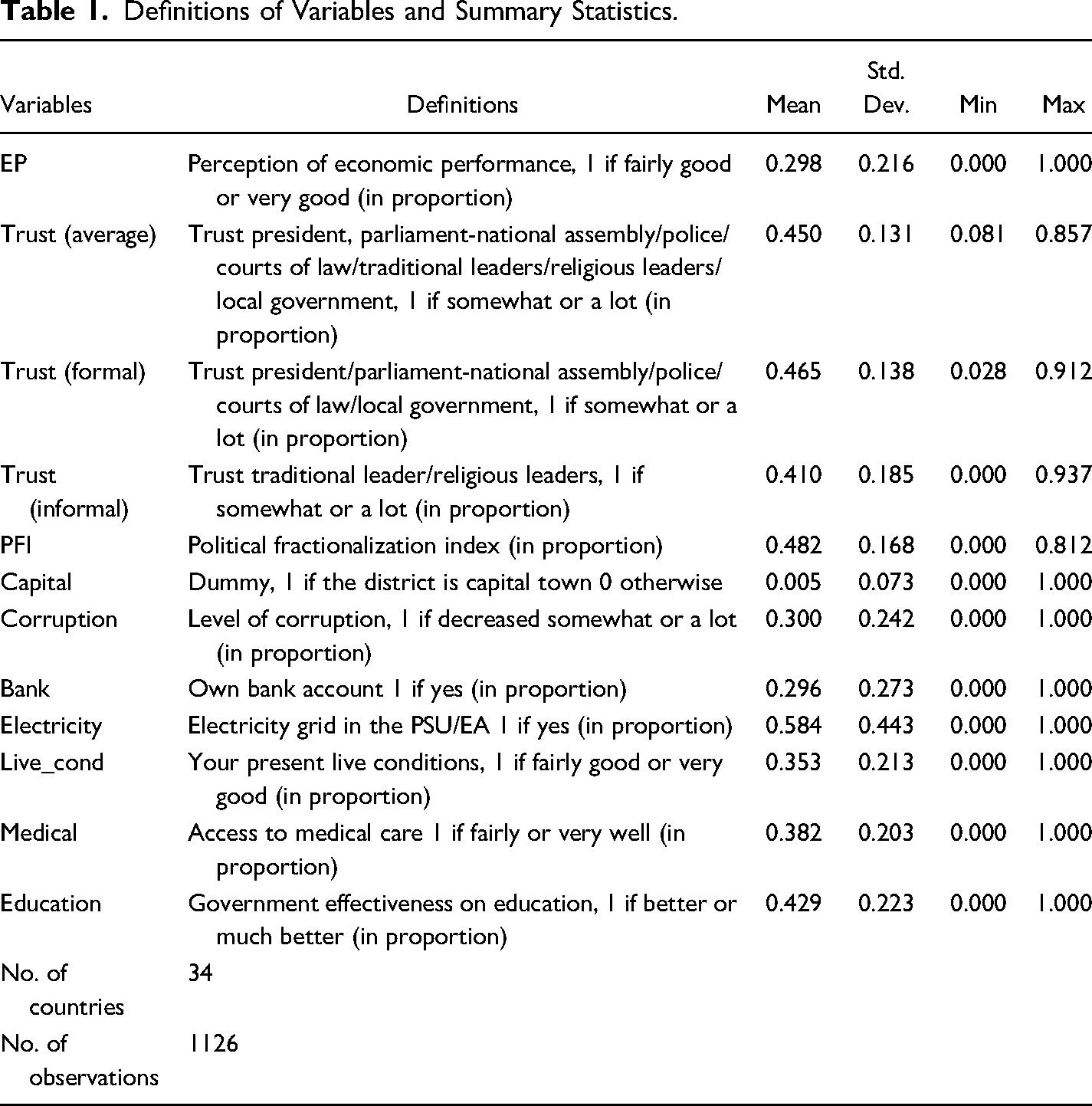
To evaluate the effects of trust on EP and the role played by political diversity in the relationship, we use the Round 7 surveys of the Afrobarometer data which includes 45823 interviews completed in 34 countries between September 2016 and September 2018. The surveys are focused on the attitude of citizens towards dimensions such as democracy and governance, markets and civil society, inter alia. The Afrobarometer is a joined enterprise that entails, the Institute for Justice and Reconciliation in South Africa (IJR), the Centre for Democratic Development (CDD-Ghana), the Institute for Development Studies (IDS) at the University of Nairobi (Kenya), and the Institute for empirical Research and Political Economy (IREEP) in Benin. Extra technical support is provided to the program by some universities such as the University of Cape Town and the Michigan State University. Table 1 provides a description of variables included in the different regressions.
Definitions of Variables and Summary Statistics.
Measuring EP
Our independent variable is EP. The variable is constructed from responses to the question in Round 7 Afrobarometer surveys. The corresponding question on the perception of EP is: “In general, how would you describe: the present economic condition of the country?” with the variable label “Country's present economic condition.” The respondents choose his/her response from the seven options, including “very bad,” “fairly bad,” “neither good nor bad,” “Fairly good,” “very good,” “don’t know,” “refused to answer.” EP is constituted by the proportion of people in the administrative level 2 unit (district) who respond by “Fairly good” or “very good.” For example, a value of 0.80 indicates eight out of ten citizens (80%) describe the national economic condition as fairly or very good on their subjective perception.
Measuring Trust
To measure trust, we use the response to the questions, “How much do you trust each of the following, or haven’t you heard enough about them to say: The President (Parliament-National assembly/Police/Courts of law/Traditional leaders/religious leaders/local government) ?” with the variable label “Trust President (Parliament-National assembly/Police/Courts of law/Traditional leaders/religious leaders/local government)” and which the respondents were asked to select from these six options namely: “Not at all,” “Just a little,” “Somewhat,” “A lot,” “Don’t know-Haven’t heard enough,” and “Refused to answer.” We define three types of trust: Trust_average, Trust_formal, and Trust_informal. Trust_average is computed by the average of the seven measures of trust at the administrative unit. Trust_formal corresponds to the average of five types of trust, namely: the president, the parliament or national assembly, police, courts of law, and local government while Trust_informal is measured by the average of trust in traditional and religious leaders. For each indicator, the trust corresponds to the proportion of the respondents who choose “Somewhat” or “A lot” as an answer to the question. Thus, the more the proportion is close to one, the more the citizens trust the corresponding structure.
Measuring Political Diversity
Political diversity is measured at the district level. Its measure is based on ethnic or religious diversity widely used in the existing literature (Alesina et al., 2003; Awaworyi Churchill & Danquah, 2020; Benier & Wickes, 2016; Churchill et al., 2019, inter alia). We use the question “which party is that” after answering by “yes” to the question “Do you feel close to any particular political party?.” Let us define 
Empirical Strategy
Our empirical strategy to evaluate the effect of trust on EP perception and the mitigating role played by the PFI is exposed into two steps. Firstly, we estimate the relationship between trust and EP. Secondly, we evaluate whether the nature of the relationship differs upon the level of the PFI.
Let us define 
To test the effect of the PFI in the relationship between EP and trust, we consider the following relationship:
Empirical Results
In this section, we exploit the results of the relationship between trust and EP contingent on the moderating role of political fractionalization with a focus on the interactive term in the first step and proceed to the robustness checks in the second section.
Baseline Results
The estimation results are reported in Tables 2 to 4. Table 2 reports the estimation with the average trust measured as the mean of the seven types of trust. In column 1, we use “trust_average” (i.e., average trust) and PFI without country fixed effects, the interaction term, and control variables. The estimated coefficient of trust is not significant but the estimated coefficient of political diversity is positive and significant at the 1% significance level. Nevertheless, the R-squared (i.e., coefficient of determination of adjustment) is extremely weak (1.2%). In column 2, we run the same regression but add the interaction term without control variables and fixed effects. The average trust estimate becomes significant at the 10% significance level and positive, the interactive expression is negative and significant at the 10% level but the coefficient of determination, explanatory power or R_squared is still weak (1.5%). In columns 3–10, we introduce an interaction term between trust and PFI and also for control fixed effects and other variables. On the one hand, we notice that the estimated coefficients of trust_average and the interaction term are robust and significant across columns. On the other hand, the model is improved in terms of its R_squared value as we add the controls (from 1.2% to 60.3%). For interpretation, we use column 10 due to its performance. The findings suggest that the estimated coefficient on trust is positive and statistically significant at the 1% significance level. This coefficient can be interpreted as the correlation between EP and trust for districts where there is no political heterogeneity. Thus, in a district unit where there is no political diversity, a one standard deviation rise in trust average increases the perception of EP by 0.532. Interestingly, the estimated coefficient of the interaction term between trust average and political diversity is negative and significant at the 1% level. This result reveals that even if trust average has a positive effect on EP, political diversity at the district level can inhibit the effect. More precisely, administrative units located in highly politically fractionalized areas are less likely to have their perception of EP positively affected by trust average and vice versa. Turning to the other district characteristics, our findings show that with the exception of own bank account (which has an estimated coefficient that is negative and significant) and the existence of electricity in the primary sample unit (which is insignificant), all other characteristics such as capital town, decrease of corruption level, present living conditions, access to medical access, and effectiveness of education have a positive and significant effect on the perception of EP.
Trust Average, PFI and Economic Performance (Dependent Variable: Economic Performance).
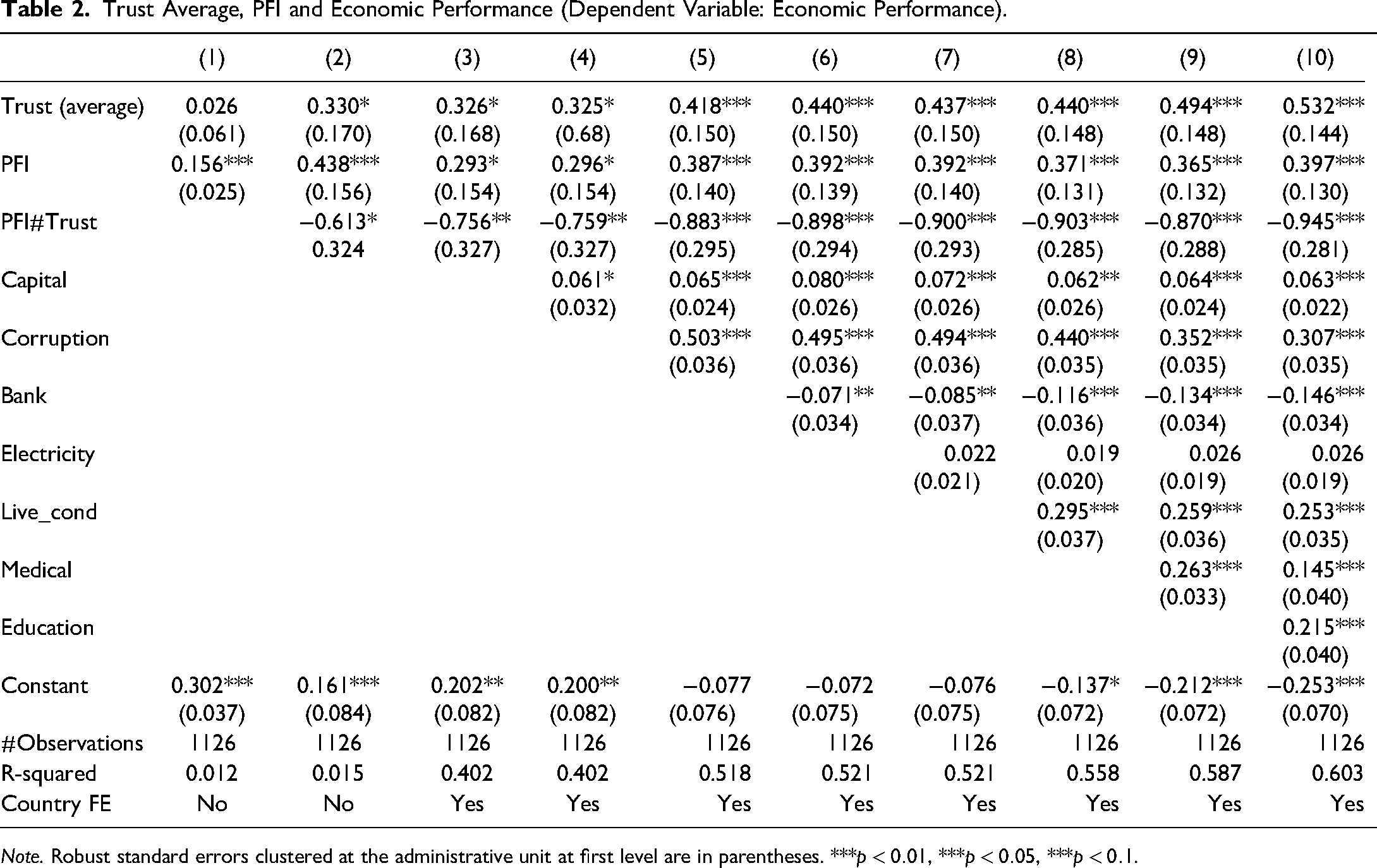
Note. Robust standard errors clustered at the administrative unit at first level are in parentheses. ***
Trust Formal, PFI and Economic Performance (Dependent Variable: Economic Performance).
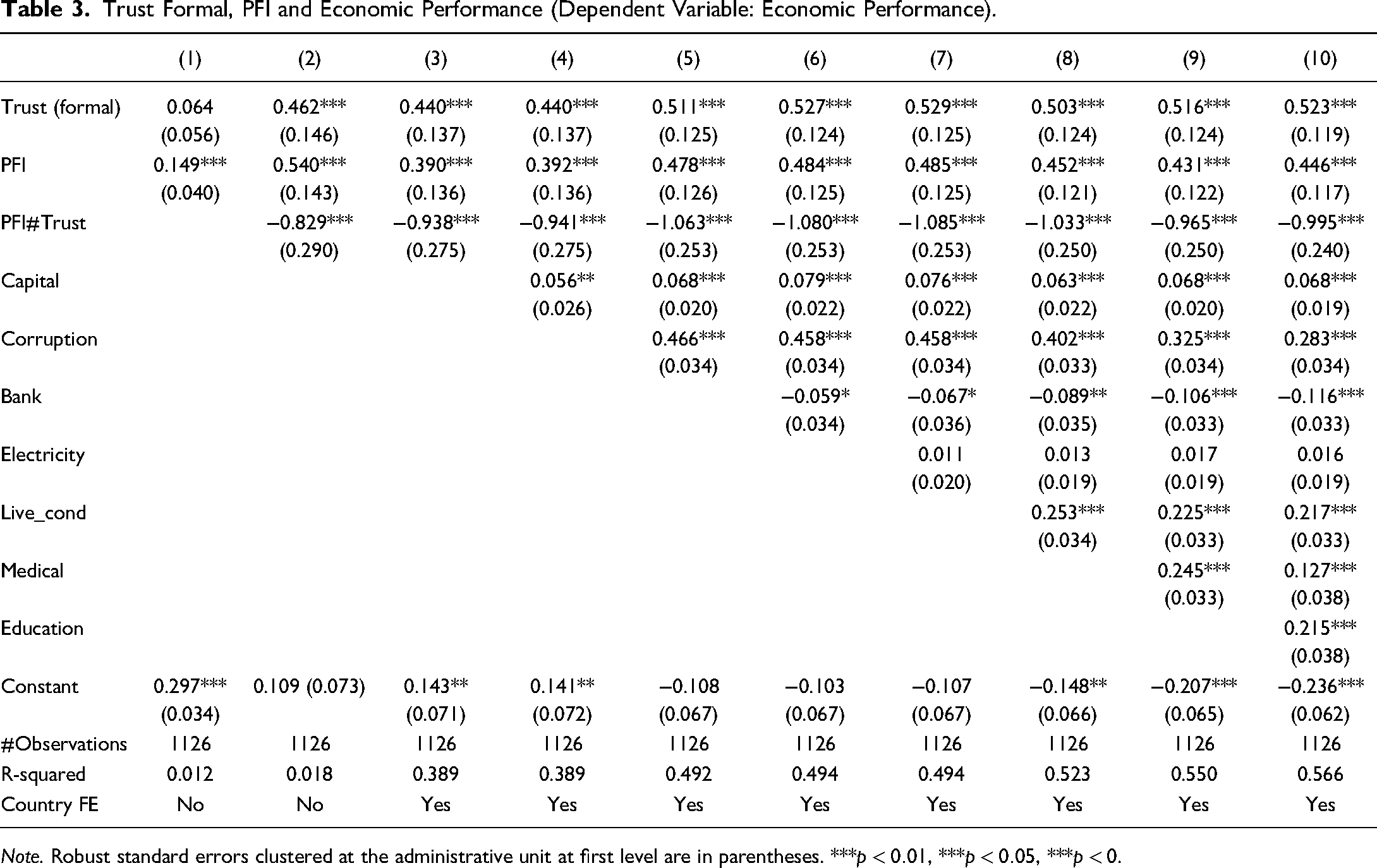
Note. Robust standard errors clustered at the administrative unit at first level are in parentheses. ***
Trust Informal, PFI and Economic Performance (Dependent Variable: Economic Performance).
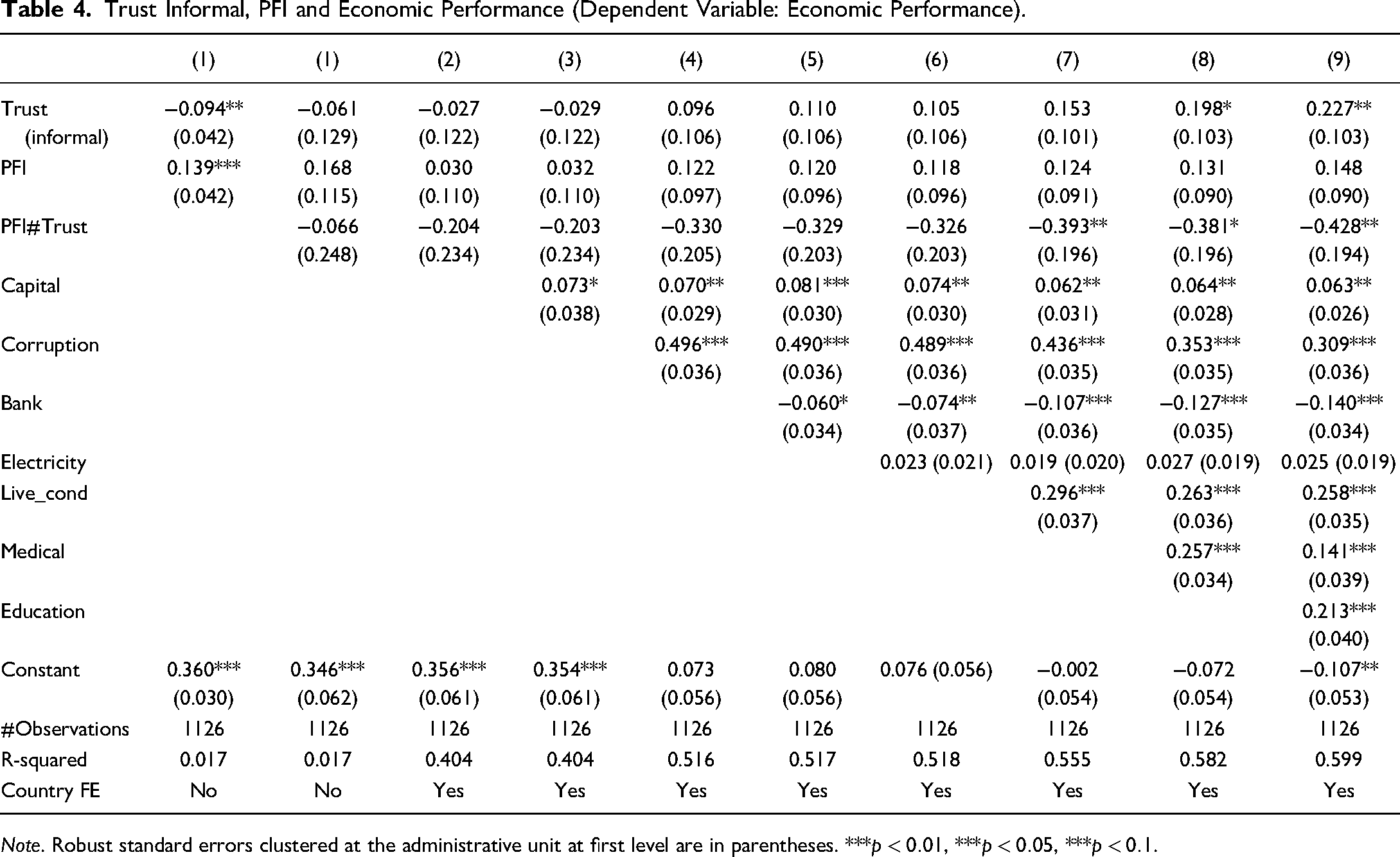
Note. Robust standard errors clustered at the administrative unit at first level are in parentheses. ***
We now turn to the estimation regarding formal trust exposed in Table 3. In effect, we replace “average trust” with “formal trust” which is defined as the trust for administrative and formal structures (president, parliament or national assembly, police, courts of law, local government council). The estimated coefficient of trust_formal (i.e., formal trust) is positive and significant at the 1% level in all equations. For districts where political diversity is null, a rise of one standard deviation of formal trust increases the perception of EP by around 0.50. Indeed, the estimated coefficient of political fractionalization is positive and highly significant indicating that an increase of this variable induces a rise in EP. Regarding the interaction variable, the estimated coefficient is still significantly negative and slightly higher than the coefficient of trust average. This finding confirms that political diversity mitigates the effects of formal trust on EP perception and the mitigating role is more apparent in the formal system.
Finally, the results with informal trust are reported in Table 4. Informal trust is constructed from religious and traditional leaders. The effect of trust_informal is significant only in three out of ten equations with a mitigated sign. Concerning the interaction terms, the findings show that the significance and the magnitude of the estimated coefficient decrease drastically compared to trust_formal. This result indicates that the role played by political diversity in the relationship between trust_informal and EP is not clearly apparent contrary to formal_trust. This is because informal offices are not associated with a political party. Therefore, political diversity plays a minor or no role in the relationship between trust_informal and EP.
In order to better describe the mitigating role of political diversity on the relationship between trust and EP, we carry out an in-depth analysis of the interaction term. In effect, we assess how trust affects EP perception at each point of the distribution of political fractionalization. The result of this strategy is reported in Table 4 for the three measures of trust. The table shows the marginal effects at different points of the distribution of the PFI.
Regarding the trust_average (column 1), the results reveal that at the lower value of PFI, trust positively affects EP contrarily to higher level of PFI. Quantitatively, a one standard deviation rise in trust induces an increase of 0.438 standard deviation of EP for districts with low-PFI (PFI = 0.100) while it is associated with a decrease of 0.413 standard deviation in districts with the highest political fractionalization (PFI = 1.000). Indeed, in districts where the political diversity is perfectly balanced (PFI = 0.500), the findings show an insignificant marginal effect.
When we turn out to trust_formal, the previous results are confirmed. We also notice that the effects are more magnified. For example, in districts without political diversity, a one standard deviation increase of trust_formal is associated with an increase of 0.523 standard deviation of EP. Contrarily, if the probability that two randomly selected individuals in a district belong to different political parties is equal to one, a one standard deviation rise of trust_formal is associated with a decrease of 0.472 standard deviation of their EP. The same trends are observed when we consider trust_informal. Nevertheless, the marginal effects are lower in magnitude and significance. This finding could indicate that compared to trust_formal, the marginal effect for trust_informal is noticeably small. So, we can deduce that the PFI is not flexible enough to reverse the relationship between trust_informal and EP.
To gain understanding, these previous results can be explored graphically. In Figure 1, the marginal effects at different points of the distribution of PFI are plotted with 95% confidence intervals (CIs). The results are clearly confirmed. Figure 1 suggests that higher trust is associated with lower EP at higher political fractionalization and vice versa with a steady linear decrease of the estimated coefficients.
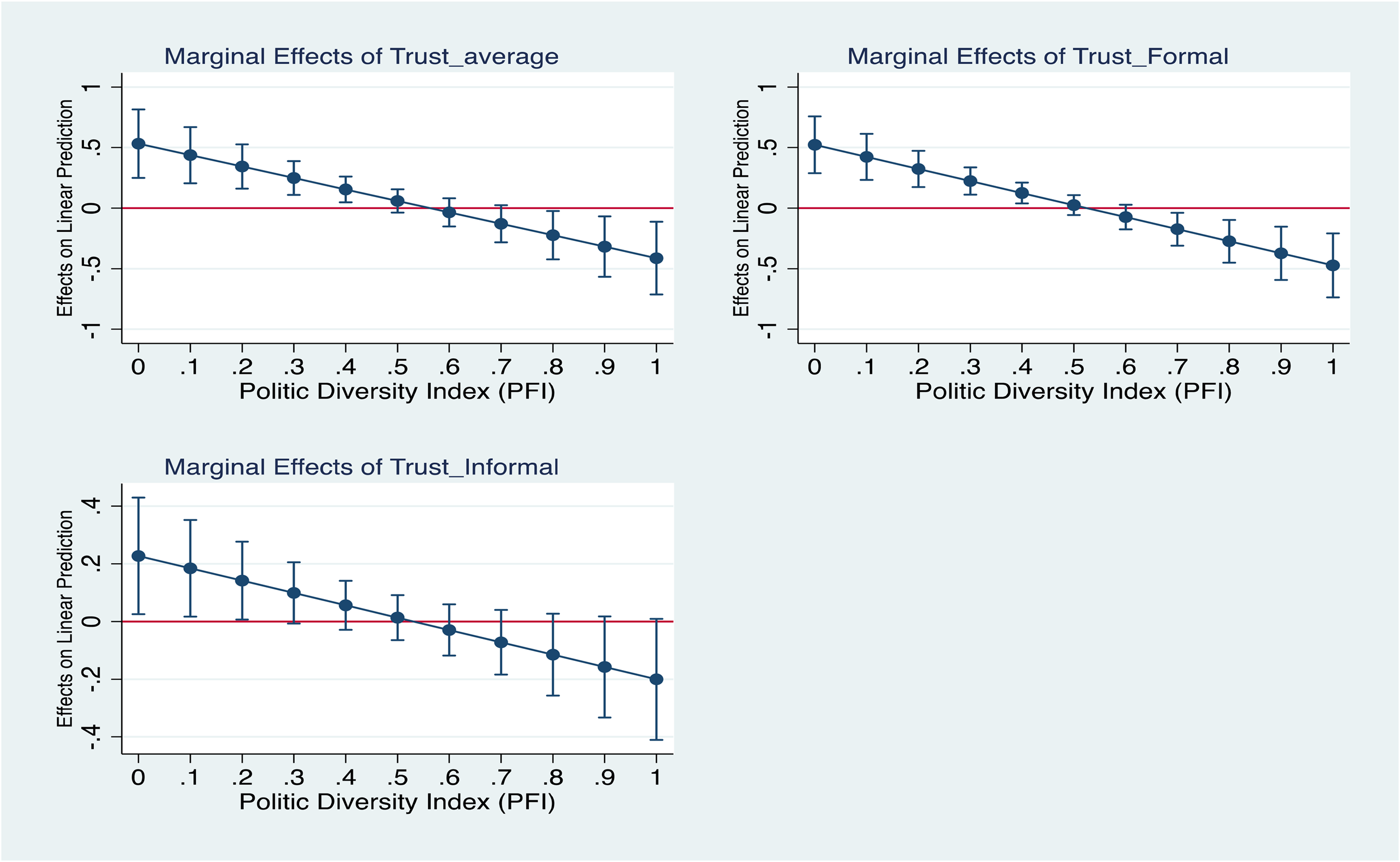
Marginal effects of trust on economic performance depending on the political fractionalization index.
Robustness Checks
After discussing our baseline estimations, we conduct an arsenal of sensitivity checks to examine the robustness of our main finding. Firstly, we examine the robustness by replacing our independent variable with another EP perception. Secondly, we use the IV approach to deal with a potential presence of endogeneity.
Alternative Measure of EP
In our first sensitivity analysis, we examine whether our findings are robust by replacing the independent variable by another indicator of the perception of government effectiveness. We explore the following question: “Let's start with your general view about the current direction of our country. Some people might think the country is going in the wrong direction. Others may feel it is going in the right direction. So let me ask you about the overall direction of the country: would you say that the country is going in the wrong direction or going in the right direction?” with the variable label “overall direction of the country” and the respondents could answer “going in the wrong direction,” “going in the right direction,” “don’t know,” “refused to answer,” and “missing.” We define a dummy variable as 1, if “going in the right direction” and 0 otherwise) and compute the proportion of people at the district who agree that the country is going in the right direction. This variable informs us how people appreciate the overall direction of the country.
Table 5 provides the estimation results of this strategy. Our main results found previously are still strongly hold. In effect, the estimated coefficient of the interaction is negatively significant for average trust and formal trust. Indeed, the estimated marginal effect reveals that in districts with higher political heterogeneity, the effect of trust on EP is negative while it becomes positive in districts that are less politically fractionalized. The result is more apparent for formal trust as founded is the baseline estimations.
Marginal Effects of the PFI on Trust on Economic Performance (Dependent Variable: Economic Performance).
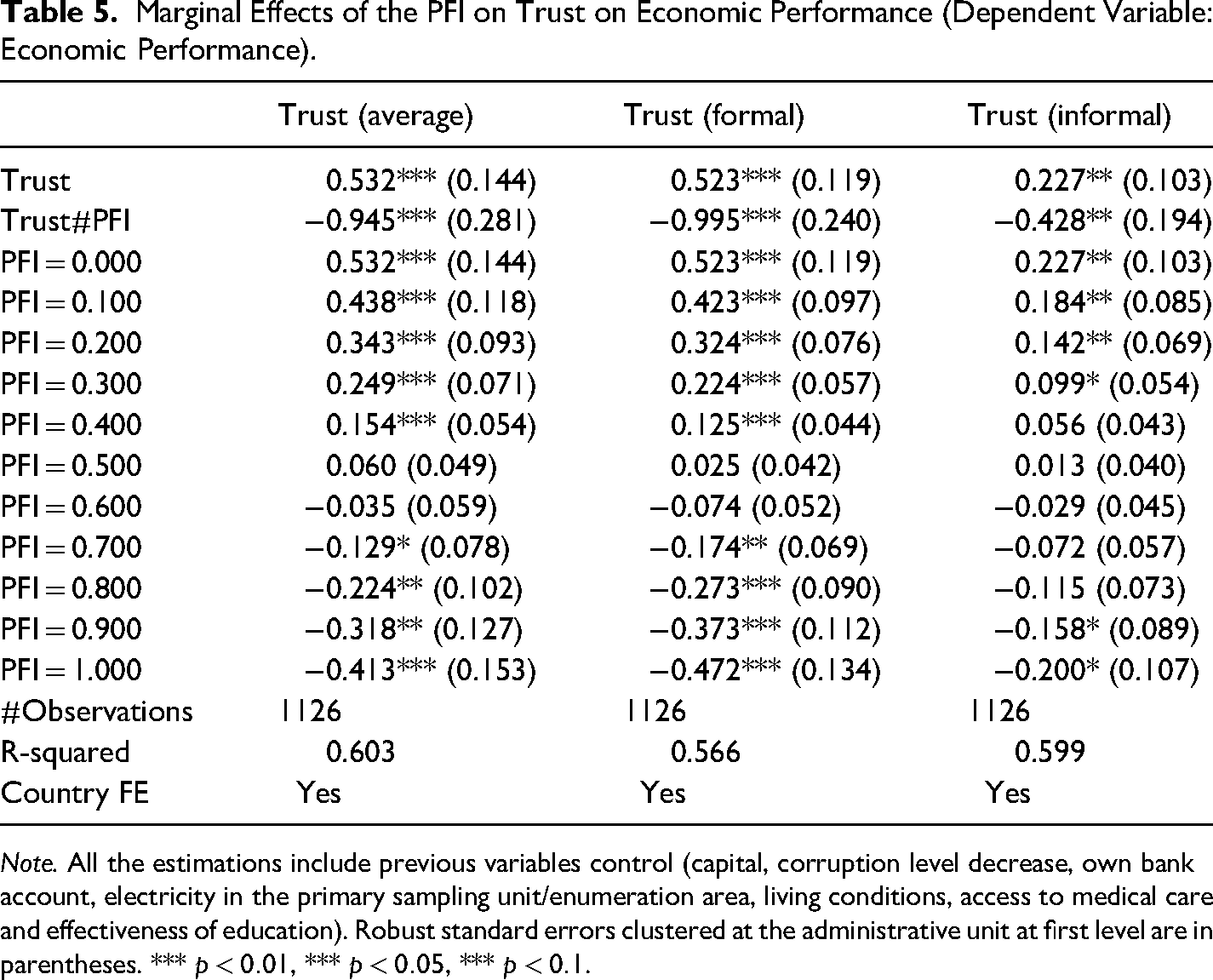
Note. All the estimations include previous variables control (capital, corruption level decrease, own bank account, electricity in the primary sampling unit/enumeration area, living conditions, access to medical care and effectiveness of education). Robust standard errors clustered at the administrative unit at first level are in parentheses. ***
Endogeneity
Political diversity may not be exogenous when estimating the relationship. In effect, EP and political diversity could be mutually reinforcing in a reciprocal pattern. We use an instrumental (IV) estimation to mitigate the eventual concern of reverse causality. To do this, finding a valid instrument that must be correlated with political diversity and not with EP is not an easy task. We adopt a strategy already used in the existing literature. The approach is to instrument political heterogeneity at regional and country levels. In effect, the severity of endogeneity decreases with the length of the geographic dimension (Dustmann & Preston, 2001). Indeed, Awaworyi Churchill and Danquah (2020) utilized ethnic diversity at the regional level as an instrument to evaluate the effects of ethnic diversity on informal work. In another context, Bertschek and Niebel (2015) employed average mobile internet at industry level to mitigate the reverse causality between labor productivity and internet use. In this study, we use political fractionalization at regional and country levels as an instrument. Since we are exploring an interactive term between the political diversity endogenous variable and trust which could also be endogenous, we adopt the strategy proposed by Aghion et al. (2005) which consists of interacting the instrument and the second term. We also add the proportion of citizens who feel close to a political party at regional and country levels. We assume that even if this variable is correlated with political diversity in the district, it is not directly associated to EP. As previously established, we use an interaction term between this instrument and trust. The IV 2SLS (i.e., two stage least squares) estimation results are presented in Table 6. The findings confirm the negative effect of political diversity in the relationship between trust and EP.
Trust, PFI, and Economic Performance (2SLS IV Estimations).
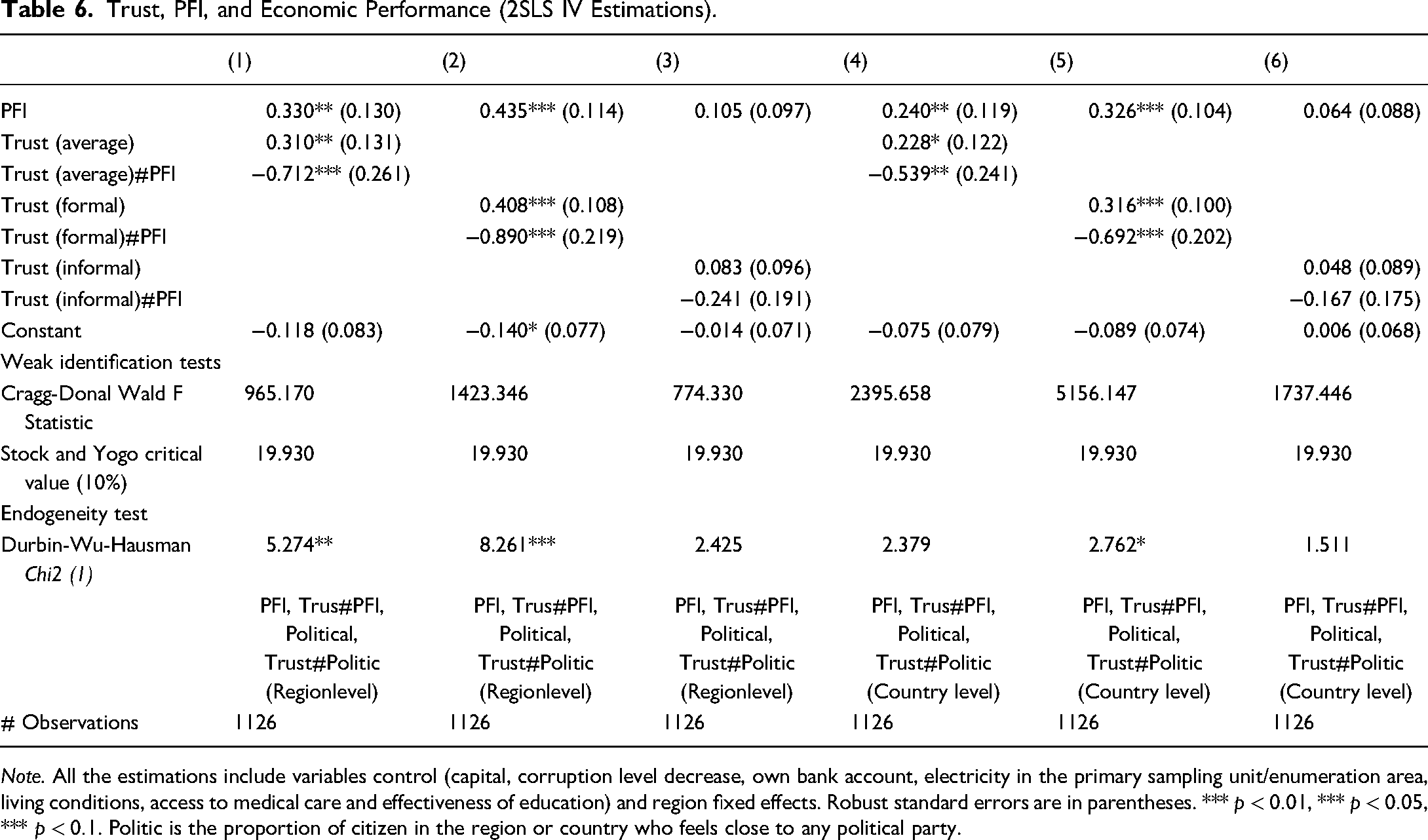
Note. All the estimations include variables control (capital, corruption level decrease, own bank account, electricity in the primary sampling unit/enumeration area, living conditions, access to medical care and effectiveness of education) and region fixed effects. Robust standard errors are in parentheses. ***
Indeed, in order to mitigate the endogeneity concern, we estimate other models with regional fixed effects. In the first regressions, we regress country fixed effects while in the robustness checks, we introduce the fixed effects at a more disaggregated level (regions) (Table 7). The results from this approach are shown in Tables 8 and 9. The results confirm the negative role of political diversity in the relationship between formal trust and the perception of EP. Regarding informal trust, there is no significant mitigating role of political diversity on the relationship.
Marginal Effects of the PFI on Trust on Economic Performance (Dependent Variable: Country Direction).
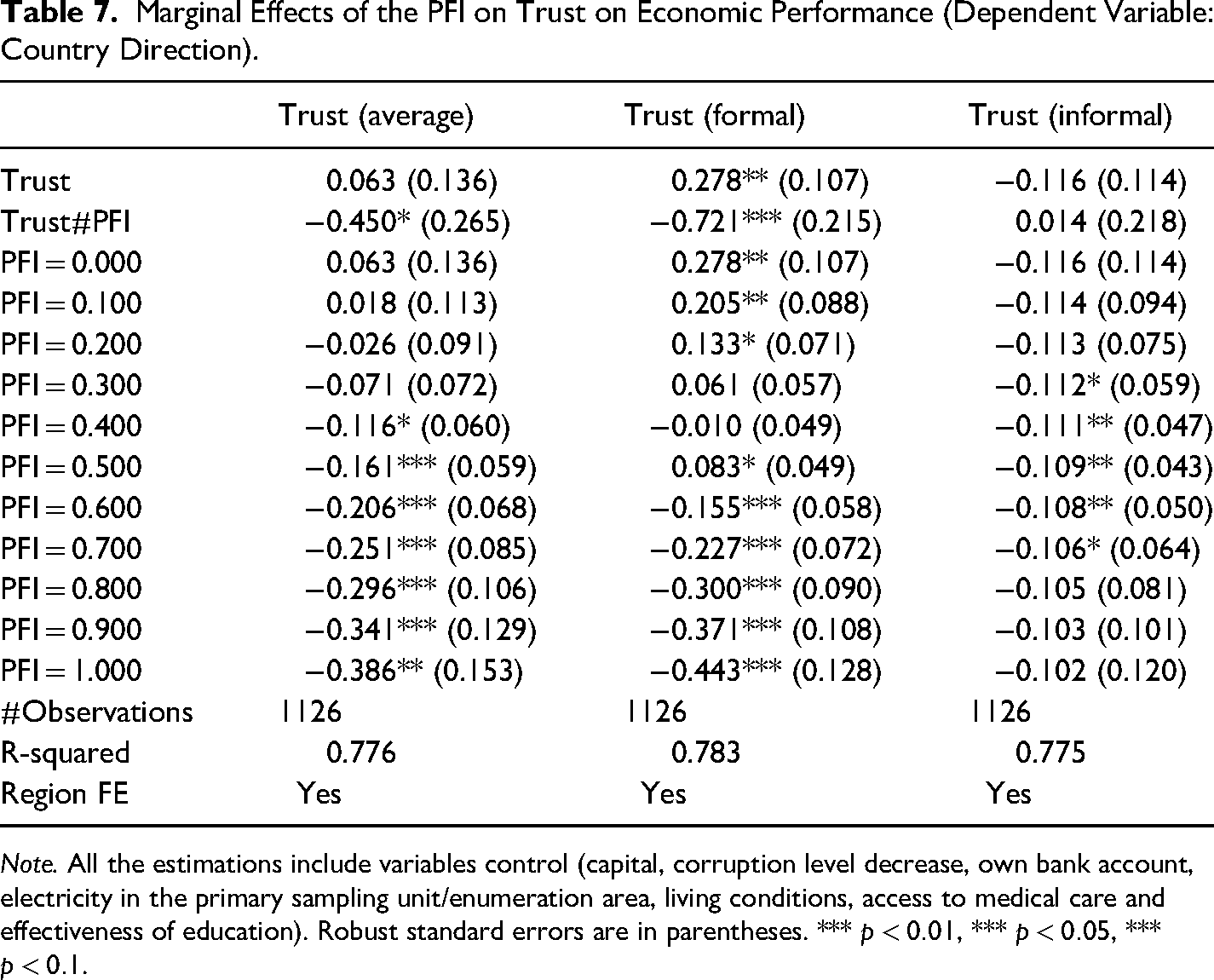
Note. All the estimations include variables control (capital, corruption level decrease, own bank account, electricity in the primary sampling unit/enumeration area, living conditions, access to medical care and effectiveness of education). Robust standard errors are in parentheses. ***
Trust (Formal), PFI and Economic Performance (Dependent Variable: Economic Performance).
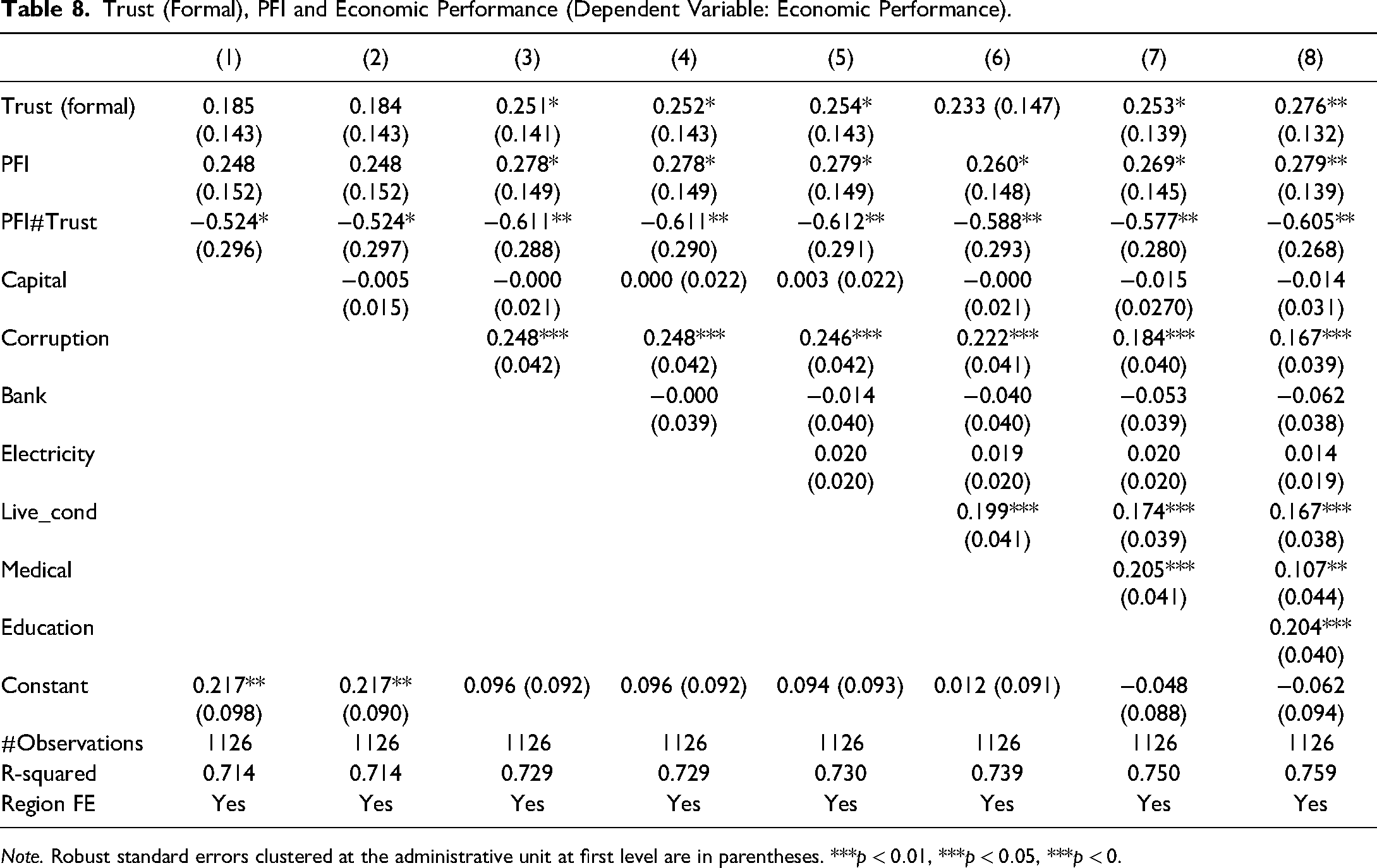
Note. Robust standard errors clustered at the administrative unit at first level are in parentheses. ***
Trust (Informal), PFI and Economic Performance (Dependent Variable: Economic Performance).
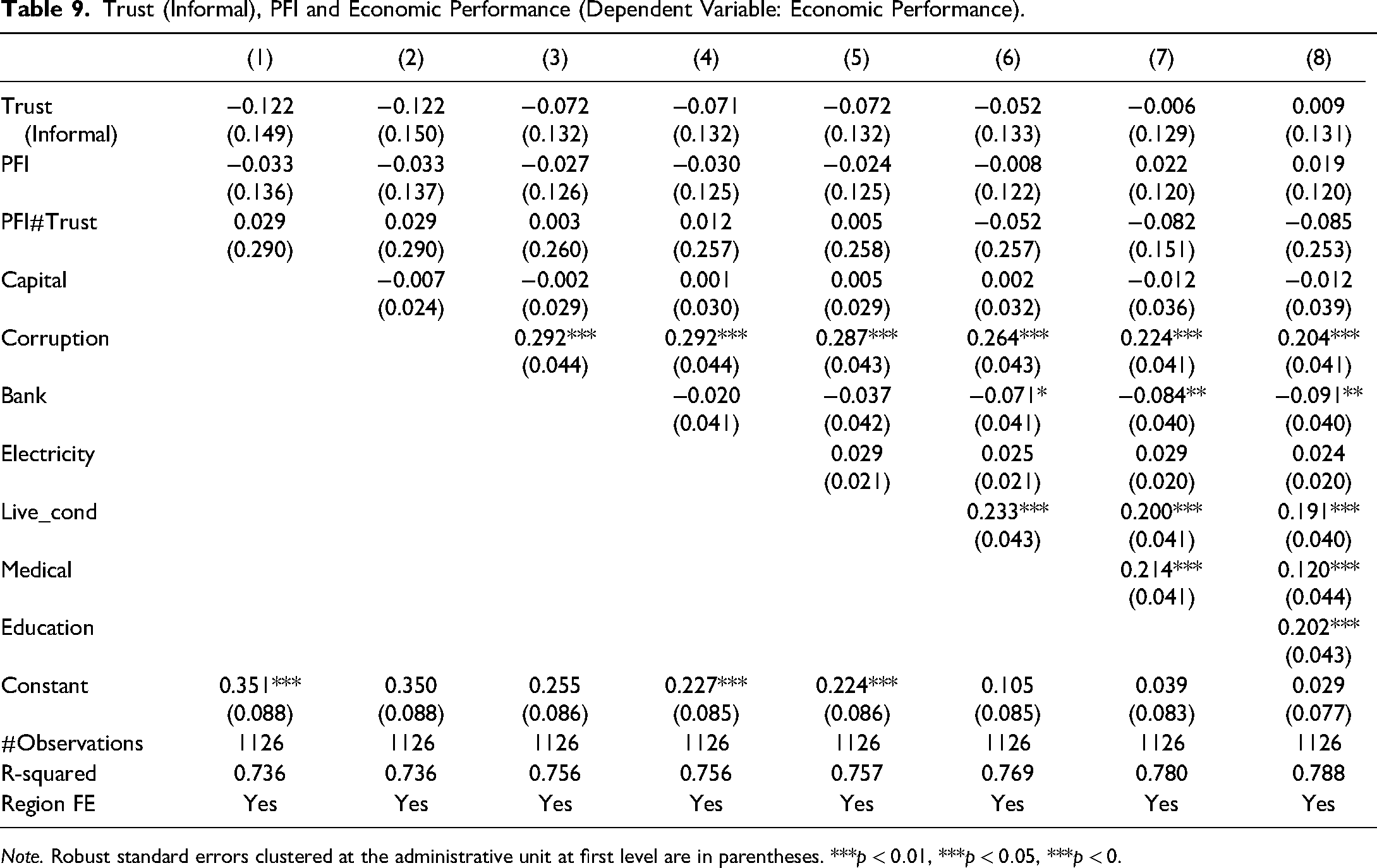
Note. Robust standard errors clustered at the administrative unit at first level are in parentheses. ***
Conclusion
A large body of studies have analyzed the relationships between trust, economic conditions, diversity, and economic development. However, to the best of our knowledge, the literature on factors mitigating or moderating the relationship is very sparse. In this paper, we have used political diversity as a factor that could mitigate the positive and established relationship between trust and EP. For this purpose, we have defined three new indicators namely: trust institutions, political fractionalization, and perception of EP based on the Round 7 Afrobarometer data survey. The data are from over 1000 districts covering 34 countries in Sub-Saharan Africa. To better depict the role played by political diversity, we employ a model with an interactive form and compute marginal effects at different points of the distribution of political heterogeneity.
We find that trust in institutions is positively associated with the perception of EP. However, the relationship becomes negative in districts with a high level of political diversity. More precisely, a higher level of trust is associated with lower EP at a higher level of political diversity. These findings are more confirmed when we consider trust in formal institutions (president, parliament/national assembly, police, courts of law, local government) than trust in informal institutions (traditional leaders and religious leaders). Thus, in Sub-Saharan Africa, political fractionalization (i.e., existence of many political parties in the district) could worsen the perception of government effectiveness and therefore EP.
In the terms of policy implications, the following recommendations are worthwhile. Firstly, we caution that care must be taken to promote trust between citizens and their officials. This is essential to lubricate social cohesion, glue the citizenry together, and reinforce civic engagement in order to boost living conditions at an aggregate level. Secondly, reducing political diversity is a likely solution to ensure the positive effects of trust. In fact, since our findings reveal that political fractionalization mitigates the positive relationship between trust and the perception of EP, we suggest that in Sub-Saharan Africa, the multiplicity of political parties in the districts does not necessarily correspond to democracy. Thus, limiting the number of political parties is a condition for an objective evaluation of the government's economic policies.
This study obviously leaves space for future research especially in the light of understanding how these interactions speak to the achievement of some sustainable development goals. Moreover, revisiting the analysis within the context of other regions in the world is a worthwhile future research endeavor in order to enable a comparative understanding of established linkages between trust and macroeconomic outcomes. Another direction of future research is to consider an analysis of the relation between trust and EP and the mitigating role of political diversity on individuals and not at a district level. In this future paper, we will use a contextual model to control country characteristics such as growth, unemployment, safety, inter alia.
Footnotes
Acknowledgments
The authors are indebted to the editor and reviewers for constructive comments.
Declaration of Conflicting Interests
The author(s) declared no potential conflicts of interest with respect to the research, authorship, and/or publication of this article.
Funding
The author(s) received no financial support for the research, authorship, and/or publication of this article.
