




Abstract
The present study seeks to add to the growing literature related to off-field actions impacting labor economic issues. It examines how off-field incidents with law enforcement and violations of league policies governing performance enhancing drugs impact career earnings for players. Furthermore, we seek to understand how career earnings are impacted for visible minorities. Ordinary least squares and quantile regression estimations of career earnings for over 3,500 National Football League players show generally these actions do not impact career earnings. If there are significant impacts, then the impacts generally tend to be positive, but not for racial minority players.
Introduction
Labor economic issues are at the heart of sports economics research (Kahn, 2000) and understanding determinants of wages is a popular area within this field (e.g., Kuethe & Motamed, 2010; Soebbing et al., 2016). Factors such as human and social capital formation, player and team productivity, and league policies play a role in these determinants (e.g., Lucifora & Simmons, 2003; Wicker et al., 2016). The literature provides less guidance as it relates to the determinants of career earnings of athletes and coaches. Previous research by Ducking et al. (2014) uncovered some of these determinants for National Football League (NFL) players over an eight year period including draft status and on-field performance. Furthermore, what is less understood is how off-field behaviors of players impact these earnings. Research noted that off-field behaviors in terms of misconduct lead to lower draft position, longer time on the free agent market, and dismissals of coaches (e.g., Allen, 2015; Foreman et al., 2021).
At the same time, a number of studies also considered the impact race has on wages and the career length of players (e.g., Ducking et al., 2014, , 2015, 2017; Groothuis & Hill, 2011; Kahn, 1991). Although there is long-lasting evidence of employer-based discrimination, including the decades long segregation of professional sport leagues (Kahn, 1991), more recent research provided mixed results. Notably, Groothuis and Hill (2011) examined wages of NBA players and found that, while there may be reverse discrimination in that White players received lower salaries, the White players also tended to have longer career lengths when controlling for other factors. In the context of the NFL, Ducking et al. (2014, 2015) initially found no evidence of race-based discrimination in terms of wages or career length. However, follow up work focused on defensive positions noted the presence of wage discrimination against Black players at key positions (Ducking et al., 2017).
The purpose of the present research is to explore how off-field incidents of players impact their career earnings. For the empirical setting, we examine career earnings of players in the NFL. Publicly available data documented a number of NFL player run-ins with law enforcement over the past two decades. This increased outside scrutiny by the media and the general public provides the environment to see if these incidents impact a player's career earnings. We also consider the potential impact that the race of players who are involved in off-field incidents has on wages. Our estimation of career earnings of over 3,000 NFL players from 2000 to 2016 shows that off-field incidents have either no impact or a positive impact on career earnings. These findings contribute to a growing literature that enhances our understanding of the impact of off-field incidents. Our study also finds that minority players overall earn higher career earnings at certain segments of the conditional distribution when estimating quantile regressions.
Literature Review
Player Career Duration and Earnings
The present review focuses on the career aspects of players. This specific area of the literature generally focuses on two areas: career duration and career earnings. As it relates to career duration, existing studies examined various topics such as exit discrimination (e.g., Ducking et al., 2015), factors related to specific positions on the field of play (e.g., Salaga et al., 2020), league policies such as the amateur draft (e.g., Staw & Hoang, 1995), and a classification of players such as rookies (e.g., Allen & Curington, 2018). Results from this stream of literature highlight how both economic and social factors affect career length of players.
The present study focuses on career earnings of players. While much of the literature studied yearly compensation of amateur and professional athletes in sports leagues all over the world (e.g., Ducking et al., 2017; Kuethe & Motamed, 2010; Lucifora & Simmons, 2003), little research focuses on career earnings. Winfree and Molitor (2007) examined the decision for high school players who are selected in the MLB amateur draft to go to college or go play professional baseball. They determined high school players selected after round 12 in the amateur draft would have higher career earnings playing professional baseball by first going to play baseball in college.
More closely related to the present research is the study by Ducking et al. (2014) who examined career earnings of offensive and defensive players in the NFL. Investigating career earnings of players from 2000–2008, their results indicated selection in the NFL draft and experience as it relates to games played in the NFL had a positive impact on career earnings for both offensive (e.g., yards gained) and defensive players (e.g., sacks). They also found some performance measures for offensive and defensive players had a positive impact on career earnings. A player's race did not have any impact on total compensation for either offensive or defensive players. Given the mixed findings related to exit discrimination for minority players in the literature (e.g., Ducking et al., 2015; Hoang & Rascher, 1999), Ducking et al.'s (2014) finding as it relates to compensation is not necessarily surprising. Likewise, race has generally not been found to impact career earnings in the NFL when players are aggregated together (Ducking et al., 2014). However, evidence of discrimination does emerge at either key leadership or skill positions, with scholars arguing that this potential wage discrimination emerges because of undervaluing certain talents (Berri & Simmons, 2009), coaches playing players who share the same race as the coach more minutes (Schroffel & Magee, 2012), or consumers displaying prejudice against minority players in leadership positions (Ducking et al., 2017).
The present study contributes to this literature by further examining career earnings of players. Our focus, however, is on off-field behavior. In particular, we look at player off-field incidents with law enforcement during their career along with performance enhancing drug (PED) violations. We specifically examine the NFL where off-field behavior received increased scrutiny over the past two decades (Leal et al., 2015).
Off-Field Behavior in the NFL
The research on the impacts of off-field incidents in the NFL is growing. Early research was conducted mainly in the legal literature and looked at the power of commissioners to punish offenders (e.g., Owens, 2016; Ugolini, 2007). More recently, research studied how off-field behavior impacts outcomes for players. One outcome is draft position where research found off-field behavior of athletes impacts their draft position (Palmer et al., 2015; Weir & Wu, 2014). Research by Foreman et al. (2019, 2021) documented how off-field incidents impacted coaching dismissals. Allen (2015) found that off-field behavior in the form of suspensions led to longer days on the free agent market for veteran players. The literature does not look at the role that off-field behavior has on yearly wages or career earnings. The present study seeks to understand the impact on career earnings.
Methods
Data Collection
Yearly salaries for NFL players are publicly available since 2000. These yearly figures come from two main sources. From 2000 through 2009, the player salary database from USA Today includes player specific information related to base salary, bonus money, total compensation, and information related to the salary cap. From 2011 through 2017, the website Spotrac provides player compensation information and breakdown. The year 2010 presents a year of missing compensation from both websites. The research team was able to obtain total player compensation for that year using an archival search of multiple websites. The websites, however, do not provide an indication as to when these contracts are signed which does limit the analysis in our study. For the sample, we include players who were eligible to begin their career in the year 2000 and later. From this group of players, those individuals who were still playing following the 2016 season were dropped. The final sample is 3,472 player-career observations.
Measures and Variables
The outcome variable is player career earnings (Earn). The yearly earnings figures were converted into 2017 constant dollars and then aggregated to the player-career level. The career earnings were then converted to its natural log (LnEarn).
The independent variables of interest capture players’ off-field behavior. We specifically look at two different types of off-field incidents. The first variable is off-field incidents for NFL players during the study period (Law). The NFL does not provide a list regarding incidents involving players (Ugolini, 2007). This information comes from a number of secondary sources. The initial source of information was a database compiled by the San Diego Union Tribune newspaper. The reporters from that newspaper moved to other newspapers such as USA Today and continued building the database. In addition to these two newspaper databases, the research team conducted an archival news search through major US national newspapers such as the New York Times and the Washington Post as well as a larger search through the Factiva database. Thus, the research team is confident all incidents with the police involving NFL players that were reported by the news media were found.
The second off-field incident is performance enhancing drugs (PED). Similar to incidents involving law enforcement, the NFL does not provide a database. The present study relies on the websites Spotrac and ProSportsTransactions to accumulate a database of performance enhancing drug suspensions. From there, we used the newspaper database Factiva to search for any other incidents.
The present research includes a number of control variables which might also affect career earnings. The first is a set of indicator variables for the primary position of the player in his career (e.g., QB). This information was gathered from Pro Football Reference (PFR). In the event where multiple positions were listed at PFR, we relied on the information provided from the two main salary databases, USA Today and Spotrac. The reference position group is special teams (ST), which consists of kickers, punters, long snappers, kickoff returners, and punt returners. It is anticipated the position groups will have a positive and significant impact on career earnings in comparison to the reference group.
The next two variables deal with player characteristics. The first is a player's amateur draft position. Previous research finds that being selected in the amateur draft and where a player is selected in the amateur draft leads to increased career length (e.g., Staw & Hoang, 1995). During the sample period, players can enter the NFL in three ways. The first is being drafted in the amateur entry draft. The second way is through the supplemental amateur draft. The final way is not being selected in either draft and being signed as a free agent by clubs. With these three entry points, we include a variable, DraftPick, which is the pick the player was selected in the amateur draft. Players who were selected in the supplemental draft received the draft number following the final selection in the amateur draft. 1 Players who were not selected in either draft received a value of 264, which was the first number past any selection in the NFL amateur draft during the sample period. In addition to the draft pick variable, we include a variable equal to 1 if the observed player was not selected in either the amateur draft or the supplemental draft (Undrafted). We anticipate this variable to be negative and significant in relation to a player's career earnings.
The second characteristic is the race of the player (Race). We follow earlier research by Ducking et al. (2014) and use a dichotomous variable. For the present study, a value of 1 indicates the player is a visible minority. To determine a visible minority, we examined pictures of the players from a variety of websites including PFR, NFL.com, and Tradingcarddb. When those websites did not have a picture of the player, we sought out media guides and newspaper articles to try and find a picture of the player.
The third set of variables includes the performance attributes that the player has accrued over his NFL career. The first is a player's career annual value which is used to determine their performance (Perf). PFR calculates a player's annual value for each season. We sum these season values to arrive at the total value. The use of the annual value metric from PFR allows us to include all players in the analysis rather than breaking them out by offensive or defensive players (e.g., Ducking et al., 2014) or specific player groupings (e.g., Keefer, 2013). The annual values from PFR have been used in other research looking at the change in productivity of NFL running backs (Salaga et al., 2020) and a coach's productivity as a player when looking at head coach dismissals (Salaga & Juravich, 2020). Another attribute is the total number of games played by a player in his career (Games) and its squared term (Games2). The number of games played came from PFR. The final variable is the career Pro Bowl selections (ProBowl) for the player. Pro Bowl information was also obtained from PFR.
Estimation Technique and Issues
The main regression model to be estimated is presented in Equation 1:
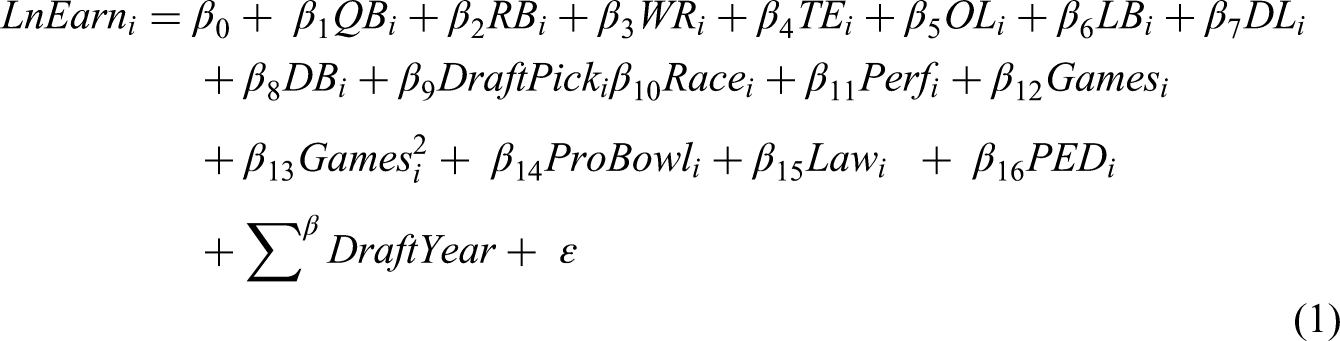
To estimate Equation 1, we undertake a similar approach to Ducking et al. (2014). In their research, they estimate an ordinary least squares (OLS) regression along with a quantile regression. Originally developed by Koenker and Bassett (1978), the use of quantile regression in sport studies estimates dependent variables such as salaries, income, and profit (Leeds, 2014). Research by Ducking et al. (2014), Keefer (2013), and Burnett and Van Scyoc (2015) estimated quantile regression for NFL wages. Leeds (2014) summarized the properties of the technique, how to interpret results, and some of the prior research using quantile regression. In the present research, we estimate regressions at the 10th, 25th, 50th, 75th, and 90th quantiles. We also estimate these equations with robust standard errors.
Results
Summary Statistics
Table 1 presents the summary statistics for the 3,471 players in the final sample. 3 The average total earnings in the sample is $3,011,708, and $485 is the minimum career compensation. These are players who were paid for one NFL preseason camp tryout and subsequently cut. The maximum career earning is over $85 million. This player is Calvin Johnson, a wide receiver elected to the Hall of Fame in 2021.
Overview of Variables and Summary Statistics.
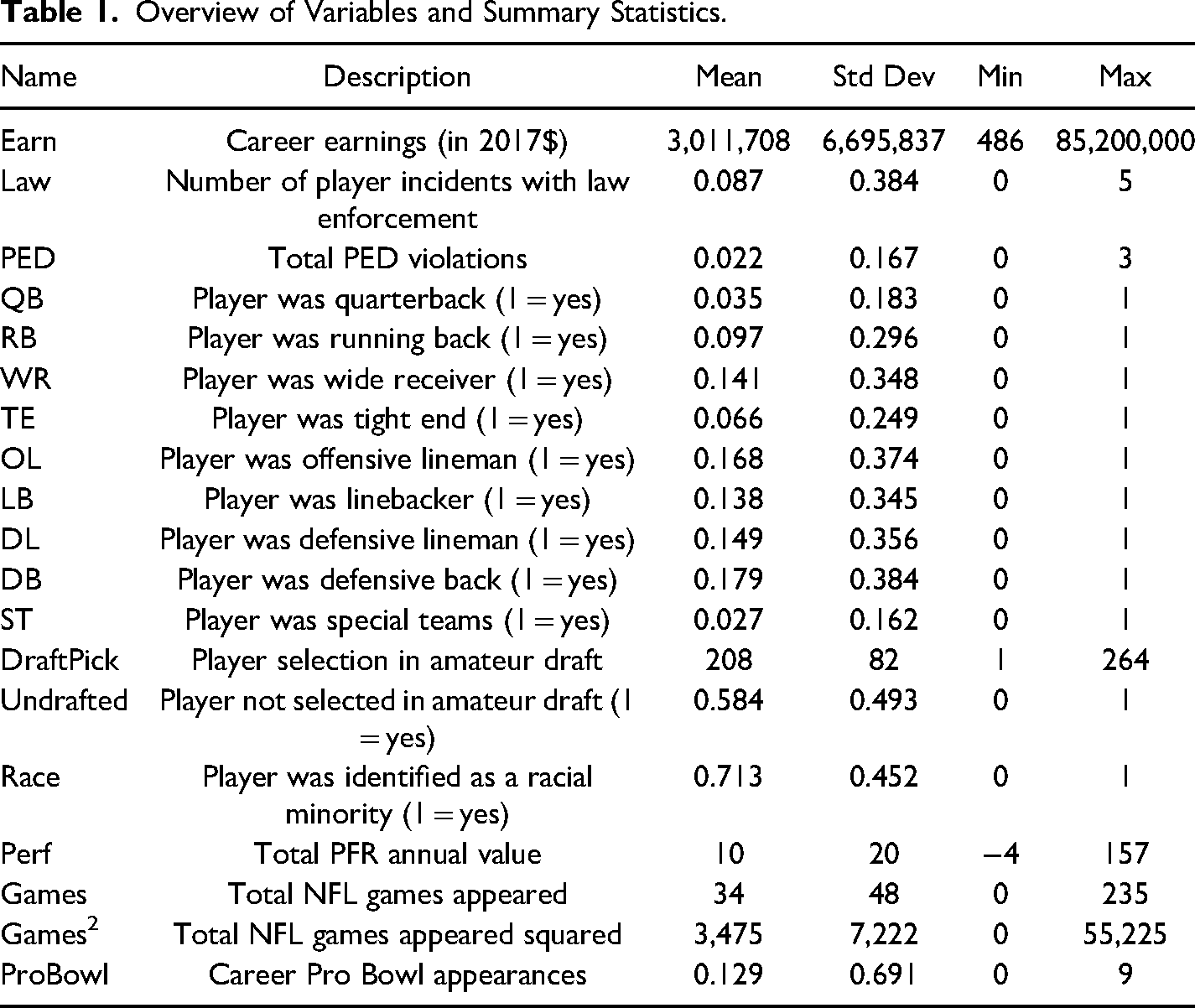
For the two variables of interest, the majority of players in the sample do not have any incidents with law enforcement or PED violations. Of those players having incidents with law enforcement (n = 221), the majority of them (n = 167) had only one incident. The maximum number of recorded law enforcement incidents for one player is 5. For PED violations, 69 players in the sample were found to have violated the PED policy and faced punishment by the league. This number is approximately 2% of the players in the final sample. The majority of players in our sample are defensive backs (18%) followed by offensive lineman (17%), defensive lineman (15%), and linebackers (14%). Altogether, 71% of players in the sample are a visible minority. During the sample period, the average number of games in which players appeared is 34.
Base Regression Results
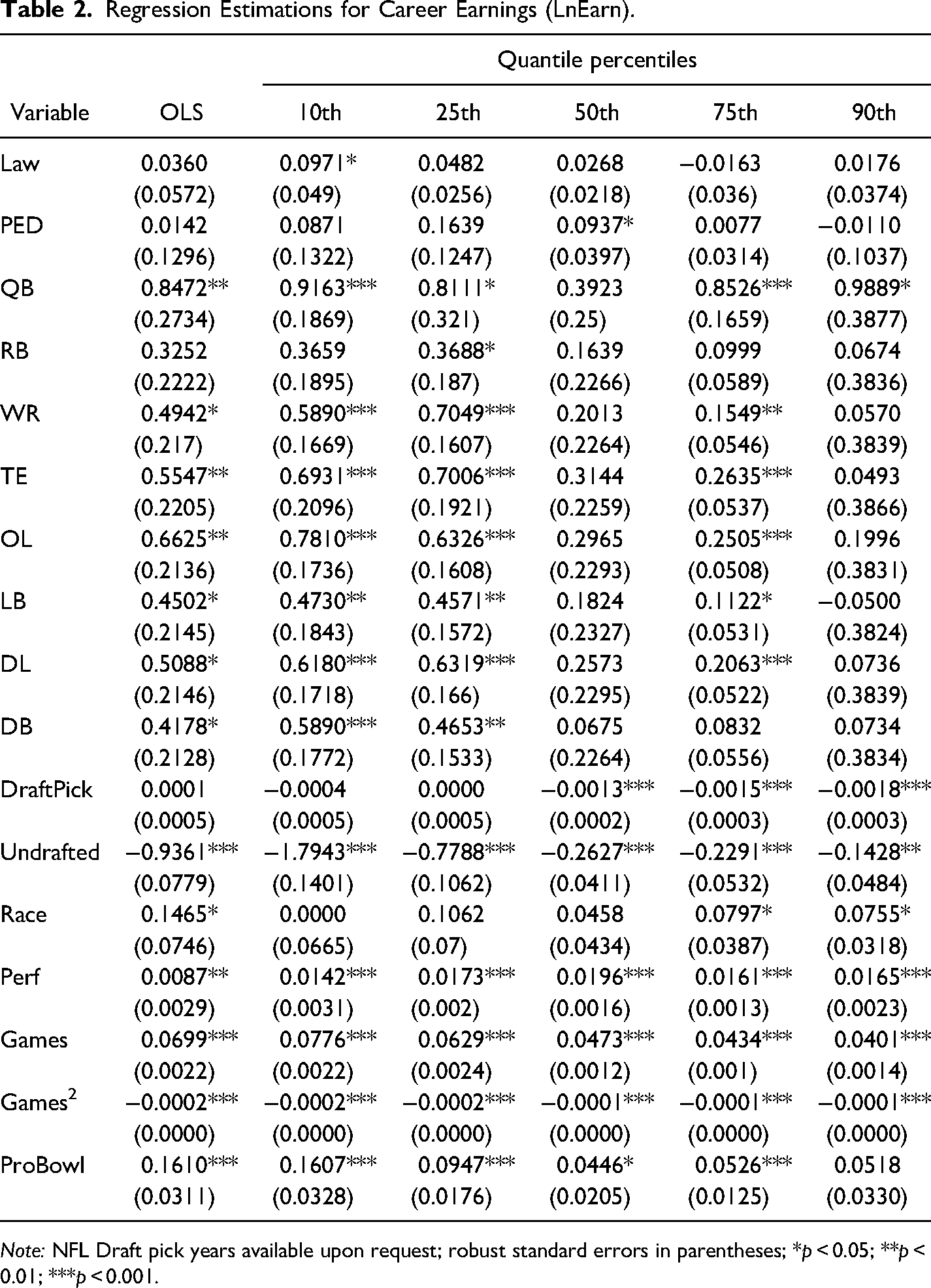
Table 2 presents the results of the OLS and the quantile regression estimation at the 10th, 25th, 50th, 75th, and 90th quantiles. The two variables of interest, Law and PED, are statistically insignificant in the OLS model. Regarding player attributes, we find several position groups that are positive and statistically significant in comparison to the reference group (special teams). These groups consist of skill position groups such as quarterbacks, wide receivers, tight ends, defensive backs, and linebackers along with offensive and defensive lineman. Surprisingly, running backs are not statistically significant although these players can be some of the highest paid players in the league.
Regression Estimations for Career Earnings (LnEarn).
Note: NFL Draft pick years available upon request; robust standard errors in parentheses; *p < 0.05; **p < 0.01; ***p < 0.001.
We find undrafted players have lower career earnings as evidence by the negative and statistically significant variable coefficient on the Undrafted variable. Recall, the Race variable is equal to 1 if the player is a visible minority. Thus, visible minorities receive higher career earnings in comparison to non-visible minorities. As it relates to the performance variable, we find a positive and statistically significant impact for a player's total performance, measured by PFR's annual value metric. Positive and significant variable coefficients were found for games played in the league with a negative and statistically significant coefficients for its squared term (Games2).
For the quantile regression estimation, different results can be observed along the conditional distribution of the dependent variable LnEarn. Leeds (2014) pointed out the proper interpretation of the variable coefficients is related to the conditional distribution of the dependent variable. For the two variables of interest, we see some interesting findings in Table 2 in the quantile regression estimation. For the Law variable, there is no statistically significant impact in the 25th, 50th, 75th, and 90th percentile of the conditional distribution of the dependent variable. For the 10th percentile, we find a positive and statistically significant impact. Thus, some evidence exists that total career compensation increases for some players who are involved with incidents with law enforcement. We observe similar findings for the PED variable. At the 10th, 25th, 75th, and 90th percentiles, there is not a statistically significant impact. At the 50th percentile, a positive and statistically significant impact was found.
For the position variables, we find differences across the distribution for positional groups in comparison to the reference group special teams. For example, the variable coefficient for quarterbacks is insignificant at the 50th percentile of the conditional distribution of total compensation. This variable coefficient is positive and statistically significant at the other quantiles of the conditional distribution. The running back position, insignificant in the OLS estimation, is statistically insignificant in the 10th, 50th, 75th, and 90th percentile of the conditional distribution. However, it is positive and statistically significant in the 25th percentile of the conditional distribution.
Unlike the OLS estimation, we find a negative and statistically significant impact at the 50th, 75th, and 90th percentiles of the conditional distribution for the DraftPick variable. In other words, being selected closer to the first overall pick in the draft increases a player's total career earnings in the top half of the conditional lifetime earnings distribution. The Race variable shows different results across the conditional distribution. For the 10th, 25th, and 50th percentiles, the results are insignificant. This finding means that race does not impact career earnings in these percentiles of the conditional distribution. For the 75th and 90th percentiles, we find a positive and significant increase in salaries for visible minorities. The interpretation is that being a visible minority increases the total career earnings in the 75th percentile of the conditional distribution by 8.0%. This impact lowers to a 7.6% increase when looking at the 90th percentile of the conditional distribution.
For the on-field performance variable, we find performance is positive and statistically significant across all points of the conditional distribution. For total games played in the league, we find a positive and statistically significant impact across all the percentiles. In looking at its squared term, it is negative and statistically significant across all percentiles. Taking these two results together, we see that there is an inverted-U relationship as it relates to games played and career earnings across all percentiles. The apex point of the inverted-U occurs around the 175th game played. This finding is similar to the findings in the OLS estimation.
Robustness Checks and Additional Findings for Racial Minorities
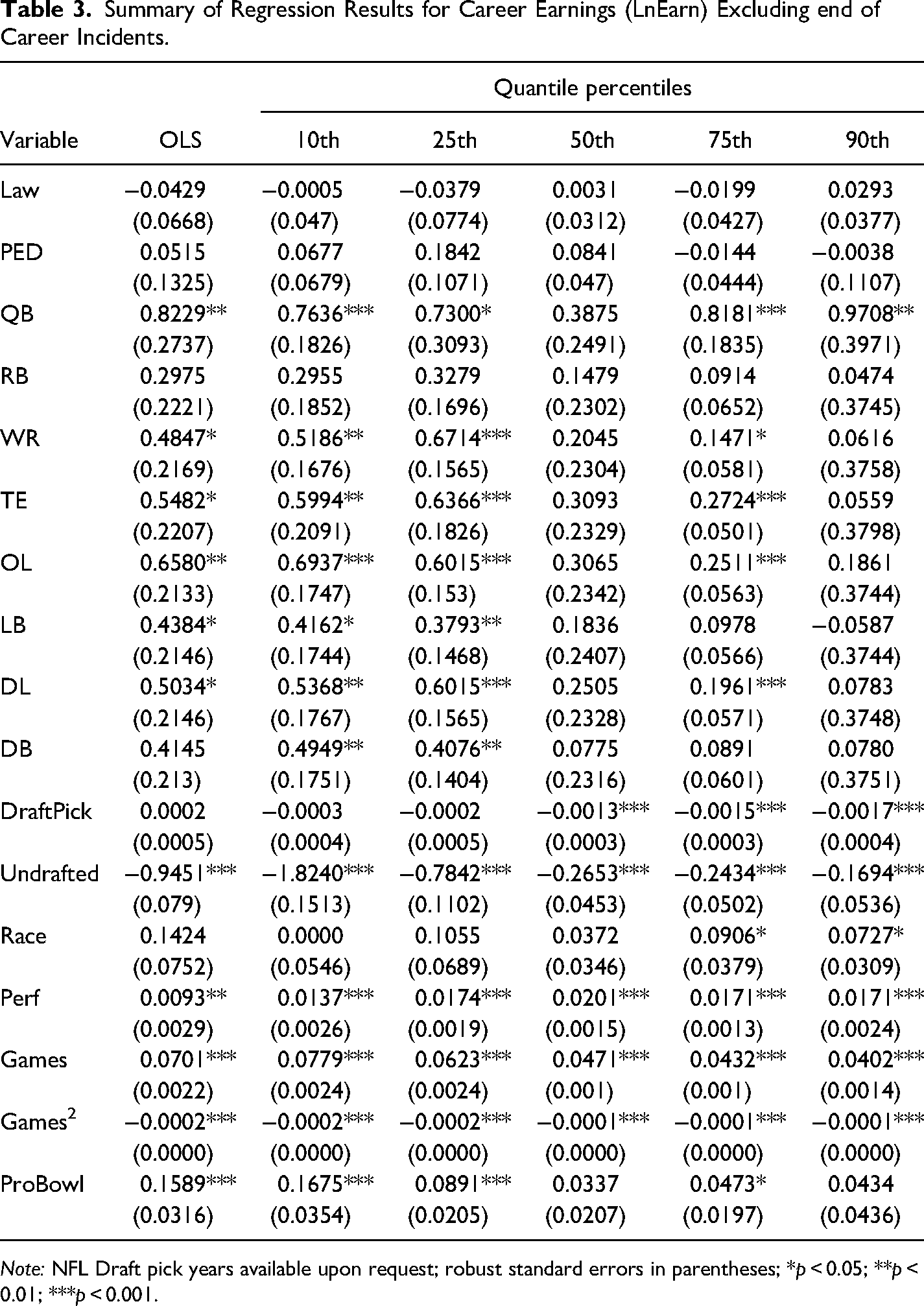
One of the potential issues relating to the findings in Table 2 is a PED violation or an incident with law enforcement may occur in the same year as the ending of a player's career. This timing element would certainly skew any significant impacts that these activities would have in relation to a player's career earnings. While we cannot know for sure that the reason the player did not earn another contract (and higher career earnings) was due to their PED violation of issue with law enforcement, we know the player earned all of their career earnings prior to these occurrences at the end of the career. Thus, we drop players who had a PED violation or an incident with law enforcement and never played another game in the NFL. The total sample for these estimations is 3,416 player-career observations as 55 observations were removed. Table 3 presents these results. Similar to Table 2, the OLS estimation yields statistically insignificant variable coefficients. For the quantile estimation, we observe neither the LAW nor the PED variable is statistically significant across any of the quantiles. In other words, we do not find any impact that incidents with law enforcement and PED violations have on career earnings of these players. This results is different from Table 2 where we did find some statistically significant coefficients. Combining these results together, it would seem like individuals who were at the end of the career may have been causing the significant impacts in Table 2. It could be that the players dropped from the sample for Table 3 had been using PEDs for much of the career which could be indicative of higher performance and higher pay.
Summary of Regression Results for Career Earnings (LnEarn) Excluding end of Career Incidents.
Note: NFL Draft pick years available upon request; robust standard errors in parentheses; *p < 0.05; **p < 0.01; ***p < 0.001.
In Table 4, we look at the interaction between off-field behavior and race of the player has any impact on player compensation. To do so, we interact the Race variable with the Law and PED variables (i.e., Race x Law; Race x PED). We find no statistically significant impact for law enforcement incidents for players we identified as white looking at both the OLS and quantile regression estimations. For the PED violations, we observe some different findings compared to those findings presented in Tables 2 and 3. At the 10th percentile of the conditional distribution, a PED violation does increase a player's career earnings. Conversely, at the 75th percentile of the conditional distribution, a PED violation decreases a player's career earnings. When interacting race with either legal incidents or PED violations, we find that a legal infraction for a visible minority does decrease total earnings in the OLS estimation. For the quantile regression estimations, we find no statistically significant impact. In looking at the interaction with race and PED violations, we find this impact is significantly less for minority players at the 10th percentile of the conditional distribution. At all other percentiles of the conditional distribution, there is no statistically significant impact when looking at minorities and PED violations.
Interaction of Race with law and PED Incidents.
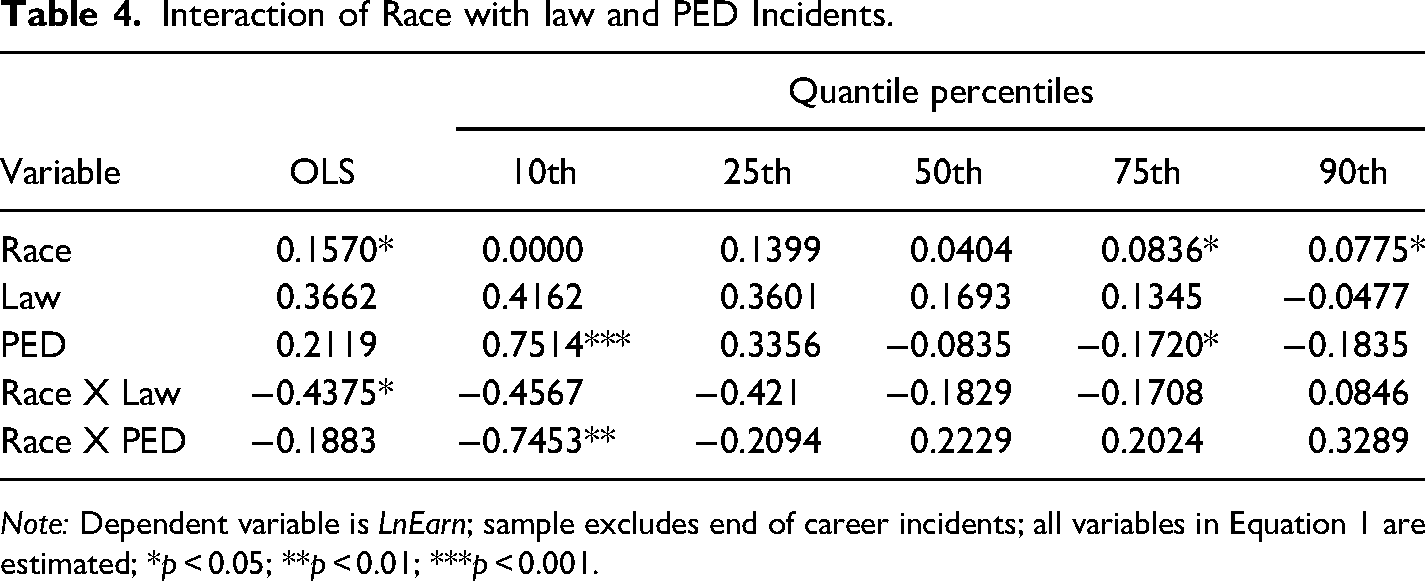
Note: Dependent variable is LnEarn; sample excludes end of career incidents; all variables in Equation 1 are estimated; *p < 0.05; **p < 0.01; ***p < 0.001.
The final set of results breaks out the type of off-field incident. The sources mentioned above contained details regarding the incidents. Thus, we coded these incidents by the following categories: alcohol, drugs, driving, harm to others (not domestic), domestic, weapon, other. The variables are dichotomous measures equal to 1 for each incident. For each incident, multiple categories could be coded. For example, a drunk driving incident would have a 1 entered for alcohol and a 1 for driving. These individual incidents are tabulated for the player's career.
Table 5 presents these results for the smaller sample, which removes players who had law enforcement and PED violations during the last year of their career. For the OLS estimation, an incident involving alcohol is positive and statistically significant. No other incident yields a statistically significant variable coefficient. Across the quantile estimation, we find that incidents involving alcohol are positive and significant at the 50th percentile of the conditional distribution of the dependent variable. Harm to others (non-domestic) is positive and significant at 75th percentile of the conditional distribution. Finally, incidents involving a weapon of any type (e.g., gun, knife) leads to a negative and statistically significant result at the 25th percentile of the conditional distribution.
Regression Results with law by Type.
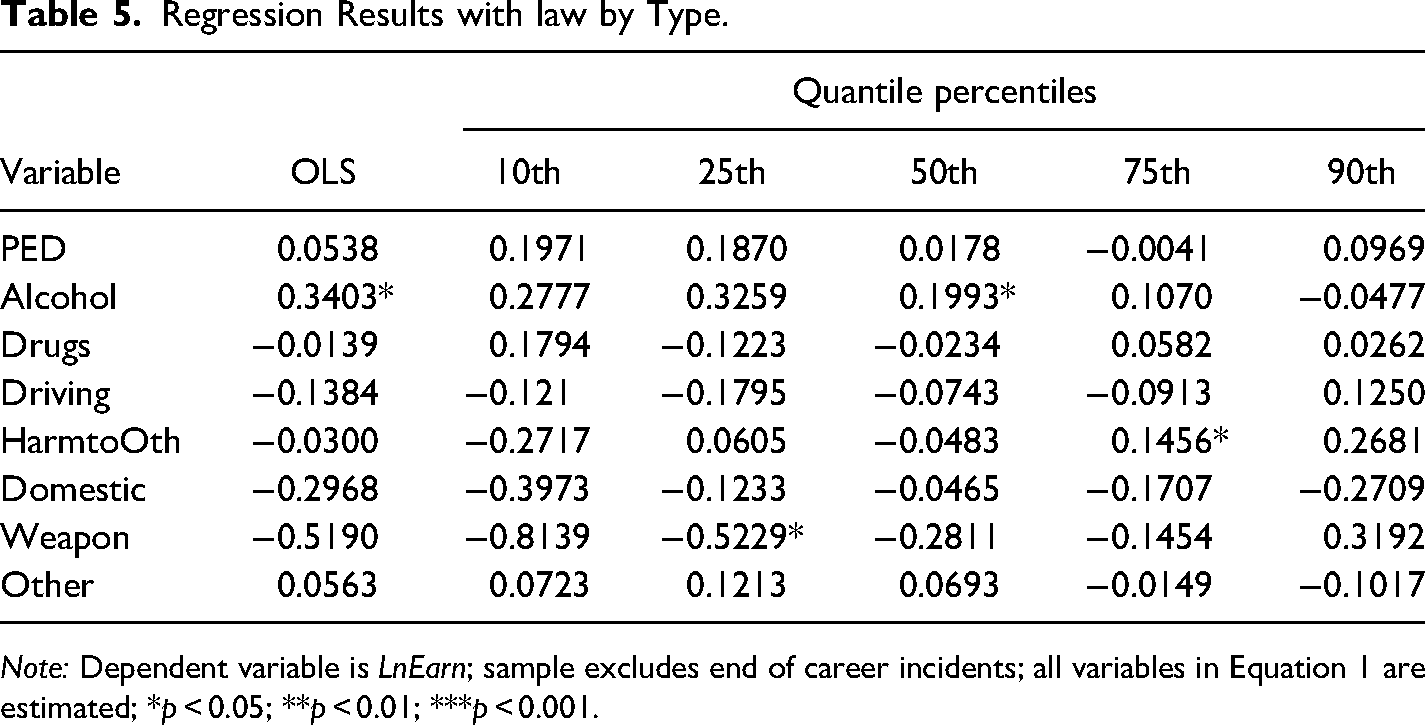
Note: Dependent variable is LnEarn; sample excludes end of career incidents; all variables in Equation 1 are estimated; *p < 0.05; **p < 0.01; ***p < 0.001.
Discussion and Conclusion
The present research set out to understand what impact incidents with law enforcement along with PED violations have on a player's career earnings. The results from OLS and quantile regression estimations generally find if a statistically significant variable coefficient is determined, the impact is positive. This finding goes against conventional wisdom arguing incidents with law enforcement would lead to a decrease in career earnings. One reason for this finding could be that football, by nature, is an aggressive sport. Thus, the incidents with law enforcement could pick up on a quality of aggressiveness that scouts and team officials such as general managers state is something they look for in players. It could be some reason why we see a positive and statistically significant result for our Harm to Others variable at the 75th percentile of the conditional distribution of career earnings.
It should also be noted the NFL has been slow to respond to criminal incidents of players and team executives. As one person commented, the only thing that would get somebody barred from playing in the NFL is murder (Benedict & Yaeger, 1998). Thus, the findings could also show how teams as well as a league showed a blind eye to run-ins with law enforcement by players and team executives. During the sample period, the NFL did, however, reform its policies, but not without criticism (Ugolini, 2007). As it relates to PED violations, PED violation could be a signal of additional gains in athleticism for players in the 50th percentile of the conditional distribution compared to non-PED violators. This proxy for additional athleticism, similar to aggressiveness from our discussion above, could be something that scouts, coaches, and front office personnel are looking for in players.
Within the present study, one other interesting finding is related to race. While some previous research did not find any difference in career earnings between Caucasian players and those players of a visible minority (e.g., Ducking et al., 2014), our study provides evidence minority players generate higher career earnings, particularly those players at the higher percentiles of the conditional distribution of total earnings. This finding may be related to the positions these players play at this part of the conditional distribution of career earnings (e.g., linebacker or wide receiver). 2 Our research indicates there may be a shift in the market for minority players compared to earlier findings by Ducking et al. (2014).
In addition, we find the intersection of race and incidents with law enforcement and violations of the PED policy to have some statistically significant impact on career earnings. This impact is at the 10th percentile of the conditional distribution, meaning minority players who have a PED violation at the lower wage of the conditional distribution of total earnings have lower total earnings compared to a player who is white at the same percentile.
Another interesting finding relates to performance. We find total performance, measured by a player's total annual value calculated by PFR, to have a small impact on total earnings. These impacts are generally less than or equal to 2% on the conditional distribution of career earnings. We would anticipate more. One main reason could be players who did not play in a season are given a value of 0 for that season. By doing so, we might not take into account that if the player did play, they would earn a negative value. Thus, we may be overinflating the performance of these players compared to players who played the field and earned a positive annual value. Future research could look to apply other measures of player performance such as the one outlined by Hoffer and Pincin (2019).
There are several areas for future research. The first is to further explore the link between the timing of legal incidents and PED violations in their playing careers and the impact on yearly earnings and earnings for the remainder of their career. As noted above, we remove player observations that had a PED violation and an incident with law enforcement at the end of their career. Those new estimations yield different results compared to our full sample results. However, a much deeper look at the timing of the incidents and violations and career earnings for incidents that occur besides the last season would be a fruitful area of future research. This research would have to rely on knowing when players sign new contracts which is something that we do not know at the current time. Similarly, future research can examine the movement of players over the course of their careers. In other words, players joining more organizations may generate higher career earnings. Finally, future research can explore changes in policies related to personal conduct in the league and how that may impact the relationship between this type of behavior and career earnings. Over the sample period, numerous changes have been made which had an effect on the selection of amateur players (Weir & Wu, 2014), coaching changes (Foreman et al., 2019, 2021), and player movement (Allen, 2015). Future research could explore these policy changes and how they impact career earnings.
Footnotes
Acknowledgments
We would like to thank Yinle Huang and Wyatt Urbanski for their valuable research assistance in collecting the player information. We also would like to thank the participants at the 2020 North American Association of Sports Economists Virtual Conference. All errors are our own.
Declaration of Conflicting Interests
The author(s) declared no potential conflicts of interest with respect to the research, authorship, and/or publication of this article.
Funding
The author(s) disclosed receipt of the following financial support for the research, authorship, and/or publication of this article: This work was supported by the University of Alberta's Endowment Fund for the Future – Support for the Advancement of Scholarship Program (EFF-SAS).
