




Abstract
A great deal of media attention has been given to the scarcity of black head-coaches in the NFL. Using data on coordinators for every NFL season since the introduction of the Rooney Rule in 2003, the authors estimated several probit regressions to examine how various factors, including race, were correlated with a coordinator's probability of becoming a head coach. There was evidence that, all else equal, black coordinators who played in the NFL have been less likely to be promoted than similar non-black coordinators. Furthermore, there was evidence that black coordinators were significantly less likely to be promoted between 2018 and 2020. The analysis also suggested that a lack of black coordinators who played quarterback or tight-end in college as well as a lack of black coordinators with experience coaching the tight-end and wide-receiver positions in the NFL have contributed to the low number of black head-coaches. The authors also examine the specific case of Eric Bieniemy by using the empirical model to compare Bieniemy's probability of promotion with those of other relevant coaches. This analysis offers several potential explanations as to why Bieniemy has yet to receive a head-coaching opportunity.
At the end of the 2001 National Football League (NFL) season, the Buccaneers fired head-coach Tony Dungy and the Vikings fired head-coach Dennis Green. This prompted attorneys Cyrus Mehri and Johnnie Cochran to commission a study by economics professor Janice Madden to analyze performance and opportunities for black coaches relative to white coaches (Valkenburg, 2002). The results of this study, discussed in more detail in the following section, suggested that black head-coaches outperformed their white counterparts in most respects but were still less likely to be considered for head-coaching jobs (Madden, 2004). This led to the creation and enactment of the Rooney Rule in 2003. The Rooney Rule, named after the late Dan Rooney who was a member of the family that owns the Pittsburgh Steelers, required all teams to interview at least one minority candidate when they had vacant head-coaching positions.
Before 2003, there had been seven black-head-coach tenures since the AFL-NFL merger in 1970 – Art Shell (1989–1994 with the Raiders), Dennis Green (1992–2001 with the Vikings), Ray Rhodes (1995–1998 with the Eagles and 1999 with the Packers), Tony Dungy (1996–2001 with the Buccaneers and 2002 with the Colts), and Herm Edwards (2001–2002 with the Jets). Dungy's tenure with the Colts continued until his retirement in 2008, while Edwards’ tenure with the Jets ended with the coach being fired in 2005. In addition to those two, and excluding interim-head-coach tenures, there were 22 other black-head-coach tenures over the 2003–2021 NFL seasons. 1 Thus, whether attributable to the Rooney Rule or other factors, head-coaching opportunities for black coaches increased after the implementation of the league-wide policy.
To begin the 2018 NFL season, there were seven black head-coaches. At the conclusion of that season, eight franchises fired their head coaches, with five of those being black head-coaches. To begin the 2019, 2020, and 2021 seasons, only three teams had black head-coaches. As a result, there has been renewed interest in head-coaching opportunities for black coaches in the NFL and questions surrounding the efficacy of the Rooney Rule (Belson, 2019). In response, the NFL expanded the Rooney Rule to require all teams to interview at least two external minority-candidates for vacant head-coaching positions as well as at least one minority candidate for vacant coordinator jobs (Patra, 2020).
One of the primary routes to becoming a head coach in the NFL has been to be a position coach, then a coordinator, and finally a head coach. Thus, many head coaches were offensive or defensive coordinators in the NFL immediately preceding their head-coaching tenures. The offensive coordinator is responsible for managing the team's offense, while the defensive coordinator is responsible for managing the team's defense. We collected data on all coordinators for every season since the Rooney Rule was introduced in 2003. We then estimated several probit regression models to examine the relationship between a coordinator's race and probability of becoming an NFL head-coach. In addition to controlling for a coordinator's race, we also included controls for the position they played in college, years of NFL playing experience, their coaching background, whether they were an offensive or defensive coordinator, whether their head coach specialized in offense or defense, their age, their NFL experience as a coordinator, and various measures of their performance as a coordinator. While our study was not the first to examine this issue, as we discuss in greater detail in the following section, our analysis is distinct from previous research on this topic. We identified several factors correlated with a coordinator's probability of becoming a head coach, and we used our findings to proffer several potential explanations for why there may be fewer black head-coaches in the NFL than many would expect. Because NFL coordinators are not the only candidates for head-coaching jobs, we could not address all of the issues surrounding this topic. However, our study makes several contributions to the growing literature on this topic and sheds more light on the relationship between a coordinator's race and their probability of becoming a head coach. Also, we give special attention to the case of the Chiefs’ current offensive-coordinator Eric Bieniemy who has largely been the face of the lack of black head-coaching opportunities in recent years (see, e.g., Dragon, 2020; Moriarty, 2020).
Previous Literature on the Relationship Between Race and Head-Coaching Opportunities in the NFL
While a few researchers, such as Braddock (1989), examined the relationship between a coach's race and their likelihood of becoming a head coach in the NFL before the year 2004, Madden’s (2004) examination of the success of NFL coaches by race is clearly the jumping-off-point for current researchers investigating this relationship.
The Performance, Promotion Rates, and Dismissal Rates of NFL Coaches by Race
Using data from the 1990–2002 NFL seasons, Madden found that black coaches were generally more successful than white coaches with the exception that white coaches were found to have higher playoff-winning-percentages. Also, the results of a logistic regression showed that black coaches were more likely to be fired. All of these findings were consistent with black coaches needing to be better than white coaches to get and keep head-coaching positions in the NFL.
In a reply to Madden’s article, Malone et al. (2008) found that race did not have a statistically significant impact on a coach's probability of being fired when mid-season firings were included in the dataset. Analyzing the likelihood of a coach being rehired after previously being fired from a head-coaching position, Madden and Ruther (2009) did find that black head-coaches were more likely to be given another opportunity than their white counterparts. However, they still found evidence that, all else equal, black head-coaches were more likely to be fired over the 1990–2002 NFL seasons. The authors also examined post-Rooney-Rule data covering the 2003–2009 NFL seasons and concluded that the Rooney Rule eliminated the disadvantage faced by black head-coaches found in Madden (2004). Similarly, DuBois (2016) found that minority candidates who were coaching after the implementation of the Rooney Rule were 19–21% more likely to be hired as head coaches than minority candidates who were coaching before the implementation of the Rooney Rule. Also similar to Madden (2004); Branham’s (2008) findings suggested that black head-coaches outperformed non-black head-coaches in the regular season, all else equal. However, contrary to Madden (2004), there was no evidence that a head coach's race had any correlation with their team's performance in the playoffs.
Unlike Madden (2004) and Branham (2008); Goff and Tollison (2009) found no evidence that a coach's race was correlated with their team's performance over the 1987–2007 NFL seasons. Performance differences of offensive and defensive coordinators were also considered, and the authors once again found no evidence that race was correlated with a coach's performance. Madden and Ruther (2011) concluded the same in their investigation of performance differences between coordinators. More recently, Salaga and Juravich (2020) examined data on all permanent head-coaching tenures in the NFL between the 1985 and 2018 seasons. Estimating Cox proportional-hazards models accounting for a head-coach's race, coaching experience, playing experience, and age as well as several other control variables, the authors found no evidence that a head-coach's race was related to their performance nor did they find any evidence that firing rates were different for head coaches of different races. However, Salaga and Juravich did find evidence that, all else equal, non-white head-coaches enjoyed moderately longer tenures than white coaches in the era of the Rooney Rule (Ducking et al., 2014, 2015, and 2017).
The Importance of Centrality and its Relationship to Race
Another line of literature has focused on whether playing or coaching a central position affected a coach's likelihood of becoming an NFL head-coach. According to Grusky (1963), central positions, such as quarterback, are spatially central to the team's on-field activity; thus, coaches of such positions may develop skills that are transferrable to becoming a head coach.
Most of this research has focused on the relationship between race and labor market outcomes for players, rather than coaches. For example, Pitts and Yost (2013) found that black quarterbacks and white running-backs were more likely to change positions when transitioning from high school to college. While Ducking et al. (2014) found no evidence that a player's career earnings were impacted by their race, Ducking et al. (2017) found evidence of compensation discrimination against black linebackers and non-black defensive linemen in the NFL. However, regardless of position, Ducking et al. (2015) did not find any relationship between race and career length for players.
Braddock et al. (2012) examined data on all active coaches between the 2000 and 2006 seasons, including head coaches, assistant head-coaches, coordinators, and position coaches. The authors estimated logistic regressions to examine a coach's likelihood of becoming a central-position coach, a coordinator, and a head coach. They found that black coaches were significantly less likely to become central-position coaches and offensive/defensive coordinators, all else equal. However, race was not a statistically significant determinant of a coach's likelihood of becoming a head coach. Central positions in the study were defined to be quarterback, guard, center, and linebacker. The impact of playing a central position was not considered in their head-coach model as its impact was only considered on the likelihood of becoming a central-position coach.
Foreman et al. (2018) employed data from the 1984–2016 NFL seasons to examine the issue of coach promotions in the NFL. In addition to race, the authors were particularly interested in how experience coaching a central position impacted a coach's likelihood of promotion. They found that black position-coaches were significantly less likely to be promoted to offensive or defensive coordinator. The authors also considered an interaction term between their race and Rooney-Rule dummy-variables. The marginal effects of this interaction term were insignificant in all of their regressions, suggesting that the Rooney Rule did not lead to higher promotion rates for black coaches. Coaching a central position was associated with a greater likelihood of promotion. However, similar to Braddock et al. (2012), Foreman and Turick (2021) found that black position-coaches have been significantly less likely to make lateral moves to coaching central positions.
The Relationship Between a Coordinator's Race and Their Likelihood of Being Promoted
In an analysis more similar to our study, Fee et al. (2006) investigated the likelihood of offensive and defensive coordinators being promoted to head-coaching positions. While it was not the focus of their research, they did consider the impact of race on the likelihood of promotion for coordinators. For the most part, the authors found that a coordinator's race did not impact their likelihood of promotion. However, they found weak evidence that minority coordinators may actually have been more likely to be promoted and less likely to be demoted over the time-period examined. Madden and Ruther (2011) note an issue with the analysis presented by Fee et al., though. During the period examined by Fee et al., no black offensive coordinator had ever been promoted to head coach. Madden and Ruther conclude “there is no way that a logit analysis of hires could yield a racial coefficient, either significant or insignificant” (p. 138).
Using data covering the 1990–2009 NFL seasons for coordinators who never held a head-coaching position, Solow et al. (2011) found that coordinators with better performance records and more experience were more likely to be promoted to head coach. Older coordinators, however, were found to be less likely to get a promotion. They found no evidence that race impacted a coordinator's likelihood of being promoted to head coach. Lastly, the authors split their data into two periods (1990–2002 and 2003–2009) in order to investigate the impact of the Rooney Rule. Their race dummy-variable remained statistically insignificant in all models estimated with these subsamples of their data. The authors concluded there was little evidence to suggest that the Rooney Rule led to an increase in the number of minority head-coaches. In similar analyses, Madden and Ruther (2011) and Foreman et al. (2018) also found no evidence that a coordinator's race impacted their probability of becoming a head coach in the NFL.
Our analysis adds to the existing literature in several ways. First, while Foreman and Turick (2021) did consider whether a coach played a central position in college, none of the other research in this area addresses the potential impact of a coordinator's college-position on their probability of becoming a head coach. In our empirical models, we included controls for each of the college positions a coordinator played and incorporated a variable accounting for those who never played college football. Second, we considered whether a coordinator's number of Super Bowl appearances impacted their likelihood of becoming a head coach, which is a performance-related measure that has not been previously considered. Third, we accounted for whether the coordinator's head coach was considered an offensive-minded or defensive-minded coach. We then included an interaction term between this variable and a variable accounting for whether the coordinator is an offensive or defensive coordinator. This allowed us to investigate whether having a head coach specializing in the same area impacts a coordinator's likelihood of promotion, which has not been explored in previous research. Fourth, while Braddock et al. (2012) and Foreman et al. (2018) controlled for whether a coordinator had been a central-position coach, we included controls for each of the individual positions a coordinator could have coached in the NFL. Fifth, we included an interaction term between our binary race-variable and a variable measuring the coordinator's years of NFL playing experience. This allowed us to investigate differences in the impact of NFL playing experience on probabilities of promotion for black and non-black coordinators, which has also not been explored in previous research. Lastly, our dataset covers the 2003–2020 NFL seasons. We created three-year time-period dummies and interacted these variables with our binary race-variable to determine if coordinators’ probabilities of promotion have varied by race over the six different three-year time periods covered in our dataset. Obviously, the two previous studies most similar to ours by Fee et al. (2006) and Solow et al. (2011) would not have been able to explore recent changes in black coordinators’ likelihoods of becoming head coaches.
2003–2020 NFL Coordinator Data
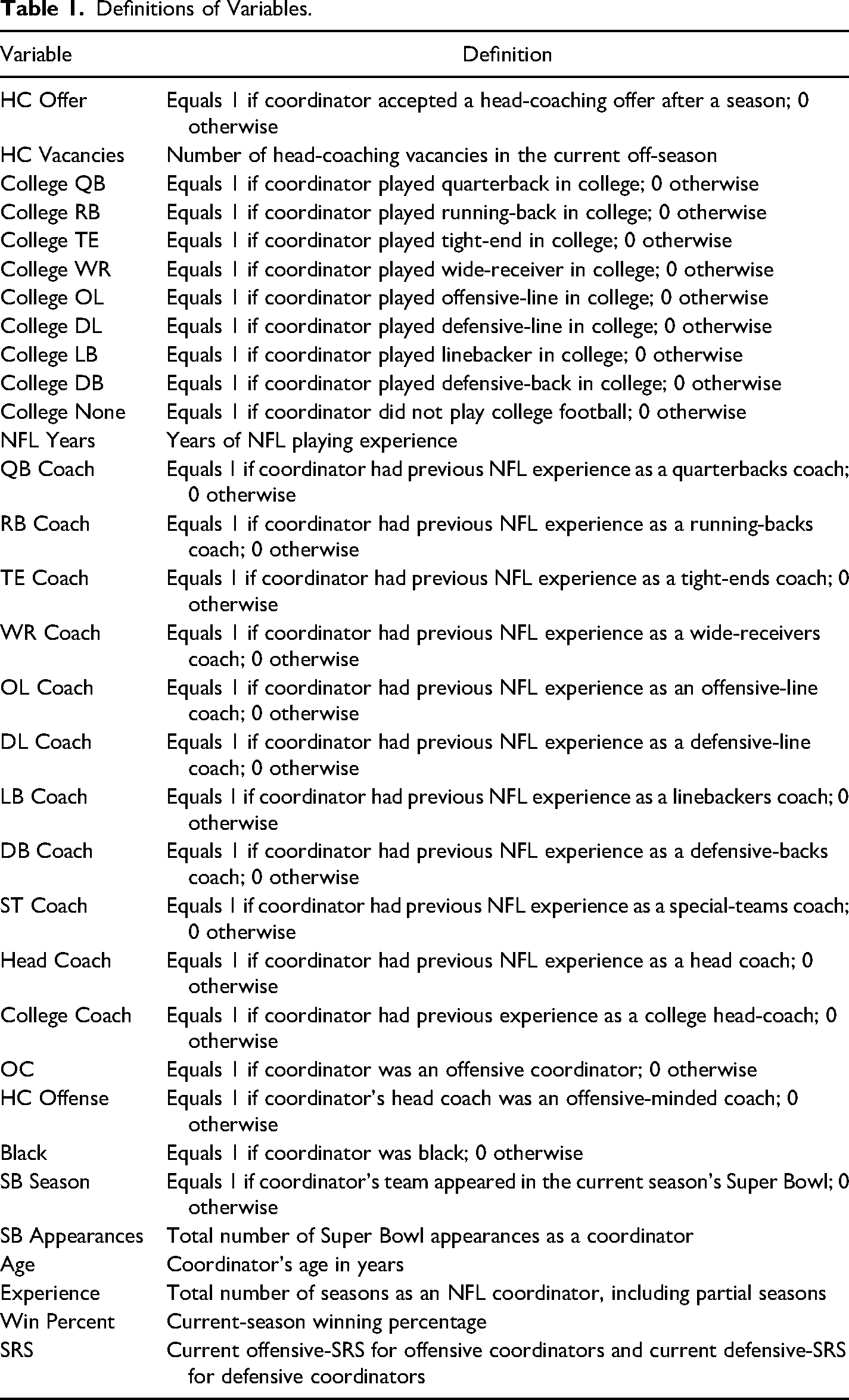
In order to investigate the entire period following the implementation of the Rooney Rule, data collection began with the 2003 NFL season and ended with the 2020 NFL season, the most recent season at the time of writing. The primary source of data collection was Pro-Football-Reference.com. However, the position played in college by a coordinator was collected from either Sports-Reference.com or Wikipedia. 2 Table 1 offers definitions of variables included in the empirical analysis, and Table 2 provides means and standard deviations of those variables. Means and standard deviations are reported for the full sample, offensive-coordinator and defensive-coordinator subsamples, and black-coordinator and non-black-coordinator subsamples. The full sample consists of 1,150 observations on 267 coordinators and treats each individual season for a coordinator as a separate observation. In total, there were 144 unique offensive-coordinators and 123 unique defensive-coordinators. Similarly, there were 51 unique black-coordinators and 216 unique non-black-coordinators. The statistics reported for the subsamples in Table 2, however, treat a coordinator's tenure with one team as a single observation while treating that coordinator's tenure with another team as a separate observation. Over the period examined, there were 89 coordinator-tenures in which the coordinator was black and 398 coordinator-tenures in which the coordinator was non-black.
Definitions of Variables.
Means and Standard Deviations.
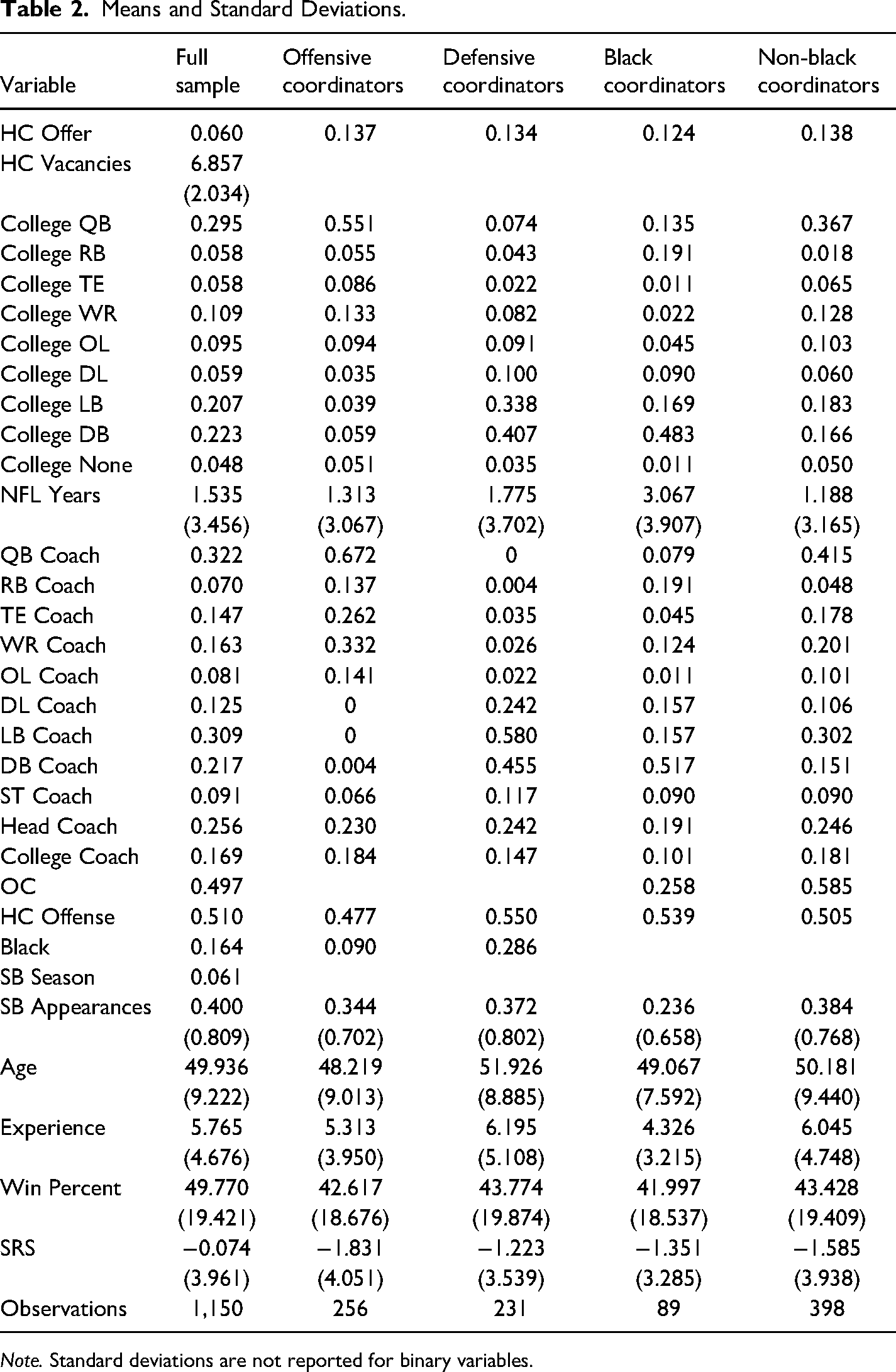
Note. Standard deviations are not reported for binary variables.
Following Fort et al. (2008), Foreman et al. (2018), and Foreman and Turick (2021), we constructed the binary race-variable Black to equal one if a coordinator was black and zero otherwise. HC Vacancies measures the number of head-coaching vacancies in a given off-season. Table 2 shows that nearly seven of 32 teams hired a new head-coach in the typical off-season between 2003 and 2020. While we were unable to observe whether coordinators were offered head-coaching positions, we were able to observe whether they accepted those positions. 3 HC Offer accounts for whether a coordinator accepted an offer for a head-coaching position with any NFL team after the conclusion of an NFL season. This does not include interim coaches who temporarily took over head-coaching responsibilities during a season in which a team fired the individual who began the season as head coach. The means reported in Table 2 suggest that offensive-coordinator and defensive-coordinator tenures were equally likely to end with a head-coaching opportunity. Similarly, since the adoption of the Rooney Rule, about 12.4% of black-coordinator tenures and 13.8% of non-black-coordinator tenures ended with the coordinator accepting a job as a head coach. These are only simple means, but they are not suggestive of systematic discrimination against black coordinators in the NFL.
Coordinator Race and College/NFL Playing Experience
Some players play multiple positions in college. This could occur due to a player changing positions during their collegiate football career, or it could be that a player's talents were versatile enough to allow them to play multiple positions in the same season. If a player ever played a given position in college, then a value of one was assigned for that dummy variable. In our empirical models, this means there was no need to leave out one of these variables as a comparison group. If a coordinator never played college football, then they were assigned a value of one for College None. Table 2 reveals that the position most commonly played in college by offensive coordinators was quarterback. Linebacker and defensive back were the positions most commonly played by defensive coordinators in college. Perhaps owing to racial position-segregation, there were noticeable differences in the typical positions played by black and non-black coordinators. Black coordinators were much more likely than non-black coordinators to have played running-back and defensive-back in college, while non-black coordinators were much more likely than black coordinators to have played quarterback and wide-receiver. In addition to accounting for the positions played by coordinators in college, we also accounted for their years of NFL playing experience. Table 2 reveals that, on average, black coordinators have more years of NFL playing experience than non-black coordinators.
Coordinator Race and College/NFL Coaching Experience
The majority of NFL coaches began their careers as position coaches in the NFL, and many coached several positions before becoming a coordinator. A value of one was assigned to the coaching-background dummy-variables if the coordinator had previously coached that position, otherwise a value of zero was assigned. Head Coach accounts for whether the coordinator had previous head-coaching experience in the NFL, and College Coach accounts for whether the coordinator had previous head-coaching experience in College. Table 2 suggests that the most common position coached by offensive coordinators was quarterback, while the most common positions coached by defensive coordinators were linebacker and defensive back. Again, differences in the means of these variables for the black and non-black coordinator subsamples were noticeable. This is likely attributable to the observed racial differences by position in college. If non-black coordinators were more likely than black coordinators to have played a position in college, they were also more likely to have coached that position in the NFL.
There was also an obvious racial difference for the variable OC when comparing the means of the black-coordinator and non-black-coordinator subsamples. Non-black-coordinator tenures since 2003 were much closer to a 50/50 split between those serving in offensive-coordinator and defensive-coordinator roles, but only 25.8% of black-coordinator tenures since 2003 were in the role of offensive coordinator. Over the past three seasons, twenty head-coaching vacancies have been filled, and fourteen were filled by coaches who specialized in offense. 4 Unless black coaches increase their share of offensive-coordinator roles in the NFL, a trend towards teams hiring offensive-minded head-coaches likely puts black coaches at a disadvantage.
Offensive coordinators with head coaches who specialize in offense and defensive coordinators with head coaches who specialize in defense may be at a disadvantage in getting head-coaching opportunities. Any success the team enjoys in the relevant area may be credited to the head coach, and the coordinator's contributions may be seen as trivial by NFL owners and executives. To investigate this potential relationship, we created the binary variable HC Offense. We also collected two experience-related measures for coordinators, including their age and the total number of seasons they had been coordinators in the NFL.
Coordinator Performance Measures
We employed four variables to control for a coordinator's performance. SB Season indicates whether the coordinator's team appeared in the current season's Super Bowl. SB Appearances measures the total number of times a coordinator coached in the Super Bowl as a coordinator. Win Percent is the team winning percentage for a coordinator in a given season. SRS is the team offensive-SRS for offensive coordinators and the team defensive-SRS for defensive coordinators. The simple rating system (SRS) is a statistic developed and reported by Pro-Football-Reference.com. A team's offensive-SRS measures its points scored per game relative to the league average, and a team's defensive-SRS measures its points allowed per game relative to the league average. Both variables are adjusted for the quality of the team's competition. Offensive SRS is adjusted by the average points allowed per game of the opposing defenses the team played in a season, while defensive SRS is adjusted by the average points scored per game of the opposing offenses the team played in a season. Both variables can be negative or positive. Also, for both variables, a higher value indicates better performance. Consistent with Goff and Tollison (2009) and Madden and Ruther (2011), Table 2 does not offer any strong evidence that black coordinators have performed better or worse than non-black coordinators. On average, non-black-coordinator tenures have produced slightly higher winning percentages and more Super Bowl appearances since the introduction of the Rooney Rule, but they have also produced slightly worse SRS values than black-coordinator tenures.
Probit Regression Results
In order to identify which variables were correlated with a coordinator's probability of becoming a head coach, we estimated several probit regression models of the form:
Marginal Effects for Probit Regressions.
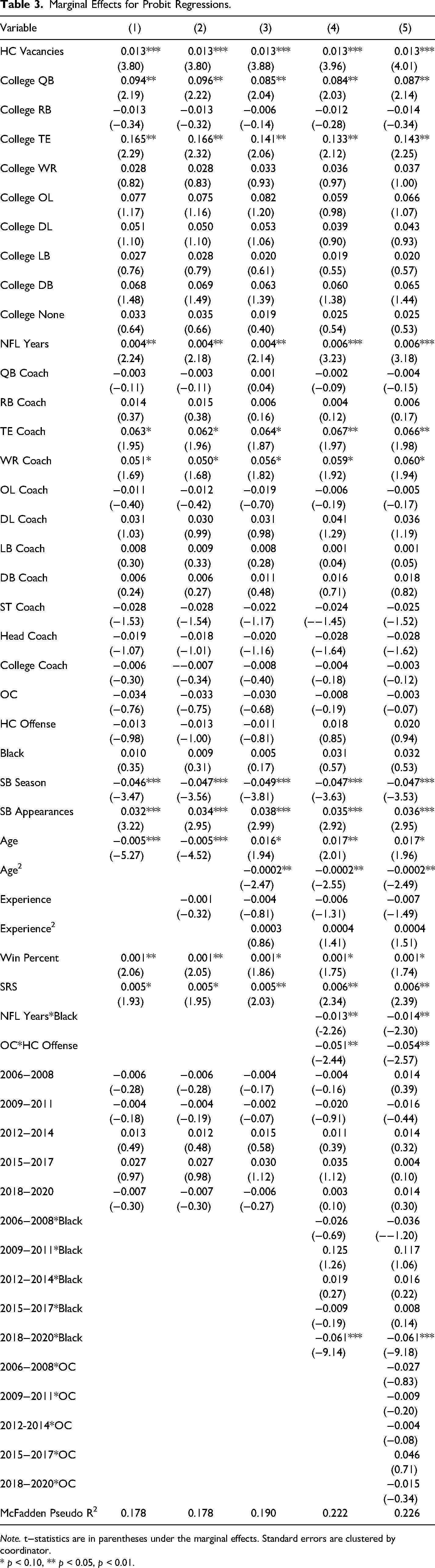
Note. t−statistics are in parentheses under the marginal effects. Standard errors are clustered by coordinator.
* p < 0.10, ** p < 0.05, p < 0.01.
All else equal, our findings suggest that an additional head-coaching vacancy in an off-season increased a coordinator's probability of becoming a head-coach by 1.3%. Coordinators who played quarterback or tight end in college were significantly more likely to get an NFL head-coaching opportunity, other things equal. For example, a coordinator who played quarterback in college was 8–10% more likely to receive a head-coaching opportunity than an otherwise similar coordinator who did not play quarterback in college. We also found that coordinators with NFL playing experience were more likely to get head-coaching jobs. As for the coaching-background variables, only TE Coach and WR Coach had statistically significant marginal effects in any of the specifications reported in Table 3.
While NFL teams may be trending towards hiring offensive coordinators to be their head coaches, we did not find any evidence, after controlling for other factors, that offensive coordinators were more likely than defensive coordinators to be promoted to head coach over the 2003–2020 NFL seasons. Contrary to the findings of Braddock et al. (2012), the marginal effects of Experience were statistically insignificant in all of our model specifications. However, the marginal effects of Age were significant in each of our specifications, indicating older coordinators have been less likely than younger coordinators to get head-coaching jobs. 5 When the squared term for age was included, negative returns set in at 40 years old using the estimates provided in column (3) and at 42.5 years old using the estimates provided in columns (4) and (5). 6 Thus, consistent with Solow et al. (2011), we found strong evidence that NFL teams prefer younger head-coaches, all else equal. Also consistent with Solow et al., all of the performance-related measures were found to significantly impact a coordinator's probability of becoming a head coach. An increase in SB Appearances, Win Percent, and SRS were all found to be correlated with an increased probability of getting a head-coaching job. For example, since the introduction of the Rooney Rule, an additional Super Bowl appearance for a coordinator has been correlated with about a 3.5% increase in their probability of becoming a head coach. However, there is a caveat. Appearing in the Super Bowl was correlated with about a 4.7% decreased probability of getting a head-coaching job in the season the coordinator's team participated in the Super Bowl. This may be due to the NFL's anti-tampering policy that does not allow teams to interview any coach from another team until that team's season has concluded (NFL, 2018). If teams seek to fill head-coaching vacancies quickly, then coordinators on teams playing in the Super Bowl are at a disadvantage relative to coordinators on teams that did not make it to the Super Bowl. 7
While the marginal effects for HC Offense were insignificant in all of our regressions, the marginal effects for the interaction term OC*HC Offense were significant. The result suggests that coordinators have been less likely to get a promotion when their head coach specializes in the same area as they do. Over the period examined, offensive coordinators whose head coaches specialized in offense were about 3.3% less likely to get head-coaching offers than otherwise similar offensive coordinators whose head coaches specialized in defense. 8 Thus, all else equal, coordinators with head-coaching aspirations are likely best served by working for head coaches whose specialty is on the other side of the ball.
Similar to previous research by Madden and Ruther (2011), Solow et al. (2011), Braddock et al. (2012), Foreman et al. (2018), and Salaga and Juravich (2020), the marginal effects for our binary race-variable Black were statistically insignificant in all of our probit regressions. However, no previous research considered the potential for an interaction effect between a coordinator's race and their NFL playing experience, and the marginal effects for the interaction term NFL Years*Black were found to be statistically significant and negative, as shown in columns (4) and (5) of Table 3. Thus, our analysis suggests that the premium for NFL playing experience has been smaller for black coordinators than non-black coordinators since the introduction of the Rooney Rule.
In order to investigate whether the impact of coordinator race on probability of promotion varied between 2003 and 2020, we interacted Black with our three-year time-period variables. The marginal effects for these interaction terms are reported in columns (4) and (5) of Table 3. The comparison time period is 2003–2005. For the most part, we found no evidence that the impact of Black varied over time. However, there was a statistically significant decline in probability of promotion for black coordinators in the most recent three-year period of 2018–2020. The findings imply that black coordinators who coached between 2018 and 2020 were 5.8% less likely to become head coaches than otherwise equal black coordinators who coached between 2003 and 2005. 9 All else equal, when compared to their non-black peers over the same time period, black coordinators who coached between 2018 and 2020 were 3% less likely to become head coaches. 10
Given the lack of black offensive coordinators, we also estimated a specification of our model that included interaction terms between the time-period dummies and OC to determine if these findings simply captured a recent trend of teams hiring offensive coordinators as head coaches. The marginal effects for this specification are given in column (5) of Table 3. All of the interaction terms between the time-period dummies and OC had insignificant marginal effects. Furthermore, the marginal effect for 2018–2020*Black did not change. Thus, we conclude that the negative effects of being black during the 2018–2020 seasons were independent of black coaches’ underrepresentation as offensive coordinators. 11
Discussion on Coordinator Race and Probability of Becoming an NFL Head-Coach
About 70% of NFL players were black at the beginning of the 2020 NFL season (Zirin, 2020). However, fewer than 10% of head coaches were black to begin the 2019, 2020, and 2021 seasons. Instead of only three head-coaches being black, about 22 would need to be black for black persons’ share of NFL head-coaches to approximate their share of the players. According to Census data, about 13.4% of Americans were black in 2020. About four or five head-coaches would need to be black for black persons’ share of NFL head-coaches to approximate their share of the U.S. population. So, depending on which standard is appropriate, black head-coaches have been either slightly or extremely underrepresented in recent NFL seasons.
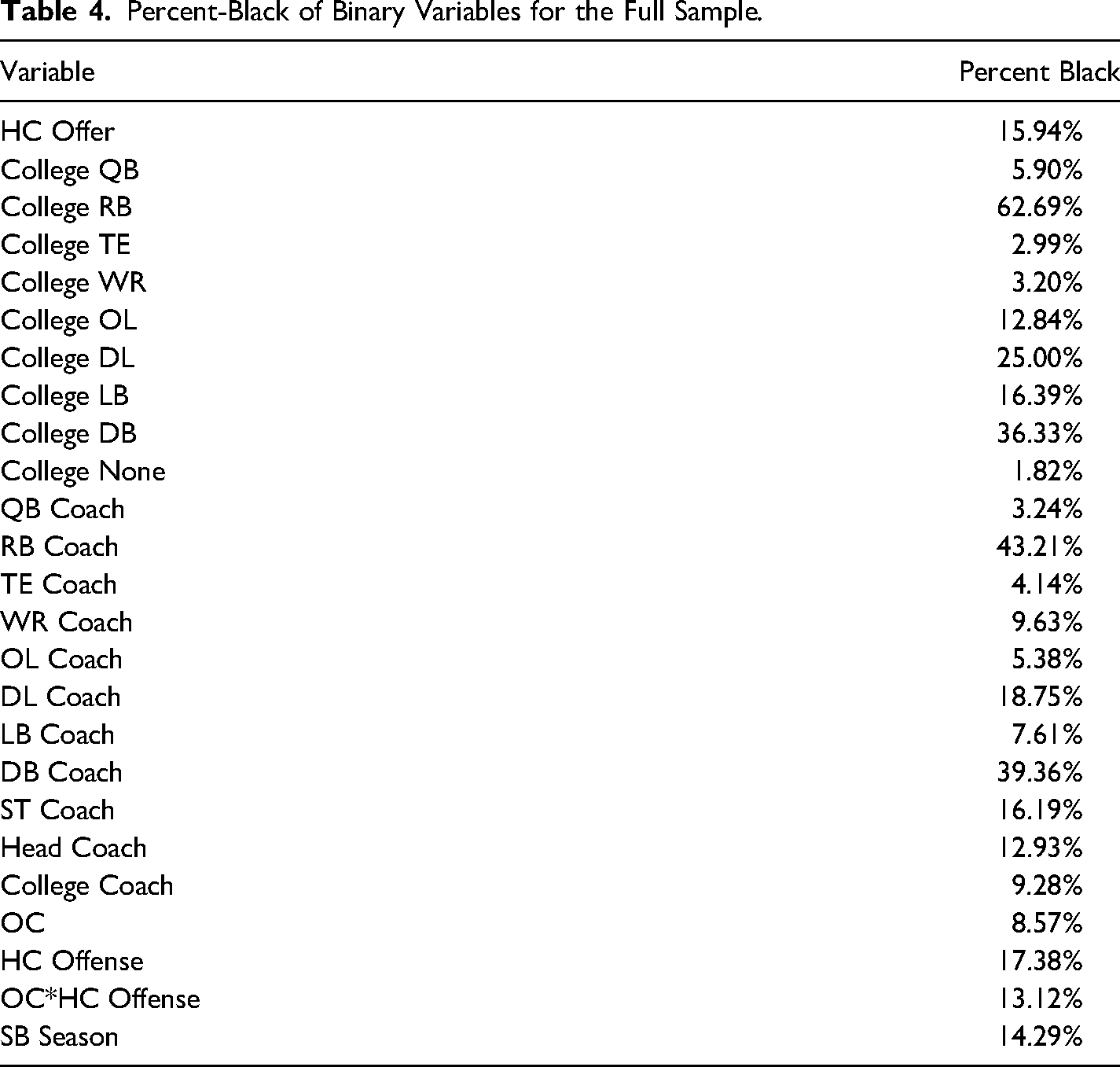
The empirical analysis we presented does not allow us to offer any guidance as to how many black head-coaches there should be or the number we would expect in the absence of racial discrimination since it is unclear what their share of NFL head-coaches should approximate. However, our analysis does allow us to draw some conclusions about why there have been few black head-coaches in the NFL. Table 4 gives the percentage of coordinators that were black among coordinators who possessed a given characteristic for the full sample. For example, when a team had a coordinator who played linebacker in college, that coordinator was black 16.39% of the time. Table 2 shows that 16.4% of coordinators in the full sample were black. Thus, black coordinators would be considered overrepresented in any category in Table 4 with a percent-black greater than 16.4% and underrepresented in any category with a percent-black less than 16.4%.
Percent-Black of Binary Variables for the Full Sample.
A Lack of Black Coordinators That Played Quarterback or Tight-End and A Lack of Black Coordinators That Coached the Tight-End and Wide-Receiver Positions
Table 4 shows that black coordinators were underrepresented among coordinators who played quarterback or tight-end in college. Using college-football-recruiting data from 2008 and 2009, Pitts and Yost (2013) found that black high-school-quarterbacks were significantly more likely to change positions in college than their white counterparts. According to our probit regressions, switching positions from quarterback to a position other than tight-end likely has a negative impact on the probability of becoming an NFL head-coach. Thus, one potential reason for a lack of black head-coaches in the NFL was a lack of black coordinators who played quarterback or tight-end in college. In the absence of racial discrimination, black players receiving more opportunities to play quarterback and tight-end in college should eventually lead to an increase in the number of black head-coaches in the NFL as some of those players retire and transition to coaching careers.
We also found that coordinators who coached tight-ends and wide-receivers in the NFL were significantly more likely to get NFL head-coaching jobs. The percent black for TE Coach and WR Coach in Table 4 were 2.99% and 9.63%, respectively. Thus, another potential reason for a lack of black head-coaches in the NFL was that black coordinators were underrepresented among coordinators who coached tight-ends or wide-receivers in the NFL. Overwhelmingly, the most common position played in college by black coordinators was running back, which we found to have a statistically insignificant impact on a coordinator's probability of becoming a head coach. Excluding special-teams positions, running back was the only position not played by any head coach to begin the 2021 NFL season.
Experience with the quarterback, tight-end, and wide-receiver positions are what NFL teams seem to value in head coaches. These are also the primary three positions related to offensive passing attacks. Thus, more often than not, it seems that NFL teams are primarily interested in hiring head coaches who can improve their teams’ offensive passing attacks.
Labor-Market Discrimination Against Black Coordinators
All of the probit regressions suggested that NFL playing experience was correlated with an increased probability of being promoted from coordinator to head coach. Table 2 shows that black coordinators tend to have more NFL playing experience than non-black coordinators. Furthermore, 46.56% of black coordinators in the full sample played at least one season in the NFL, while the same is true for only 15.82% of non-black coordinators. Thus, black coordinators are overrepresented in this category. However, as discussed in the previous section, the impact of NFL playing experience on the probability of becoming a head coach has been smaller for black coordinators than non-black coordinators. Obviously, this has the potential to result in fewer black head-coaches in the NFL than there would be otherwise, especially when considering that NFL playing experience was much more common among black coordinators. This racial difference in the treatment of NFL playing experience may be indicative of discrimination against black coordinators. Furthermore, our finding that, even after accounting for numerous characteristics of coordinators, black coordinators were significantly less likely to become head coaches over the 2018–2020 seasons is also consistent with labor-market discrimination against black coordinators in recent years.
In our dataset, only six black coordinators played quarterback in college. Only one black coordinator in our dataset played tight-end in college, only two black coordinators coached tight-ends in the NFL, and only seven black coordinators coached wide-receivers in the NFL. In total, eleven black coordinators in our dataset possessed at least one of these characteristics, and three of those coordinators did receive head-coaching opportunities in the NFL – Hue Jackson (played quarterback in college and coached wide-receivers and tight-ends in the NFL), Vance Joseph (played quarterback in college), and Raheem Morris (coached wide-receivers in the NFL). 12 Thus, whereas Madden (2004) concluded that the small number of black head-coaches in the NFL was unlikely to be a pipeline problem, this is suggestive of a pipeline problem at least in that there were very few black coordinators with these characteristics. Perhaps college and NFL position coaches with these characteristics are never given the opportunity to serve as a coordinator; this is another potential source of discrimination. Indeed, Braddock et al. (2012) and Foreman et al. (2018) found that black coaches were significantly less likely to get coordinator jobs. So, the pipeline problem could still be indicative of racial discrimination against black coaches if there were numerous black coaches with these characteristics and they were discriminated against in the process of NFL teams hiring coordinators.
Changes to the Rooney Rule
If the recent additions to the Rooney Rule that required all teams to interview at least one minority candidate for vacant offensive-coordinator and defensive-coordinator positions leads to an increase in the number of black coordinators with these characteristics, then we would expect to eventually see more black coordinators promoted to head coaches as a result. Considering our findings for coordinators with experience at the quarterback, tight-end, and wide-receiver positions, this would seem to be particularly true if this expansion of the Rooney Rule leads to more black offensive-coordinators since quarterback, tight end, and wide receiver are all offensive positions. Also, as we have previously discussed, black coaches have been and continue to be underrepresented among offensive coordinators, and the league appears to be trending more towards hiring offensive-minded head-coaches. So, if the additions to the Rooney Rule are to result in more black head-coaches, then it will likely need to be successful in aiding the matriculation of black coaches from offensive position coaches to offensive coordinators, and finally, to head coaches. This would help to address the pipeline issues, which our findings suggest are a significant part of the problem. However, if black coordinators are treated differently than non-black coordinators, as our findings were consistent with, then addressing pipeline problems may not completely resolve the issue of there being fewer black head-coaches in the NFL than many would expect.
The Case of Eric Bieniemy
Many media members were perplexed that the 2019, 2020, and 2021 NFL seasons began and Chiefs-offensive-coordinator Eric Bieniemy still had not been given a head-coaching opportunity (see, e.g., Gosling, 2019; Kilgore, 2019; Dragon, 2020; Klemko, 2020; Moriarty, 2020; Paylor, 2020; Alper, 2021). The Chiefs’ offense has been extremely productive during Bieniemy's tenure as offensive coordinator. In the 2018 season, their quarterback, Patrick Mahomes, was named NFL MVP, and the team advanced to the American Football Conference (AFC) Championship game. 13 One season later, the Chiefs won the Super Bowl with an impressive offensive burst in the fourth quarter. The Chiefs made it to the Super Bowl again in the following season, but lost to the Tampa Bay Buccaneers. Despite these accolades, Bieniemy, who is black, had yet to receive a head-coaching job at the beginning of the 2021 NFL season. By comparison, two of the previous three offensive coordinators for Chiefs-head-coach Andy Reid, Matt Nagy and Doug Pederson who are both white, were given head-coaching jobs. 14 In addition, eight coordinators, none of whom were black, were promoted to head coach between 2018 and 2020. Many concluded that Eric Bieniemy's race was the reason he had not yet been given a head-coaching job. Using the estimates given in column (4) of Table 3, we calculated Bieniemy's probabilities of becoming a head coach in each of his three seasons as an offensive coordinator. We also calculated these probabilities for Doug Pederson and Matt Nagy in the seasons they were promoted as well as the probabilities for all eight coordinators promoted to head coach between 2018 and 2020. These are reported in Table 5.
Probability of becoming a Head Coach for Eric Bieniemy, Doug Pederson, Matt Nagy, and all Coordinators that were promoted to Head Coach between 2018 and 2020.
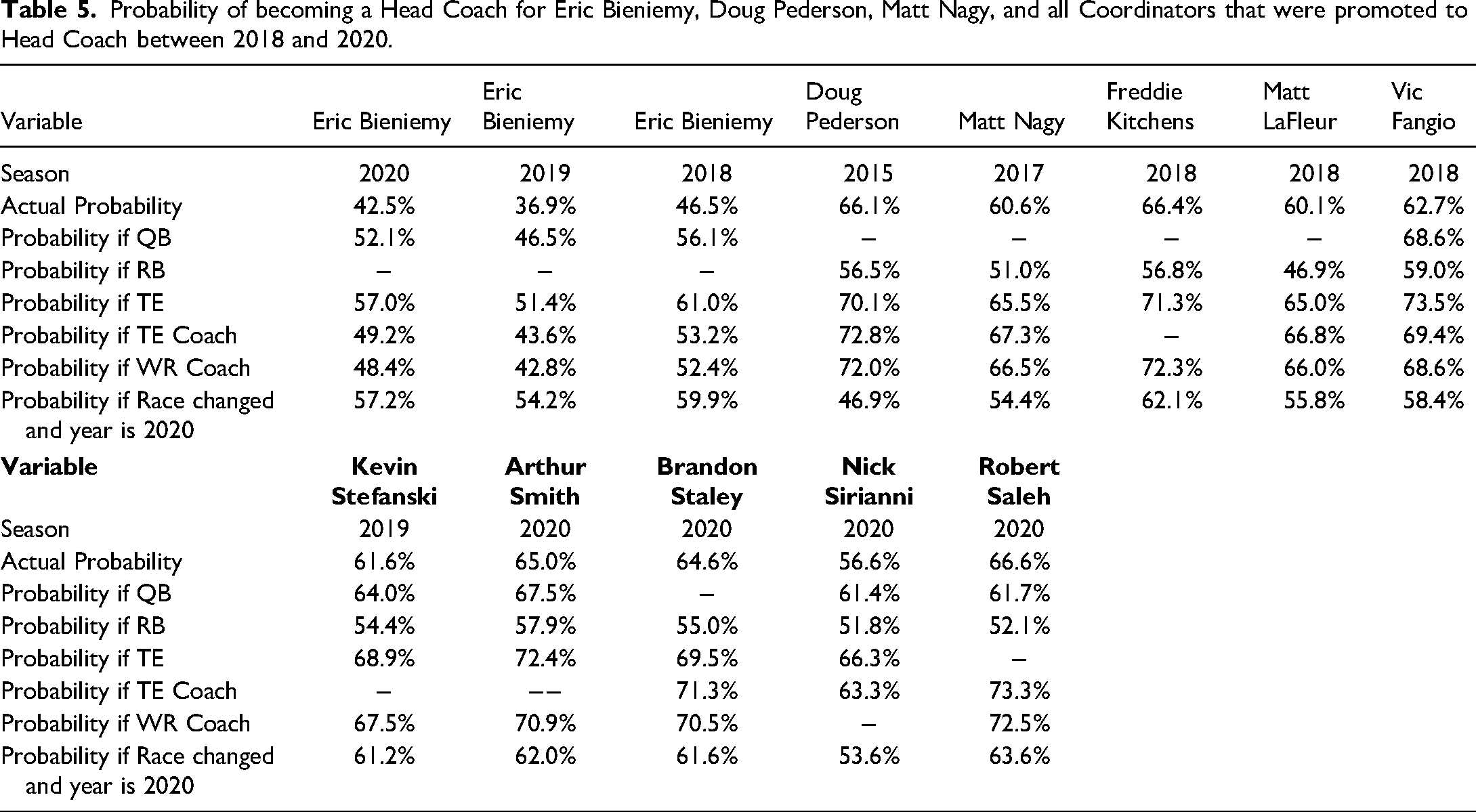
For each coordinator, the first probability given is the coordinator's actual probability of becoming a head coach in that season, according to our model. Bieniemy's probabilities of promotion in 2018, 2019, and 2020 were the three lowest actual probabilities in the table even though he had better performance-measures than any other coordinator listed in the table. Robert Saleh and Vic Fangio both had one Super Bowl appearance as a coordinator in their careers, Bieniemy had two as of 2020, and all other coordinators in the table did not have any Super Bowl appearances as a coordinator. Based on our findings, however, appearing in the Super Bowl in the 2019 and 2020 seasons actually contributed to a slight decline in Bieniemy's probability of becoming a head coach in those seasons. Bieniemy's lowest winning percentage was 75%, which was only rivaled by Vic Fangio's team winning 75% of their games in 2018. Thus, Bieniemy's worst season in this respect was the best performance of any of the other coordinators. Bieniemy's SRS value of 12.6 in 2018 was the highest mark on the list, and his SRS value of 6.2 in 2019 was only matched by Brandon Staley's 6.2 in 2020. Clearly, the other coordinators listed in Table 5 have not enjoyed the same success as Bieniemy in terms of performance.
Bieniemy was an offensive coordinator with a head coach that also specialized in offense. However, this was also true for Doug Pederson in 2015, Matt Nagy in 2017, and Nick Sirianni in 2020. More importantly, Bieniemy did not possess any of the following characteristics we found to be correlated with a coordinator becoming a head coach – (1) played quarterback in college, (2) played tight-end in college, (3) coached tight-ends in the NFL, or (4) coached wide-receivers in the NFL. Doug Pederson, Matt Nagy, Freddie Kitchens, Matt LaFleur, and Brandon Staley all played quarterback in college, and Robert Saleh played tight end in college. Freddie Kitchens, Kevin Stefanski, and Arthur Smith all coached tight-ends in the NFL, and Nick Sirianni coached wide-receivers in the NFL. Other than Bieniemy, the only other coordinator shown in Table 5 that did not possess any of those four characteristics was Vic Fangio. Fangio did not become a head coach until he had completed 19 seasons as a defensive coordinator, and 2020 was only Bieniemy's third season as an offensive coordinator.
Table 5 also shows how each coordinator's probability of becoming a head coach would have changed if a certain characteristic about them were changed. For example, if Matt Nagy and Matt LaFleur played running-back instead of quarterback in college and Eric Bieniemy played quarterback instead of running-back, then Bieniemy's probability of becoming a head coach would have exceed Nagy's and LaFleur's probabilities. The last row of Table 5 shows what would happen to each coordinator's estimated probability of becoming a head coach if their race were changed from black to non-black and vice-versa as well as if the season were 2020. Bieniemy is the only black coordinator in Table 5. Changing his race from black to non-black has a dramatic impact on his estimated probability of becoming a head coach. The other coordinator's estimated probabilities all decline to varying degrees when their races are changed from non-black to black. However, no coordinator's probability declines more than Doug Pederson's since he would now also suffer from the disadvantage of being a former black player, as Bieniemy does. Among the race-altered estimates, Bieniemy's highest estimated probability ranks sixth among the coordinators shown in Table 5. Thus, our findings suggest that, at this point in his career, Bieniemy still may not have received a head-coaching opportunity even if he were not black. However, our findings are also consistent with Bieniemy's race being one of the reasons for his lack of head-coaching opportunities.
Summary and Conclusions
Using data from all NFL seasons since the implementation of the Rooney Rule in 2003, we estimated probit regression models to examine the impact of various factors on an NFL coordinator's probability of becoming a head coach. The primary focus of our analysis was how a coordinator's race impacted their probability of becoming a head coach. The marginal effects for our binary race-variable Black were statistically insignificant in all of our regressions. However, the marginal effects for two interaction terms were statistically significant and negative – NFL Years*Black and 2018–2020*Black. Thus, we did find evidence that black coordinators who played in the NFL have been less likely to become head coaches than otherwise similar non-black-coordinators who played in the NFL. Also, we found that black coordinators were significantly less likely to be promoted over the 2018–2020 seasons.
Based on our empirical analysis, we would expect the number of black head-coaches in the NFL to increase as (1) the number of black coordinators who played quarterback in college increases, (2) the number of black coordinators who played tight-end in college increases, (3) the number of black coordinators with experience coaching the tight-end position in the NFL increases, (4) the number of black coordinators with experience coaching the wide-receiver position in the NFL increases, (5) the racial difference in the marginal impact of NFL playing experience on the probability of becoming a head coach is eliminated, and (6) recent discrimination against black coordinators is eliminated. Also, our data showed that black coordinators were extremely overrepresented among those coordinators who played running-back in college and among those coordinators with experience coaching the running-back position in the NFL. However, we found no evidence that NFL teams valued those characteristics in head coaches over the time-period examined. Thus, a movement towards NFL teams placing more value on head coaches with those characteristics would also result in an increase in the number of black head-coaches in the league.
It is important to note that we only examined the relationship between race and probability of becoming a head coach for coaches who already made it to coordinator positions, which are only one step away from being a head coach. Previous research by Braddock et al. (2012) and Foreman et al. (2018) suggested that black coaches have faced some degree of discrimination in getting jobs as coordinators. While neither study differentiated between offensive-coordinator and defensive-coordinator positions, the descriptive statistics of our data suggested it is likely the offensive-coordinator position that has been relatively inaccessible to black coaches. Only 25.8% of all black-coordinator tenures between the 2003 and 2020 seasons were offensive-coordinator tenures, while 74.2% were defensive-coordinator tenures. For non-black-coordinator tenures over the same period, 58.5% were offensive coordinators and 41.5% were defensive coordinators. If this trend continues and the trend of teams hiring offensive coordinators as head coaches also continues, then it seems unlikely that there will be any substantial changes in black coaches’ representation among head coaches in the NFL. However, the recent expansion of the Rooney Rule to include coordinator positions may help in this regard. All teams must now interview at least one minority candidate for every vacant coordinator position. If this new policy leads to an increase in the number of black coordinators who possess the characteristics owners and executives seem to value in head coaches, then an increase in the number of black head-coaches should follow, based on our analysis. Specifically, the Rooney Rule expansions will likely need to significantly improve the matriculation of black coaches from offensive position coaches to offensive coordinators in order to significantly increase the number of black head-coaches in the NFL.
Lastly, we gave specific attention to the case of Chiefs-offensive-coordinator Eric Bieniemy whose lack of head-coaching opportunities caught the attention of many journalists and media personalities. Our findings suggested several reasons Bieniemy had yet to secure a head-coaching job at the beginning of the 2021 NFL season. Bieniemy played running-back in college, only coached the running-back position before becoming an offensive coordinator, and served under an offensive-minded head-coach. Also, based on our findings, appearing in the Super Bowl during the 2019 and 2020 seasons actually hurt Bieniemy's chances of becoming a head coach in those seasons. Lastly, Bieniemy is a former black player, and his entire career as a coordinator has occurred during a period in which we found that NFL teams were significantly less likely to promote black coordinators to head coaches. Thus, while our findings do not suggest that Bieniemy's race is the only reason he has yet to become a head coach, they are consistent with his race being one of the reasons. We calculated that Bieniemy's probability of becoming a head coach at the end of the 2020 season was 42.5%. Holding other factors constant, it would have increased to 57.2% if he were not a former black player.
Our research only examines what factors were correlated with NFL coordinators becoming head coaches over the 2003 to 2020 seasons. Future research could help to determine if these same factors are correlated with head-coach performance. For example, it could be determined whether the apparent apprehensiveness to hire head coaches with backgrounds as running backs or running-backs coaches has been warranted. Anthony Lynn, who was the Chargers’ head-coach from 2017 to 2020, is the only black NFL running-back to become a head coach in the NFL. No current NFL head-coaches even played running-back in college. Similarly, future research could also help to determine whether there have been significant performance differences between head coaches whose coordinator tenures were with coaches who specialized in the same area and head coaches whose coordinator tenures were with coaches who specialized in a different area since our analysis showed that it has likely influenced the hiring decisions of NFL owners and executives.
Footnotes
Declaration of Conflicting Interests
The author(s) declared no potential conflicts of interest with respect to the research, authorship, and/or publication of this article.
Funding
The author(s) received no financial support for the research, authorship and/or publication of this article.
