



Abstract
There is no shortage of evidence documenting glaring disparities on important socioeconomic and health indicators between White and Black Americans. Persistent racial disparities are the consequence of a historic system of structural racism. Given ongoing inequities in nearly every realm of American life, we aim to calculate the contemporary cost of racial inequity. We contribute to a growing body of literature concerning the “hidden cost” of being Black by employing a novel methodological approach and centering a paradigm of intersectionality ( Crenshaw, 1991; Shapiro, 2004). Specifically, we account for the disparities in health and income between Blacks and Whites by using the compensating and equivalent surplus frameworks to calculate willingness to accept (WTA) and willingness to pay (WTP) estimates. We estimate the WTP to avoid the disparity in health, income, and wellbeing between Black and White Americans, to be between approximately $38,000 and $45,000 per year per person using the Behavioral Risk Factor Surveillance System as well as the General Social Survey, respectively. These estimates can be interpreted as the annual willingness to pay by an average White person to avoid the disparities in income and health experienced by the average Black person.
Introduction
What is the cost of additional stress, worse health, or lower pay for the same work that the average Black person must take on in comparison to her White counterpart? To what extent would a similarly situated White person's subjective wellbeing change if they were Black? What is the monetary value of that change? Insight into this set of questions requires a measure to take into consideration of the ongoing harm from a system of historic (and contemporary) laws, policies, and individual and collective efforts to maintain a racial hierarchy, whereby White Americans dominate (Feagin, 2013; Omi & Winant, 1994). Specifically, such a measure would capture the loss in wellbeing from disparities between Whites and Blacks that have been documented in health (Acevedo-Garcia et al., 2008; Center on Society & Health, 2015; Joffe & Parker, 2012; Tucker et al., 2007), wealth (Eligon & Gebeloff, 2016; Oliver & Shapiro, 1995; Zaw et al., 2017), return on investment of education for wages and income (Cohen, 2014; Editorial Board, 2017; Eligon & Gebeloff, 2016), debt (Cottom, 2017; Seamster, 2019) employment (Bureau of Labor Statistics, 2014; Pager & Shepherd, 2008), criminal justice outcomes (Alexander, 2010), and even the benefit of the doubt (Pager, 2007; Royster, 2003).
Scholars who are cognizant of these persistent inequalities have worked diligently toward calculating the “hidden costs” of being Black (Johnson & Sell, 1976; Shapiro, 2004; Siegel, 1965) but determining the costs of anti-Black racism is difficult. Despite the challenge, some scholars have tackled the issue by focusing on the historical legacies of slavery and Jim Crow, particularly as they effect intergenerational wealth accumulation and transfers (or the lack thereof); both systems—slavery and Jim Crow—are at the root of ongoing and persistent racial inequity in the United States (Darity, 2008; Darity & Frank, 2003). Models that incorporate purloined wages and stolen property from the slavery and antebellum eras produce monetary sums that help Americans wrap their minds around the financial costs of the legacy of racially discriminatory policies in their society. Indeed, a renewed and broadened conversation around reparations to Black Americans requires such calculations (Coates, 2014; Darity & Mullen, 2020).
We contribute to this intellectual, practical, and policy pursuit, but we approach the question from the standpoint of estimating the contemporary, every day, and mundane costs of being classified as Black in the United States. We overcome some of the basic challenges of calculating the hidden costs of being Black by employing a novel methodological approach and centering a paradigm of intersectionality (Crenshaw, 1991; Shapiro, 2004). Specifically, we estimate the costs of the disparities in health and income between Blacks and Whites across gender by using the compensating and equivalent surplus frameworks. Ultimately, we calculate the willingness to accept (WTA) and willingness to pay (WTP) estimates of experiencing the “downside” of racial inequality. We estimate the WTP to avoid the disparity in health, income, and wellbeing between Black and White Americans, to be between $38,000 and $45,000 per year per person using the Behavioral Risk Factor Surveillance System as well as the General Social Survey, respectively. An alternative interpretation of this estimate can be said to be the willingness to pay by an average White person to avoid the disparities in income and health experienced by the average Black person so as long as inequalities persist.
Racial Inequality in Black & White
As mentioned, the United States is a racialized social system (Bonilla-Silva, 1997). Consequently, in nearly every aspect of American life, Whites gain more benefits and people of color experience more disadvantages, on average. These disparities are well-evidenced in the areas of health and income. Black Americans have historically had shorter life expectancy as well as higher rates of chronic diseases, such as diabetes, hypertension, and cardiovascular disease. Black infants are more likely to die in their first year of life than White infants. Researchers who focus on racial disparities find that chronic stress, experiences with racial discrimination, and economic distress produce suboptimal health outcomes (Dressler et al., 2005). Though some attempt to point to issues of diet, Black culture, and individual behavior as explanations for racial disparities in health, experts reveal that structural determinants are more important to consider (Dressler et al., 2005), such as access to quality health care and affordable, healthy foods. Both are in much shorter supply for Black Americans in comparison to Whites (Center on Society and Health 2015; Fitzpatrick & LaGory, 2002; Hasnain-Wynia et al., 2007). What's more, doctors are systematically likely to under-treat Black patients (Cykert et al., 2010).
Similar patterns exist in the realm of income and wages. To begin, Black unemployment have historically been twice as high as the rate of Whites, even in times when these rates are at historic lows (Lopez Bunyasi & Smith, 2019a, 2019b). Research shows that Black folks are less likely to get call backs for jobs than Whites, and even formerly incarcerated White men are more likely to receive an interview for a job than Black men with no criminal record (Pager, 2007). What's more, despite the vast changes in anti-discrimination laws as well as transformations in social norms, research shows that between 1980 and 2015, the gap in median wages between Black and White men has largely gone unchanged; researchers also find that Black Americans do not receive the same return on investment from higher education (Patten, 2016).
Relatedly, a paradigm of intersectionality (Crenshaw, 1991, 1989) reveals that Black women face special challenges to their health as well as their income due to overlapping systems of oppression, including racism, sexism and classism. For instance, Black women are more likely to die from pregnancy related complications than White women (Simon, 2016; Tucker et al., 2007). While women, generally speaking, make significantly less than White men, research shows that “on average, Black women in the U.S. are paid 38% less than White men and 21% less than White women” (Hegewisch & Williams-Baron, 2017; Lean In, 2019). Scholars have pointed out that education does not close important gaps for Black women. For example, the Black-White infant mortality gap is greater among the well-educated than those who have less education; in fact, highly educated Black women are more likely to lose a child than low-educated White women (Matthew et al., 2016). Attaining education also does not close key financial gaps, such as wealth, for Black women or their families. Indeed, though Black women are much more likely to go to college than Black men, one of the barriers to wealth accumulation for Black women is crushing student debt (Zaw et al., 2017).
These patterns which mark a racialized social system can be found in a wide array of realms of American life. However, we focus on these two aspects of racial inequality—income and health—because (a) there is a great deal of reliable data that we can analyze, and (b) touching on each of the many inequalities in American society (e.g. residential segregation, school quality, criminal justice, stereotypes, wealth, debt) would balloon the scope of this article given the ubiquity of racial inequality; we simply do not have the space. Consequently, we should note an important caveat: because we only incorporate disparities in health and income in our analysis below, all of our calculations about the hidden costs of being Black are underestimations.
The Cost of Living While Black
With a full appreciation of the depths and consequences of these persistent inequalities, researchers, public intellectuals, and journalists have made efforts to determine either the costs of living as a Black person in the United States as well as to ascertain the financial costs wrought by the legacies of slavery and/or Jim Crow to Black Americans’ current financial well-being and wealth status, or lack thereof. For instance, Ranson and Sutch (1990) estimated that the value of exploited labor of enslaved people between 1806 and 1860 was about $3.4 billion, compounded to 1983. Darity (2008), then compounded that sum into 2004 dollars at an annual interest rate of 5 percent and determined the value to be around $9.12 billion. Other scholars who have developed alternative calculations based on lost wages and stolen property estimate sums between $1 trillion and $6 trillion dollars (see Darity, 2008 for a review of this literature). Darity (2008) notes that, “none of these approaches incorporate the harms of slavery, the inherently coercive nature of the system, the denial of the ability to accumulate property or acquire education, or the denial of control over one's family life.” Consequently, estimates like these are best characterized as underestimations of the value of past injustices. To be sure, present day inequalities that we see in American society are rooted in this history.
Those who are cognitive of these inequities have also noted that White Americans, whose political will is required to make major policy transformation, must first recognize disadvantages that are disproportionately allocated to Blacks as well as the unearned advantages of White privilege in order to buy into this conversation (Dawson & Popoff, 2004; Mazzocco et al., 2006). With this in mind, some researchers have relied on Whites’ calculations of either White privilege or Black disadvantage to estimate the costs of living as a Black person in the United States. To the best of our knowledge there are only two studies that have attempted to assign an economic value to contemporary racial inequalities, and both leverage the contingent valuation method (CVM), widely used and well established in environmental economics, to estimate the economic value of racial disparities. The first study was originally conducted by Hacker (1992) and the most recent was conducted by Mazzocco et al. (2006). Simply put, scholars asked White respondents what they would need to be paid to move from the status quo (i.e., being classified as White) to some hypothetical counterfactual (i.e., living as a Black person).
Hacker found that most of his respondents, comprised of a convenience sample of college students, felt it “would not be out of place to ask for $1 million for each future year they would be living as a Black American” (42). In stark contrast, Mazzocco et al. (2006) relied on a more systematic study of White respondents, who were asked directly for their estimation of the economic value of a change in race from White to Black; on average, the response was below a lifetime amount of $10,000. However, this group of scholars also developed a scenario that mimicked the information of racial inequality in the United States; rather than ask about the cost of being Black, directly, they instead inquired about the cost of a shift from majority to minority status in a fictional land called Atria. In this scenario, the median request was around $1 million. A charitable reading of the results suggests that Whites severely underestimate the extent to which Black American face inequalities. But, the results of the latter study are not much different from that of Hacker’s (1992) and highlights Whites’ awareness of the cost of persistent racial inequality. The gap between the requested values across the two experiments in the Mazzocco et al. (2006) study reveals that the CVM approach to estimating the value of racial inequalities is not a suitable approach when framed in the context of a change in race. The estimations will be informed by respondents’ knowledge or acknowledgement of racial inequality. Research on an epistemology of ignorance highlights White Americans’ aggressive efforts to not know the extent and depths of anti-Black racism and White racial privilege (Mills, 2007; Mueller, 2017).
While we acknowledge the intrinsic value of race and ethnicity, we suggest developing an analysis that centers the instrumental or economic value of racial disparities as measured in health, income, and wellbeing could provide an estimate of the “hidden costs” of being Black in a way that is reliable and replicable, and further, does not pivot on whether or the extent to which respondents understand the ramifications of structural racism. Instead, one can empirically estimate both compensating surplus (CS) and equivalent surplus (ES) for a simultaneous change in health, income, and wellbeing that would hypothetically occur for a change in race. Put simply, CS speaks to the monetary compensation that one would need to provide an individual to make them indifferent to any changes to the status quo. Meanwhile, ES refers to change in one's income that would need to be made in order to make the condition of one's life in a counterfactual situation about the same as it is in the status quo.
We have previously outlined the inequalities that arise in health and income. Scholars of subjective wellbeing provide evidence that measures of subjective wellbeing, such as happiness, are widely considered “valid and reliable [measures] of quality of life, positive affect and mental well-being” (Cummings, 2020, “6”; Yang, 2008; Veenhoven, 1996). Yang notes that measures of subjective wellbeing “are also useful for determining the extent to which societies meet the needs of their members and the degree to which citizens thrive” (Yang, 2008, p. 204). Relatedly, stratification scholars suggest that differences in subjective wellbeing across racial groups captures aspects of structural inequalities, noting that the persistent “racial disparity in quality of life…strongly suggested that lingering social and economic disadvantages exerted a powerful negative effect on the subjective well-being of African Americans” (Hughes & Thomas, 1998, p. 786). Additionally, fluctuations in well-being across populations have been linked with major social, political, and economic transformations in society, such as historic elections or economic recessions (Cummings, 2020; Malat et al., 2011). Taken together, we can leverage measures that are reliable and valid, such as subjective wellbeing, as well as objective measures, such as income to estimate the non-market valuation of the hidden costs of experiencing racial inequality.
Theoretical Framework
In order to ascertain estimates of the economic value of racial disparities between White and Black Americans, we rely on a theoretical grounding developed within welfare economics (Hausman, 1981; Hicks, 1943; Lankford, 1988; Willig, 1976). Specifically, we estimate compensating surplus (CS) and equivalent surplus (ES), opposed to compensating variation (CV) and equivalent variation (EV), as the preferred measures of a change in welfare given the constrained nature of race and health (Freeman, 2003; Lankford, 1988). In the context of this study, CS represents the pecuniary compensation needed to make the average White American indifferent to being subjected to the inequalities experienced by the average the Black American. Alternatively, the ES measure represents the change in income needed to make the average White American, without being subjected to the inequalities experienced by the average the Black American, no better off or worse off than the average Black American.
Throughout our models, both theoretical and empirical, we assume that being White, as a race state, is the status quo from which we measure the change in welfare. This positioning of the status quo anchors our
We begin an outline of the CS and ES measures with a simple model of indirect utility. The indirect utility function for any given individual is explained here as


Empirical Strategy
The empirical strategy we use to estimate CS and ES is built on a non-market valuation technique which leverages subjective measures of wellbeing (Benjamin et al., 2014; Ferrer-i-Carbonell & van Praag, 2002; Finkelstein et al., 2013; Levinson, 2012; Luechinger, 2009; Perez-Truglia, 2015; Welsch, 2007). The subjective measure of wellbeing (SWB) empirical approach uses wellbeing survey instruments, such as life satisfaction or happiness, as a proxy for utility to estimate the marginal and inframarginal WTP for non-market goods such as environmental and health quality. To the best of our knowledge this study is the first to extend the SWB method to measure the economic value of racial disparities. Appropriately, we examine the validity and the robustness of our results in later sections.
While much of the applications of the SWB method estimates the marginal willingness to pay (MWTP), we base the SWB approach on the infra-marginal changes in welfare. Drawing on the framework discussed in the previous section, we model the SWB function as

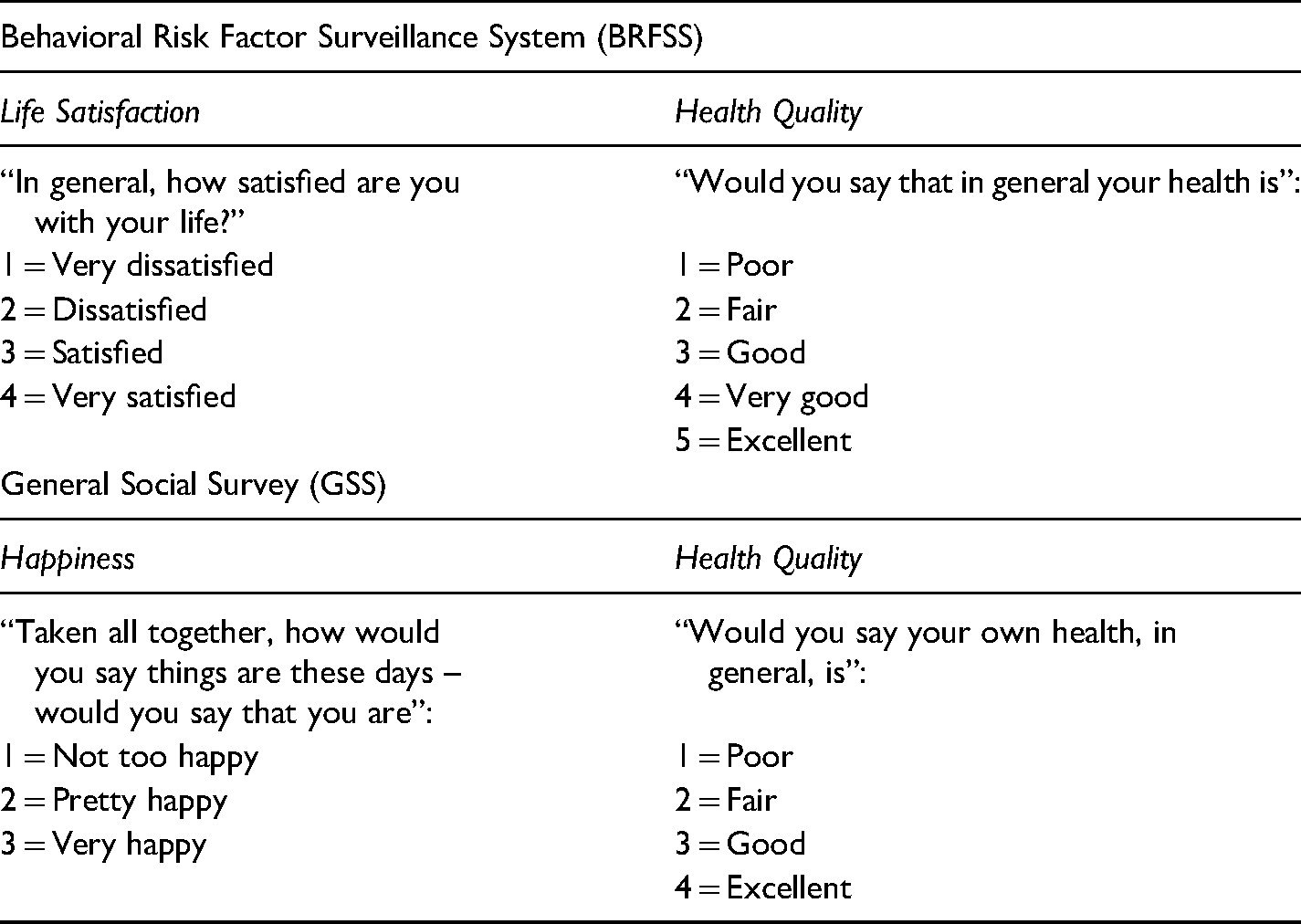
Survey Instruments Description (BRFSS and GSS).
Evaluating CS and ES
The estimates from the SWB and expenditure functions, Equation (3), are used to calculate 

To facilitate an unambiguous interpretation of our results, it is important to be aware that the model, both theoretical and empirical, produce an ex-post estimation of a pecuniary payment one would be willing to pay to avoid, or the compensation necessary to induce one to accept, a hypothetical change in race – specifically, the implication of race on income and health. The
Data Description
The primary data used in the analysis include repeated cross-sections of the Behavioral Risk Factor Surveillance System (BRFSS) data series between 2006 through 2017. The BRFSS data series is conducted by the Center for Disease Control and Prevention (CDC) and is designed to be a nationally representative health-related survey of the American population. The sample includes only Black and White respondents between the ages of 18 and 65 who reside in the United States
The SWB measure in the BRFSS is measured as an indicator of life satisfaction. As a result, life satisfaction is used in the empirical model as the dependent variable for the SWB function. The life satisfaction survey instrument asks respondents: “In general, how satisfied are you with your life?” Respondents are given a Likert scale type response choice, which is described as: “Very satisfied,” “Satisfied,” “Dissatisfied,” “Very dissatisfied.” Health quality is surveyed in a similar fashion, where individual health quality is self-reported and is based on a 5-point scale. The BRFSS asks respondents “Would you say that in general your health is: Excellent, Very good, Good, Fair, Poor.” In our analysis, the values for life satisfaction and the health quality variables are ordered from worst the best. For instance, the life satisfaction variable is expressed numerically as one
Income, in the BRFSS, is recorded at the household level and is explained by 8 categories. We address the income categories by setting income to the midpoint between the lowest and highest value characterized in each category (Hout, 2004). Given that there are a small number of income categories, we regress the midpoint household income variable on age, age squared, education, and gender then fit the model for each individual within the bounds of each household income category.
Summary Statistics
The descriptive statistics for the BRFSS sample are shown in Table 2. Each of the estimates are cut across race and ethnicity and are compared to the estimates for Whites. Given the design of the empirical model, life satisfaction and health quality are evaluated in detail. The estimates reported in Table 2 shows that Black respondents, on average, reported lower life satisfaction than that of Whites by 0.15 on a 4-point scale. An evaluation of each life satisfaction category reveals the largest Black – White differences are measured in the “satisfied” and “very satisfied” categories. While White respondents reported being “very satisfied” at a greater rate, a difference of 11-percentage points, Black respondents reported being “satisfied” at a greater rate, a difference of 8-percentage points.
Descriptive Statistics & Means Comparisons.
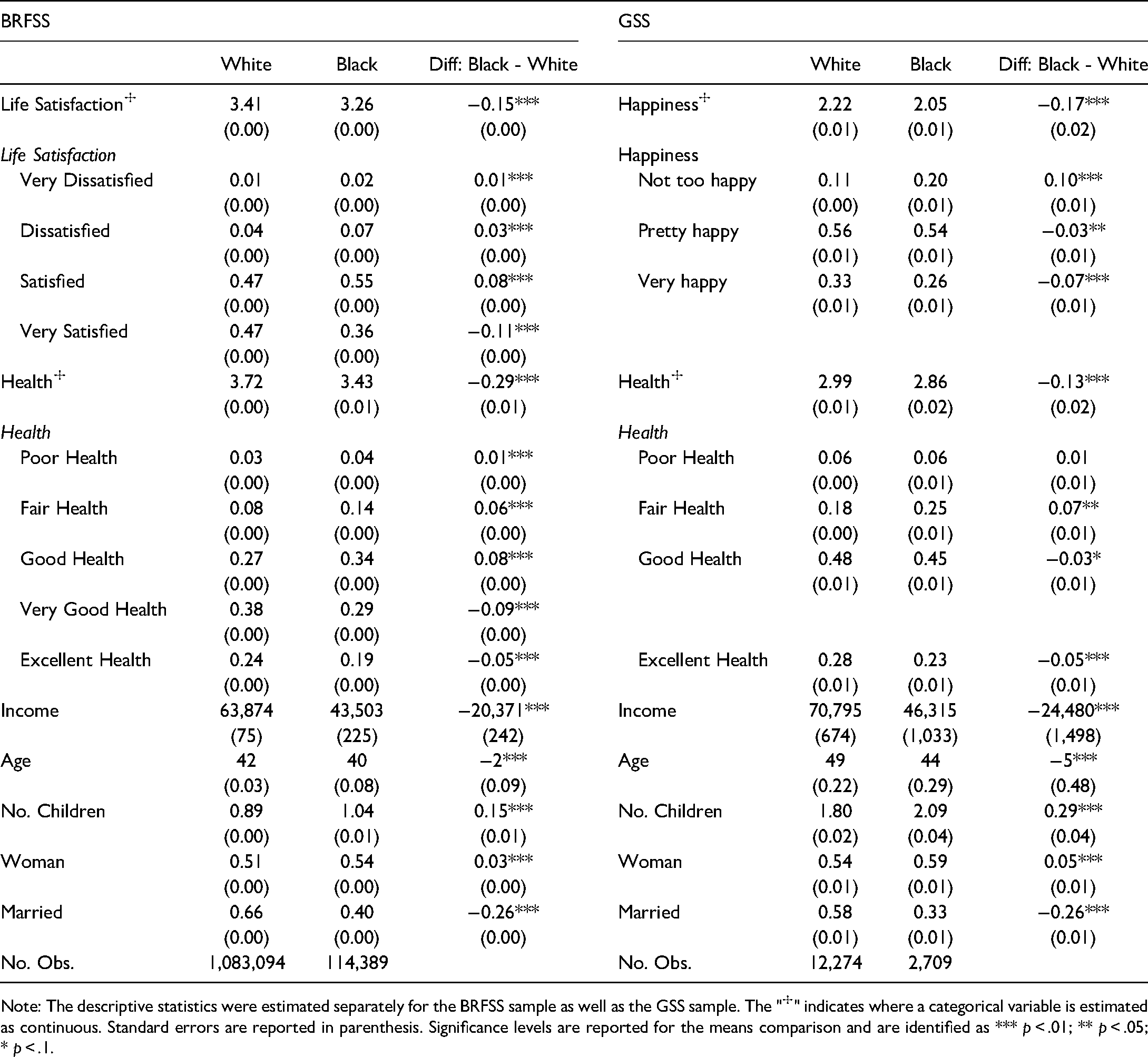
Note: The descriptive statistics were estimated separately for the BRFSS sample as well as the GSS sample. The "✣" indicates where a categorical variable is estimated as continuous. Standard errors are reported in parenthesis. Significance levels are reported for the means comparison and are identified as *** p < .01; ** p < .05; * p < .1.
A comparison of self-reported health quality between Black and White respondents reveals a similar pattern. White respondents, on average, reported higher levels of health quality by approximately 0.3 on a 5-point scale. The percentage of White respondents who reported “very good health” and “excellent health” is approximately 9-percentage points and 5-percentage points higher, respectively, than that of Black respondents. Alternatively, the percentage of Black respondents who reported “fair health” and “good health” is approximately 6-percentage points and 8-percentage points higher, respectively, than that of White respondents. The disparity in self-reported health quality measured in the BRFSS may be driven by systematic differences in how members of each racial group perceive their health quality, or it may be attributable to a systematic race specific measurement error. This argument also applies to the disparities observed in life satisfaction. However, given extensive empirical evidence reported throughout the health literature, the racial health disparities that we measure in BRFSS are likely representative of more objective measures of racial health disparities, if not an underrepresentation, as previously discussed (also see Williams and Mohammed, 2009).
Household income estimated in the BRFSS reflects the household income inequality, as an indicator economic disparity, reported between White and Black Americans. U.S. Census data shows that in 2016 the median income among White households was approximately $65,000 while the median income among Black households was approximately $40,000, a difference of $25,000 (Chetty et al., 2018). The difference in annual household income between White and Black BRFSS respondents is estimated to be approximately $20,000. The similarity between the BRFSS and the U.S. Census household income estimates, across race, suggests our sample closely measures the income and economic inequalities experienced by Black Americans.
Considering the disparities in reported health quality and household income, it is likely that the estimated differences in life satisfaction between White and Black respondents is not asymptomatic or a statistical artifact. Rather, the relatively lower life satisfaction among Black BRFSS respondents, as a representative sample of Black Americans, is likely an expression of experienced health, economic, and other inequalities and injustices – ultimately, an inequality in overall wellbeing (Hughes & Thomas, 1998). Empirical evidence supporting this notion would be revealed if differences in the levels of life satisfaction reported by White and Black respondents are explained away when racial inequalities are accounted for in the empirical model. Or in other words, levels of subjective well-being ought to be equivalent when systematic inequalities are accounted for; if not, this would suggest that there are, perhaps, some inherent differences between the racial groups’ outlook on life. Given the fact that race is socially constructed, the latter proposition is unlikely to be supported empirically.
Results
The Value of Racial Disparities
We begin our analysis with a basic OLS characterization of Equation (3) using the BRFSS sample. The results from the OLS estimation are presented in Column 1 of Table 3, along with the corresponding
SWB Estimates From the BRFSS and GSS Samples.
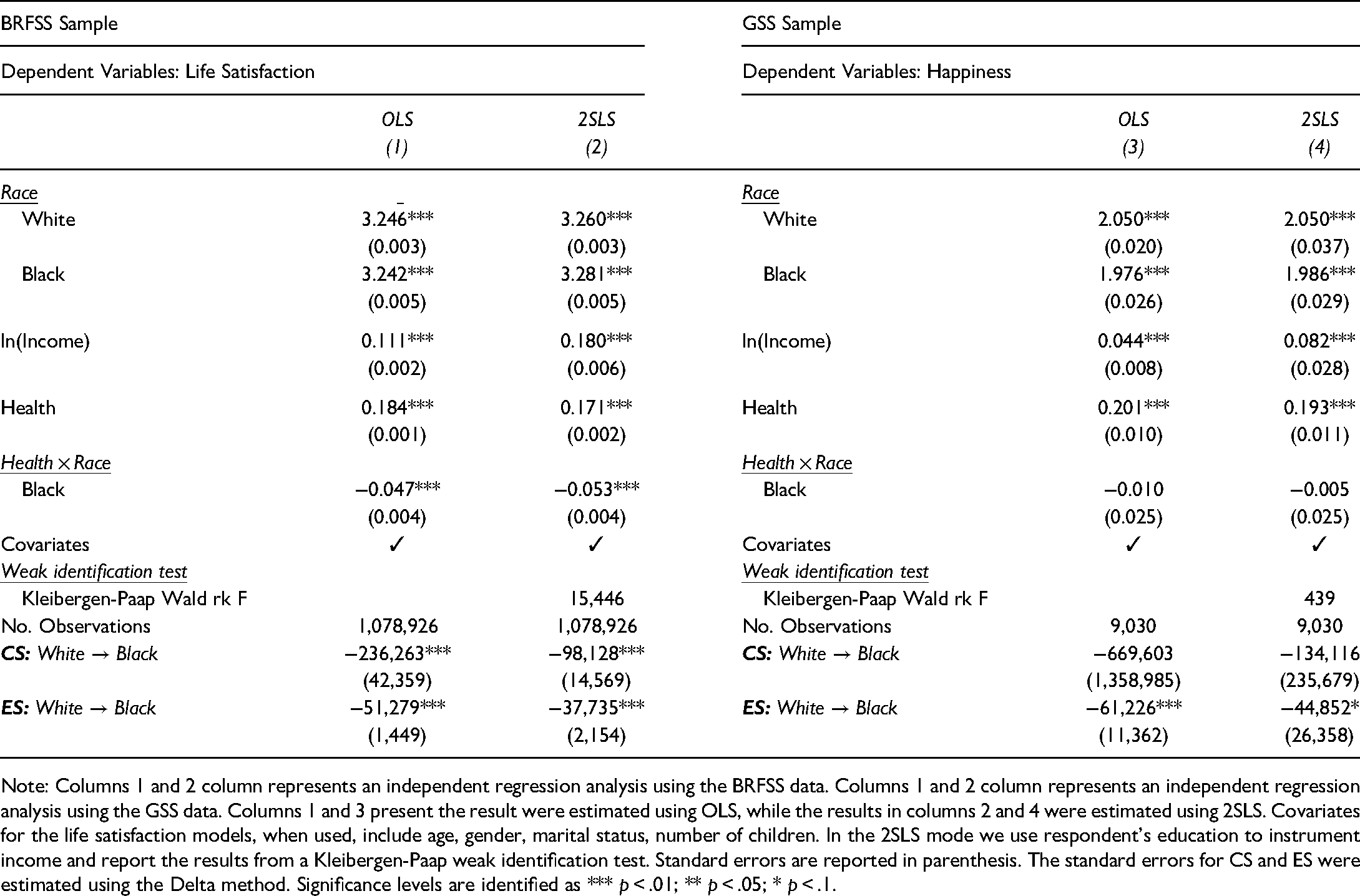
Note: Columns 1 and 2 column represents an independent regression analysis using the BRFSS data. Columns 1 and 2 column represents an independent regression analysis using the GSS data. Columns 1 and 3 present the result were estimated using OLS, while the results in columns 2 and 4 were estimated using 2SLS. Covariates for the life satisfaction models, when used, include age, gender, marital status, number of children. In the 2SLS mode we use respondent's education to instrument income and report the results from a Kleibergen-Paap weak identification test. Standard errors are reported in parenthesis. The standard errors for CS and ES were estimated using the Delta method. Significance levels are identified as *** p < .01; ** p < .05; * p < .1.
Results from the 2SLS estimation of the BRFSS sample are presented Column 2 of Table 3. A weak identification test of the instrument was conducted using the Kleibergen and Paap (2006)
Validity and Robustness
To assess the robustness and validity of our estimates, we begin our assessment by reevaluating our models using data from the General Social Survey (GSS). The GSS is a biennial survey that is designed to be representative of American sociological and attitudinal trends (NORC). The GSS sample, used in this assessment, consists of 8,148 Black and White respondents spanning seven biennial cross-sections between 2006 and 2018. Individuals categorized as White include all non-Hispanic White respondents
We re-evaluate the OLS and 2SLS models using the GSS sample and present the results in Table 3, where each model is appropriately labeled in column 3 and 4. The results from OLS model suggests a WTP
In Table 4, we display the WTP
Evaluation of ES (WTP) Estimates Between GSS and BRFSS.
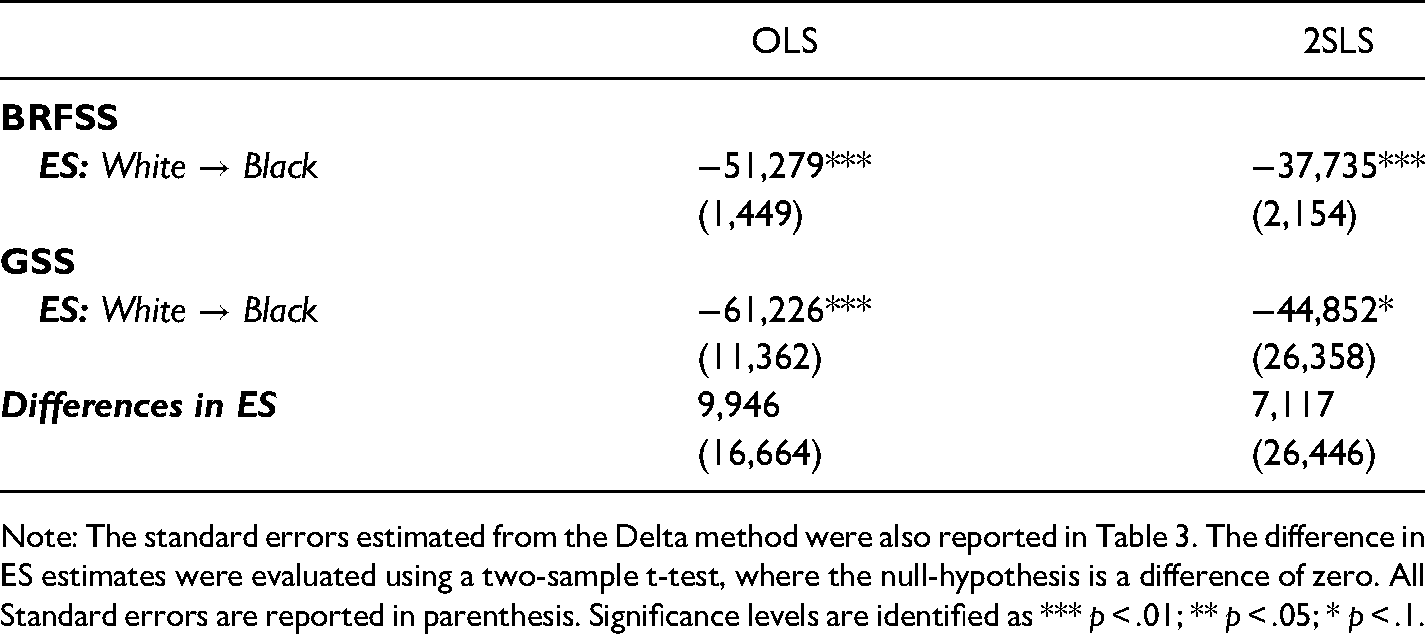
Note: The standard errors estimated from the Delta method were also reported in Table 3. The difference in ES estimates were evaluated using a two-sample t-test, where the null-hypothesis is a difference of zero. All Standard errors are reported in parenthesis. Significance levels are identified as *** p < .01; ** p < .05; * p < .1.
An Intersectional Analysis
Our final analysis investigates the economic value of inequalities at the intersection of race and gender. To account for the intersectionality of race and gender, we split the sample across gender then across race. The results from the intersectional analysis are presented in Table 5. The first two models, presented in the “Men” and “Women” columns, investigate the economic value of racial inequalities across gender. Here we use the 2SLS estimation using the BRFSS sample restricted by gender. Results from the sample of men suggests that the WTP
Estimates From the Intersectional Analysis of the BRFSS.
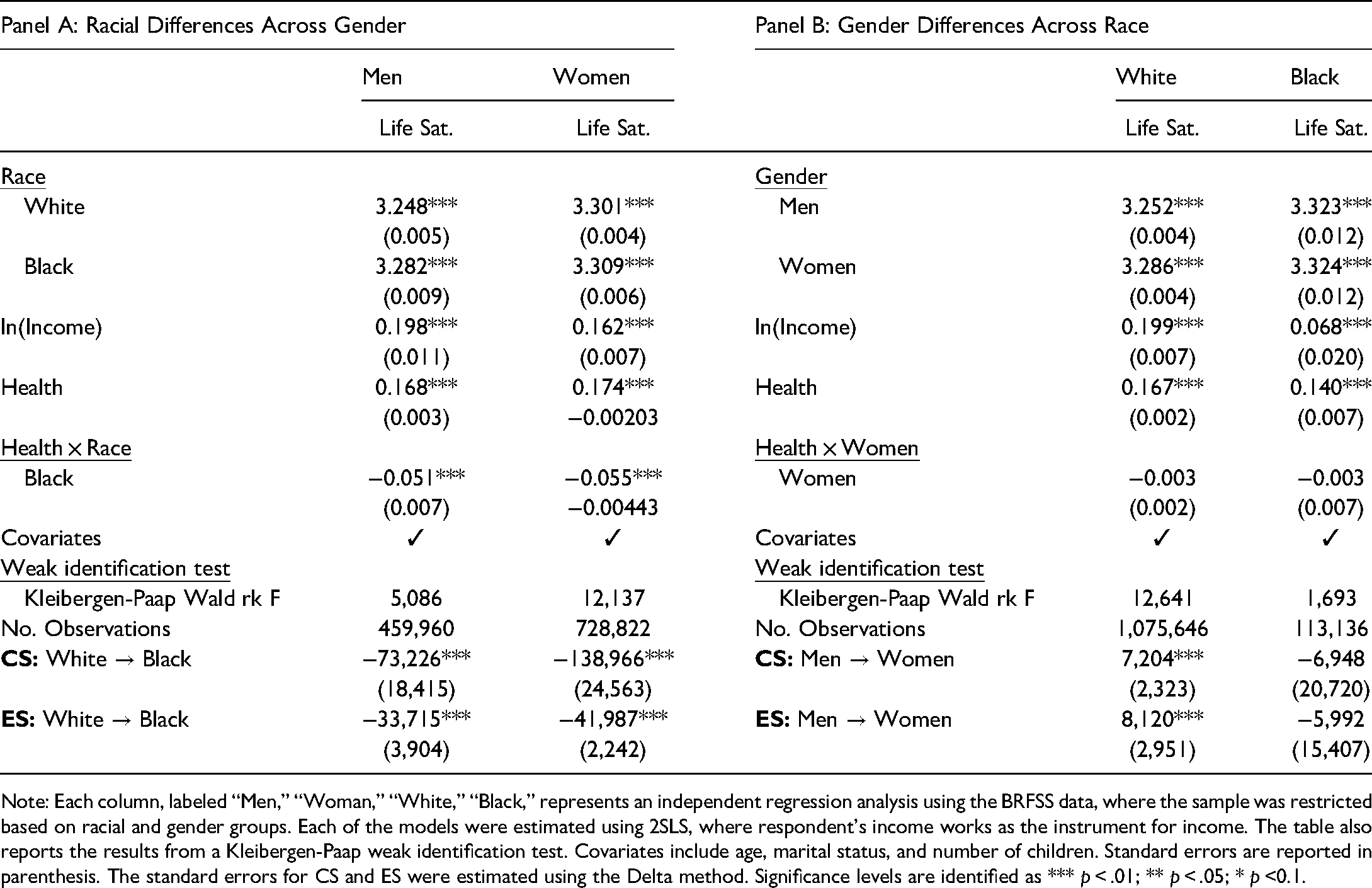
Note: Each column, labeled “Men,” “Woman,” “White,” “Black,” represents an independent regression analysis using the BRFSS data, where the sample was restricted based on racial and gender groups. Each of the models were estimated using 2SLS, where respondent's income works as the instrument for income. The table also reports the results from a Kleibergen-Paap weak identification test. Covariates include age, marital status, and number of children. Standard errors are reported in parenthesis. The standard errors for CS and ES were estimated using the Delta method. Significance levels are identified as *** p < .01; ** p < .05; * p <0.1.
The subsequent analysis restricts the BRFSS sample by race and models the inequalities experienced across gender. The results from the analysis across race are also presented in “White” and “Black” columns of Table 5. In this analysis, gender is modeled in the same manner as race was in previous model. For instance, we include both gender groups into the SWB function to represent the gender specific intercepts.
Discussion
Scholars have provided a great deal of evidence relating to the existence of racial inequality across various realms of American life. But what is the everyday cost of living as a Black person in the U.S.? What is the cost of living in a less healthy body? What are the costs of having lower levels of happiness and wellbeing due to experiences with racism? Or lower wages due, in part, to racial discrimination? One way that scholars have attempted to determine the financial costs of racial inequity is to calculate the value of lost or stolen wealth, or to establish the cost of closing the racial wealth gap (Darity, 2008; Darity & Frank, 2003; Ranson & Sutch, 1990; Shapiro, 2004). Other scholars have relied on White Americans’ perceptions and evaluations of racism to estimate these costs of racial inequality. Our study is the first study to rely on largen, nationally representative data and measures of well-being to assess the non-market valuation of racial inequality on health and income. Using data from the BRFSS as well as the GSS and models that allow us to disentangle racial disparities from a subjective well-being function, we are able to approximate compensating and equivalent surplus values for a change in health, income, and wellbeing that would hypothetically occur with a change in race—from White to Black.
The equivalent surplus (ES) value we calculate corresponds to the maximum willingness-to-pay (WTP) to avoid the inequalities. Here, we estimate the WTP to be approximately $38,000 ranging within a 95% confidence interval between $33,000 and $42,000. What's more, these welfare estimates were similar in value between two independently collected surveys – providing validating evidence of our primary results. It should be noted that the WTP estimates are bounded by one's income. In contrast to a WTA scenario, whereby somebody has asked you how much they would have to pay you to move from the status quo condition to another, WTP asks how much you are willing to pay to avoid shifting from the status quo. The median income of White Americans in the BRFSS sample is about $65,000. Essentially, the WTP estimate here suggests that White Americans would pay between 51% and 64% of their income to avoid the health and income inequalities that the average Black American lives through on a day-to-day basis. While the income disparity between White and Black respondents (≈$20,000) is a one-for-one value, the pecuniary value of the health disparity is approximately $18,000 or between 20% and 33% of the total income among the average White American.
Scholars theorize that WTP and WTA values should be about the same in a condition where the shift from the status quo to another state is about the same (Hanemann, 1991; Shogren et al., 1994). For example, these two values should be about the same if we offer a Kit-Kat rather than a Reece's Peanut butter cup; one is a decent substitute for the other. But these two values are have been shown empirically to be quite different in a condition whereby the status quo cannot be easily duplicated, or when there no close substitutes found in the market (Chapman et al., 2017; Coursey et al., 1987; Kahneman & Tversky, 1979). Though we did not consistently find statistically significant values for WTA measures
In addition to questions around racial inequality, our analyses also speak to the overlapping and intersecting costs of racial inequality and sexism. Though limited in scope, our analysis highlights the differential experiences Black women and Black men have from their White counterparts. To reiterate, the WTP estimates of shifting from a White person to a Black person across genders range from $34,000 (male shift) to $42,000 (female shift). And though the differences in shifting across gender among Black respondents aren’t significant, the findings suggest (a) race is a key lens through which gender (and life, generally speaking) is lived, and (b) all groups would be willing to pay something to avoid being a Black woman.
We should be clear about what these findings do not tell us. First, they do not suggest that being Black is valued less by Black Americans. In fact, our results reveal that when various inequities are accounted for in our models, Blacks’ scores of subjective well-being are very similar to that of Whites. Consequently, our estimates reveal not the value of being White or Black, per se, but instead the value of living through systematic inequalities in health and income. Should these inequalities disappear, we predict that we would find ES and CS values that are statistically insignificant; in fact, we did find this (Model 5, Table 3). Our estimates, then, are best understood as the willingness to pay by an average White person to avoid the disparities in income and health experienced by an average black person so as long as inequalities persist.
Although our method serves as a substantial improvement over the contingent evaluation method used in previous studies, we should reiterate a major caveat: all of the above estimates are very likely to be underestimations on at least two levels. First, what our results reveal is the costs that come from living with systematically fewer wages, lower quality health, and lower overall quality of life. Our models do not include inequalities that are manifested in wealth (Hamilton et al., 2015), quality of or access to education (Hannah-Jones, 2014), racialized debt (Seamster, 2019), and the like. It is likely that inclusion of additional factors such as the aforementioned would increase both ES and CS values. Second, research suggests that a one dollar increase income does not equate to a proportional change in health quality for Blacks as it does for Whites; or in other words, money has a greater impact on the health of Whites relative to Blacks. An excellent example of this is illustrated by the data that reveals that Black women with relatively high incomes and levels of education still suffer greater levels of infant mortality than low-income White women (Matthew et al., 2016).
In 1989, John Conyers introduced H.R. 40, a bill that calls for the study of reparations to Black Americans and did so every year for nearly three decades to no avail. 5 Meanwhile, stratification economists have been working for just as long to highlight the so-called hidden costs of racism in effort to justify reparations to Black Americans. Despite the detailed and nuanced analyses put forward by some of the U.S.'s most acclaimed scholars concerning the legacy of legalized inequality, structural racism, and race-gendered violence in this country, a conversation around redress and reparations has only recently come to the attention of a broader proportion of Americans—perhaps, due to the most recent Black freedom movement's efforts to resist and transform the national narrative of inevitable and consistent racial progress (Lebron, 2017; Taylor, 2016). Arguments against reparations are often rooted in aggressive unwillingness to acknowledge inequality that arises from systemic racism meanwhile other detractors note that we simply do not know or cannot quantify the on-going costs of racial inequality. The analyses in this paper serves to weaken both arguments.
Footnotes
Declaration of Conflicting Interests
The author(s) declared no potential conflicts of interest with respect to the research, authorship, and/or publication of this article.
Funding
The author(s) received no financial support for the research, authorship and/or publication of this article.
