




Abstract
The Gospel of John challenges the use of violence in both the exercise of power and in resistance to power. This article identifies how power is used in John, discusses who uses it, and examines how power is complicated or inhibited within the narrative. God and the Logos are introduced in the Prologue as the Gospel’s most powerful figures, yet their power is resisted. The Jewish leaders (often co-identified with “the Jews”) hold sociocultural power, though it is limited by Rome. The Empire looms in the background until the passion narrative, in which Roman power is relativized to the power of the empire of God. Cosmic evil co-opts Rome and the Jewish leaders and serves as the most dominant force arrayed against Jesus in the Fourth Gospel, even if constrained. Jesus’s power is superior, yet he exercises self-restraint. The article then explores the resistance practices to dominant power by the Jewish leadership, Peter, then Jesus, focusing on the arrest and (quasi-)trial in John 18. While “the Jews” resort to violence by colluding with Rome, Peter assaults with a sword then denies Jesus. Although greater in power than the arresting party and judicial authorities, Jesus responds to threats with nonviolence, undermining an imperial imagination sustained by ideologies of violence and death.
Introduction
It was dark. And on this night, there would be no narrow escape, no evasive fading into the crowd. His time had come, and an entire military cohort was now on the scene with their informant, along with the officers of the religious authorities. When the glow of their lanterns cast shadows across the garden, Jesus rose to meet them and supplied a threefold admission (“I am (he)”). Peter, however, drew a sword, then drew blood, and moments later supplied a repeated denial of the one he had just violently defended (“I am not (he)”). The contrast between Jesus and Peter in John 18 is between their responses to power and threat. One attacks and denies; the other, who is portrayed as having great power, yields and endures, then undergoes capture and death.
Though often “read from above” by those with varying forms of access to dominant institutions in Western culture, the Gospel of John has been widely understood as a text “written from below,” the product of a social network largely removed from the established mechanisms of power in its own day. “Johannine Christianity” is not the Western Christianity of European (and later North American) Christendom. Biblical scholarship is becoming more attentive to Christendom’s complicity in the forceful exertion of colonial will. It would be difficult, however, to sustain the idea that the “John” behind the Fourth Gospel and his eponymous letters held or even aspired to imperial power that he could use or abuse (though certain institutions of power have undeniably enlisted his voice for their violent agendas). Written “from below,” these are not the publications of a hegemonic political force from the ancient Mediterranean world. Perhaps because of this marginal social location amid the instability of regional conflicts, the author is acutely conscious of power dynamics and alert to varying modes of resistance to dominant forces that include violence and nonviolence. 1 Writing is itself an act of nonviolent resistance while also an exercise of power. 2 The purpose of this article is to identify where power resides within John’s narrative, evaluate how it is wielded, then discuss three different paths of resistance to more dominant powers, noting how John commends nonviolence in the face of social, political, militaristic, and cosmic forces. I conclude with reflections on how John might be read today when the heirs of his tradition reside in different social locations to that of the movement from which it emerged.
Identifying power in the Fourth Gospel
A range of groups and figures throughout John’s narrative hold authority, and they administer power in a diverse array of forms. Below I sketch the narrative development of the powerbrokers in the Fourth Gospel, beginning with God and the Logos in the Prologue before turning to the Ioudaioi (specifically, the Jewish leadership), the Romans, the forces of cosmic darkness, then Jesus himself in the narrative proper. For every character or group, power is problematized in some way, whether resisted, relativized, restrained, constrained, or limited. Among these collective figures, only the divine characters of God, Jesus, and the Paraclete refuse to use their power to commit physical violence. 3
The resisted power of God and the Logos
The Prologue establishes unequivocally that God and the Logos hold an authority both cosmic and supreme. They co-exercise the highest form of power in early Jewish tradition: creative power, the power to generate life, which of course implies the ultimate capacity to rule over that which is created. By opening the Gospel with “in the beginning” then referring to the λόγος (logos, “word”, along with the imagery of “light” and “life”), John instantly situates his readers within the scriptural accounts of creation. In a controversial Christological move, John positions the Logos as a co-creating figure alongside the Creator God of Israel (1:3–5). The demonstration of this creative, life-giving power is not isolated to cosmogony but also includes eschatology because a new creative work is underway. Receiving the Logos, human beings are newly created through divine birth ἐκ θεοῦ (ek theou), “out of God.” Later in the narrative, the sharing between God and Jesus of this creational power to give life is reaffirmed (5:21, 25–26).
The bearers of this most supreme form of power, however, may be not only unrecognized but also resisted: The true light, which enlightens everyone, was coming into the world. He was in the world, and the world came into being through him; yet the world did not know him. He came to what was his own, and his own people did not accept him. (1:9–11)
4
So, the co-creating, and thus supremely powerful, Logos entered the created realm and met resistance. Conflict within the cosmos has already been intimated with the reference to a conflict between Light and Darkness (1:5). A nuanced degree of determinism features in certain Johannine passages, but for the purpose of this article on power and violence, an important observation is that the highest form of power and its divine agents are not presented as irresistible. Moreover, there is no vision here for the divine use of violence to compel allegiance or to punish disloyalty. 5 Though the Johannine Prologue has been rightly recognized as bearing tremendous theological and Christological weight for the story that ensues, one of its thematic emphases is the contest of cosmic powers with hints of how divine power is and is not exercised.
The violent but limited power of the Jewish religious leadership
Moving into the narrative proper, the fourth evangelist immediately introduces one of his most significant character groups: “the Jews” (οἱ Ἰουδαῖοι—from now on referenced in the transliterated form, Ioudaioi 6 ). This collective unit (rendered synonymous with “the Pharisees” in 1:24 and often used as shorthand for the religious authorities 7 ) exercises significant power within the story’s social context.
First, readers learn that they possess sending power: “This is the testimony given by John when the Jews sent priests and Levites from Jerusalem” (1:19); 8 “now they had been sent from the Pharisees” (1:24). In the ancient world, an emissary represents and thus participates within the power of the sender, a dynamic actively deployed throughout the Gospel of John (most prominently in Jesus as the sent agent of the Father). Though the one sent represents the authority and voice of the sender, the former is usually subordinate to the latter. The sending power of the Ioudaioi, repeatedly depicted by John as powerholders in the centralized locus of cultic power, is clearly not to be taken lightly since the commissioned functionaries press John the Baptist “so that we might give an answer to those who sent us” (1:22; AT).
The Ioudaioi are also invested with the power to question. In their initial reference, one can detect through their messengers an investigative approach to John the Baptist: “Who are you?” (1:19); “What then? Are you Elijah?” (1:21); “Are you the prophet?” (1:21); “Who are you?” (1:22); “What do you say about yourself?” (1:22); “Why then are you baptizing if you are neither the Messiah, nor Elijah, nor the prophet?” (1:25). Their questioning continues with Jesus in John 2 and 3: “What sign can you show us for doing this?” (2:18); “This temple has been under construction for forty-six years, and will you raise it up in three days?” (2:20); and, from Nicodemus, a “ruler” of the Ioudaioi, “How can anyone be born after having grown old? Can one enter a second time into the mother’s womb and be born?” (3:4); “How can these things be?” (3:9). 9 Such persistent questioning seems elevated to the level of interrogation, a prerogative of those in power.
Another demonstration of the Ioudaioi’s authority is the power to point out incursions of religious practice: “So the Jews said to the man who had been cured, ‘It is the sabbath; it is not lawful for you to carry your mat’” (5:10). The Pharisees/Ioudaioi are immediately on the scene investigating after the man born blind receives his sight on the Sabbath (9:13–34). Later in the passion narrative, they ask Pilate to finish off the victims of crucifixion and remove their bodies to avoid ritual offense (19:31).
More indirectly, one can discern that in John’s portrayal of the Ioudaioi, they carry the power of symbolic production and management. 10 These Jewish leaders are most qualified to decry religious infractions because they regulate the constitutional elements of socioreligious culture. 11 In John, these elements include material symbols such as the temple and the stone water jars at Cana, as well as the cultic imagery and performances during the festival celebrations. These feasts are specifically denoted as events “of the Ioudaioi” (τῶν Ἰουδαίων, tōn Ioudaiōn—2:13; 5:1; 6:4; 7:2; 11:55; 19:42; cf. 2:6 which refers to the καθαρισμὸν τῶν Ἰουδαίων, katharismon tōn Ioudaiōn). Though most individuals in this Gospel are ethnically Jewish, John seems to be purposefully ascribing these influential resources of symbolic capital as part of the hegemony of the Ioudaioi who hold power in the narrative. 12
The components of power-brokerage thus far identified as indicative of the Jewish leadership are part of the broader power to define and arbitrate group identity. 13 John, of course, is prescribing his own vision of group identity in the social environment devastated by the Jewish War and the destruction of the temple. As competing visions of “Israel” shaped post-70 CE Jewish discourse, John (usually) depicts the Ioudaioi as religious leaders (plus those aligned with their ideological leanings) whose idea of “Israel” holds sway in Jesus’s day (and perhaps more directly in his own day). Jason Staples has provided robust evidence that the Greek term Ἰουδαῖοι does not necessarily refer in early Jewish and late biblical texts to all “Jews” but often to a “subset” of the wider people of God collectively belonging to the label “Israel.” 14 Similarly, Christopher Blumhofer argues that the Ioudaioi emerged out of post-exilic contexts as a particular Jewish group, associated with Judah as the former southern kingdom of biblical Israel, that “embody a particular way of life that is an argument for how to live faithfully as God’s people.” 15 Having developed their convictions about a restored “Israel” in the face of threatening geopolitical forces, these specific Ioudaioi have a clear vision into which they are ready to lead the people of God in this new crisis. In John’s narrative presentation of their aims, these Ioudaioi seem to envision bloodline and ethnic particularity (along with faithful constitutional practice expressive of that particularity) as criteria for covenant membership. 16
This level of regulatory control to arbitrate socioreligious life and define the particulars of identity means that the Ioudaioi also wield the power to instill fear. 17 And the Ioudaioi are feared in John’s narrative world because they hold punitive power, that is, the power to persecute, ostracize, and exclude (e.g., 5:16; 9:22, 34). This authority to identify and oppose dissent or religious infraction aggressively is substantiated by the power to commission arrests (πιάζω, piazō: 7:30, 32, 44; 8:20; 10:39; 11:57; συλλαμβάνω, sullambanō: 18:12), even though this power seems ineffectual when it comes to arresting Jesus prior to his hour.
Finally, the Ioudaioi demonstrate the intention to extend their power beyond stoking fear and excommunicating deviants to actual violence. Twice Jesus seems narrowly to escape stoning by the Ioudaioi (8:59; 10:31–33; cf. 11:8), and there are multiple references to their plotting not only the death of Jesus (5:18; 7:1; 11:53) but also the death of Lazarus (12:10). Yet their power to kill is complicated and limited. Despite the misfired attempts at stoning Jesus, the Ioudaioi acknowledge that a higher authority limits their power to execute. After delivering Jesus to Pilate, the Roman prefect instructed, “‘Take him yourselves and judge him according to your law’. The Jews replied, ‘We are not permitted to put anyone to death’” (18:31). Some have wondered if the Ioudaioi have been granted the right to carry out capital punishment in cases of religious blasphemy but not in cases of political machinations, which would rest in the power of Rome and its officials. 18 Either way, the Ioudaioi lack the legal authority to have Jesus tried and executed as an aspiring (and thus seditious) king.
Despite their range of powers, the Ioudaioi also seem to fail in their attempts to silence Jesus. He withstands their verbal challenges in a series of rhetorical debates (5:18–47; 6:41–59; 8:12–59; 10:19–39) and evades their arresting officials (7:45–46) as well as their stones (8:59; 10:39). Neither can the Jewish leaders quell the movement developing around him: “Look, the world has gone after him!” (12:19).
In summary, the Ioudaioi constitute a powerful character group in John who are willing to consider, plot, and enact violence even though they must exercise their authority within the strictures of a more dominant (and more violent) power broker: Rome. And despite their range of socioreligious powers, the Jesus movement that grows and draws interest even from their own ranks exceeds their capacity to silence and shut down.
The violent yet relativized power of Rome
Though Roman power dominates the geopolitical realities of the Fourth Gospel’s milieu, John is ostensibly unimpressed, and Rome’s power remains spectral in the narrative until the passion narrative. John’s critique of Rome-dictated reality, however, even when subtle, would not have been lost on his ancient audience, a critique some scholars (convincingly, I think) find stitched across every strip of papyrus touched by his pen. 19 These studies have alerted readers to possible “hidden transcripts” within the Fourth Gospel, prompting insights and allowing for more vivid contrasts. 20 John’s particular theology of the cross as an emblem of exaltation can only be appreciated when understood against the countervailing backdrop of imperial ideology. The odd nature of Jesus’s kingship (which includes his refusal to be made king by the crowd in John 6:14–15) is surely juxtaposed with imperial rule, a contrast brought acutely to the narrative foreground in the choice between Jesus and Caesar as King of the Ioudaioi (19:15). But John’s overall narrative program seems more invested in dismissing and relativizing Roman power than in accentuating its comprehensive influence or in calling for action against its incontrovertible might. Dismissal and relativization are the primary Johannine strategies of dealing with Empire/empire, instantiated in Jesus’s interaction with Pilate.
These strategies do not deny, however, the actual powers of Rome. Specifically, this (post-70 CE) narrative acknowledges that Rome has the power to sustain or terminate the Ioudaioi’s social and cultic vision. For the Jewish leadership within the story, the dark prospect ever looms that, as the chief priests and the Pharisees put it in John 11:48, “the Romans will come and take away both our place (τὸν τόπον, ton topon) and our nation (τὸ ἔθνος, to ethnos).” In this one line issued to the Sanhedrin, John encapsulates the pressure point at the heart of Rome’s relationship to the Jewish leadership. The τόπος in view here is most likely Jerusalem, and particularly the temple, which (roughly) serves as the site of the Ioudaioi’s power. 21 For the Ioudaioi, no “nation” exists apart from the “place” of the temple in Jerusalem. Absent the latter, the former is nullified. The preservation of place, and thus nation, must be maintained at any cost. Fundamental to the Ioudaioi’s vision of “Israel” are the centralized functions of Jerusalem and its temple. The position is entirely understandable and readily premised on sacred texts in Israel’s religious tradition. Yet John’s readers are acutely aware of that jagged hole in Jerusalem’s skyline. A vision for Israel’s future hinged on the temple has since been proven unsustainable, heightening the irony. Even so, within the actual narrative, the Jewish leadership is so determined to avoid Roman interference with Jerusalem’s cultic center that they themselves plot violence, “that one man should die for the people, not that the whole nation should perish” (11:50).
The Jewish leadership’s violent plot, however, necessitates further partnership with Rome, because only Rome possesses full-scale socio-political power to arrest and to kill. Both attempts by the Ioudaioi to arrest Jesus have been foiled (7:45–46; 10:39). They secure success only when Judas brings to the garden not only officials from the chief priests and Pharisees (groups identified collectively as Ioudaioi in 18:12) but also a Roman cohort (σπεῖρα, speira) led by a tribune (χιλίαρχος, chiliarchos), all bearing torches and weapons (18:3). The force may seem ridiculously excessive for the arrest of one man, yet prior experience dictates extreme measures and unlikely alliances (with Judas and Rome). And, as it turns out, the arresting party still fell short (literally, to a degree). When they collapse before the one they seek to bind, Rome’s power is exposed as weak and ineffectual. The arrest of Jesus in John is not a matter of force but of timing; only because his hour has now come does Jesus go willingly. 22
Now that Rome’s power to arrest has been successfully co-opted by the religious authorities, the plot turns to their attempts to instrumentalize Rome’s power to kill. Pilate articulates the imperial prerogative over life and death when he rhetorically asks Jesus, “Do you not know that I have power to release you, and power to crucify you?” (19:10). Here the Johannine Jesus issues the firmest dismissal of Rome’s supposed might and relativizes its authority: “You would have no power over me unless it had been given you from above” (19:11). Jesus has already acknowledged before Pilate that he is indeed a king (18:37; cf. 1:49). Because his “kingdom is not out of this world” (18:36, AT), his servants have no need to struggle (ἁγωνίζομαι, agōnizomai) and stage a violent rescue operation. The aim is to bear witness, not arms (18:37). 23 Jesus refuses to resist Rome not because he lacks power but because Rome is ultimately insignificant and uninteresting.
For John, Rome is primarily an agent of violence, capable of the destruction of the temple and yet serviceable to the Jewish leaders for the arrest and execution of Jesus. Though the Ioudaioi live under the threat of the former, Rome’s efficacy in violence is such that they seek its help in securing the latter, craftily utilizing imperial power for their own violent ends.
The violent yet constrained power of cosmic evil (darkness, death, and the devil)
John is more interested in the power-brokerage underway behind the scenes. Jesus is barely interested in Rome because Roman rule is merely a front for another’s rule. The polemic is so fierce with the Ioudaioi because they have unwittingly partnered with ὁ διάβολος (ho diabolos, “devil”), the most violent of figures, whose impulse is deceit and murder (8:44; cf. 1 John 3:8). Evil is not an abstract concept in John, even if it is expressed at times with metaphysical terms such as “darkness”; for John, evil is personal and personified, ὁ πονηρός (ho ponēros), “the evil one.” Its power poses the greatest threat to the mission of Jesus.
Cosmic evil holds the power to rule the κόσμος (kosmos, “universe”). The great figure of Caesar hardly inspires fear or commands respect in the Fourth Gospel. Caesar is not “the Savior of the world,” as material propaganda proclaimed.
24
This role belongs, of course, to Jesus (4:42; cf. 1 John 4:4). Neither is Caesar “the ruler of the world.” That role belongs to the devil (12:31; 14:30; 16:11). This figure’s dominion of darkness is comprehensive (“the whole world lies under the power of the evil one,” 1 John 5:19) and actively encroaching (“walk while you have the light, so that the
The power to kill, and the intent to do so, is perhaps cosmic evil’s most distinctive trademark in the Johannine tradition: “You are from your father the devil, and you choose to do your father’s desires. He was a murderer from the beginning.” (John 8:44; cf. 1 John 3:12). For John, the violence perpetrated against Jesus is ultimately the work of cosmic evil (“The devil had already put it into the heart of Judas son of Simon Iscariot to betray him,” John 13:2). Those who demand and enact that violence are in collusion with the darkest of forces, more powerful than the Ioudaioi and mightier even than Rome.
Yet once again, this power is not totalizing. Constraints to the power of darkness are established as part of its Johannine profile in the initial lines of the Prologue: “The light shines in the darkness, and the darkness did not overcome it” (1:5). 25 Despite cosmic evil’s exploitation of the Ioudaioi, Judas, and Rome for violent ends, Jesus claims that “the ruler of this world . . . has no power over me” (14:30). Indeed, this evil figure is condemned (16:11) and “will be driven out” (12:31). The author of 1 John claims that “the Son of God was revealed for this purpose, to destroy the works of the devil” (3:8). Jesus will pray for believers to be protected from the evil one (John 17:15), but the νεανίσκοι (neaniskoi, “young people”) are praised in 1 John for having ultimately conquered him (1 John 2:13–14). The power of cosmic evil is violent, grounded in an impulse toward murder, the ending of life sourced in the creative activity of God and the Logos, yet its destructive scope is constrained.
The nonviolent and (self-)restrained power of Jesus
Within John’s narrative, among the characters and groups of the Ioudaioi, Rome, and the evil one, Jesus is unquestionably the most powerful. As established in the Prologue and intimated briefly above, Jesus somehow participates in the prerogatives and powers of God. 26 As with all the other figures under review thus far, however, the power of Jesus is also complicated in the Fourth Gospel. It is marked by restraint, though one that is self-governed.
Although the following will sound like a reference to a science fiction film featuring a “metaverse,” the first power of Jesus to identify is the power to interpenetrate cosmic domains. The Logos of the Prologue “became flesh and lived among us” (1:14). In this journey between the sphere of God and the gritty space occupied by humanity, Jesus arrives as an alien figure, as one who is “other.” His status as a divine being in our midst demonstrates the power to interrupt, to interfere (some might even say “to invade”).
John therefore presents Jesus as one who is sent, but also, like the Ioudaioi, Jesus holds the power to send (13:20; 15:16; 17:18; 20:21). The Ioudaioi hold power over formative symbols and the construction and maintenance of group identity, yet Jesus acts as though he holds the power to redefine Israel’s symbology and to redraw the lines of covenant membership. His signs and teachings about the festivals expand and rework meaning, from the light and water imagery of the Feast of Booths to the paschal imagery of Passover. The Prologue signals the end of bloodline and biological genealogy as the guarantors of belonging to the people of God (1:12–13). Reception of Jesus becomes the primary means of inclusion/exclusion (10:9; 15:5–6). Similarly, Jesus deploys the power to create and shape the new family of God while on the cross, the point at which he is ostensibly most powerless (19:26–27).
In a dramatic adumbration of his role as Israel’s divine Shepherd-King, Jesus also exhibits the power to feed. Although this may read a bit awkwardly, the sign of the multiplied loaves and fish is an act that qualifies Jesus for kingship because the administration of grain stores and the management of provisions were key royal tasks in the ancient world (hence, the hasty campaign to make him king in 6:14–15). Significantly, the feeding of the multitude is an act of provision specifically divine and unrepeatable by any mortal aspirant to Israel’s throne.
Astonishingly, Jesus is presented as having the power to enact divine judgment: “The Father judges no one but has given all judgment to the Son . . . and he has given him authority to execute judgment, because he is the Son of Man” (5:22, 27). He is also entrusted with the divine power to give life: Just as the Father raises the dead and gives them life, so also the Son gives life to whomever he wishes . . . the dead will hear the voice of the Son of God, and those who hear will live. For just as the Father has life in himself, so he has granted the Son also to have life in himself. (5:21, 25–29; cf. 14:19)
As the raising of Lazarus makes clear, the power to grant life is no mere metaphor for John. Although Jesus has just received threats of his own death (8:59; 10:31) and thus risks his life in returning to Judean territory (11:8), he still approaches the tomb of his friend and enacts this power to un-kill. Rather than commit retributive violence on the Ioudaioi who have threatened his capital punishment, he stands among them in Bethany to undo the power of death.
The power to give life is also demonstrated in the signs of healing. Disease and death have complex links to darkness and the devil in John (see, for example, 5:14; 9:2–3), so the remote healing of the official’s son, the restoration to health of the man at Bethesda’s pool, and the healing of the man born blind are all coordinated with Lazarus’s resuscitation as evidence of the power to counter cosmic evil and its effects in the κόσμος.
As acknowledged already, John also presents Jesus as possessing power over his own fate. He does not just slip out of reach when arrest or stoning is imminent; he is also fully aware of the stratagems at play (devised by both human and cosmic forces) and cognizant of the fateful timing of his “hour” (13:1). Once Satan enters Judas, Jesus asserts control by issuing the command, “do quickly what you are going to do” (13:27). He predicts the betrayal of Peter (13:36–38) and the scattering of his disciples (16:32). He knows how the arrest in the garden will unfold (18:4), and even carries his own cross to Golgotha (19:17; cf. Matt 27:22; Mark 15:21; Luke 23:26).
The power of the Ioudaioi is limited; Rome’s is relativized, and the power of cosmic evil is constrained. All resort to violence and all are in some way incomplete or debilitated in their power to enact it. In John, the power of Jesus is restrained, but not by outside forces or greater powers. The curbing of his power is by self-restraint, which is remarkable given the Johannine convictions about who Jesus is.
For John, Jesus shares the “divine identity” with Israel’s God. 27 The repeated “I am” statements, the participation in divine roles and activities (creating, giving life, judging, et al.), and the inclusion of Jesus within the oneness language of the Shema (John 10:30; cf. 1 Cor 8:6) 28 serve to reinforce directly and indirectly the “high” Christology of the Fourth Gospel. Jesus states, “No one will snatch [the sheep] out of my hand [οὐχ ἁρπάσει τις αὐτὰ ἐκ τῆς χερὸς μου, ouch harpasei tis auta ek tēs cheros mou]” (10:28), because no one is able to snatch them out of the hand of his father in whose power he participates (οῦδεὶς δύναται ἁρπάζειν ἐκ τῆς χειρὸς τοῦ πατρός, oudeis dunatai harpazein ek tēs cheiros tou patros, 10:29). These statements recall God’s protective power in Deut 32:39 and Isa 43:13:
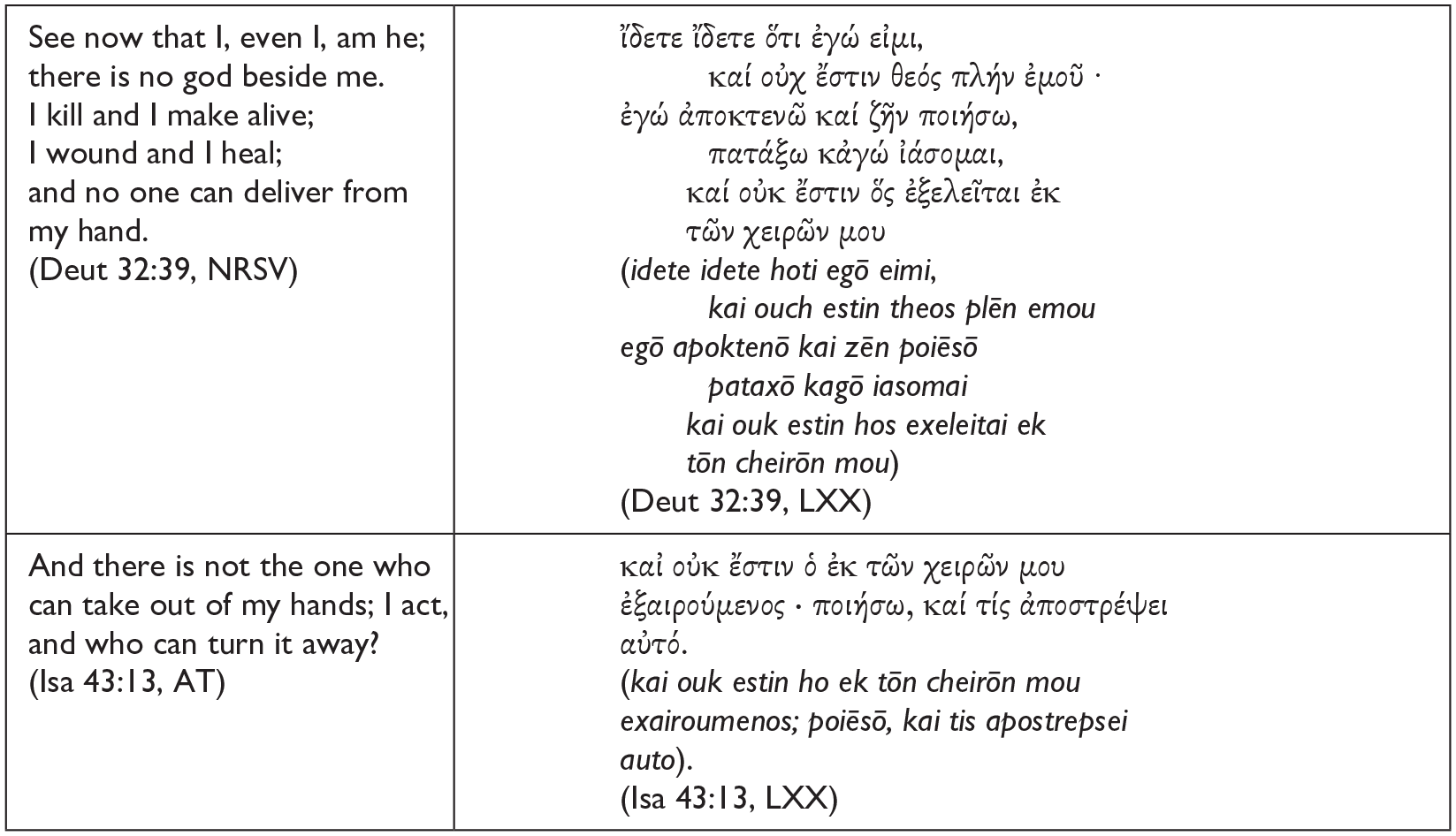
The divine authority in which Jesus shares in the Johannine portrait includes powers that are not enacted. As the scriptural texts on which John relies indicate, these powers include the irreversible power to kill and wound. Though Jesus does not commit these violent actions in the Fourth Gospel, John is fully convinced that the power to which he has access is the power of the sovereign God of Israel whose might is incontestable, whose imprisonment is impossible, whose arrest and execution are unthinkable, and who kills as well as makes alive.
Yet there Jesus stands in the garden, yielding to armed soldiers. 29 And there he is in the praetorium, the divine judge permitting a provincial governor to decree his death. The (self-)restraint is striking, and markedly in contrast to how power is stretched to its furthest limits by the Ioudaioi, presumptuously flaunted by Rome, perniciously directed by cosmic evil, and deployed for violence by all three.
Resisting power in the Fourth Gospel: Violent and nonviolent practices
Power is exercised within layered authority. A marginal group within a particular social context may wield power over weaker groups, but its performance is always constricted by the more dominant structures. Groups holding imbalanced degrees of power may also collide and jostle with one another, leveraging whatever is at their limited disposal to perpetrate, to resist, or to defend themselves. In this section on “resisting power,” my concern is with the negotiation of dominant powers by “weaker” characters: the Ioudaioi, Peter, and Jesus. Focus narrows onto the scene of Jesus’s arrest in which the Ioudaioi indirectly employ violence, Peter directly attacks, and Jesus surrenders (only after demonstrating that he does so as one who volitionally relinquishes power).
The resistance practices of the Ioudaioi: Strategizing, pressure, collusion, compromise
Although their power is limited by Rome, John carefully demonstrates that the Jewish leadership opposed to Jesus is shrewdly capable of navigating their limitations to secure desired outcomes. The Ioudaioi are strategists. In John 2, when Jesus creates such a dramatic stir in the temple, they respond first by asking, “What sign can you show us for doing this?” (v. 18). The approach is pragmatic and tactically wise in that they are testing his divine authorization. If he cannot perform a sign beyond making a ruckus, he is merely a nuisance who poses no legitimate threat. Nicodemus, “a ruler of the Jews” (3:1), seems strategic in visiting Jesus not in broad daylight by “by night” (3:2). At times, the Jewish leaders seem merely reactive to something Jesus has said and done (e.g., 6:41, 52; 7:15, 51; 8:22; et al.). At other times, however, their alarm over his speech and activity becomes sharpened into strategic thinking and planning (e.g., 6:16–18; 7:1). Their role as careful strategists is dramatically on display in the decision to warn against excommunication for anyone confessing Jesus as the Christ (9:22) and in the justification of the plot to eradicate Jesus (11:47–53). One of the less strategic moments occurs when the Jewish leaders explain why they are demanding Jesus’s death: “We have a law, and according to that law he ought to die because he has claimed to be the Son of God” (19:7). They are clear and honest, yet the effect almost fails: Pilate becomes more fearful of Jesus and more inclined to release him (19:12). The final strategic move, however, achieves the desired aim: “the Jews cried out, ‘If you release this man, you are no friend of the emperor. Everyone who claims to be a king sets himself against the emperor.’ When Pilate heard these words, he brought Jesus outside . . . ” (19:12–13a).
As this scene indicates, pressuring, alongside strategizing, is an additional response to the dominant power structure. They lack the juridical power to accomplish their plans for Jesus as well as the official capacity to determine Pilate’s actions directly, but the Jewish leaders retain enough social clout and soft power to apply pressure. In Matthew and especially Mark, the “crowd” influences Pilate’s decision-making. 30 For John (and to some degree Luke), the cunning of the Jewish leaders ultimately bends Roman power to their purpose. Although they cannot persuade him to edit the writing on the titulus (“what I have written I have written,” 19:22), in questioning Pilate’s fidelity to Caesar they press him into a position that ensures the intended ruling on Jesus. This pressure has also been exerted within the wider Jewish community life through the fear of expulsion, as discussed earlier.
Collusion is another strategy of negotiating dominant power. The Jewish leadership seems to value Rome solely for its function of stabilizing their “holy place” and “nation” (11:48). When they cannot accomplish strategies by their own limited means of power, they collude with the imperial authority structure. Having failed twice to stone Jesus, Judas and the officers (ὑπηρέται, hupēretai) of the chief priests and Pharisees (Ioudaioi in 18:12) work together with the Roman tribune and cohort to arrest Jesus. 31
Finally, compromise is a necessary response to dominant power adopted by the Ioudaioi. From the presumed acceptance of Caiaphas’s counsel to the Sanhedrin, the Jewish leadership is clearly willing to endure limitations to their own power as long as it keeps Roman power from becoming too invasive or interventionist. Since their own leadership is grounded in a conditional form of imperial sanction, they are willing to temporize and compromise. Professing “we have no king but Caesar” (though they may be entertaining some sense of expectation for a messiah, as 10:24 possibly suggests) is the chief example of their willingness to compromise to retain borrowed power. The claim of political allegiance to Caesar, whether actual or feigned, is a compromise that ennobles their demand for the death of Jesus, an illegitimate king, when Pilate seems hesitant to eliminate a royal contender. 32
Strategizing, pressuring, colluding, and compromising are all understandable modes by which marginal groups operate within social structures governed by greater powers. Though the success of the Ioudaioi and correlated Jewish leadership in John is restricted by factors unrelated to Rome (namely the timing of Jesus’s hour), they are largely effective in maneuvering the limitations of empire, especially in the passion narrative (even if their success is actually determined by an unanticipated alignment with divine providence).
The resistance practices of Peter: Assault and denial
Because he directly engages in violence as a disciple of Jesus, attention now turns to Peter’s responses to threat and dominant power. Though many interpreters have detected a competitive relationship between Peter and the Beloved Disciple in the Fourth Gospel, 33 the concern here is with Peter’s interactions not with peers or (potentially rival) colleagues, but with his resistance to the powers of Rome and the Jewish leaders (cf. 13:8). Earlier in the narrative, Peter has resisted the temptation to abandon Jesus when others left (6:60–71), perhaps under a degree of pressure from the Ioudaioi. 34 The depth of this loyalty is put to the test at Jesus’s arrest in the garden, and again some hours later by the charcoal fire in the courtyard of the high priest. When Jesus seems to have brokered the release of the disciples from the oversized arresting party (18:8–9), Peter draws a sword and attacks Malchus, severing off the ear of this servant of the high priest. 35
Surely reverberating in Peter’s own ears is Jesus’s foreboding prediction only hours earlier of his eventual betrayal (13:38). Peter had professed unswerving commitment at the table of their final meal (“I will lay down my life for you,” 13:37). His drawing of the blade in the face of a Roman cohort and officers of Ioudaioi may well be Peter’s demonstration of the loyalty Jesus has just doubted. Yet Jesus does not respond favorably to the dramatic gesture: “Put your sword back into its sheath” (18:11). Jesus flatly rejects the response of violence here. 36
Peter’s initial response in John 18 to threat by dominant powers is to assault. His second response is to deny. Jesus’s bold self-declaration of ἐγώ εἰμι (egō eimi, “I am (he) 18:5, 6, 8) is darkly echoed by Peter’s οὐκ εἰμί (ouk eimi, “I am not (he) 18:17, 25) by the charcoal fire. Warming himself in the courtyard of the high priest, the disciple is unmistakably positioned within the physical space of a more dominant power system. Still, his denials of association with Jesus are addressed to servants (though John indicates that both δοῦλοι (douloi, “slaves,”) and ὑπηρέται (hypēretai, “guards”) are standing by the fire). John does not narrate Peter weeping or shedding tears, but once the cock crows the audience recognizes that this response to power is profoundly inadequate, its cowardice amplified by the responses of Jesus to his own interrogation by the high priest.
The nonviolent resistance practices of Jesus: Protest, testimony, evasion, endurance, resurrection
As implied earlier, John installs the theme of Jesus’s conflict with dominant power as early as the Prologue (1:5). Because Jesus is so thoroughly aligned with the authority and sovereignty of God in John, he is depicted as the prime representative of the supreme power of the cosmos. So how does the most powerful character in the Gospel respond to the (supposed) dominant powers arrayed against him at various stages of the narrative?
One of Jesus’s resistance practices is protest. His dramatic act in the temple in John 2 challenges what he perceives to be corrupt activities distorting the essential function of that space as the house of God (rather than an ἐμπόριον, emporion, “market”). Though this scene features in the Synoptic accounts, only John includes the detail that Jesus crafted a “whip of cords” (φραγέλλιον ἐκ σκοινίων, phragellion ek skoiniōn; 2:15). The effect is to convey how methodical and thus intentional Jesus was in staging this protest. But questions must be addressed: is this whip wielded by Jesus comparable to the sword later wielded by Peter? Is the whip a weapon? Does the temple protest amount to an act of violence?
Largely thanks to Augustine, this scene of protest has indeed been interpreted as violent and thus taken as license for later Christian acts of violence against the heretical and wayward (C. litt. Petil., 2.10.24). 37 Yet the text makes no indication that Jesus injures or attacks anyone, and the driving out, from the freighted verb ἐκβάλλω (ekballō), of the animals in one sense excuses them from the queue of sacrifice, at least temporarily (2:15). 38 Ἐκβάλλω bears tremendous symbolic value in Johannine idiom, and this initial instance vividly illustrates the repeated theme of transfer or abrupt departure from one (symbolic) space into another. The term is later used to express the action that renders the man born blind ἀποσυνάγωγος (aposunagōgos, “forced out of the synagogue,” 9:22, 34–35), a scene that sets up the imagery of the Good Shepherd who drives out sheep and brings them into his own domain. The temple protest scene provides an early illustration of these dynamics.
The scene also prefigures the violence that Jesus himself will eventually suffer. “Zeal for your house will consume me” is the scriptural text (which John modifies from Ps 68:10 LXX/Ps 69:9) the disciples recall in their post-resurrection reflections on this protest. Though zeal (ζῆλος, zēlos), in biblical and Jewish tradition, is normally associated with vindicated violence against God’s enemies, 39 Jesus becomes the recipient whom the zeal of others consumes (a fate the disciples will face as well according to 16:2 40 ). The prior episode in Cana is designed to adumbrate the crucifixion. 41 As the setting shifts from Cana to Jerusalem’s temple, not only the foreshadowing elements of that wedding lingering in the narrative but also the twofold claim of John the Baptist point to Jesus as a sacrificial lamb (1:29, 36). When the authorities question Jesus’s act of protest, he responds with reference to his death (as a lamb 42 ) as well as to the resurrection of his (executed) body (2:19–22). Andrew Lincoln writes that the temple protest “anticipates the end of temple sacrifices through the death of Jesus as the true Passover lamb.” 43 Jesus’s protest is interruptive, highly dramatic, conspicuously public, and certainly physical, but any intimation of violence in the text ultimately prefigures the violence that puts his own body in a tomb by the narrative’s end.
Jesus also responds to dominant power structures with testimony. He explains and defends himself. He engages in debate, providing evidence and the rationale for his claims while expecting his interlocutors and accusers to do the same and legitimate their counterclaims (see, for example, 5:16–46 and 18:19–24). These interactions become fiercely heated, and, as repeatedly mentioned, death by stoning seems imminent on two occasions. In such moments of threat Jesus exhibits a third response, that of timely evasion: “Jesus hid himself” (8:59); “he escaped from their hands” (10:31, 39). In these scenes, Jesus does not stay to take the beating/execution, but neither does he retaliate in kind.
Though at times he evades, Jesus is not characteristically evasive. His decision to re-enter Judea (where “the Jews were just now trying to stone you,” 11:8) to resuscitate Lazarus shows he is neither risk-averse nor unwilling to face ongoing dangers. He even serves the one betraying him, washing the feet of Judas Iscariot who is under diabolic influence and on the verge of betrayal. Moments later, when the “hour” has come, he endures the onslaught of the powers against him. Evasion was only temporary: “And what should I say—‘Father, save me from this hour’? No, it is for this reason that I have come to this hour” (12:27). In this succumbing to the power of cosmic evil (with which the powers of Rome and the Jewish leadership have aligned), the Johannine accent lies with Jesus’s volition. He endures violence, but he does so electively, not because any other power avails, but because he wishes to obey his Father: “for the ruler of this world is coming. He has no power over me; but I do as the Father has commanded me, so that the world may know that I love the Father” (14:30–31).
Protest, testimony, evasion, endurance: these are the resistance practices of Jesus thus far discussed. Although the temple protest was physical, disruptive, and public, it was perceived by the religious authorities not as an act of violence but as an intended prophetic act (for which an accompanying “sign” would have been confirmatory). The self-testifying often results in sharp polemics, but Jesus condemns physical violence in the most intense debate (8:39–47) and evades it before it happens. Eventually he endures, yielding to the arresting party in the garden not as an act of compromise or hopeless surrender, but as an act of faithful obedience. Jesus does not resist dominant power with violence.
The collapse of the arresting party in the garden is the act of power that proves the exception and most explicitly depicts this important Johannine implication: 44 Jesus is capable of exercising disproportionate might, yet he resists. John clearly juxtaposes Peter and Jesus in the garden and the high priest’s quarters. Though attention is normally placed on the parallel confessions and denials, the Gospel writer also parallels the implements of resistance. As a perpetrator of violence, Peter raises a weapon (“Peter, having a sword, drew it and struck . . .” 18:10); as a victim of violence, Jesus raises a figurative cup (“the cup that the Father has given me, shall I not drink it?” 18:11). 45 Peter resists power by attacking a potential assailant in the garden (18:10) then by denying his affiliation with Jesus in the high priest’s courtyard (18:15–27). Jesus identifies himself (as the divine Lord with ἐγώ εἰμι), requests the release of his disciples (even the one with the sword), then permits his captors to bind and take him in a nonviolent endurance he later predicts as Peter’s own eventual fate (21:18–19). There is, however, one final resistance practice of Jesus, and this one may indeed be, in a sense, violent: resurrection.
Death is the ultimate weapon of dominant power. Nothing eliminates dissent or eradicates resistance as effectively as an execution. Jesus does not shy away from this fate. Rome is identified in the narrative as the most competent institution at the craft of death. The Jewish leaders partner with Rome because their own powers to execute are limited. As noted previously, John deems killing as the chief signature of cosmic evil (8:44; 1 John 3:12). Resurrection is thus an act of resistance, an un-killing, an undoing of physical violence, a reversal of execution, which is the most powerful act available to the forces of darkness and human institutions. Resurrection is divine symbolic violence against evil and human power that, by necessity, can only be enacted through the non-triumphalist means of first suffering and enduring death. John is clear that Jesus conquers (16:33; 1 John 2:13–14; 4:4; 5:4–5). But a conquering king who associates glory not with the power to kill but to un-kill, not with the power of swords but with a cup of nonviolent endurance, not with a throne but with a cross, is one who upturns the triumphalism of empire. And his followers conquer not through fighting (19:36) but through faith(fulness) (1 John 5:4–5). Jason Ripley writes, John shapes aspects of his narrative about Jesus to critique various ideologies of violence and piety current in his environment and to provide a model of nonviolent faithfulness to God for those threatened by the discourse of religious violence.
46
Conclusion: John’s breaking of the imperial imagination?
This article has provided a brief analysis of the relationship between power and physical violence in John’s Gospel, examining how four groups or individuals in the narrative use power. Alert to the complex dynamics of social and political struggle, the evangelist portrays the power of the Ioudaioi as limited, Rome’s as relativized, that of cosmic evil as constrained, and the power of Jesus as (self-)restrained. Having identified Rome and the forces of darkness as the dominant violent powers in the Johannine story, I then discussed the resistance practices of the marginalized Ioudaioi, along with those of Peter and Jesus. Violence can certainly issue from harsh rhetoric of the kind Jesus is depicted as using in this Gospel, and readers of this text might be tempted to promote a non-physical “symbolic violence” that stifles the imagination so no alternative reality can be envisaged. 47 But John seems programmatically invested in critiquing the use of physical violence by those who hold power, as well as by those who resist it.
If this “John” is indeed a leading figure of a politically weak social group on the fringes of ancient Mediterranean power structures and thus wrote “from below,”
48
then challenges arise for those who would read the text “from above” to justify force, coercion, and especially violence for self-interested gains. The project of postcolonial criticism is exposing how biblical texts have been co-opted by (primarily Western) powers to exploit and re-narrate reality for their own triumphalist ends. Many postcolonial interpreters of John, however, find little in which to rejoice. A text in which an outsider (the Logos) invades the space of another (through Incarnation), imposes a totalizing sense of reality (“I am the way, the truth, the life”), and uses imperial self-designations (“Savior of the World”) is met with suspicion and sounds too much like the empire it challenges.
49
Fernando Segovia writes, The Gospel of John is a text bent on claiming and exercising power—in fact, absolute power—in both the religious and political spheres at once. It invalidates and displaces all existing institutions and authorities, values and norms, ideals and goals, while promoting and emplacing alternative authorities and institutions, norms and values, goals and ideals. Such a project the Gospel conceives and articulates from within the imperial-colonial framework of Rome and, in so doing, highlights and scrutinizes the differential relationship of power operative within such a context. In sum, a postcolonial text.
50
Surely such a reading is understandable given the vicious cycle of colonial and imperial power transfers in the current geopolitical landscape and throughout history, as one regime gives way to another that eventually repeats the abusive powers of what it replaced (at times using the Bible to vindicate hegemonic practices). Though my own social location and background limits my reflection on these power dynamics, I suggest one can read the Johannine message not as a campaign for (re-)colonialization of a different name, but as a breaking of the imperial imagination, an exposé of the symbolic violence that shapes reality, and a decommissioning of the physical violence used when cracks appear in the imperial edifice. Perhaps only someone from outside systems of violence and mechanisms of power can stand as the most powerful figure in a garden and speak before captors to the lone defender: “put your sword back in its sheath.”
Footnotes
1.
As Judith Lieu writes, “The Gospel narrative is played out against a backcloth deeply resonant with social upheaval.” Lieu, “Messiah and Resistance in the Gospel and Epistles of John,” in Redemption and Resistance: The Messianic Hopes of Jews and Christians in Antiquity, ed. Markus Bockmuehl and James Carleton Paget (London: T&T Clark, 2009), 97–108 (104). See also Richard A. Horsley, Jesus and the Spiral of Violence: Popular Jewish Resistance in Roman Palestine (Minneapolis: Fortress, 1993).
2.
“The very fact of writing a Jesus book may be viewed as a subversive act.” Tom Thatcher, Greater Than Caesar: Christology and Empire in the Fourth Gospel (Minneapolis: Fortress, 2009), 4.
3.
I am aware that “violence” is increasingly attributed to speech, not simply physical acts. For a discussion on this trend, see Greg Lukianoff and Jonathan Haidt, The Coddling of the American Mind: How Good Intentions and Bad Ideas Are Setting Up a Generation for Failure (London: Penguin, 2019), 81–98. Although I acknowledge throughout the article the polemical sharpness of the Gospel’s language, I am primarily understanding “violence” in its meaning of physically harmful acts of conflict.
4.
All biblical translations are from the NRSV unless qualified with “AT,” indicating my own (“author’s translation”).
5.
Jörg Frey argues, “There is no colsed dualism” in the Gospel of John. Frey, “Dualism and the World in the Gospel and Letters of John,” in The Oxford Handbook of Johannine Studies, ed. Judith M. Lieu and Martinus C. de Boer (Oxford: Oxford University Press, 2018), 274–91 (288). Divine and human agency are mysteriously and perhaps paradoxically coordinated in this Gospel in such a way that resistance to God and the Logos is both willful and yet also a function of an enslaved will (see, for example, 8:12–59).
6.
The decision to use the transliteration of Ἰουδαῖοι here is not a denial that John’s most negatively portrayed (human) characters are Jews, nor is it to skirt one of the most difficult debates in contemporary Gospel scholarship. The purposes of this essay are narrowly defined, and the transliteration keeps the terminology of the text, which is historically situated and invested in a particular rhetorical program. For more, see the discussions in Ruth Sheridan, “Issues in the Translation of οἱ Ἰουδαῖοι in the Fourth Gospel,” JBL 132.3 (2013): 671–95; and Christopher M. Blumhofer, The Gospel of John and the Future of Israel, SNTSMS 177 (Cambridge: Cambridge University Press, 2020), 15–16. For my own arguments on John’s alleged anti-Judaism (in which I translate οἱ Ἰουδαῖοι as “the Jews” using inverted quotation marks), see Andrew J. Byers, John and the Others: Jewish Relations, Christian Origins, and the Sectarian Hermeneutic (Waco, TX: Baylor University Press, 2021), 45–94 (esp. 50–53).
7.
Though here indeed coextensive with the Pharisees, elsewhere in John Ioudaioi, they are closely linked with this group (at times with the chief priests, as well) but not equated.
8.
The Greek phrase in 1:19 reads ὅτε ἀπέστειλαν πρὸς αὐτὸν οἱ Ιουδαῖοι ἐξ Ἱεροσολύμων ἱερεῖς καὶ Λευίτας (hote apesteilan pros auton hoi Ioudaioi ex Hierosolymōn hiereis kai Leuitas; “when the Jews from Jerusalem sent priests and Levites to him”). The Jerusalem base of the Ioudaioi precedes reference to the emissaries, a reality obscured in translations, such as the NRSV, that usually render the phrase “the Jews sent priests and Levites from Jerusalem.” The Ioudaioi are (mostly) associated with Jerusalem, the center of socioreligious power, just as directly as the priests and Levites.
9.
The questioning continues as the narrative progresses. For further discussion, see Byers, John and the Others, 78–83.
10.
Horsley points out that the Jewish leadership often adapted traditional religious customs to accord with the imperial power structure from which they benefitted (Jesus and the Spiral of Violence, 29–30). Arthur M. Wright, Jr. argues these Jewish leaders were not just “spiritual” but local elites beholden to Roman power. Wright, The Governor and the King: Irony, Hidden Transcripts, and Negotiating Empire in the Fourth Gospel (Eugene, OR: Pickwick, 2019), 55–58. See also Thatcher, Greater Than Caesar, 46.
11.
On “constitution” as a set of identity-defining practices, see John M. G. Barclay, “Ἰουδαῖος: Ethnicity and Translation,” in Ethnicity, Race, Religion: Identities and Ideologies in Early Jewish and Christian Texts, and in Modern Biblical Interpretation, ed. Katherine M. Hockey and David G. Horrell (London: T&T Clark, 2018), 46–58.
12.
On the hegemony of symbolic production, see James C. Scott, The Weapons of the Weak: Everyday Forms of Peasant Resistance (New Haven: Yale University Press, 1987), 314–18. Scott notes that the cultural experience of carnival is one in which power is often awkwardly balanced between the elite and the subordinate classes. This observation may be helpful in understanding how tense the social environment becomes between the Johannine Jesus’s attempts to re-symbolize the feasts “of the Ioudaioi.” See also James C. Scott, Domination and the Arts of Resistance: Hidden Transcripts (New Haven: Yale University Press, 1990), 177–78.
13.
“It is important to note that ‘the Jews’ are here presented as the actors who both initiate and arbitrate the matter of Jewish identity.” Martinus C. de Boer, “The Depiction of ‘the Jews’ in John’s Gospel: Matters of Behavior and Identity,” in Anti-Judaism and the Fourth Gospel, ed. Reimund Bieringer et al. (Louisville: Westminster John Knox, 2001), 141–57 (154).
14.
Jason A. Staples, The Idea of Israel in Second Temple Judaism: A New Theory of People, Exile, and Israelite Identity (Cambridge: Cambridge University Press, 2021), 51–53.
15.
Blumhofer, Gospel of John, 16.
16.
For more on this line of argument, see Byers, John and the Others, 45–94.
17.
See 7:13; 9:22; 12:42–43; 19:38; 20:19.
18.
See Craig. S. Keener, The Gospel of John: A Commentary, 2 vols. (Peabody, MA: Hendrickson, 2003), 2:1107–109.
19.
For example, see David K. Rensberger, Overcoming the World: Politics and Community in the Gospel of John (London: SPCK, 1988), esp. 87–106; Warren Carter, John and Empire: Initial Explorations (London: T&T Clark, 2008); Thatcher, Greater than Caesar; and Wright, Governor and the King.
20.
The phrase “hidden transcripts” is, of course, from the work of James Scott cited previously, and each of the studies just cited draws on Scott’s model.
21.
Mariane Meye Thompson, John: A Commentary, NTL (Louisville: Westminster John Knox, 2015), 253.
22.
Note John’s brief remark at the scene’s opening that Jesus faced his would-be captors while “knowing all that was to happen to him” (18:4).
23.
Rensberger astutely observes that, although Jesus’s kingdom is not of this world, what is not of the world may nevertheless be in the world, as Jesus and his followers are (see 17:14–18), and Jesus’ words about his kingship do not deny that it is a kingship, with definite social characteristics. Instead, they specify what those characteristics are. It is not a question of whether Jesus’ kingship exists in the world but of how it exists; not a certification that the interests of Jesus’ kingdom are ‘otherworldly’ and so do not impinge on this world’s affairs, but a declaration that his kingship has its source outside this world and so is established by methods other than those of the world. (Overcoming the World, 97)
24.
See Craig A. Evans, “Mark’s Incipit and the Priene Calendar Inscription: From Jewish Gospel to Greco-Roman Gospel,” JGRChJ 1 (2000): 67–81.
25.
Whether καταλάμβανω katalambanō is best translated here as “overtake” or “comprehend,” the point stands.
26.
The Spirit-Paraclete is also presented as a powerful divine figure correlated to the Father and Son. He holds the power to recall the disciples’ memories (14:26), to reveal and guide into truth (16:13–15), and to convict/prove wrong (from ἐλέγχω): he will prove the world wrong about sin and righteousness and judgment: about sin, because they do not believe in me; about righteousness, because I am going to the Father and you will see me no longer; about judgment, because the ruler of this world has been condemned. (16:8–11)
27.
I am drawing here on Richard Bauckham, Jesus and the God of Israel: God Crucified and Other Studies on the New Testament’s Christology of Divine Identity (Grand Rapids: Eerdmans, 2008).
28.
For wider discussions on Jesus’s inclusion within the Shema’s language of divine oneness, see Andrew J. Byers, Ecclesiology and Theosis in the Gospel of John, SNTSMS 166 (Cambridge: Cambridge University Press, 2017), 103–52; Byers, John and the Others, 105–109; Lori A. Baron, The Shema in John’s Gospel, WUNT 2/574 (Tübingen: Mohr Siebeck, 2022), esp. 145–85.
29.
For a comparative study of the arrest scene in which the author argues that Luke and John most emphatically emphasize Jesus’s commitment to nonviolence, see Eben Scheffler, “Jesus’ Non-Violence at His Arrest: The Synoptics and John’s Gospel Compared,” Acta Patristica et Byzantina 17.1 (2006): 312–26.
30.
Matt 27:15, 20, 24; Mark 15:8, 11, 15.
31.
See recent discussion in Wright, Governor and the King, 77–80.
32.
Note, however, that Barabbas, whose release they secure with Pilate, is a λῃστής (lēstēs), which may designate him as a political revolutionary. See comments in Rensberger, Overcoming the World, 99.
33.
For a positive reading of Peter’s juxtaposition with the Beloved Disciple, see Byers, Ecclesiology and Theosis, 213–23. For a helpful overview of the debate, see Bradford B. Blaine Jr., Peter in the Gospel of John: The Making of an Authentic Disciple, SBL AcBib 27 (Atlanta: Society of Biblical Literature, 2007), (8–18, for the literature review).
34.
The existence of such pressure can only be inferred from the text, not confirmed. The primary provocation to turn away from discipleship is Jesus’s own disturbing words about eating and drinking his flesh and blood (6:48–71). Also worth noting Peter is not “sifted” by Satan in John (see Luke 22:31), nor is Peter accused of working under Satan’s influence (as he is in Matt 16:23; Mark 8:33). For John, satanic involvement in the group of disciples is isolated to Judas (6:70–71; 13:2, 27).
35.
Wright (Governor and the King, 104–105) astutely points out the potential irony in the use of ἕλκω (helkō, “to draw”), normally connotated positively in John.
36.
A longstanding debate has been revived in JSNT claiming that Jesus was an apocalyptic leader willing to engage Rome physically with holy war. For arguments in support, see Dale B. Martin, “Jesus in Jerusalem: Armed and Not Dangerous,” JSNT 37.1 (2014): 3–24; Fernando Bermejo-Rubio, “(Why) Was Jesus the Galilean Crucified Alone? Solving a False Conundrum,” JSNT 36.2 (2013): 127–54. For arguments against Jesus and his disciples as staging insurrection, see Paula Fredriksen, “Arms and the Man: A Response to Dale Martin’s ‘Jesus in Jerusalem: Armed and Not Dangerous,’” JSNT 37.3 (2015): 312–25. Justin Meggitt argues that Peter’s “sword” would have likely been a standard bladed tool, not a professional-grade weapon. Meggitt, “Putting the Apocalyptic Jesus to the Sword: Why Were Jesus’s Disciples Armed?” JSNT 45.4 (2023): 371–404.
37.
See the history of interpretation (and important counter arguments) in Andy Alexis-Baker, “Violence, Nonviolence and the Temple Incident in John 2:13–15,” BibInt 20.1–2 (2012): 73–96. Paul N. Anderson also argues against premising violence on John’s Gospel: Anderson, “Anti-Semitism and Religious Violence as Flawed Interpretations of the Gospel of John,” in John and Judaism: A Contested Relationship in Context, ed. R. Alan Culpepper and Paul N. Anderson, RBS 87 (Atlanta: Society of Biblical Literature, 2017), 265–311.
38.
See the arguments against reading Jesus as attacking human characters in N. Clayton Croy, “The Messianic Whippersnapper: Did Jesus Use a Whip on People in the Temple (John 2:15)?” JBL 128.3 (2009): 555–68.
39.
See, for example, Num 25:1–13; Ps 106:28–31; 1 Macc 2:24–26, 54; Phil 3:6.
40.
Jason J. Ripley has argued that John is intentionally challenging zeal-based violence and offering an alternative form of resistance. See Ripley, “Killing as Piety? Exploring Ideological Contexts Shaping the Gospel of John,” JBL 134.3 (2015): 605–35.
41.
In this wedding episode are John’s first reference to Jesus’s “hour” (which is persistently linked to the timing of his fateful death), the demonstration of “glory” (which is again associated with Jesus’s ironic exaltation on the cross), the presence of the “mother of Jesus,” who only appears in Cana and at Golgotha, and, of course, the featuring of wine (Jesus made “good wine” in Cana and drank the “sour wine” on the cross).
42.
Pilate’s twofold “Behold” acclamations (19:5, 14) echo those of the Baptist, and the narrator’s aside in v. 14 links the timing of Jesus’s death to the sacrifice of the Passover lambs.
43.
Andrew T. Lincoln, The Gospel According to Saint John, BNTC (Peabody, MA: Hendrickson, 2005), 137.
44.
One could perhaps argue that this collective collapse is an act of divine violence against the cohort and officers of the religious authorities, but the scene looks more like a theophanic encounter or scene of worship than an act of divine warfare. See, for example, the instance of πεσὼν χαμαί (pesōn chamai, “fell to the ground,” in Job 1:20.
45.
John 18:10–11; cf. 12:27–28.
46.
Ripley, “Killing as Piety?” 609.
47.
See Pierre Bordeau, The Logic of Practice (London: Polity, 1992), 127; see also discussion in James Davison Hunter, To Change the World: The Irony, Tragedy, & Possibility of Christianity in the Late Modern World (Oxford: Oxford University Press, 2010), 177–80.
48.
For example, Harold W. Attridge, “Johannine Christianity,” in Essays on John and Hebrews (Grand Rapids: Baker Academic, 2012), 3–19; Raymond E. Brown, The Community of the Beloved Disciple: The Life, Loves, and Hates of an Individual Church in New Testament Times (New York: Paulist, 1979); J. Louis Martyn, History and Theology in the Fourth Gospel, 3rd ed. (Louisville: Westminster John Knox, 2003); D. Moody Smith, Johannine Christianity: Essays on Its Setting, Sources, and Theology (Columbia: University of South Carolina Press, 1984).
49.
See, for example, Musa W. Dube, “Savior of the World But Not of This World: A Postcolonial Reading of Spatial Construction in John,” in The Postcolonial Bible, ed. R. S. Sugirtharajah (Sheffield: Sheffield Academic Press, 1998), 118–35; plus essays in Musa W. Dube and Jeffrey L. Staley, eds., John and Postcolonialism: Travel, Space and Power (London: Sheffield Academic Press, 2002); Stephen D. Moore, Empire and Apocalypse: Postcolonialism and the New Testament (Sheffield: Sheffield Phoenix Press, 2006), 45–74. For a study of titles shared between Jesus and the Emperor alongside Jewish titles that are not shared, see Carter, John and Empire, 176–203. Carter argues that, while John does employ imperial titles, these function within a “rhetoric of distance” that ultimately critique Roman power.
50.
Fernando F. Segovia, “The Gospel of John,” in A Postcolonial Commentary on the New Testament Writings, ed. Fernando F. Segovia and R. S. Sugirtharajah, The Bible and Postcolonialism 13 (London: Bloomsbury, 2009), 157.