




Abstract
In Cinema II by Gilles Deleuze, the time-image, there is a chapter (4) called, the ‘crystals of time’. Deleuze’s chapter puts forward the thesis that there is discernible in cinema moments wherein time is in-between an internal or virtual state, where it could be said to be an attribute of the unconscious and likened to a dream-state, and an external or actual state, where time is an objective aspect of the world, that may be understood, for example, as ‘clock-time’. It is in these in-between times that ‘time-in-itself’ becomes discernible, as in Tarkovsky’s Solaris, in which the voyagers are trapped in an internal state by the unexpected manipulation of the strange new planet, or as the author’s perception-memory in his film, Mirror. Dreams are mixed up with external waking hours, life has become a ‘crystal-image’, whereby the characters are unable to discern whether life is real or imaginary, truth or fiction. Beyond a metaphor, the ‘crystal-image’, wherein time oscillates between memory and future-apparition, describes how we are schooled from the earliest days to university, and drawn along modernist lines of progress, efficiency, high cognitive functioning and the pursuit of capital, and are exposed to the realities of the digital panoply, neoliberal ruthlessness, ecological catastrophe, and one world capitalism. In sum, the teaching and learning that we are engulfed in from birth comes from the past, the Holocene, wherein human growth was possible, yet we have arrived in the Anthropocene, a retrogressive state, with human reality falling apart under pressure from its own impulses (like a crystal).
Introduction
This essay combines three concerns with the intent of discovering new knowledge in the field of education. The first is Deleuze’s crystal-image that is in his second book on cinema, the ‘Time-Image’ that has previously been used in educational research on poverty and using high tech for informal learning (Cole and Moustakim, 2022; Deleuze, 1989). Deleuze’s thesis is that post-war cinema shifts away from the ‘movement-image’ wherein films were constructed through movement towards the ‘time-image’ wherein film was constructed through time. Of course, not every post-war film is constructed through time, nor is movement replaced by time wholly or completely. Yet, this thesis does reveal the post-war tendency to experiment with the time dimension in cinema, and how time can be presented through image. As part of this thesis, (Deleuze, 1989: pp. 66-94) describes the ‘crystal-image’, which is an aspect of the revelatory process to express ‘time-in-itself’ through images, and that locates an ‘in-between’ state between presentation of the unconscious through dreams, and the objective presentation of time as the actual mechanics of time, e.g., ‘the working day’ or ‘the timetable’. Importantly, the crystal-image shows us how images can grow and multiply (in time), exhibiting the crystalline structure of repeated and uniform cells that proliferate and multiply under the right chemical and environmental conditions.
The second two concerns of this essay are integral to what is being claimed along with the importance of the crystal-image. The first concern is that of the Anthropocene, which is defined as a new geological era, and that suggests the indelible and intensifying effects of Homo sapiens on the planet Earth (Cole, 2021; Hamilton, 2016). Even though its definition is still disputed, the term and the concept of the Anthropocene has seen exponential growth, as the effects of crossing planetary boundaries, such as climate change, become increasingly apparent and reported upon (Rockström et al., 2009). Coincidentally, a date that has been suggested for the beginning of the Anthropocene is 1952 (e.g., Malhi, 2017) and this date parallels the start of the rise of the post-war time-image in cinema according to (Deleuze, 1989). Hence, the Deleuzian thesis of the presentation of time in cinema through new experimentation in filmmaking coincides with a period in history wherein humans have become conscious of their effects on the environment and planetary wellbeing (e.g., Hays, 1982) as well as increasingly changing the environment, a process known as the ‘Great Acceleration’ (Steffen et al., 2015). Thirdly, the coincidence of the Anthropocene and the time-image is underscored by learning. Education as a system, process, and institution, demarcates learning in certain ways that are designed to set up the current generation for a potential lifetime of work and achievement. However, beneath the smooth functioning of the education system and the ecosystems around it, are points of rupture, diversion and disinclination, which point to the changing facts of the present-day education system and the environment (the Anthropocene) in which learning has been determined to operate (cf., Cole, 2020). As such, the crystal-image from Deleuze, that is exemplary of the post-war time-image, and an emergent state between dreams and being awake, simultaneously reveals truths of the Anthropocene and education, as a mediating factor in and of time and image. In sum, the crystal-image, here exemplified below through Solaris and Mirror by Tarkovsky adds to the pedagogy of cinema (Cole and Bradley, 2016), not as a simple lesson (morality), or as an instance of direct instruction or project based learning, but as part of the underlying and emergent milieu in which we are all participating (and learning) in post-war societies in Europe, the US and elsewhere – i.e., as the Anthropocene, and as environmental catastrophe (that we have caused and are causing). In sum, the underlying milieu of learning in the Anthropocene is dealt with in this essay through the crystal-image from (Deleuze, 1989) and two films from Tarkovsky (Solaris/Mirror), and leads to the rupturing of the moment, or the immanence of the contemporary situation.
What is a crystal-image?
In this essay, the crystal-image (Deleuze, 1989), and its examples through Tarkovsky, are thought-generators and disruptors to repetition of the Holocene-past, to make a new education in the Anthropocene. Deleuze was a philosopher, concerned to critique and overturn western metaphysics through his analysis (Linck, 2008). His solo publications involved writing about other philosophers, and showing how their philosophies could be made to fit with the project of rewriting western philosophy. Tellingly, in Deleuze’s thesis, Difference and Repetition (1994), the nature of the egg is included in the analysis of difference and repetition, as a crucial (immanent) aspect of becoming, identity and change, and that could be said to specifically challenge western metaphysical hegemony: “[t]he world is an egg, but the egg itself is a theatre: a staged theatre in which the roles dominate the actors, the spaces dominate the roles, and the Ideas dominate the spaces” (p. 216). This is an example of Deleuze’s regressive analysis that undermines common sense and the normative functioning of concepts, words, and ideas. Henceforth, the egg plays a vital role throughout Deleuze’s philosophy and works differently depending upon the context of analysis and inquiry (cf., Cole and Mirzaei Rafe, 2017). In Difference and Repetition (1994) Deleuze emphasizes the theatrical nature of matter and life, and latterly shows how intensities become unified and differentiated in individuals, bodies, and across cultures, for example, as the ‘Dogon egg’ – and accordingly, as a creation myth (cf., Roff, 2019; Deleuze and Guattari, 1987: pp. 149-166). The references to eggs in Deleuze’s philosophy have been neatly summarised by John Protevi in a blog exchange with Jeff Bell and others with respect to the egg and the theatre of representation: [Egg = metastable field = existent = individuation] (Protevi, 2011, online). In other words, it could be argued that the egg carries with it the vitalist (life-affirming) impulse that concentrates aspects of reality and subsequently divides the world in pieces through expansion into segments yet can simultaneously still contains the world within it (like a crystal).
Hence, I would argue that the egg is the prototype for the crystal-image in Cinema II. Philosophically, the crystal-image is based on the vitalism of Bergson (1944) in that it is novel and emergent, in combination with the semiotic of J.S. Peirce (Uhlmann, 2004), because the crystal-image responds to a regime of crystalline signs. From (Bergson, 2004) matter is conflated with image (via memory/mind), as may be understood through the crystal-image that is simultaneously matter and image, and ‘thought-generative’, as the prismatic surfaces create other worlds of vision, light, and imagining through refraction. From Peirce (cf., Hoopes, 2014: pp. 24-37) the crystal creates its own semiotic regime of signification that (Deleuze, 1989: p. 274) called the ‘hyalosign’, wherein the world is refracted, and not simply as reflection in a mirror, but in the mode of crystals, distorting reality, creating new micro worlds of colour and light, and in so doing trapping time with respect to the formation, structure, and colour of the repeated crystal-form. In sum, the crystal-image relates back to the philosophical project of the egg in that it contains the universe inside itself (as potential) - and communicates this growth through its unique and time-based development (as a sign): The crystal-image has these two aspects: internal limit of all the relative circuits, but also outer-most, variable, and reshapable envelope, at the edges of the world, beyond even moments of world. The little crystalline seed and the vast crystallizable universe: everything is included in the capacity for expansion of the collection constituted by the seed and the universe (Deleuze, 1989: p. 78).
The purpose of the crystal-image is not to communicate action, or the meaning of the film as a microcosm of the whole. Rather, according to (Deleuze, 1989) the crystal-image specifically acts in cinema to trap and work with time, as mediation and transport from the wholly irrational dream-state wherein juxtaposition and absurdity might cloud judgement or the logical presentation of what is happening, and, equally, the objective realism of, for example, standardised regimes of work and education, that set up repetitive and time-based continuums of productivity and conformity, wherein the worker-subjects find themselves trapped and bereft of the possibility to think (and act) otherwise (Cole, 2024). The crystal-image is therefore a portal, through which dreams are emergent and ‘real life,’ which carries on despite the formation of the crystal-image but is subject to the refractive, dissonant, and diffractive surfaces, edges, colours, and shapes of the crystal. The crystal-image is hence not a remedy, reflection, or counter to real life, but contorts and plays with the sense that cinema merely reflects real life, or, if it does not, inevitably sinks into surreal meaninglessness and disconnected absurdity (Eggener, 1993). This specific point is borne out by a quote from a section of Cinema II on ‘thought and cinema’ that clarifies the crystal-image in terms of life-force, becoming, and the body: We must believe in the body, but as in the germ of life, the seed which splits open the paving stones, which has been preserved and lives on in the holy shroud or the mummy's bandages, and which bears witness to life, in this world as it is. We need an ethic or a faith, which makes fools laugh; it is not a need to believe in something else, but a need to believe in this world, of which fools are a part (Deleuze, 1989: p. 167).
Here we can see the coincidence between ‘egg-seed-crystal-image’ in Deleuzian philosophy, and the sense that he is grounding an ethic in this conflation - that gives us a chance to believe in the world again. (Deleuze, 1989: p. 76) identifies the germinal moment as crucial to this ethic and worthy of repetition, but ontologically repeated as difference and not the self-same that we find, for example in the products of standardised and commercial curriculum (cf., Cockayne et al., 2017), or in work as defined in the operations of top-down corporations that are primarily interested in profit/domination/power (e.g., Muras et al., 2008). Hence, the crystal-image in the context of this essay on the Anthropocene and education is an instance of the realism of Deleuze (Bell, 2011), extending belief in the world as it is, yet the crystal-image is simultaneously employed to recognise and define moments of revelation, truth and otherness, that can lead to new explanations of the said (real) world. The said world of this essay is education in the Anthropocene and its bifurcations, opened and explored through the crystal-image.
Are crystal-images psychedelic?
There has been a recent attempt to link the work of Deleuze & Guattari (Kubala, 2023; Pisters, 2023) with a resurgence of interest in psychedelics for healing (Paulus, 2023). Psychedelics, such as psilocybin (magic mushrooms), have been dosed under strict medical conditions and the results have been closely examined and recorded scientifically (cf., Carhart-Harris and Goodwin, 2017). Predictably, results vary according to the state of mind of the trialist, and their willingness to embrace the psychedelic experience and use its power for their own good (e.g., Walther and Van Schie, 2024). The practice and use of psychedelic drugs to treat mental disorder coincides with Guattari’s (2009, 2013) interest in anti-psychiatry and shamanism, and his experiments and theorisations about how to help, for example, schizophrenics and neurotics come to terms with their mental states through schizoanalysis and transversality under extreme pressure from capitalism (Cole, 2016; Thorstenberg Ribas, 2017). Contrariwise, Deleuze’s work pertained to philosophy, and in specifically doing something new in philosophy, and not the practice of psychotherapy. Hence, his interests did not extend to the healing power of psychedelics or crystals (or any treatments), but his analysis of crystal-images, though thought provoking, are not meant to induce hallucination/other worldliness/catharsis. Rather, they extend and deepen the analysis of cinema through the crystal-image as a theory, such as will be offered below through Tarkovsky’s Solaris and Mirror and as applied to education through immanence.
In terms of the broader connections in this essay to the Anthropocene and education, the difference between crystal-images and psychedelia (cf., Figure 1) is that the cinematic production of crystal-images is not a shortcut to experiencing the desired effects of time manipulation and revealing alternative dimensions of reality (cf., Dholakia and Čižmár, 2011), but a focused and stringent methodology for understanding how these effects may be achieved. As Deleuze’s analysis in Cinema II shows (1989) the production of crystal-images achieves an order of the highest art and creativity via filmmaking - that works from within and without. Certainly, and coincidentally, the craft and skill of the shaman to produce and comprehend internally created images after taking hallucinogenic brews such as Ayahuasca, may be of benefit to modern psychic diseases (Hamill et al., 2019), but this is a distinct path from the one that motivates this writing. The point and direction here is to connect crystal-images with the Anthropocene and education immanently, to encapsulate a new direction in thought with respect to teaching and learning in the Anthropocene. This is philosophical work in terms of educational ontology and epistemology, with real outcomes and consequences for practice (see section four), and that considers the creation of crystal-images as artistic processes and puts them to work for the affective future of thought. Geometry of the Soul series two. Background design of human profile and abstract elements about spirituality, science, creativity, and the mind — Illustration by agsandrew. Free Download from: https://depositphotos.com/illustration/beads-of-dreams-39139631.html.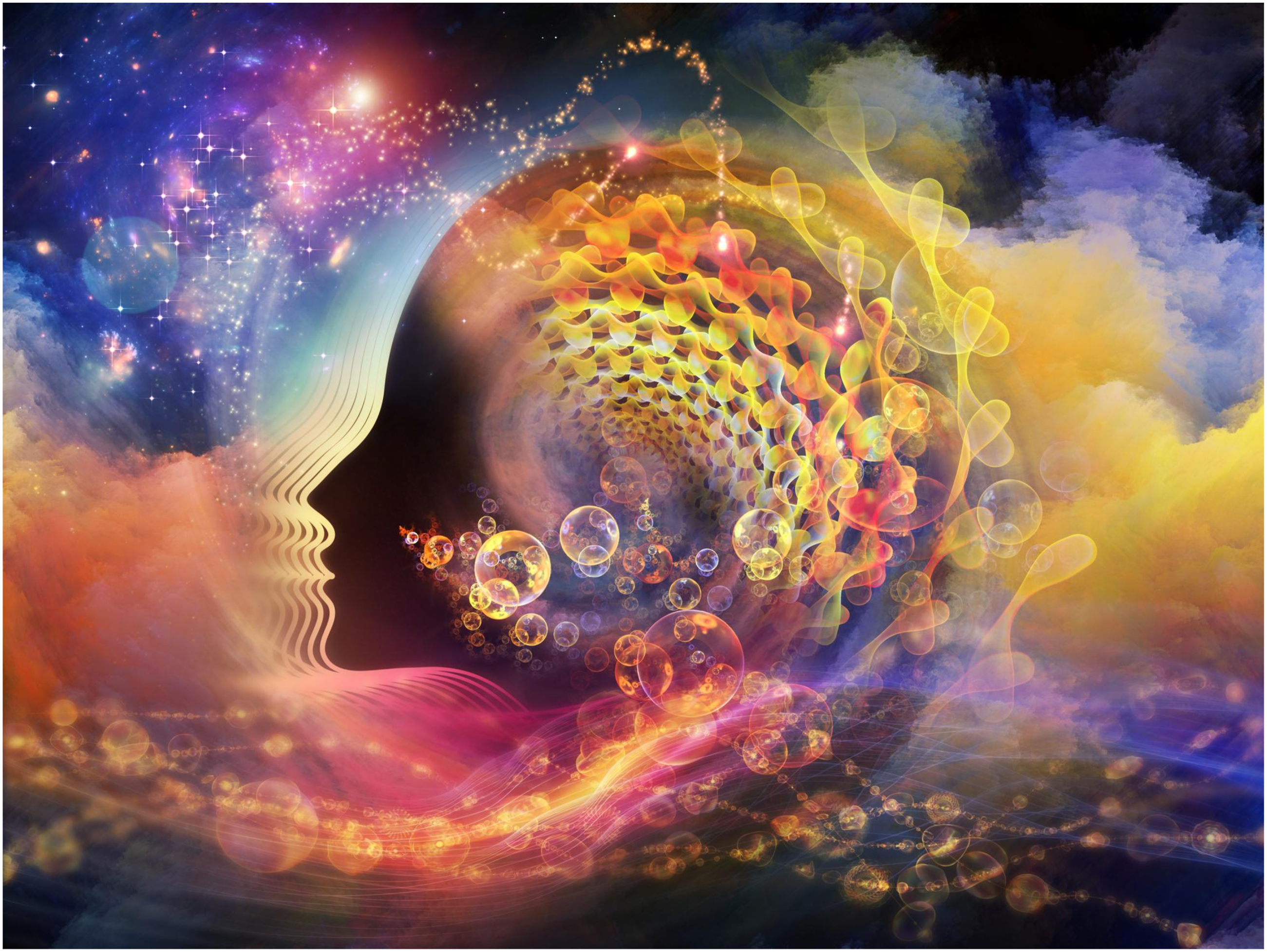
Tarkovsky – Solaris and Mirror
“The function of the image, as Gogol said, is to express life itself, not ideas or arguments about life. It does not signify life or symbolise it, but embodies it, expressing its uniqueness.” (Tarkovsky, 1986: p. 111)
Solaris and Mirror by Tarkovsky
1
present cinematic examples of crystal-images, and function as new ways to conceptualise education in the Anthropocene. In Solaris, the crystal-images are from the perspective of the psychologist Kris, who is tasked with understanding the mental states of the remaining Solarists, who had been assigned to comprehend the alien life-form of the planet Solaris, and whether the research project should be shut down. In Mirror, the crystal-images are rendered from the perspective of the dying narrator, Alexei, who explains about his life before, during, and after World War II. In both films the crystal-images conjure up deep psychological states and desires about love and life, that frequently remain unfulfilled and tend towards tragedy. In Solaris, Kris is confronted by a physical presentation of his ex-lover, Harey, who committed suicide after he ended their relationship. Harey has been created by the planet, Solaris, and is at once an unimaginably personal and emotionally draining apparition of a deeply buried, painful memory, come back to haunt the psychologist as ‘the real.’ Mirror works at this level throughout its entirety, as the crystal-images are overlaid and integrated into a flowing montage that disposes with a linearity of plot in favour of a time-based evocation of pain and suffering of life, interspersed with an intense yearning to be someone and somewhere else. The unveiling of hidden emotional states through crystal-images is well-described by (Deleuze, 1989): We have seen how on the broader trajectories, perception, and recollection, the real and the imaginary, the physical and the mental, or rather their images, continually followed each other, running behind each other and referring to each other around a point of indiscernibility. But this point of indiscernibility is precisely constituted by the smallest circle, that is, the coalescence of the actual image and the virtual image, the image with two sides, actual and virtual at the same time (p. 67).
In sum, the smallest circle, the point of convergence and the indiscernible is the crystal-image. In Solaris, the crystal-image is solidified by the question: What is Solaris? And the secondary question: How does it affect us? The writer of Solaris, Stanislav Lem, has insisted that the novel is about the impossibility of communication with alien intelligence, and explores the metaphysics and epistemology of this impossibility (immanence). However, in the film, Tarkovsky emphasizes Kris’s relationship with his dead girlfriend, and this journey explores similar psychoanalytical territory to Mirror, where the crystal-image is based on Alexei’s memories, and how he interprets them on his deathbed. In general, the crystal images from Tarkovsky’s Solaris and Mirror (Figures 2-9) tell us: • Women foreground and end the production of crystal-images. They are the portals to understanding life and death. • Time is non-linear, and acts in spirals, loops and overlaid, entangled complexities, to give rise to meaning over time (and in non-normative ways). • Nature is overwhelming. Human consciousness is meagre and helpless in comparison. • Relationships are flimsy and easily dismantled. Most things in life are transitory. • Language (and poetry) is little comfort against the backdrop and dismal fatality of life. The swirling mass of the ocean of Solaris. Kris (the psychologist) reflects upon his mission to Solaris at the beginning of the film. The ocean of Solaris starts to move in formation in response to communication from the ship. Water plants move underwater. A burning hayloft at the beginning of the film (Mirror). The opening shot of the main character (mother/wife/woman) sitting on a fence. The children watch the burning hayloft. The shot on the hill reminiscent of Pieter Bruegel the Elder’s The Hunters in the Snow.
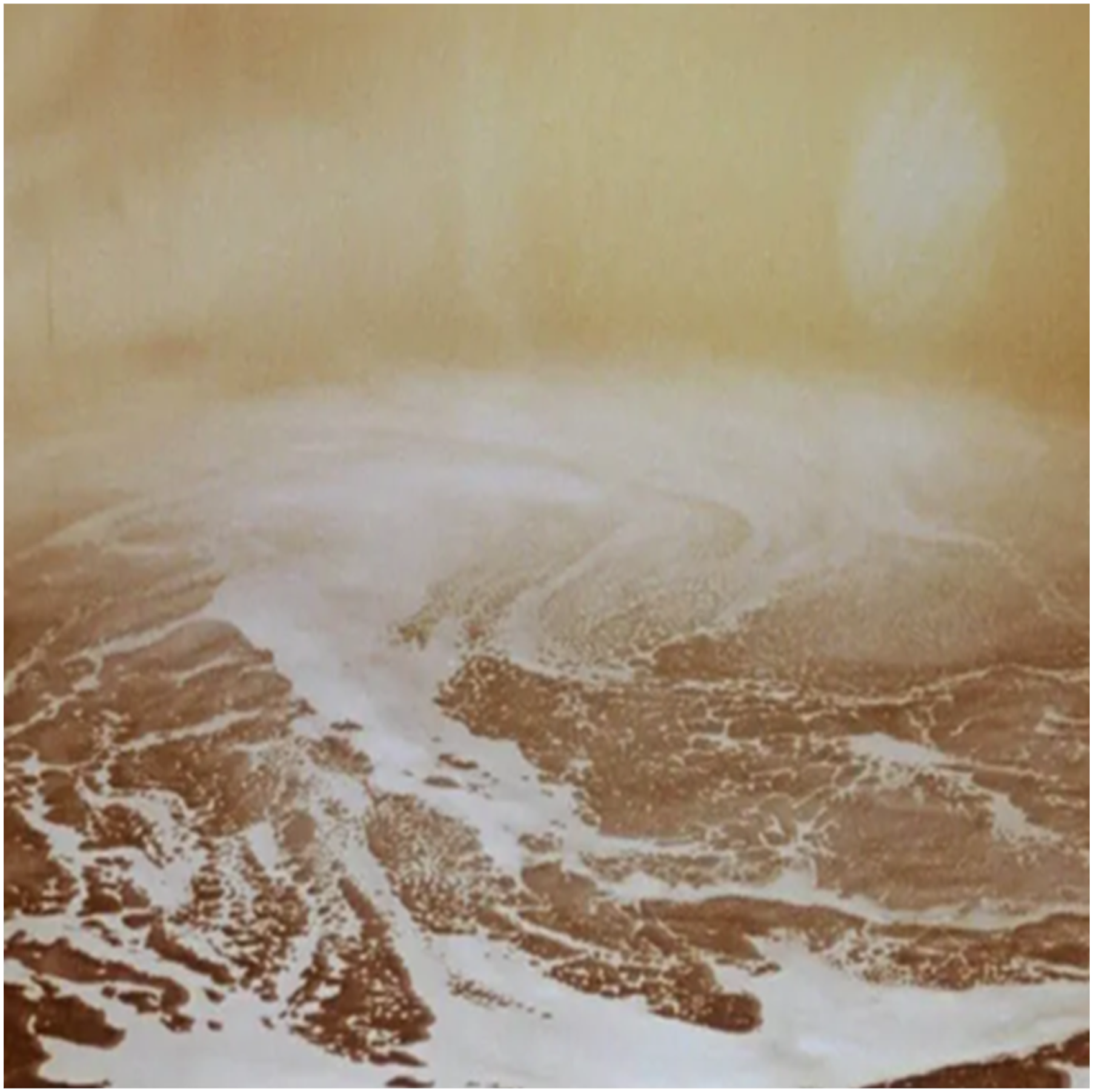
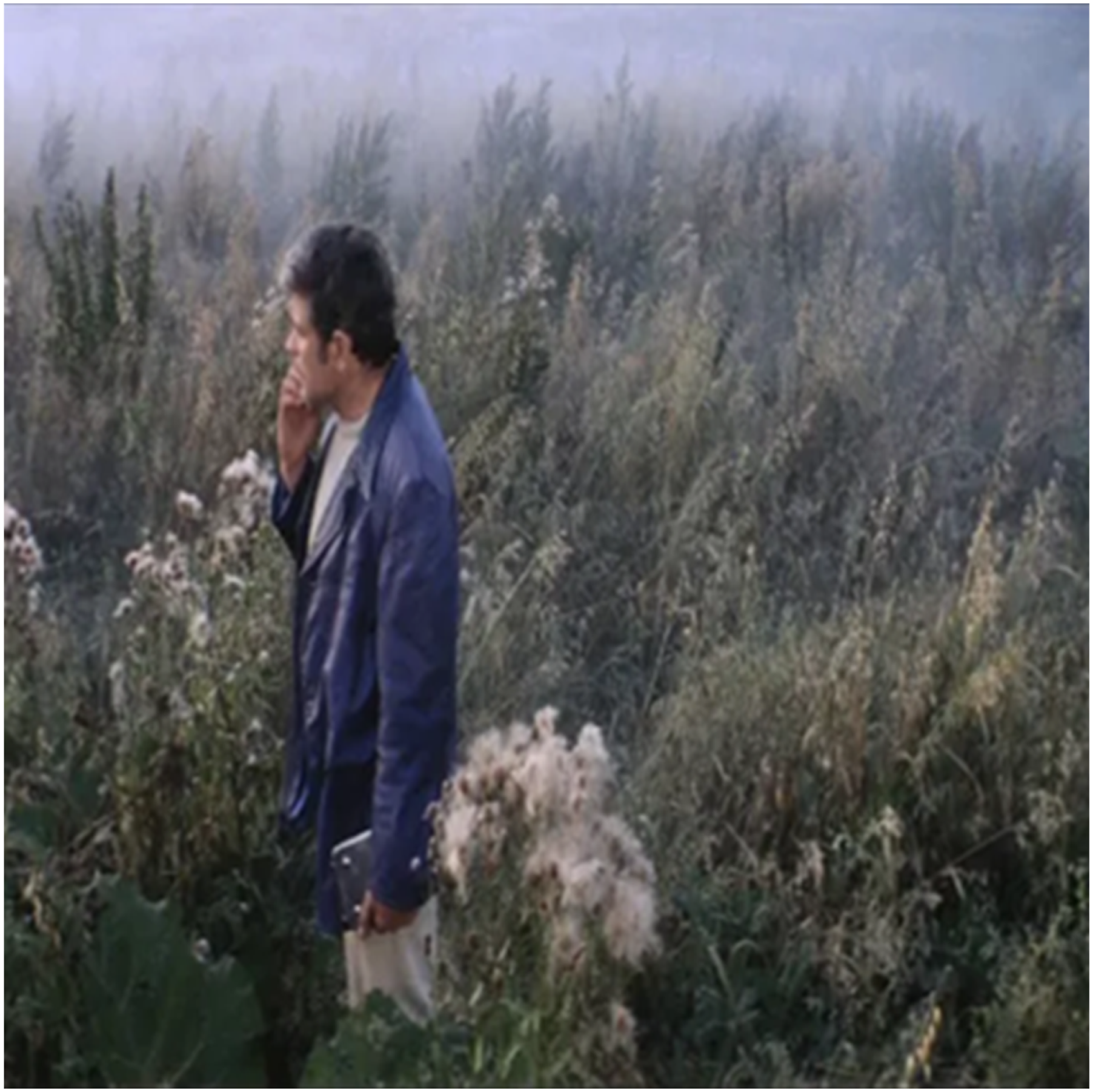
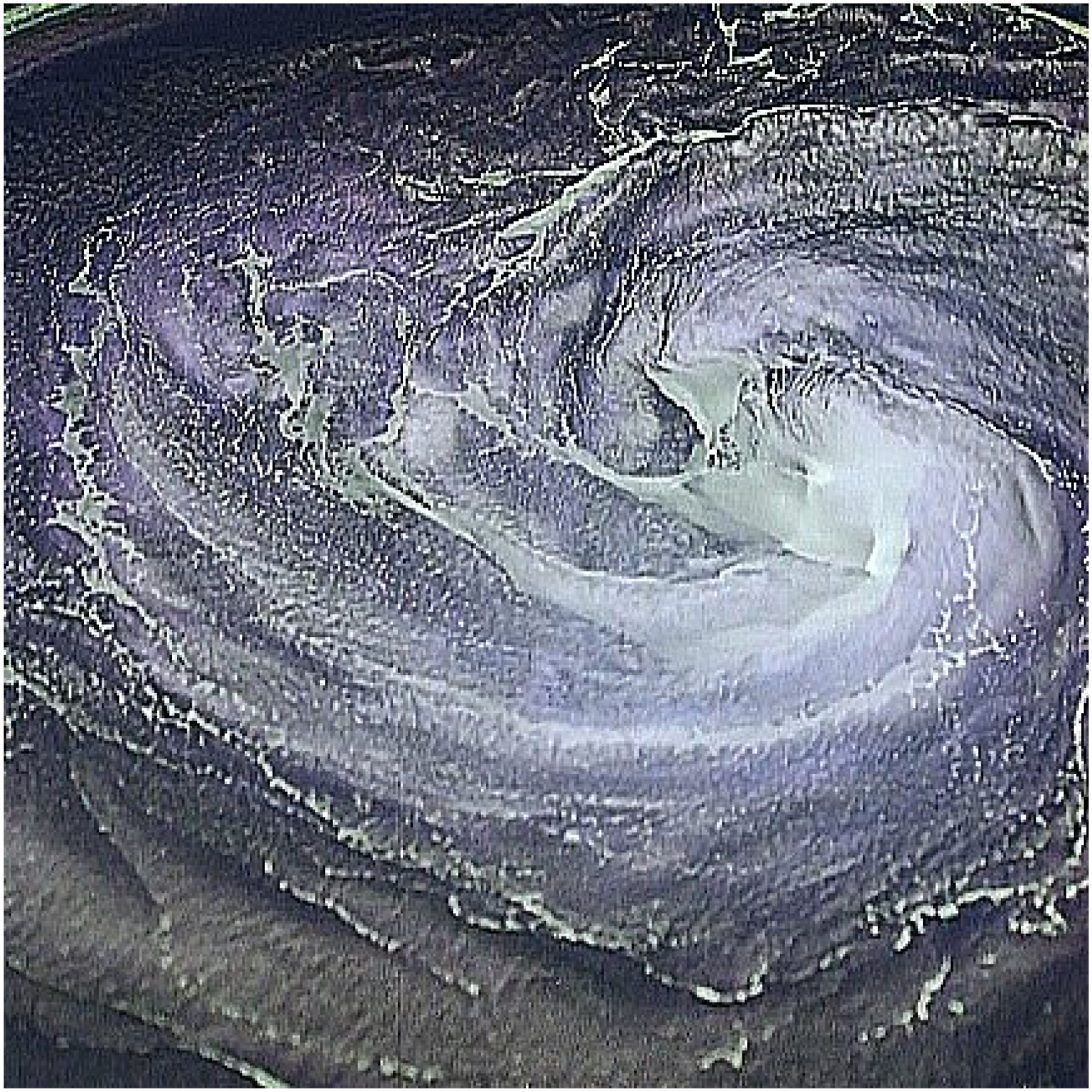
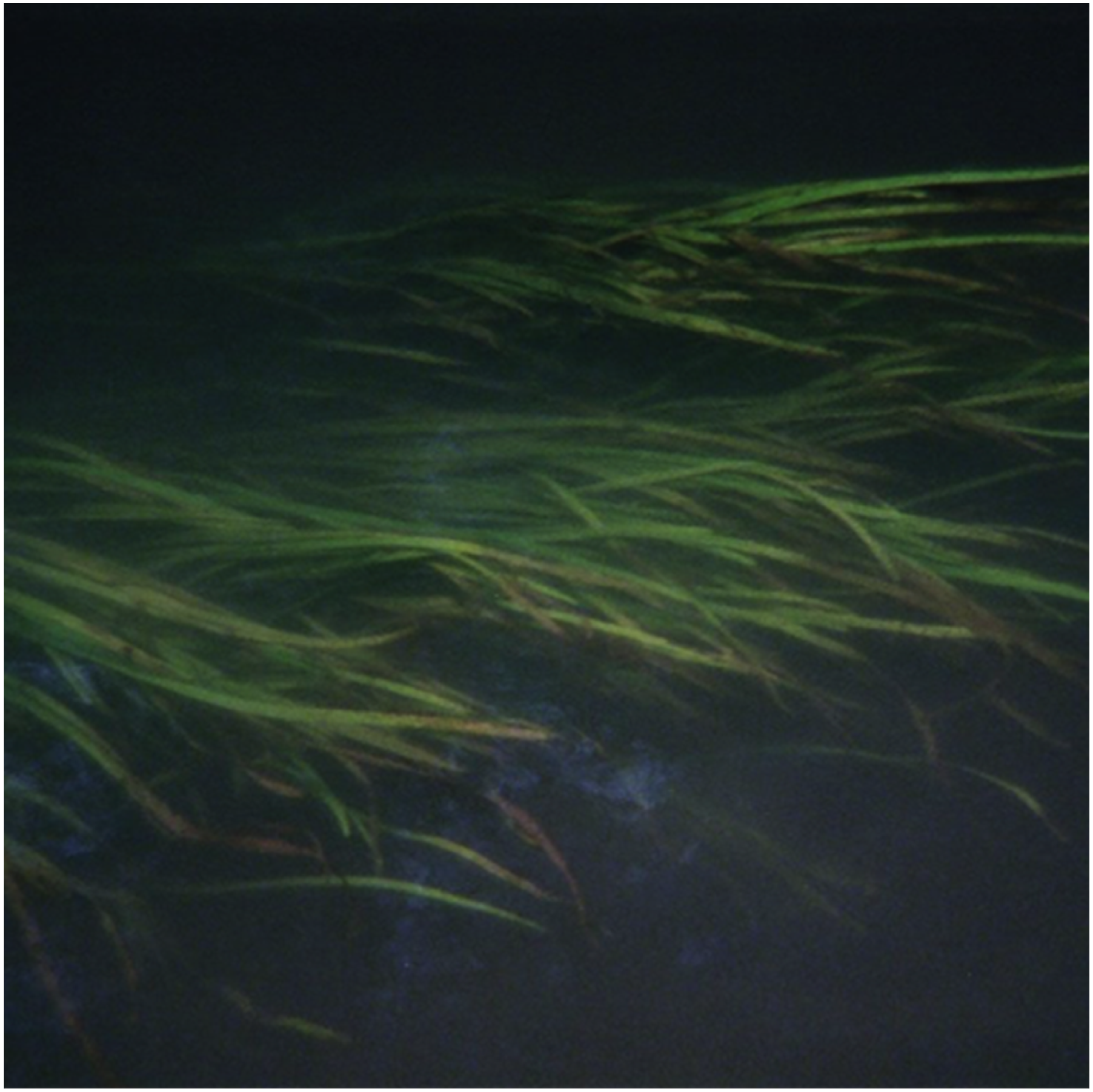
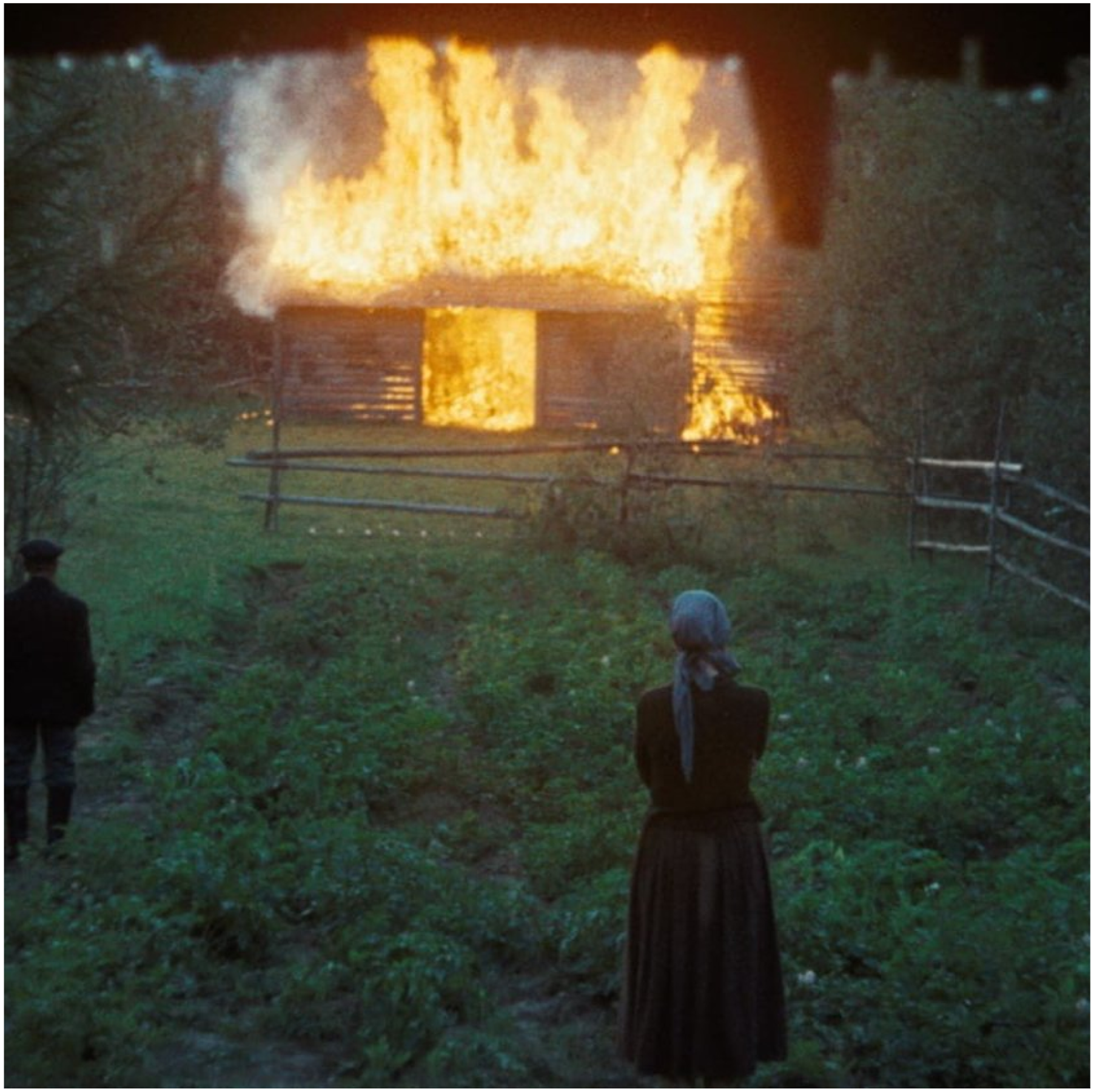
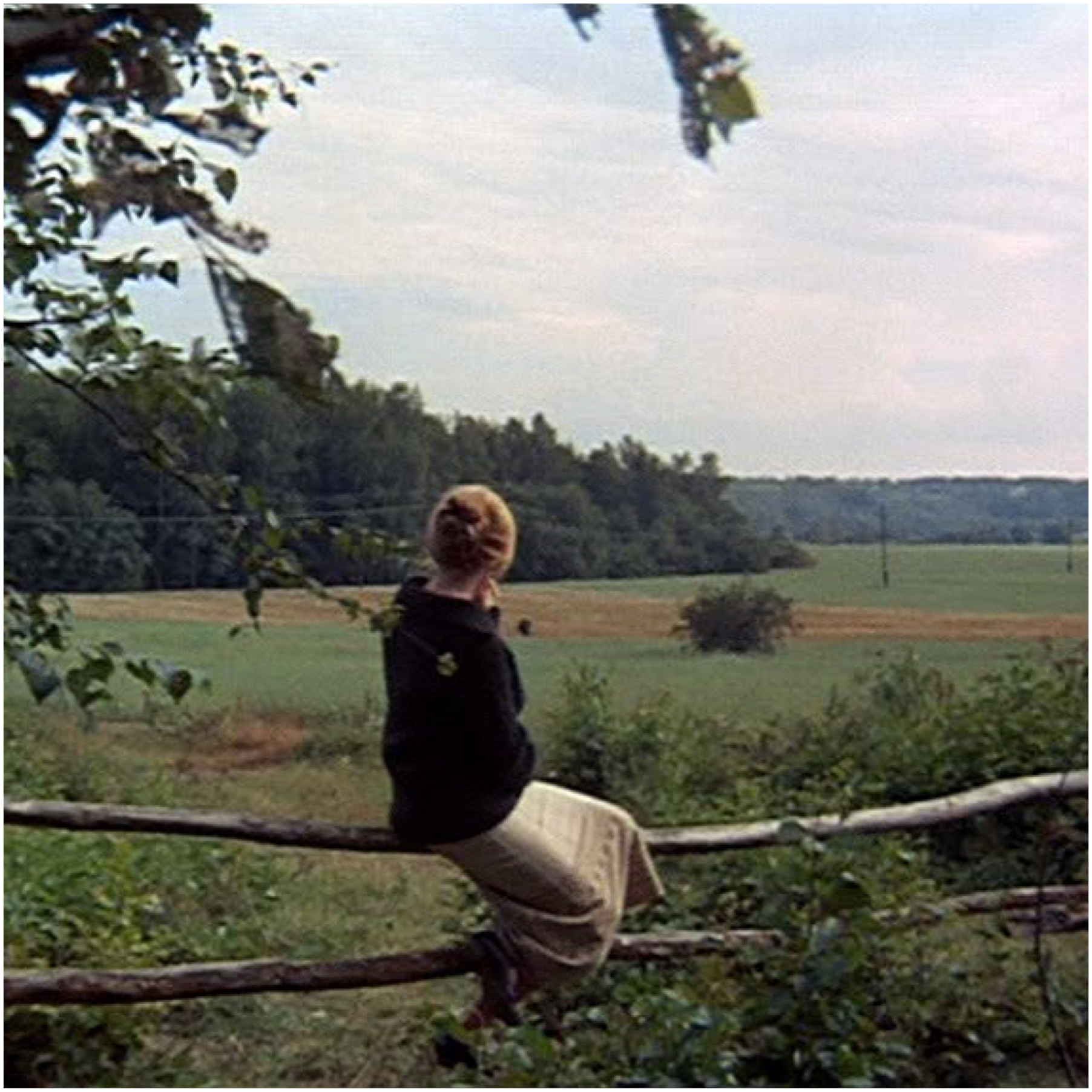
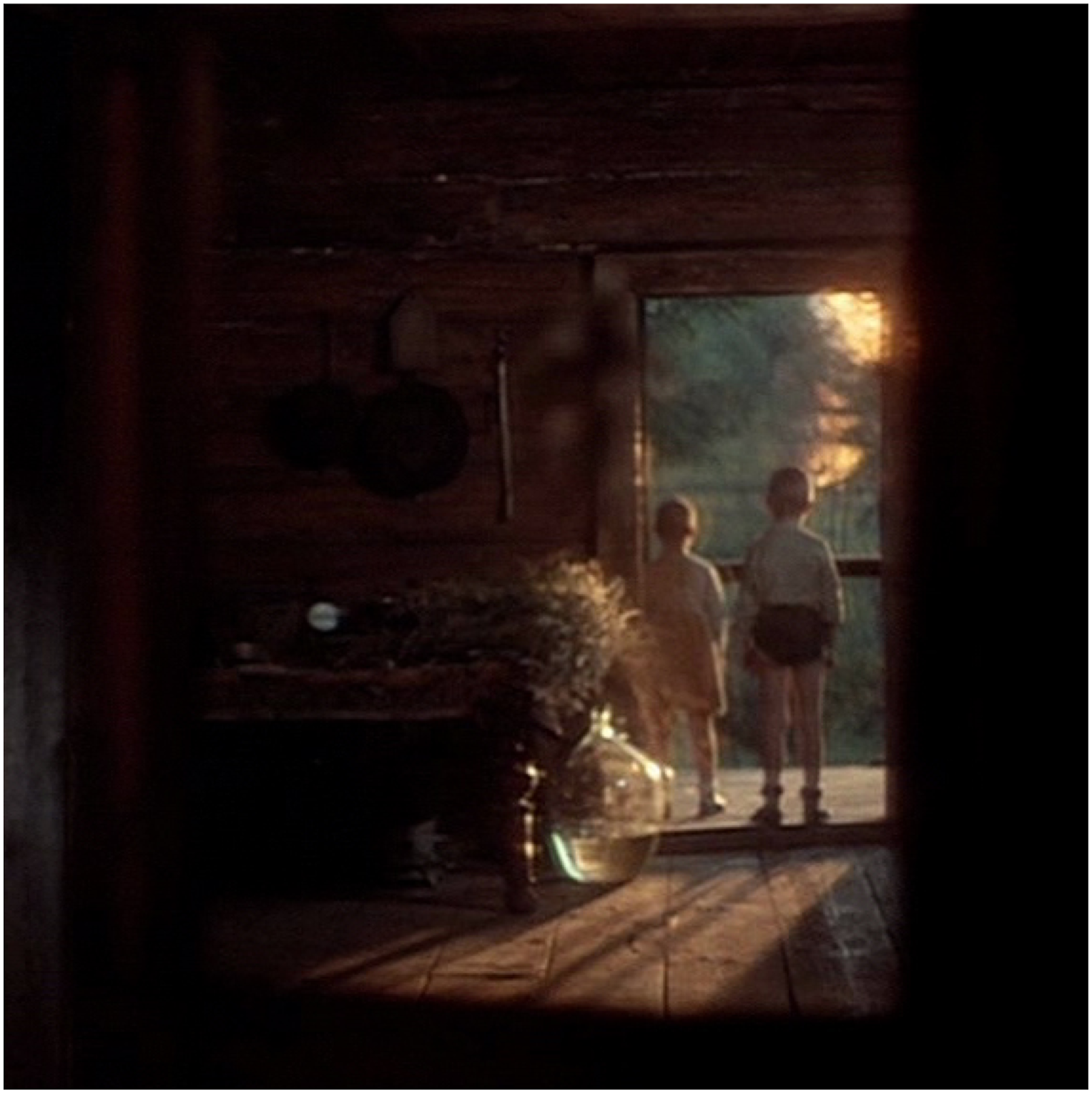
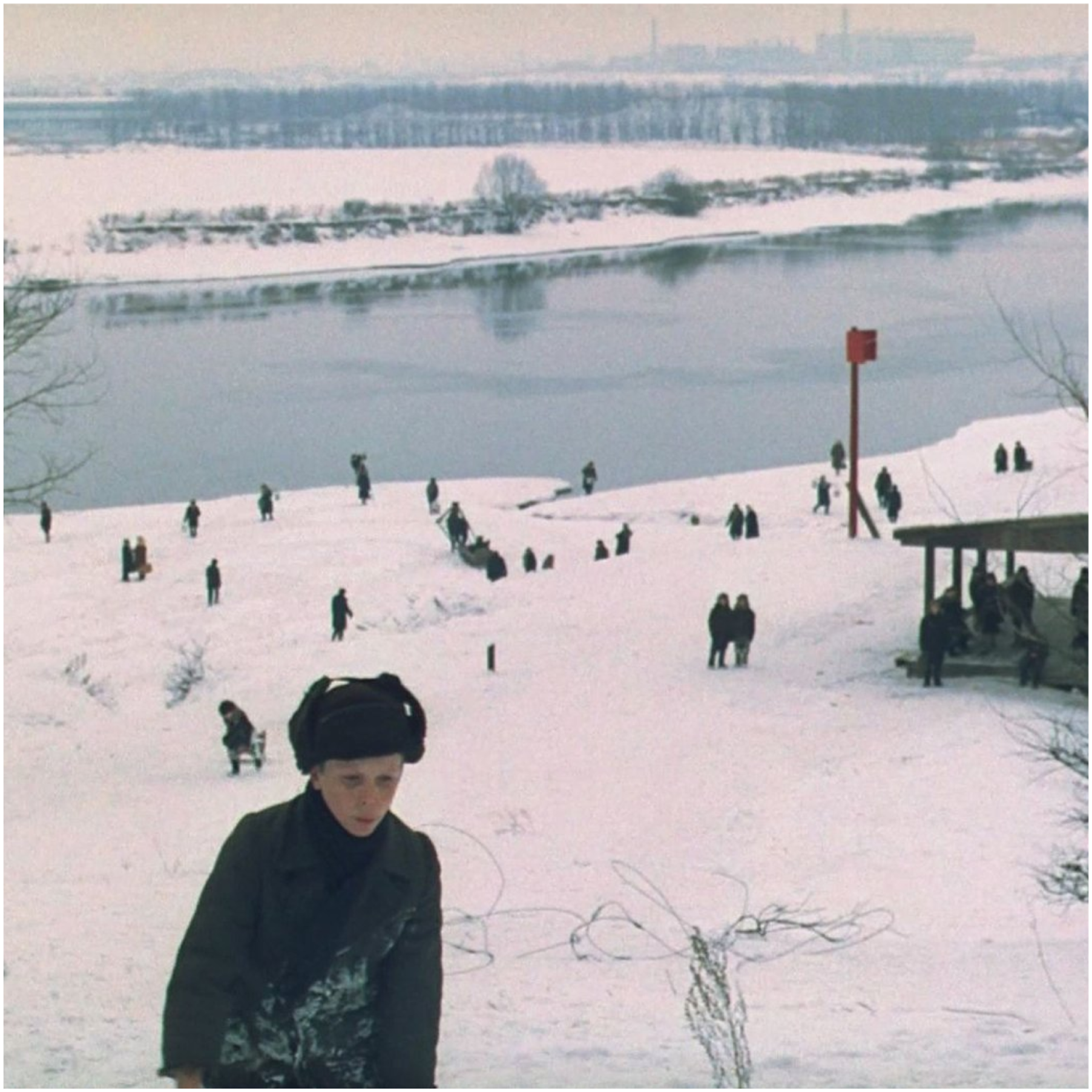
These images (Figures 2–9) from the Tarkovsky films Solaris and Mirror demonstrate the in-between and ‘formative-egg’ crystal-images from (Deleuze, 1989). 2 They also show how the hyalosigns “follow each other in three ways in the crystalline circuit: the actual and the virtual (or the two mirrors face to face); limpid and the opaque; the seed and the environment” (Deleuze, 1989: p. 71). In Tarkovsky, the crystal-images, whilst depending on ‘flashback’ and the evocation of ‘dream’ also show us how these mechanisms can, at the same time, become indistinguishable from everyday life, and, indeed, are integrated into it through the art of the crystalline moment of the filmmaker.
Anthropocene
What is the connection between the crystal-images from (Deleuze, 1989), their presentation in the films of Tarkovsky, and the Anthropocene (and latterly education, below)? The direct answer is that the Anthropocene (Figure 10) requires a heightened awareness of how Homo sapiens have arrived at the juncture in time and space to be able to change the planetary environment, and how we can challenge/reverse the habits that have formed the Anthropocene through education (Cole, 2021: pp. 103-118). This is because Deleuze’s account of the time-image (as false or aberrant movement) arises always already from the movement breaking away from the ‘sensory-motor perception-affect-action’ nexus and trajectory, getting the viewer’s memories and habits to conform to chronologically repeated and causally anticipated time and temporality. As such, the Anthropocene is introspective (as well as action oriented), involving memories of past processes, and applying them to the present moment to create change for the future (as difference-ontology or immanence). Deleuze’s crystal-images and their exemplification in Tarkovsky are a guide to how this might happen in the Anthropocene and as applied to education below (Figure 10): Image Credit: Human Origins Program, adapted from United States Geological Survey, and Visible Earth, NASA (Open Access Image).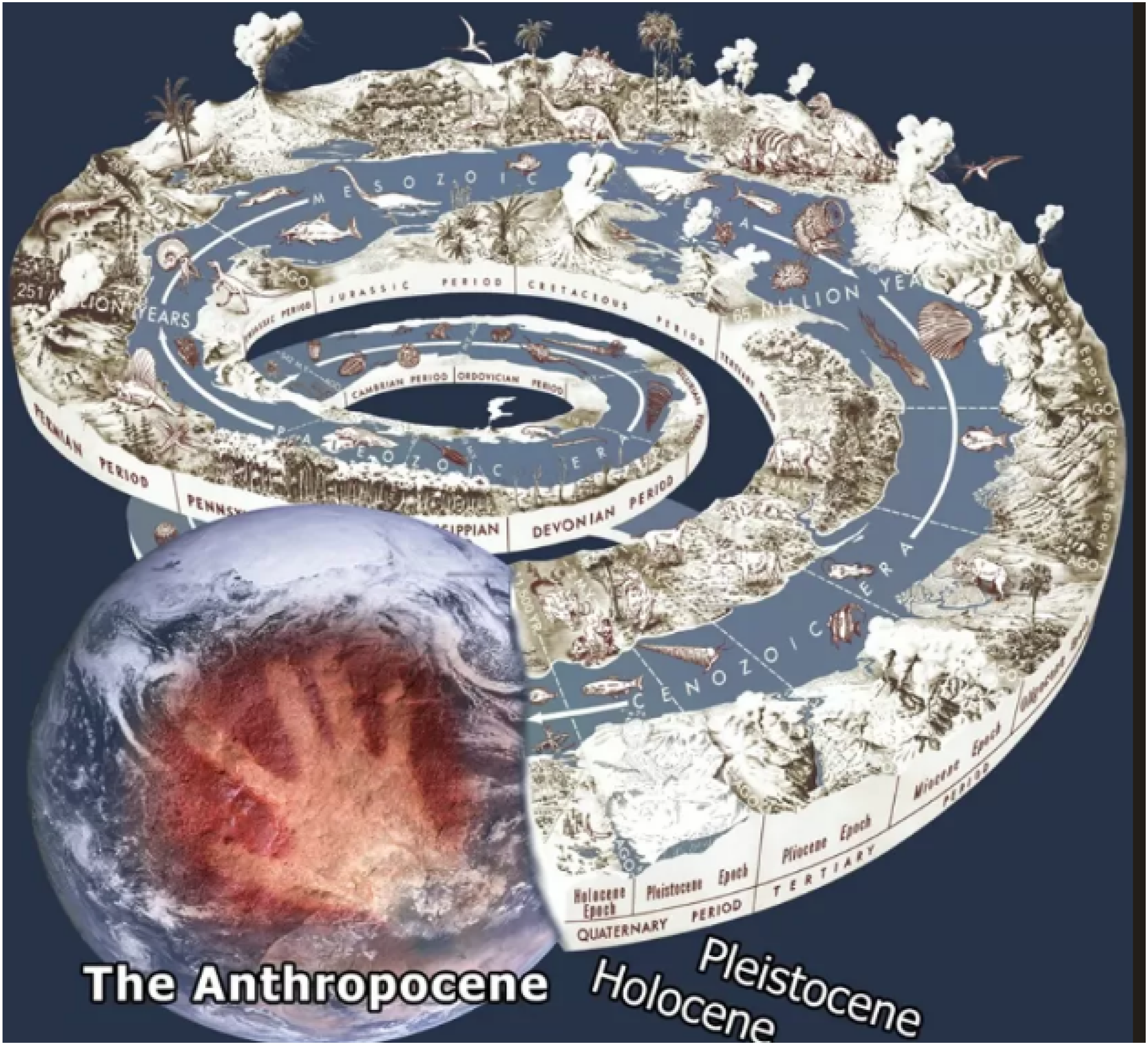
The crystal-image from (Deleuze, 1989) clarifies the introspective and retrospective yet future-orientated aspects of the Anthropocene. In essence, we need to radically change our collective thinking about the Anthropocene (cf., McPhearson et al., 2021) to potentially unearth the drives that have propelled us to this situation of domination and transformation of the planet Earth (cf., Yusoff, 2018) whilst simultaneously holding onto the idea that we can recreate another (better) world for the future – or, indeed, do anything about the Anthropocene. Deleuze was a materialist (Cole, 2012) and the discovery of the drives that have propelled us from a state of nature to the Anthropocene, and the rendition of these drives in this essay as crystal-images, should not result in idealisms about human society (utopias), nature (romanticism), or the past (nostalgia). Rather, the human drives of the Anthropocene, produced as a crystal-images of human development and regression, suggest that fragmented, repeating, complex and time-based scenarios will be present in ever-expanding systems and structures in the world (e.g., Tan, 2022). Elsewhere, I have theorised the four drives of the Anthropocene as; (1) Tool-enhancement; (2) Carbon trail; (3) The Phallocene; (4) Atomic-time (Cole, 2021: pp. 21-103) by taking Guattari’s (2013) seminal theorisation of the four zones of the unconscious diagram (Territory/Ideas of the Universe/Social Flux/Machinic Phylum) and applying it to the Anthropocene. As a result, we can understand the human propulsion devices of the Anthropocene (Cole, 2021) and their entanglements, and potentially notice the changes in the planetary circumstances that ensues from these drives and investigate them empirically, whilst connecting the description of the human drives with tangible evidence. Lovelock (2009) has executed this move with reference to his conceptual notion of ‘Gaia’; which is the Earth as a self-regulating and synergistic system that has recently been put out of kilter by human action such as the burning of fossil fuels on an industrial scale: There is no tipping point; we are sliding down a bumpy slope that grows ever steeper to the future hot world. Even in the survival havens [including the UK and New Zealand] where climate change is gentle enough to allow the continued growth of food there will be disasters and difficulties. Thus, in the more fertile parts of Europe unaffected by heat and drought, including the Netherlands, the UK and Ireland, rising sea level and storms may lead to catastrophic inundations. Much of London is likely to be flooded, and the underground transport system disabled. The Netherlands may be uninhabitable. (Lovelock, 2009: p. 50)
As such, Lovelock’s Gaia (2009) is analogous to the alien planetary intelligence of Solaris or Morton’s (2013) hyperobjects. This idea is encapsulated by the statement that there is something beyond direct observation and measurement that simultaneously acts as a driving force for change and the transformation of planetary processes, in our case, in the Anthropocene. In other words, scientific inquiry can push into the observable and measurable aspects of Gaia, Solaris, or the hyperobjects, but can never entirely explain their full systematic workings, as they are too immense and complex for one to grasp the entirety of their functioning at the same time, and other than as chaotic forces (cf., Shevchenko, 2020: pp. 15-73). Hence, even though science has done its best to grasp, for example, the changes that are occurring due to the Anthropocene – or human action on the systems of planet Earth (e.g., Braje, 2015), there will always be processes that cannot be reconciled with current system functioning, as the consequences and interconnectedness of all planetary systems is too intricate and enormous to entirely unpack. Consequently, the aim of research into the Anthropocene (and education below), should be directed towards previous human systems based on industrial models of capitalism, their planetary extraction of minerals, fossil fuels, and how they have ignored the ecological signs of resource overshoot and global warming. Further research should demonstrate how industrial-capitalist processes can be replaced by small scale communities of cooperative endeavour, which can live within the confines of specific biomes and ecological niches without degradation or exploitation of resources until they become extinguished (e.g., Rockström et al., 2009; Steffen et al., 2011). However, in the current human societal mode of one world capitalism (and education as its enabler), backed up, and augmented by the cognitive and attention-based effects of integrated digital companies such as Microsoft, Apple, Google, Facebook and Amazon; it seems unlikely that a planetary change of consciousness will occur to make us act on mass in the direction of restoring Gaia (Lovelock, 2009), or unhinging the barriers to comprehending alien intelligences such as Solaris or concepts such as hyperobjects, and henceforth humans will probably maintain the systems and habits that have been driving the Holocene in the direction of the Anthropocene (cf., Purfield, 2023: pp. 230-243).
Admittedly, scientists can retort that there are no such things as Gaia, Solaris and hyperobjects, and with respect to the cognitively-dissonant argument from (Deleuze, 1989) crystal-image and Tarkovsky’s films - that the crystal-image does not (and cannot) do the work of relationality and connection as claimed. However, (Deleuze, 1989) crystal-image extends the single unit of a crystal to the whole, and, as such, is a means to connect the specific with the general. Crystals are real (like eggs), and their structures are known, and can be (re)created in mediums such as cinema, which plays with imagistic and semiotic regimes (the hyalosigns), to make diffraction, distortions, dissonance, amplification, cuts; and these crystal-images reveal how units of time work to produce a whole through the synthesis of the real (Deleuze, 1989: p. 124) – for example, with respect to the processes of aging and how climate change is reforming the planet. Indeed, the crystal-image is a device for the Anthropocene (and education) whereby the impossible leaps of faith and inter-connections between the local effects of climate change and the global processes of climate change may be reconciled, as they are both happening in time. This relational nexus comes about because human consciousness, that simultaneously experiences the breakdown of climate through trauma and any potential movement away from and reaction to catastrophic climate events, can imagine a crystal-image to connect these experiences with respect to transformations in time, i.e., as events in one’s life that determine a break or ‘before’ and ‘after’. These processes of imagining contrasts with, for example, a phenomenological approach to connecting the local with the global with respect to climate change (e.g., Hepach and Hartz, 2023), that expands and delves into the components of human consciousness, making it universal, to the detriment of intervention of differences in the world. One way to understand the differences that are being drawn out here through crystal-images and the Anthropocene (and in contrast to a phenomenological analysis) is through the practises of education (see below) and, for example, the craft of writing, as exemplified by the novelist J.G. Ballard when constructing the Crystal World: The crystallisation process, originating in deep space, initially affects vegetation – and is thus thought to be some form of plant disease – but soon spreads to animals, people, and all matter. The process is detected as having over-run entire galaxies and is named the ‘Hubble Effect’ by the astronomers who first observe it. (Tynan, 2018: p. 400)
Education
The educational complex that this article defines concerns the habits, forces, and movements in practice that are revealed through analysis of the Holocene-Anthropocene divide and movement via the crystal-image of (Deleuze, 1989) and the examples of the films of Tarkovsky, Solaris and Mirror. Application of the crystal-image changes our perception of education as difference-ontology, the films of Tarkovsky unhinges the framing of this new perspective immanently. Specifically, the challenge of this article is to perceive and define educational practises of the Holocene as those of the past, as memories, and as potential ghosts in the present educational machine that power it onwards but are also the reason that it is resistant to change (Cole and Hager, 2010). For example, the clamour for profit, continually opening new markets (neoliberalism), and the techno-positivist biases that are written into the contemporary curriculum and its accompanying practises (i.e., the claim that technology and innovation always lead to better education as outcomes) (e.g., Watson, 2006) predominantly come from the Holocene, wherein nature was seen as an unlimited resource, and education was perceived as a means to lift populations out of poverty through exploitation of the natural world, and the accompanying human populations to these processes were frequently reduced to consumerist masses (cf., McLaughlin, 1993: pp. 45-61). The secondary problem for this paper, which follows on from the educative perception of nature as exploitable, and human populations as reductive to consumer-conformist masses, is that there is a certain naïve energy and happiness wrapped up in being part of these masses (e.g., Boucher, 2020). As theorists such as (Baudrillard, 2018) have shown the contemporary media (and its society) is a hall of mirrors, wherein identities are deliberately confused, distorted, and reflected to aid the fluid transfer of capital in identity exchange; as such, ‘selves’ are reduced to worthless images in the functioning of money machines, or have become human capital, leaving empty and hollow communities, able to be easily torn apart and deconstructed by the exploitation of capitalism – yet they are simultaneously blindly ‘happy’ (cf., Hertz, 2002: p. 102-149). In this essay, which uses (Deleuze, 1989) crystal-image as a critical focus, and the Tarkovsky films as examples of crystal-images, the imagistic desire for happiness is overridden as part of the ‘monkey trap’ as explained by Nick Land: The Monkey Trap The monkeys became able to pursue happiness, and the deep ruin began. If the terrestrial biosphere had held back for a few million years, let the primates get annihilated by a comet, and found a way to provide the cetaceans with prehensile organs somewhere up the road — after socio-linguistic sex-selection and relentless Malthusian butchery had fine-tuned their brains — then techno-history might have had another 50 points of average IQ to play with in its host population. It didn't, and here we are … Land (2013, online)
Evolutionary science and anthropology have proven that Homo sapiens are niche social animals (e.g., Shea, 2011), capable of survival and reproduction in various environments due to their adaptability, organization, social skills, ability with tools and capability to perform abstract thought (Ibid.). However, as Land (2013) asserts, and in line with Deleuze’s (Stengers, 2009: p. 34) use of the term ‘bêtise’ – that is usually kept in the French, as it is evocative of more than the English stupidity or stupor – as it evokes a certain take on ‘animality’, critical human qualities have been diminished and realigned in the contemporary situation for survival, as, for example, an economist who is convinced that markets are the solution to all human ills without seeing their downsides (Ibid.). The crystal-image shows us how the image of the human, coming from the Holocene, has been diffracted, tarnished, distorted, amplified and diminished through the prism of contemporary life, which includes the mass education systems that have evolved alongside and as part of technologies and processes that have come to define us (cf., Wallin, 2023). In effect, the crystal-image is an invitation to escape the superficial, blandly happy, non-thinking, and uncritical image of humanity that has become the norm in global society, and to (re)engage with a new type of thinking that would effectively deal with the Anthropocene through education, and should be seriously considered, for example, by pre-service teachers (Cole, 2021: pp. 1-20). However, what is this type of thinking, and how can education help us to achieve it?
Firstly, the new thinking for the Anthropocene is not a singular or unique mode of thinking or perception that will automatically usher in a new age for humans that deals with the problems coming from the Holocene past (Hamilton, 2019). Rather, it builds upon elements or flows from the past that are best suited to take us to a better future, and the crystal-image and the cinematic examples from Tarkovsky are guides and/or portals to what this thinking might look like. One may properly ask: How do we know what these flows are? Whilst this is a legitimate question, it is not the right one in terms of this essay, as the deployment of Deleuze (1994) shifts thinking away from epistemology to ontology and metaphysics. The differential ontology from Deleuze requires ‘difference-thinking’, and the new conditions of the Anthropocene require this difference-thinking to be applied to how to flourish under pressure from resource constraint, human overpopulation, global warming, pollution, and natural diversity and species loss (extinction) (Tupelo, 2022: pp. 3-7). In short, the thinking required here necessitates breaking with the negatively impacting aspects of the formation of human capitalist-industrial civilization from the past and taking us forward in terms of a synthesis of what can enable human flourishing in conjunction with the current state of the natural world (like crystals). For the purposes of this essay [crystal-image-Anthropocene-education] - this schema for thinking in education (and specifically, for example, by pre-service teachers) may resolve into: • Elementary education: Fundamental to new thinking in the Anthropocene is repairing the broken relationships between humans and nature. Thus, at all stages of education, children and adults need to be (re)introduced to the natural world through alternative pedagogies (cf., Jagodzinski, 2024: p. 15). Clearly this will be more challenging in urban environments, where humans have swarmed into cities, and the loss of a connection to nature is especially felt (cf., Cole and Baghi, 2022, 2024). However, there are multiple ways to circumvent the urbanisation of human populations, such as the exploration of urban gardens, parks, day trips to the country and outdoor educative experiences in nature as part of structured and organized reconnection programs (e.g., Nash, 2005: pp. 1-39). These programs should be recursive and can happen at any time during the educational journey to reengage the students with the natural world, specific biomes, ecology, and, importantly, exploring the ways in which nature is changing in the Anthropocene (Steffen et al., 2011). This elementary aspect of education should also help to reintegrate the human ego with nature, so that human populations do not see themselves as apart from, above, or outside of natural processes - but as integrated crystal-images. • Primary education: Building on the elementary and recursive aspect of the enhanced human relationship with nature, is the task of integrating units of work with the environment and behaviour. The students should learn how to take care of specific ecologies and biomes, and how human populations may flourish and positively benefit the natural world (as we once did) (Cole, 2021: pp. 121-137). At this stage, the students may learn about how to grow food, the nature of water systems, the carbon cycle and all processes that emanate from the sun (e.g., photosynthesis). Twinned with these ongoing and vital learnings are how human behaviours can entwine with these natural processes and be part of the natural ecology rather than as exploitative and parasitical upon them (Hamilton, 2019). Students should realise that we are dependent on natural resources for food and life, and we cannot keep using these resources at an unsustainable rate, for example, by over fishing the seas (as resources are already depleted) or continuing to eat so much meat – i.e., they learn how to grow as crystal-images. • Secondary education: At the secondary stage, students should understand that there are independent fields of knowledge such as the sciences, maths, and the humanities, which can be combined in interdisciplinary study to create knowledge about the Anthropocene (cf., Little, 2017). It is important to introduce the Anthropocene at this stage, and the suite of interconnected conceptual framings such as the Capitalocene, Chthulucene, Urbanocene, Plasticene, Technocene, … (there are more) (Chwałczyk, 2020), so that students may orientate themselves to the ongoing causes and effects of the Anthropocene. The students will engage in purposeful units of work that deploy specialist knowledges from those available and understood from the existing curriculum. Direct instruction and open ended, inquiry-based learning should alternate to retain student interest and be focused on the key issues of the Anthropocene such global warming, habitat and diversity loss, population, the economy, and food and resource supply chains (cf., Marshman et al., 2019). In the secondary context, students are manipulating crystal-images. • Tertiary education. Once students (such as pre-service teachers) can navigate the complexities of the Anthropocene, they need to apply their knowledge, skills, and social abilities to its solutions. At this stage, students must work in groups as communities of inquiry that purposefully discover the ongoing issues of the Anthropocene and look to remedy them through their understandings and shared skills (Ibid.). Tertiary education can still be divided into different areas such as engineering, medicine, education, the sciences and humanities, the difference in this schema is that there will be multidisciplinary teams working on specific problems of and in the Anthropocene, such as, how to make urban environments sustainable? What will happen to housing in the Anthropocene? (Cole and Baghi, 2022, 2024). How can humanity survive global warming? How can the global economy be refigured in the Anthropocene to function to the benefit of humans and the planet? What is the optimal nature of governance and the running of human societies in the Anthropocene? Lastly, students are applying and reimagining crystal-images.
Figure 11 is a crystal-image (recursive/refracting and multidimensional) of education in the Anthropocene:
Conclusion - The underlying milieu – immanence
The fundamental problem that this essay addresses is how to think education differently, and how changing practice may align with this alteration in perspective (Figure 11). As enunciated above, the methodology chosen is to apply (Deleuze, 1989) crystal-image (and the examples from Tarkovsky) to the Holocene-Anthropocene threshold, and to henceforth re-envision images coming from the past, such as the notion that technology will fix the Anthropocene (and not human action/change in consciousness), or that market solutions, aided by techno-capitalist educational mores (cf., Means and Slater, 2019), will usher in a better world, fit for humans in the Anthropocene. This essay deploys the creative and critical power of filmmaking and cinematic end products (e.g., Tarkovsky) that do not conform to the sensory-motor schema and that generate the crystal-image & hyalosign precisely to envision such new conditions. As the crystal-images from Tarkovsky disturbingly show, the path to transformation of the self for a new education in the Anthropocene is an introspective, frequently torturous journey into the self, resulting in perturbation, oscillation, and the navigation of personal depths to summon the creativity necessary for change, as shown above (Figure 12) where this change is related to immanence, or the rupturing of the moment from within: Educational connectivity in the Anthropocene as a crystal-image (‘Anthro-edu-relations’) © Cole, 2025. The underlying milieu – immanence.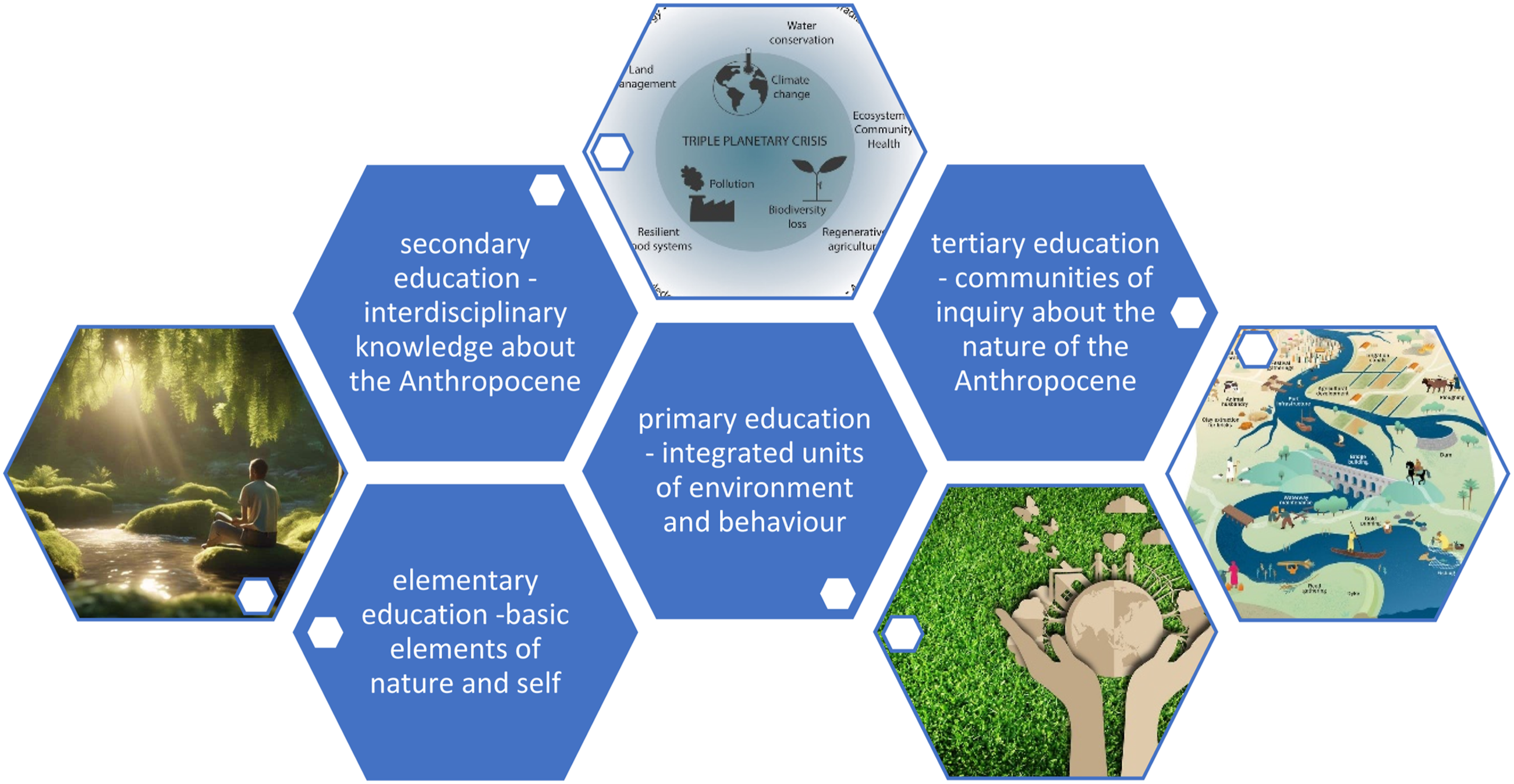
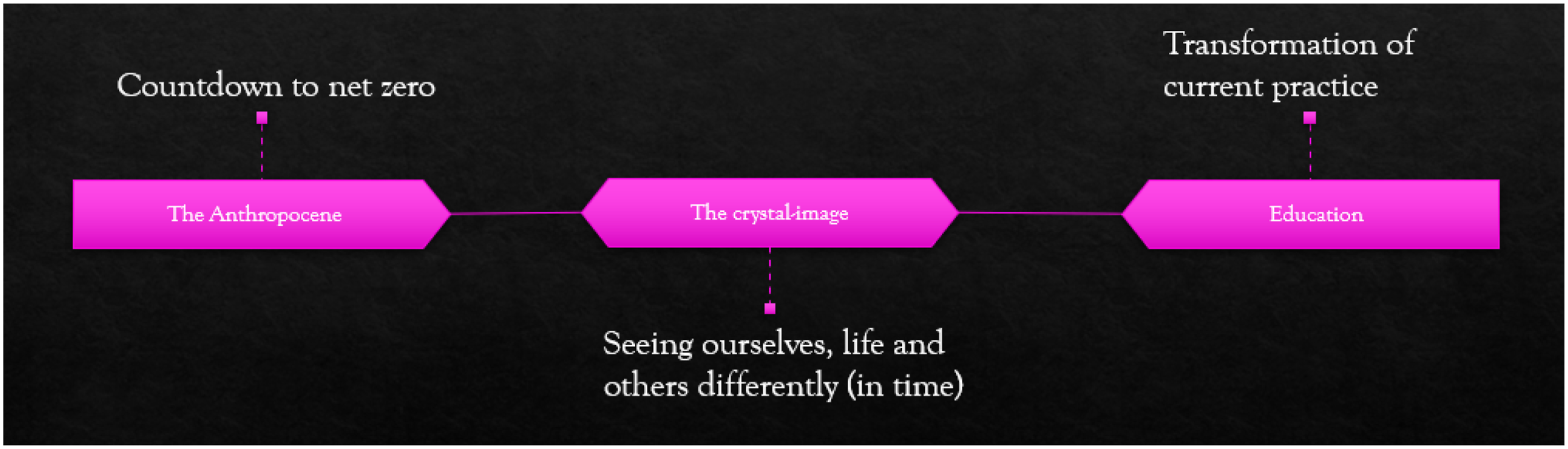
The change initiated and envisaged through this article connects to the notion of time. Immanence suggests an inner time, interpreted, and acted upon for the necessary changes of education in the Anthropocene to come about. Admittedly, the recourse to immanence brings along with it material factors and chaotic happenings that are part of the philosophical method from Deleuze and Guattari (1987) in that refiguring social and ecological relations in terms of time means that human and non-human relations can be jointly influenced by factors ranging from the deeply personal to the planetary (cf., Cole, 2013). In sum, human society must collectively change how its educational systems are conceptualised to properly address the Anthropocene for its continued survival into the future, and the crystal-image and examples from Tarkovsky are tools to achieve this, as they concentrate, harness, and focus energy solely on transformation …
Footnotes

Funding
The author received no financial support for the research, authorship, and/or publication of this article.
Declaration of conflicting interests
The author declared no potential conflicts of interest with respect to the research, authorship, and/or publication of this article.