




Abstract
During the COVID-19 pandemic, virtual observations were utilised in teacher education programmes internationally (Murtagh, 2022; Mynott et al., 2022; Ó Grádaigh et al., 2021). In Scotland, virtual observations have been continued as part of teacher education programmes and this article explores student perspectives on their continued use. A situative analysis (Clarke et al., 2018) was used to explore questionnaire and interview data from student teachers. The analytical process examined the data and utilised memoing to consider emergent themes against the situation of virtual observations in teacher education. There is a duality to the findings. On the one hand, students express preference for in-person observation when they consider the process to be assessment-focused. Conversely, when not considering virtual observations as assessment, the ability to reflect more deeply on their practice, increase their control and agency over the observation and reduce the stress surrounding observations are all themes that emerged from the data. Therefore, the data suggests that further innovation moving from summative to formative observations might increase the benefits of virtual observations. Limited research exists on virtual observations. The literature that is available often focuses on university staff. This article considers virtual observations from the student perspective and provides clear feedback on how a pandemic response has been developed for post-pandemic purposes. The findings of this article can be further explored and built upon, and this will enhance the use of virtual observations within teacher education.
As the COVID-19 pandemic moved across the globe in early 2020, education systems quickly needed to adapt their instructional approaches. In Scotland, schools and universities moved to remote teaching, and teacher education departments adapted to working with their student teachers remotely. In practicum placements this meant undertaking virtual observations of students through a video recording platform and providing feedback through online meetings. Mynott et al. (2022) explored these virtual observations from the perspective of the university tutors, identifying that there was potential for their use to continue as pandemic restrictions eased. Similar studies in England (Murtagh, 2022), Ireland (Mac Mahon et al., 2019; Ó Grádaigh et al., 2021) and Australia (Ó Grádaigh et al., 2021) also suggest that there is a place for virtual observation in post-pandemic teacher education. This potential is the locus of this research explored through our research question: What were the experiences of students using video as part of their student placement assessments?
While previous work has focused on the use of virtual observation as a pandemic response, we will explore how video can continue to be utilised by student teachers as a tool on practicum placement. The student teacher’s voice has been underrepresented in previous scholarship on virtual observations in teacher education; therefore, through analysis of student questionnaires and follow-up interviews, we will explore how the pandemic-initiated use of video as a form of observation assessment is experienced by student teachers.
Our research adds to the literature focused on virtual observations by identifying that: video can support students to build their capacity for critical reflection; for some students, using video reduces the anxiety of practicum observations; for others, perceived technical challenges increase the pressure of observations; and, overall, while student teachers value virtual observations, they prefer in-person observations.
Literature review
The limited literature that exists around virtual observations can largely be characterised as occupying two domains: pre-pandemic literature concerning video as a formative assessment tool to support student teachers’ practice (though the technologies used in such studies have generally been supplanted by newer tools, limiting the currency of these papers); and during and post-pandemic papers which start to explore video as a summative assessment tool, as a way for universities to assess students’ progress in teacher education programmes. With regards to the latter, despite the COVID-19 pandemic acting as a catalyst for virtual and remote observations around the world (Ó Grádaigh et al., 2021), the field of literature remains limited. The emerging literature is made up solely of small-scale research pieces, the majority of which are from the perspective of academic staff working in teacher education (Ó Grádaigh et al., 2021; Murtagh, 2022; Mynott et al., 2022) and therefore there is a continuing absence of the student teacher’s perspective on virtual observations: this is the gap we aim to redress.
Virtual observation as assessment
Recently in teacher education, the use of virtual observation has primarily been as a summative assessment tool, partly in response to the pandemic; however, as Mynott et al. (2022) observed, there is a limited overview in the literature of the effectiveness of video for this purpose. The findings of their paper suggested that virtual assessments are effective as a summative tool, when paired with additional information such as placement portfolios (Mynott et al., 2022).
Other opportunities to develop the parity and moderation of assessment stem from using virtual observations, addressing a problem identified in Scotland’s Measuring Quality in Initial Teacher Education (MQuITE) Report (Kennedy et al., 2023). Ordinarily, in practicum assessments an individual university tutor would observe and assess a student teacher in person, giving only one perspective and judgement on an observation. Whereas, Ó Grádaigh et al. (2021) suggest that the use of video in the pandemic has now opened up the possibility of multiple observers reviewing observation assessments, providing an opportunity for moderation and broader perspectives. However, it is important to note that whilst the students in Mac Mahon et al.’s (2019) study found that when student teachers received feedback from multiple tutors, they enjoyed the immediate feedback and different perspectives, but they felt the volume of feedback was too great, which in turn prevented them from focusing on specific development goals; this reduced the feedback’s impact. This places the emphasis on the need to hear from students and ensure that their voice is present in research on virtual observations and to consider how this might help them develop their own teaching.
Another benefit linked to assessment captured in the existing literature is that virtual observations can increase the frequency of ‘visits’, and provide support to students through additional observations from tutors, which could in turn help the student teachers to develop their practice. There are organisational benefits of virtual observations: they can reduce travel costs (Mynott et al., 2022) and potentially increase collaboration between tutors, schools and student teachers (Mac Mahon et al., 2019; Murtagh, 2022; Mynott et al., 2022). Both Mynott et al. (2022) and Ó Grádaigh et al. (2021) recognise that the use of virtual observational assessments can support combined approaches of in-person and virtual observations. Indeed, Ó Grádaigh et al. (2021) propose a hybrid model where both in-person and virtual observations are offered within teacher education programmes to support student teachers. However, the actual practicalities of using more virtual observations alongside in-person observations, post-pandemic, needs further research.
Benefits of virtual observations
There are further notable benefits identified of using virtual observations.
Liang (2015) notes that one of the key benefits of virtual observations is that it removes the observer from the physical teaching space and ensures a more authentic performance by the student teacher and the pupils being taught. Removing the ‘observer effect’ can help student teachers reveal their practice, and means that there is a more genuine discussion about their practice with their university tutor (Liang, 2015: 239). In their research, Mac Mahon et al. (2019) noted that the student teachers felt their virtual observations were more natural and that they could forget that they were being observed. Schmidt et al. (2015) also noted that technological approaches to observation can be less intrusive for student teachers and schools. Therefore, removing the presence of the observer might enable a more genuine observation of practice (Liang, 2015) and thus it would be important to explore if student teachers felt that virtual observations were more genuine.
Another benefit Liang (2015) noted was a reduction in stress, for the student teacher, through remote observations, as they do not need to contend with the physical presence of the observer in a lesson. Removing the observer’s status, within the learning situation, supports the student teacher in focusing on the lesson and their normal practice (Liang, 2015: 246). This aligns with Dyke et al. (2008) and Mac Mahon et al. (2019) who found that virtual observation provided a window into authentic student teacher practice. Furthermore, reducing the need for observers to travel will have economic and environmental savings (Mynott, et al. 2022). Yet, there is a contradiction in the findings of different studies with others suggesting that in-person observations might remain needed, outlined in the next section (Ó Grádaigh et al., 2021; Mynott et al., 2022).
Challenges of virtual observations
There are some prevailing challenges of using virtual observations.
The student teacher’s awareness of the camera can bring back the ‘observer effect’. Liang (2015) notes that some student teachers will react to the presence of the camera, as they may to a physical observer, but silent technology, where the camera blacks out, can assist in overcoming this reactivity, as identified in Mynott et al.’s (2022) study. The position of the camera can also impact the student teacher’s awareness, and as Dyke et al. (2008) note, if the camera is poorly position it can give a limited vantage point for an observer. This is a point supported by Ó Grádaigh et al. (2021) and Mynott et al. (2022). However, Mynott et al. (2022) note that this is something that can be overcome through utilising a wider range of evidence available to the skilled university tutor. Dyke et al.’s. study (2008) would also have been undertaken when the camera was much more obvious to the student teacher, with modern recording being undertaken on Smart Phones or tablet devices. Yet, even being aware that a recording is taking place might impact the student teacher and bring back Liang’s (2015) ‘observer effect’.
Technological difficulties are a prevalent theme. This takes a variety of forms, including poor sound or audio quality (Ó Grádaigh et al., 2021; Mac Mahon et al., 2019; Mynott et al., 2022) and difficulty in uploading recordings or connectivity issues (Mynott et al., 2022). Technological difficulties are a common feature of work undertaken digitally. In digital collaborations, we can see that technological difficulties can be both actual (for example, connectivity), and structural (for example the type of device impacting on how individuals can interact in digital spaces) (Holden et al., 2023; Mynott & O’Reilly, 2023). Understanding, in more detail, how students perceive and respond to technical difficulties will help develop our understanding of the use of virtual observations and their impact on observational anxiety.
Liang (2015) noted that observation is a chosen tool for developing teacher performance. It is prevalent in all aspects of education, but in teacher education it serves both a formative and summative purpose. Student teachers in Scotland must pass their observed lessons in order to progress into their teaching careers (i.e. a summative assessment of practice). While Mac Mahon et al. (2019) agreed with Dyke et al. (2008) that virtual observations assessments are similar to those undertaken in-person, Mynott et al. (2022) has suggested that there are key differences in the way university tutors need to work, and that there are more opportunities to develop the student teacher’s own reflection that are ignored by a more summative approach to virtual observation. Liang’s (2015) conclusion focuses on the need to consider all observations with a focus on teacher development (i.e. as ongoing formative assessment) and ensuring that video observation does not impact the observed student teacher, causing them to react and teach differently from their normal practice. Using virtual observations formatively in order to aid student reflection is still underdeveloped as a theme within the literature.
Summary of literature
Internationally, there is evidence that summative observation assessments can be effectively undertaken virtually (Murtagh et al., 2022; Mynott et al., 2022). Ó Grádaigh et al. (2021) found in their comparison of Ireland and Australia that virtual observation facilitated an authentic insight into classroom teaching. Mynott et al. (2022) found in Scotland that university tutors felt confident in their assessments when observing virtually. Yet, these international perspectives do not explore whether the previous literature’s focus on a more formative approach is more valuable in supporting improved outcomes and enhanced reflection for student teachers.
Context of study
Student teachers at the University X undertaking a Master of Arts degree programme in Primary Education have school-based practicum placements each year of their 4-year degree programme, in line with requirements of the accrediting body, the General Teaching Council of Scotland (GTCS).
During the pandemic, all student observations were undertaken via virtual observations due to restrictions in place in Scotland designed to mitigate the spread of coronavirus. Post-pandemic, the Initial Teacher Education department at the University took the decision that students in the second year of this programme would continue to receive a virtual observation in academic year 2021-2022, and this formed their summative assessment for the practicum placement. These virtual observations are the focus of this study. The practicum placement was undertaken January 2022 to mid-February 2022 for 5 weeks, with the virtual observation being undertaken within the final 2 weeks of the practicum placement.
For their virtual observation, student teachers were asked to select a lesson they would teach, and to record this lesson as they taught it, using a secure video storage platform. After the lesson, the student teacher would share this video recording with their university tutor through a sharing function within the platform. The university tutor would then review the recording and meet with the student teacher to discuss their lesson and communicate the outcome of the assessment. The video recording was the focus of the observation, which was reviewed alongside a lesson plan for the recorded lesson and the student’s placement portfolio, to make a summative assessment of the student teacher’s practicum placement. As part of the assessment the tutor and student teacher would talk through the student teacher’s reflections on their lesson and their considerations about how they might change or develop the lesson. Student teachers were not explicitly instructed to review their own recordings in order to reflect on these but, as will be seen in the findings, some chose to do so.
All students in the third year of the programme were eligible to take part in the study (n = 98) and of these nine students completed the questionnaire and were invited to take part in a semi-structured interview with the research team. Four students participated in semi-structured interviews which were transcribed from the audio recorded. Overall, the research data represents the perspectives of approximately 10% of the cohort of students.
The study received ethical approval from the University X’s ethics committee, and General Data Protection Regulations (GDPR) (2018) ensured that informed consent was obtained from the student teachers to record themselves and share this with their tutors. Agreements linked to GDPR meant that the recordings did not include children on screen; as such, this continues a limitation Mynott et al. (2022) noted in their study; however, this agreement meant it was possible for the virtual observations to take place.
Methodology
Grounded theory was selected as a qualitative method for this project, as it enables researchers to see themes and findings emerge through an analytical process without pre-empting these (Charmaz, 2014; Cresswell and Poth, 2018; Merriam and Tisdell, 2016). The situational analysis approach to grounded theory was chosen in particular, given its usefulness in considering the specific situation of the use of video and the emergent data (Clarke, 2003, 2005; Clarke et al., 2018): the complexities of the post-pandemic context, at a national, local authority and school level, could be considered and scrutinised as the data was analysed. Due to the use of video as an object (Holden et al., 2023) within our research we borrowed ideas from Thota (2015), a connectivist, who suggest that interactions within networks, between human and non-human/digital can be articulated in four ways aggregation, relation, creation and sharing. This articulation is helpful for interpreting how connections are made between different parts of the assessment process. Situational analysis also complements this connectivist approach as it allows the researcher to look closely at links within data and evidence, both with the human and non-human points of knowledge and reference.
In order to gather data on students’ views of video as part of their practicum assessment, the research team (following ethical approval and informed consent processes) initially issued a questionnaire (Appendix A) to the entire cohort of third year MA Primary Education students. These students had used video the previous academic year as part of their second year placement, and were invited to share their views on this. Questions invited participants to consider benefits and drawbacks of video as part of their practicum assessment, with free text formatting to allow space for reflection (Galletta, 2013). The focus on the video was due to this being the aspect of the summative assessment that was different from the other practicum placement assessments in the programme, which are assessed with a university tutor visiting the student teacher’s classroom. Exploring the affordance and limitations of video was therefore key to responding to our research question. As part of the questionnaire, students were given the opportunity to take part in a follow-up semi-structured interview to provide more detail about their responses. Four student teachers chose to do this.
Interview questions were structured in line with the questionnaires (Appendix B), to allow participants to expand further on the ideas already shared, as well as outlining further thoughts. Some initial recurrent ideas from the questionnaire were identified to shape some of the interview questions, to elicit further detail in relation to these areas. The interviews were audio recorded and transcribed. Transcripts were anonymised, with each interviewed participant being issued a gender-neutral pseudonym (used within this paper). Transcripts were checked for accuracy and then closely scrutinised; initial codes were created by each of the researchers. The researchers then used the initial codes to undertake situational analysis (Clarke et al., 2018). This process is outlined in Figure 1. Coding analysis process.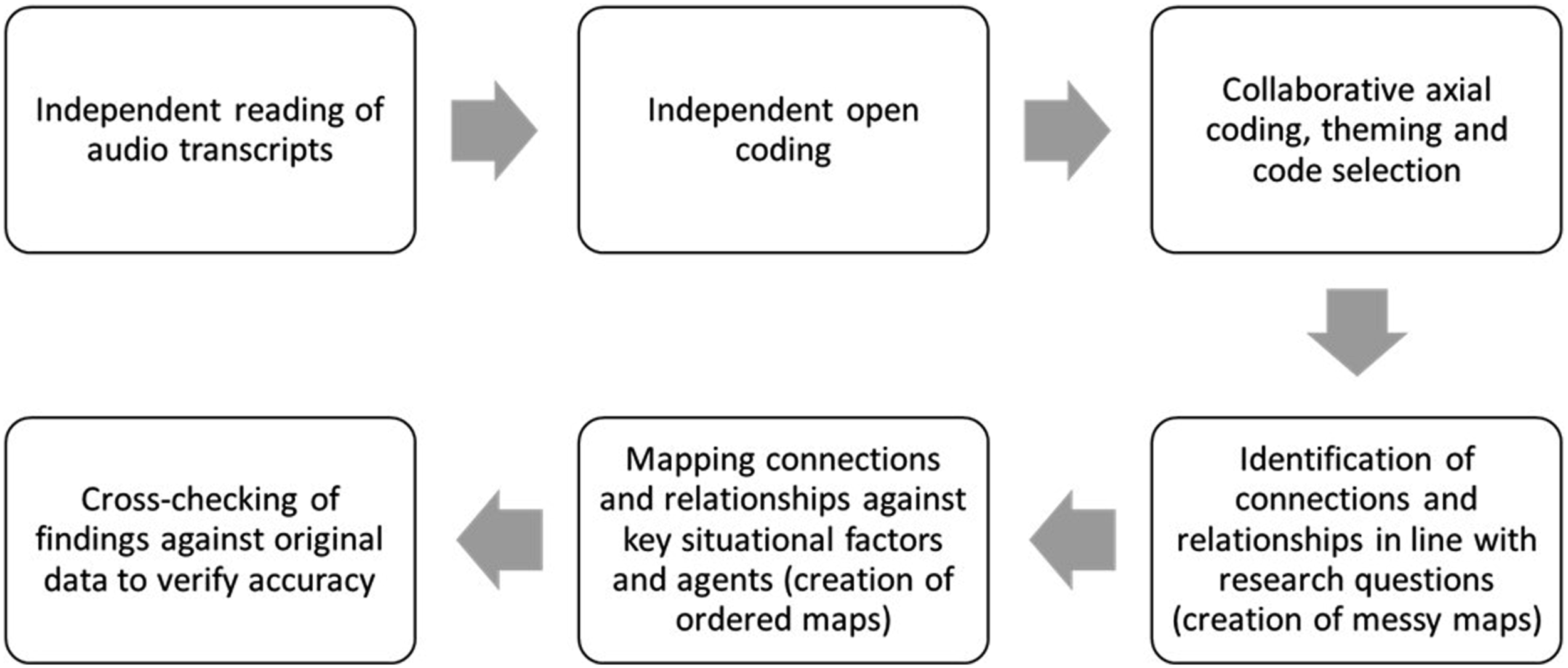
Coding was undertaken independently by each researcher first, and then collaboratively, to generate axial codes and thereby enhance the validity and usefulness of the codes (Kolb, 2012). Codes were allocated positive or negative labels in line with their content. For example, an early code identified was that of ‘pressure’: some participant comments pointed to the additional pressure created by having to contend with the technology required to facilitate the use of video (negative pressure); other participant comments intimated an ostensible or perceived lessening of pressure as a result of not having a university tutor in the room (positive code related to pressure). Prevalence of codes was also noted, with attention paid to those which recurred more frequently. Through collaborative discussion, codes were grouped together and refined in order to identify emerging patterns and initial connections. These were used to generate ‘messy maps’ (Clarke et al., 2018), and creation and discussion of these, through an iterative memoing process (Birks et al., 2008; Charmaz, 2014), developed understanding of the key ideas present within the data.
Following on from this, researchers reviewed the messy maps and connected key ideas within them against different situational factors and agents. For example, consideration was given to key network actors/elements such as the University tutors and requirements of the teacher education programme, as well as legislative requirements such as the General Data Protection Regulation (GDPR) laws, and regulatory requirements in the General Teaching Council for Scotland (GTCS) Standards. The data was mapped against these to create ordered maps, so that researchers could identify the role of, and implications for, these agents (if any) in line with the data and research questions (cf. Clarke et al., 2018 etc.). This stage enabled the researchers to consider the connections between these knowledge points and build a clearer understanding of their findings.
The final stage then involved checking all of these ordered maps back against the original transcript data, mapping transcript evidence against each key point to mitigate against researcher bias or embellishment. A few points were identified as having no direct transcript evidence, indicating that they had emerged from researchers’ discussion rather than the data itself. Identifying this enabled researchers to remove these points from the maps, thereby ensuring accuracy as far as possible, but also responding to their emergence analytically as way of considering the data set more deeply (Clarke et al., 2018). The memoing through discussion was captured and aided the sense-making of the data, which frames the findings and this article’s discussion.
Three overarching ideas emerged in the final messy maps, as will be explored in the subsequent findings section.
Findings
Situational analysis is an analytic process (Clarke et al., 2018) and the findings from our research developed through our mapping, memoing and connecting. This section sets out the findings at the point of saturation and the reflexive discussion that occurred between the authors throughout the analysis process.
There are three multi-dimensional themes that represent the findings of this research. These are: • Video is a useful tool to develop reflective practice • Virtual observations impact agency and control • Student teachers prefer in-person observations
Each theme and its development will be described in the following subsections.
Video as a tool to develop reflective practice
Figure 2 is a visualisation of the positioning of video as a reflective tool within the data. In the initial messy mapping process, reflection was a strong finding; however, through discussion, the differing perspectives on how effective virtual observations were for developing reflection emerged. Ordered situational map: Good reflective tool.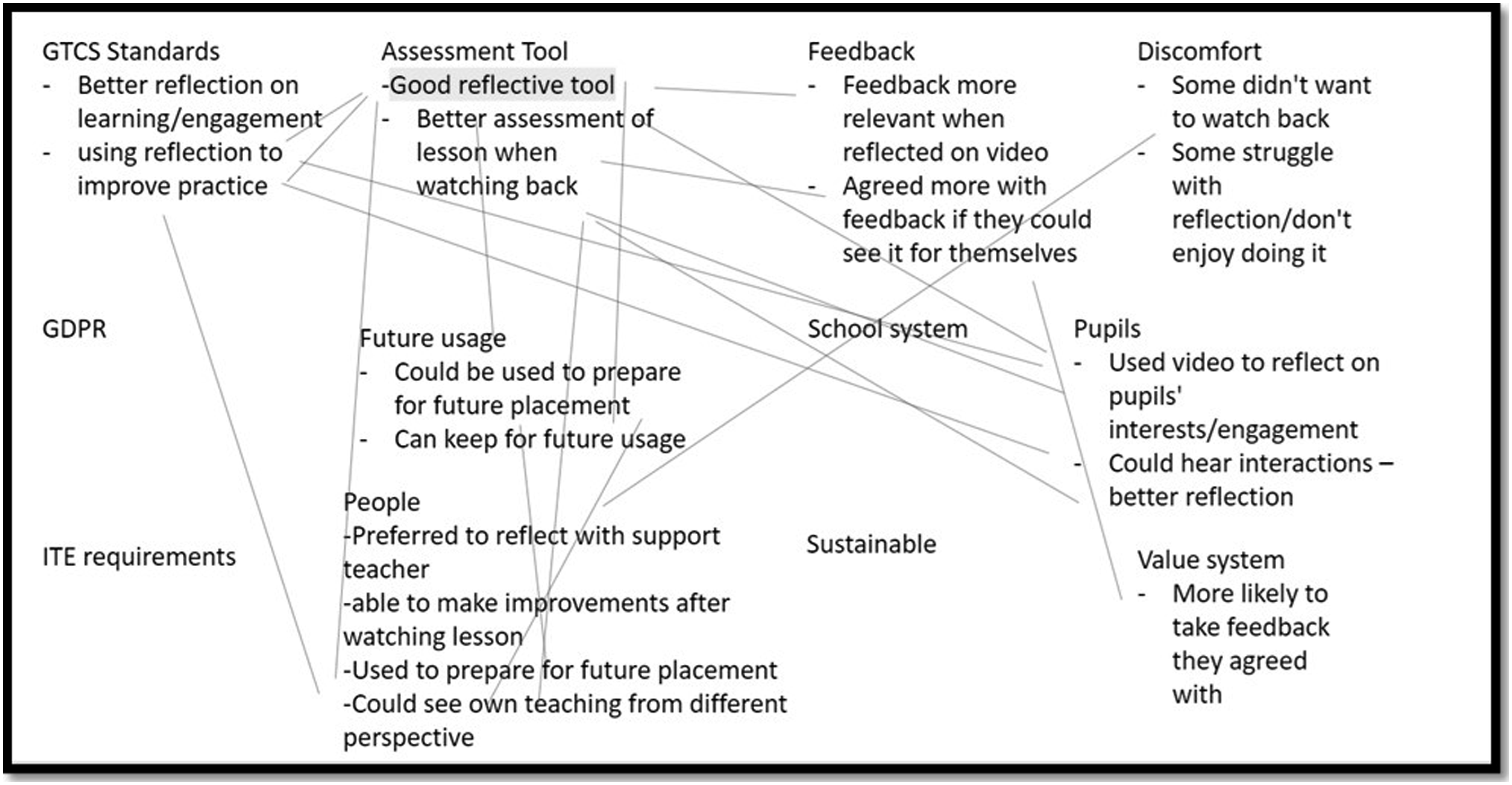
Virtual observations enabled student teachers the opportunity to see their own teaching for themselves, which helped them reflect more on their feedback from their university tutor and deepen the relevance of that feedback: Charlie: I thought it was quite insightful because obviously, I don’t get to see myself teaching, or myself in practice ... and, like, a good opportunity for me to, like, reflect on my own teaching, like, from a different perspective. Sam: So, it’s helpful to kind of be able to have something to look back on and be like, okay, so this is what I said and that worked, and this didn’t.
Charlie and Sam were both positive about the opportunity virtual observations gave them to revisit and think about their own teaching to help them develop their practice. They both found the value in rewatching themselves teach and considering the feedback they had been given by their university tutor. This connection between reviewing the video and developing their practice can be understood as a creation connection (Thota, 2015) as the students are developing their own learning from linking parts of their network of knowledge together.
However, not all the participants found the same value in rewatching themselves. Discomfort was present for student teachers. Jordan found it difficult to watch themselves back: Jordan: I watched a little bit of it; I couldn’t bring myself to watch the rest of it…
Jordan did further elaborate that the small section they did manage to watch back was helpful to see, but they only managed to view a few minutes of a much longer recording due to the personal discomfort they felt watching themselves back. Jordan’s discomfort could be considered as a lack of aggregation within the design of the use of video observation, as Thota (2015) suggests that connections must be considered so that links can be made by students. In this case, students were not requested to review their videos, and so students like Jordan did not overcome the personal discomfort of watching themselves on tape, to be able to develop the creation links Charlie and Sam developed.
Linking the feedback the student teachers were receiving from their in-class mentors to their practice was another aspect of reflection that was revealed through the discussion of the discomfort. This connection was both relational and creation, as the feedback and independent review of the video by the student teacher meant that they could identify aspects of their teaching they wished to improve. Charlie was able to take a repeated area for development, flustered pace, and reflect on this in their own recording to help them ‘calm down a bit and go a bit slower’, with Sam suggesting in their interview that seeing the pupils and how they responded to teaching was helpful to consider ‘what was interesting to them’ and ‘where they engaged’, which, in turn, helped develop Sam’s practice.
Virtual observations impact agency and control
Within the mapping around reflection, the theme of control and student teacher agency emerged. Through our discussions on the maps on this theme, we linked seeing a virtual observation as an assessment with revealing normal practice to their observer.
Reduction of pressure was initially raised in our first discussion of the data. It was a theme that emerged in different ways from the participants: Charlie: So not having the tutor come in and watch me do the lesson, I felt like I was able to perform at my best. Perrie: I did feel a little bit less stressed because I didn’t have an extra pair of eyes watching.
For Charlie, not having the tutor present helped them to maintain normality of the lesson, which they felt would aid them in performing at their best. Perrie focused more on the reduction of external influence by suggesting as the observer was not seen, it was easier to forget about them.
Sam agreed that there was less pressure, but their focus was more on how not having the tutor present meant that they were able to make decisions, and the observed lesson was not such a snapshot or final picture of their practice: Sam: And just knowing that I kind of had a little bit of control and I could always … just kind of do another recorded lesson... it took the pressure off...
These connections are linked to Thota’s (2015) relational and sharing connections. The sharing aspect is about demonstrating a more authentic version of their teaching to their assessing tutor, and the relational aspect is about continuing to ensure that the relationships within the classroom are maintained, through not allowing the observer’s presence to impact how the student teacher made decisions within the classroom.
Student teachers prefer in-person observations
In juxtaposition to findings above, the final theme indicated that there was a preference from some of the student teachers for in-person observations, despite them also suggesting that they would experience more pressure from the tutor being present.
One aspect of this theme was the practicality of recording a video in some classrooms. Charlie had concerns that the tutor would not be able to hear the audio as their placement was in an open plan classroom. Sam’s concerns were technological: Sam: the file wouldn’t upload for ages and I was so scared of the iPad dying cause then I would have lost everything.
An in-person observation would not have generated the same concerns, as the tutor would have seen the pupils and heard their talk, and that observation would not be dependent on connectivity or device availability. This concern is best described as a relational connection. There is an implicit understanding that if something does not go to plan in a classroom where the student teacher and the observer are, means that there is a shared relationship on those elements of their connected network. So removing the observer from the classroom, removes a part of the confidence in that relational connection.
Due to General Data Protection Regulations (GDPR, 2018), the student teachers were not able to record pupils within their classrooms. Perrie articulated why they felt an in-person visit would be superior to a virtual one as it would allow their observation to take into account all the information within the classroom: Perrie: I just don’t think a video gives you the full... picture of everything.
Both Perrie and Jordan felt that there was a reassurance of being seen in person, despite it having ‘extra pressure’ (Jordan). This sharing connection links to the students wanting to demonstrate their best work. Therefore, the restriction on what information could be recorded does impact their ability to share their teaching with their tutor, and so it is reasonable to see why Perrie and Jordan conclude that it would be better to have an in-person observation. This resonates with one of the limitations tutors noted in their perceptions of virtual observations (Mynott, et al. 2022) with the suggestion being that there might be something missed in an observation if the whole classroom is not seen in the observation.
Discussion
The findings indicate both positive considerations of using virtual observations, and reservations from the student teachers. This next section will explore the findings linking them to the purpose and innovation of virtual observations.
Virtual observations as assessments
As mentioned previously, virtual observations were introduced to the teacher education programme, during the COVID-19 pandemic, as a way to continue the assessment of student teachers in their practicum placements. It is this purpose, virtual observations as assessment, that frames some of the findings surfaced above.
If we consider the findings against the context that the virtual observation were summative assessments, we can see that the student teachers are focused on their assessment going well. Ideas of discomfort, reassurance and the desire to evidence their practice all feature in the ordered map, Figure 3, preferencing an in-person observation. These are relational and sharing connections, with part of the network providing reassurance (the choice of the observation time) and others causing discomfort (knowing that they are being assessed on their performance). Ultimately, these ideas can all be linked to the student teachers wishing to be as successful as possible in their virtual observation. The concerns voiced by Charlie and Perrie about the video not capturing everything the tutor needed further underscores their desire to ensure that everything needed was accessible to their university tutors. Ordered situational map: Preference to have an in person visit.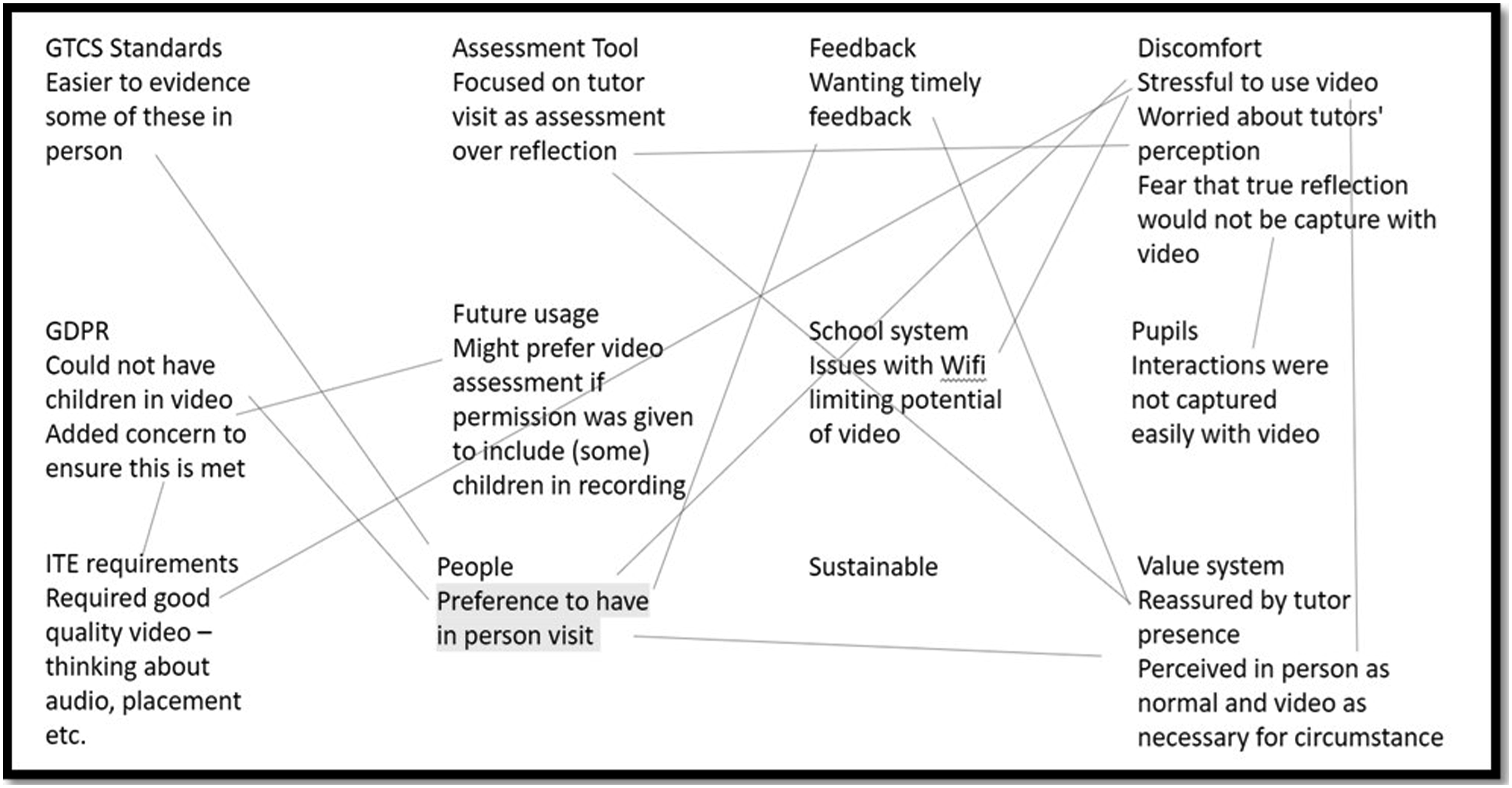
The student teachers have a valid concern about what can be seen in virtual assessments, as University tutors have recognised that there are limitations to what can be observed in comparison to an in-person observation (Dyke et al., 2008; Mynott et al., 2022; Ó Grádaigh et al., 2021). Yet, both Mynott et al. (2022) and Ó Grádaigh et al. (2021) demonstrate that the information obtained by the tutor is sufficient to make an effective assessment. However, sufficiency is not necessarily reassuring to a student teacher who wants to ensure that they are developing their practice effectively.
By framing the virtual observation as a summative assessment, the pressure of successfully recording and uploading the observation so that it can be viewed is an additional source of potential stress that does not exist in in-person observations. Indeed, Sam’s technical challenges are also not uncommon. Dyke et al. (2008) and Schmidt et al. (2015) recognise the challenges that technical issues can have. Mynott et al. (2022) and Murtagh (2022) also identified aspects of working virtually that were impaired by poor devices or connectivity. Students are also less likely to focus on reflection and gleaning pedagogical benefits from the process because of this understandable preoccupation with the recording as a high-stakes summative assessment. Due to the importance of the assessment on the student teacher’s progression within their teacher education programme, it therefore makes sense that they would display a preference towards in-person visits.
Therefore, the findings about preferring an in-person observation do not necessarily respond to how beneficial the student teachers found using virtual observations, but rather attend to the situational dimension of this being part of their assessment leading to their degree. Hence, not being able to see their tutor, and gauge their reactions, during the lesson increased uncertainty. Jordan’s suggestion that tutor presence is ‘extra pressure, but it’s also a bit of reassurance as well’ captures the dual findings related to the virtual observations as assessments: remote viewing lessens some pressure, but students would prefer to know that their practice is being assessed with as much information available to the tutor as possible. The summative nature of the use of video may generate challenges to how students feel their teaching is shared, and this can impact their confidence in the relational aspects of their assessment. So, a more formative approach to virtual observation might further reduce pressure and reduce the desire for an in-person observation.
Innovation
Focusing on virtual observations as summative assessments negates other dimensions of the findings. The formative nature of feedback and how the virtual observations gave the student teachers opportunities to review their own teaching in a way they could not do with an in-person observation is an example of how, despite the purpose of the virtual observation, there is more than can be explored from reviewing them.
Introducing virtual observations at scale during a pandemic (Mynott et al., 2022) was innovative, but how the observations are being utilised by the student teachers indicated that there are further innovations taking place, as the usage of virtual observations continues.
One of the key points discussed was the way that student teachers were able to use their observations to consider their feedback. Sam and Charlie both discussed this and used their recordings to revisit their feedback to understand it more clearly, linking it to their own practice development. This was not a requirement set out of the virtual observation and not all students, like Jordan, felt able to revisit their recordings and watch their own practice. Yet, Sam and Charlie were able show links to how the recording and the feedback could help them prepare for future practicum placements and look at their own practice from a new perspective (Figure 2). This creation of new knowledge and understanding is a key finding. Mac Mahon et al. (2019) found a similar finding from the student teachers they interviewed, who said seeing the points raised in their feedback and hearing it from multiple tutors was helpful. This help extends to the student teacher having agency over their feedback, as they can review it and see if the points raised are relevant to them and develop their own next steps. However, a warning from Mac Mahon et al. (2019) is that too much feedback can still be overwhelming for the student teacher, so some support to prioritise feedback will still be required.
The agency or control of the observation was another aspect that enabled the student teachers to be innovative. They needed to record their virtual observation and share it with their university tutor within a given date window. Charlie notes that this gave them control over whether they shared a specific lesson or not, reducing the pressure on one lesson going perfectly, as in an in-person scenario. For Perrie the lack of the observer in the room meant that the lesson felt more realistic, or natural. This links to Liang’s (2015) research on observation and the reactivity to observers, from student teachers and pupils within the classroom. Liang (2015) suggests that student teachers will perform differently when they have someone in the room as they are trying to gauge if the observer is satisfied with their practice as well as delivering the lesson. This can in turn lead to a false impression of the student teacher’s practice. The ability of the student teachers to share a normal example of their practice, that they have chosen, without an observer present is therefore likely to give a more authentic impression of the student teacher’s practice and therefore one they are more likely to be able to reflect on individually to help further develop their practice.
Conclusion
This research has revealed a tension related to the continuation of virtual observations within the teacher education programme. This tension is a relational tension, one that is linked to the purpose of virtual observations. When virtual observations are framed as summative assessments, they are considered a poorer option than in-person observations by student teachers. They are poorer because of the incomplete information that can be gauged (Dyke et al., 2008; Mynott et al., 2022; Ó Grádaigh et al., 2021) and because the benefits of using a virtual observation are not realised as they do not encourage aggregation and wider reflection of practice.
There is, however, significant potential in reframing virtual observations so that they are part of students’ development. Mac Mahon et al. (2019) proposed a hybrid model where some observations were undertaken virtually and some in person. However, a more reflective, formative process, potentially cumulating in an assessed observation, in-person or virtual, is likely to be potentially even more productive for students as this builds on the creation, relational and sharing connections seen within this research. If this gradual process were virtual, it would build on the findings that virtual observations have the potential to reduce observation reactivity, increase student teacher agency and control of the times and examples of practice selected, and also enhance their ability to reflect, understand their feedback and move their own practice forward. If this process were potentially enhanced by helping student teachers to use a tool or framework to focus their initial work on reflection, it might prove to be even more supportive to helping student teachers develop and extend their own reflective practice, as seen in the two student teachers who watched their videos back.
Fundamentally, to ensure that the innovation of introducing virtual observations into our teacher education programme is realised, we now need to consider how to adapt the focus of their use so that the potential benefits for student teachers are maximised and so they are less about being a fixed point of summative assessment and more a formative tool, or part of a suite of formative tools, to support teachers in seeing, developing and reflecting on their own practice. While this research has shown that student teachers are able to take initiative and use virtual observation to enhance their practice, teacher educators should be focusing on building processes to aid all student teachers in utilising virtual observation so that they can be engaged with in ways beyond assessment. This ensures that connections are made, aggregated and developed so that student teachers are able to make their own connections to develop their practice. Moving to a more formative process is likely to further reduce stress, and build reflective practice, which in turn should support an improvement in student teacher practice as they progress through their chosen teacher education pathway.
Supplemental Material
Supplemental Material - Continuing virtual observations: A situational review of student perspectives
Supplemental Material for Continuing virtual observations: A situational review of student perspectives by John Paul Mynott, Faye Hendry, Kaitlyn Edwards and Rebecca Hossick in Research in Education
Footnotes
Declaration of conflicting interests
The author(s) declared no potential conflicts of interest with respect to the research, authorship, and/or publication of this article.
Funding
The author(s) disclosed receipt of the following financial support for the research, authorship, and/or publication of this article: This work was supported by the Learning and Teaching Enhancement Project funding from the QAA and the University of Aberdeen as part of the Enhancement Theme development work.

Supplemental Material
Supplemental material for this article is available online.
References
Supplementary Material
Please find the following supplemental material available below.
For Open Access articles published under a Creative Commons License, all supplemental material carries the same license as the article it is associated with.
For non-Open Access articles published, all supplemental material carries a non-exclusive license, and permission requests for re-use of supplemental material or any part of supplemental material shall be sent directly to the copyright owner as specified in the copyright notice associated with the article.
