




Abstract
Reconceptualising the neoliberal project in education as a process of colonisation, this paper considers the effects of what the authors argue amounts to a reconstitution of schooling in England. This argument examines how the narrative about education’s liberatory purposes in support of human flourishing that gained particular prominence in the social democratic consensus following 1945, is becoming eroded and subjugated by a neo-colonial imaginary. This disavows past connections to local communities and undermines a democratic polity. The ontological colonisation of schools and teachers by ways of working rooted in neoliberalism is examined by drawing on research on the lived experience of schools and Multi Academy Trusts (MATs) and the narratives of educators and leaders who are part of them. The narratives illustrate how such neo-colonial processes appear to appropriate and reconstitute teacher identities and shape schools’ connections with their communities. The authors analyse and interpret narratives of those in schools and the spaces to re-construct and re-imagine possible alternative futures.
In this paper we argue that the well documented neoliberal project in education and schooling in England can be viewed as the colonisation of education by an ideology and value system which is outside both the occupational professionalism (Clarke and Phelan, 2017: 23; Evetts, 2009) of those working in schools and community understanding and expectations of what role education should have in healthy community life. We argue that these expectations and purposes of an education that is liberatory and supports human flourishing gained particular prominence in the social democratic consensus following 1945. However we contend that since 1979, under the guise of parental choice, markets, teacher autonomy, improved standards and accountability, these more wide ranging emancipatory aims have been delegitimized. This process of colonisation is one of imposed “regimes of truth” and arguably has taken over all areas of schooling; curriculum, organisation, student wellbeing and governance (Fuller, 2019). Whilst this process of colonisation began with the imposition of neoliberal disciplines in these aspects of schooling, we argue that the acceleration and intensification of the government's academy programme in England has resulted in schools becoming powerless constituents of multi-academy trusts (MATs). This, we maintain, has given rise to what we conceptualise as a process of colonising schools and their communities. It could be argued that mass schooling has always been closely linked to the colonial project. Donald (1992) highlights the links between colonial activity in India and the roll out of mass schooling for the working classes in England in the 19th century. Our contention is that the academisation project can be interpreted as a resurgence of these connections between schooling and colonial activity in the form of neocolonial discourses today.
With the majority of children in England now educated in academies, these academy schools are increasingly being subsumed into MATs. This turn is manifest in the post 2010 drive to academy status for English schools. Academies are state funded but independent schools under contract to the secretary of State for Education and divorced from local democratic public stewardship exercised by elected local authorities and instead under the control of unelected, self appointed boards of trustees. We suggest that this process of MAT formation and growth serves to unravel the links between education and local democracy and acts as a form of neo-colonial practice which is inimical to enhanced social justice and corrosive of democratic community. We argue that this issue is of critical significance because it constitutes a remaking of English schooling which removes schools from local democratic influence and places ownership and control in the hands of unaccountable corporate and market-driven MATs, takes public assets from communities and undermines a democratic polity.
This paper adopts a qualitative approach to examining narratives of lived experiences of educators and leaders in MATs. The paper focuses on two studies of MATs in England and uses interviews and field notes to gather data on the views, ideas and thoughts of participants from chief executive officers (CEOs) and executive directors of MATs to classroom teachers of some constituent schools. The analysis of the data is our interpretation through our application of a neo-colonial perspective.
There is a wide body of literature critiquing neoliberalism and education with reference to themes of educational leadership and management, MATs, neoliberalism and the colonisation of education (for example, Sefa Dei, 2019; Starr, 2019; Spicksley, 2022; Faris, 2022). As a contribution to this well documented field of study this paper tenders a neo-colonial perspective and seen from this gaze, it raises significant questions about models of school leadership and governance, the erosion of school community connection, “local ways of knowing” (Walker, 2019) and the disavowal of citizenship. The wider importance of this analysis for the field lies in the fundamental epistemological and ontological issues raised regarding local knowledge and what we have conceptualised as ontological colonisation, that are surfaced through our analysis of the imposition of modes of governance which arguably, undermine the polity.
Research context: Two studies of multi-academy trusts in England
The two studies of MATs featured in this paper complement each other in relation to the overall aims of the research project. While both studies are concerned about the lived experiences of educators, study one focuses on the individual participants in management and leadership positions; study two mainly reports on findings from individuals in the role of teachers. The combination of the narratives from both studies enhances the research in two ways: firstly, it enabled the researchers to make sense of the impact of MATs on teachers, education leaders and local communities; and secondly; it provides the opportunity to construct a perspective across the hierarchical structure of a MAT from trustee and senior executive levels through to classroom teachers. The neo-colonial gaze applied by the authors to the interpretation of the narrative data coheres the two studies, drawing together the common strands and feeding into a critique of current orthodoxies which, the authors argue, represent the incursion of neoliberal modes of organisation and governance, and disavow schools’ community connectedness and “local ways of knowing” (Walker, 2019).
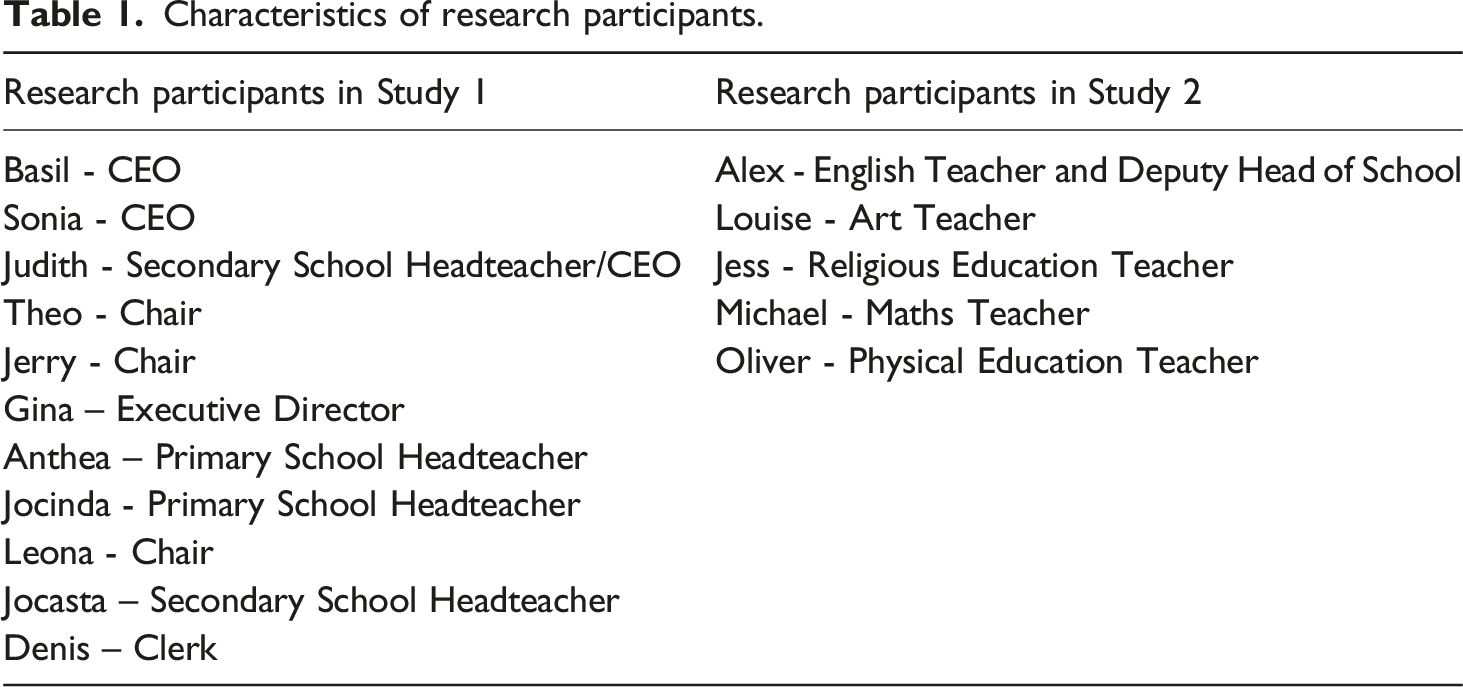
Characteristics of research participants.
Study two adopts a narrative inquiry approach to explore teachers’ experiences of the change to academy status in an English secondary school setting. Following a series of external inspections, the school was deemed to be “failing” and under government legislation was required to move out of Local Education Authority control to become part of a MAT. This study took place over a two-year period during which the school was navigating this transition between 2016 and 2018. The school is located in a small, coastal town in England. It is the only secondary school in the town. In the 2 years leading up to September 2015, the school was subject to a high number of school inspections. An initial Office for Standards in Education and Children’s Services (Ofsted) inspection, which took place in March 2013, rated the school as “Inadequate”, finding a number of serious weaknesses. This precipitated an increased level of inspection and a list of recommendations. By June 2014, the school was subject to special measures. After this, three further monitoring inspections were carried out. The school was eventually forced to move out of Local Authority control and become part of an established MAT.
Narrative inquiry as a methodology creates an inquiry space which facilitates the listening to, and the exploration of, stories told and lived, of education. The teachers’ narratives recognise and place value on schooling as an experience grounded in conceptualisations of space and place as interrelational and plural. The narrative data were gathered through researcher’s field texts, interviews, family stories and personal reflections and memories of four teachers. Again, all participants were given anonymity by the use of pseudonyms as shown in Table 1 and to protect the school's identity, it is referred to throughout as Longton Academy Seachurch, formerly Seachurch School.
Narrative inquiry is a way of understanding and inquiring into experience through “collaboration between researcher and participants, over time, in a place or series of places, and in a social interaction with milieus” (Clandinin and Connelly, 2000: 20). Study two locates that researcher and those participants in a particular place, at a particular time. Relationships are key to understanding the work of narrative inquirers. The relational space between researchers and participants is central to understanding how field texts and narrative data are composed. Relationships are also an important way of making sense of the temporal and contextual aspects of narrative inquiry (Clandinin, 2013). In this study, experience is seen as narrative composition not merely an analytic or representational device.
Findings: Narratives of lived experiences of educators and leaders at multi-academy trust schools
A neo-colonial perspective is applied as the conceptual and analytic framing for the critique advanced in this study. Whilst appreciating that colonialism is associated with bleaker aspects of history, including racial injustice and domination, this is not part of the conceptual framing as applied in this paper. Rather, a neo-colonial perspective is employed here for the resonance it has with what Pennington (2022: 45) referred to as “the evolving system of schooling in England dominated as it is by the growth of MATs as the only approved organisational form”. It is applied as a useful framing with which to develop a critique of how issues of power play out in the logics of MAT school governance. In developing this framing Pennington’s critical analysis of MATs as a neo-colonial enterprise is drawn on, the logic of which we argue can influence relationships between MATs and their constituent schools and communities. Whilst a neo-colonial lens is thus applied, it is important to make clear that we do not suggest, nor should it be inferred that the individuals involved are colonisers or imperialists or that they as individuals exhibit the negative attitudes and behaviours associated with those terms. Motivations are shaped by the desire to do the best for the children, families, and communities they serve (Pennington, 2022: 188). Through the application of this conceptual frame, the logics of performativity, the pressures imposed by regulatory constraints and the distance between school leadership and local needs emerge in study two (Walker, 2019). For example, a neo-colonial conceptual framing informs the critique of the apparent disavowal of the situated nature of local knowledge, a characteristic of the exercise of colonising power.
Study one
In examining the way the case study MATs relate to and interact with the range of communities in which they are situated, the analysis of the participant data employs a framework of neo-colonialism to interpret the findings. The analysis within this discourse yields three themes: that of MAT mission which in the way it enmeshes benevolence, power and control has resonance with the concept of the civilising mission, a core feature of the rhetoric of colonialism; the characterisation of schools and their communities as a problematic “other” lacking in organisational, technical, epistemological and moral attributes and thus in need of benevolent external intervention by a MAT; and an imperative of growth driving MATs to take over and absorb schools in pursuit of financial sustainability and enhanced positioning in the marketplace.
MATs vision and mission
The idea of the school as a benevolence driven “civilising mission” is not a new one but has received renewed emphasis in examination of the work of some high-profile academies and their approach (Kulz, 2017). We argue that this mission can be constructed from analysis of participants’ responses, for example where there is discussion of vision, mission, and moral purpose of the MAT. In this extract, Judith, CEO of the Orchid Trust focuses on this in talking about how the MAT relates to communities: I think that, coming back to that central vision, of making sure that our youngsters are school ready, work ready and life ready, we then have a moral purpose to ensure that the curriculum offer in each of the schools meets that vision (Judith, CEO, Orchid Trust).
It can be argued that the MAT’s mission as expressed here is suggestive of a form of ontological colonisation, shaping young people in line with the MAT’s mission and its attendant view of its educational purpose. The assertion that the purpose of schooling is solely concerned with preparation for work, and this is the route through which young people will be “life ready” indicates the MAT locates itself firmly within the neoliberal discourse of education. This is a discourse that re-constitutes education as a commodity to be bought and sold in a marketplace to consumers anxious to secure economic advantage through schooling which confers readiness for work (Thomson, 2020; Biesta, 2006). The language here, with its stress on the importance of vision, reflects the colonisation of non-economic domains by the business discourse of leadership and management in which “visions are the property of leaders who should enact them relentlessly and are authorised to have them enacted by their objects, who are all the other actors in and within the sphere of the school” (Courtney and Gunter, 2015: 401).
Judith explains how the MAT determined its mission over an 18-month period in what seems to be a hierarchical and top-down process. It was something that: very much, probably, came from the leadership of the three schools, when we sort of started talking about the vision for the Orchid Trust almost eighteen months ago, and then that’s been shared through leadership with local advisory committees, what were then local governing bodies, before the conversion, so that they understood what they were buying into, what they were becoming a part of, and then, that was articulated at that launch event, to everybody that attended, which was quite a large audience, and we feel that we need to convey that information, we need to have a clarity of our purpose, and we need our parents to understand the offer that the Orchid Trust is going to provide for their child (Judith, CEO, Orchid Trust).
The mission appears to be very centrally determined, the property of a senior leadership. What is on view here appears to be a centre-periphery model with a process of absorption and take over where those at the periphery (local schools and their communities) are taken over by a central power which imposes its aims and purposes and sets about instructing the community about what is going to happen under the new arrangements. As Pennington (2022: 160) puts it in the case study analysis: the “superior” power determines its aims and purposes and articulates the superior knowledge, organisational and managerial prowess and moral authority of the coloniser and imposes this in a hierarchical manner. The MAT will explain what is going to happen and what will be provided to children and families, but there is to be no room for consultation, negotiation or amendment, the MAT authority is both superior and final. The process is that of a monologue rather than dialogue.
The colonisation of schools and the growth of MATs
Motives of collaboration and partnership across a group of schools in the establishment of a MAT are in evidence from the participants’ interviews: So from the beginning what we felt was that every school should have a stake in that Trust Board. And initially, every school was able to send a representative to be on the Trust board (Sonia, Iris Trust CEO).
However as this MAT (the Iris Trust) developed, seeking to put in place its ideals of a collaborative, mutually supporting partnership, it came into conflict with the rigid, hierarchical business logics and corporatism of the state and its agents and agencies. These logics insist on the adoption of neoliberal technologies of governance which privilege specialist business knowledge and corporate school structures over local connection and democratic modes of operation. The CEO of the Iris Trust explains how the adoption of the governance structure required by the Department for Education (DfE) officials challenged and changed the Trust’s principles: So now it’s very, very clear and this has enabled us to get to recruit more people onto our Trust Board who have got expertise and see it much more strategically than where we were before. So although what we set off to do about being inclusive seemed like a good idea at the time, it isn’t a good idea going forward’ (Sonia, Iris Trust CEO)
The inclusive partnership initially constructed on the schools’ own ideals of self-governance, mutual support and local community are quite quickly re-directed and repurposed into a neoliberal mould by the dominant business logics and what started as an aspiration of collaboration between schools is rendered into something more akin to a take over by a MAT.
As many analyses of colonialism show (for example, Rodney, 1972; Said, 1978), despite a justificatory rhetoric of benevolence and improvement for the colonised subjects, the essential motivations were about economic growth and advancement of the coloniser. The case study suggests that a similar process can be discerned in the way in which some MATs seek to absorb schools and grow to secure their financial and organisational sustainability. Data from the participants shows that business logic and commercial imperatives are bound up with discussion of community benefit. For example, the CEO of the Heath Trust explains the MATs approach to community engagement. So each of the communities have different problems and team members are trying to solve those on the ground because without solving the problem of community engagement, your numbers are going to drop and they will drop dramatically. If you ignore that, what the community feel, you will find your numbers go down and then the viability of the school goes (Basil, CEO Health Trust).
The suggestion from the case study is that community engagement by a MAT can be influenced by the concern to secure financial viability through attracting pupil numbers in a competitive marketplace.
Pennington (2022) argues that the logics and discourse of neo-colonialism provide a framework with which to interpret the way in which MATs engage with and relate to constituent schools and their communities and how leaders conceptualise their role. As explained previously and important to reiterate here, this is not to suggest that the individuals involved in leadership of MATs are colonisers or imperialists or that they exhibit the negative attitudes and behaviours associated with these terms; this is not so much about personal beliefs but the wider discourses that structure and validate what is reasonable and accepted in the sector. Pennington’s study suggests motivations are shaped by individuals’ desires to do the best for children, families, and communities but the pervasiveness of these discourses narrow and constrain the options by which these intentions can be translated into actions. In this way, MATs and the manner in which they are required to form and grow become “part of a project of neoliberalism and is permeated by values informed by this colonial economic paradigm” (Shahjahan, 2011: 193).
Study two
Some of the narratives are captured here and give us a window into how it feels to be taken over by a MAT. A high number of staff had left during the summer term, just before study two began, as the school left local authority control and became part of a MAT. Of those who remained many found the transition to the new ways of working difficult to accept.
Participant Alex recounted the story of the first staff meeting where staff were told that a set of behaviour management strategies would involve the whole school, teachers included, conforming to a series of ways of working. One such change was the way in which the need for silence would be demonstrated. At this staff meeting, the new principal entered and raised his hand in the air. He waited. As Alex explained, staff were unsure what to do and reacted with a mixture of nervousness, some laughing, some chattering, and confusion, looking around the room to see what others were doing. The principal explained that from now on, whenever the teacher wants the students to be silent, she or he must raise their hand in the air, as he was doing, and request that all the students do the same and simultaneously stop talking. Similarly, in all future staff meetings, teachers must also put their hand in the air and be quiet if instructed to do so by the senior leadership team (SLT). It was explained that this modelling of the behaviours to staff by the SLT would promote staff’s awareness of the behaviour policy and help them to embed it into their own practice and ensure that they became whole school behaviours.
This narrative is just one example of a range of stories shared by the teachers that highlighted the tension of teacher agency, professionalism, and the mechanics of a “toolkit” of processes. These behaviour management initiatives are influenced by the “no excuses” principles originating in the US, with the performative agenda and the pressures of continual scrutiny (Ayers et al., 2001). The impact of the influence of no excuse behaviour strategies is further evidenced in the following narratives.
Performative pressures and no excuses: “Don’t you think it’s like a prison here, Sir?”
As newly qualified teachers, participants Louise and Oliver were sent to a neighbouring academy school which had employed an even stricter policy than Seachurch. They were asked to spend 3 days at the school to familiarise themselves with the approach. Louise reflected and remarked: It’s ridiculous like the routines have just gone too far. They had silent corridors that worked but the kids knew that they had to be silent and I never really saw anyone particularly behave badly except for this one student … he’d been silent the whole day with no break and he was just ready to just explode and I think he was Y7 so he was new to the school and he, sort of, just threw his book on the floor and obviously got sent out and was put on report. [...] One of them had said to the P.E. guy here “Don’t you think it’s like a prison, Sir?” and the fact that that was a Y7 and the fact that they are thinking that, I just worry.
Oliver shared a similar observation: It was completely robotic. We use a lot of their ideas. I think we’ve just tamed it down a little bit. I don’t think our kids would cope with their behaviour. It was silent, every corridor. It was just the norm though. They all had to, before every lesson, line up in this big hallway. [...] It’s a good school because they get the grades, but it’s a prison.
For Louise and Oliver this had been a disturbing visit. It had challenged their core beliefs about children and young people having freedom and space. In a sense it is the “wrongness” of it all that is overwhelming for them. Seeing a school so effectively shut down identity for both students and teachers in a way awakened them to considering how the changes being brought about in their own school would impact on them and the young people who they work with. Also evident in Louise and Oliver’s observations is the discourse of neo-colonialism in which an external regime of discipline had been imposed on a school taken into the MAT. The sense of the school becoming a powerless colony of the MAT subject to an alien and harsh regime is foregrounded when both talk of the prison-like school environment in their narratives. It resonates with Foucault’s question “is it surprising that prisons resemble factories, schools, barracks, hospitals, which all resemble prisons?” (Foucault, 1977: 228).
In the zealous drive to find and implement initiatives which can make education “work” we fall into the trap of thinking that we must deconstruct what is a complex and creative endeavour into component parts which can be evaluated and where satisfactory outputs are defined, measured, and secured. As Biesta (2013: 3) cautions, the desire “to make education strong, secure, predictable and risk-free” raises moral, political, and educational questions about what price we are willing to pay to make education “work”.
Performance oriented school culture also has a significant impact on participants’ lived experiences. Oliver reflected on his experience of performance management. Yes, but grades, as a school it’s all you are judged on. As a teacher your performance management is all about grades. I think that’s what’s putting a lot of people off as well….a lot of people……there are so many things that you could do….your trips, letting kids see the real world because that’s the best thing for them but you can’t get kids for trips any more or fixtures for P.E. For a P.E. teacher I can’t get year 10s and 11s out of school because they would be missing lesson time. Ultimately, they are going to miss out on learning for these grades, but you get as much out of a sports fixture representing your school going around doing these things as you would a lesson. The pressure is there, and people can’t have any leeway. They are restricted.
Oliver describes the pressure he feels and enhances further the sense of the school as a subaltern institution subject to the imposed regime of the MAT and its attendant rules, regulations, restraint, and constraint imposed on thinking and practice.
We still call it “top school” here
In the final narrative from study two, we hear the head teacher describe an encounter with one of the student’s grandfather. He tells this story at a whole school meeting that he organises ahead of the school open evening the following Thursday. The other day I was talking to one of the students' grandfathers about how the school has changed. I explained that it was important that everyone used the new name and no longer called it Seachurch School. He replied, ‘Well, we all call it ‘top school’ here. I said to him that it should be called Longton Academy, Seachurch as it is now part of Longton Academy Trust. This is what I am expecting you to do, especially next Thursday.
The above narrative fragments give a glimpse into what was experienced by teachers as they attempted to navigate the challenging terrain of the MAT “takeover” and colonisation of the school. The teachers and students were clear that to them a sense of place and what Walker (2019) describes as the “local ways of knowing” of their school and their community was central to its ability to flourish. Disavowal of such ways of knowing and local history and context is characteristic of the process of colonisation, in which the colonising power seeks to diffuse and spread its supposedly superior beliefs, ideas and practices from centre to periphery, convinced that this is “profitable for everybody and also is right, rational and natural” (Blaut, 1993: 29)
Discussion: The colonisation of schools and the erosion of community engagement
Central to the context of both studies is the success of the neoliberal project and the ongoing colonisation of schools, and their adverse impacts on the communities. According to Andrews (2021) the close links between these phenomena are manifest in what he terms the “new age of empire”; the continuity of unjust practices, constituted by neoliberal economics, technologies of governance and ideologies that dominate social, political, and economic discourse. Sefa Dei (2019: 41) is explicit about the link in an education context, making it clear how neoliberalism is the “premier colonial science of education” and “is heavily complicit in reproducing colonizing relations of schooling today.” Davies (2017) argues that the common thread which weaves through the neoliberal project is the desire to replace political judgement with economic evaluation. If conceived of as a project of rationalisation, this “disenchantment of politics by economics”, involves the deconstruction of the language of “the common good” or the “public” and in so doing we argue that this is corrosive of community.
Both studies featured in this paper highlight community as a constitutive element of schooling: both the nature and basis of the community within the school; and the manner and form of engagement with communities in and around the school. What can be constructed from the studies is a foundational linkage between community and citizenship. To realise full citizenship, the community in which a school is located needs to be inclusive, democratic and to embrace difference and plurality (Ranson 2018: 69). Democracy is therefore a way of living in community with others rather than a system of government or the formal institutions of representation (see for example Macmurray 1999; Dewey 1966). It is characterised by plurality and should be judged “by the extent to which different voices from diverse sections of the people can actually be heard” (Sen 2010: xiii). Such a democratic community is one of the casualties of the colonisation of schooling by neoliberal logics for, as Gunter (2016: 92) asserts, the idea that schools should be separated from local democratic processes, as seen in the charter schools in the United States and in the academy and free school programme in England, is at the basis of neoliberal reforms.
The studies quoted above illuminate one of the enduring threads in the random and haphazard patchwork of English education, that of a democratic sensibility. Schools have been an important site in the struggle for greater participatory democracy. Schools and their structures and processes of governance have thus provided small-scale opportunities for involvement of citizens in the everyday business of democracy through shaping actions and decisions at a local level (Pennington, 2022). There is a long tradition of community involvement in school governance and engagement of local communities by governing bodies making the kind of “explicit efforts to bring into being a people capable of engaging in modest self-rule” identified by Brown (2019: 27).
The interpretation of evidence from the studies on which this paper draws may suggest that the advent and growth of MATs is diminishing this kind of community engagement and reducing opportunities for the practice of democracy through participation in school governance. This is not just an English phenomenon, with overall participation of parents and community participation in governance in decline across the OECD (Baxter and Cornforth, 2021: 570). Engagement with communities is increasingly re-shaped as a commercial transaction in which community becomes defined as the “customer base” (Pennington, 2022: 114) and the role of the MAT is to market itself to passive consumers in pursuit of market share and financial sustainability driven by the relentless and pervasive business logics of neoliberalism. Where study one identified an alternative approach to engaging with the communities in and around a school which shifts the balance away from caring about performance to caring about people (Stern, 2018: 18), this was a small scale, ad hoc, school by school initiative of a particular headteacher, not a MAT policy direction. It is, according to Pennington, a result of what De Certeau (1984: 37) identifies as the use of tactics that can “accept the chance offerings of the moment and seize on the wing the possibilities that offer themselves” and “make use of the cracks that particular conjunctions open up in the surveillance of proprietary powers”.
Conclusion: The need for alternative futures
This paper has examined the rich narratives of lived experiences of educators and leaders in two studies of MATs in England. Study one illustrates the pressures and processes by which MATs engage with schools and communities in what we argue can be interpreted as a neo-colonial project which takes over resources, concentrates power and control at the centre and diminishes the scope for local communities to exercise democratic influence and engagement with schooling. Study two gives further insight into what are conceptualised as neo-colonial processes in action. It highlights the manner in which external regimes, bringing harsh discipline and autocratic modes of working appear to be imposed on some schools taken over by a MAT and the impact this has on individuals and their communities. Under the neo-colonial gaze applied in our analysis, the data suggests that, driven by neoliberal logics the governance and practice of MATs appear to have had a detrimental impact on people working within their schools and their connections with local communities. The creation and expansion of MATs have also raised some important questions, for example, what are schools for? What are the roles of different stakeholders in the governance of schools? To what extent, if at all, is the market suitable as an organising logic for schooling?
Whilst the foreclosure and disavowal of opportunities for schools as sites of democratic participation has been a motif in the two studies, more optimistically, opportunities exist for alternative approaches rooted in responsiveness to the communities served by schools and to local need, reflective of “local ways of knowing” (Walker, 2019). Such an epistemological positioning acts as a bulwark against colonisation by the corporate business logics and interests which erode community bonds and connections to the neighbourhood. Opportunities to counter such market-driven approaches in ways that respond to local need exist particularly in those MATs that allow some flexibility to enable this, but in those that are more rigid and centrally directed, such opportunities can be significantly curtailed. By galvanising these opportunities, not only does the reinvigoration and restoration of a tradition of community involvement and democratic practice in education become possible, but the agency of staff, students, parents and other school constituencies to shape decisions and actions is reinstated.
Footnotes
Acknowledgements
We would like to thank Professor Matthew Clarke for his valuable comments and suggestions on an earlier version of the paper. The ethical approval for this study was given by the research ethics committee at York St John University. We would also like to thank the two anonymous reviewers who commented on the original submission of the paper.
Declaration of conflicting interests
The author(s) declared no potential conflicts of interest with respect to the research, authorship, and/or publication of this article.
Funding
The author(s) received no financial support for the research, authorship, and/or publication of this article.
