




Abstract
This paper reports on Henri Lefebvre’s methodological approach of 'rhythmanalysis' as a productive tool to understand the complex social constructions of school spaces. Schooling is founded on relationships. These relationships exist in multi-directional and multi-layered ways between teachers, students, school leadership, parents and carers, the school and local community, and official Departments of Education; but also between education policy, official curriculum, and official assessment regimes; and between the material spaces of schools such as school buildings, classrooms and outdoor spaces. These relations are complex and multidimensional, and are characterised by movement. This paper reports on the methodological approach of a recent ethnographic study in a secondary school in suburban Melbourne, Australia that investigated the complex socio-spatial relations that shape teachers’ intercultural work at this school. This paper reports on the nature of relations in school spaces across three domains - conceived, perceived and lived space - and identifies the kinds of rhythms these produce. I argue that this approach enables education researchers to examine in close detail the complex and mobile nature of relations that shape teachers' work in local settings, and may better inform a situated approach to curriculum and policy development.
Keywords
Introduction: Why space?
Barbara Comber (2021) asserts that “‘the spatial’ has always been in educational research. Research is always done somewhere, by particular people, about people and phenomena, somewhere” (19). Yet, space in education research remains commonly constructed as mere context or backdrop to the activities being investigated (Comber, 2015), or with focus on the material spaces of school buildings and resources, of spaces specifically designed for particular kinds of teaching and learning, and of school architectures as a technology of discipline (Foucault, 1977; Gulson and Symes, 2007). In recent times, however, there has been a spatial ‘turn’ in education (Comber, 2021; Gulson and Symes, 2007). Although there remains a long way to go for educational research to be comprehensively theorised by concepts of space, according to Gulson and Symes (2007: 98) drawing on theories of space contributes in critically important ways to subtle and more sophisticated understandings of the competing rationalities underlying educational policy change, social inequality and cultural practices.
That is, spatial theory offers new possibilities to understand and explain complex educational problems.
This paper draws on an ethnographic study at a secondary school in outer-east Melbourne, Australia, to propose Lefebvre’s (1991) production of space and rhythmanalysis methodology (2004) as a productive tool for examining the situated social complexity of teachers’ work in school spaces. This paper operationalises Lefebvre’s (1991) framework of conceived-perceived-lived space to explain complex relations between teachers, school leaders and students. These relations cut across spaces of education policy, curriculum and administration, in material spaces constructed for particular purposes while also imagined in competing ways. These complex intersections are acted on and lived through social action in and across time. Through this framework it becomes possible to articulate how space constitutes situated school practices. Taking Comber’s (2021) lead, this analysis attempts to “offer new possibilities for transforming education” (20) and contributes to furthering conceptual and methodological practice in educational research. First, a word on the study.
The study: a conceptual and methodological overview
This paper reports on the methodological approach taken in a single-site ethnography at a school in the outer-east of Melbourne, Australia. I have called the school Hillside High School (pseudonym). The study, born out of 12 years of experience as a high school English teacher in suburban primarily ‘white’ public schools, was focused on interrogating the question: what makes teachers’ intercultural work so challenging? In Australia, social, administrative, and physical spaces are normatively produced within an imaginary of the ‘white possessive’ (Moreton-Robinson, 2015) that sustains the ‘fantasy’ of a white Australia (Hage, 1998). Within this production of space, anxiety of dispossession as a result of invasion and claiming terra nullius over a land that Always Was, Always Will Be Aboriginal Land constitutes white privilege (Moreton-Robinson, 2015; Nicolacopoulos and Vassilacopoulos, 2004; Ravenscroft, 2004) and remains the foundation for race relations in Australia today (Cowlishaw, 2004; Slater, 2019). This foundation has entrenched a set of norms whereby markers for inclusion and exclusion largely remain constituted by race, and in particular, whiteness, as a signifier by which cultural diversity continues to be measured. This is important for this study because if intercultural education is to contribute towards creating a respectful and cohesive society as detailed in key curriculum and policy documents (ACARA, 2016; Council of Australian Governments Education Council, 2019), then intercultural education must examine the symbolic practices that signify, include and exclude cultural diversity and that shape intercultural relations today (cf. Davies, 2022a; Davies 2022b; Zembylas, 2014, 2018).
In this study, intercultural work is understood to be the formal curriculum work of teachers enacting the Intercultural Capability curriculum as laid out in the official Victorian syllabus (Victorian Curriculum and Assessment Authority (VCAA), 2017), as well as the everyday social practices that implicitly convey value related to ways of knowing and being. This study is equally interested in the enactment of the official curriculum as with attitudes and behaviours towards cultural diversity that exist at Hillside, and the emotional labour of teachers navigating intercultural spaces in their classrooms. This dual focus allowed for close analysis of the everyday discursive spaces of cultural difference at Hillside in relation to abstract spaces of official curriculum directives, everyday spaces of curriculum translation and enactment, and the lived spaces of symbolic interaction that render intercultural work polyrhythmic in nature.
Overview of teacher-participants.
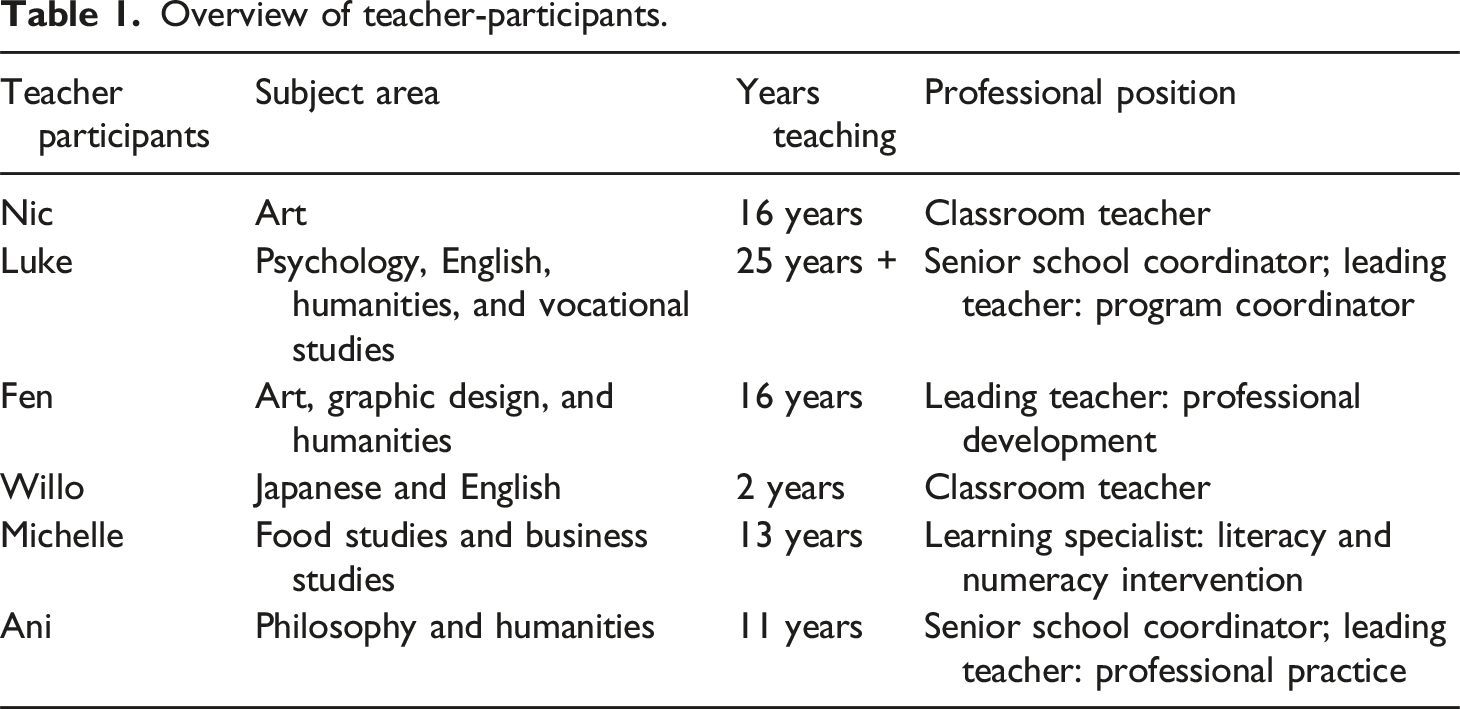
I spent 3 days a week over 6 months at the school observing classes, writing fieldnotes, going to staff meetings and participating in yard duty. The teachers each participated in two one-on-one interviews bookending my time at the school, and three focus groups across the 6 months of my fieldwork with their teacher-participant colleagues. My observations and fieldnotes informed casual conversations and reflections, as well as prompts for the more formal interviews and focus groups. Questions, observations and prompts were posed and expanded on dialogically in the data generation activities, enabling meaning of shared experiences of the intercultural at Hillside to be constructed together. This co-constructed approach to data generation and analysis took seriously my ethical responsibility in representing the worlds of my teacher-participants, and in particular, an ethnographic commitment to the contingencies of human relationships (Campbell and Lassiter, 2015; Denzin, 1997). In addition, it operationalised Lefebvre’s (2004) notion of ‘seen from the window’, whereby researchers are ‘positioned observers’, who engage all the senses in an embodied approach to data generation and interpretation, rendering all interpretations provisional (De Beauvoir, 1989; Gordon, 2015; Rosaldo, 1989).
Data was organised around Lefebvre’s (1991) triadic production of space while data was analysed to grasp the situated nature of relations with and between abstract and everyday spaces of the school and how these intersect to rhythm the lived spaces of teachers’ intercultural work. While this approach was designed for this specific project, the implications for the adoption of spatial theory and rhythmanalysis in education research are vast and will be taken up later in this paper. First, I will provide an overview of the conceptual and methodological foundations of the study.
In-Between intercultural education and SA local identities
In Australia, cultural diversity is typically signified as non-white other (Nicolacopoulos and Vassilacopoulos, 2004) within the ‘fantasy’ of white Australia (Hage, 1998). This shapes how concepts of culture and difference are broadly understood and serves as a reference point for the intercultural – commonly taken as being about an ambiguously identified cultural other (Gorski, 2008; Gunew, 2004; Walton et al., 2013, 2018). A more productive conceptualisation of the intercultural, however is the spaces between diverse cultural groups (Dietz, 2018; Guilherme, 2015). As taken up in education, this conceptualisation positions intercultural education as understanding the relational spaces between diverse cultural groups and the conditions that constitute these relations (cf. Davies 2022a, 2022b). In this study, I brought together the work of Stuart Hall (Hall, 1993, 1996, 2017) in conversation with Lefebvre (1991, 2004) to consider the way intercultural work in schools is a complex negotiation across local discursive practices and those from distant horizons that produce culture and difference in particular ways in particular settings.
The imperative of the Intercultural Capability in the Victorian curriculum as an assessable requirement across all levels (Victorian Curriculum and Assessment Authority (VCAA), 2017) was an important anchor for this study. Curriculum and policy levers directing schools and teachers to do intercultural work occur within broader social and political discourses, or orders (Aman, 2018; Dreamson, 2017; Lefebvre, 1991) that entangle across local, national and transnational administrative spaces. For this study, Lefebvre’s work was productive in offering a conceptual language and methodological tool to describe and articulate complex relational spaces where social actors mediate local social practices across curriculum directives and networks of power that are exerted both locally and from elsewhere.
Henri Lefebvre’s production of space: conceived, perceived and lived
Lefebvre (1991) asserts “that a space is not a thing but rather a set of relations between things” (83). For Lefebvre, physical space can only be grasped through the relations and attachments associated with that space. As such, the “concept of space denotes and connotes all possible spaces, whether abstract or real, mental or social” (Lefebvre, 1991: 299). That is, spaces are constituted by the imaginary and lived realms. For Lefebvre, the symbolic meanings assigned to particular spaces in the ways they are lived cannot be separated from the complex networks of power that shape the ways these spaces are produced through abstract structures and everyday function. To unpack this in more detail I now examine each element of space as theorized by Lefebvre before discussing how space creates new possibilities for thinking about education.
Spaces are conceived through the social, cultural, historical, political and administrative structures that attribute particular functions to them. Middleton (2014) suggests that “conceived spaces are abstract, mental” (11) while Simonsen (2005) adds conceived spaces are constructed through the discourses of law, administration and order. Conceived space refers to the dimensions of space that determine administrative and regulatory constructs, and the division of labour related to them. The concept of conceived space denotes a school as a space for learning, while also determining the abstract structures that direct ownership, responsibility, labour and value. In Australia, a public school is a space owned and governed by the State, whose administration are regulated by complex networks of policies, codes of conduct and divisions of labour. Public schools in Australia, as opposed to Independent or religiously affiliated schools, are symbolically conceived as apolitical institutions (as in not holding political influence or affiliation) and must be secular (Victorian Government, 2006). Public schools are constructed in abstract ways as culturally neutral institutions (Berger, 2010; Bernstein, 1996), even though they are rarely experienced this way (Apple, 1982; Osler, 2015; Steinberg and Kincheloe, 2009). Public schools are tools of nation-building, shaped by the distant horizons (Lefebvre, 2004) and orders of national and transnational political and economic agendas, but schools are also populated by diverse social actors whose mobile trajectories require negotiation (Comber, 2015; Massey, 2005). Despite public schools being conceived in neutral ways through the rhetoric of education policy and curriculum, the positioned nature of schools within particular communities and as populated by particular people shapes the way the conceived spaces of local schools are perceived and acted on in the everyday lives of local people.
Lefebvre (1991) summates that perceived space “is social space – the common-sense, taken-for-granted physical/embodied world of ‘social practice’” (38). Perceived space relates to the particular—the activities and practices of a particular space that produce its rhythms (Lefebvre, 2004). Perceived space accounts for the ways social actors relate to and engage with space relationally through social interaction. These everyday relations produce particular schools as, for example, ‘academic’, ‘rough’, ‘comprehensive’ or ‘privileged’. Within schools, the social practices of students and teachers produce each as ‘engaged’, ‘disruptive’, ‘fun’, ‘strict’, ‘unfair’, ‘boring’, as well as the way some subjects are perceived as more important or more expendable than others within a school’s hierarchy of value (Bernstein, 1996). The everyday relational practices of space give body to the abstract productions of space that determine utility and function. And it is in the ways these everyday relational practices of space are experienced where meaning is made and space is lived.
Lived spaces are hence produced through the meanings attributed to perceived and conceived spaces. Middleton (2014) describes how ‘lived’ space “taps into unconscious, imaginary and symbolic dimensions of experience” (11). Lived spaces embody the meanings produced through social action. Lived space is what produces a particular experience of a school as, for example, transformative; a particular class and teacher as inclusive; the art room as a safe-haven; or school as a punitive waste of time. It is the triadic relation between the conceived, perceived and lived that produce spaces in particular ways for particular people. The production of space in this sense becomes an embodied site of relational engagement between “the experiential, the philosophical and the political” (Lefebvre, 2005: 17). There is a danger, however, in assuming the production of space across these layers is final.
Space is never complete or fixed. Relations with space evolve, changing the way space is produced across conceived, perceived and lived dimensions over time. Space is a multi-layered entanglement of experience and struggle, constituted by multiplicity and unfinalizability, space itself an actor in the ‘becoming-with’ of social actors across time (Haraway, 2016; Renshaw, 2021). As such, the shifting trajectories and intersections between the conceived-perceived-lived productions of space are far from simple, rather a mobile entanglement of simultaneous multiplicity.
In recognising that productions of space are both cohesive and incomplete, it becomes clear that productions of space are always contestable. This means that productions of space cannot exist in the binaries of ‘either-or’, but rather are more productively understood as ‘both-and’ (Zembylas, 2014). That is, there is always multiple ways to story and experience space (Renshaw, 2021) and this multiplicity is important for understanding how teachers’ work is situated within complex relations and contestations of space. In this way educational spaces are not only the physical architectures of school buildings, purpose built to discipline teaching and learning (Foucault, 1977), but also the administrative and regulatory spaces of schools that discipline teachers work. The power of these spaces is not experienced equally. Policy is not interpreted nor implemented in universal ways, curriculum is translated and enacted in relation to particular school contexts and groups of students, and school subjects are constructed within a hierarchy of value (Bernstein, 1996). However, by articulating the complex and mobile intersections of school spaces across abstract, everyday and lived realms it becomes possible to understand the way teachers’ work traverses the particular in relation to the conforming tendencies of education policy and official curriculum produced elsewhere.
Rhythmanalysis as methodology for understanding teachers’ intercultural work
Henri Lefebvre’s (2004) final theoretical and methodological contribution to his theorisation of the production of space—the exploration of the rhythms of everyday life through rhythmanalysis—encourages a rethinking of the way complex interactions across and between abstract and lived spaces are understood. Rhythm is a metric of time. In terms of the production of space, rhythm is produced through the divisions of labour that determine how time is allocated and the spatial relations that produce, interfere, disrupt or cut across the repetitive rhythms of conceived, perceived and lived spaces.
The work of schools, teachers and students is deeply rhythmic. The rhythms of schools are marked in many ways by the hourly and daily rhythms of the timetable, school bells and routines of teaching and learning – linear rhythms that track time across the school day, term and year. These rhythms of schooling discipline perpetual cycles: day and night, seasons, cycles of the moon, and perennial festivals and rituals. Between natural rhythms of nature and the body, and administrative rhythms that divide labour, social action creates its own rhythms, an additional layer that is irregular and spontaneous and can disrupt the regular rhythms of school life.
In setting out on his discussion of rhythm, Lefebvre (2004) suggests starting with the body—the breath and the cycles of physiology (hunger, rest) and the cycles of maturation (infancy, childhood, adolescence, adulthood)—to focus on the body’s rhythms rather than function. When in good health, these rhythms are both polyrhythmic (multi-layered) and eurythmic (in harmony). That is, the living body is present to the ways diverse rhythms that are not uniform work together in distinct and productive ways. As such, the ways the rhythms of the body maintain balance become a constant reference point for complex networks of rhythms produced through human interaction. In this way, rhythmanalysis encourages a sensitive palpation of “the rhythms of multiple and complex social relationships inherent in the production of space as continuous encounter” (Christie, 2013: 777). Lefebvre insists rhythms are produced triadically, across three axes in space and time through the exertion of energy. He says, “time and space without energy remain inert” (2004: 70). It is the exertion of energy—social action— that produces rhythm. Schools are inherently relational, produced through continuous social action. These interactions produce complex polyrhythmic orchestrations that rhythm teachers’ work.
In this study rhythmanalysis is a productive way to describe the competing divisions of labour across administrative structures and curriculum, as well as through social action. In grasping complex divisions of labour relevant to intercultural work, it is possible to describe how rhythms produced by the allocation of intercultural work, the power relations associated with divisions of labour, and how these intersect with productions of cultural difference shape possibilities for doing intercultural work at Hillside. I have applied rhythmanalysis through data generation practices, ethnographic writing and interpretation, and finally analysis. I looked specifically for the way rhythms related to productions of cultural difference manifest in conceived spaces, and how these intersect with the perceived spaces of curriculum translation and enactment, and the lived spaces of social action. The description of rhythms are important data that represent the pace, tone and timbre of productions of cultural difference, and when brought into conversation with the experiences and reflections of teachers, offers a view of the broader horizons that distribute and (de)value intercultural work. This approach is useful for describing social complexity and dominant practices without, as Christie (2013) argues, reducing complexity to a single logic. The challenge of taking up rhythmanalysis as a researcher is tapping into the rhythms that are unseen or unheard as well as the ambiguity with which rhythms are experienced. I attempt to deal with this by presenting and bringing together a range of participant voices with my own to demonstrate the polyrhythmic nature of intercultural work. While there are broad lessons to be learned from a rhythmic approach to understanding the work of teachers, those lessons are found in the complexity of situated social spaces, not in their generalisability.
Rhythms of conceived – perceived – lived spaces at Hillside
The conceived space of the Intercultural Capability in relation to the conceived space of The Hills
As a starting point, it is worth briefly introducing the conceived space of the Hills – the region where the school is situated – and the place of cultural diversity within the imaginary of the local area. When I first met the Principal of Hillside he described the Hills as a “rural enclave”, situated geographically close to the metropolis of Melbourne, but detached from the bustle and grind of the city’s suburbs. As I described my project to him his initial response was: “we’re a very ‘white’ school, so I’m not sure how useful this will be for you”. I found this assessment interesting. From the outset, the conceived space of intercultural understanding was signalled as already regionalised (Massey, 2005) to perceived spaces (more visibly) culturally diverse. This can productively be understood through Lefebvre’s (2008) concept of the ‘symbol’. In the Hills, practices of inclusion and exclusion occur symbolically between the imaginary of a white, culturally neutral self and a non-white culturally diverse other. According to Lefebvre (Vol 2, 2008: 284) “the symbol includes and excludes, by bringing the members of one particular group closer together, while excluding other individuals and groups”. In the Hills the binary between the white (belonging) self and non-white (excluded) cultural other constitutes the conceived space of the intercultural, and intercultural work as the work of culturally diverse schools and communities.
When I presented my project at the whole staff meeting to recruit teacher participants, the curriculum leader stood up and said: “we have taken a conservative approach to the Intercultural Capability. It is the sole responsibility of LOTE (Languages Other Than English) and I encourage people who teach in the languages and humanities to join the study”. Again, the conceived space of the intercultural is conflated with the conceived space of cultural difference and labour is allocated to spaces conceived as culturally diverse, such as LOTE. After I finished my presentation a teacher who did not participate in the study commented to me: “we’re not a multicultural school, so this intercultural stuff is not a priority for us. Perhaps you should go to a more [visibly] diverse school.” So even though Fen, a participating teacher of Art and Humanities stated in a focus group conversation: “there’s a lot of difference [in the Hills] in terms of background, educational difference, political ideals, all sorts of stuff”, under the conditions described, cultural difference at Hillside is understood as the constitutive outside (Hall, 1996), excluded from the dominant imaginary of the Hills. The symbolic production of cultural difference as external to Hillside and the Hills becomes the reference point for how intercultural work is perceived and lived at this school.
The discursive practices that reproduce the Hills as not diverse, as “mainstream white” (teacher participant Michelle), and where “intercultural stuff is not a priority” create normative rhythms of what it means to belong at Hillside. These rhythms constitute the way the Intercultural Capability is conceived as the responsibility of cultural others rather than of the neutral (white) self, allowing the school to position intercultural understanding as “not a priority” and to take a “conservative approach” by allocating intercultural labour to LOTE – the conceived space of cultural difference. This occurs despite the official directives that determine intercultural work as the responsibility of all teachers (Victorian Curriculum and Assessment Authority (VCAA), 2017) and demonstrates the way official curriculum priorities are translated in local spaces. As Ani, another teacher participant stated: “if you’re not assessing it, it’s not on your radar”, demonstrating how divisions of labour as allocated through abstract productions of curriculum, assessment and reporting regimes determine responsibility within the everyday spaces of intercultural work.
Perceived spaces of cultural difference
To demonstrate the way the conceived space of cultural difference is perceived in everyday spaces at Hillside I share an excerpt from my fieldnotes. I describe a moment between participant teacher Fen and his year nine Humanities class. In the previous class the students had been exploring geographical concepts of ‘space’ and ‘place’. Fen arrives and raises his arm to draw the attention of his class. Three boys meander over asking “where are we?” wanting to know which room their class has been moved to. “That’s a great question” Fen replies. “We are here, in this space. What is this space? And what makes it a place?” He is drawing students into a conversation from yesterday’s class. One of the boys, wearing smoky eyeliner and dyed black hair side swept over his face starts to respond quietly. For a moment he engages with the question without appearing self-conscious. Fen and the boy’s friends listen, Fen nods his head, he seems impressed. When he finishes speaking, the other boys burst into laughter and the smoky-eyed boy joins in, the moment gone. Being a year nine student sucks. There’s been a room change. Fen gets the students moving: “c’mon, we’re missing out on valuable learning time”, his tone dripping in sarcasm that is equally met in the response of his students. They enter the classroom from the outside ramp. Students are chatty. Someone complains “not the Japanese room!” Followed by another student’s cry – “can we watch a movie?” Fen waits. “Right. Concepts: Space. Place. Change. Influence over time. Sustainability. Interconnection. Environment.” Fen invites the students to contribute their understandings of the concepts. Joel immediately asks if the class can watch ‘Totoro’ – the Japanese children’s animation, which is met with a chorus of pleas from the class. Fen continues to turn the question into a discussion about space and place. B1 – the room this class has been moved to, is a classroom, a space for learning, but it is known as the Japanese room – set up and decorated as a place for doing Japanese. The students seem to feel out of place taking geography in there and appear to want to revert to the behaviours that I observe in their Japanese class. Fen ploughs on and the students eventually settle.
This extract captures the kinds of relations these year nine students have with the everyday space of Japanese. Amidst the students reorienting themselves physically and mentally for the room change, some students rebel using the space of the Japanese room as reason enough to dismiss the plans Fen had for the class. In my observations of the year nine Japanese class with Willo—the Japanese teacher participant—students commonly call out on entering the Japanese room “can we watch Totoro? Can we watch a movie?” The plea to watch a movie here understood as a low-stakes task indicative of the kinds of value attached to Japanese language learning. The students’ response to the physical space of the Japanese classroom is embodied in their interactions with it, where their rejection is symbolic of the students’ efforts to assert their place and power, while excluding that which does not belong. For these students the Japanese classroom does not carry value. Even though Fen is moving his geography class to the Japanese room, the students’ response is representative of the relations these students have between the Japanese classroom (perceived space) and the conceived space of Japanese language learning as constitutive of a symbolic construction of the cultural other. These intersecting relations across the conceived and perceived spaces of cultural difference at Hillside shape the rhythms of the lived spaces of intercultural work at this school.
Lived spaces of intercultural work
The reactions of students in Fen’s year nine geography class represent how that group of year nine students relate to and (de)value Japanese language learning. According to Willo, this is a product of the conceived space that Japanese language learning occupies within the school. LOTE learning is only compulsory to the end of year nine and according to Willo, studying LOTE is not valued. Willo reflected: In terms of languages, sometimes I feel like in general – like I’m trying to create a culture of my students to value it, but I feel like I’ve got to try and create a culture in the staff to value it too, which can be really hard. It’s one thing to try and get a student on side, but if the teachers aren’t even on side then you’re like well, this is harder because students are malleable. I think students feel torn, and I feel like there is still a lot of – I won’t say ridicule – but there is still a lot of, I feel like, negativity around the idea of ‘oh, do you like Japanese? Oh, are you going to continue?’ I feel like it’s not seen as a positive thing to study a language. I feel like you’re the strange one if you enjoy Japanese. In my experience, it feels like yeah, if a student is liking it, it’s like ‘why? Why do you like it?’ And it’s not, ‘oh, why do you like it?’ It’s ‘why do you like it?’ You know, it’s a negative kind of question.
I observed this kind of negativity in the way some students overtly attempted to undermine Willo’s planned lessons with pleas to watch a movie. However, more subversive rhythms that disrupt time and labour related to teaching and learning Japanese were present too. Students regularly complained: “why can’t everyone just speak English?” At times, some students engaged in more provocative disruptions such as “don’t they eat dog?”, or “watch out! Japanese is taking over English!” or respond to speaking and listening activities in mocking and generic Asian accents. Willo was required to orchestrate her lessons in response to these rhythms, working hard to not let them dominate. Yet, deficit representations of cultural difference like those observed in the Japanese classroom were observed in other classes too.
In the year 10 International Food Technology class a student searched for a cheap laugh by mocking someone of Indian background while making samosa, chiming “curry muncher” repeatedly and waggling their head; while in Fen’s year nine humanities class a student made a slur towards another student as a ‘dirty Abo’ – an ongoing occurrence according to Fen; while another year nine student of Philippino background is called ‘Chinga’. This kind of everyday racism is normalised in dominant white spaces (Hage, 1998; Wilkinson, 2008)– as seen at Hillside, and is used as a mechanism to exclude cultural difference and assert the authority of the ‘white possessive’ (cf. Hage, 1998; Moreton-Robinson, 2015; Nicolacopoulos and Vassilacopoulos, 2004). In the lived spaces of intercultural work, such as the Japanese classroom, the conceived and perceived spaces of cultural difference converge to resist and disrupt efforts to build intercultural understanding. And it is here, in examining the way productions of space intersect the rhythms of teachers’ intercultural work can be grasped.
Discussion: Spaces of intercultural tension and rhythms of intercultural work
Curriculum and policy directives play an important role in positioning the role of schools in developing active and informed community members who respect and value cultural and linguistic diversity (Council of Australian Governments Education Council, 2019). In this study, official curriculum such as the Intercultural Capability scope and sequence alongside education policy such as the Mparntwe Education Declaration (Council of Australian Governments Education Council, 2019) are powerful conceived spaces of education. The abstract spaces of curriculum and policy create imaginaries of value (such as intercultural understanding as an education priority) and divide labour (such as, who is responsible for teaching intercultural understanding). As described above, these abstract spaces of curriculum and policy are interpreted, translated and enacted in the perceived and lived spaces of schools. Intercultural curriculum and policy are not merely implemented in instrumental ways, but imagined and enacted in ways entangled with existing practices and relational dynamics between the conceived and lived spaces of education settings (Aoki, 1983, 1993; Priestley and Philippou, 2018) across symbolic spaces of cultural difference.
The experiences from Hillside show how everyday school spaces become more than mere backdrop or context (Comber, 2015; Massey, 2005), but rather are constitutive of the relational practices between official directives and social actors in schools. As Lefebvre (1996: 105) states, “the far order projects itself on the near order” – for example, the far orders of intercultural curriculum and policy – “however, the near order does not reflect transparently the far order. The latter subordinates the immediate through mediations”. This is seen in the way the Intercultural Capability is interpreted through the immediacy of discursive practices that produce cultural diversity and the intercultural as external to Hillside High, shaping the way the intercultural is understood and taken up in this setting.
In this study the rhythms of productions of cultural difference appear in the way time is divided and allocated to the abstract space of the Intercultural Capability and the lived spaces of intercultural work. Rhythms of cultural difference are also grasped through repetitious representations of cultural others. Taking up rhythmanalysis enabled an attentiveness to the competing temporalities of Hillside High School, and of teachers’ and students’ work and personal lives. Rhythmanalysis can be thought of as more than an analytical method, but rather a methodology for conceptualising spatial relations and capturing the complexities and mobilities of situated human experience. It is a way of being in the world that requires an attentiveness to more than the obvious, while illuminating taken-for-granted practices (Campbell and Lassiter, 2015; Gordon, 2015; Olson, 1991; Wolcott, 2003; Woods, 1986).
Implications for education research
Embodying a rhythmanalytical approach to understanding teachers’ work requires a researcher to use the senses of the body to experience the phenomenon being investigated while being removed enough to see how rhythms are produced within “an order, which comes from elsewhere … a sort of presence-absence … which is not seen from the window, but which looms over this present” (Lefebvre, 2004: 42). As Christie (2013) argues, to grasp this moving complexity “requires the apprehension of everything present at a particular point in time-space” (777). Lefebvre (1991) argues, to grasp and be grasped by the moving complexities of social spaces requires attuned attentiveness to “individual entities and peculiarities, relatively fixed points, movements, and flows and waves – some interpenetrating, others in conflict and so on” (88). That is, to grasp and be grasped by the phenomenon, the researcher must be open to the experience, to the unexpected and unpredictability of human relations (Campbell and Lassiter, 2015). It is here, in being open to provisionality and complexity where spatial theory offers a conceptual framework for thinking educational problems anew.
In acknowledging the production of space across the layers of the conceived-perceived-lived, the everyday lives of people become a complex negotiation of relational and representational practices embedded in the multi-layered production of intersecting spaces. It is not possible to occupy a ‘singular’ social space. Everyday life requires crossings between and through multiple social spaces that are deeply entangled across various levels of social and cultural codes, practices and rhythms. This triadic conceptualisation of space opens new possibilities for theorising schooling and teachers’ work. In terms of understanding the complexities of intercultural education, a spatial lens allowed me to capture the way abstract divisions of space-such as the intercultural curriculum, policy and governmental requirements rhythm teachers’ work unevenly and in relation to local power networks and discursive practices. This understanding may help teachers respond to the challenges of intercultural work in situated ways.
Footnotes
Acknowledgements
I would like to acknowledge Rob Hattam, who in his examination of this study offered much encouragement to the development of this paper, and my supervisors for their patience and commitment to my work. I would also like to thank the reviewers of this paper, who engaged in genuine scholarly dialogue via the review process.
Declaration of conflicting interests
The author(s) declared no potential conflicts of interest with respect to the research, authorship, and/or publication of this article.
Funding
The author(s) received no financial support for the research, authorship, and/or publication of this article.
