




Abstract
The paper critically reflects on data derived from prolonged periods of ethnographic study in an economically disadvantaged white workingclass rural community in the North East of England. A central aim the study was to understand the culture of the village and to capture and penetrate the social relationships and meanings within that culture as understood by its inhabitants and their relationship with the local school (see Bagley and Hillyard, 2013, 2015, 2019; Hillyard and Bagley, 2013, 2015). The research employed participant observation inside the village and included semi-structured interviews with residents individually and collectively in a host of formal and informal settings. For the purposes of this paper, the research draws on those interviews conducted with white working-class young people aged 16-21 years old (N= 25), born in the village who were in neither education, employment nor training. The findings suggest the experiences of rural disadvantage for these young people results in them holding a strong relational metaphorical sense of belonging (Cuervo and Wyn, 2014) that draws on bonded social capital (Putnam, 1995) to help them survive.
Introduction
Previous research on young people has revealed the ways in which their lives have been impacted and reshaped by neo-liberal informed socio-economic, cultural and political processes (Cuervo, 2014; Cuervo and Wyn, 2012; Wenham, 2020). This reformulation of welfare systems and more individualised responsibility for social support and survival (Asenova et al., 2015), alongside economic insecurity, has increased notions of precarity in terms of employment, income, health and prosperity (Standing, 2011). In evidencing these changes and their impact on communities in the UK, urban studies rather, those undertaken in rural areas have tended to dominate (Bernard et al., 2019).
As Beach and Ohrn (2019: 1) observe, the implication of this so-termed metro-centricity is that the ‘knowledge of young people’s marginalisation and participation in education and wider society is based on observations of life in limited geographical/social contexts'. Moreover, this dearth of ethnographic knowledge and understanding, is occurring at a time when global and national economic changes have created regional and place-based inequalities which potentially have significant implications for young people living in disadvantaged rural areas (Farrugia, 2014); discursively and literally positioning them as left behind (Wuthnow, 2018). As Black et al. (2019) observe, in contrast with both rural studies in North America (Sherman, 2009; Tickamyer et al., 2017) and Europe (Gkartzios, 2013; Murphy and Scott, 2013), there have been very few UK-based studies investigating the impact of the economic changes and austerity on rural communities and young people.
Consequently, there is need for in-depth ethnographic research, able to illuminate and explore young peoples’ relationship to place, sense of identity and construction of social relations. In particular, how their experiences of rural disadvantage are made sense of, managed and negotiated at a time of global austerity (Canterbery, 2014). In an attempt to provide a greater qualitative understanding, the data presented in the paper, are derived from prolonged periods of ethnographic study in an economically disadvantaged white working-class rural community in the North East of England. A central aim of the study was to understand the culture of the village and to capture and penetrate the social relationships and meanings within that culture as understood by its inhabitants; in this case, white working class young people aged 16–21, who were in neither education, employment, nor training.
In line with Black et al. (2019), the contention as presented, is a need for greater recognition of ‘place’ and ‘belonging’ in understanding the social relations of young people and the ‘interconnections between biography and social context’ (Black et al., 2019: 265). As such, the paper draws theoretically on the relational metaphor of belonging (Cuervo and Wyn, 2014), and Putnam’s (1995) notion of Social Capital, to situate and explain the research findings.
The English rural context
From a normative understanding of the English rural context, almost 90% of England’s land area is categorised as rural with rural areas home to 9.5 million people or 17% of the population (DEFRA, 2018), with 97% classified as ‘White British’ (DEFRA, 2021). In contrast to this relatively homogenous ethnic demographic, it is important to note England’s rural communities are extremely diverse economically, environmentally and socially. They include small remote middle-class hamlets, working-class coastal villages, and commuter townlets as well as former mining communities or ‘pit villages’ as they are known.
In relation to rural disadvantage the picture appears to be one which is similarly diverse and complex. For example, according to the Ministry of Housing, Communities and Local Government (MHCLG, 2019), the Index of Multiple Deprivation indicates that overall rural areas tend to be less deprived than urban ones; the proportion of the urban population in the most deprived 40% of areas higher than the proportion of the rural population. However, as Burke and Jones (2016: 93) observe these indices as constituted are more appropriate for representing disadvantage in urban compared to rural areas (Martin et al., 2000). In effect, in providing an aggregate measure of disadvantage within the geographical areas for which the index is calculated, they can readily overlook isolated areas of rural deprivation (Cloke, 2013; Huby et al., 2009 Burke and Jones, 2016). Moreover, governmental measures of deprivation are themselves subjective with the result that deprivation encountered by residents of rural areas may differ markedly from that experienced by urban residents (Burke and Jones, 2016). For example, the tendency for facilities and services such as post offices, shops, public houses, youth and sports centres and job centres to close and centralise in urban out-of-centre areas, thereby reducing access for rural residents to get to, except by private car. At the same time, rural public transport is continuing to decline (DEFRA, 2018) and to run only intermittently making access to training, employment, education opportunities and fixed- time appointments extremely difficult compared to those in urban areas. According to DEFRA (2018), only 51% of rural students have access to a Further Education site within 30 minutes travel time using Public Transport/Walking compared to 93.6% in urban areas.
In terms of educational qualifications, in predominantly urban areas, the proportion of the working age population with National Vocational Qualification Level 4 or an equivalent qualification was 44.7% compared with 35.4% in predominantly rural areas (DEFRA, 2018). English and Maths GCSE results show that for pupils in rural areas the attainment levels are lower for all decile bands compared with pupils in urban areas (DEFRA, 2018). Indeed, 20% of 16-year-olds in rural areas attain no GCSEs (the basic National qualification) with 13% of all young people living in rural areas in neither employment, education nor training (DEFRA 2019). The limited number of readily accessible educational institutions means there are restricted opportunities in rural areas for either compulsory education post-16 or vocational courses (National Youth Agency, 2021). Data from the Social Mobility Commission over the period 2013–2020, show young people from rural and former industrialised areas to be 50% less likely to those living in other areas to go to University. Moreover, the reduced opportunities for work experience or volunteering mean that young people in rural areas are potentially disadvantaged against their urban peers when seeking employment. (Social Mobility Commission, 2020).
For those in employment, the earned average wage in rural areas compared to the urban average is almost 9% lower, with 20% of households in rural areas including 700,000 children, living below the official poverty line (DEFRA, 2019). In essence, on the everyday level, far from living in a ‘rural idyll’ (Short, 2006), many young English working-class rural inhabitants face fundamental challenges including the availability of public transport, ready access to social amenities, good health care and perhaps most notably access to education (Giarchi, 2006). Moreover, a £1bn reduction in local authority expenditure on youth service provision in England over the past ten years has had a particularly negative impact on the 2.25 m young people living in predominantly rural areas (National Youth Agency, 2021). A recent survey by the Campaign to Protect Rural England CPRE (2021) of over 1,000 young people (16–25 years) in ‘rural’ or ‘town and fringe’ areas, found less than 1 in 10 (8%) feel listened to by decision makers, only two in five (43%) anticipate remaining in their rural area and only 18% viewed their future positively.
Previous research has stressed the interplay of economic, social, political and cultural forces which coalesce and intersect to frame and shape this diverse rural landscape (Bagley and Hillyard, 2013); a shifting picture complicated by counter-urbanisation and demographic changes in rural communities. Middle-class urban migrants (often with no connection to the locality) attracted by aesthetic notions of the ‘rural idyll’ within a consumption-based countryside’ (Woods 2006, 587) have moved to or bought second homes in rural areas. This in-migration compounded at times by an outward migration of younger people from these same local communities (DEFRA, 2021), seeking education and employment elsewhere and leaving elderly relatives behind (Giarchi, 2006; Woods, 2006). The result is a blurring as to what constitutes rural living, rural spaces and rural identity in England and marks the existence of a ‘differentiated countryside’ that resists any ready essentialism being ascribed to rural localities (Murdoch et al., 2003).
The notion of differentiation is particularly pertinent when one considers former mining communities in rural areas. The economic characteristic of these communities meaning they relied almost exclusively on the coal industry for their prosperity. In the 1980s there were around 250 coal mines operating across England, Scotland and Wales, by the mid-1990s almost all had closed (Bright, 2016). The virtual ending of coal production in the UK in the 1990s has had a lasting socio-economic impact, as over 40 years later these former mining communities continue to fall well behind other parts of the country on a range of factors. The material impact highly visible in terms of statistics on unemployment, welfare benefits and health (Foden, Fothergill, and Gore 2014). As Beatty et al. (2019) report,
…the weakness of the local economy, the extent of economic and social disadvantage, and the incidence of ill health….The coalfields occupy a place in the economy that in many respects is at the opposite end of the spectrum to metropolitan Britain.(Beatty et al., 2019: 7: 7)
The rurally situated coal-mining village featured in the ethnographic study, is precisely one of those communities.
Minbury: the ethnographic rural locale
The rural, former mining village, called Minbury, 1 is situated in the North East of England with a population of around 2,500, the overwhelming majority (99%) of whom could be categorised as ethnically White British. From the mid-19th to late 20th Century, the village could be classified as a coal mining community. The arrival of coal mining and associated railways in the 1840s turning what was originally a small farming village into a growing overwhelmingly working-class coal mining settlement. From 1801 to 1891, the population of Minbury grew from 252 to 2958 (similar to the current population). There were originally three coal mines in or very near the village, one closed in 1919, one in 1935 and the last in 1965. From the 1960–1980s, the major occupation of male residents remained mining with men travelling to other pits to work. However, as the coal mines in the 1980s were systematically closed by the UK government, employment opportunities decreased, meaning those growing up in Minbury no longer had the expectation that they would follow their fathers or grandfathers ‘down the pit’. Villagers subsequently found jobs in the service sector or were unemployed. At the time of the study, the unemployment rate of 10% was over double the national UK average.
The village contained at its centre a community centre used by a number of different local groups, associations and clubs including a pensioners drop in, knitting circle, history association, local residents association, dominoes club, St John Ambulance and the village parish council. The village also contained a working men’s club, two public houses, a news agent, bakers, pharmacy, hairdressers, a convenience store, fish and chip shop, and post office (scheduled for closure). A small primary school that had opened in 1804 was also located near the village centre and had been attended by local residents for generations.
At the time of the study, Minbury had also become a dormitory settlement for a small but growing number of city commuters with access to a major road and rail network. To meet the needs of these commuters, a new private housing estate had been built in 2007 at the south end of the village for approximately 250 newcomer residents. These residents tended to keep themselves very much apart from the rest of the village, choosing neither to use the local amenities nor send their children to the village school. For the most part, notwithstanding the new estate, the impact of years of social and economic neglect and disadvantage were readily apparent in the aged housing stock (some of it now derelict), diminishing social amenities, and very high levels of unemployment, ill-health and child poverty.
In the next section, the paper describes the research method used to undertake the study, followed by the theoretical framework utilised to situate and analyse the data, before s presenting the findings and conclusion.
Research method
As Bourdieu (1993: 271) observes, ‘One cannot grasp the most profound logic of the social world unless one becomes immersed in the specificity of an empirical reality’. The immersive ethnographic approach taken in the research was one of viewing phenomena in everyday context requiring the direct involvement and long-term engagement of the researcher, giving high status to the accounts of participants’ perspectives and understandings’ (Walford, 2009: 26). The research process, guided by symbolic interactionism (Atkinson and Housley, 2003), was formative and creative with a focus on the motivations, interpretations and meanings of the actors involved (Hammersley, 1989).
Initially, the research site had been the focus of a three-year investigation into the interrelationship between the local rural school and its community (see Bagley and Hillyard, 2013, 2015, 2019; Hillyard and Bagley, 2013, 2015). This was followed by a further one-year period of fieldwork in the same locality focusing exclusively on the experiences and perspectives of young people in the village who had all attended the village school but who were now neither in education, employment or training. The research continued to employ participant observation inside the village in a host of informal settings including social clubs, bars, community centres, sports centres and shops, as well as on the street. As the following extract from my research diary helps illuminate: Waiting to speak to Brandon and Connor, my eyes drawn two old guys that look about 70 but could in reality only be 50, sitting on a bench with pealing green paint and a missing wooden slat, talking to each other and smoking roll ups. A girl possibly no more than 17, walks passed with a baby in a push chair. She nods to them, they nod back and she walks in to the fish and chip shop to get some lunch or more accurately dinner as the call it here. The delicious smell of fish and chips in the air, is one of which I never get tired, although it always seems to smell even better at the seaside. Unfortunately, the nearest beach is about 25 miles away. Just as I am wondering if I should treat myself, Brandon and Connor come round the corner both wearing identical Nike track suits, both smoking. Connor with his black Staffordshire bull terrier cross breed called Tyson. As they approach, we also nod to each other, not in the same way as the old man to the girl, but in a way which means they know who I am and even though I am not from the village I am alright. Alright, not in any friendly sense, but as in we know who you are and you’re not a threat to us. After four years here, that’s important, as I know outsiders aren’t the most welcome and I take it as a sign that my presence outside the very ‘local’ fish and chip shop, is understood and at least tolerated.
2
Brandon and Connor continue towards me, passing a bordered-up house ironically showing the graffiti bearing their tags, and missing the dog dirt on the street by inches in their pristine white trainers.
In a very strong echo of the young people, featured in the research of Bright, G (2016), undertaken in a similar de-industrialised coal-mining community in the North of England. All 25 of the participants interviewed were from families that at some time had formerly made their living in the coal-mining industry. Again, in line with Bright (2016), all the young people interviewed had had a difficult relation with education having at one time permanently or temporarily excluded from school. Equally, their personal and family lives had all been touched in one way or another by a range of experiences including unemployment, drug use and overdose related deaths, arrest, custodial sentences, anti-social behaviour orders, housing eviction and physical assault.
The study draws on unstructured interviews with this group of white working class young people. The overall aim was to help produce an in-depth and comprehensive understanding of the culture in the village and to capture and penetrate the social relationships and meanings within that culture as understood by a section of its inhabitants; young people aged 16–21 who were in neither education, employment nor training.
To enable a rigorous analytical engagement with the research findings and to iteratively develop theoretical ideas (Hammersley and Atkinson, 1983), the research employed a thematic analysis of the data generated (Braun and Clarke, 2006). Data segments, instances and fragments were brought together to create categories defined as having common properties or elements (Coffey and Atkinson, 1996). Iterative cycles of data collection and data analysis were deployed as individual codes were analytically narrowed into conceptual categories and meaningfully organized at a theoretically abstract level of meaning. Subsequently, in seeking to provide a deeper sociological understanding, the data are situated within a theoretical framework of the relational metaphor of belonging (Cuervo and Wyn, 2014), and Putnam’s (1995) notion of Social Capital, both presented in the next section, before moving to the study’s findings and conclusion.
Theoretical framing
Social capital
For Putnam (2000), the existence of social capital can be identified, developed and utilised within all communities—including those deemed socially disadvantaged. From this standpoint, the concept of social capital may be further delineated into more specific types of networks that arise from social interaction in informal and formal settings such as families, clubs, neighbourhoods, the work place and schools. Further, based on trust, reciprocity and social cohesion (Putnam, 1995), it is concerned with the value and well-being (Coleman, 1988) individuals, families and groups derive from networked social interaction (Billett, 2012). As Butler and Muir (2017) observe: A social capital framework brings the dynamics of..social relationships into analysis and allows us to make sense of the importance of social ties in a young persons’ social, economic and cultural life. (Butler and Muir, 2017, pp. 319-20)
Application of a social capital framework provides particular insight and understanding into those relationships and networks, both positive and negative, pertaining to young people not least those deemed vulnerable (Butler and Muir, 2017; Morrow, 1999; Bassani, 2007; Bottrell, 2007). A further analytical distinction is made between what is termed bonding, bridging and linking social capital (Granovetter, 1973). Bonding social capital describes closer connections between people, e.g., among family members or among members of the same ethnic group. Bridging social capital relates to more distant connections between people, e.g., with business associates, acquaintances, friends of friends, etc. Linking social capital describes connections with people in positions of power and influence outside of immediate social networks and associations. The social networks associated with each of these forms of capital consist of both strong and weak ties (Granovetter, 1973). Strong ties are usually related to bonding capital and are associated with homogenous social networks between individuals who share an intimate relationship and/or social identity such as family or close neighbours and friends and who share common interests and values and interact frequently (Ashman et al., 1998). According to Butler and Muir (2017: 319), in terms of the youth studies literature (Holland et al., 2007; Chester and Smith, 2015), bonding capital has been at times seen as ‘inherently disabling for youth, rather than being recognised as a possible source of support in different circumstances’. As such, the benefits of bonding capital have at times been downplayed or overlooked with the more positive benefits seen as being derived from other forms of social capital.
Moreover, it has been recognised that strong bonded ties can potentially operate in a negative and exclusionary way, isolating certain sections of the community from the outside world by over-embedding a network in its own social context (Martínez-Fernández, 2009). Such action facilitates a process of like-mindedness which fails to consider views outside of those predominant within a network (Granovetter, 1985), resulting in individuals and groups who are not members of a particular social network being perceived antagonistically as outsiders (Portes, 1998). To this extent, complex and negative forms of bonded capital can exist and impact upon the lives of young people in a myriad of different ways (Butler and Muir, 2017). In contrast, bridging and linking forms of capital tend to be associated with weak ties, based on a wider heterogeneous social network of relationships, which while less intimate and not necessarily based on shared values, may nonetheless prove more beneficial in providing access to a greater array of useful and powerful contacts, information and resources (Edwards and McCarthy, 2004; Putnam, 2000). In essence, the distribution of different forms of social capital arguably related to the degree of cohesion within a locality (Putnam, 2000; Woolcock, 2001). Morrow (1999) contends, however, that Putnam’s (1995) model of social capital, when viewed in relation to young people, could be seen as a deficit model in which their access to capital is wholly dependent upon the presence and attention of adults. The case has subsequently been made, by Butler and Muir (2017), for an approach to understanding the social capital of young people from a youth-centred perspective, analytically linked to the metaphorical concept of ‘belonging’.
Sense of belonging
In determining both young people’s social relations, identities and opportunities, the relational metaphor of belonging is seen in youth studies research as having particular salience in the theorisation and analysis of young people’s lives, not least those who are disadvantaged (Wenham, 2020; Cuervo and Wyn, 2014; Farrugia, 2014). For Cuervo and Wyn (2014), the relational metaphor of belonging ‘brings into focus the nature and quality of connections between young people and their worlds’, highlighting the importance of ‘youth as a social process’ and the ‘significance of relationships to people, place and to the times’ (Cuervo and Wyn, 2014: 905). In this context, Cuervo and Wyn (2014) offer a sociological approach to belonging in line with Hall et al. (2009: 547). Namely, it is one which seeks to illuminate and uncover both stability and transformation in young people’s lives through their accounts of the ‘personal, local and social’ and ‘the ways in which institutions and formal processes include and exclude (i.e. who ‘belongs’ and who doesn’t)’ (Cuervo and Wyn, 2014: 903). In conceptual terms, Cuervo and Wyn (2014) outline three key dimensions related to a heuristic understanding of young people’s sense of belonging. Firstly, a feeling of rootedness and attachment to place (Cuervo and Wyn, 2012) is important in so far as it challenges and questions previous notions of modernity whereby any sense of attachment to locality was seen as structurally undermined through consumption driven, individualistic life style choices around mobility (Bauman, 1998). In such theories, place is often only referenced in the sense that it is no longer perceived as relevant (Geldens, 2007), with geographical differences discounted in a globalised world in which identities, local places, and communities are seen as eroded (Savage et al., 2005). A viewpoint universally conceived as implicitly urban (Farrugia, 2014). In contrast, Cuervo and Wyn (2014) reassert the centrality and importance of young people’s attachment to place. In keeping with Gieryn (2000) and Antonish (2010), they perceive place phenomenologically, symbolically and emotionally as ‘a structural category that defines who we are and…view individuals’ relationships to place as a source of provision of well-being and security, particularly in times of uncertainty’ (Cuervo and Wyn, 2014, p. 907). For Cuervo and Wyn (2014), the second key dimension of young people’s lives understood through a metaphor of belonging is their relationship with people who are meaningful and important to them. These are personal relationships with family, close friends, neighbours, and members of the community whom they trust and who through their social relationships and interaction help to engender a sense of belonging and influence the decisions and actions they take. Moreover, they constitute ‘a life anchor, a sense of personal physical and symbolic location’ (Cuervo and Wyn, 2014, p.907).
The third key dimension is a ‘a social generational approach’ (Cuervo and Wyn, 2014: 907). The metaphor of belonging in this context relates to the times in which young people are living. In particular and importantly, it ‘builds on the idea of youth as a relational concept linked to social, economic, political, cultural and ecological currents that form the experience and consciousness of a generation’ (ibid. p. 907). The objective is to provide a deeper insight into the wider social conditions of society at any one time (including continuities with the past), which coalesce to frame, shape and inform for example, social and culturally dominant ‘patterns of family formation, educational processes and labour markets’ (ibid. p.907). This socio-cultural framework in turn forms/informs the choices and decisions young people need to take in order to manage the different opportunities and challenges they face in order to live and in areas of social disadvantage, simply survive. Similarly, as Farrugia (2014) observes: The transitions, and cultures, of young people in both urban and rural places are connected by macro-level processes which create the structural and cultural environments that young people from different places are negotiating….. (Farrugia, 2014: 294: 294)
In determining both young people’s social relations, identities and opportunities, the relational metaphor of belonging as place, people and times, alongside the concept of social capital (most notably in bonded form) are seen as having particular salience in the theorisation and analysis of young, white, rural working-class people’s lives as subsequently presented in the findings of this paper.
Research findings
In terms of the relational metaphor of belonging and feelings of rootedness and attachment to place (Cuervo and Wyn 2012), the self-descriptor of being ‘from the village’ was found to be used universally with a high degree of pride by the young people, to identify themselves emotionally, socially and historically. As Ryan and Courtney commented: Yes, I am from the village born and bred here, same as me Mam and Dad, Nana and Grandad. We’ve always lived here, proud of it, it’s where I know, went to school, play football for the village team, drink, everything. (Ryan, 18 years old) All my family are from the village, this is where I went to school, parents went to school and I guess my kids, when, if I have them will go to School. I like been from the village, it’s where I know, it’s where I’m from you know what I mean? (Courtney, 19 years old)
Rosvall and Rönnlund (2019), in presenting the ethnographic findings from their study on young people in a Swedish rural community, similarly identified strong attachments of individuals to the place where they live aligned with notions of the rural idyll. But they go on to refer to what they term ‘cracks in the idyll’ (p. 23). The notion refers to the fact that young people recognize they will have to leave the community to find work (Corbett, 2013; Paulgaard, 2017; Sørensen and Pless, 2017), while nurturing the hope of one day returning, not least because the village is associated with their family history (Rosvall and Rönnlund, 2019). This significance of family history in relation to attachment to place and a sense of belonging has also featured strongly in other rural research (Johansson, 2017; Hargreaves et al., 2009; Sorensen and Pless, 2017).
The concept of mobility has been posited a critical to ‘understand the relationship between rural communities, schooling and young people’s lives’ (Cuervo, 2014, p.651). The degree to which young people have or do not have access to resources to enable mobility in a more liquid global world (Bauman, 1998) claimed to act as an indicator of social difference (Urry, 2007) and a catalyst for increasing existing social inequalities and social exclusion (Dolby and Rizvi, 2008; McLeod, 2009). Nonetheless, while studies might suggest that for those with the necessary ‘capital’, spacial mobility has become ‘a normative requirement of youth in rural places’ (Cuervo, 2014, p651). It remains crucial to appreciate young people’s specific cultural, economic and social circumstances (McLeod, 2009). As Sherman (2009, p189) comments, in relation to the urban poor, the establishment of close social ties utilised as safety net for survival ‘can often act as disincentives to geographic mobility’.
Hence, and in contrast to the findings of Rosvall and Rönnlund (2019), for the young people in Minbury, there was very little consideration by the young people interviewed, of the future need to leave the village to find work. This was not because of good local employment opportunities, rather a lack of optimism and belief that things were better anywhere else. As Jack observed: One of two of my mates did leave to take up jobs somewhere else but they were only gone 6 months before those jobs folded and they came back to village. I mean there’s no point in being stuck in some place down South where you don’t know anybody and no one can help you out. I know now, me and my mates just think might as well be unemployed here than down there, in fact we are much better off being unemployed here because we have family and friends who can help us out. (Jack, 22 years old)
The recurrent theme of family and friends able to ‘help them out’ at times of economic hardship resonates with the metaphor of belonging in terms of their relationship with people who are meaningful and important to them (Cuervo and Wyn, 2014). A sense of attachment for the young people was linked to close social relationships, integration and interdependency between family and close community members and their support networks. All key aspects of the young people’s lives associated with the existence of the strong ties of bonded social capital; an aspect of rural life (discussed further below), juxtaposed in previous research, to life in urban settings (Rye, 2006; Leyshon, 2008; Stenbacka, 2016; Rosvall and Rönnlund, 2019). Rosvall and Rönnlund (2019) speak of close social relationships in the village, where everyone knows everyone else, with cross-generational socializing a common occurrence. They found at one level this degree of social intimacy to be perceived by young people as a positive aspect of living in the village. On another level, however, it meant that nothing was ever private with everyone knowing everyone else’s business! Interestingly, despite the extremely close social relationships identified in Minbury, this negative aspect was not identified from the data. One possible explanation, similar and underpinned by the difference to the findings of Rosvall and Rönnlund (2019) in relation to economic migration above, is their understanding and response to the impact on their community and lives of severe economic deprivation and disadvantage and the need to survive.
Such experiences manifested in a strengthening of both their sense of belonging but also an overwhelmingly positive appreciation of the networks associated with the strong ties of bonded social capital. In terms of this form of capital, the ability to trust and draw on the close network of family and friends, was both valued and seen as a critical mechanism by which young people in the study found themselves, quite literally, able to survive in an economically deprived and disadvantaged community.
Feelings expressed explicitly in the comments of Brandon and Connor below: The shops are boarded up, the works gone, there is nowt for us here and nobody gives a shit. I mean you see the politicians saying this and that but what do they know about me and my life. Do they have to struggle just to live, to get enough money to feed and clothe the kids? Without my mam and dad and friends we would go fucking under! (Brandon, 22 years old) If my car breaks down or something else, or I need some good quality cheap meat or fish, or I want to maybe buy a tv or anything like that, cheap cigs, I have a mate who can sort it out or know a friend of friend you know what I mean it is just like that round here, I mean if it wasn’t like then I don’t know what a lot of us would do! (Connor, 19 years old)
In accordance with previous research undertaken by Black, et al. (2019), the findings from the Minbury study, reveal the enormous social and economic challenges facing young people in rural England and their dependence on family and friends for survival. In contrast however to findings from American studies in poverty-stricken rural communities (Sherman, 2013), the use and dependency by young people in Minbury on ‘informal self-provisioning activities and social networks’ wasn’t to the ‘avoid shame and stigma’ of taking government benefits (Sherman, 2013: 414), it was out of necessity. They expressed only anger and resentment over their social and economic predicament, enforcing on them a need to rely on family and friends to supplement any income or support they received from the State. I claim all the benefits and allowances I can get, I know from my mates and family, who are claiming what I can get, it’s a fucking pittance! Why should it be like that, I can work, I want to work, but there’s nothing for me! (Dave, 20 years old)
As with the research findings of Wenham (2020), young people in the study possessed a clear understanding of the impact of economic decline on both the village and their opportunity for finding work locally. A sense of belonging aligned with a ‘social generational approach’ (Cuervo and Wyn, 2014 p.907) and the harsh economic times in which young people in the village found themselves living and which made the reliance on bonded social capital networks all the more significant and important. Certainly, their sense of belonging far from being removed or devalued and undermined as a consequence of the strong macro-economic neo-liberal forces, as reported by Rosvall and Ronnlund, (2019), it was in contrast, if anything, reinforced and strengthened.
On the negative side, and in keeping with the findings of Johansson (2019), the dense social bonded capital networks and very close relationships between the young people was found to be exclusionary and engendering social closure. To this end, young people had an extremely strong communal sense of identity as being ‘from the village’; determined by birth right. The notion of being ‘from the village’ used discursively to position the ‘other’ as ‘from’ or ‘not from’ the village. In interviews, individuals described as ‘not from the village’ category included anyone who lived outside the village, as well the ‘middle class’ newcomers living in the village, on the periphery, but with no family association to it. As Michael and Shannon commented: You see those lads over there. They went to my School but they are not from the village, weren’t born here, they live a couple of miles away in the next village. My Dad told me that when he was my age there were regular street fights at the weekends between gangs from Minbury and the other villages. You know organised. That doesn’t still happen, but if anything kicks off in a pub or anything and they are one of us from the village then we will all get stuck in! (Michael, 18 years old) What you need to understand is that we are from the village. Those people who have moved into those new big houses, they don’t know anything about this place they just live here because it’s cheaper than living in the city. They don’t go to the local school because they probably think it’s too rough and not good enough for them and they don’t mix or use the shops, that we have left! (Shannon, 20 years old)
As Black et al. (2019) similarly observed, from their rural study in England, young people drew attention to how the place was changing through in-migration of older middle-class residents, less attuned and engaged with the village. Newcomers with a diminished sense of social belonging and utilising bridging capital to network and preferentially engage more widely beyond the local community. In relation to the newcomers and their apparent lack of social engagement with the village, young people tended to identify the village as ‘ours’ and not ‘theirs’, arguably setting the ground for a form of xenophobia. On a similar point, Beach and Öhrn (2019) considered the conception of place as a signifier of certain negative and prejudicial social and material relations that presented differently in rural communities than urban settings. Namely, whereas in urban areas it was found to be related to ethnicity and class (Beach and Sernhede, 2011; Gitz-Johansen, 2003), in rural communities it had a geographical settlement related element. As in the Minbury study, for Beach and Öhrn (2019), this was presented as a prejudicial tension between those living in the centre of the village and those more middle-class newcomers living on the outskirts.
For the young people in Minbury, however there was also a strong racist discourse, not towards the newcomers who were all white, but towards immigrants more immigration generally, used to express their feelings of anger and frustration regards their predicament. As the following two comments from Luke and Paige reveal: You explain to me how it is that my family can live around here for generations and find themselves without work and yet you see more and more foreigners coming in taking what little work there is or getting money from the state when we have nothing ourselves. I mean we don’t have many immigrants round here but it’s not right that they can come over and take our jobs. Shouldn’t we be looking after our own people. I mean I know families whose kids barely have shoes on their feet. (Luke, 22 years old) I have to rely on (state) benefit to live and it’s getting harder and harder not only to get any money cos there is no work but when you do get it pays for less as less and prices go up and up. And then you read of these people coming over and not only getting benefit but sending it back home for their kids who don’t even live here, that can’t be right can it? I mean we have nowt and the government is giving people money to send out of the country rather than spend it here..have you walked around the estates here, dog shit, boarded houses, rubbish in the streets. (Paige, 20 years old)
In the harsh economic environment encountered by the young people interviewed, there was a strong tendency in the almost totally White community, to blame immigration and immigrants. This was fuelled by a real sense of anger and frustration with established politicians and political parties precipitating a sense of social abandonment. As Jade and Ryan emotionally state: I’m angry that they sit down there in London and they haven’t got a clue what it is like round here, have you seen the state of things? Nothing to do, drink and drugs. People think the cities are bad but they should come and visit some of the villages, like ours around here. You are walking thru dog crap, broken glass, used needles and what is the government doing. I’ll tell you, absolutely fucking nothing! (Jade, 20 years old) The politicians, they are all the fucking same, they look out for themselves and don’t give a shit about people like me. As my Dad says, you see them once every couple of years when they want your vote and that is it…at the same time the factories are closing, shops are closing, and very little work anywhere and you see these rich fucking bastards moving into new houses on the edge of the village with no interest in it whatsoever. (Ryan, 19 years old)
In essence, the research found young people in this White working-class rural community to feel dispossessed, disenfranchised and disadvantaged by a ‘distant’ ‘out of touch’ central government. Consequently, their metaphorical sense of belonging was hardened as they became increasingly reliant on strong bonded social capital ties for mutual socio-economic and cultural survival. Arguably, this bonded social capital increasingly operating in a negative and exclusionary way, resulting in individuals and groups who are not members of a particular social network being perceived antagonistically as outsiders, who alongside a ‘distant’ government and ‘out of touch’ politicians, are to blame for their problems.
Conclusion
Farrugia (2014) observes how in much of the literature around theories of modernity the notion of place only features ‘in order to assert that it is no longer relevant’ (ibid p. 295). Such theories reduce in apparent importance geographical and locational variation and ‘posit a universal subject of modernity that is implicitly urban’ (ibid: 295). The findings presented in this paper emphasise and reassert the importance and need for research into specific localities outside of the metropolis, especially disadvantaged rural communities and the meanings, feelings and experiences of young people living within them. In the case of Minbury, the overriding and dominant findings from the data suggest an everyday existence steeped in poverty, with little perceived hope for the future, fuelling anger and blame.
In terms of theoretical framing, it was found that notions of social capital and the relational metaphor of a sense of belonging provided useful ways in which to engage and make analytical sense of the data and the importance of place and social relationships for the young people living in a disadvantaged rural community. Significantly, and in line with Billet (2012), it was the importance of the strong ties of bonded social capital networks which were found to be particularly salient (see Figure 1. Note: bonded capital segment deliberately enlarged). Forms of social capital.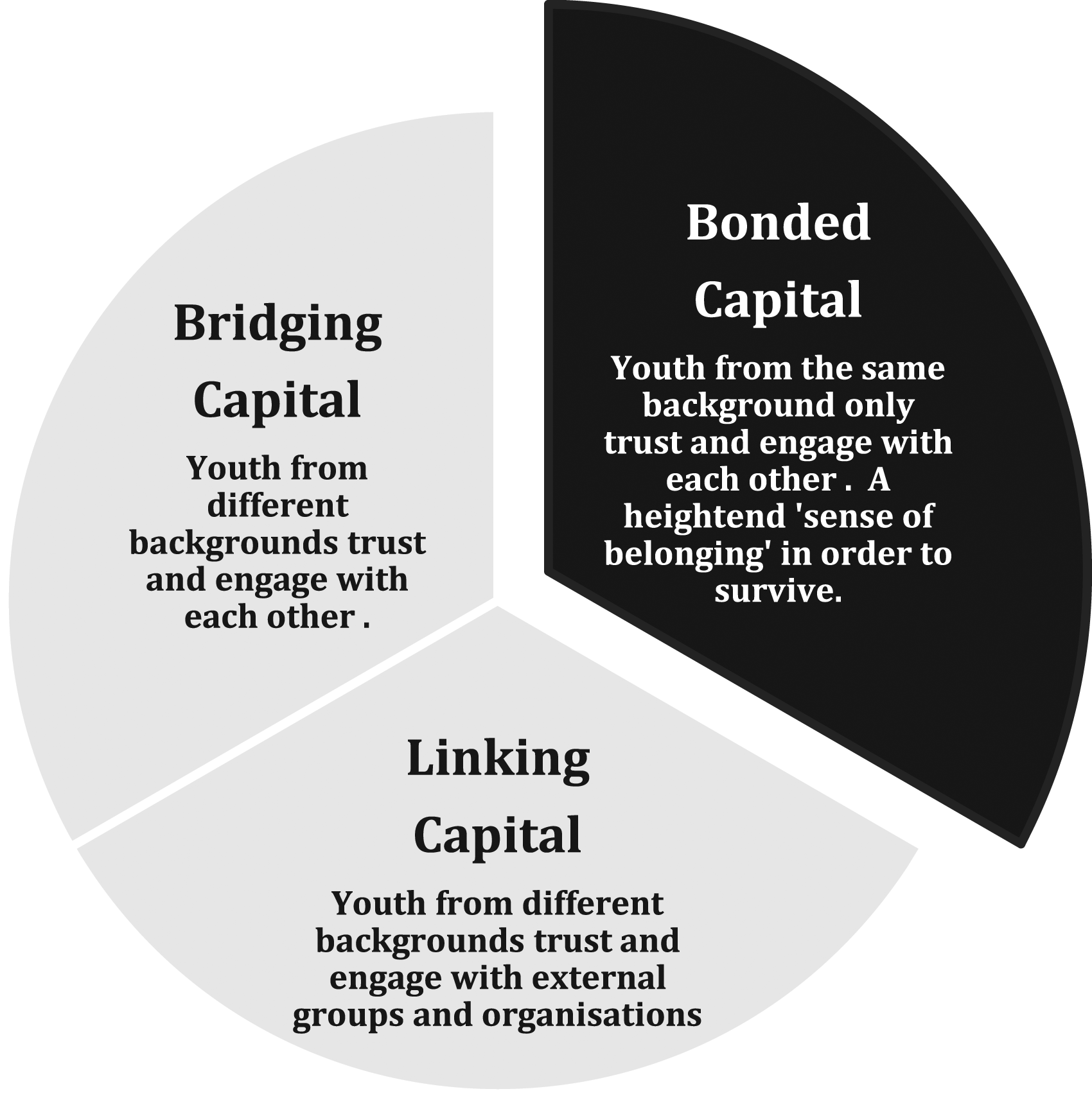
In relation to other forms of social capital the research found no evidence of bridging or linking capital (Putnam, 1995). Rather, what operated was a very high degree of bonded social capital, to the extent that it could be perceived as separated, even moving away from the creation of other forms of capital, which are arguably seen as irrelevant and socially antithetical (see Figure 1); youth from the same background and village trusting and engaging with each other for economic survival. For these young people, living with a sense of economic and political abandonment, any external ‘not from the village’ factors, associated with bridging and linking capital, were counterintuitively perceived as emblematic and symptomatic of the problem rather than providing any solution. The bonded cultural entrenchment of these views posing a potential obstacle for those advocating a policy of rural networked development (Shucksmith, 2012, 2019) to address disadvantage and promote rural economic growth. That is not to say local control and capacity building isn’t achievable. Rather it is to acknowledge the possible degree of endogenous work required, to achieve its goal, especially in former rural mining communities like Minbury. A community, whose young people and their families, having experienced generations of economic decline and social neglect (Beatty, et al., 2019; Foden, et al., 2014), no longer trust those outside of their immediate networks.
As evidenced, a sense of belonging and strong bonded social ties were harnessed by Minbury’s young people to ground and safeguard themselves against the worst excesses of rural disadvantage and social deprivation, to negotiate a response to the social challenges they were experiencing (Butler and Muir, 2017; Cuervo and Wyn, 2014; Farrugia, 2014). In this case, it took the form of a social exclusionary position reinforced by their close intimate connections and relationships.
As previous research has signalled, the entrenchment and application of bonded social capital is not necessarily a positive occurrence and can be a networked environment capable of reinforcing negative and exclusionary aspects (Morrow, 1999; Bassani, 2007; Bottrell, 2007; Butler and Muir, 2017). For example, related to their strong sense of belonging, working-class young people in Minbury were seemingly found to be locked-in to their locality. As such, they had become discursively and emotionally isolated from the outside world, their networks arguably over embedded in their own social context (Martínez-Fernández, 2009). Consequently, those not born in the village and not members of their close socially bonded networks were perceived and positioned antagonistically as outsiders (Portes, 1998). Further, in terms of the presence of racialized discourse, their predicament was blamed on immigration and immigrants alongside a sense of political neglect on behalf of the national government. The pervasiveness of these views was evidenced in the data, indicative of bonded social capital whereby a process of like-mindedness seemingly fails to consider views outside of those predominant within a network (Granovetter, 1985).
The key point here, however, is not to simply dismiss certain views of the White working-class young people featured in the study as xenophobic and racist (which indeed they are), but rather to also understand and see them in context. It is to appreciate the ways in which rural mining communities in England, such as Minbury, have over the last 50 years, faced the worst excesses of disadvantage and deprivation (Beatty, et al., 2019; Foden, et al., 2014). An economic decline witnessed alongside a policy failure on behalf of repeated UK governments to comprehend and address those inequalities (Beatty, et al., 2019; Foden, et al., 2014) and in turn marginalise rural communities (Shucksmith, 2019). In effect, a neo-liberal policy trajectory based on the ‘individualisation of risk and responsibility’ which embeds ‘uneven development and a perpetuation of spatial inequality between rural and urban as well as within the rural itself’ (Shucksmith, 2019: 317).
In such a policy context, the central question to be answered and which is critical, is how these White working-class young people are to be socially and culturally empowered; to help them address the disadvantages they experience and to engender a more informed understanding of the material reasons why those social inequalities exist and persist.
Footnotes
Declaration of conflicting interests
The author(s) declared no potential conflicts of interest with respect to the research, authorship, and/or publication of this article.
Funding
The author(s) received no financial support for the research, authorship, and/or publication of this article.
