




Abstract
Historically, teachers had been delegated the primary responsibility for the organization and management of classroom instruction in US public schools. While this delegation afforded teachers professional autonomy in their work, it has also resulted in disparities in students’ educational experiences and outcomes within and between classrooms, schools, and systems. In the effort to improve instruction and reduce disparities for students on a large scale, one reform effort in the US has focused on building instructionally focused education systems (IFESs) where central office and school leaders collaborate with teachers to organize and manage instruction. These efforts are playing out in a variety of contexts in the US, including in public school districts, non-profits, and other educational networks, and it is shifting how teachers carry out the day-to-day work of instruction. In this comparative case study, we investigate two IFESs in which efforts to improve instruction pushed against historic norms of teacher autonomy. We found that these new systems are not at odds with teacher autonomy, but rather these systems reflect a transition to more interdependent notions of teacher autonomy.
Keywords
In the US, decades of macro-level educational policies have incentivized district-level and school-level improvement to advance the quality and equity of students’ educational experiences and outcomes. One primary press has been through accountability policies that focused on establishing standards, associated assessments, and system accountability to improve teaching and learning for all students (Cohen and Moffitt, 2010; Cohen et al., 2018; Jennings, 2012; Smith and O’Day, 1991). Another has been through market-based policies that created an exchange for schooling and resulted in increased competition among schools (Chubb and Moe, 1991; Cohen et al., 2018; Jennings, 2012). This agenda reflects a broad push in the US to move beyond providing students universal access to education and toward systems that more seriously address educational equity and quality for all students (Cohen et al., 2018; Peurach et al., 2019).
Scholars raise questions, however, about the extent to which these policies have advanced students’ educational experiences and outcomes (Cohen and Mehta, 2017; Cohen et al., 2007; Jennings, 2012; Mehta, 2013). Some districts and schools, for instance, responded to these policies by narrowing instructional practice and teaching to the test (Cuban, 2013; Desimone et al., 2007; Jennings and Bearak, 2014; Smith and Kovacs, 2011), while other districts engaged ceremoniously (but not substantively) in reform practices (Yurkofsky, 2017). These policies have also been associated with the disempowerment and stigmatization of minority groups (Lane et al., 2019; Trujillo and Renée, 2012). As such, there are questions about the ways in which these policies have advanced teaching and learning on a large scale.
However, more robust responses to these policies have been successful in certain niches of the educational landscape (Cohen and Mehta, 2017). Outlying districts and networks have responded to these policies by focusing keening on improving teaching and learning and designing systems to support large-scale instructional improvement. In what Peurach et al. (2019) describe as instructionally focused education systems (IFESs), some districts and networks are developing new organizational and social relationships that redistribute responsibility for instruction and its improvement across various levels of the system (district/hub, school, and classroom level). Broadly speaking, in IFESs central offices and school leaders collaborate with teachers to organize and manage the day-to-day work of classroom instruction (Peurach, 2019).
Yet large-scale, instructionally-focused educational reform of this sort is playing out amidst two salient legacy conditions that have long characterized US public education: the loosely-coupled nature of public education (Meyer & Rowan, 1978; Weick, 1976) and teacher autonomy as a prominent professional norm (Lortie, 1975). These legacy conditions remain bound up in the complex educational environments in which schools are located and in the structural organization of US schools. By and large, these legacy conditions continue to complicate efforts to improve teaching and learning on a large scale (Cohen & Mehta, 2017).
Efforts by some districts and networks to organize as IFESs in the pursuit of improving students’ educational experiences are playing out in a variety of contexts in the US, including in public school districts, non-profits, and other educational networks, and these efforts are shifting the professional work of teachers. Yet, there are pervasive challenges to these efforts. As some districts aim to evolve as IFESs, new ideas for organizing and managing instruction and its improvement intersect with the legacy conditions of US schooling. Districts remain tied to the educational environments and professional norms that have longed characterized their work, and evolving as IFESs has them pushing against the habituated conditions of US schooling.
In this study, we investigated two IFESs in which efforts to improve instruction pushed against legacy conditions. Using a comparative case study design, we explored (a) the ways in which central offices, school leaders, and teachers worked together to organize, manage, and improve instruction, and (b) how this work reshaped teachers’ professional autonomy. We argue that these new systems do not necessarily usurp teacher autonomy, but rather these systems reflect a transition to more interdependent notions of teacher autonomy.
Analytic framework
Legacy conditions of teacher autonomy
Teachers in US schools historically had broad autonomy in organizing their day-to-day work with students in their classrooms. Seminal organizational analyses of schools described teachers in classrooms as working without formal guidance or commonly held conceptions of instructional goals around teaching and learning (Meyer and Rowan, 1978; Weick, 1976). This loose coupling, or disconnect, between classroom instruction (on the one hand) and educational organization (on the other) buffered the work of teaching and learning from educational environments. In the absence of a set of commonly held conceptions of high-quality instruction, and in the absence of technical guidance and accountability at the state or federal levels, few districts developed coherent programs of instruction (Cohen and Mehta, 2017; Goldin and Katz, 2009). Instead, individual teachers served as the main arbiters of instruction, deciding what and how to teach the students in their classrooms (Bidwell, 1965; Cohen and Mehta, 2017; Meyer and Rowan, 1978; Spillane, 1999; Weick, 1976).
Sociological accounts described the work of teachers as occurring in the privacy of their own classrooms often structurally isolated from their colleagues (Jackson, 1968; Lortie, 1975). This “cellular structure” of schools (Lortie, 1975) had teachers spending most of their time in their classrooms distanced from colleagues and supervisors with limited opportunities for collaboration and learning.
Scholars associate the aforementioned legacy conditions with a particular understanding that affiliates teacher autonomy with independence and individualism (Moomaw, 2005; Street and Licata, 1989; Vangrieken et al., 2017). Under this conceptualization, teacher autonomy involves freedom from governance or influence in classroom affairs (Hodgins et al., 1996). This notion of autonomy reflects conceptions of teacher professionalism that emphasize teacher control of (and discretion in) their day-to-day work (Vangrieken et al., 2017).
Research suggested that these legacy conditions and teacher individualism contributed to an overall conservatism (Lortie, 1975) in teachers’ instructional practice. A steady line of research on school reform found that by and large teachers continued to teach in traditional ways by focusing on basic facts, rote skills, and didactic pedagogies despite efforts and policies aimed at improving instruction (Cohen, 1990, 1993; Cohen and Spillane, 1992; Cuban, 1993; Lortie, 1975; Tyack and Cuban, 1995). A common response of teachers was to modify or assimilate policies, practices, and resources to fit within their existing approaches to teaching (Coburn, 2004; Cohen, 1990; Cuban, 1993; Spillane, 1999), or reject these policies altogether (Coburn, 2004; Golann, 2018). The structural isolation from colleagues and supervisors meant that teachers worked mostly alone to improve their own practice with limited opportunities to collaborate around the use and coordination of new resources (Little, 1990). A result was teachers defaulting to using familiar routines to teach in ways in which they were taught (Cohen, 1990; Little, 1990; Lortie, 1975; McLaughlin and Talbert, 2001).
Pushing toward instructionally focused education systems
With macro-level educational policies, such as standards-based and market-based reforms, increasing pressures on schools to improve, some districts and other educational organizations are pushing against these legacy conditions of schooling by fundamentally reorganizing structures and norms between central offices, schools, and classrooms to involve more interdependence across the various levels of the organization in pursuit of instructional improvement. In what Peurach et al. (2019) describe as instructionally focused education systems (IFESs), some district central offices (or network hubs), school leaders, and teachers are working more interdependently to organize and manage the day-to-day work of classroom instruction. By interdependence, we mean the ways in which central offices and school leaders interact with teachers around instruction and its improvement, namely through expanded and shared responsibility for organizing and managing classroom instruction. A critical component of IFESs is that these systems create new organizational and social relationships around the work of organizing and managing instruction by distributing this work across various levels of the system (district/hub, school, and classroom level).
Researchers describe IFESs as characterized by capabilities for five core domains of work distributed and coordinated among intermediary organizations (e.g., central offices and network hubs) and schools Peurach et al., (2019) 1. Building educational infrastructure by devising and coordinating designs for instructional practice, formal instructional resources (e.g., instructional models, curricula, and assessments), and social instructional resources (e.g., norms, values, and relationships among students, teachers, and leaders). 2. Supporting the use of educational infrastructure by mobilizing infrastructure in day-to-day classroom work via coordinated workshops, practice-based coaching, and collegial learning. 3. Managing environmental relationships by reconciling among the many cultural, political, and technical influences bearing on the pursuit of excellence and equity. 4. Managing performance both for continuous improvement and accountability by assessing and advancing the work of building infrastructure, supporting use, and managing environments. 5. Developing and distributing instructional leadership by establishing formal and informal leadership roles, teams, and structures with responsibility for performing, coordinating, and managing all of the preceding.
Instructionally focused education systems are novel in that they seek to build systems to support the work of district- (or network-) wide instructional improvement, in contrast to delegating the work of organizing, managing, and improving instruction to individual teachers. IFESs are also distinct from more piecemeal approaches to reform that focus intervention in more targeted areas (Bryk et al., 2010). Efforts to reform districts and other educational organizations into IFESs are playing out in a variety of contexts in the US, including in public school districts, non-profits, and other educational networks.
Interpreting increased interdependence
For those educational organizations transitioning as IFESs, there is increased interdependence between central offices (or network hubs), schools, and classrooms around the organization and management. A question, though, is how this is bearing on conventional patterns of teachers’ day-to-day work.
As described by Adler and Borys (1996), whether a specific organizational structure is controlling or enabling is a matter of interpretation and perspective, and can vary among individuals. As applied to the organization and management of instruction in IFESs, we describe this as a distinction between a bureaucratic perspective and an empowerment perspective. From a bureaucratic perspective, increased efforts by central offices and schools to organize and manage instruction would be interpreted as usurping teachers’ autonomy. This perspective is consistent with a line of research that sees efforts to bound instruction as coercive, constraining, and potentially de-professionalizing (e.g., Bowles and Gintis, 2011; Carlgren and Klette, 2008; Sinclair et al., 1996). Those who advance this perspective argue that bounding teachers’ professional work through prescriptive instructional guidance, for instance, advances the technification of teaching (Apple, 1998), limits teachers’ professional skill around the traditional work of instruction (Sinclair et al., 1996), and reflects increased efforts by central offices and schools to centralize control over teaching (Apple and Jungck, 1990). This perspective reflects an independent and individualized notion of teacher autonomy.
From an empowerment perspective, efforts by central offices and schools to organize and manage instruction do not necessarily usurp teachers’ autonomy. Rather, these efforts enable professionals to make prescriptive choices and allows individuals to do their job at a higher level than could have otherwise been done. Under this perspective, efforts by central offices and schools to organize and manage instruction would be viewed not as coercive and usurping teachers’ autonomy. Rather, these efforts would be seen as enabling conditions that helped teachers carry out their work more effectively. This perspective is consistent with research that views organizational structures and routines as having the potential to increase efficiency (Adler and Borys, 1996), build knowledge (Winter and Szulanski, 2001), and facilitate adaptation (Peurach and Glazer, 2012). This perspective reflects more collaborative and interdependent notions of autonomy where teachers manage their dependency through personal choice.
The terrain is shifting, however, with regards to the legacy conditions of education and notions of teacher autonomy. Over time, there has been a growing trend in US schools toward interdependence as districts and schools create opportunities for more collaborative work (via professional learning communities, school improvement teams, etc.) (Carroll, 2007; Hamilton et al., 2009; MetLife Foundation, 2009; National Staff Development Council, 2011). In part, this shift is in response to the evidence of the positive impact of collaboration on student learning (Ronfeldt et al., 2015) and the potential for collaboration to support the increasingly complex workload of teachers (Vangrieken et al., 2017). It is also a response to policy environments pressing districts and schools to organize and improve quality and reduce disparities (Cohen et al., 2018; Peurach et al., 2019).
Moreover, a shift is also occurring in the conceptualization of teacher autonomy from the notion of autonomy as independence and individualism to autonomy as involving collaboration and interdependence (Koestner and Losier, 1996; Vangrieken et al., 2017; Zeng, 2013). This developing conceptualization acknowledges the growing interdependence in teachers’ work and suggests autonomy involves collaborative decision making with the freedom to make prescriptive professional choices (Vangrieken et al., 2017: 303). Under this conceptualization, teacher autonomy is not the freedom from external influence, but it is where individuals are aware of and able to manage his/her dependence through personal choice and agency (Gavrilyuk et al., 2014: 136).
With the increase in collaboration and interdependence within schools, there is an open question as to how new, more interdependent organizational structures and norms intersect with notions of teacher autonomy. Much of the research on collaboration and teacher autonomy have focused mostly on teacher-to-teacher collaborations in the context of departments, grade-level teams, and professional learning communities (e.g., Melasalmi and Husu, 2019; Valckx et al., 2020; Vangrieken and Kyndt, 2020). Few studies have focused on collaboration and interdependence among central offices, schools, and classrooms and its intersection with teacher autonomy. Thus, a question remains; how does the work of transitioning as IFESs bear on conventional patterns of teachers’ day-to-day work and notions of autonomy?
Situating the study
This study focuses on two central matters for investigating instructional improvement in IFESs and notions of teacher autonomy. First, there is a need to develop straightforward descriptions of IFESs in order to produce examples and descriptions of this work. Most common in this research base are single case studies exploring the specific designs and outcomes of districts/networks operating within particular educational niches (e.g., charter market, public sector, and external support providers) (Herman and Baker, 2003; Macey et al., 2009; Peurach, 2011; Wohlstetter et al., 2003). More limited research compares across cases and market sectors to identify and compare designs for instructional improvement. We focus here on building out a comparative perspective in the effort to identify patterns and distinctions that would help to generalize about the work of IFESs across various contexts.
Second, we consider how the work of transitioning as IFESs bears, in principle, on conventional patterns of teachers’ day-to-day work and professional autonomy. In particular, we consider how the instructional designs of educational organizations that are transitioning as IFESs reflect bureaucratic and empowerment perspectives. From a bureaucratic perspective, IFESs and teacher autonomy appear to be in direct tension, as if a zero-sum proposition. That is, more efforts by central offices and schools to organize and manage instruction necessarily usurps the autonomy of individual teachers. From an empowerment perspective, efforts by central offices and schools do not necessarily usurp teachers’ autonomy but rather reframe how teachers exercise autonomy.
Study design
We used a qualitative, comparative case study design to explore two educational organizations transitioning as IFESs: Apex, a charter management organization (CMO), and Novel, an external support provider. A CMO is an alternative public school district that directly manages semi-autonomous public schools in the US, known as charter schools (Lake et al., 2010). External support providers are a newer category of environmental actor that work with school districts to help them improve (Hatch, 2002; Honig, 2004; Rowan, 2002). The data for this study comes from a larger 3-year study exploring network-based designs for implementing new instructional standards in 10 educational organizations (Duff et al., 2019). This study draws on the breadth of that data, but explores two organizations more deeply. 1
Case descriptions
Apex is a CMO operating more than 30 schools across three states. With the mission to provide high-quality educational alternatives in traditionally underserved areas, Apex served predominantly at-risk, low-income, and minoritized students. The network underwent significant expansion since it opened as a single school in the 1990s, growing in both number of students and geographic regions served. Apex schools typically outperform their host district on standardized measures of student achievement.
Organizational characteristics.
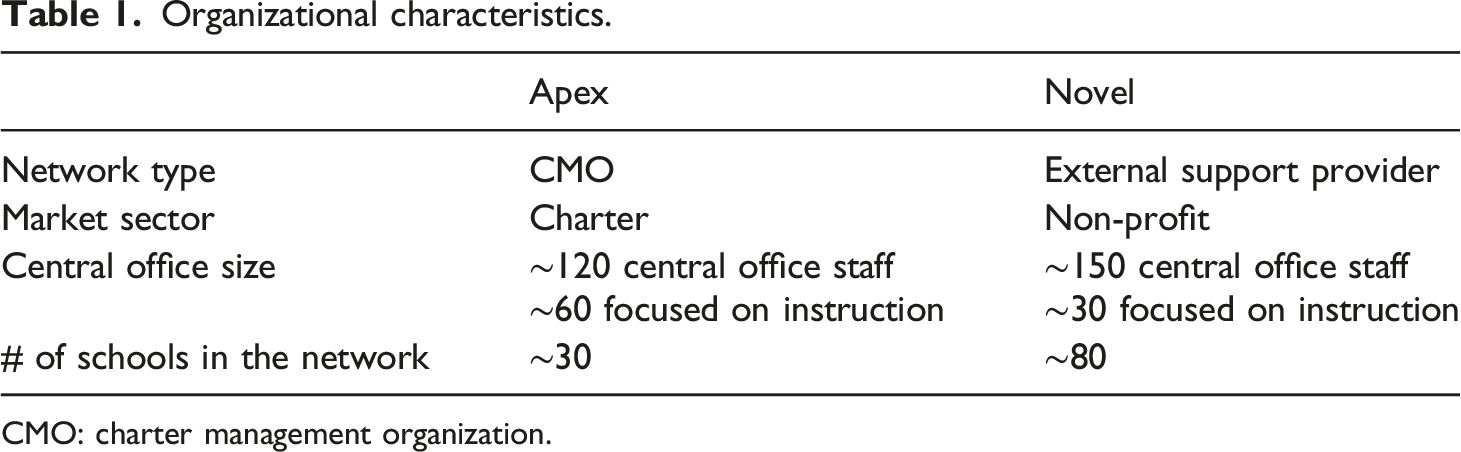
CMO: charter management organization.
Data collection and analysis
Data for this study included semi-structured interviews, field observations, and documents. We conducted 22 interviews with network hub and school leaders. For Apex, these leaders included executive and deputy directors, instructional coaches, regional superintendents, and principals. For Novel, these leaders included the network president, deputy directors, instructional coaches, and improvement coaches—all of whom worked directly for the external support provider (and not the DOE). Interviews were semi-structured and approximately 60 min in length. Each interview was audio recorded and transcribed. We observed 42 h of professional development (PD) for both school leaders and classroom teachers. We used an observational field instrument during all observations to capture the activities, conversations, and content of each session. We also collected documents pertinent to our research questions, including strategic plans, intra-organizational charts, contracts, operational protocols and manuals, PD/instructional support schedules and materials, curricula, working documents, memos, and website materials.
We used an iterative coding process (Corbin and Strauss, 2008) to guide analysis. Using the Dedoose Qualitative Software, we began with focused coding using organizational codes (Maxwell, 2005). We then moved to more elaborate coding based upon both substantive and theoretical coding (Maxwell, 2005) to generate a series of sub-codes. We also engaged in frequent descriptive and analytic memo writing to summarize preliminary patterns emerging from the data. We constructed comparative analytic matrices to identify similarities and differences across cases. We concluded with more analytic memo writing to summarize key distinctions and similarities.
Limitations
In this article, the primary source of teachers’ perspectives were observations of teachers PD, which provided opportunity both to learn about the instructional design, to listen to teachers’ questions, and to listen to teachers’ table-talk. However, due to access restrictions, we were unable to interview teachers or observe instructional practice. As a result, teacher voice is under-represented in our data. One consequence is that we were unable to directly explore how teachers understood and experienced their network’s designs for instructional improvement and how teachers reconciled those designs with their interpretations of autonomy. Instead, we focused on understanding the designs for instructional improvement themselves and interpreted those designs as it related to conceptualizations of teacher autonomy described in the literature.
Even without teacher interviews and classroom observations, we believe there is much we can learn from deep analysis of Apex’s and Novel’s design for instructional improvement. In particular, our focus on the designs themselves allowed us to center our analysis on the organizational structures and norms as it related to espoused theories of action. In so doing, we were able to build rich descriptions of the interdependency between network hubs, schools, and classrooms.
Findings
There are two central findings regarding Apex’s and Novel’s designs for instructional improvement. (1) Each organization used fundamentally different designs for organizing and managing instruction: one leveraging a highly developed, fidelity-based approach; the other leveraging a more adaptive approach and (2) Apex’s and Novel’s design for instructional improvement reshaped teachers’ autonomy: Apex’s design advanced a “constrained discretion” where teachers made targeted instructional decisions while working within explicit parameters and resources; Novel’s design leveraged teacher autonomy by establishing broad parameters and resources to support and bound the exercise of autonomy. We report our findings in two phases. First, we describe Apex’s and Novel’s designs for instructional improvement. Then, we turn to the research questions to probe the similarities and differences in these designs.
Designs for instructional improvement
Apex. Apex pursued an approach to organizing and managing instruction that placed a strong emphasis on fidelity to a highly developed instructional design. The theory of action underlying Apex’s design presumed that through faithful use of network-developed resources and supports teachers could (a) quickly develop the knowledge and skills needed to teach more ambitiously and (b) focus teachers’ work on addressing the particular needs of their students. Under this design, Apex’s central office established a set of detailed guidance and support for instruction to be used across the network and actively monitored the use and impact of that guidance in practice. On the one hand, this design limited teachers’ autonomy by tightly bounding features of instructional practice. On the other hand, it also left room for (and provided parameters and resources supporting) teachers to exercise a sort of “constrained discretion” in their day-to-day work.
A fidelity-based design: Foundational to Apex’s instructional design was faithful use of a highly specified educational infrastructure that aimed to direct classroom practice across the network. In response to new state instructional standards and assessments (and associated drops in proficiency scores across the network), Apex made changes to its educational infrastructure with the aim of improving instruction and proficiency scores including explicating its educational infrastructure and increasing teacher and leader training around its instructional resources. Apex’s infrastructure included the following: 1. Full curricular resources, including scopes and sequences; formative and summative assessments aligned to the curriculum; daily, semi-scripted lesson plans; and supplemental instructional resources that supported classroom-level instruction.
2
2. Written and video instructional models illustrating the network’s vision of instruction. 3. Established tools and processes for collecting and analyzing student data, monitoring student achievement progress, and evaluating teachers. 4. A codified set of core values that was cultivated among members through organizational onboarding, PD, and other mechanisms. 5. A management contract that articulated a set of core responsibilities of the central office and member schools and established an initial shared agreement between the parties.
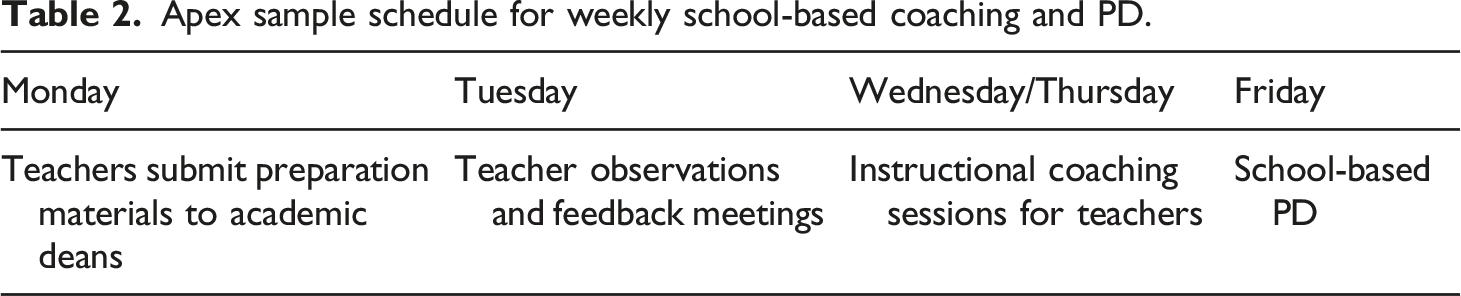
Apex sample schedule for weekly school-based coaching and PD.
Central office leaders saw Apex’s highly developed, fidelity-based design as a solution to the particular set of challenges facing the network. These challenges included (a) an increased pressure to improve instruction in response to the state’s adoption of more ambitious instructional standards, (b) the need to support the large numbers of novice teachers in the network to teach to these standards, and (c) the ongoing press to provide high-quality instruction and support to disadvantaged students that are typically behind grade level. As described by central leaders, it was through the faithful use of Apex’s highly specified educational infrastructure that teachers could quickly and effectively teach more ambitiously and produce higher-quality results districtwide. One central leader explained the network’s highly developed educational infrastructure. The reality of our organization is we have a lot of educators who are new to the profession and we have students who typically are behind their peers and more disadvantaged generally. There is too much at stake to take the time that’s needed to really ramp up a teacher’s planning skills.
For central leaders, this infrastructure served to codify best practices for ambitious instruction and the faithful use of these resources in practice helped to ensure rigorous instruction across the district. District leaders acknowledged that both school leaders and teachers were requesting more instructional guidance from the central office in order to meet the demands of the new standards.
Apex’s design also included a robust set of monitoring mechanisms to hold schools and teachers accountable for using its educational infrastructure with quality and fidelity. The central office closely monitored school-level performance through formative and summative assessments built into the curriculum, as well as through annual, standardized measures of student achievement, such as state standardized tests and Advanced Placement exams. Ongoing analysis of these measures helped the central office to closely monitor progress at the school, teacher, and student level, and assisted the network in tailoring supports for individual schools and teachers based on achievement. Apex also used frequent observations of teachers to monitor practice, including formal and informal teaching observations.
Apex’s robust mechanisms for holding schools accountable for using its educational infrastructure also enabled the network to continuously improve its overall instructional design. Mechanisms for data collection, such as measures of student achievement and observations of practice, captured data and feedback directly connected to the network’s instructional design. Apex’s central office then used this information to refine and improve the design itself. For example, following the release of state standardized tests results, central office leaders spent 4 weeks conducting what Apex called “learning agendas.” During this process, the central office collaborated with high-performing teachers and studied their instruction. Central leaders then worked with these teachers to codify high-leverage practices and built these practices back into its educational infrastructure. Apex’s ability to continuously improve its design was made easier by its fidelity-based approach. Given the faithful use of Apex’s educational infrastructure across the network, central leaders could embed high-leverage practices into its educational infrastructure and quickly spread those practices throughout the network.
Constrained autonomy: While Apex’s design focused mainly on the faithful use of a highly developed educational infrastructure to improve instruction, the design also depended on school leaders and classroom teachers adapting and extending instructional resources to meet the particular needs of their schools and classrooms. For example, principals made decisions about school-level initiatives (e.g., school-wide focus on social-emotional learning) and planned school-specific PDs based on school/teacher needs. School-based instructional coaches tailored coaching sessions to support the individual learning needs of classroom teachers. These sessions were designed to support teachers in making targeted adjustments to lessons plans to (a) differentiate instruction to meet student needs and (b) refine and/or adjust instruction based upon student data. For instance, teachers were to work with instructional coaches to elaborate lesson plans to meet student needs by reviewing student work and making modifications to future lessons to address student misconceptions. One school leader described how Apex’s educational infrastructure enabled teachers to be more responsive to student needs. I think because our daily lesson level resources are consistently meeting the rigor bar, we’re able to then move more quickly to that next level around how do we look at the quality of student work and respond in the moment to misconceptions that arise? How do we quickly take an exit ticket, identify a gap, and then plan a reteach the next day?
From a bureaucratic perspective, Apex’s highly developed, fidelity-based design could be viewed as limiting teachers’ autonomy. Under Apex’s design, the central office functioned as the main instructional decisionmaker in the district, leaving little room for substantial modification at the school or classroom level.
Yet from an empowerment perspective, this design could be viewed as liberating teachers and school leaders to focus more keenly on the pressing needs of their students. This approach involved a sort of “constrained discretion” where teachers and leaders made instructional adaptations within the parameters established in the network’s instructional design and with a set of resources supporting them in this work. With the central office focused on establishing the resources and practices for instruction, teachers focused on how best to support the learning of their students. Teachers did this by actively monitoring student data (both formative and summative) and making targeted adaptations to the lessons to address student learning needs. Moreover, some teachers actively collaborated with central office and school leaders around the continuous improvement of the instructional design by engaging in an analysis of their practice and refining the district’s educational infrastructure. This suggests that the system is designed and led with the intention of empowering teachers as collaborators in the ongoing development of the network’s instructional design.
Novel. Novel’s design represented a more locally adaptive approach for instructional improvement that distributed the work of developing educational infrastructure between the central office and schools. Under this approach, the central office provided broad instructional frameworks under which teachers worked and established processes for teacher collaboration around those frameworks. The theory of action underlying this design presumed that through broad instructional guidance and collaboration teachers would develop and leverage their own capacity to improve instruction. These efforts did not minimize teacher autonomy. Rather, Novel’s design sought to leverage teacher autonomy in important ways by establishing parameters, resources, and conventions to support and bound the exercise of autonomy.
An adaptive approach: Comparatively less specified than that of Apex, Novel’s educational infrastructure included broad instructional frameworks that teachers used and modified as they designed instruction to meet the needs of students. These frameworks included unit-level scopes and sequences, lesson-level activities, instructional routines, and formative and summative assessments. The intention of Novel’s infrastructure was not to be prescriptive. Rather, central leaders explained that the intent was to provide high-quality resources that teachers could modify in ways to meet student needs. One central leader explained. We want teachers to make adaptations. We want them to really be thoughtful about who their students are, what they need, what to emphasize, what to not emphasize, and make those adaptations.
In contrast to Apex’s fidelity-based approach, Novel established limited expectations for infrastructure use. Novel teachers were expected to (a) follow the instructional framework’s scope and sequence, (b) commit to participation in network provided PD, and (c) use at least some of Novel’s instructional resources.
Similar to Apex, Novel’s central office recently redesigned its instructional support in response to increased demands placed on schools as a result of new state standards and assessments. Given the new demands, the central office responded by moving away from its previous approach which focused on working directly with individual teachers on lesson and unit planning to establishing a set of centrally developed instructional resources and PD aimed at supporting collaborative instructional design across the network.
Novel supported the use of its educational infrastructure through unit-based PD that provided opportunities for teachers to collaborate around using and adapting the instructional resources. As evidenced through observations of network-led PD, sessions typically provided time for teachers to reflect on their practice with colleagues, make sense of upcoming content, work in small groups to discuss problems of practice, and plan collaboratively for adaptive use of the educational infrastructure. Unlike Apex, Novel’s design for support used an opt-in approach. This meant that teachers decided whether or not to participate in Novel’s design. Novel saw the opt-in model as critical to building a coalition of willing participants. One central leader explained the importance of the opt-in model by saying, “The opt-in is really important because our curriculum materials are grounded in a particular pedagogical stance. […]. We want teachers to want to do that.”
Yet, Novel’s adaptive approach created certain challenges for the network’s ability to both monitor performance and continuously improve its instructional design. Unlike Apex where its fidelity-based design helped to facilitate continuous improvement, Novel’s central leaders described that inconsistent and modified use of the educational infrastructure limited the network’s ability to monitor classroom practice and student outcomes. With inconsistent and modified use of assessments across classrooms, Novel relied on teachers’ self-reported data about their practice as a key mechanism for learning about classroom instruction.
As a consequence, Novel did not have access to explicit and comprehensive data around implementation that would allow the central office to closely track performance and practice. This minimized Novel’s ability to provide more tailored supports based on this data, share learning across the network, and continuously improve its design.
Leveraging autonomy: For Novel, efforts to improve instruction did not minimize teacher autonomy. Instead, the network sought to leverage autonomy by establishing parameters, resources, and conventions to support and bound the exercise of autonomy. Novel’s design showed that distributing the responsibility for the organization and management of instruction need not come at the expense of teachers’ professional autonomy. Rather, this distribution can be organized in ways that maintain and value teachers’ autonomy while also earnestly engaging in efforts to improve instruction on a large scale.
While Novel’s design privileged teacher discretion and adaptation, central leaders acknowledged the importance of Novel’s broad instructional guidance for facilitating teacher collaboration. As described by central leaders, without teachers using a set of base-level resources for practice with some level of fidelity there was little to “organize conversations among teachers.” As explained by one central leader: I think what we’re trying to get to is a place where there’s something to ground your engagement with schools that’s at the student level […] that serves as an organizer for conversations and also a check on the tendency to push and pull schools in a million directions […].
These broad parameters and resources enabled conversations among teachers and created shared experiences around which teachers could collaborate. It was through these collaborations that teachers shared and leveraged their professional expertise to better meet student needs.
Similarities in designs
While Apex and Novel used different designs to support instructional improvement, both organizations operated as IFESs that (a) distributed responsibility for the organization and management of instruction across various levels of the organization and (b) provided opportunities for professional collaboration around instruction. Within each design, Apex and Novel bounded the professional work of teachers in order to take on instructional improvement in the organization, although each did so to varying degrees.
In the case of Apex, the district tightly bounded teachers’ professional work by establishing a highly developed educational infrastructure and set of supports, mandating its use, and closely monitoring practice. As Apex saw it, teachers built the capacity for high-quality instruction through the faithful use of its infrastructure, and consistent, widescale use of this infrastructure improved instruction across the network as a whole. Through its educational infrastructure, Apex cultivated a common language, set of practices, and instructional vision across the network that allowed teachers and leaders to collaborate within and across schools explicitly around teaching and learning. Moreover, Apex’s tight bounding of practice reframed teachers’ professional work away from focusing on what to teach students (and with what resources) and toward a focus on understanding and planning for the individual student learning needs. These shifts focused teachers’ attention on monitoring student progress, identifying instructional needs, and making targeted adaptations to address student learning.
For Novel, the central office bounded the professional work of teachers more generally by establishing broad instructional frameworks and leveraging teachers’ expertise through professional collaboration around instructional design and decision making. The instructional frameworks established a set of base-level practices and understandings that allowed teachers to engage and collaborate with one another to design instruction. This bounding of practice was particularly important for Novel as its network included a diverse set of city schools that varied across a range of dimensions, including location, size, socioeconomic status, achievement levels, and school-specific initiatives. Although broad, this bounding of practice was essential for creating a level of shared experiences and knowledge around which teachers could collaborate.
Discussion
In Apex and Novel, designs for instructional improvement both (a) bound professional practice in ways that enabled adaptation and (b) facilitated professional collaboration around instruction Yet, while supportive of their own aims, this had both Apex and Novel working at odds with legacy norms of teacher autonomy that privilege individualism and independence. Instead, Apex and Novel were working consistent with conceptions of autonomy as related to collaboration and interdependence.
For Apex and Novel (and, for that matter, other enterprises developing as IFESs), actualizing instructional improvement involves two essential matters. One is a matter of design. Transitioning as IFESs for Apex and Novel involved building out a design for instructional improvement that redistributed responsibility for the organization and management of instruction across various levels of the system and established a level of educational infrastructure and support to guide teachers in this work. Another matter goes beyond formal designs for instructional improvement and involves understanding and managing the opportunities for teacher autonomy within the context of the network’s instructional design.
Applying the empowerment and bureaucratic perspectives
The work of IFESs suggests a developing conceptualization of teacher autonomy that pushes against independence and individualism that has long characterized US public education. Under traditional notions of teacher autonomy in the US, teachers operated as autonomous professionals making decisions over the organization and management of instruction in their classrooms absent substantial guidance and support. Efforts by IFESs to improve instruction pushed against individual and independent notions of autonomy by distributing responsibility for the organization and management of instruction across central office leaders, school leaders, and teachers, and by establishing a level of educational infrastructure and support to guide teachers in this work. This shift reflects a similar phenomenon identified in the broader research on teacher autonomy where independence and individualism are giving way to views of autonomy as interdependent and collaborative (e.g., Gavrilyuk et al., 2014; Vangrieken et al., 2017; Wermke and Höstfält, 2014).
As IFESs redistribute the work of organizing and managing instruction, a matter becomes how professionals working within IFESs interpret the increased interdependence in their day-to-day work. That is, do professionals see increased efforts by central offices and schools to organize and manage instruction as usurping their professional autonomy, or do they see these increased efforts as enabling them to do their work at a higher level than could have been done working on their own?
We presented two perspectives to characterize the tension between viewing organizational structures as enabling or controlling features of one’s work; a bureaucratic and empowerment perspective. In applying these perspectives to understand Apex’s and Novel’s designs for instructional improvement, the bureaucratic and empowerment framings proved to be generative constructs and language for interpreting the dynamics between IFES designs and teacher autonomy.
Outwardly, each design seemed to lean primarily on one perspective; Apex leaning primary on a bureaucratic perspective and Novel on an empowerment perspective. Though some might be inclined to apply the bureaucratic and empowerment perspectives to whole designs, we argue that the real analytic benefit of these perspectives is to apply them to particular features of network designs in order to understand the nuance in instructional designs that would be missed by painting it with a wide brush. In applying these perspectives not whole cloth but to particular features of network designs, these perspectives have the potential to highlight the complexity of the designs, and allows for the consideration of these perspectives playing out simultaneously.
For instance, on the whole Apex’s highly developed, fidelity-based design appears to lean more bureaucratic. Apex’s centrally developed educational infrastructure and ongoing support/monitoring of practice could be seen as controlling structures that limited teachers’ autonomy over instructional decision making. As designed, the tight bounding of instructional practice by the central office’s educational infrastructure could be viewed as being in conflict with independent and individualized notion of teacher autonomy. If interpreted from a wholly bureaucratic perspective, we might expect Apex’s design to be vulnerable to limited buy-in, pushback, and potential resistance.
Yet, when looking deeper at the particular features of Apex’s design, there is evidence of designed opportunities for teachers’ constrained autonomy within the bounds of the instructional design. By emphasizing constrained autonomy, we hypothesize that teachers expressed autonomy in how they adapted resources for classroom use in targeted ways. As such, Apex’s highly specified design could be viewed as liberating teachers and school leaders to focus more keenly on the pressing needs of their students. From this perspective, one could interpret this design as shifting teachers’ instructional decision making toward the thorniest matters of instruction; deeply understanding the learning needs of students and adapting practice to meet those needs. This shift placed a particular value on (and sought to leverage) teachers’ professional knowledge and expertise for taking on some of the most challenging work of teaching—understanding, diagnosing, and supporting student learning needs. Viewed from this perspective, we hypothesize that Apex’s highly specified educational infrastructure served as a set of resources to build different types of professional knowledge and to support teachers in meeting the individual needs of their students.
On the whole, Novel’s design is readily interpreted as empowering. Under Novel’s design, teachers maintained a high level of autonomy amidst the network’s improvement efforts. As designed, network parameters placed on teachers’ practice were broad (and seemingly less bureaucratic) and were in the service of facilitating opportunities for collaborative work.
Yet Novel’s design was not monolithic in its empowerment perspective. There were certain dimensions of Novel’s design that needed to be enacted with fidelity if the design was to work as an empowering mechanism. For instance, teachers needed to follow Novel’s scopes and sequences and use Novel’s instructional resources to a certain degree to be able to collaborate with one another.
This analysis suggests that applying the bureaucratic and empowerment perspectives to whole programs—that is interpreting a design as either wholly bureaucratic or wholly empowering—minimizes the nuance and complexity of both the networks’ designs and the practical matters of using those designs across organizations. Taking the whole program as the unit of analysis, whether the design is seen as bureaucratic or empowering sits at the intersection of a set of complex factors, including designers’ intent, teachers’ perception, and leaders’ framing. It is not that a design is either solely bureaucratic or empowering. Rather, whether it is one, the other, or both depends on how people working within these networks understand and interpret the design as shaping their work. By this analysis, the bureaucratic and empowerment perspectives are largely useful for understanding particular dimensions of an instructional design with different types of structures and routines within designs being viewed as more or less empowering or bureaucratic (Peurach and Glazer, 2012).
Implications for instructionally focused education system leaders
We also argue that using the bureaucratic and empowerment perspectives can serve as useful analytic constructs for those leading IFESs. If IFESs are to function in step with collaborative, interdependent notions of teacher autonomy, teachers must be able to manage their dependency by exercising constrained autonomy (Gavrilyuk et al., 2014; Vangrieken et al., 2017). Without opportunities for choice and agency within the bounds of a network’s instructional design, IFES designs’ risk being understood as bureaucratic with no designed opportunities for empowerment.
Thus, if IFES designs are to work within contemporary notions of teacher autonomy, those leading IFESs need to understand, design for, and manage opportunities for teachers to exercise constrained autonomy within the context of instructional improvement efforts. This suggests that an aspect of IFES leaders’ work is to design and develop opportunities for teachers to use their professional expertise and agency to make decisions within the bounds of the design, and to support teachers in making those decisions. For those leading IFESs, applying the bureaucratic and empowerment perspectives to understand their organization’s instructional design can serve as an analytic lens to identify what opportunities the design provides for teachers to enact agency and choice within the instructional design itself.
Considerations for future research
We conclude by offering some final thoughts on the changing notions of teacher autonomy in districts and networks transitioning as IFESs and present considerations for future research in this area. We argued that IFESs are not necessarily at odds with teacher autonomy, but rather these systems reflect a transition to more interdependent and collaborative notions of teacher autonomy.
In considering these new dynamics between organizations and teachers as professionals, we focused here on intermediary organizations, teachers, and their designs. Yet this research yields further questions about how these dynamics play out for those engaged deeply in these systems. In particular, this study focused on examining the intersection of IFESs’ designs for instructional improvement and teacher autonomy. Future research in this area would benefit from deeper exploration of instructional designs as they are enacted in practice and as teachers interpret these designs as bearing on their professional autonomy. Other useful questions for exploration include the following: How do teachers co-process changes in their autonomy while working within IFESs? How do teachers engage in professional communities when they have new roles? How do leaders manage these new ways of working while operating within policy environments that themselves can be coercive?
Despite the challenges in managing this work, this study suggests there is promise in districts and networks organizing as IFESs. While transitioning as IFESs might push against traditional norms of teacher autonomy, this evolution also presents opportunities for reframing teacher autonomy as interdependent and collaborative work in ways that advance the quality and equity of students’ educational experiences.
Footnotes
Acknowledgments
The authors gratefully acknowledge those who shared comments on earlier manuscripts and presentations on which the analysis draws, as well as the members of the research team: Megan Duff, Clare Flack, Diane Massell, and Priscilla Wohlstetter. All opinions and conclusions expressed in this article are those of the authors and do not necessarily reflect the views of any funding agency.
Declaration of conflicting interests
The author(s) declared no potential conflicts of interest with respect to the research, authorship, and/or publication of this article.
Funding
The author(s) disclosed receipt of the following financial support for the research, authorship, and/or publication of this article: Work on this analysis was funded by a research grant from the Spencer Foundation [201600049].
