




Abstract
Multiple sclerosis (MS) has been linked to numerous challenges that affect well-being due to its unpredictable nature and debilitating symptoms. The study seeks to evaluate the psychometric properties and factor structure of the PERMA-Profiler, a well-being assessment tool within the context of MS. A confirmatory factory analysis was performed to test structural validity. A confirmatory factor analysis revealed a correlated five-factor, indicating that well-being encompasses multiple dimensions for individuals living with MS. Reliability analysis indicated high internal consistency for all factors except for engagement. Validity was supported through correlations with measures of disability-related stress and functional limitations. These findings suggested that the PERMA-Profiler is a reliable and valid instrument that can be used for assessing well-being among individuals living with MS. Overall, the PERMA-Profiler offers a promising avenue for understanding and promoting well-being in the MS population, with implications for tailored interventions and holistic care approaches.
Multiple sclerosis (MS) is an autoimmune disease that results in demyelinating of the nerve fibers in the central nervous system (CNS; National Multiple Sclerosis Society [NMSS], 2023). Damaged areas of the CNS produce a variety of neurological symptoms that vary by MS type and severity. Disability resulting from MS is unpredictable and can vary substantially across individuals. The disease course is classified into four types which include: clinically isolated syndrome, relapsing-remitting MS, secondary-progressive MS, and primary-progressive MS (NMSS, 2023). Clinically isolated syndrome is the first episode of neurological symptoms that lasts at least 24 hr and may or may not progress into MS. Relapsing-remitting MS is the most common type of MS and is characterized by defined periods of relapse or increasing neurological symptoms followed by partial or complete recovery from symptoms. Secondary-progressive MS follows the initial relapsing-remitting course that eventually goes on to a secondary progressive course characterized by progressive neurological symptoms and worsening disability over time. Primary-progressive MS refers to a progressive worsening of neurological functioning and disability accumulates over time. Common symptoms of MS may consist of fatigue, dysesthesia, mobility impairment, spasticity, numbness or tingling, vision problems, vertigo or dizziness, bladder or bowel dysfunction, sexual dysfunction, cognitive changes, and depression (NMSS, 2023).
The prevalence of MS is on the rise globally, affecting an estimated 2.8 million people worldwide (Walton et al., 2020). The onset of MS generally occurs in young adulthood where mean age of diagnosis is approximately 32 years (Walton et al., 2020), a time when individuals are building careers, planning families, and establishing their place in the society. MS is a leading cause of neurological disability among young and middle-age adults. Individuals with MS are challenged by significant motor, sensory, cognitive, psychosocial, and environmental challenges resulting from the unstable and disabling disease process (Ng et al., 2013). These concerns have important consequences for living full and independent lives, limiting community integration and participation (Wu et al., 2019). About one third of individuals with MS have a major decline in their standard of living after the diagnosis (Hakim et al., 2000). The employment rates among people with MS range from 51% to 61% (Flachenecker et al., 2017; Roessler et al., 2015), compared with 90% to 96% prior to their diagnosis (Pompeii et al., 2005). Other research has observed that half of all individuals with MS were unable to fulfill household and employment responsibilities within 10 years of onset, half were unable to walk unaided within 15 years of onset, and half required the use of a wheelchair within 25 years of onset (Confavreux et al., 2000). In addition to physical sequelae, studies have found individuals with MS experience high rates of depression (Peres et al., 2022; Saadat et al., 2021), anxiety (Peres et al., 2022; Saadat et al., 2021), higher levels of disability-related stress (Lee & Chan, 2023), lower quality of life (Bishop et al., 2019; Strober, 2018), and poor psychosocial adaptation to disability (McNulty et al., 2004). Collectively, the physical and psychological consequences of MS threaten well-being to a severe extent (Mullins et al., 2001).
PERMA Model of Well-Being
In light of the high prevalence of factors that affect psychological well-being (e.g., depression, anxiety, and psychosocial adjustment to disability) and health-related quality of life (e.g., disability burden, functioning), well-being has become an important construct to understanding the clinical impact of MS on the rising population that acquire the disease. Well-being is a multidimensional construct of optimal psychological functioning and experience (Ryan & Deci, 2001). In positive psychology, well-being has been conceptualized as achieving happiness, living “the good life,” or flourishing (Seligman, 2011). Seligman (2011) suggests the key to high levels of well-being is to tend to the five pillars of well-being, coined the PERMA model. These five pillars include: positive emotion (e.g., feelings of joy, pleasure), engagement (e.g., becoming captivated, immersed in tasks or activities), relationships (e.g., feelings of being cared about by others), meaning (e.g., having sense of purpose in life), and accomplishment (e.g., making progress toward personal goals). Since Seligman’s theory takes a holistic approach, it is a fitting model to measure and understand well-being among individuals with MS.
Butler and Kern (2016) developed the PERMA-Profiler based on Seligman’s five pillars of well-being. The researchers compiled and tested hundreds of theoretically relevant items across a series of studies (N = 7,188), which resulted in a 23-item measure comprising 15 items across the five PERMA factors (i.e., three items per factor) and eight filler items to assess happiness, negative emotion, loneliness, and physical health. Subsequent studies (N = 31,966) evaluated the psychometric properties and established normative data for the PERMA-Profiler. The measure demonstrated acceptable model fit, validity, and reliability (Butler & Kern, 2016).
The psychometric properties and factor structure of the PERMA-Profiler has been evaluated among a variety of disability populations, such as college students with disabilities (Coffey et al., 2016; Tansey et al., 2018; Umucu et al., 2020), young adults with CNS tumor (Grenawalt et al., 2022), and adults with autism (Grosvenor et al., 2023). The factor structure has varied across different disability populations. For instance, Umucu et al. (2020) found a two-factor model among student veterans with disabilities, whereas Tansey et al. (2018), Grenawalt et al. (2022), and Grosvenor et al. (2023) found a one-factor solution for the PERMA-Profiler among college students with disabilities, young adults with CNS tumors, adults with autism, respectively. Thus, the composition of well-being may vary by the unique factors faced by different disability populations. The PERMA-Profiler was observed to be correlated with physical health in the normative samples (Butler & Kern, 2016) and a sample of young adults with CNS tumor (Grenawalt et al., 2022). The measure was negatively correlated with perceived stress among the samples in the Umucu et al. (2020) and Grenawalt et al. (2022) studies and disability functioning in the Grenawalt et al. (2022) study. The measure was also found to be positive correlated with life satisfaction and negatively correlated with depression and anxiety among adults with autism (Grosvenor et al., 2023). To our knowledge, the PERMA-Profiler has yet to be evaluated among a sample of adults with MS.
Purpose of the Study
Given the effect MS has on physical and psychological functioning, employment, family life, and other quality of life outcomes that affect well-being, it is progressively important to examine well-being with psychometrically sound measurements that are relevant to people with MS. Several well-being measures that have been applied in people with MS include the MSQOL-54 (Vickrey et al., 1995), Ryff’s Psychological Well-being Scale (Ryff, 1989), and General Health Questionnaire (Goldberg & Hillier, 1979). However, to our knowledge, this is the first study to examine the psychometric properties and factor structure of the PERMA-Profiler in a sample of people with MS. As the PERMA-Profiler is based on Seligman’s five pillars of well-being, having a more nuanced understanding of the constructs that comprise well-being among people with MS can help target psychosocial intervention.
Method
Procedures
After receiving the Institutional Review Board approval from a U.S. Midwest research-intensive university, the researcher reached out to the NMSS for study advertisement on the NMSS website and emails to NMSS members. The inclusion criteria for this study included being at least 18 years old and having an MS diagnosis. Prior to starting the survey, participants had to review the informed consent form and indicated that they agreed to participate in the study. As indicated in the consent form, the first 250 participants who participated in the study would receive a $10 gift card. The sample consisted of 373 participants.
Measures
Well-Being
Well-being was assessed using the PERMA-Profiler (Butler & Kern, 2016). The PERMA-Profiler consists of 23 items with 15 main items and eight filler items. In this study, the main 15 questions were included (e.g., “In general, how much of the time do you feel you are making progress toward accomplishing your goals?”). Each item is rated on an 11-point Likert-type scale, ranging from 0 (never or not at all) to 10 (always or completely). Higher scores indicate higher levels of well-being. Cronbach’s alpha was computed to be .95 in the current study.
Disability-Related Stress
Disability-related stress was assessed using the Brief Disability Related Stress Scale (BDRSS; Lee & Chan, 2023). The BDRSS consists of 10 items (e.g., “societal attitudes toward your disability.”). Each item is rated on a 5-point Likert-type scale, ranging from 1 (not at all stressful) to 5 (extremely stressful). Higher scores indicate higher levels of disability-related stress. Cronbach’s alpha was computed to be .86 in the current study.
Functional Limitations
Functional limitations were assessed using the World Health Organization Disability Assessment Schedule 2.0 (Ustun et al., 2010). It has 12 items (e.g., “In the past 30 days, how much difficulty did you have in taking care of your household responsibilities?”). Each item is rated on a 5-point Likert-type scale, ranging from 1 (none) to 5 (extreme or cannot do). Higher scores indicate higher levels of functional limitations. Cronbach’s alpha was computed to be .92 in the current study.
Data Analysis
Regarding missing data analysis, missing value analysis demonstrated no variable had more than 1% missing data. Expectation maximization was used to impute missing values (Fox-Wasylyshyn & El-Masri, 2005). We performed a series of confirmatory factor analysis (CFA) via the “Lavaan,” “SemTools,” and SemPlot packages for R Studio (Epskamp, 2019; Jorgensen et al., 2021; R Core Team, 2021; Revelle, 2021; Rosseel, 2012; Wickham, 2016) to test structural validity. We used the following goodness-of-fit indices to evaluate well-being models: χ2 is not significant, the comparative fit index (CFI) and Tucker–Lewis index (TLI) are greater than .95, the standardized root mean square residual (SRMR) does not exceed .05, and the root mean square error of approximation (RMSEA) does not exceed .08 (Byrne, 2016). This study compared three well-being models: a one-factor model (Model 1); a five-factor model (Model 2), where items in different well-being subscales were loaded separately on the five independent but correlated factors of well-being; and a higher-order model (Model 3), where a higher-order factor of well-being was added to the first-order five-factor model.
In addition to testing structural validity of the well-being, we also calculated reliability values of well-being factors by coefficients alpha (α) and omega (ω), as well as the average variance extracted (AVE). Finally, we conducted correlation analysis to test whether each factor of well-being is associated with disability-related stress and functional limitations in a theoretically expected direction.
Results
Descriptive Statistics
Participants’ mean age was 48.77 years (SD = 11.70). Most participants were females (81.0%) and Caucasians (90.6%). Many participants indicated they were married (61.9%), had at least a bachelor’s degree (63.2%), and were employed (54.4%). Regarding MS characteristics, most participants had relapsing-remitting MS subtype (77.5%). The mean MS duration was 12.26 years (SD = 9.28).
Confirmatory Factor Analysis
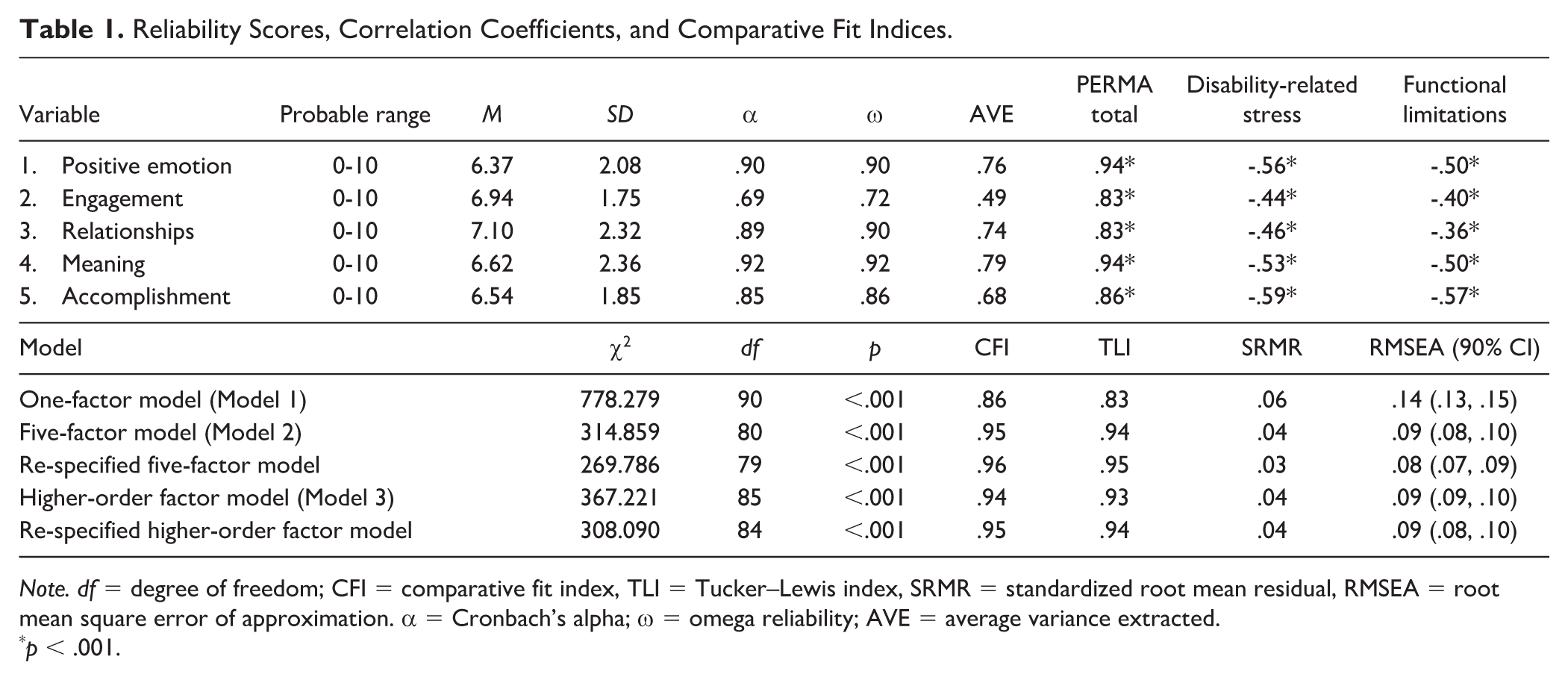
For this study, we tested a total of three models. The first model tested whether well-being is a unidimensional construct for people with MS. Our analysis demonstrated that the unidimensional model (Model 1) does not fit well with our data: χ2(90) = 778.279, p<.001; CFI = .86; TLI = .83; SRMR = .06; RMSEA (90% confidence interval [CI]) = .14 (.13, .15). Our second model (Model 2) evaluated whether the five-factor model, proposed by Seligman (2011), generates an acceptable fit for people with MS. Our results revealed that Model 2 generated somewhat unacceptable fit: χ2(80) = 314.859, p < .001; CFI = .95; TLI = .94; SRMR = .04; RMSEA (90% CI) = .09 (.08, .10). However, the chi-square difference test indicated that Model 2 fits data significantly better than Model 1, Δχ2(10) = 464.42, p < .001.
Hierarchical CFA
The factors in the five-factor model (Model 2) of the well-being were found to be strongly intercorrelated, indicating that the five factors can be influenced by a latent trait of a higher factor (Byrne, 2016). To examine this premise, we created Model 3 to evaluate whether well-being is a higher order construct for people with MS. Our hierarchical CFA results revealed that Model 3 generated somewhat unacceptable fit: χ2(85) = 367.221, p < .001; CFI = .94; TLI = .93; SRMR = .04; RMSEA (90% CI) = .09 (.09, .10). Interestingly, the chi-square difference test indicated that Model 2 fits data significantly better than Model 3, Δχ2(5) = 52.362, p < .001.
Re-Specification Analysis
Given Model 2 was a better fit for the data compared with Model 3, we decided to check modification indices only for Model 2. Based on modification indices, conceptually and empirically meaningful correlated error terms (i.e., P3 [“To what extent do you feel contented?”]-R3 [“How satisfied are you with your personal relationships?”]) were added to the model (Byrne, 2016). We re-evaluated whether our modified and re-specified five-factor model have an acceptable model fit. Our results revealed that re-specified five-factor model fit indices fell within acceptable good ranges: χ2(79) = 269.786, p < .001; CFI = .96; TLI = .95; SRMR = .03; RMSEA (90% CI) = .08 (.07, .09). Finally, our re-specified five-factor model fits data significantly better than Model 2, Δχ2(1) = 45.07, p < .001 (see Figure 1).
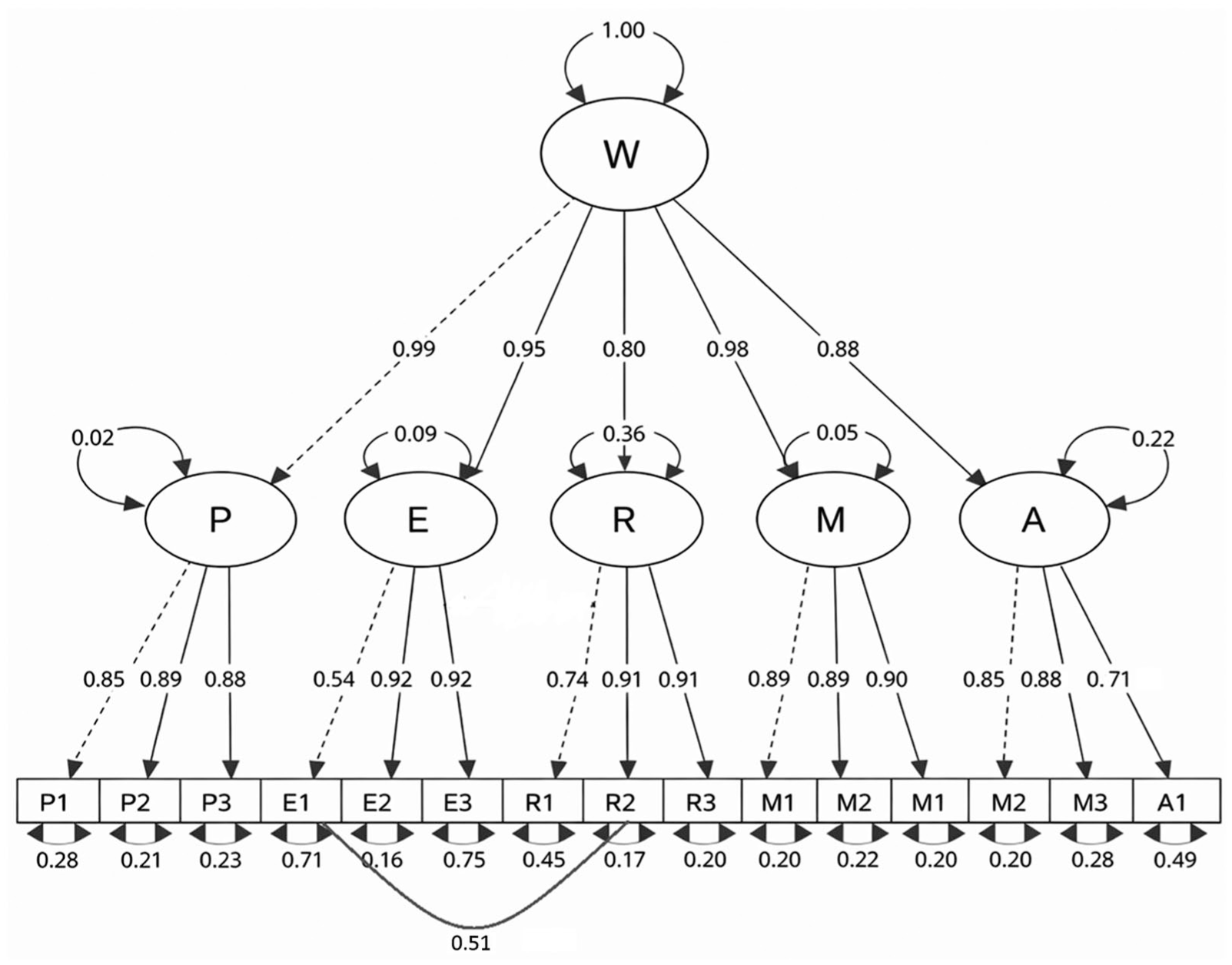
Re-Specified Model.
Reliability
A coefficient alpha value of .90 for positive emotion, .69 for engagement, .89 for relationships, .92 for meaning, and .85 for accomplishment were calculated for the current study. A coefficient omega value of .90 for positive emotion, .72 for engagement, .90 for relationships, .92 for meaning, and .86 for accomplishment were calculated for the current study. Finally, an AVE value of .76 for positive emotion, .49 for engagement, .74 for relationships, .79 for meaning, and .68 for accomplishment were calculated for the current study. Overall, well-being factors, except for the engagement factor, had very good to excellent reliability values.
Reliability Scores, Correlation Coefficients, and Comparative Fit Indices.
Note. df = degree of freedom; CFI = comparative fit index, TLI = Tucker–Lewis index, SRMR = standardized root mean residual, RMSEA = root mean square error of approximation. α = Cronbach’s alpha; ω = omega reliability; AVE = average variance extracted.
p < .001.
Validity
We tested whether each factor of well-being is associated with disability-related stress and functional limitations in a theoretically expected direction. Our results revealed that disability-related stress was negatively associated with positive emotion (r = −.56, p < .05), engagement (r = −.44, p < .05), relationships (r = −.46, p < .05), meaning (r = −.53, p < .05), accomplishment (r = −.59, p < .05). Our results also revealed that functional limitations were negatively associated with positive emotion (r = −.50, p < .05), engagement (r = −.40, p < .05), relationships (r = −.36, p < .05), meaning (r = −.50, p < .05), accomplishment (r = −.57, p < .05). See Table 1 for more detailed information on these results.
Discussion
The unpredictable course, disabling symptoms, and varying severity of MS impose significant challenges for individuals to fully participate in activities of daily living, employment, family, and community life, adversely impacting the well-being for those with MS. It is imperative to measure well-being among people with MS with psychometrically sound measurements so that the clinical impact of MS on the rising population acquiring the condition can be better understood. This study aimed to examine the psychometric properties and factor structure of the PERMA-Profiler as a measure of well-being in people with MS. A correlated five-factor model demonstrated acceptable model fit, with two error terms correlating (i.e., P3 [“To what extent do you feel contented?”] and R3 [“How satisfied are you with your personal relationships?”]). Both items share similar wording (“contented” and “satisfied”), possibly leading to covariance unexplained by their corresponding latent factors. It is also possible that people with MS value personal relationships, associating their overall contentedness with the satisfaction of their connections with others (Aydın & Onger, 2022; Gulick, 1997); hence, similar response patterns on these two items were observed but unaccounted by the factors.
The retained factor solution in this study is comparable to the original PERMA-Profiler development and validation study (Butler & Kern, 2016), supporting the PERMA-Profiler as a multidimensional measure of well-being in people with MS. These findings align with Seligman (2011) position that the five domains of well-being can be viewed and assessed as individual but correlated constructs. However, the factor model differs from the unidimensional factor structure supported by existing studies validating the PERMA-Profiler among college students with disabilities (Tansey et al., 2018) and young adult survivors of CNS tumor (Grenawalt et al., 2022). This may suggest that people with MS experience and evaluate the construct of well-being, either in general or with the PERMA-Profiler, similar to the population in Butler and Kern (2016), but differently from the populations in Grenawalt et al. (2022) and Tansey et al. (2018).
The internal consistency reliability of the PERMA-Profiler, measured by coefficient alpha, coefficient omega, and AVE, was high for all factors except for the engagement factor, indicating that the scale is reliable. This is consistent with the findings in the work by Butler and Kern (2016) where engagement was the weakest factor in the model. In addition, validity evidence was presented by correlating the PERMA-Profiler with measures of disability-related stress and functional limitations. Each factor of the PERMA-Profiler was negatively associated with disability-related stress and functional limitations in a theoretically expected direction. Among these correlations, the accomplishment factor had the highest absolute value, indicating the strongest association among all factors. This suggests that disability-related stress and functional limitations significantly hamper individuals’ well-being, especially their sense of accomplishment.
Our study provides relevant implications for guiding psychosocial rehabilitation and mental health treatment for individuals with MS. Rehabilitation and mental health professionals can use the PERMA-Profiler as a brief and reliable tool to assess overall well-being and its five domains among people with MS. With a multidimensional factor structure, the PERMA-Profiler not only provides a global indication of well-being but also sheds light to meaningful variation among the five domains (Butler & Kern, 2016). Rehabilitation and mental health professionals would be able to better understand the clinical impact of MS on individuals and tailor interventions to target specific domains with relatively lower scores. With strong correlates with disability-related stress and functional limitations, the PERMA-Profiler can be used to assess and monitor the effectiveness of psychosocial rehabilitation treatments that improve functioning and promote positive adaptation and coping with disability-related stress.
With satisfactory psychometric properties, the PERMA-Profiler’s potential as a research tool for assessing well-being among people with MS is warranted. Researchers can assess and compare individuals’ total scores on the PERMA-Profiler before and after positive psychology interventions to evaluate the global effectiveness of interventions or administrate and monitor the PERMA-Profiler at multiple time points to understand the impact of interventions on specific well-being domains. For example, Everyday Matters, a positive-psychology-principle-based intervention developed by NMSS, features six 90-min sessions that aim to support ongoing happiness for people living with MS (Kalb & Koch, 2016). It shows promising results in promoting resilience in a pilot randomized controlled trial (Alschuler et al., 2018). The PERMA-Profiler can be assessed multiple times in such an intervention to understand how individuals’ well-being, globally or in specific domains, responds to the different components of the intervention.
By incorporating a well-being assessment into a routine clinical care setting, it can possibly lead to several practical implications for individuals living with MS. Most notably, when leveraging tools like the PERMA-Profiler, there are several benefits, such as (a) early detection of well-being issues, (b) tailored treatment planning, (c) monitoring treatment outcomes, (d) holistic care approach, and (e) preventative care. First, routine assessment of well-being and utilizing the PERMA-Profiler can help rehabilitation and mental health professionals identify individuals at risk of poor well-being early in the disease stage. By having regular screenings for well-being domains such as positive emotion, engagement, relationships, meaning, and accomplishment, clinicians can proactively address psychosocial concerns before they start escalating to a higher stage. Second, the PERMA-Profiler can provide more support to clinicians in terms of creating different rehabilitation and mental health treatment plans to address specific well-being deficits identified in individuals with MS. For instance, if a patient scores low on the engagement domain indicating a lack of involvement in meaningful activities, certain interventions such as cognitive-behavioral therapy or occupational therapy may be recommended to increase engagement levels and promote more participation in those activities. Third, incorporating the PERMA-Profiler into routine clinical assessments can lead to ongoing monitoring of treatment outcomes related to well-being. By documenting and tracking changes in well-being over time, treatment specialists can gauge the effectiveness of intervention and adjust treatment plans effectively. Fourth, well-being assessment using the PERMA-Profiler allows clinicians to adopt a holistic approach to MS care, targeting not only physical symptoms but also psychosocial and emotional well-being. By taking into consideration the broader spectrum of well-being domains, clinicians can create a comprehensive care plan that supports the patients’ overall health status in coping with the challenges of MS. Fifth, mandatory routine well-being assessments may serve as a prophylactic measure by identifying those individuals who may be vulnerable to psychological disturbances or reduced quality of life. Rehabilitation and mental health professionals can use the PERMA-Profiler results to create and implement targeted interventions that are aimed at enhancing coping skills and promoting strategies for managing stressors that are linked to MS. It is imperative to empower individuals with MS to be more aware of their well-being needs; that way clinicians can support long-term resilience and quality of life.
There are several limitations to this study that should be considered when generalizing the findings. First, given the cross-sectional nature of the study, the reliability evidence of the PERMA-Profiler is limited to the internal consistency reliability. Future research should collect data at different temporal points to supplement test–retest reliability evidence. Next, a convenient sampling strategy was used, and participants were recruited from NMSS, limiting the heterogeneity of our sample. The pool of potential participants who have access to the study recruitment advertisement and emails are primarily members of the NMSS, which may not have the best representation of the MS population. Several of our sample characteristics such as gender, race, age, and MS subtype are similar to the broader MS population. Our sample was mostly well-educated, married, and employed, which could limit the generalizability of our findings to those who may have lower levels of educational attainment, and different marital and employment status as these factors can impact well-being scores. Third, due to the limited sample size, we were unable to conduct measurement invariance analysis, which is essential to compare the PERMA-Profiler scores among different gender, age, and clinical groups within the MS population. Researchers in the future could recruit a larger, more diverse, and more representative sample to replicate our findings and examine the measurement invariance. Last, all data collected in this study were self-report in nature, which subject to the limitations of self-report measures (e.g., social desirability). More objective measures, such as medical diagnosis, biobehavioral indicators of well-being, and clinician-rated functional limitations, may be implemented alongside self-report measures to supplement validity evidence for the PERMA-Profiler.
In conclusion, the PERMA-Profiler is a reliable and valid self-report measure for assessing well-being among people with MS. The analyses support the correlated five-factor model as the optimal factor structure of the PERMA-Profiler, and the PERMA-Profiler demonstrates satisfactory internal consistency reliability. The use of the PERMA-Profiler can provide meaningful insights into effectiveness of psychosocial rehabilitation and mental health treatments and research on interventions using a positive psychology framework.
Footnotes
Declaration of Conflicting Interests
The author(s) declared no potential conflicts of interest with respect to the research, authorship, and/or publication of this article.
Funding
Support for this research was provided by the University of Wisconsin-Madison, Office of the Vice Chancellor for Research and Graduate Education with funding from the Wisconsin Alumni Research Foundation.
