




Abstract
Although families can be critical partners in the pursuit of paid employment of individuals with intellectual and developmental disabilities (IDDs), their insights and experiences in this area are rarely explored. We interviewed 60 parents and other caregivers about the factors that could facilitate integrated employment for their family members with IDD. Participants described dozens of distinct practices and postures that contributed to finding and maintaining paid work in the community. Their recommendations spanned eight major categories: employment mindsets, skill development, family supports, hands-on work experiences, employer connections, job fit, transportation, and workplace supports. We offer recommendations for research and practice aimed at increasing access to the array of benefits that come through meaningful work in one’s community.
Keywords
Like anyone else, individuals with intellectual and developmental disabilities (IDDs) have much to gain from involvement in the workforce. In addition to a steady paycheck, finding the right job can bring a host of impactful benefits. For example, a literature review conducted by Almalky (2020) indicates that integrated employment can provide a pathway to greater self-worth, confidence, independence, skill development, social connections, sense of purpose, and quality of life. Not surprisingly, most adults with IDD aspire to find paid work (National Core Indicators, 2021). Although parents and other caregivers remain mixed in their expectations, the majority want to see their family members with IDD obtain a paid job in the community (Gilson et al., 2018). As highlighted by Athamanah et al.’s (2022) scoping review, employers also experience benefits from hiring people with IDD, which include higher retention rates for all employees and improved workplace culture.
Although U.S. state and federal legislation, policy, initiatives, and advocacy increasingly aim toward integrated employment outcomes (Americans with Disabilities Act, 1990; Workforce Innovation and Opportunity Act, 2014), most youth and adults with IDD still lack the opportunities, encouragement, and support needed to participate in the workforce. Indeed, employment rates for working-age people with IDD in the United States have languished below 20% for much of the last decade (Winsor et al., 2021). Among individuals with IDD who do obtain jobs, many experience low pay, limited hours, and few opportunities for advancement. The persistence of these disappointing employment outcomes has remained an enduring concern throughout the fields of special education and vocational rehabilitation (VR) alike (Wehman et al., 2018).
Changing this landscape is likely to require approaches that more fully attend to the constellation of barriers that stand in the way of meaningful work. Numerous studies have examined the array of factors that can coalesce to keep people with IDD from accessing integrated employment in their community (e.g., Carter et al., 2023; Gilson et al., 2018). Carter et al. (2023) identified 64 distinct barriers related to six areas: individuals with disabilities (e.g., abilities, mindsets, skills), families (e.g., knowledge, logistical issues, mindsets, supports), schools (e.g., communication, instruction, mindsets), service systems (e.g., access to services, quality of services), workplaces (e.g., application processes, mindsets, workplace supports), and communities (e.g., employment outlook, mindsets, transportation). In light of these widespread barriers, what can be done to clear the pathway to paid employment?
Parents and other caregivers can offer constructive answers to this pressing question. Many are active players in efforts to connect their family members with IDD to employment. Amidst the dearth of community residential options, most adults with IDD continue to reside with their parents or other relatives, while very few adults with IDD live independently as they age into older adulthood (Burke et al., 2021). Moreover, Larson (2019) estimates that approximately 60% of adults with IDD cannot access state-provided disability services, often because of long waitlists, narrow eligibility requirements, or limited funding. Even when disability services are available, commitment to and support for integrated employment may be limited within provider organizations. As a result, pursuit of paid employment can often fall to families. Even when strong employment services are available, best practices affirm the importance of engaging families as central partners (Kamau & Timmons, 2018).
Unfortunately, families are infrequently asked for their recommendations regarding the design and delivery of integrated employment practices (Gilson et al., 2018). Families whose members with IDD have obtained employment have first-hand experiences and unique insights that could inform broader efforts to elevate employment outcomes. However, few studies have examined the advice that parents and other caregivers derive from their own pursuits. Schutz et al. (2023) held focus groups with 24 parents of youth with severe disabilities to ask about their views on facilitators of paid employment. Amidst the abundant advice they offered, participants emphasized the importance of quality job coaching, community-based work experiences, and family collaboration. This important line of research should be extended to families of adults with IDD who are no longer transition-age and who have had direct work experience.
The purpose of this study was to explore parent and caregiver perspectives on pursuing integrated employment for youth and adults with IDD. For an intervention being developed as part of this project, we were interested in learning from parents and other caregivers who had first-hand experience related to seeking, obtaining, and maintaining paid jobs with and for their family members with IDD. Our central research question was: What factors facilitate access to paid employment for working-age individuals with IDD?
Method
Participants
Participants consisted of 60 parents or other caregivers of 60 working-age youth and adults with IDD. We did not include multiple parents or other caregivers of the same individual with IDD. Demographic information was collected from participants via self-report survey. Most participants were parents (91.7%); 6.7% were siblings and 1.6% were grandparents. To be included in this study, participants must have (a) a working-age family member with IDD, (b) been at least 18 years of age, and (c) lived in (state masked). Participants ranged in age from 22 to 81 years old; nearly, half (46.7%) were between the ages of 50 and 59 (M = 55.6 years, SD = 10.6). One third (33.4%) were non-White and 16.7% lived in a rural community. Over half (59.7%) had earned a bachelor’s degree or higher (i.e., 29.8% bachelor’s degree, 22.8% master’s degree, and 7.1% doctoral degree). Additional demographic information (e.g., age, race/ethnicity, community type) is presented in Table 1.
Demographic Information for Participants and Their Family Members With IDD.
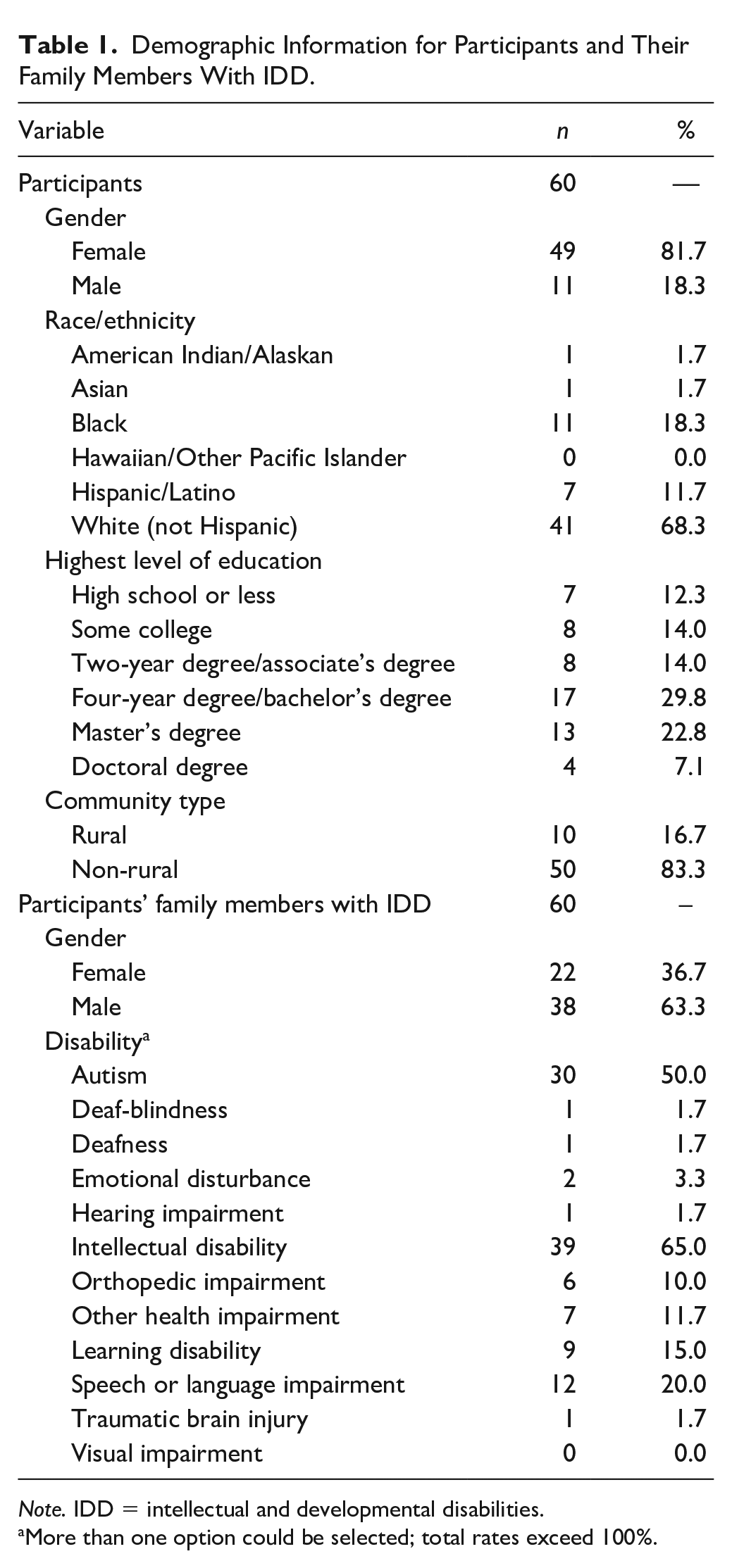
Note. IDD = intellectual and developmental disabilities.
More than one option could be selected; total rates exceed 100%.
Regarding demographic information about participants’ family members with IDD, the majority were male (63%); average age was 26.8 years (SD = 9.5, range = 16–60). When asked on the demographics survey about their family member’s degree of disability, 58.3% of participants selected moderate, 25.0% selected mild, and 16.7% selected severe. Over half of the participants (65%) reported intellectual disability (ID) as their family member’s primary disability, with 50.0% reporting autism spectrum disorder (ASD) as the primary disability, and 16.7% reporting co-occurring ID and ASD. Almost, half (45%) of the participants reported that their family members with IDD were currently employed in the community, and 86% reported that their family members with IDD had previous employment experience.
Recruitment
Recruitment occurred over 6 months and concluded when (a) new codes rarely emerged in our coding (saturation) and (b) our sample reflected diversity with regard to race/ethnicity, locale, and family member demographics. Following the recruitment advice of our project advisory committee, we used broad announcements, targeted invitations, and snowball sampling. We partnered with more than 50 disability organization and community programs, including local Arc chapters, inclusive college programs, Down syndrome associations, Best Buddies chapters, community service providers, and family support groups. We crafted recruitment flyers, email invitations, social media announcements, and electronic newsletter blurbs to share with these partner organizations. Study announcements included a link to the project’s interest survey and announced the opportunity to earn a US$50 gift card for participating in an interview or focus group. All procedures were approved by the university’s Institutional Review Board (IRB).
Interview Procedures
We conducted interviews to explore the experiences, insights, and recommendations of participants. Anticipating that some participants would feel more comfortable sharing their input in different venues, we provided the option to choose their preferred interview format (i.e., individual or group). We conducted 31 individual and six focus groups interviews. Midway through the study, the onset of the COVID-19 pandemic required us to offer remote interview options. Three individual interviews took place in person, nine took place over the phone, and 19 took place using a web-based video conferencing platform. The average length of individual interviews was 55 minutes. Four focus groups were held in-person and two used web-based video conferencing. The average group size was five participants and the average length was 99 minutes.
Two members of the project team facilitated all interviews. Both had extensive disability and employment experience. An additional team member attended each focus group to welcome and assist participants, take notes, and track the order of speakers. We developed a semi-structured interview protocol (available by request) based on prior employment research and our goal of obtaining a comprehensive list of facilitators to employment. Interviews all began with introductions, a review of the study’s purpose, and an overview of the process. Our interview protocol addressed four core areas: (a) the importance and conceptualization of employment, (b) barriers to integrated employment, (c) facilitators of integrated employment, and (d) recommendations for our intervention development. For this article, the most relevant questions were: What do you think would have to be in place to support your family member to access integrated employment? Which of these factors do you consider to be most important? If your family member is not currently employed, what sort of supports or help do you think they need to be successful in a paid job? If your family member is currently employed, walk us through how this job came to be. Tell us about the support or help he or she gets while at work. Tell us about the support or help he or she gets from your family. However, participants mentioned facilitators naturally throughout the interviews. We used follow-up questions to encourage clarification or elaboration. Participants also completed a demographic survey.
Data Analysis
Each audio recording was professionally transcribed and checked for accuracy before we removed all identifying information. We used thematic analysis (Patton, 2015) to compile a comprehensive list of major themes and patterns to succinctly describe participants’ perspectives of factors that facilitate access to integrated employment. Analyses were carried out by a team comprised two project staff, four graduate students, and three faculty members with expertise in integrated employment and working with families. This team-based approach ensured multiple perspectives were brought to the analysis and helped temper any individual biases. However, we acknowledge that potential biases may remain given team members’ beliefs about the importance of connecting adults with IDD to integrated employment and the essential role that parents and other caregivers play in this process. In our data analysis, we strived to promote the perspectives and priorities of families by utilizing our team’s expertise solely as a means for summarizing and reporting what families shared with us.
Data analysis occurred in multiple stages. First, two project staff and four graduate students conducted an initial reading of each transcript as they listened to the audio and took note of potential facilitators described by participants. Then, these six team members compiled a preliminary list of soft coded facilitators from across all 37 interviews. The two project staff met and came to a consensus on a preliminary coding framework of soft codes. The three faculty members reviewed initial drafts of this preliminary coding framework. Through discussions and additional review of the transcripts, the faculty members and project staff met to review and revise the coding framework until consensus was reached. Then, the initial coding framework was finalized by assigning names based on a combination of our team’s expertise in integrated employment (e.g., customizing employment, natural supports) and language used by participants (e.g., job coaching, resources for families).
Next, each transcript was independently coded by two team members—one project staff and one graduate student—using Dedoose, a qualitative coding application, to assign and organize codes. Each member of the two-person team read the transcript closely and assigned an initial code to relevant segments. We used codes from the initial framework when relevant and generated new codes when necessary. Each team then met to discuss and compare codes by working through each transcript line-by-line. These discussions allowed for resolving of discrepancies and refining of code definitions. The whole team met regularly to review revisions to the coding framework and organize codes into categories and sub-categories based on key similarities. The coding framework was finalized after each transcript was reviewed again to verify that all codes were correctly assigned and honored the sentiment of the participant (see Figure 1).
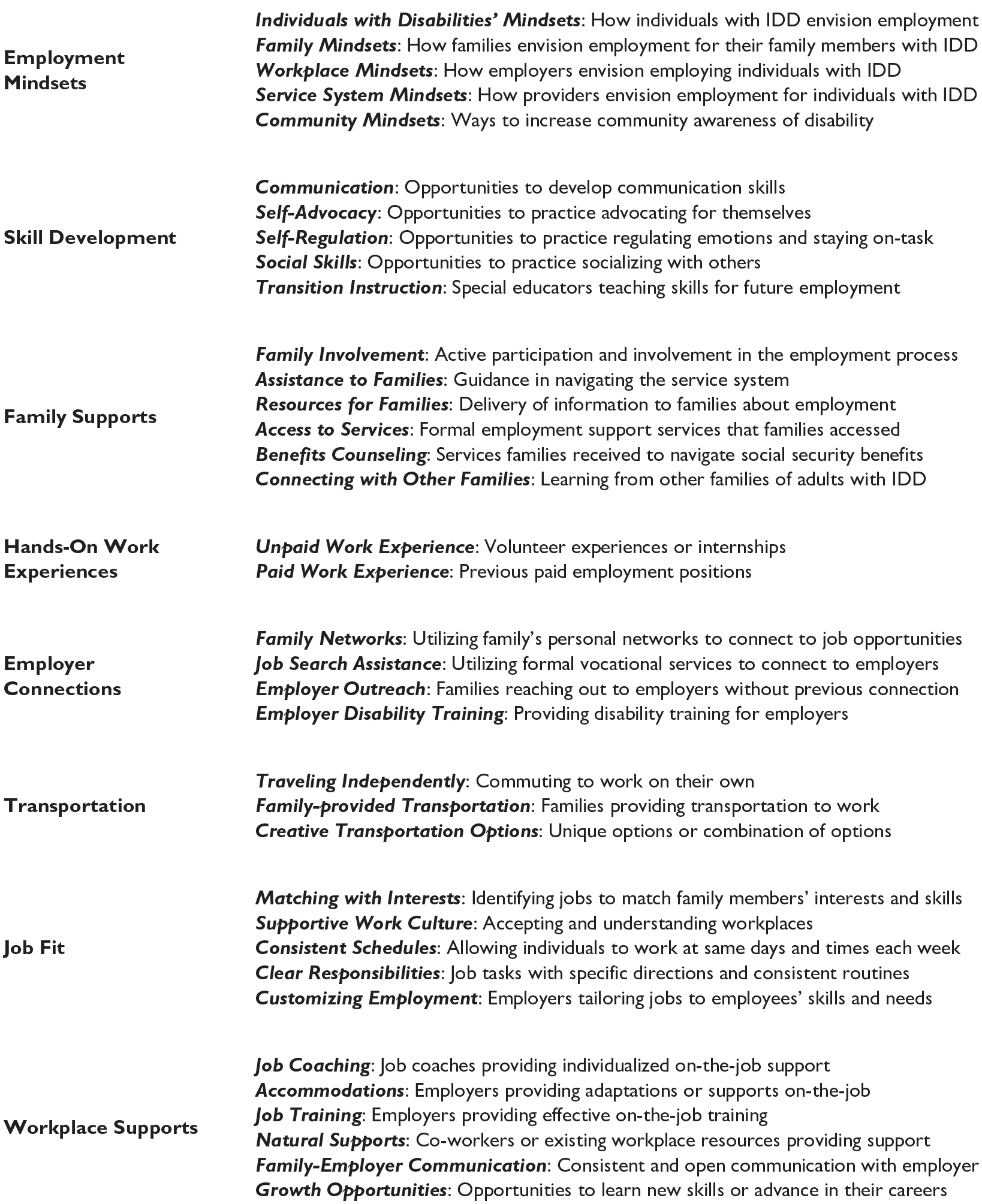
Themes, Categories, and Descriptions of Family-Identified Facilitators of Employment.
We were deliberate about conducting this study in ways that would enhance the credibility and trustworthiness of our findings as recommended by Brantlinger et al. (2005). This required recruiting participants who had direct personal experience supporting their family members’ pursuit of integrated employment. We kept a detailed audit trail throughout data collection and analyses. We adopted a collaborative approach to coding that allowed investigator triangulation and consensus during coding to mitigate individual biases. We also incorporated member checking by sharing a summary of themes back with each participant via email and inviting them to share feedback on any themes they felt were missing or needed to be changed.
Findings
Family members identified a variety of factors that facilitated access to integrated employment. We organized these 36 facilitators into eight broad categories (see Figure 1
Employment Mindsets
Participants addressed five areas in which attitudes, expectations, and perceptions about individuals with IDD impacted their ability to successfully connect to employment opportunities.
Individuals With Disabilities’ Mindsets
Participants shared examples of how their family members’ thoughts about the employment process had an influence on their subsequent paid employment success. Many examples focused on individuals with IDD wanting to have the same experiences as their family members and peers. A mother of a 21-year-old son with ASD and ID shared that her son wants a job, so that, he can be “like everybody else in the household and gives him a reason to want to go do something and not just lay around.” Another mother of a 19-year-old son with ID shared that he asked her if he “could get a job at [the grocery store] because there’s a lot of people at the [grocery store] near us who have disabilities.” Participants shared a variety of ways that paid employment has had a positive and motivating impact on their family member’s lives. One father described how his 22-year-old son with ASD benefits from being employed in that: He loves his job. He’s very happy as he comes out of that job and he tells me about what he did during the day. It impacts him positively. He enjoys working, he doesn’t mind it, he makes sure he does a good job. He’s proud of it.
Other participants described how work “build[s] up that confidence” and “self-worth,” “makes him feel good about himself,” and “gives him such a sense of purpose.”
Family Mindsets
The ways families encourage and expect their family members with IDD to pursue paid employment was seen as essential. One sister of a 58-year-old female with ID shared, “In my family, work in general is seen as essential and valuable . . . so, both my sister and I have a deeply instilled work ethic . . . whether she had a disability or not.” Other participants emphasized setting the expectation for employment early in life by “starting young” and “at the very beginning, to work with your child . . . to help them understand what they love to do.” Some participants, like one mother of a 19-year-old son with ASD, emphasized the importance of being open-minded “to take advantage of every opportunity” without “any preconceived ideas or notions of what [employment] should look like [so that they] find something that they enjoy doing and are excited about.”
Workplace Mindsets
Workplace mindsets were also critical to facilitating paid employment. Participants described the importance of co-workers being supportive, kind, and welcoming to employees with disabilities. A mother of a 46-year-old daughter with ID shared that co-workers have “been very cooperative. And, just for them to love her is such an amazing thing. And she looks forward to going to work.” In addition, participants, like one mother of a 23-year-old son with ID, emphasized how essential it is to identify employers who are “open to a variety of [employees] and what their strengths and weaknesses are” and to target “specific companies . . . that will hire those with disabilities who’ve made it a board of directors mandate.” Other participants suggested strategies to increase employer willingness like advertising “the advantages of hiring [employees] with disabilities,” and demonstrating how employees with IDD could have a “positive impact on the company as a whole.”
Service System Mindsets
Participants described how the postures of service providers could facilitate connections to paid employment. One mother of a 27-year-old son with ASD recounted the experience of meeting her son’s supported employment staff for the first time: “The job coach came out to our house and sat down for an hour or so with our entire family and got to know us. Listened to [my son] and me and got a foundation by listening to the family.” This made it clear to her that “from the very get-go [the staff] cared about [my son] and cared about his success.” She went on to say they were able to create “a better [job] application that didn’t just show what [my son] had done in his life, but showed his character and personality.”
Community Mindsets
Community awareness of disability and the benefits of hiring employees with IDD were also said to matter. Participants suggested ideas for sharing their success stories with the community through “billboards on the street,” “a story on the news about inclusive hiring,” “speaking engagements,” and an employed self-advocate serving as “an ambassador for her [company].” One mother of a 16-year-old daughter with ASD explained, If we show the benefits for them to be included, then maybe everybody might not catch on. But there’s quite a few that might buy into it! But if they don’t know about it and they never could look at it like this, then the opportunity is not there.
Skill Development
Participants described how preparation for the world of work could be enhanced by efforts to build the skills of their family members in five key areas.
Communication
One mother described how she helped her 16-year-old daughter with ASD learn new communication skills through participation in a verity of local speaking engagements at a conference and college class. She also encouraged other parents to be similarly creative in developing opportunities, “Let’s not stick to this script over here. Think of some ideas that your [family member] might like to do.”
Self-Advocacy
Participants described how supporting their family members in developing self-advocacy skills helped prepare them for workplace success. The father of a 26-year-old son with ASD and ID shared how his family fostered self-advocacy at home by giving him more of a say in everyday decisions: We, at our house, were engaging in forced compliance. “Hey son, would you like to do this?” “Well, no I don’t.” “No, I think you really would” “Well, okay.” And it was amazing how much we were doing that. And we had to break it. And it was hard, but that was the single most important thing . . . now [that he’s] going to be in a workplace.
Self-Regulation
Participants described supports that could help their family members regulate their emotions, stay on-task, and prepare for difficulties that might occur on the job. A mother of a 16-year-old son with ASD expressed that the most impactful support her family could have to prepare him for work would be someone who could help him: To be more independent, to stay on schedule, to have structure, but [who] also tells the parents how to do it, how to reach your child, how to know how to educate him, how to know how to deal with him, what to do in his worst moments.
She said that this support would help both her son and help the family better support him.
Social Skills
Some participants described specific social skill groups, interventions, or programs that improved their family member’s work-related social skills. A mother of a 32-year-old daughter with ID described how, prior to starting a paid job, they focused on: Helping her understand how to be a part of a work group [and] an appropriate participation with things that aren’t really, say, a part of [her] job description—if the whole staff decides we’re going to do Secret Santa at Christmas or we’re all going to bring something, have a potluck when [they] have workshops.
Other participants described how their family members strengthened their social skills by participating in volunteer opportunities and early work experiences. For example, one mother shared how her 18-year-old son with ID, “from the 10th grade on up to now, did volunteer work and it did open him up a little more to be sociable to other people, learning not to be so shy.”
Transition Instruction
Participants described the role of special educators in equipping their family members for paid employment. One mother explained how a teacher helped her 17-year-old son with ASD and ID understand the motivation for working after graduation: He doesn’t want to be broke his entire life. And that’s because his teacher taught him that. His teacher taught him that to be independent: “You have to get a job, you work, you make money, then you get an apartment, maybe you have a roommate.” So, he sees how it’s supposed to work.
A mother of a 19-year-old son with ASD relayed how helpful her school district’s postsecondary community-based transition program was in this preparation: They go to different job sites and just practice full job skills, which is awesome. That has been a plethora of information. The teacher has been able to hook us up with [the local paratransit company] and we learned about the [local disability services provider agency] to go get resources.
Family Supports
Participants described six key facilitators related to families that directly or indirectly impacted paid employment outcomes for their members with IDD.
Family Involvement
The importance of active and ongoing participation of families was emphasized by numerous participants. One mother of a 22-year-old male with ASD shared that her husband “was extremely involved” and, without that involvement, her son “probably would have lost the job . . . when a certain workplace navigating situation came up.” A mother of a 19-year-old with ID described how she had to go above and beyond to support her son’s work, saying it was “all hands in deck, whatever needs doing, whatever hours.”
Assistance to Families
Many participants described the guidance and help they needed to navigate the service system and recruit employment supports. For example, a sister of a 58-year-old female with ID said she wished her family “had a guide through the maze.” A mother of a 31-year-old daughter with ASD offered a similar suggestion based on their experience: We had to go to so many different places to find the information. It would be wonderful if someone said call this number, they’re going to give you somebody and then you can sit down and go through everything that you need and get it done in one package. It took us maybe seven years to get what we needed!
Resources for Families
Participants advocated for multipronged efforts to inform them about local employment programs and supports, including: hosting conferences or parent classes, developing a website, or creating printed materials like a checklist or book, to “[get] information out to the high schools.” The mother of a 26-year-old daughter with ID emphasized learning about these resources before high school ends, “That’s the scary part for parents. It’s like: ‘What now?’” Likewise, the father of a 22-year-old son with ASD emphasized their family’s need for more practical employment-related guidance: “[We need] the practical. We always want to see what the next step is, how to implement, where do we go from here? That’s what’s so critical. Who do we connect with?”
Access to Services
Participants detailed examples of formal services that were critical to their family members employment success, including VR, home and community-based settings (HCBSs) waiver program services, and specific local disability service provider agencies. For example, the mother of a 22-year-old daughter with ASD and ID said that without their “Vocational Rehabilitation counselor and [disability service provider staff], we could have never got where we are.”
Benefits Counseling
Many participants specifically raised the value of understanding how work would impact their family member’s benefits. One mother of a 46-year-old daughter with ID recounted how helpful a benefits counselor was when navigating the complexities of social security, “She knew so much about social security. She knew the laws, the rules, and so . . . we followed through on [her suggestions] and it made a big difference.”
Connecting With Other Families
Participants emphasized the power of relationships with other parents who are navigating the same journey. One mother of a 23-year-old son with ID said that talking to other parents who family members with IDD were already employed enabled “an open discussion about the jobs that [they] are in and how they’ve handled going into these new jobs and the good things about it and the conflicts and everything.” Participants also discussed how they have learned about resources and services from other families. For example, one mother of a 27-year-old son with ASD lauded a group of other mothers she relied on: I sit down with my [group of mothers]—there’s nine of us—and each one of us has a different resource and you pool it together. I’m not going to have all the resources. Somebody else is not. But with all the contacts you’ve had, [we] pool together resources.
Another mother of a 25-year-old son with ASD and ID longed for similar connections: If I had a group of people to come together with and just listen to their stories and support them, [and] for people to do the same for me, that would have been fantastic. Because what you do is you come together with people at your church or in your family and . . . no one else is going through what you are . . . It’s just so different.
Hands-On Work Experiences
Two types of direct work experiences were seen as strengthening long-term possibilities.
Unpaid Work Experience
Participants described an array of volunteer and internship experiences that helped their family members learn valuable skills and build their resume during high school or in a postsecondary program. One mother noted that her 24-year-old daughter with ID had a volunteer position that transitioned directly into a paid job offer, “At the end of the summer, [her boss] says: ‘She can do this. I hired her on Saturdays.’” Another mother described how her 29-year-old son with ASD had multiple unpaid internship experiences as part of his inclusive postsecondary program, which helped expose him to new possibilities: One semester, they lured him to work at [an art gallery] and he was like, “I don’t like art.” He loved [working there]. Then, he worked at [a local museum] and then he got his docent degree. Then, he worked at [a historic mansion]—started volunteering there and giving tours there. So, he decided he liked tours and museums and those kinds of things. Then he found [a job at a music museum and] he never did an internship there. He interviewed there, through the job coach, got him the interview. But his other jobs gave him very good recommendations. So that concept of trying something totally different every semester, it helps you decide what you do and don’t like.
Paid Work Experience
Participants also emphasized how paid work training opened doors for later competitive positions. A mother of a 46-year-old daughter with ID described how an early paid work experience led her daughter to refining her interests and motivated her to seek additional training to pursue a job in a different field she preferred: So then when she finished [the job training program], the only thing she qualified to do was food services [and she got placed] frying chicken at [a fast-food restaurant]. And she worked two years in that situation . . . we’re proud of her for sticking to it . . . which I’m sure was not a good fun thing for her. Anyway, she survived it, and I’m sure she grew from having that challenge of working with different people. And then, she was really tired of that, so she went back to [another job training program], and she was able to do childcare. So that was extremely beneficial for her to get the work training.
Employer Connections
Participants emphasized four sets of approaches for connecting with employers and businesses about potential job opportunities for their family members with IDD.
Family Networks
Participants illustrated how they tapped their personal connections in locating local job opportunities. A father of a 21-year-old daughter with ID shared how their family was “networking really hard and just reaching out, not only in our own community, but outside of our community—friends, friends of friends, Facebook, social media, churches. You have to use all these networks to find something.” Many participants shared stories of how those personal connections led to new jobs. For example, one mother of a 46-year-old daughter with ID described approaching a good friend who was the human resource person at a local factory, “We had known [him] forever, so he wanted to give her a chance.”
Job Search Assistance
Participants described how receiving assistance from VR provider agencies enabled them to connect to local employers for tours, applications, and interviews. A mother of a 21-year-old son with ASD and ID explained how their job coach gathered information about her son before approaching an interested employer: The job coach came and talked to me about my son. He talked to my son about himself. He went over a resume and a job interview with him so that he would know what was being handed over [to the employer] on his behalf [and] what to expect when they got there and then he laid it all out on the table for the manager in the very beginning.
Employer Outreach
Some participants explained how they contacted new employers directly without assistance from a job coach. The mother of a 25-year-old son with ASD described this relationship-building process: Going out to different businesses and talking to them and getting them used to the idea of having someone with a disability—an intellectual or developmental disability—coming in and working for them. And it would be a case of just go in, talk to the business, see what they need. Then, a month or so later, to go back for another visit. It may take three or four visits to build up a relationship with all these businesses.
Employer Disability Training
Participants also emphasized the importance of increasing employers’ knowledge about hiring people with IDD. They recommended emphasizing the strengths people with disabilities possess and the benefits that can accrue to businesses. A father of a 22-year-old son with ASD shared what he felt employers should know: It would be great if these employers had a kind of an overview picture of certain developmental disabilities . . . I think that we make some assumptions when we talk to employers and [we say] special needs and disabilities and “they’re going to really be a benefit to you.” [Employers] don’t understand that. And if they could understand [that], I think it could really put [employees with IDD] in a position of being highly valued from the start and not like, oh we’re going to help this poor person. No, let’s put this person where they can be successful and a highly valued individual. You’ve got to set the tone for that with the employer.
Another father of a 28-year-old son with ID shared about educating employers as part of a local disability employment consortium: I’m on an employment consortium here in [city], and whenever we get an employer to listen to us, it’s amazing how fast they hire people with disabilities because they realize there’s a lot less risk than they think. And because [people with disabilities] are so appreciative of their jobs, they’re usually in the higher performing categories, they’re model employees.
Transportation
Participants addressed three aspects of transportation that warranted attention.
Traveling Independently
Participants described the variety of ways their family members with IDD commuted to work on their own, including public transportation, paratransit, disability services agency-provided transportation, ridesharing (e.g., Uber or Lyft), or driving themselves. A father of a 26-year-old son with ASD and ID shared how his son used ridesharing to commute to work and increase his independence throughout the week: Lyft has been a lifesaver for us. Now, it costs [but] we aren’t worried about the financial piece other than the immediate. He spends more than he makes, but we get some reimbursement from [Medicaid] that helps it. In addition to employment—where Lyft by itself has made a huge, huge difference for us—is my wife and I, he’s an only child, can go away and he can be by himself at home and get to work and back.
Family-Provided Transportation
Participants addressed having to provide transportation, so that, their family members with IDD could get to work when other forms of transportation were not available or appropriate. A mother of a 21-year-old daughter with ID described how several family members pitched in for her daughter: “We have a fabulous support group—both of my husband’s parents live in town [and] my daughter who’s actually younger than her. So, we have a lot of people who drive her places [and] pick her up.”
Creative Transportation Options
A few participants emphasized the need for creative combinations of options. For example, the father of a 28-year-old son with ASD and ID made a special request to a free ride service available in their city’s downtown area: It was these souped-up golf carts that are FTA street-ready that hold four people. And you basically have an app. The app sees where you are by GPS, you call it, it comes and picks you up, takes you anywhere within that service area. And it’s free. You just tip the driver. The way they pay for the vehicles and the service is through advertisement with local businesses. And we [contacted] them, [. . .] even though it was slightly outside their service area, they redrew the service area to include his house on the app and we agreed that he would pay the driver a six dollars per trip. And they added a driver to take him to work at 11 o’clock and then pick him up at four and bring him home.
Job Fit
Participants emphasized considerations focused on ensuring a particular job was well-suited for their family member’s skills, strengths, and needs.
Matching With Interests
Participants noted that a close fit with their family member’s interests contributed to more success in the workplace. One mother shared how her 21-year-old daughter with ID had a passion for cooking that made working at a bakery a perfect fit, “She really likes it. And she’ll say that all the time, she goes ‘this is my step to owning my own bakery.’” The mother of a 22-year-old son with ASD and ID noted how working in a hospital was a good match for his interests: He really has a heart for people. He wanted to help people. And so we said, well, the healthcare industry is a great place to help people no matter what you’re doing. And he’s working as a floor tech at [a hospital], but the residents love him. And the employees do. Everybody just loves him. He’s like a magnet . . . That was really important to him to be able to help people.
Supportive Work Culture
Participants detailed the importance of finding a workplace that is positive, accepting, and understanding of employees with disabilities. Their examples addressed how particular employers “bent over backwards to help,” “doted on,” and “had fun” working with their family members. One mother of a 27-year-old son with ASD described how her son “has just continued to excel and to grow and to learn . . . They get him. They encourage him. They also correct him. But he takes it in a positive way because of the way [the staff] work with him.” A mother of a 21-year-old with ASD and ID explained how her son grew to love his job after experiencing the positive work culture: It’s more about the environment and the people than it is about the task. Because you know, he never would have said, I want to work in fast food. He loves it, but it’s the last thing he wanted to do. I think it just makes a big difference that he’s accepted there. He’s understood there.
Consistent Schedules
Participants noted how important it was for their family members to work at the same times each week due to transportation availability, scheduling constraints, or needs (e.g., medication timing). One mother described the importance of scheduling for her 19-year-old son with ASD because he prefers routine, “Sometimes, if you change his routines, he gets stressed.” A sister of a 58-year-old female with ID added that her sibling’s “consistent schedule makes a huge difference for planning and transportation.”
Clear Responsibilities
Participants also emphasized how their family members preferred job tasks and directions to be clear and concrete to avoid confusion and improve their focus. Some described how it was helpful for their family members to complete the same job tasks daily. For example, one mother shared that her 22-year-old son with ASD and ID was “really happy [at his job] because he could do the same thing repetitively. If he’s in a routine, he feels safe and secure. And so that worked out really well.”
Customizing Employment
Participants discussed their appreciation for employers who were willing to make adaptations to job responsibilities based on their family members’ abilities and needs. They shared about employers who were flexible about work hours due to transportation difficulties, stress, or physical limitations. A mother of a 20-year-old with ID explained how his employer was originally “putting him on eight-hour shifts, but he [would get] tired . . . They agreed that he did much better when he had a four- or five-hour shift instead of longer. So, they’ve adjusted his shifts to being shorter.” Participants elaborated on other ways employers had individualized job tasks and work environments based on their family member’s needs and abilities. For example, a mother of a 19-year-old son with ASD and ID shared that his employer “met him to make sure he was comfortable with the stuff he would be doing [and] they asked would he be more comfortable being on the floor or being in the back.”
Workplace Supports
Six factors were supportive of a successful work environment and a sustainable position.
Job Coaching
Participants identified job coaches as essential supports for their family members with IDD in that they provided assistance communicating with co-workers, supervision on tasks, help with time management, in-the-moment reminders and prompts related to their work completion, and encouragement for a job well-done. One mother of a 21-year-old daughter with ASD put it simply, “Number one was the job coach.” Another mother estimated that without job coach support for their 22-year-old son with ASD, “We’d probably be spending 30 hours a week supporting him. We’re almost at our wits end doing what we’re doing now.” One father of a 28-year-old son with ID emphasized how essential job coaching was for his son, but also recognized the need for fading this support over time for long-term success: I think job coaches are important across the board, but I also think it’s equally important when a job coach realizes that somebody’s pretty self-sufficient, they kind of step back and they don’t micromanage it. And understand that the success of your job is that you’re not needed anymore by an individual.
Accommodations
Participants listed numerous changes to the workplace that enabled their family members to work effectively. Some shared examples of basic accommodations they requested employers to provide, such as adaptive equipment or task analyses. Written or visual tasks lists were mentioned frequently. One mother of a 21-year-old son with ASD and ID shared, “The manager gave him a written list of daily tasks. Maybe more, you know, shift overviews, like all these things just to support his memory and to make him not feel helpless.”
Job Training
Participants saw job training as central to job success. A mother described how her 25-year-old son with ASD received job training from his employer in a way that was especially effective, “I could tell the first day they did it. He came in all pumped up and happy and walking on his toes. That little bit makes all the difference in the world.” A few participants shared how comprehensive job training at the start of the job eliminated their family member’s need for a job coach. A mother of a 19-year-old daughter with a disability explained: Once they have shown her what she needs to do, and positioned her, and given her the instructions to advocate for herself when she doesn’t understand something, she can pretty much do a job that anyone else can do, once you’ve given her those guidelines, that bit of support on the front end.
Natural Supports
Participants described tapping into existing workplace supports available to any employee, such as helpful co-workers. One father, who was initially hesitant that his 28-year-old son with ID could work in a food preparation position, noted how natural supports were conducive to his success. The hiring manager of the local coffee shop told the father, “I’ll be with him for 30 days, working with him from 7am-1pm. I really think he can do this! If he can’t, I’ll call you.” After 30 days, his son demonstrated his ability to “cook the four basic breakfasts and lunches . . . in the appropriate amount of time.” The manager had created lists after realizing the son was “routine-oriented.” As a result, the son did not need an outside job coach or other formal supports. Other participants also described environments where co-workers were supportive, patient, and willing to solve the problem.
Family–Employer Communication
Striking the appropriate balance of communication between the family and the employer was also important. One mother of a 32-year-old daughter with ID asked her daughter’s manager to simply “copy [her] email in all communications.” Many other participants talked to the managers on an as-needed basis or if something unexpected arose, such as a behavioral challenge or scheduling change. The mother of a 21-year-old with ASD and ID described her communication to a workplace supervisor as “the best thing ever.” The job coach specifically recommended that the mother call the supervisor before the first day to “get a line of communication going . . . it was wonderful.”
Growth Opportunities
Participants shared how employers encouraged their family members to advance in their careers by learning new skills or through obtaining promotions. For example, a father described how an elementary school had hired his 28-year-old son with ID as a teacher’s aide. After seeing his skills on the job, they began to expand his role: The school has been phenomenal with him. He assists the teachers, [then] they hired him for summer camp as well. And what’s happened is, the headmaster of the elementary school said, ‘I’m going to gradually do this. I want the teachers to recognize what [your son’s] capabilities are, and ask for him, rather than me tell them what [your son’s] going to do. So, he’s going to be delivering mail and stuff at first, but when this happens organically, it’s going to be a lot better.’ So, it wasn’t very long before teachers were saying, “how do I get [your son to help me]?”
Discussion
Elevating employment outcomes has been a longstanding emphasis within disability policy and practice. Families who have navigated this employment journey (or are in the midst of it) have valuable insights from their first-hand experiences. Through conversations with 60 parents and other caregivers, we identified a constellation of factors that may contribute to the employment success of individuals with IDD. Our findings extend the literature in several ways.
Leveraging Experiences of Families to Provide Practical Guidance
Parent and caregiver perspectives on their experiences navigating the employment process alongside their family members with IDD provide valuable insights and practical guidance for improving employment outcomes. Our participants were especially generative in the numerous solutions and concrete examples shared that they found to be effective in connecting their family members with IDD to paid employment opportunities. As emphasized by Fletcher-Watson et al. (2019), solutions to enduring challenges are more likely to be practical and successful when the voices of those with first-hand experiences are included. Creating opportunities for families to meaningfully participate in the development of programs and interventions should be more widely adopted by practitioners and researchers.
Essential Employment Mindsets and Strategies
Families recognized the importance of both mindsets and strategies involved in the employment of their family members with IDD. Many shared stories illustrating how the attitudes and expectations among everyone involved in the employment process facilitated workplace success (e.g., families, individuals with disabilities employers, service providers). Mindsets have long been recognized as critical to employment (Awsumb et al., 2022; Carter et al., 2023). Families also emphasized sharing employment successes to transform views among those who were unfamiliar with the vocational capabilities individuals with IDD possess. Businesses and employers were also recommended as being influential in this area, particularly those who have implemented inclusive hiring practices and can speak first-hand to benefits related to productivity, work culture, and community perceptions.
Integrated Approaches to Employment
Families recognized the complexities involved in connecting their family members to paid employment and called for a more integrated approach to this pursuit. Previous research supports this stance that a broader approach is needed—beyond mere skill building—to overcome longstanding and multifaceted barriers (Schutz et al., 2023). As an example of a broader approach, participants in our study described connecting to potential employers through their own social networks, the networks of disability providers or support staff, or reaching out directly to employers themselves without an existing connection. Indeed, a study by Petner-Arrey et al. (2015) demonstrated the success of utilizing social networks and community connections contributed to identifying potential job opportunities and employment sustainability for adults with IDD.
Many families emphasized the impact of job coaching on their family members’ success on the job. Supported employment has long been advocated as an effective practice (Wehman et al., 2018). However, many families described needing longer-term support due to the challenges that may arise as soon as job coaches begin to fade their more intensive supports so as to promote independence (Awsumb et al., 2022). Accessing natural supports in the workplace was also raised as collateral approach to advancing employment. Identifying and harnessing natural supports that are already built-in to the environment or workplace is often advocated, but more research is needed to identify the most effective ways of doing so (Hedley et al., 2017).
Areas of Investment for Community Partners
Participants called for deeper investment by schools, employers, service systems, and families alike. First, participants emphasized the role school system must play in equipping their family members for future employment success. Previous research affirms the powerful influence special educators and pre-employment transition service (pre-ETS) providers can have on the employment preparation of transition-age youth (Schutz & Carter, 2022). This emphasis on collaboration in transition services provision is in alignment with Workforce Innovation and Opportunity Act (2014) which mandates that 15% of state VR budgets are to be allocated to pre-ETS. Second, strong commitment and capacity among employers was said to be critical. Participants suggested ways that employers could increasing their knowledge of integrated employment through trainings and information sharing. Other studies have described the uneven attitudes and experiences of employers (e.g., Awsumb et al., 2022; Waisman-Nitzan et al., 2019), highlighting the continued need for empirically validated trainings and support for these individuals (Phillips et al., 2016). Third, the experiences of many participants pointed to needed changes among employment providers. The scarcity of available, effective, and ongoing job coaching and support services left many parents on their own to figure out how to find and maintaining employment for their family members. Fourth, participants described their own involvement as essential to employment success. But they also noted their continued need for practical tools and guidance that could help them navigate the complexities of the adult service system. Hirano and Rowe (2016) similarly argue that parents’ knowledge of the employment process and related supports is key to successful vocational outcomes.
Implications for Practice
Families provided a wealth of information and suggestions for improving employment outcomes for individuals with IDD, which addressed each step of the employment process: preparing for employment, obtaining employment, and maintaining employment. In preparing for employment, families described their need for more guidance and information. Special educators, specifically those who teach transition-age youth, are often identified as the primary information liaison responsible for connecting families to needed resources. However, for many families, it is unclear from whom they should seek guidance beyond high school.
In attaining employment, families shared the central role of the service system, specifically job coaching, in providing their family members with assistance in connecting to paid work and on-the-job support. Although some of the families in the current study were able to successfully connect to supported employment services, it is much more common for families to experience difficulties accessing job coaching due to the substantial gap between the availability of job coaches and the number of adults with IDD needing services (Nicholas et al., 2018). It is important for policymakers and state agencies to continue to advocate for funding to adequately support the employment goals and needs of their state’s residents with IDD.
To address access to needed employment guidance and support, some families connect to parent support groups or informal networks of other parents to exchange information and personal experiences (Marsack-Topolewski & Church, 2019). Some participants in our study also addressed the actual or anticipated benefits of connecting with others in this way. Special educators, agencies, and disability organizations should develop new avenues for connecting families seeking employment with families who have already been successful in navigating the road to employment.
Limitations and Future Research
Several limitations should be considered when interpreting our findings. First, we held some of our interviews and focus groups online due to the onset of the COVID-19 pandemic. Although virtual options have since become ubiquitous, this approach was new at the time and may have impacted rapport building and openness. Second, families of individuals with IDD across the country are incredibly diverse. We narrowed our recruitment to a single state and involved a limited number of families from rural communities who had lower educational levels. This study should be extended to families in additional states to ensure that a wide range of voices is represented in the literature. Third, we focused only on the perspectives of parents and other caregivers. Future studies should also incorporate the views of youth and adults with IDD, so that, a more robust set of recommendations emerge based on lived experience.
Conclusion
Families can provide unique and valuable insights into the types of supports, resources, and interventions that are needed to overcome prevailing barriers to paid employment. Families affirmed the need for more comprehensive approaches to services and supports that integrate multiple components and bring multiple community members together. Changing mindsets, building community connections, obtaining hands-on experiences, and identifying creative ways to access needed supports are all essential pieces of the efforts required to facilitate attaining and maintaining paid employment for adults with IDD.
Footnotes
Declaration of Conflicting Interests
The author(s) declared no potential conflicts of interest with respect to the research, authorship, and/or publication of this article.
Funding
The development of this manuscript was supported by grant funding from the National Institute on Disability, Independent Living, and Rehabilitation Research (NIDILRR) Rehabilitation Research and Training Center (RRTC) on Employment of Persons with Intellectual and Developmental Disabilities (NIDILRR Grant #90RTEM000301-00). NIDILRR is a Center within the Administration for Community Living (ACL), Department of Health and Human Services (HHS).
