




Abstract
In U.S. higher education, the student veteran population is growing. As we research and research and gain deeper insights into student veterans and the impact that their military service has on their lives, we begin to uncover connections, such as challenges in romantic and sexual aspects, as well as negative emotions, that may provide valuable insight to counselors. This study aimed to examine whether the relationship between unhealthy attachment and academic problems could be mediated by problems in romantic and sexual relationships, as well as negative emotions, among student veterans with disabilities. Data were collected from 129 student veterans with disabilities who receive counseling and accommodation services from college disability services. The findings revealed that, in student veterans with disabilities, the association between unhealthy attachment and academic problems was partially mediated by romantic and sexual relationship problems, as well as negative emotions. We discussed the implications for counselors and researchers.
Veterans are a growing population of students in U.S. higher education institutions. Although a desire to serve is a common motivation for members to enlist in the armed forces, educational benefits are also compelling factors for many service members (Kuhn & McCaslin, 2018). University settings have become more accessible to veterans through the 2008 Post 9-11 Veteran’s Education Assistance Program (Olsen et al., 2014). Despite the increase in enrollment, student veterans experience academic challenges due to unique barriers associated with their identity as veterans; such barriers compass feelings of isolation and lack of social support (Grenawalt et al., 2023; McGuire et al., 2023; Yeager, 2022). The transition to civilian life after military duty can be particularly challenging for veterans, and this challenge can be compounded by the presence of traumatic brain injuries and posttraumatic stress disorder (PTSD) (Barry et al., 2014; Umucu et al., 2018; Umucu et al., 2019). Veterans may encounter difficulties transitioning from a strict military schedule, which emphasizes resilience and effective problem-solving, to the university setting characterized by a distinct culture of student-led and self-directed schedules (Kuhn & McCaslin, 2018). Veterans may also be at a higher risk of experiencing both mental and physical health conditions (Umucu, 2021a; Umucu, Reyes et al., 2021; Umucu, Villegas et al., 2021; Umucu & Lee, 2023), negatively affecting their college adjustment and employment (Umucu, 2023). One of the aims of this study was to examine student veterans with disabilities and attempt to identify factors that could either assist or hinder academic success in student veterans with disabilities within university counseling and disability centers.
Student veterans’ academic success has been correlated with feelings of connectedness and social belonging, including veteran social groups on campus, support from professors and instructors, and a robust social network (Olsen et al., 2014); these social networks can include romantic relationships. Research into student veterans has emphasized the significance of community and a sense of belonging, as well as the importance of healthy relationships both on and off campus for academic success (Kirchner, 2015; Semer & Harmening, 2015). Healthy relationships have been correlated with an absence of negative emotions and contribute to increasing positive ones (Bartholomew & Horowitz, 1991). Positive emotions can positively impact the level of commitment and persistence that a student devotes to their higher education coursework, thus affecting their overall academic performance.
Numerous studies have focused on academic success as a counseling outcome both for student veterans and the general population of college students. However, limited research exists that has considered the relationship between attachment, romantic and sexual relationships, emotions, and their impact on academic success within a single model, which could potentially contribute to counseling modalities counselors utilize in university counseling and disability centers. Therefore, the primary objective of this study is to examine the serial mediating relationship among the variables of unhealthy attachment, romantic and sexual problems, and negative emotions on academic problems for student veterans in higher education.
Attachment
Attachment and attachment orientations have long been an area of interest in counseling research. Attachment theory is a psychological model that centers around the human response dynamics of long- and short-term interpersonal relationships when faced with hurt, separated from loved ones, or perceiving a threat (Waters et al., 2005). The theory postulates that personality development and enduring patterns of social interaction result from caregiver response during infancy (Ainsworth et al., 1978). Ainsworth and Bowlby (1991) further extrapolated that the human drive for intimate and close relationships is an evolutionary and biological trait.
Attachment theory is relevant to the population of student veterans (Umucu, Chan, Lee, et al., 2022), as well as Veterans in general, as it can be related to responses to posttraumatic situations such as deployment and active combat. Additionally, attachment theory may shed light on the strengths and vulnerabilities of veterans’ relationships and the impact of deployment and combat on those relationships. When an individual goes through trauma or a significant life change, such as joining the military and returning to civilian life, these experiences can threaten an individual’s sense of safety and stimulate their attachment (Bowlby, 1988). People with secure attachment style, as well as those who receive comfort and support after a traumatic situation, are more likely to report a reduction in traumatic or posttraumatic symptoms (Mikulincer et al., 2015). In the study conducted by Bannister and colleagues (2018) on male and female veterans, unhealthy attachment was found to be positively associated with greater severity of PTSD symptoms and increased difficulty transitioning to civilian life.
Attachment theory has conceptualized attachment as either secure or insecure, with attachment avoidance and anxiety as the measurement dimensions: high attachment avoidance and anxiety characterizing insecure attachment, and low attachment avoidance and anxiety characterizing secure attachment (Bartholomew & Horowitz, 1991). Unhealthy attachment is operationalized within adult romantic and sexual relationships (Mikulincer & Shaver, 2018) and has been correlated with negative emotions such as depression and anxiety (Dagan et al., 2018). Previous research has also documented that attachment style may negatively affect therapeutic alliance and bond between clients and counselors (Diener & Monroe, 2011).
Romantic and Sexual Relationships
Attachment theory has been proven useful in research examining adult relationships, as it provides a helpful model for understanding adult relationship patterns, emotional regulation, and sexual relationships (Mikulincer & Shaver, 2018). In long-term relationships, success is often characterized by several key factors, including relationship length, levels of intimacy, levels of commitment, and a mutual vision for the future. In such relationships, couples support each other, share important experiences, seek out, and see their partner as a figure of attachment (Mikulincer & Shaver, 2018). Shaver and Hazan (1987) conducted seminal studies among adults with unhealthy attachment (anxious or avoidant), and the results indicated that these individuals had less optimism about romantic relationships and experienced difficulty in falling in or out of love. The result also indicated that these individuals had a greater tendency to perceive threats within the relationship and were more likely to engage in dysfunctional behaviors, they were found to have a lack of confidence in establishing and maintaining healthy relationships. Conversely, those with healthy attachment styles can perceive and express respect, positive emotions, and gratitude to their partners more; the expression of these positive emotions can lead to the success of a relationship via its longevity, intimacy levels, and commitment (Mikulincer & Shaver, 2018).
Healthy or unhealthy attachment also impacts sexual relationships and sexual functioning within relationships. Hazan and Shaver (1987) believed that romantic love includes an attachment, giving care to another, and incorporates sex. Mikulincer and Shaver (2018) mentioned that, while the sexual system may be in part for physical mechanisms such as pleasure and an evolutionary desire to propagate the species, it is also part of a healthy romantic relationship. The authors further stated that adults with insecure attachment are more likely to experience problems of a sexual nature and less likely to report sexual enjoyment.
Attachment style has been empirically linked to an ability to express love and affection for partners both during and outside of sexual experiences (Hazan & Shaver, 1987). Individuals with insecure attachment styles reported less sexual pleasure and a lack of control over their sexual experiences (Birnbaum, 2007). Attachment security is correlated with increased positive emotions, more passion during sexual encounters, more satisfying long-term relationships, and more confidence and positive feelings about self (Birnbaum, 2007).
Negative Emotions
Attachment theory considers the quality of attachment formed between children and their parents and how it affects relationships later in life as a significant basis for developing emotions in childhood and adulthood (Bowlby, 1988). Relationships formed in the family are interrelated with relationships formed with peers, including romantic partners (Kerns, 1996). Negative emotions have been found to mediate the relationship between attachment and relationship quality (Abraham & Kerns, 2013) and correlated with unhealthy attachment. Specifically, in a meta-analytical study, avoidant attachment was linked with less positive emotions and lower ability to navigate healthy social relationships; anxious attachment was linked with more negative emotions or affect (Cooke et al., 2018).
Unhealthy attachment patterns, such as anxious or avoidant attachment, are related to negative emotions. For example, avoidant attachment is characterized by distrust and emotional distance within relationships (Mikulincer & Shaver, 2018); it was found to be correlated with negative feelings of hostility or anger and sadness or depression (Paech et al., 2016). Anxious attachment is characterized by distrust and concern for unmet emotional needs (Mikulincer & Shaver, 2018); it was found to correlate with negative emotions of sadness, anger, and anxiety (Paech et al., 2016). Paech and colleagues (2016) also found that feelings of anxiety, fear, and depression were highly impactful to one’s mastery of their environment, including work and higher education settings. Positive feelings, or emotions, and the regulation of emotions can influence an individual’s relationships, management of stress, and experiences in higher education institutions (Mikulincer & Shaver, 2018).
Mental and Emotional Health and Academic Success
Academic success is an important aspect of higher education and is correlated with mental health and counseling outcomes (Lee et al., 2009; Sadeghi Bahmani et al., 2018; Whiston & Quinby, 2009). Academic success is implicated by cognitive processes as well as emotion. Studies have found that academic problems, which are the opposite of academic success, were linked with depressive symptoms and poor self-esteem (Feshbach & Feshbach, 1987). More recent studies have linked anxiety and depression with academic success; lower levels of anxiety and depressive symptoms correlate with higher academic success and vice versa (Sadeghi Bahmani et al., 2018).
The role of positive and negative emotions has been increasingly studied in terms of academic success (Fiedler & Beier, 2014; Pekrun & Stephens, 2010). Negative emotions, such as anxiety, sadness, and anger, have been found to be correlated with academic problems and mental health issues (Mandracchia & Pendleton, 2015). While much research has focused on test anxiety and its role in poor academic success (Rowe & Fitness, 2018), a newer and growing research body begins to examine the effect of other emotions such as sadness, fear, loneliness, and anger on academic success.
Negative emotions correlate with academic outcomes, including failure to reach academic goals, lower levels of motivation and self-efficacy in educational settings, and even cognition (Rowe & Fitness, 2018). Martin and colleagues (1993) theorize that emotional effects can impact academic success like this: one’s positive emotions will prolong their engagement in an activity (e.g., studying), thereby increasing their success, while one’s negative emotions will shorten this time and engagement, thereby decreasing their success or causing academic problems.
When considering veterans in institutions of higher learning, some of the data is encouraging. Mediating factors between negative emotions and academic problems include life experience, age, and the ability to work independently and problem-solve, all of which are traits found among student veterans (Barry et al., 2014). Addressing academic challenges and mitigating academic problems in student veterans with disabilities is a clear need to help the services provided by counselors in disability centers (Umucu, Moser et al., 2020; Umucu, Wu et al., 2020; Umucu, Lee et al., 2021). College can be a difficult transition for traditional college students in dealing with anxiety, depression, and other negative emotions, and student veterans with disabilities face even more difficulties in this area (Umucu, Castruita Rios et al., 2022; Umucu, Chan, Phillips, et al., 2022; Umucu, Ghosh et al., 2022). There has been a recent increase in college students’ utilization of student counseling centers, as they seek help with academic problems (Mandracchia & Pendleton, 2015).
The Current Study
Based on the literature discussed above, it is essential to examine whether the relationship between unhealthy attachment and academic problems can be mediated by romantic and sexual relationship problems and negative emotions in student veterans with disabilities. The findings from this study will inform counseling practice and the development of targeted interventions to work with student veterans with disabilities. We hypothesized that the indirect effect of unhealthy attachment on academic problems through romantic and sexual relationship problems and negative emotions would be significant.
Method
Procedures
These data were collected from a Hispanic-serving institution in a Southwestern U.S. state following institutional review board (IRB) approval. The principal investigator (PI) collaborated with the college’s Disability Center to gather the data. The survey link, hosted on Qualtrics, was electronically distributed by the disability office, a hub for students seeking counseling and accommodation services. Prior to starting the survey, all participants provided their consent through an online form. Upon completion of the study, participants were rewarded with a $10 gift card.
Measures
Attachment
The unhealthy attachment was measured by the Short-Form Version of the Attachment Style Questionnaire (Iwanaga et al., 2018). This scale measures anxious and avoidant attachment styles with a total of 8 items rated on a 6-point Likert-type scale ranging from 1 (totally disagree) to 6 (totally agree). We summed anxious (e.g., “I worry a lot about my relationships.”) and avoidant (e.g., “I find it hard to trust other people.”) attachment scores to create an unhealthy attachment score, with higher scores indicating a greater level of unhealthy attachment. The total score demonstrated an internal consistency of .70 for this study.
Academic Problems
Academic problems were measured by the academic problems subscale of the Inventory of Common Problems (ICP; Hoffman & Weiss, 1986). The subscale consists of a total of 4 items (e.g., “Difficulty caring about or concentrating on studies?”) rated on a 5-point Likert-type scale ranging from 1 (not at all) to 5 (very much). The internal consistency reliability coefficient was .80 for this study.
Romantic and Sexual Relationship Problems
A single item measured romantic and sexual relationship problems from the ICP (Hoffman & Weiss, 1986). We asked participants how much “problems with romantic or sexual relationships” distressed, worried, or bothered them in the past few weeks. The item was rated on a 5-point Likert-type scale ranging from 1 (not at all) to 5 (very much).
Negative Emotions
Negative emotions were measured with three items from the PERMA-Profiler (Butler & Kern, 2016). Each item (e.g., “How often do you feel sad?”) is rated on an 11-point Likert-type scale ranging from 0 (terrible) to 10 (excellent), or 0 (not at all) to 10 (completely), with higher mean scores indicating better physical health. Cronbach’s alpha was .75 for this study.
Data Analysis
We conducted a descriptive statistic to examine participants’ sociodemographic characteristics. Subsequently, a serial mediation analysis was performed to test our primary hypothesis, aiming to assess the indirect impact of unhealthy attachment on academic problems through the intermediaries of romantic and sexual relationship problems and negative emotions. Serial mediation analysis assists in elucidating the influence of an independent variable through a series of mediators, each with a specific direction. The specific indirect effects in this model were (a) through romantic and sexual relationship problems (a1b1); (b) through negative emotions (a2b2); and (c) through romantic and sexual relationship problems and negative emotions (a1d21b2). If the final indirect effect is significant, it supports multiple serial mediations (Hayes, 2013). In addition, a bootstrap test (5,000 bootstrap samples; 95% confidence interval (CI)) was used to test the indirect effect of unhealthy attachment on academic problems through romantic and sexual relationship problems and negative emotions through the mediators (Preacher & Hayes, 2008). We also calculated R2 effect size to assess the variance accounted for in the mediation model. The Statistical Package for the Social Sciences (SPSS) 27.0 was used to perform all analyses. We used PROCESS macro (Hayes, 2013) for the serial mediation analysis.
Results
Sample Characteristics
A total of 129 student veterans with disabilities were recruited from the college’s Disability Center. Participants’ mean age was 33.05 years (SDage = 0.80). Our sample consisted of a total of 94 (72.9%) males and 35 (27.1%) females. Descriptive statistics revealed that the sample consisted of mostly White (81.4%) participants, followed by multi-racial (6.2%), African-American (4.7%), and others (7.7%). About 52% of participants identified themselves as Hispanic, Latino, or Spanish origin. A majority of participants served either in the Army (62%), followed by the Navy (16.3%), the Air Force (10.9%), the Marine Corps (9.3%), and Coast Guard (1.6%). About 97% of our sample reported having a service-connected disability.
Serial Mediation Analysis
We conducted a serial mediation analysis to examine romantic and sexual relationship problems and negative emotions as mediators for the relationship between unhealthy attachment and academic problems. We used the PROCESS macro (Hayes, 2013) to identify total, direct, and indirect effects. The indirect, specific impact in this model was (a) through romantic and sexual relationship problems (a1b1); (b) through negative emotions (a2b2); and (c) through romantic and sexual relationship problems and negative emotions (a1d21b2).
The unhealthy attachment was positively correlated with academic problems (path c = .46). The unhealthy attachment was directly and positively linked to romantic and sexual relationship problems and negative emotions (path a1 = .24 and path a2 = .45, respectively). Romantic and sexual relationship problems were positively linked to negative emotions and academic problems (path d21 = .18 and path b1 = .28, respectively). Negative emotions were directly linked to academic problems (path b2 = .39). The relationship between unhealthy attachment and academic problems stayed significant (path c’ = .19), indicating that romantic and sexual relationship problems and negative emotions partially mediated the relationship between unhealthy attachment and academic problems. The R2 for the serial mediation model analysis was found to be 0.44, indicating that 44% of the variance in academic problems was explained by romantic and sexual relationship problems, negative emotions, and unhealthy attachment.
We used PROCESS macro with 5,000 bootstrap samples (95% CI) to test the indirect effect and found a significant indirect effect of unhealthy attachment on academic problems. The first indirect path from unhealthy attachment to academic problems through romantic and sexual relationship problems was significant (point estimate =0.09, 95% CI = 0.02, 0.19). The second indirect path from unhealthy attachment to academic problems through negative emotions was significant (point estimate = 0.23, 95% CI = 0.12, 0.35). Finally, the third indirect path from unhealthy attachment to academic problems through romantic and sexual relationship problems and negative emotions was significant (point estimate = 0.02, 95% CI = 0.01, 0.04); (see Figure 1).
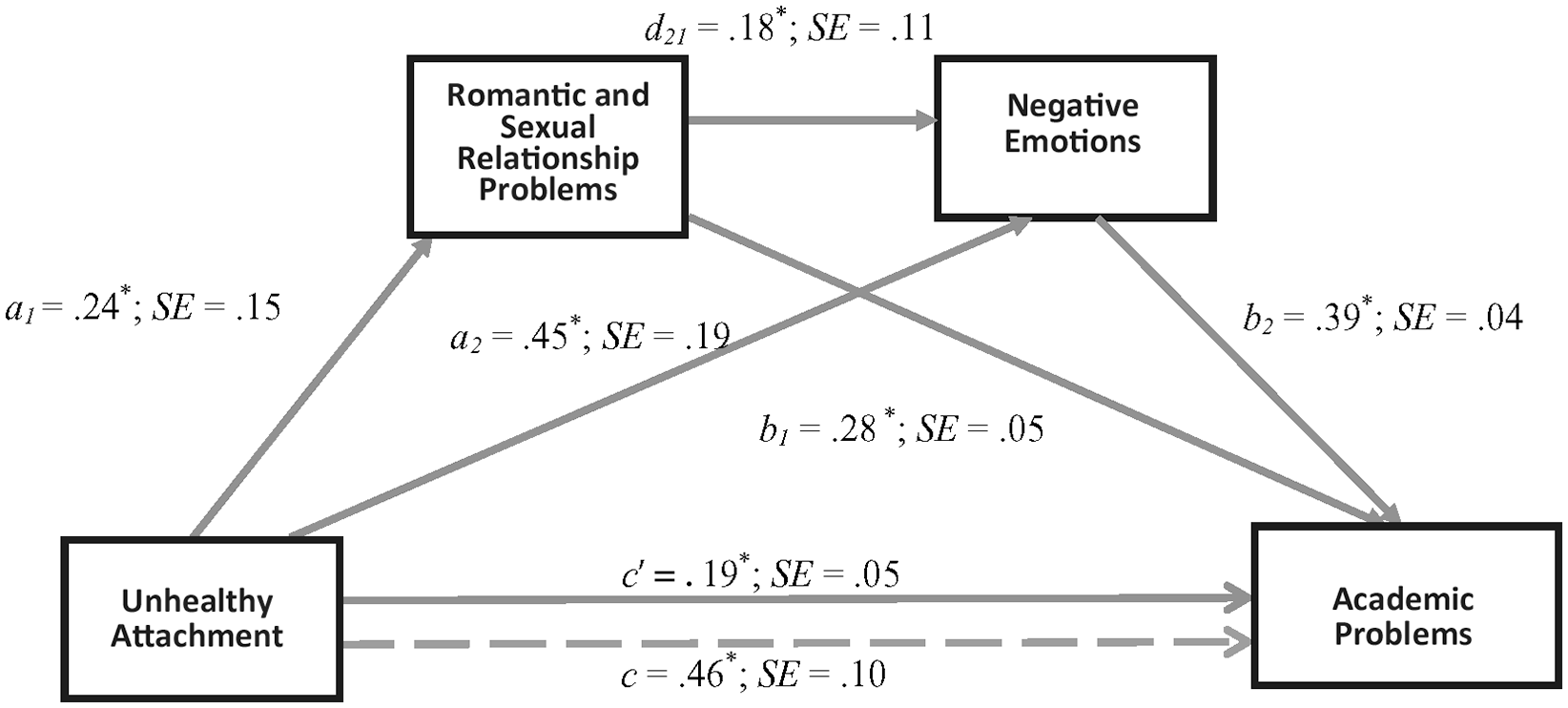
The dotted line denotes the effect of unhealthy attachment on academic problems when romantic relationships and negative emotions are not included as serial mediators.
Discussion
This study aimed to examine whether the relationship between unhealthy attachment and academic problems can be mediated by romantic and sexual relationship problems and negative emotions in student veterans with disabilities. Our results indicate that the relationship between unhealthy attachment and academic problems was partially mediated by romantic and sexual relationship problems and negative emotions in student veterans with disabilities. Our analysis provides novel counseling insights by clarifying the intermediary roles of both relationship problems and negative emotions between attachment style and academic problems for student veterans with disabilities. Similar associations were found between unhealthy attachment and relationship problems, negative emotions, and academic problems, respectively. The key finding of the analysis is that relationship problems and negative emotions mediate the initial association between unhealthy attachment and academic issues. This is valuable information because it highlights the potential for targeted counseling interventions to alleviate the negative effects of attachment style on academic performance by paying special attention to relationship issues and addressing negative emotions.
The value of this study is underscored by the dearth of research examining the complex relationships between attachment style, relationship issues, negative emotions, and academic problems. Although there is a lack of research examining the roles of relationship problems and negative emotions between unhealthy attachment styles and academic problems for student veterans, our findings consistently align with studies that examined attachment styles in other populations. Our findings corroborate studies that have found statistically negative correlations between psychiatric distress and academic performance for student veterans (Ness et al., 2015). Research indicates that in general Veterans may be at higher risk for mental illnesses such as depression, anxiety, PTSD, and others (Goff et al., 2007), in college, student veterans who experiencing adjustment difficulties had significantly higher rates of PTSD, depression, and other mental health issues than other student veterans who did not report having difficulties adjusting to (Schonfeld et al., 2015). These differing rates may be illuminated by attachment style and the effects of unhealthy attachment on behavior. For example, these student veterans, having difficulties adjusting to college, also have been shown to have lower treatment-seeking behaviors than their non-veteran peers (Bonar et al., 2015).
Additionally, student veterans may encounter added complexity in regard to their mental health, as their mental health symptoms might be markedly different from their civilian peers (Smith et al., 2017; Rumrill et al., 2023; Umucu, Lo et al., 2022; Umucu, Rumrill et al., 2022; Umucu, 2022; Umucu, Lee et al., 2023). For example, student veterans may experience more strain within their romantic and sexual relationships (Johnson et al., 2014) and have greater feelings of alienation from peers on campus (Elliott et al., 2011) and lower academic persistence (Grossbard et al., 2014; Weber, 2012). Each of these behaviors exemplifies existing research on unhealthy attachment.
Attachment styles have been studied in other populations and settings analogs to academic performance. For example, according to Little and colleagues (2011), insecurely attached individuals view relationships differently. Some of these individuals may avoid close relationships due to a belief that others will not provide adequate support during times of need. The resultant distress symptoms may include psychological ill-health due to attempts at suppressing negative thoughts, potentially leading to opposing views on exploration and diminished cognitive openness (Little et al., 2011; Mikulincer & Sheffi, 2000). People with an insecure attachment style may minimize emotional involvement and utilize limited cognitive and emotional resources to suppress negative emotions and displays of distress (Dewitte et al., 2019; Millings et al., 2019).
Regarding the mediating role of relationships between unhealthy attachment and academic problems, our findings are consistent with other research examining the links between attachment style and relationships as well as relationship issues and academic problems. Further research indicates that student veterans experience higher relationship problem-related levels than their civilian peers. Those relationship problems are characterized by more disagreements and lower overall satisfaction (Mikulincer & Shaver, 2007; Riggs et al., 2019). Insecure attachment is related to more problems in relationships than secure attachment (Riggs et al., 2019). Evidence suggests that student veterans with higher support from family and peers have better mental health and better academic outcomes (Borsari et al., 2017; Romero et al., 2015). Student veterans are at higher risk for more strained romantic relationships, exacerbating existing academic problems (Schmidt & Lockwood, 2017).
Implications for Counselors
Our study revealed that romantic and sexual relationship problems and negative emotions partially mediate the relationship between unhealthy attachment and academic problems. Our study results provide a valuable contribution to counseling literature because the negative effects of attachment style on academic performance may be mitigated by special attention to relationship issues and addressing negative emotions through targeted counseling interventions. This may assist student veterans with disabilities’ academic success rates by identifying and treating specific risk factors through counseling services.
An unhealthy attachment style may be remarkably adaptive in the military, given the common unfavorable reaction to displays of vulnerability. Our findings of unhealthy attachment seem to affect vigor toward academic performance among student veterans with disabilities. Unhealthy attachment may result in a reluctance to seek assistance, when necessary, a tendency to work in isolation, and a considerable amount of energy expended in suppressing negative emotions. When those individuals experience negative emotions, it leaves limited energy for cognitive pursuits. Besides, it is also imperative to highlight that previous research has documented that attachment style may negatively affect therapeutic alliance and bond between clients and counselors (Diener & Monroe, 2011). Counselors including rehabilitation counselors should pay attention to the attachment styles of student veterans with disabilities. A large body of literature has documented that attachment orientation may directly affect therapeutic relationships during counseling. This is especially important for student veterans with disabilities, given that they already have bias and stigma toward help-seeking due to their military-oriented culture (Umucu, 2021a). Therefore, rehabilitation counselors working with student veterans with disabilities should be emotionally available and provide a counseling climate that may establish rapport and strengthen therapeutic alliance.
Academic success and graduation are students’ ultimate goals in higher education. Our findings demonstrated that unhealthy attachment is linked to academic problems, and this relationship was mediated by romantic and sexual relationship problems and negative emotions. Counselors working in university counseling, disability centers, and VA may develop strategies to improve unhealthy attachment’s negative impact on romantic and sexual relationship problems and negative emotions in student veterans with disabilities through the lens of therapeutic alliance and relationships. Psychosocial counseling services may help student veterans with disabilities develop healthy relationships with their peers, partners, friends, and families, which may ultimately improve positive emotions and academic success in this population, given previous research (e.g., Mattanah et al., 2004; Rice et al., 1995; Terzi, 2013) reported that secure attachment is linked to a positive college, academic, and emotional adjustment in students.
Considering the negative impact of the recent pandemic on social relationships (Umucu & Lee, 2020; Umucu, 2021b; Umucu, Tansey et al., 2021; Umucu, Reyes et al., 2022), our findings suggest that targeted interventions based on attachment style may serve as a promising avenue for intervention in addressing the risk of social isolation and consequent poor academic performance among student veterans with disabilities. Insecurely attached student veterans may even be dismissive of interventions. Therefore, it is essential that counselors receive training in military culture. This study also highlights the significance of interpersonal relationship functioning for student veterans. Couple’s counseling for student veterans with disabilities may also help alleviate poor academic performance by contributing to better relationship adjustment and, therefore, better emotional adjustment.
Obtaining additional information about a person’s family of origin may be imperative in helping tease out the role of early attachment. Amiri and colleagues’ (2013) research indicates that attachment style may directly correlate with fear of failure, decision-making, coping style, and critical thinking and problem-solving ability. Research into attachment theory states that adverse experiences may strongly affect attachment style, even with secure familial attachment (Waters et al., 2005). Therefore, examining adverse events during service may also indicate shifts in attachment style.
Overall, rehabilitation counselors should be informed about the relationship between unhealthy attachment and academic problems. Institutions of higher learning, college campus counseling centers, disability centers, and VA for veterans with disabilities should use the information gathered by this study to improve student veterans’ educational outcomes and experiences.
Limitations
When interpreting the results of this study, it is important to consider its limitations, as they may impact the development or modification of interventions, as well as directions for further research. For one, our sample size is relatively small (n = 129) and drawn from only one institution from one state/region of the United States (southwest). Broader generalization of our results to the student veteran population beyond this specific region may be limited and should be done with caution. Another limitation is that responses were gathered via self-report means, which are always subject to social desirability. Participants may withhold, exaggerate, or minimize certain bits of information, particularly when being questioned on matters that are (still) often stigmatized by mental health and drug use.
Most importantly, our study is a cross-sectional correlational design study. Therefore, the causality of the relationships between predictor and outcome variables could not be verified. Future research could conduct a longitudinal research design to confirm our findings through the lens of causality. Finally, we measured romantic and sexual relationship problems among participants with a single item, which may be more susceptible to measurement error and lower reliability and validity. However, the single-item measure provided benefits in terms of reduced burden and costs, and ease of interpretation (Bowling, 2005).
Footnotes
Acknowledgements
We thank Dr. Deyu Pan for his comments.
Declaration of Conflicting Interests
The author(s) declared no potential conflicts of interest with respect to the research, authorship, and/or publication of this article.
Funding
This work was supported by the College of Health Sciences of the University of Texas at El Paso.
