




Abstract
Individuals with disabilities experience disproportionate rates of unemployment and underemployment when compared to individuals without disabilities. Furthermore, health functioning impacts career development and employment across multiple life contexts. To build on what is known regarding the relationships between functioning and career development, this study focuses on delineating how varying aspects of functioning differentially impact specific areas of career development. Based on data collected from 674 individuals with disabilities in the United States this study investigated the relationship between individual health functioning and the following three core components of career development: vocational identity, work personality, and work adjustment. Findings illuminate important differences across dimensions of functioning that impact career development. Results suggest that a multidimensional approach to career development would be most efficacious in supporting the functioning of individuals with disabilities.
Individuals with disabilities continue to represent an underutilized subpopulation within the labor market as this group experiences disproportionate rates of unemployment and underemployment compared with individuals without disabilities (Vornholt et al., 2018). The importance of work for individuals with disabilities is closely tied to health and well-being as participation in a well-fitting job promotes positive health outcomes (Blustein, 2008; Strauser, 2021). An area of research on the career development of people with disabilities is the interaction of health functioning and disability in the work environment. The International Classification of Functioning, Disability, and Health (ICF; World Health Organization, 2001) posits a multidimensional approach to understanding functioning which includes the interactions between health conditions and relevant contextual factors (Chan et al., 2019).
Work is considered an important and relevant contextual factor. Understanding the multidimensional nature of functioning as it relates to career development is critical for the provision of effective vocational rehabilitation services and necessary to improve rehabilitation outcomes (Strauser, 2021). Recent research suggests that these dynamic areas of functioning can impact employment in various ways. For example, one such study found differential impacts when comparing how emotional and physical functioning impacts job awareness, acquisition, and maintenance among a sample of young adult cancer survivors (Strauser et al., 2019). Such data provide initial support for the value of understanding the differential dimensions of functioning across core components of career development for targeting career inventions that promote high-quality employment potential for individuals with disabilities.
Research related to the career development of individuals with disabilities has identified three factors that are important for improving employment outcomes for people with disabilities (Dawis, 2005; Holland et al., 1980; Neff, 1985; Savickas, 1985). The first factor, a well-developed vocational identity, is conceptualized as an individual’s goals and interests related to work, contributing to increased confidence, better decision making, and increased ability to manage environmental factors that impact career development (Holland et al., 1980). Work personality is a second factor that has been found to be related to effective work behavior and employment outcomes for individuals with disabilities (Strauser et al., 1999). Seminal research conducted by Neff suggests that work personality is a combination of the internalized values related to work and the externalized behaviors that manifest in the work environment (Neff, 1985). Developing in early childhood, work personality consists of motivation, self-concept, and needs related to work behaviors. Hershenson (1996) expanded the concept of work personality by suggesting that work personality impacts work adjustment and the adaptation to work environments for young adults and individuals involved with major life transitions such as the acquisition of a disability.
The third factor related to career development is work adjustment. Work adjustment can be conceptualized as the ability of an individual to adjust and adapt to the changing work environment. Work adjustment contributes to job maintenance and stability over time and serves as an important construct for individual career development (Strauser, Greco, et al., 2021). Similar to work personality, work adjustment focuses on how individuals establish and sustain congruence between the work environment and themselves (Dawis, 2005). Improving physical tolerance and focusing on psychological factors such as self-confidence, self-control, social skills, and confidence in one’s ability to meet the demands of the changing work environment comprise the focus of work adjustment (Hershenson, 1996).
The Illinois Work and Well-Being Model (IW2M) model has been used to operationalize how individual, environmental, and functioning factors relate to the career development of people with disabilities and chronic health conditions. Specifically, the IW2M emphasizes the complex interaction of personal and environmental factors and functional limitations or capacities that impact career development and overall participation in society (Strauser et al., 2018). Within the model, the definition of disability incorporates an individual’s functional capacities and limitations by proposing a bidirectional relationship between functioning, career development, and overall societal participation. Instead of focusing on establishing a specific disability diagnosis, the IW2M encourages measuring the complex and multidimensional nature of functioning and the impact of disability across varying functional areas. A comprehensive discussion of the IW2M and the application of the framework to career development and work can be found at Strauser and Greco (2019).
In this study, we used the Illinois Brief Functioning Inventory (IBFI), a self-report measure of functioning which incorporates an individual’s perception of themselves across areas of physical, psychosomatic, cognitive, coping, and social functioning (Strauser, Shen, et al., 2021). The current study sought to gain a better understanding of individual functioning in relation to career development constructs that have been shown to impact employment outcomes. Therefore, the purpose of the present study was to investigate how different aspects of functioning impact the following three dimensions of career development: vocational identity, work personality, and work adjustment. The following research questions guided this study:
Method
Procedures
Human participants research approval for this study was obtained from the university’s Institutional Review Board. Participants were recruited using a combination of crowdsourcing data collection tools Amazon Mechanical Turk (MTurk) and TurkPrime. MTurk is used by thousands of researchers to obtain study participants while TurkPrime provides a more user-friendly interface and additional options for data collection (see Litman et al., 2017; Sheehan, 2018 for a description of these tools). After obtaining consent, participants were administered an online survey via Qualtrics. Participants who completed the survey received a $15.00 incentive payment. Participants were informed that their participation was voluntary, that they were free to withdraw at any time, and would receive a small honorarium for completing the survey.
Participants
The sample for this study consisted of 674 U.S. adults with a disability or chronic health condition. Participants identified as having a wide range of disability types across several categories, including physical, neurological, psychiatric/mental health, cognitive, deaf/hard of hearing, and vision impairment/blind. The majority of our sample indicated living with at least one physical disability (70%) and a psychiatric/mental health disability (60%). The participants ranged from 20 to 77 years of age, with the mean age of the participants being 43.25 years. Participant demographic characteristics are shown in Table 1.
Participant Demographic Characteristics (N = 674).
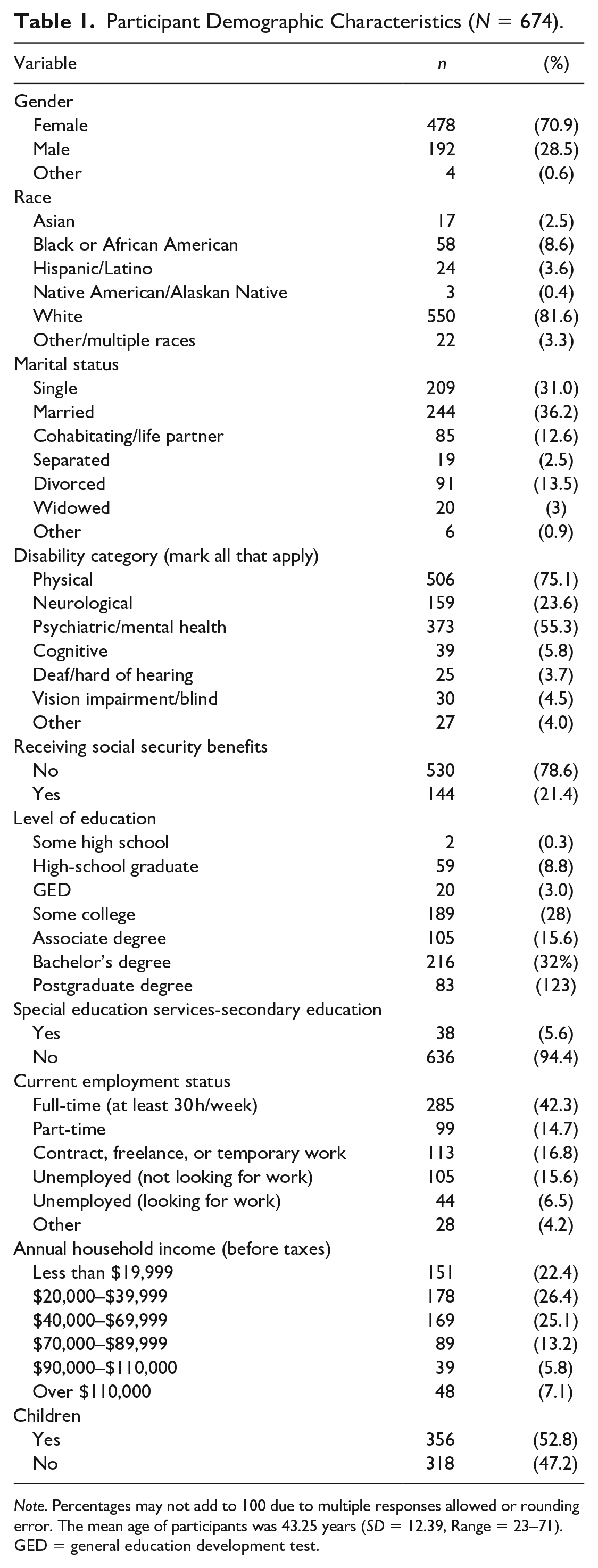
Note. Percentages may not add to 100 due to multiple responses allowed or rounding error. The mean age of participants was 43.25 years (SD = 12.39, Range = 23–71).
GED = general education development test.
Instruments
Illinois Brief Functioning Inventory
The IBFI is a 26-item brief measure designed to gather data related to functional limitations across five areas: physical/pain, psychosomatic, cognitive, negative coping, and social isolation (Strauser, Shen, et al., 2021). The IBFI measure was developed to identify levels of physical, emotional, and cognitive functioning across dimensions of both severity and intensity. Participants provided self-report evaluations of symptom on their ability to work in each of the five subscales. A 6-point Likert-type scale is used to obtain reported experiences of both severity and frequency on items such as “Do you experience problems standing/walking?” and “Do you experience difficulty focusing/concentrating.” Cronbach’s α levels obtained for each of the five subscales with this sample were as follows: Physical (0.85), Psychosomatic (0.91), Cognitive (0.85), Negative Coping (0.69), and Social Isolation (0.81).
My Vocational Situation
The My Vocational Situation (MVS) is a brief, self-administered, hand-scored instrument that Holland et al. (1980) designed for use in career planning by a wide group of individuals. The MVS may be administered individually or in a group setting and can be completed and scored in less than 10 min. The measure is composed of 26 questions total, 18 in the Vocational Identity subscale, 4 in the Information subscale, and 4 in the Barriers subscale. The 18-item subscale measuring vocational identity was utilized for this study as the 8 other questions are not specifically related to vocational identity. The MVS defines vocational identity as possessing a clear and stable understanding of one’s career goals, interests, personality, and talents. Vocational identity is operationalized through true/false questions such as “The jobs I can do may not pay enough to live the kind of life I want.” Holland et al. (1980) reported internal consistency reliability coefficients ranging from .86 to .89 for the vocational identity scale. The internal consistency reliability coefficient of the vocational identity scale in this study was 0.91.
Revised Developmental Work Personality Scale
The Revised Developmental Work Personality Scale (RDWPS) is designed to address the tasks and events that individuals encounter during the formative years of schooling that are critical in shaping the development of their work personalities. Revised Developmental Work Personality Scale scores are useful in predicting the resolution of Erikson’s fourth stage of development, Industry versus Inferiority (Erikson, 1959; Wong et al., 2012). The 14-item measure includes the following three conceptual areas: work tasks, role model, and social skills. A total scale score measuring levels of work personality was used for this study. Participants were asked to rate themselves on a scale from 0 to 5 regarding how much a behavior was like them in childhood on items such as “In school I completed my work on time.” Previous research has provided evidence of construct validity, convergent validity, and reliability for the RDWPS (Wong et al., 2012). The internal consistency reliability coefficient for the RDWPS in this study was 0.61.
Illinois Work Adjustment Scale
The Illinois Work Adjustment Scale (IWAS; Strauser, Greco, et al., 2021) was developed as a theoretically based instrument that measures self-efficacy regarding the core elements of work adjustment. Using the MTWA (Dawis, 2005) and Hershenson’s Model of Work Adjustment (1996) an 18-item scale measuring work capacity and work context was developed. A 10-point Likert-type scale was established as the rating scale for the IWAS items [(0–9) with 0 being “not confident” and 9 being “extremely confident”]. The 10-point rating scale was developed based on Bandura’s (1977) recommended scale rating for measures of self-efficacy. The total score measuring levels of work adjustment was used in this study. Cronbach’s alpha for the IWAS in this study was found to be 0.95.
Data Analysis
As shown in Table 2, the bivariate relationships between functioning as measured by the five IBFI subscales and career development as measured by the MVS, RDWPS, and IWAS were calculated by Pearson product-moment correlation coefficients. A general linear modeling with a backwards elimination method was used to examine the effect of the IBFI subscales on each career development factor. Backward elimination began with the full model with all five IBFI subscales, and at each step the subscale that showed the smallest contribution to the model was dropped. The sequence of effects in the model was determined using Schwarz Bayesian Information Criterion (SBIC). In this approach, stepwise selection continues until adding or dropping any effect increases the SBIC statistic. The model with the lowest SBIC is preferred.
Pearson Correlation Coefficients Between Variables.
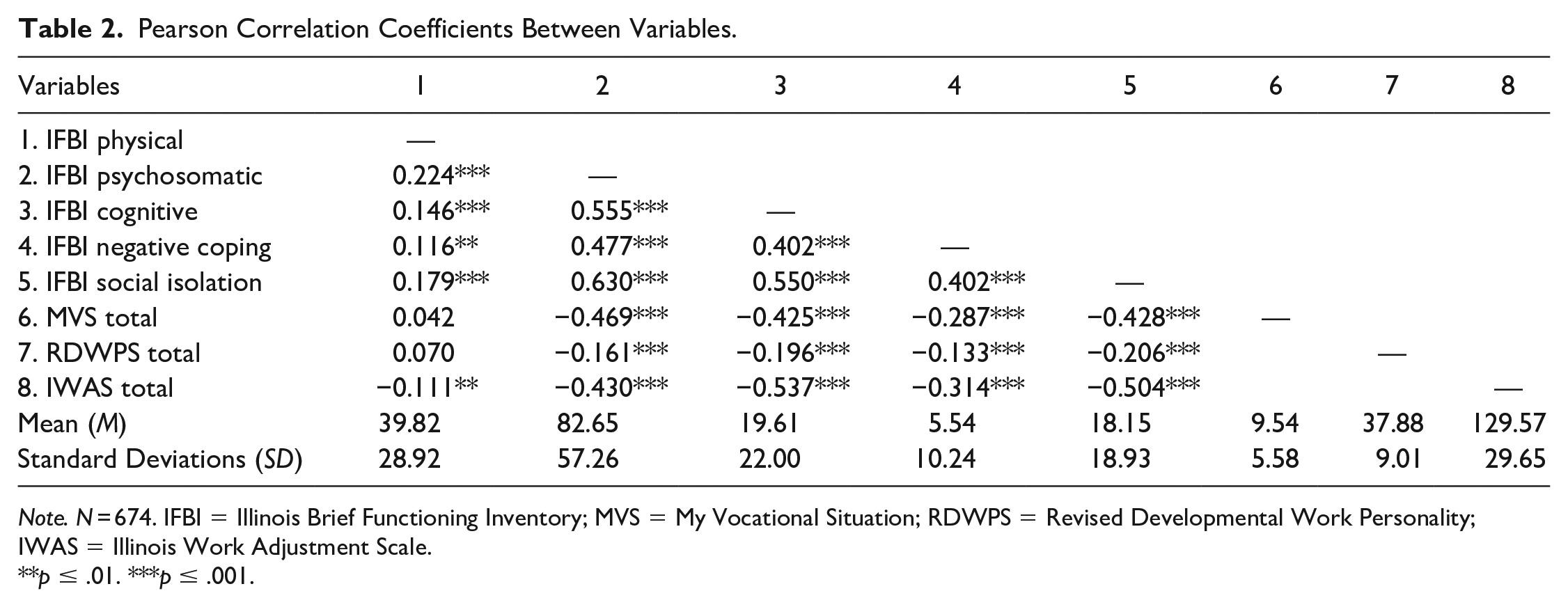
Note. N = 674. IFBI = Illinois Brief Functioning Inventory; MVS = My Vocational Situation; RDWPS = Revised Developmental Work Personality; IWAS = Illinois Work Adjustment Scale.
p ≤ .01. ***p ≤ .001.
Results
RQ1
An overall regression model of vocational identity using the MVS was regressed on the five IBFI subscales (Table 3). The overall model was significant, F(5, 668) = 56.97, p < .001, demonstrating that functioning predicted vocational identity in the current sample. Using backwards stepwise regression to obtain the lowest SBIC value, the final model indicated that physical symptoms (t = 5.00, p ≤ .001), psychosomatic symptoms (t = −6.59, p < .001), cognitive symptoms (t = −4.80, p = .001), and social isolation symptoms (t = −3.74, p ≤ .001) were all significant individual predictors and in total accounted for 29.4% of the variance in vocational identity.
Backwards Regression Analyses Predicting Vocational Identity with My Vocational Situation (MVS).
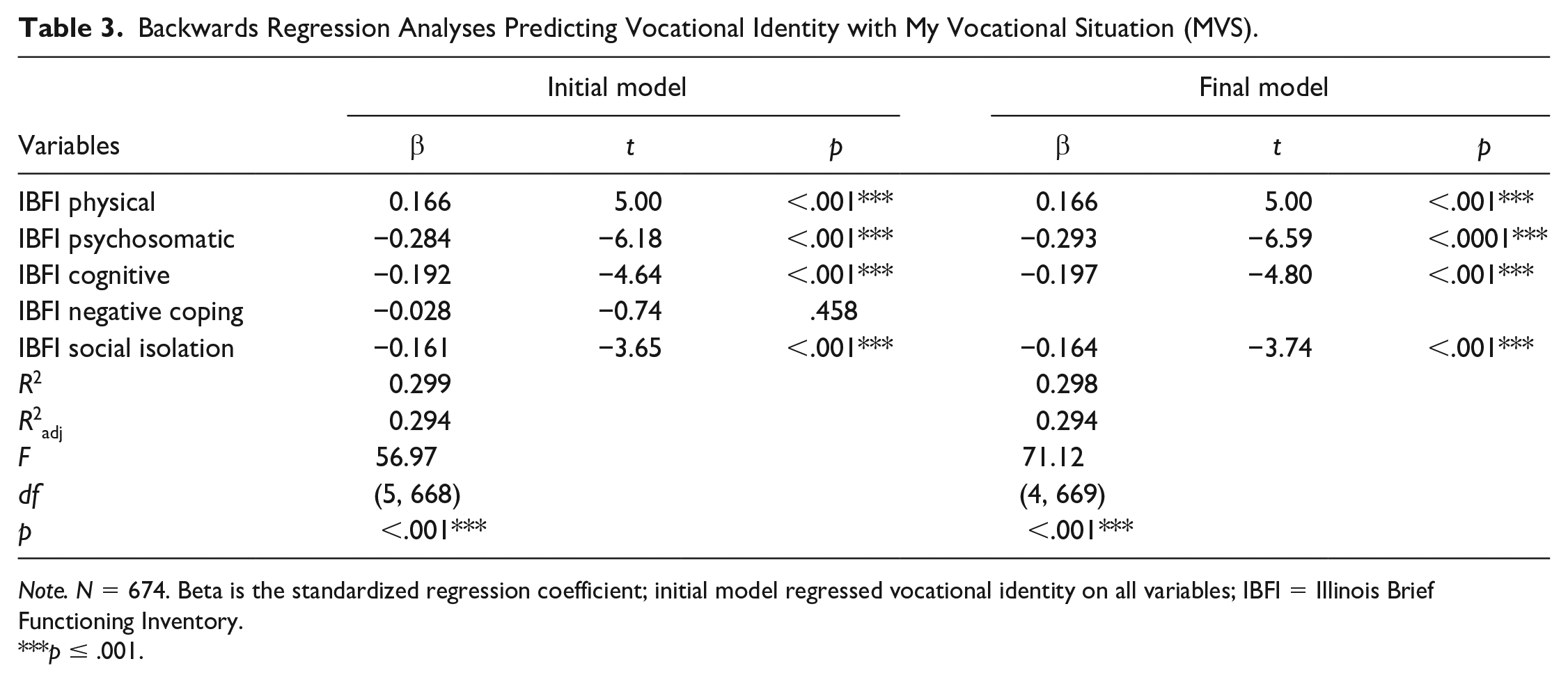
Note. N = 674. Beta is the standardized regression coefficient; initial model regressed vocational identity on all variables; IBFI = Illinois Brief Functioning Inventory.
p ≤ .001.
RQ2
An overall regression model of work personality as measured by the RDWPS was regressed on the five IBFI subscales (Table 4). The overall model was significant, F(5, 668) = 9.57, p ≤ .001, demonstrating that functioning predicted work personality in the present sample. Using backwards stepwise regression to obtain the lowest SBIC value, the final model indicated that physical symptoms (t = 3.06, p = .002), cognitive symptoms (t = −2.83, p = .004), and social isolation symptoms (t = −3.48, p < .001) were all significant individual predictors and in total accounted for 6% of the variance in work personality.
Backwards Regression Analyses Predicting Work Personality with Revised Developmental Work Personality Scale (RDWPS).
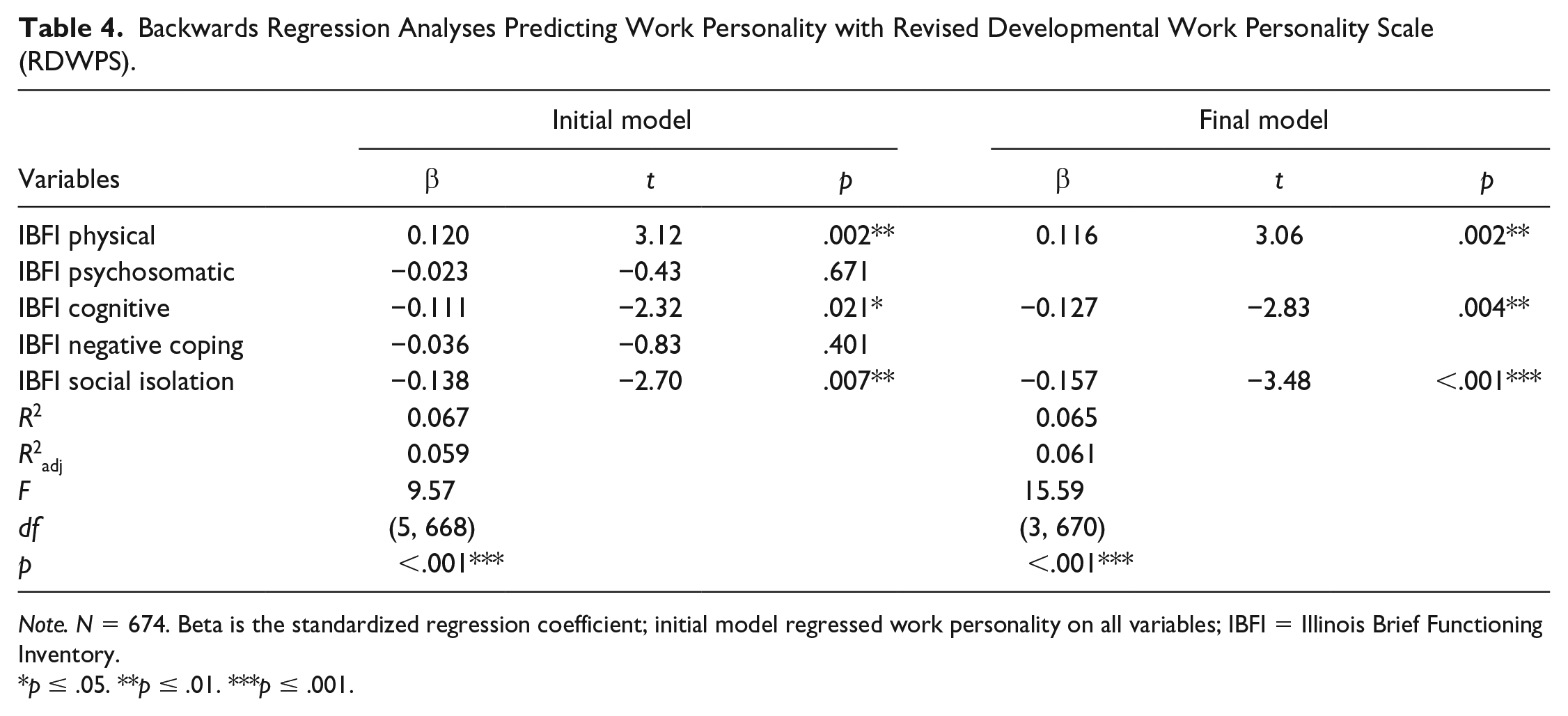
Note. N = 674. Beta is the standardized regression coefficient; initial model regressed work personality on all variables; IBFI = Illinois Brief Functioning Inventory.
p ≤ .05. **p ≤ .01. ***p ≤ .001.
RQ3
An overall regression model of work adjustment (IWAS) was regressed on the five IBFI subscales (Table 5). The overall model was significant, F(5, 668) = 73.16, p < .001, demonstrating that functioning predicted work adjustment in the current sample. Using backwards stepwise regression to obtain the lowest SBIC value, the final model indicated that cognitive symptoms (t = −9.98, p < .001) and social isolation symptoms (t = −8.01, p < .001) were significant individual predictors that accounted for 34.8% of the variance in work adjustment.
Backwards Regression Analyses Predicting Work Adjustment with Illinois Work Adjustment Scale (IWAS).
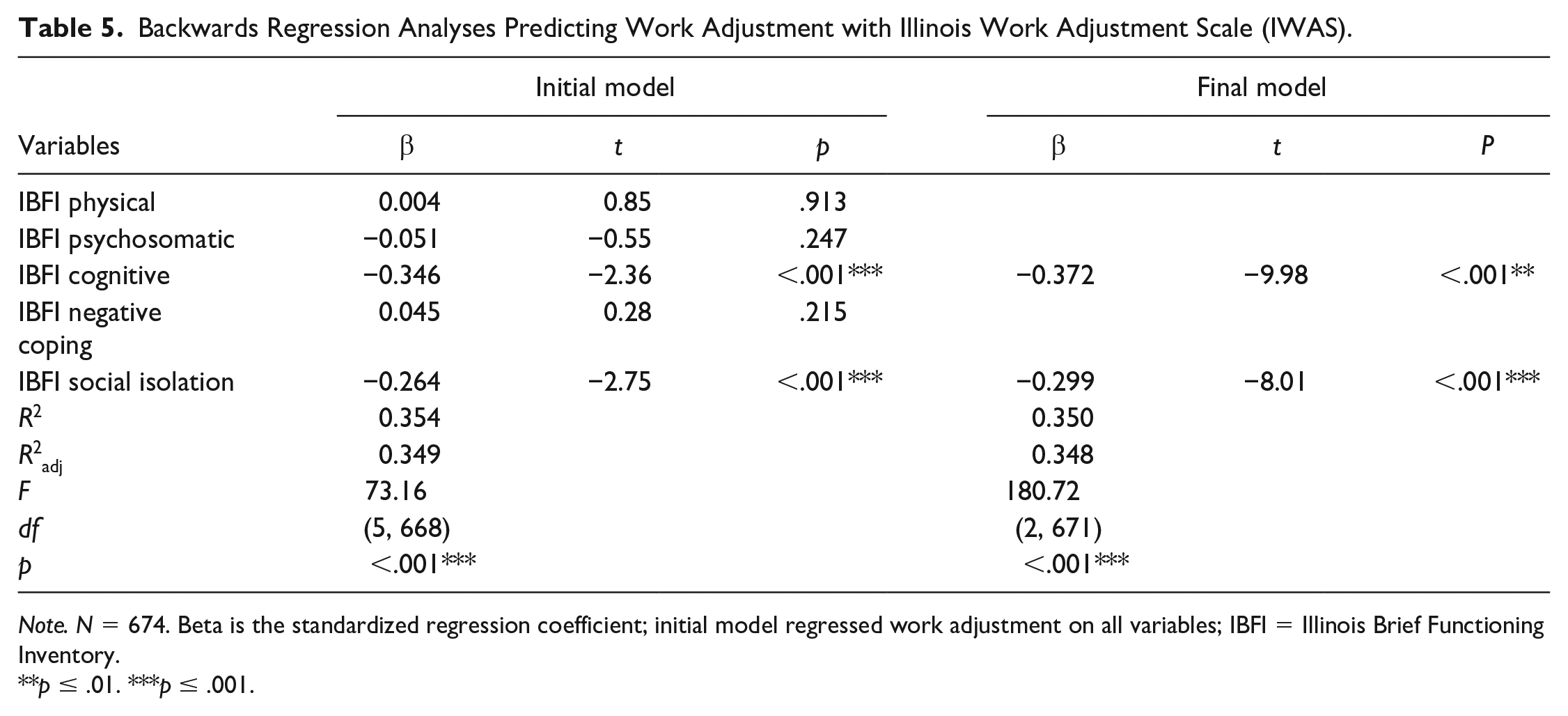
Note. N = 674. Beta is the standardized regression coefficient; initial model regressed work adjustment on all variables; IBFI = Illinois Brief Functioning Inventory.
p ≤ .01. ***p ≤ .001.
Discussion
The purpose of this study was to investigate how different aspects of functioning impact the following three dimensions of career development: vocational identity, work personality, and work adjustment. Results provide new knowledge and empirical support for how a person with a disability’s functioning can impact the career development areas of vocational identity development, work personality, and work adjustment. The findings in the current study are consistent with previous research that has found that functioning, and in particular emotional functioning, has a significant impact on the career development of persons with disabilities (Strauser et al., 2019). However, by applying a multidimensional conceptualization of functioning, data from this study provide additional information regarding the impact of functioning on career development and help inform intervention development and service provision. The current findings also provide additional support for the Illinois Work and Well-Being Model as a framework useful for guiding career interventions with individuals with disabilities. Findings related to each research question are discussed below.
Regarding the first research question, findings indicated that an individual’s overall functioning accounts for 29.4% of the variance of vocational identity with physical, psychosomatic, cognitive, and social isolation making individual unique contributions. Psychosomatic functioning, which is conceptualized as a combination of emotional and physical symptoms, was found to significantly impact vocational identity. Finding that social isolation symptoms impacted vocational identity further broadens the conceptualization of how functioning impacts vocational identity by suggesting that being isolated or having difficulty getting along with other individuals negatively impacts identity development. Such a hypothesis is consistent with findings in the broader psychological literature that suggest that developing meaningful relationships with others is important to one’s overall development and well-being (Chronister et al., 2008; Cohen, 2004). Such data provide evidence that social interactions may be an important factor contributing to how individuals perceive themselves in relation to work. The impact of cognition on vocational identity is consistent with previous career development research that has consistently found that career development is cognitively mediated (Sampson et al., 2004). One interesting finding in the current study related to vocational identity and functioning was that increased levels of physical symptoms were significantly related to higher levels of vocational identity. Such a positive relationship could be due to an individual’s understanding of their physical functioning in the context of work which may enhance identity development. Future research regarding the specific relationship between physical functioning and identity is warranted.
For the second research question, functioning was found to predict work personality, with the final model highlighting areas of physical, cognitive, and social isolation functioning as predictors accounting for a significant portion of the variance in work personality. Study findings indicate that more significant cognitive functioning difficulties were related to lower levels of work personality. Cognition is implicated in a variety of chronic health and disabling conditions and has been found to significantly limit career development and vocational outcomes (Sampson et al., 2004). Diminished cognitive functioning may impede an individual from recognizing subtle cues and stimuli within the workplace that facilitate both positive work personality development and expression. In addition, increased levels of social isolation were related to lower levels of work personality. This finding is consistent with the theoretical foundation of work personality which suggests that work personality is developed through the interaction with the broader environment, including other individuals in educational, work, family, and personal contexts (Strauser et al., 1999; Strauser et al., 2013). The finding that increased levels of physical symptoms were significantly related to higher levels of work personality was surprising. Like vocational identity, having a clear conceptualization of one’s physical functioning may provide the individual with needed clarity regarding functioning, allowing the individual to engage in activities that promote work personality development.
Finally, the results pertaining to the third research question suggest a strong negative relationship between functioning and work adjustment, with higher symptoms of cognitive impairments and social isolation accounting for 34.8% of the variance in work adjustment. The relationship between cognition, social isolation, and work adjustment is theoretically consistent with models of work adjustment which emphasize the need to accurately process information to maintain congruence with the work environment. In addition, positive work adjustment requires effective management of the social and contextual factors within the work environment. Therefore, the finding that higher levels of social isolation are negatively related to lower levels of work adjustment is theoretically consistent and reinforces the social role in the work environment. Specifically, individuals who report difficulty socializing with others, getting along with others, and being cut off from social interactions will likely experience problems with accepting supervision, getting along with co-workers, and picking up on the social and contextual cues necessary to effectively adjust to a dynamic work environment.
Implications
The findings in this study provide important implications for career interventions aimed at enhancing employment outcomes for individuals with disabilities. First, results suggest that it is important for practitioners to take a multidimensional approach to career development by addressing multiple areas of individual functioning. By using current health status and residual functional capacity as a basis to inform targeted interventions, career practitioners will be better prepared to promote positive career development outcomes. For example, when focusing on vocational identity development, strategies that focus on improving psychological well-being can address issues related to psychosomatic functioning. Furthermore, group career activities and community-based job exploration would address issues related to social isolation. To address issues related to cognition, structuring interventions that are consistent with an individual’s cognitive capacity and using appropriate cognitive supports and accommodations can help facilitate increased participation and self-determination, both critical to positive career outcomes.
Second, study data indicated that social isolation was implicated across all three career variables. This finding provides support for career interventions that stress work-related social skill development. Poor workplace social skills have long been identified as a factor negatively impacting work adjustment and employment maintenance (Strauser, 2021). Findings in this study suggest that workplace social skills training should be incorporated through the career counseling process and that activities that simulate workplace social interactions may be especially beneficial. Utilizing group career approaches may also be helpful because groups inherently provide an opportunity to interact with others and allow individuals to receive timely feedback that promotes social correction and appropriate social skill development.
Although a surprising finding, higher levels of physical symptoms were associated with a more positive vocational identity and work personality. Such data suggest that career interventions that help individuals identify and operationalize their residual functional capacity could be important for enhancing career outcomes. Increased awareness regarding physical functioning capacities in the workplace may promote a clearer understanding of an individuals’ fit within the work environment. As such, supporting individuals to achieve better clarity regarding their own physical functioning capacity may enable them to more fully engage in career development activities.
Findings in this study reiterate the importance of understanding an individual’s health and functioning beyond disability diagnosis. To best serve individuals with disabilities and chronic health conditions, it is critical to seek to understand all aspects of functioning that may be impacting the career development process. The Illinois Work and Well-Being Model provides a framework for disability and rehabilitation practitioners to use to help conceptualize factors impacting career development. Additional research is needed that examines the longitudinal impact of health and functioning across vocational identity, work personality, and work adjustment.
Limitations
The results of this study should be interpreted in the context of multiple limitations. First, a large majority of the study participants identified as white and, as a result, the sample lacked racial and ethnic diversity. Such an outcome may also reflect a selection bias limitation with the MTurk participant recruitment pool. Second, data collection was completed using a cross-sectional self-report method thus limited the ability of the data to provide a comprehensive understanding of participant functioning and career life contexts. Finally, given its reading level requirement to provide self-report evaluations of functioning, the use of the IBFI in this study may have prevented participation by some individuals with disabilities.
Conclusion
The purpose of this study was to investigate how different aspects of functioning among a sample of individuals with disabilities impact the following three dimensions of career development: vocational identity, work personality, and work adjustment. Study results provide practical data useful for career interventions for individuals with disabilities. Grounded in the International Classification of Functioning and career development research, the Illinois Work and Well-Being framework is uniquely situated to guide career research and practice. By shifting the focus from disability diagnosis and clinical presence of a health condition to individual perceptions of functioning, career interventions will address the multiple contextual factors that impact the career development and vocational rehabilitation process for individuals with disabilities and chronic health conditions.
Footnotes
Declaration of Conflicting Interests
The author(s) declared no potential conflicts of interest with respect to the research, authorship, and/or publication of this article.
Funding
The author(s) disclosed receipt of the following financial support for the research, authorship, and/or publication of this article: This study was developed with support from the Vocational Rehabilitation Technical Assistance Center for Targeted Communities (VRTAC-TC or Project E3) at the Department of Rehabilitation and Disability Studies, Southern University, Baton Rouge, LA funded by the U.S. Department of Education, Rehabilitation Services Administration (grant no. H264F15003) and from Vocational Rehabilitation Technical Assistance Center for Quality Employment, U.S. Department of Education (H264K200003). The ideas, opinions, and conclusions expressed, however, are those of the authors and do not represent recommendations, endorsements, or policies of the U.S. Department of Education.
