




Abstract
The Black Lives Matter movement exposed the broad and deep issues of institutional racism in the United States. Helping young African Americans with disabilities persevere in their pursuit of college degrees and obtain entry-level professional jobs as career pathways to the middle class will contribute to workplace equity for young adults who are at the intersection of race, disability, and poverty. The Social Cognitive Career Theory (SCCT) has been validated extensively as a model of goal persistence for women and minority college students majoring in science, technology, engineering, mathematics, and medicine (STEMM). The present study evaluated SCCT constructs as predictors of goal persistence in a sample of African American college students with disabilities across various academic majors, using hierarchical regression analysis. The final model accounted for 53% of the variance in goal persistence scores, a large effect size. Academic milestone self-efficacy and career self-efficacy were the most important predictors of goal persistence, followed by academic barrier self-efficacy, deep learning style, and career outcome expectancy. The SCCT interventions designed to increase academic and career efficacy and outcome expectancy will increase the likelihood that African American college students with disabilities will complete their degrees and successfully obtain professional jobs.
Keywords
The Black Lives Matter movement has exposed the broad and deep issues of institutional racism in the United States (American Psychological Association, 2021; Guynn, 2021; Umoh, 2020; Valderrama, 2020). Systemic discrimination against African Americans pervades every aspect of American society, including governments, health care, education, and the workplace (Goodman et al., 2019; Harvard Graduate Council, 2020; Lancet, 2020; Roepe, 2021; The White House, 2021; Walsh, 2020). As evidence of its responsibility to social causes, many business organizations have boosted their recruitment from Historically Black Colleges and Universities (HBCUs) to build the talent pipeline for people of color (Brown & Williams, 2021).
Research has indicated that helping young African Americans with disabilities pursue and complete a college degree significantly improves their opportunities to find gainful employment. However, the 6-year college success rate of African American students (44.7%) is significantly lower than the 65.9 success rate of White students (Nicols & Anthony, 2020). It is not sufficient for state vocational rehabilitation counselors to provide tuition support for African American youth with disabilities to attend college. Many African American youth are first-generation college students who come from low-income families (Hughes et al., 2007; Owens et al., 2010), which may affect their academic self-efficacy, outcome expectancy, and goal persistence (Cardoso et al., 2013; Dutta et al., 2019). Rehabilitation counselors must cooperate with other disability service and minority service providers in college to offer disability support, academic support, career development and job placement services, and psychological counseling to help African American students with disabilities cope with the challenges and stressors associated with transition from high school to college life, persist in completing their degrees, and find and obtain successful employment in their chosen professions. Helping young African Americans with disabilities find and maintain gainful employment will reduce ableism and racism in the workplace.
College and university training has a significant impact on lifetime earnings. Lifetime earnings for people with bachelor’s degrees far exceed those with a high school diploma or less. The estimated median lifetime earnings (in 2017 dollars) for college graduates at age 64 was more than US$1.2 million, whereas high school graduates earned about US$800,000 (Bauer-Wolf, 2020). For people with disabilities, higher levels of education significantly increase their job prospects and earnings (Chan et al., 2020; O’Neill et al., 2015). O’Neill et al. (2015) conducted a case-control observational study using the U.S. Department of Education’s Rehabilitation Services Administration Case Report (RSA-911) data to evaluate the effect of college and university training on earnings among people with disabilities closed as successfully rehabilitated by state vocational rehabilitation agencies. They reported significant differences in weekly earnings between clients who received college and university training and clients without college and university training. Chan et al. (2020) conducted a similar study using propensity score matching analysis to examine the effect of postsecondary education on employment outcomes and quality of employment of young adults with traumatic brain injuries (TBIs). They found that young adults with TBI who received college and university training as a vocational rehabilitation intervention have better employment and earning outcomes than young adults with TBI who did not receive college and university training.
With an increased shift to remote/hybrid workplaces and companies expanding their talent pipelines to involve more African Americans and other marginalized groups, including people with disabilities (Microsoft, 2021), this is a golden opportunity for counselors in state vocational rehabilitation agencies to expand their employer engagement efforts to connect with employers to create good entry-level professional job opportunities for young adult African Americans with disabilities. There is strong empirical evidence to support the utility of Social Cognitive Career Theory (SCCT) as a model of goal persistence for women and minority students majoring in science, technology, engineering, mathematics, and medicine (STEMM; Byars-Winston et al., 2010; Cardoso et al., 2013; Lent et al., 2003, 2005). However, there is no study in the extant literature that focuses on validating the SCCT as a model of goal persistence for African American college students with disabilities in other majors. In the present study, we were interested in evaluating SCCT constructs as predictors of goal persistence in a sample of African American college students with disabilities. Findings of this study provide valuable information to inform the development and validation of SCCT-based goal persistence and career development interventions for African American college students with disabilities.
The Social Cognitive Career Theory
The SCCT is an extension and refinement of Albert Bandura’s (1986) social cognitive theory. It emphasizes the assumption that contextual (e.g., social support), person (e.g., self-efficacy), and behavior (e.g., goal setting) can shape career and educational development across the life span (Lent & Brown, 2019). Person, contextual, and experiential factors are postulated to work together to influence students’ academic self-efficacy, outcome expectancy, career interests, choice of goals and actions, and performance outcomes. Bandura proposed that four sources of background learning experiences (performance accomplishments, vicarious learning, social persuasion, and physiological arousal) lead to the development of self-efficacy for a given behavior (e.g., academic self-efficacy). Self-efficacy, in turn, influences outcome expectations (e.g., goal persistence). Outcome expectations are the consequences that people anticipate experiencing when they perform a certain behavior or domain of behaviors. Self-efficacy and outcome expectations shape career and academic interest. Career interests are behavioral intentions to act in ways that elicit desired goals (Thompson et al., 2017). Social support can buffer the effects of barriers and bolster outcome expectations, interests, and goal persistence (Lent & Brown, 2019). SCCT has been validated extensively as a career development model to encourage young women, racial-ethnic minority young adults, and youth with disabilities to pursue education, training, and careers in the science, technology, engineering, mathematics, and medicine (STEMM) fields (Byars-Winston et al., 2010; Cardoso et al., 2013; Dutta et al., 2019; Fouad & Kantamneni, 2013; Hackett & Byars, 1996; Lent et al., 2005, 2008; Sheu et al., 2016).
Lent et al. (2005) evaluated SCCT predictors of engineering interests and goals in a sample of women and men students at historically Black and predominantly White universities. Findings indicated that there were no differences between men and women in academic self-efficacy, outcome expectations, interests, social support, social barriers, and goal persistence. The SCCT-based path model of interests and choice goals produced good fit to the data across gender and university type. In another study, Lent and colleagues (2008) examined the temporal relations among constructs in the SCCT career choice model in a sample of Black engineering students and found that self-efficacy assessed at Time 1 yielded significant lagged paths to outcome expectations, interests, and goal persistence measured at Time 2. Their findings support the hypothesized role of self-efficacy as a precursor of outcome expectations, interests, and goals for both European American and African American engineering students. Cardoso et al. (2013) used the SCCT framework to investigate the associations between (a) STEMM self-efficacy, outcome expectancy, interests, and social supports and (b) barriers to STEMM educational goals in college students with disabilities from racial minority backgrounds. They found that academic self-efficacy and STEMM interest were significant predictors of goal persistence. Dutta et al. (2019) tested academic milestone self-efficacy, academic barriers coping self-efficacy, and outcome expectancy as mediators of the relationship between deep learning and goal persistence in a sample of African American college students with disabilities. Findings of their study indicated that SCCT variables significantly mediated the relationship between deep learning and goal persistence (see Figure 1). According to Bain (2012), students who are engaging and who learn material motivated by a deep interest and a sincere desire to learn are more successful in college, employment, and life.
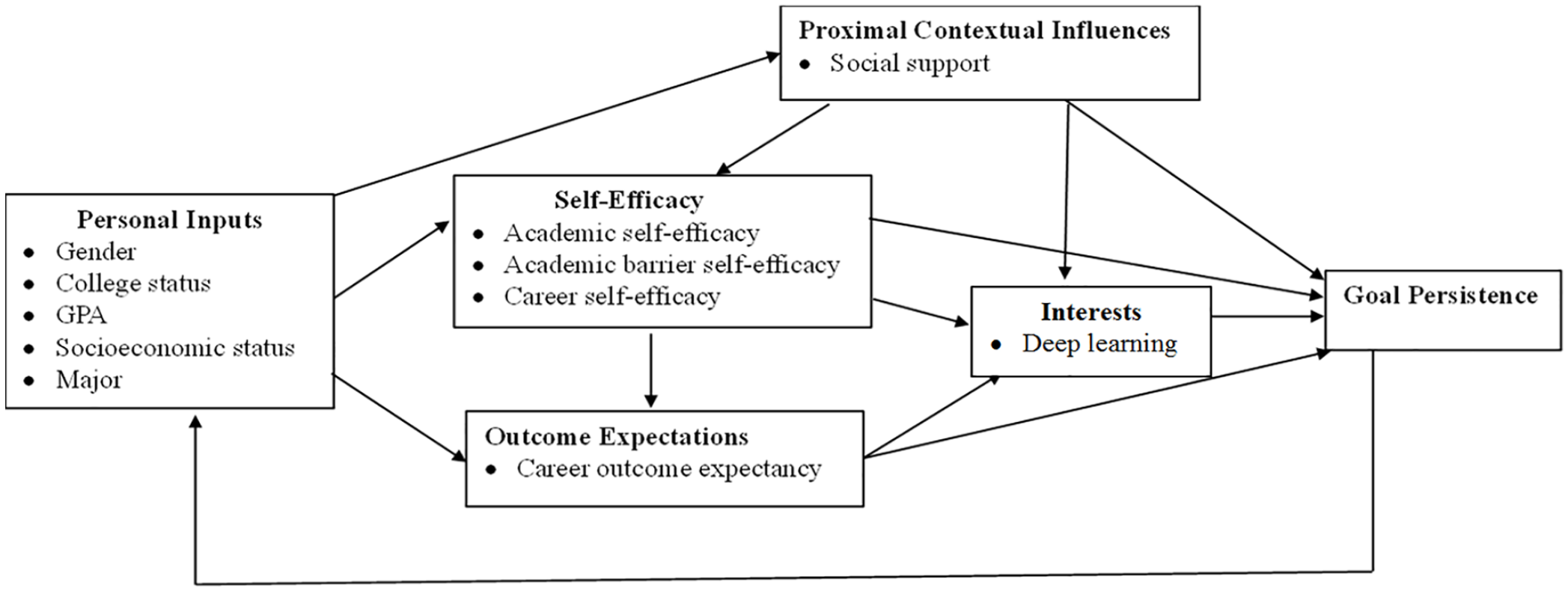
The Social Cognitive Career Theory (SCCT) framework for goal persistence.
Purpose of the Study
The purpose of this study was to examine SCCT constructs as predictors of goal persistence in a sample of African American college students with disabilities. The following two-part research question was investigated:
Method
Participants
Three hundred eighty (380) African American college students with disabilities participated in the present study. Participants were recruited from a historically Black college/university (HBCU) in a Southern U.S. state. Student participants consisted of 118 (31.1%) males and 262 (68.9%) females. Two hundred fifty participants (65.8%) were freshmen, 90 (23.7%) were sophomores, 27 (7.1%) were juniors, and 13 (3.4%) were seniors. One hundred eighty students (47.4%) were STEMM majors and 200 (52.6%) were non-STEMM majors. About half of the participants’ grade point averages were reported between the range of 2.00 and 2.99 (n = 205, 53.9%), 125 (32.9%) were between the range of 3.00 and 3.99, 19 (5%) were between the range of 1.00 and 1.99, and 10 (2.6%) had 4.0 grade point average (GPA). Seventy students (18.4%) reported receiving Supplemental Security Income (SSI) or Social Security Disability Insurance (SSDI), either at the time of the study or when they were children. In addition, 50 students (13.2%) indicated that they had received special education in high school, 17 (4.5%) received university disability services, and 11 (2.9%) received vocational rehabilitation services. Disability status of the students was determined by the six-question disability measure in the U.S. Census Bureau’s Current Population Survey (CPS). The CPS disability measure has been used by the U.S. Bureau of Labor Statistics to compute the employment-to-population ratio, the unemployment rate, and the labor force participation rate of people with and without disabilities each month (CPS; U.S. Census Bureau, 2021; Ward et al., 2017). In the present study, the distribution of the six types of disability was (a) hearing difficulty (n = 37, 9.7%): “Are you deaf, or do you have serious difficulty hearing?”; (b) vision difficulty (n = 113, 27.7%): “Are you blind, or do you have serious difficulty seeing, even when wearing glasses?”; (c) cognitive difficulty (n = 197, 51.8%): “Because of a physical, mental, or emotional condition, do you have serious difficulty concentrating, remembering, or making decisions?”; (d) ambulatory difficulty (n = 39, 10.3%): “Do you have serious difficulty walking or climbing stairs?”; (e) self-care difficulty (n = 26, 6.8%): “Do you have difficulty dressing or bathing?”; and (f) independent living difficulty (n = 52, 13.7%): “Because of a physical, mental, or emotional condition, do you have difficulty doing errands alone such as visiting a doctor’s office or shopping?” Table 1 presents detailed information regarding the demographic characteristics of and disability information on participants in the present study.
Demographic Characteristics of Participants in SCCT Study (N = 380).
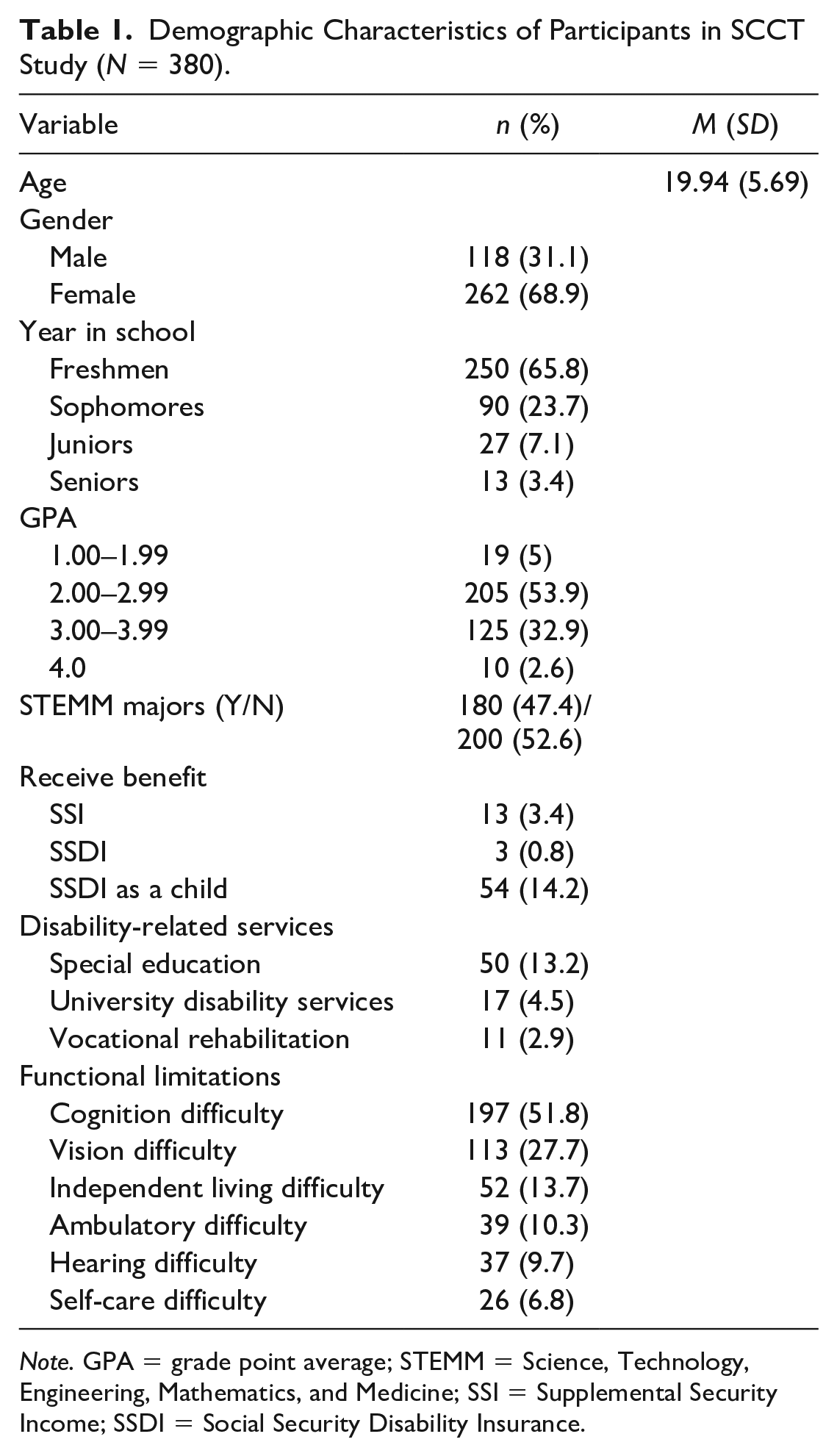
Note. GPA = grade point average; STEMM = Science, Technology, Engineering, Mathematics, and Medicine; SSI = Supplemental Security Income; SSDI = Social Security Disability Insurance.
Procedure
An a priori power analysis was conducted for hierarchical regression analysis. We used G*POWER (Erdfelder et al., 1996) to perform sample size estimation based on 11 predictors, a medium effect size (f2 = .15), power equal to .80, and an alpha level of .05. The result indicated that a sample size of 132 was needed for this study. Institutional review board approval was obtained from the HBCU. Professors from 46 mathematics and English classes were contacted to seek their help to collect data for the present study. Only African American students identified by the Current Population Survey’s six-question disability measure as having a disability were included in the present study. The Current Population Survey, sponsored jointly by the U.S. Census Bureau and the U.S. Bureau of Labor Statistics, is the primary source of labor force statistics for working adults with disabilities (U.S. Census Bureau, 2021). The response rate for the present study was 85.70%. According to Lindemann (2021), the average survey response rate is 33%. Students completed the SCCT survey online via SurveyMonkey, an online survey development cloud-based software program. Responses were kept confidential and students received a code upon completion to receive a US$15 gift card.
Measures
The SCCT survey consists of 71 items, including a demographic questionnaire (seven items) and six SCCT clinical assessment instruments (63 items). The following is a description of the SCCT measures.
Goal persistence
Goal persistence was assessed by the Goal Persistence Scale (GPS). The GPS was adapted from Lent et al.’s (2005) Goal Persistence Scale for Science and Technology Majors to include all majors (e.g., “I have the aptitude and interest in my chosen field”). It is composed of eight statements about students’ academic plans (e.g., “I will complete my college degree”). Students rated their level of agreement from 1 (strongly disagree) to 5 (strongly agree). Scores were computed by averaging ratings across the eight items, with higher scores representing a higher level of goal persistence. Lent et al. (2003, 2005) reported that the internal consistency reliability coefficient (Cronbach’s α) for the GPS items ranged between .93 and .95. In addition, Lent et al. (2003) reported that GPS scores were positively associated with academic self-efficacy and completion of college degrees in engineering. In the present study, the Cronbach’s alpha was computed to be .82.
Academic self-efficacy
Academic self-efficacy was assessed with two scales: the four-item Academic Milestone Self-Efficacy Scale (Lent et al., 1986) and the seven-item Academic Barriers Coping Self-Efficacy Scale (Lent, 2001; Lent et al., 2003). The academic milestone self-efficacy items examine students’ confidence to complete academic requirements in their declared majors (e.g., “How much confidence do you have in your ability to excel in your major area of study over the next semester”). For the academic barriers coping self-efficacy items, participants rated their confidence in their ability to cope with a variety of barriers that university students might experience (e.g., “cope with a lack of support from professors or your adviser”). Each item in both scales is rated on a 10-point Likert-type scale, ranging from 0 (no confidence) to 9 (complete confidence). Subscale scores were computed by averaging ratings across items in each subscale, with higher scores representing a higher level of academic self-efficacy on both subscales. Lent et al. (2005) reported the Cronbach’s alpha for the combined self-efficacy scale to be .91 and self-efficacy was positively associated with outcome expectations, interests, and goal persistence. In the present study, Cronbach’s alpha coefficients were .92 for the academic milestone self-efficacy subscale and .88 for the academic barriers coping self-efficacy subscale.
Career self-efficacy
The career self-efficacy construct was assessed by the Career Self-Efficacy Scale (CSES; Dutta et al., 2022). It is composed of 15 items with three domains: (a) job performance self-efficacy, five items (e.g., “I know how to maintain regular work attendance on the job”); (b) job seeking self-efficacy, five items (e.g., “I know how to talk about my skills and abilities in a job interview”); and (c) emotional efficacy, five items (e.g., “I know how to manage my emotions on the job”). Each item was rated on a 5-point Likert-type rating scale, ranging from 0 (cannot do) to 4 (can do very well). Scores for each subscale were computed by averaging ratings across items in each subscale, with higher scores representing a higher level of career self-efficacy. The Cronbach’s alpha for job performance self-efficacy was .93 and .84 for job seeking self-efficacy (Umucu et al., 2016). The CSES was found to be positively associated with goal persistence and career outcome expectancy. In the present study, Cronbach’s alpha for job performance self-efficacy was .91, job seeking self-efficacy was .82, and emotion efficacy was .85. The Cronbach’s alpha for the overall CSES was computed to be .90.
Career outcome expectancy
Career outcome expectancy was measured using the six-item Vocational Outcome Expectations Scale, which was modified from Lent’s Outcome Expectation Scale for science and engineering students (Lent et al., 2003, 2005). Students were asked to indicate how strongly they agreed that a college degree would likely lead to each of the 10 positive outcomes, such as “Find a job that I can do well,” and “Have a job with good pay and benefits.” Ratings were made along a 10-point scale, from 0 (strongly disagree) to 9 (strongly agree). Scores were calculated by averaging ratings across items, with higher scores representing a higher level of positive outcome expectancy. Lent et al. (2003, 2005) reported that the outcome expectations scale yielded a high Cronbach’s alpha of .89 to .91 and was related to measures of task and coping efficacy, interests, and major choice goals. The Cronbach alpha coefficient for the outcome expectations scale in the present study was computed to be .90.
Social support
Social support was assessed by the Multidimensional Scale of Perceived Social Support (MSPSS). The MSPSS was developed by Zimet et al. (1988) to measure social support from multiple sources. It is composed of 12 items and three subscales: (a) family, four items (e.g., “I can talk about my problems with my family”); (b) friends, four items (e.g., “I can count on my friends when things go wrong”); and (c) significant others, four items (e.g., “There is a special person who is around when I am in need”). Each item is rated on a 7-point Likert-type scale ranging from 1 (very strongly disagree) to 7 (very strongly agree). Scores were computed by averaging ratings across the 12 items, with higher scores indicating higher levels of social support. The Cronbach’s alpha for the total scale was .88 and the significant other, family, and friends subscales was .91, .87, and .85, respectively (Zimet et al., 1990). The MSPSS was found to be negatively associated with anxiety and depression in the theoretically expected direction (Zimet et al., 1990). In the present study, Cronbach’s alpha for the total scale was computed to be .94.
Deep learning
Deep learning was assessed using the Revised Two-Factor Version of the Study Process Questionnaire (R-SPQ-2F; Biggs et al., 2001). The R-SPQ-2F was further validated with a sample of African American college students with disabilities (Dutta et al., 2020). It is composed of 20 items with two subscales: (a) the deep learning subscale, 11 items (e.g., “I find that at times studying gives me a feeling of deep personal satisfaction”), and (b) the surface learning subscale, nine items (e.g., “I see no point in learning material which is not likely to be in the examination”; Dutta et al., 2020). Each item is rated on a 5-point Likert-type scale, ranging from 1 (never or only rarely true of me) to 5 (always or almost always true of me). This study used only the deep learning subscale as a proxy for crystallized career interest. An average score is computed by averaging ratings across the 11 items, with higher scores reflecting higher levels of deep learning. Dutta et al. (2020) reported a Cronbach’s alpha of .90 for the R-SPQ-2F and deep learning was significantly associated with goal persistence. In the present study, the Cronbach’s alpha for the deep learning subscale was also computed to be .90.
Data Analysis
We used the Statistical Package for the Social Sciences (SPSS Version 26.0) to perform the hierarchical regression analysis (HRA) and assess multicollinearity using the variance inflation factors (VIFs). No VIF values exceeded 5, with values ranging from 1.00 to 1.67, indicating that there was no evidence of multicollinearity (Choueiry, n.d.). We computed a simple imputation method using regression to estimate missing values at the item level. Missing data imputation is preferred to listwise deletion because listwise deletion may lead to biased, underpowered, or unreliable parameter estimates (Fox-Wasylyshyn & El-Masri, 2005; Lodder, 2014). In addition, we assessed the data for outliers using the Cook’s distance with 4/n as the cutoff value (Gogoi, 2015). Thirty-one cases with Cook’s distance greater than 0.0105 (4/380) were removed from the sample. The primary analysis was conducted using HRA to assess the incremental variance accounted for by each predictor set in the SCCT. The HRA is a flexible strategy for matching analysis to theory. It is particularly useful for hypothesis testing when hypotheses can be framed in terms of added or incremental Y variance accounted for by one set of predictors over and above what was explained by predictors entered at earlier steps in the model (Hoyt et al., 2008). In this study, the order of entry of sets of independent variables into the regression model was predetermined based on the SCCT.
Results
An HRA was conducted with goal persistence as the dependent variable. Five sets of predictors were entered in sequential steps: (a) demographic covariates (gender [male as the focal group], college status, GPA, low income [Yes is the focal group], STEMM major [Yes is the focal group]); (b) academic milestone self-efficacy and academic barrier self-efficacy; (c) career self-efficacy and career outcome expectancy; (d) social support; and (e) deep learning. The correlations among the dependent variable and the predictor variables are presented in Table 2.
Correlations, Means, and Standard Deviations for Variables.
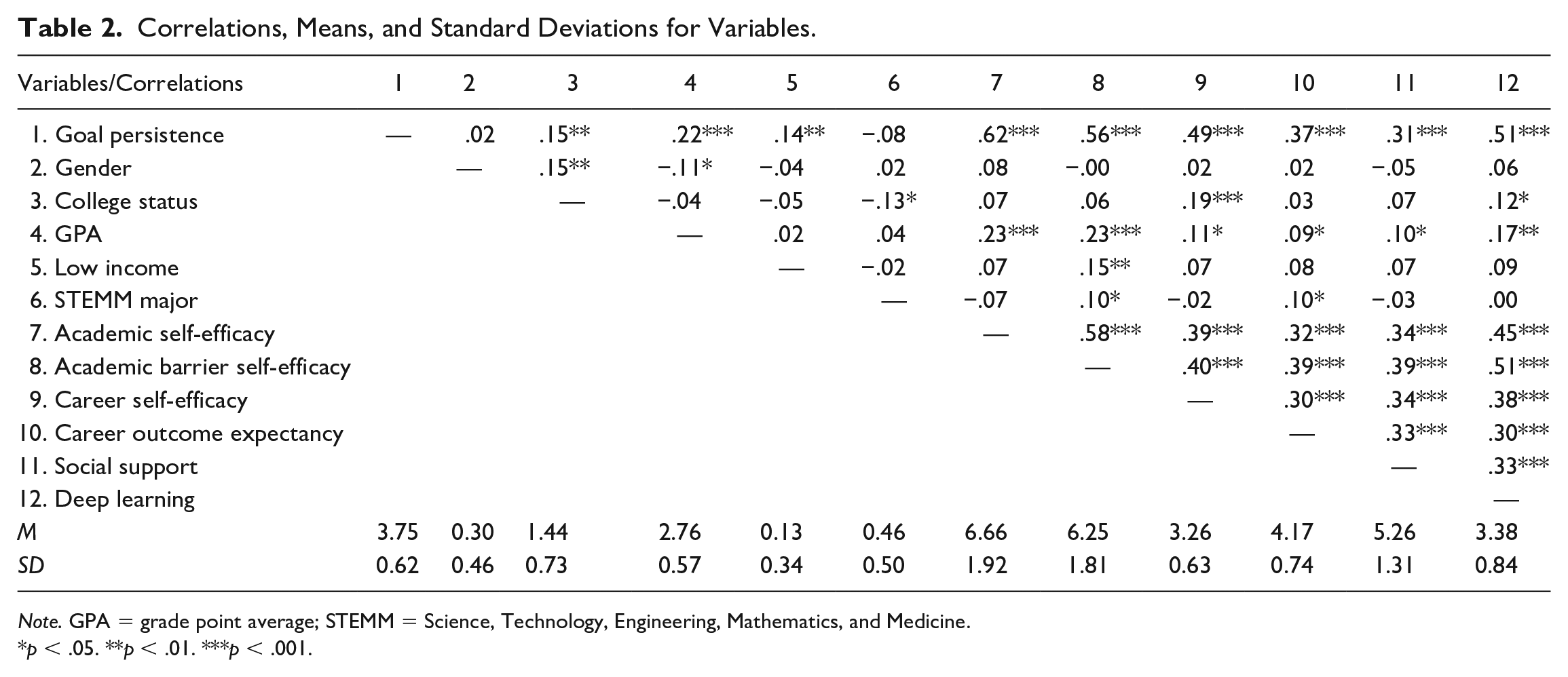
Note. GPA = grade point average; STEMM = Science, Technology, Engineering, Mathematics, and Medicine.
p < .05. **p < .01. ***p < .001.
The results of the HRA, including values of change in R2 (ΔR2), along with unstandardized regression coefficients (B), standard errors of unstandardized regression coefficients (SE B), and standardized regression coefficients (β) for the predictor variables at each step and in the final model, are presented in Table 3.
Hierarchical Regression Analysis for Prediction of Goal Persistence (n = 349).
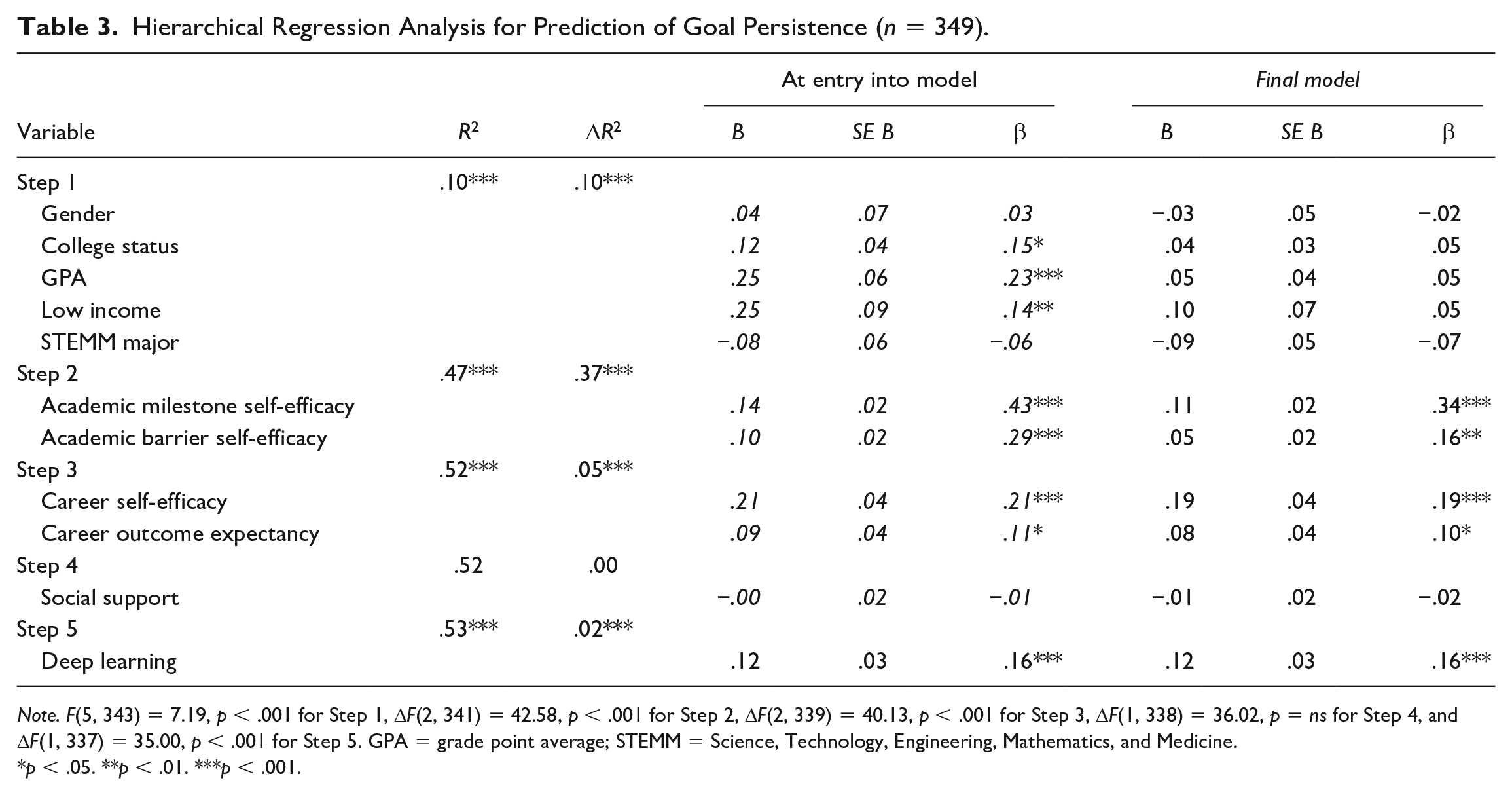
Note. F(5, 343) = 7.19, p < .001 for Step 1, ΔF(2, 341) = 42.58, p < .001 for Step 2, ΔF(2, 339) = 40.13, p < .001 for Step 3, ΔF(1, 338) = 36.02, p = ns for Step 4, and ΔF(1, 337) = 35.00, p < .001 for Step 5. GPA = grade point average; STEMM = Science, Technology, Engineering, Mathematics, and Medicine.
p < .05. **p < .01. ***p < .001.
In the first step, we entered the demographic covariates. This set of variables accounted for 10% of the variance in goal persistence, R = .31, R2 = .10, F(5, 343) = 7.19, p < .001. Upon examining the standardized partial regression coefficients, college status, β = .15, t(344) = 2.82, p < .05; GPA, β = .23, t(344) = 4.39, p < .001; and low income, β = .14, t(344) = 2.67, p < .01, were found to make significant and unique contributions to explaining the variance in goal persistence scores.
In the second step, we entered academic milestone self-efficacy and academic barrier coping self-efficacy into the model. The addition of these two variables accounted for a significant increase in variance of goal persistence beyond that explained by the demographic covariates, R = .68, R2 = .47, ΔR2 = .37, F(2, 341) = 42.58, p < .001. Both academic milestone self-efficacy, β = .43, t(342) = 8.62, p < .001, and academic barrier coping self-efficacy, β = .29, t(342) = 5.74, p < .001, were found to make significant unique contributions to the change in variance in goal persistence scores after controlling for the effects of the demographic covariates in Step 1.
In the third step, we entered career self-efficacy and career outcome expectancy into the model. These two variables also accounted for a significant but smaller amount of variance in goal persistence scores beyond the variance explained by the demographic covariates entered in the first step and the self-efficacy variables in the second step, R = .72, R2 = .52, ΔR2 = .05, F(2, 339) = 40.13, p < .001. Both career self-efficacy, β = .21, t (339) = 4.89, p < .001, and career outcome expectancy, β = .11, t(339) = 2.51, p < .05, contributed a relatively small but statistically significant amount of variance in goal persistence.
In the fourth step, we entered social support into the model. Social support did not account for a significant amount of variance in goal persistence scores, R = .72, R2 = .52, ΔR2 = .00, F(1, 338) = 36.02, p = .39, ns. Social support did not make a significant unique contribution to the change in variance in goal persistence scores, β = −.01, t(339) = 0.14, p = .89, ns. However, it should be noted that social support was significantly associated with goal persistence at the zero-order correlation level (r = .31, p < .01). The effect of social support on goal persistence dissipated when self-efficacy and outcome expectations were in the regression model.
In the fifth and final step, we entered deep learning into the model, which accounted for a significant amount of variance in goal persistence scores, R = .73, R2 = .53, ΔR2 = .02, F(1, 337) = 35.00, p < .001. Deep learning was a significant predictor of goal persistence, β = .16, t(337) = 3.54, p < .001.
The final regression model accounted for 53% of the variance in goal persistence, which is considered a large effect size according to Cohen’s (1992) standards for behavioral science research. In the final model, we found academic milestone self-efficacy (β = .34, p < .001), academic barrier coping self-efficacy (β = .16, p < .01), career self-efficacy (β = .19, p < .001), career outcome expectancy (β = .10, p < .05), and deep learning (β = .16, p < .001) positively and significantly associated with goal persistence.
Discussion
The recognition that structural racism exists in the United States has led business organizations and governments to make a strong commitment to reduce racial inequality at all levels of employment. It is imperative for rehabilitation counselors to provide tuition support as a vocational rehabilitation intervention for qualified African Americans with disabilities to pursue and complete a college education and obtain entry-level professional jobs as career pathways to the middle class to narrow economic inequality between Blacks and Whites. However, the African American college student graduation rate of 48% is significantly lower than the rate of 70% for White students (The Journal of Blacks in Higher Education, 2020). It is not sufficient to just provide tuition support for African Americans with disabilities to attend college. Many Black students are first-generation college students. The intersectionality between race, disability, and low income significantly increases their need for high levels of customized supports to cope with academic, financial, social, health, cultural, and disability-related challenges.
In the present study, we evaluated the SCCT variables as predictors of goal persistence in a sample of African American college students with disabilities. The final model accounted for 53% of the variance in goal persistence, which is considered a large effect size (R2 = .53, f2 = 1.13; Cohen, 1988) and provides strong support for the use of the SCCT as a goal persistence model for African American college students with disabilities. It is noteworthy that we did not find any differences between STEMM and non-STEMM major in their goal persistence scores. Students who come from low-income households are at higher risk of dropping out. The effect of the demographic covariates dissipated in the presence of the SCCT variables, suggesting that the effect of individual characteristic differences on goal persistence can be mediated by increasing self-efficacy and outcome expectations.
Academic milestone self-efficacy, academic barrier self-efficacy, career self-efficacy, career outcome expectancy, and deep learning were significant predictors of goal persistence. This result is consistent with findings reported by Cardoso et al. (2013) in their study of minority students with disabilities majoring in STEM, with the additional finding in this study that this model held irrespective of students’ academic majors. Academic milestone self-efficacy refers to students’ confidence to complete academic requirements in their declared majors, whereas academic barriers coping self-efficacy is students’ confidence in their ability to cope with a variety of barriers that college students might face. Career self-efficacy and outcome expectancy are also significant predictors of goal persistence. Students who perceived themselves as having higher levels of job performance efficacy, job seeking efficacy, and emotional efficacy had higher goal persistence scores in the present study. Career self-efficacy also led to higher career outcome expectations (e.g., graduation with a college degree will lead to a good paying job). Results are in harmony with previous studies (Lent et al., 2008; Thompson et al., 2017). Deep learning is also a significant predictor of goal persistence. Bain (2012) indicated that students who are motivated by a deep interest and a sincere desire to learn are more successful in college, employment, and life. The deep learning, looking for meaning, distinguishing between argument and evidence, and embracing the joy of learning are more conductive to college success (Bain, 2012). It was unexpected that social support was not a significant predictor of goal persistence in the presence of self-efficacy and outcome expectancy. This finding warrants further investigation in future research. Findings of the present study support the utility of SCCT as a working model for case conceptualization, psychological testing, development of treatment plans, and selection of evidence-based career development interventions. These findings also inform the development and validation of SCCT-based goal persistence and career development interventions for African American college students with disabilities.
Implications for Clinical Practice
Although data for the present study were collected in the fall semester of 2019 before the COVID-19 pandemic, the implications of these findings for future rehabilitation counseling practice are offered with full recognition of the profound impact of the pandemic on the disability and African American communities, and more specifically the ways in which higher education was affected and will continue to be affected by the ongoing COVID pandemic, the move to virtual educational delivery platforms, and the eventual full reopening and returning to campuses nationwide. We need to monitor how the intersection between race/ethnicity, disability, and poverty will affect African American students with disabilities during and after the ongoing pandemic. Helping African American college students with disabilities, especially first-generation college students with disabilities from low-income backgrounds, develop character strengths, academic self-efficacy, and outcome expectancy to cope with stressors and challenges associated with college life will increase the likelihood they will complete their college degrees and begin their careers, which will reduce economic and other inequities.
The regression model provides empirical support that academic milestone self-efficacy and academic barrier self-efficacy are the most important predictors of goal persistence. Rehabilitation counselors must cooperate with specialists in offices of disability services and diversity, equity, and inclusion offices on college and university campuses to provide academic support services such as time management, study skills, tutorials, remedial, and self-advocacy training for African American students with disabilities (Bank & Dohy, 2019). It may also be necessary to provide African American students with disabilities with assistive technology devices and high speed internet access to help them bridge the well-documented technology gap that exists between European Americans and people from racial-ethnic minority backgrounds, a gap that has widened in the wake of the COVID-19 pandemic (Sheppard-Jones et al., 2021). In addition, helping students obtain job shadowing experiences and find paid internships in business organizations and government agencies to gain work experience, build a good resume, develop effective job seeking and interviewing skills using impression management tactics, and develop workplace socialization skills will increase their motivation and efficacy to complete their college degrees and find and obtain entry-level professional jobs. To enhance deep learning among African American students with disabilities, rehabilitation counselors must collaborate with counseling staff in offices of minority student affairs and offices for students with disabilities to provide academic counseling and training workshops in learning styles to help African American college students with disabilities become (a) intrinsically curious about topics in their education, (b) determined to do well and mentally engage when doing academic work, (c) interested in having the appropriate foundational knowledge, and (d) able to pursue diverse interests through effective time management (Houghton, 2004). Finally, rehabilitation counselors must work with disability, diversity, and career service providers on campus to provide SCCT-related support services, including SCCT career assessment and planning, motivational speakers, peer mentors, field trips to business organizations, workplace socialization skills training, job interviewing skills training, and paid internships.
Limitations
This study has several limitations that should be considered when interpreting the results. For example, although the use of the U.S. Census Bureau Current Population Survey’s six-item disability survey allows students to self-identify their disability, using this disability measure does not allow us to identify specific types of disabilities (e.g., autism spectrum disorder, epilepsy, and learning disabilities). Because self-report measures were used in this study, the possible effects of social desirability bias and response bias should be considered. Although the sequences for entering variables in the regression model were informed by theory (SCCT), the cross-sectional design limits our ability to clearly establish cause–effect relationships between SCCT constructs and the goal persistence criterion. Finally, African American students with disabilities were recruited from only one HBCU in a Southern state, which limits generalizability of the results.
Conclusion
Race/ethnicity, disability, and poverty intersect to negatively affect the employment rate of working-age African Americans with disabilities. Helping young African Americans with disabilities to pursue college training in industries like health care, engineering, business, and technology will increase their prospects for finding entry-level professional jobs as career pathways to the middle class. Rehabilitation counselors must redouble their efforts to help African American college students with disabilities to complete their college education and find gainful employment using SCCT-based career interventions.
Footnotes
Acknowledgements
The ideas, opinions, and conclusions expressed; however, are those of the authors and do not represent recommendations, endorsements, or policies of the U.S. Department of Health and Human Services.
Declaration of Conflicting Interests
The author(s) declared no potential conflicts of interest with respect to the research, authorship, and/or publication of this article.
Funding
The contents of this article were developed with support from a Field-Initiated Research Grant funded by the National Institute on Disability, Independent Living and Rehabilitation Research (Grant 90IF0103-02-00) to Southern University at Baton Rouge, Louisiana.
