



Abstract
Persons with disabilities (PWDs) are disproportionately unemployed, underpaid, and underemployed despite their desire and capacity to work. The U.S. federal/state vocational rehabilitation (VR) program, under the supervision of the Rehabilitation Services Administration (RSA), is charged with providing services to assist eligible PWDs (VR consumers) in achieving employment. Despite research showing that VR consumers closed to self-employment (vs. non-self-employment closures) have better outcomes, self-employment is often considered as a last resort. Moreover, some evidence suggests self-employment (like non-self-employment) outcomes are associated with VR consumers’ gender and racial/ethnic identity. The objective of this study was to determine trends of case closures in self-employment among PWDs within the VR program from 2011–2013 to 2017–2019 and to examine the effects of gender and race/ethnicity on self-employment outcomes. Variables of interest were obtained from RSA’s Case Service Report (RSA-911) data set for 2011, 2012, 2013, 2017, 2018, and 2019. Data were recoded and analyzed. The number of closures in self-employment declined significantly. Weekly earnings in self-employment increased. Time from application to closure in self-employment decreased. Differences in VR self-employment outcomes by race/ethnicity and gender were noted. Efforts should be made to increase competency in self-employment of VR counselors and promote self-employment within the VR program.
Persons with disabilities (PWDs) continue to be employed at disparate rates. In 2020, only 17.9% of PWDs were employed, compared with 61.8% of persons without disabilities (PWODs), in the United States (U.S. Bureau of Labor Statistics [BLS], 2021). Disability can limit or impair one’s ability to independently complete major life roles and is reported to be a leading cause of secondary health conditions (Centers for Disease Control and Prevention [CDC], 2020), unemployment (Smith, 2020), and poverty (Semega et al., 2020). PWDs in the United States experience poverty at more than twice the rate than PWODs, 26.9% versus 12.2%, respectively (Elflein, 2020). Poverty has been linked to poor health and social isolation (Iceland, 2012). Conversely, earning a living wage is rooted in economic, social, emotional, and cognitive benefits, and provides a way out of poverty (Nye-Lengerman & Nord, 2016). Results from the American Community Survey reveal significant disparities in income by disability status; median earnings for PWODs were $49,200, compared with $35,600 for PWDs (Erickson et al., 2021). PWDs who receive college training earn higher weekly wages than PWDs who do not attend college (O’Neill et al., 2015); however, they still earn less than PWODs with similar education (Yin, 2014). Worse, the gap in earnings between PWDs and PWODs grows as level of education increases (Baldridge & Dirmyer, 2015).
In addition to being underpaid, PWDs are often underemployed despite their desire and capacity to work. Underemployment may result from a recession or technological changes, can limit workers’ ability to gain on-the-job skills or force workers to accept jobs beneath their skills, and leads to higher poverty levels (Amadeo & Estevez, 2020). For PWDs, underemployment can also result from negative employer perceptions of PWDs, poor strategic planning to recruit and retain PWDs, and unwelcoming organizational culture toward PWDs (M. E. Moore & Huberty, 2020). Although PWDs face underemployment even when the economy is thriving (Brodey, 2019), they are disproportionately impacted in times of crisis, such as with the COVID-19 pandemic which saw employment rates of PWDs drop from 19.3% in 2019 to 17.9% (BLS, 2021).
The U.S. federal/state vocational rehabilitation (VR) program, established over 100 years ago (Smith-Fess National Civilian Vocational Rehabilitation Act, 1920), is supervised by the Rehabilitation Services Administration (RSA), in the Office of Special Education and Rehabilitation Services (OSERS), under the U.S. Department of Education (DOE). The Rehabilitation Act (1973), with its amendments—the Workforce Investment Act (1998), Ticket to Work and Work Incentives Improvement Act (1999), and the Workforce Innovation and Opportunity Act (2014)—provide the statutory authority, including funding allocation for the VR program and related services. The VR program is supported by federal appropriations (78.7%) and state matching funds (21.3%); in Fiscal Year (FY) 2019, the federal budget allocated $3.26 billion, distributed according to states’ population sizes and per capita incomes (DOE, 2020). There are 78 VR agencies located in all 50 states, the District of Columbia, and U.S. territories that administer the VR program and provide VR services, such as vocational evaluation, career counseling, and job placement, to help qualified PWDs obtain and maintain competitive employment. In FY2019, the most recent RSA report available, the overall VR caseload exceeded 1.2 million (the highest since 2010), and the number of closures was 313,044, of which 142,523 (45.5%, the lowest since 2010) were closures in employment (DOE, 2020).
Despite the passage of the Americans with Disabilities Act (ADA, 1990) and the ADA Amendments Act (ADAAA, 2008), established to protect workers with disabilities (WWDs), workplace discrimination remains a significant barrier for PWDs. Although employees from protected classes (e.g., PWDs) who experience workplace discrimination can file a complaint with the U.S. Equal Employment Opportunity Commission (EEOC), a study of claims filed from 1992 to 2011 found only 23.4% of cases of disability discrimination were closed in favor of the PWD (McMahon & McMahon, 2016). Negative attitudes toward disability hinder career development for PWDs, who face discrimination by not being hired (Ameri et al., 2018), being perceived less competent than peer workers without disabilities (WWODs; Sherbin & Kennedy, 2017), and being denied promotion or advancement opportunities (Beatty, 2012). Moreover, two-thirds of PWDs who experienced workplace discrimination permanently left the workforce (J. Kennedy & Olney, 2001). PWDs who can no longer work and accumulated enough “work credits” may qualify for benefits from the Social Security Disability Insurance (SSDI) program (Social Security Administration, n.d.).
Oppressive structures in the United States create disparities for minoritized groups, such as PWDs. Belonging to multiple minorized groups exacerbates inequities and increases the risk of workplace harassment and discrimination (Nelson & Probst, 2004). Gender and race/ethnicity influence employment disability discrimination (Bruyère et al., 2010). For example, Hispanic women with behavioral disabilities experienced the highest rates of disability harassment (Shaw et al., 2012). The intersection of disability with gender or minoritized racial/ethnic identity results in lower incomes, higher poverty levels, and greater reliance on social services for economic security (Maroto et al., 2019). While broader and stronger disability discrimination laws have removed some employment barriers for PWDs, reducing their reliance on SSDI (Button & Khan, 2020), women and people from racial/ethnic minoritized groups have fared worse with the EEOC (A. H. Kennedy & Bishu, 2022).
Employment, underemployment, and income are influenced by minoritized status. Females experienced greater underemployment than males, whereas Black Americans and Hispanic Americans had higher unemployment and working-poverty rates compared with Whites and Asian Americans (De Jong & Madamba, 2001). Unemployment, underemployment, unwelcoming work environments, and limited opportunities for advancement have pushed women and those from racial/ethnic minoritized groups out of the employed labor force and into self-employment (Heilman & Chen, 2003; Light, 1979). Job loss and SSDI also push people into self-employment, whereas risk perception, wealth, and education pull people into self-employment (Moulton & Scott, 2016). People from racial/ethnic minoritized groups were generally less likely to be self-employed than Whites (Butler & Herring, 1991).
Scholars have noted how the intersection of stereotyped identities and systems of power serve to advantage those in privileged groups and to oppress those from marginalized groups (Crenshaw, 1989; Ransford & Miller, 1983). Moreover, the combination of minoritized statuses creates additional difficulties or “double jeopardy” (e.g., racism + sexism = unique barriers of Black women; Beale, 1969). For example, single jeopardy (i.e., racism) explains why compared with their White peers, African Americans and Hispanic Americans have more disabling health conditions, greater functional limitations, and more severe symptoms, as well as lower job status, fewer employment benefits, and lower wages (Wray, 1996). However, gender differences found among PWDs—that women were more prone to psychological symptoms due to inequitable work conditions, such as earning less, experiencing more stress, and having less autonomy—are better explained by the double jeopardy resulting from sexism and ableism (Brown & Moloney, 2019).
Like other disadvantaged minoritized groups, PWDs may be pushed or pulled into self-employment. According to results from the Current Population Survey between 1989 and 2009, persons with work limitations, including PWDs were more likely to be self-employed than those without work limitations (Gouskova, 2012). The VR program includes services that can be used to assist consumers (i.e., qualifying PWDs) in pursuing entrepreneurial, small business, or self-employment goals, yet VR counselors often only consider self-employment as a last resort (J. E. Moore & Cavenaugh, 2003). Research shows VR consumers closed to self-employment have better outcomes, such as earning significantly higher hourly wages (Ipsen & Swicegood, 2017; Revell et al., 2009), working fewer hours per week (Ipsen & Swicegood, 2017), earning higher weekly wages (Revell et al., 2009), and being most likely to be closed in professional, technical, and managerial occupations (J. E. Moore & Cavenaugh, 2003). Despite the obvious benefits of self-employment for VR consumers, closures in self-employment had dropped for some time (Revell et al., 2009), then appeared to be increasing but dropped again (Yamamoto & Alverson, 2017).
Therefore, this study seeks to determine trends in self-employment among PWDs within the VR program. The VR program is not free from bias and can influence service provision and outcomes for PWDs. Studies have reported racialized differences in VR acceptance rates (Rosenthal et al., 2005) and service provision (Wilson et al., 2002). Specifically, White VR consumers were 80% to 91% more likely to be closed in self-employment, whereas female VR consumers were 26% to 30% less likely to be closed in self-employment (Yamamoto & Alverson, 2013, 2017). The following five research questions (RQs) guided this study:
Method
Data for this study were obtained from the RSA’s Case Service Report (RSA-911), an administrative data set comprising information on consumers closed in a fiscal year from each VR agency. The data set includes information on all individuals who apply for VR services, regardless of eligibility, receipt of services, or closure status. For the purposes of the RSA-911, employment is classified as a closure into any of the following types of status lasting for at least 90 days: employment with or without support in integrated settings, self-employment, Business Enterprise Program, homemaker, and unpaid family worker. Changes have been made to the RSA-911, the most significant in 2002, 2014, and 2017. We examined data for FYs 2011, 2012, 2013, 2017, 2018, and 2019, the most recent years available following the latest change (i.e., FY2017–FY2019) and their respective matches for years immediately preceding the 2014 (i.e., Workforce Innovation and Opportunity Act [WIOA]-related) changes (i.e., FY2011–FY2013).
Data Variable Definitions
Three demographic categorical variables representing VR consumers’ individual characteristics were selected: (a) gender, with categories of male coded as 1 and female coded as 2; (b) racial membership, with five groups (American Indian or Alaskan Native, Asian American, Black or African American, Native Hawaiian or Other Pacific Islander, and White or European American), coded to indicate membership (1 = yes; 0 = no); and (c) ethnic identity, with Hispanic American coded as 1 (0 = non-Hispanic American). Two service variables were selected: (a) SSDI at application, with receiving SSDI benefits coded as 1 (0 = not receiving SSDI benefits); and (b) total time from application for VR services to self-employment closure (number of days). Three outcome variables were selected: (a) average hourly wage at closure; (b) typical weekly hours worked at closure; and (c) average weekly earnings at closure (gross wages, calculated prior to any payroll deductions).
Data Analysis
Data were analyzed using IBM SPSS Statistics (Version 27). We prepared the data set for analysis by selecting all cases of PWDs closed as self-employment and then by recoding and transforming variables to measure the number of closures, the earnings, and the time to closure, as well as the demographic characteristics of the people nationally served by the VR program. We aggregated each data set relative to the 3-year spans FY2011–FY2013 through FY2017–FY2019 into two data sets, each yielding one record per year. Sum of cases, mean of earnings as well as mean of time to closure, and rehabilitation rate were computed. We did not need to estimate parameters of the population studied because the RSA-911 data set is the actual population of VR consumers.
Results
Closures
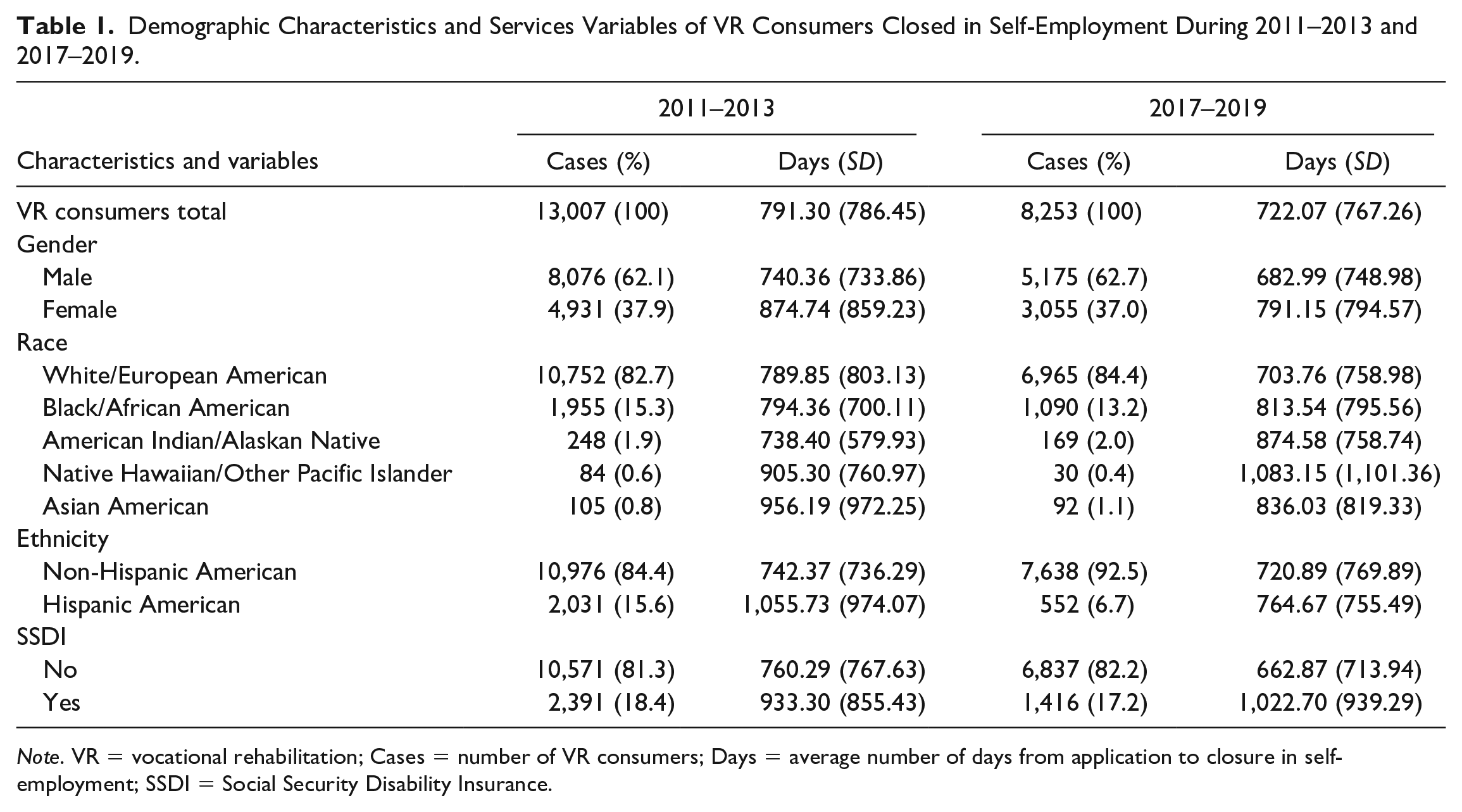
A review of closure information for FY2011–FY2013 and FY2017–FY2019 indicates that self-employment decreased as a percentage of overall VR closures in employment. For FY2011–FY2013, the percentage of closures in self-employment was 2.40. For FY2017–FY2019, the closure rate for self-employment was 1.75%. There were 13,007 individuals closed in self-employment in FY2011–FY2013 compared with 8,253 in FY2017–FY2019, resulting in a 36.55% drop during that timeframe. Overall, VR closures in employment decreased by 13.00% during that same period, from 541,712 in FY2011–FY2013 to 471,274 in FY2017–FY2019.
Earnings
In FY2017–FY2019, weekly earnings in self-employment averaged $475, showing a 4% average annual increase from $382 in FY2011–FY2013. In FY2017–FY2019, VR consumers closed in self-employment worked an average 26.9 (SD = 14.0) hours per week, slightly less than in FY2011–FY2013 (M = 27.74, SD = 12.70). The average hourly wage significantly increased from $13.94 (SD = $13.09) in FY2011–FY2013 to $17.38 (SD = 18.11) in FY2017–FY2019.
Time to Closure
In FY2017–FY2019, closures in self-employment required an average of 722 days from application, a significant decrease from 791 days in FY2011–FY2013. It is noteworthy that the average number of days from application to closure was substantially greater for applicants who were SSDI recipients. For instance, in FY2017–FY2019 VR programs spent an average of 1,023 days to close cases of applicants who were receiving SSDI benefits. Conversely, fewer days were needed for non-SSDI recipients (663), males (683), and Whites (704). (See Table 1 for details.)
Demographic Characteristics and Services Variables of VR Consumers Closed in Self-Employment During 2011–2013 and 2017–2019.
Note. VR = vocational rehabilitation; Cases = number of VR consumers; Days = average number of days from application to closure in self-employment; SSDI = Social Security Disability Insurance.
Race/Ethnicity
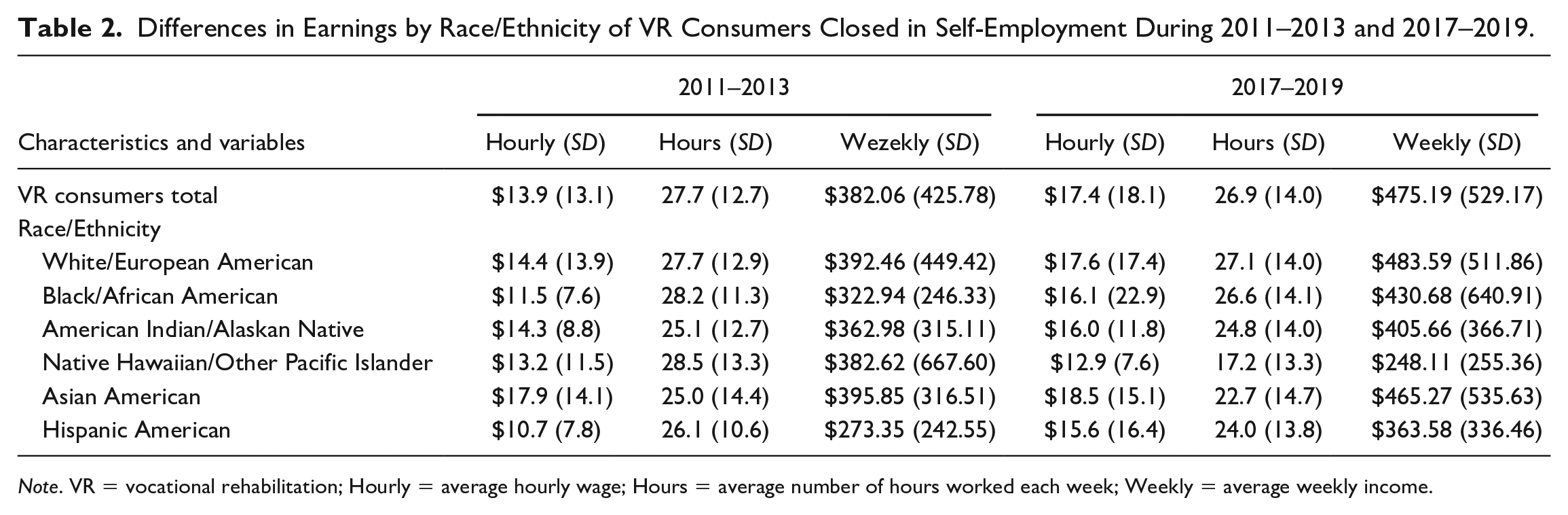
Table 2 presents information on participation in self-employment by racial identity and ethnicity. Asian Americans earned the highest hourly wages in FY2011–FY2013 ($17.92) and also in FY2017–FY2019 ($18.54); the lowest hourly wages in FY2017–FY2019 were earned by Native Hawaiians/Other Pacific Islanders ($12.89), a drop both in status (ranked 4/7) and rate ($13.19) from FY2011–FY2013. As presented in Table 1, 552 (6.7%) Hispanic Americans were closed in self-employment in FY2017–FY2019, a significant drop from 15.6% in FY2011–FY2013. White VR consumers earned the highest weekly wages in FY2017–FY2019, an average of $483.59, which is an increase in both status (ranked 2/7) and income ($392.46) from FY2011–FY2013.
Differences in Earnings by Race/Ethnicity of VR Consumers Closed in Self-Employment During 2011–2013 and 2017–2019.
Note. VR = vocational rehabilitation; Hourly = average hourly wage; Hours = average number of hours worked each week; Weekly = average weekly income.
Gender
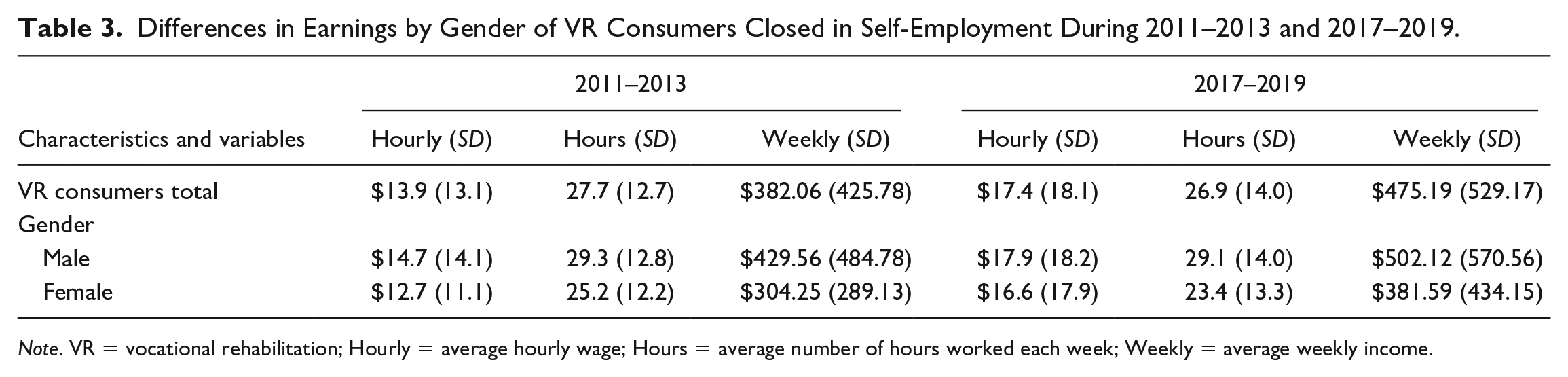
Table 3 presents information on self-employment closures by gender. Males earned higher hourly wages in FY2011–FY2013 ($14.70) and in FY2017–FY2019 ($17.85); they also had higher weekly earnings in FY2011–FY2013 ($429.56) and in FY2017–FY2019 ($502.12).
Differences in Earnings by Gender of VR Consumers Closed in Self-Employment During 2011–2013 and 2017–2019.
Note. VR = vocational rehabilitation; Hourly = average hourly wage; Hours = average number of hours worked each week; Weekly = average weekly income.
Discussion
The purpose of this article was to describe trends in outcomes of the VR program for PWDs who were closed in self-employment between FY2011–FY2013 and FY2017–FY2019. Answers to the five RQs are as follows: (RQ1) What are the trends of closures in self-employment? Whereas the overall number of closures slightly declined, the number of closures in self-employment declined drastically; (RQ2) What are the trends of earnings in self-employment? Weekly earnings in self-employment increased, even despite a slight decline in the number of weekly hours worked; (RQ3) What are the trends of the time frame from application to closure in self-employment? The time from application to closure in self-employment decreased; (RQ4) How do VR self-employment outcomes differ by racial/ethnic identity? Whites are overrepresented and Hispanic Americans are underrepresented in self-employment; (RQ5) How do VR self-employment outcomes differ by gender? Males are overrepresented in self-employment.
Closures
Results from this study show that during the period from FY2011–FY2013 to FY2017–FY2019, the overall number of self-employment closures declined. This finding is consistent with previous studies, which also found a downward trend in self-employment case closures (Revell et al., 2009; Yamamoto & Alverson, 2017). The decrease in the number of closures from FY2011–FY2013 to FY2017–FY2018 is odd, considering many PWDs were in the VR program. According to data from VR agencies, 3,025,087 PWDs were receiving VR services in FY2011–FY2013, and the cases increased to 3,144,151 in FY2017–FY2019 (DOE, 2020), an increase of 3.94%. Under federal regulation, VR is the premier provider of job-related services to PWDs; however, continuous federal and state budget cuts have forced VR programs to prioritize services to applicants with the most severe disabilities through “order of selection” (Hager, 2004). Recent policy changes designed to improve long-term outcomes for transition-age youth with disabilities (i.e., WIOA) have negatively impacted employment for non-transition-age VR consumers as VR counselors are faced with time constraints, burdened with accountability paperwork, and expected to take on larger and more complex caseloads (Sherman et al., 2019).
Whereas the rehabilitation rate remained relatively stable between 2011 (54.0%) and 2013 (53.6%), it dropped significantly between 2017 and 2019, from 49.5% to 45.5% respectively. This decline corresponds to the discontinuation of policies that removed barriers to employment and provided protections to employees with disabilities during the most recent prior administration (Ne`eman, 2019), and coincides with “a tenfold decrease in job gains for people with disabilities since 2016” (Kim, 2020, para. 4). Notably, research suggests that up to 37% of PWDs who exited the VR program without employment were employed in the future (Hayward & Schmidt-Davis, 2003); however, VR consumers who received services but left without employment had worse outcomes than those who exited without employment and never received services (Mann et al., 2017). PWDs face extensive barriers to successful employment and economic sufficiency outcomes, stemming from social stigma, discriminatory policies, and hostile work environments, which can exacerbate health conditions, erode self-efficacy, and hinder motivation (Whittle et al., 2017). Self-employment could be a way to help PWDs achieve meaningful careers, expand opportunities for advancement, and better integrate in communities (Martin & Honig, 2020).
Unfortunately, VR closures in self-employment dropped from 13,007 cases (2.40%) in FY2011–FY2013 to 8,253 cases (1.75%) in FY2017–FY2019, representing a 36.55% decrease in self-employment closures. These rates pale in comparison to national data which show that self-employment for PWDs only slightly declined from 11.8% in 2011 (11.3% in 2012, 10.9% in 2013) to (10.6% in 2017, 10.2% in 2018) 10.0% in 2019 (BLS, 2012, 2013, 2014, 2018, 2019, 2020). VR counselors should receive training in entrepreneurship, collaborate with small business experts to provide technical skills training, and involve consumer support networks to improve self-employment outcomes (Yamamoto & Alverson, 2015). VR counselors should also develop relationships with professionals who can consult on best practices in self-employment, such as Small Business Development Centers (SBDCs). Indeed, SBDCs that had formal contracts or informal agreements with VR agencies reported higher referral rates of PWDs, more experience working with PWDs, and greater successes in serving PWDs (Ipsen et al., 2005).
Earnings
Findings of this study indicate that earnings in self-employment increased enough to compensate for inflation. Moreover, earnings in self-employment were definitely higher than those reported in the literature for non-self-employment closures (Revell et al., 2009). Despite these positive results, weekly earnings are still less than those self-employed in the general population (Gouskova, 2020). Some reasons for low weekly earnings, include PWDs in self-employment worked between 26.9 (FY2017–FY2019) and 27.7 (FY2011–FY2013) hours on average per week. PWDs interested in self-employment could benefit from specialized training, mentorship, and accountability supports (Ostrow et al., 2019; Yamamoto et al., 2012). PWDs should be educated about and referred to existing federal programs, such as the Small Business Administration (SBA) which sponsors small business development programs and provides free services, including technical assistance, financing, and relevant information (Griffin et al., 2014).
Time to Closure
Number of days from application to closure in self-employment significantly decreased from 791 days in FY2011–FY2013 to 722 days in FY2017–FY2019. This finding suggests that despite all the policy changes implemented in the past decade, placing PWDs in self-employment has not become substantially more difficult, requiring more time for successful closure (Sherman et al., 2019). VR consumers subjected to excessive wait times from entry to service provision or successful employment are more likely to leave the workforce and to seek early SSDI benefits (Stapleton & Martin, 2020). It is important to monitor the time from application for services to closure in self-employment, as unemployment can cause psychological distress, erode self-confidence (Theodossiou, 1998), reduce motivation, and hinder VR engagement (Dutta et al., 2017). Quickly linking VR consumers to self-employment, small business, and entrepreneurial services could mitigate the negative effects of perceived stagnation (Schwab et al., 1999; Yamamoto & Olson, 2016) and may even reduce time to closure (Honeycutt & Stapleton, 2013).
Race/Ethnicity
There were notable changes in self-employment of PWDs that differed by race/ethnicity during the time period studied. Specifically, from FY2011–FY2013 to FY2017–FY2019, the percentage of VR closures in self-employment increased for Whites/European Americans (1.7), Asian Americans (0.3), and American Indians/Alaskan Natives (0.1), but decreased for Native Hawaiians/Other Pacific Islanders (0.2), Blacks/African Americans (2.1), and Hispanic Americans (8.9). Although Whites comprise 75.1% of PWDs in the United States (U.S. Census Bureau, 2019), they accounted 84.4% of VR closures in self-employment in FY2017–FY2019. This finding matches what is reported in the literature—White VR consumers are most likely to be closed in self-employment (Yamamoto & Alverson, 2018; Yamamoto et al., 2011); however, this is in contrast to national population rates and increasing. In addition, VR closures in self-employment for Hispanic Americans dropped significantly, from 15.6% in FY2011–FY2013 to 6.7% in FY2017–FY2019, yet 13.2% of PWDs in the United States are Hispanic (U.S. Census Bureau, 2019). Previous VR research reported that compared with White Americans, Hispanic Americans were less likely to receive on-the-job support services and less likely to obtain employment (da Silva Cardoso et al., 2007). Hispanic Americans are underrepresented in self-employment (Moulton & Scott, 2016), earn significantly less than (employed Hispanic, non-Hispanic self-employed) peers (Butler & Herring, 1991), and are more likely to exit self-employment (Ahn, 2011). These issues may partially explain why the percentage of Hispanic VR consumers closed in self-employment is lower than their percentage in the general population.
PWDs from minoritized racial/ethnic backgrounds may face racialized barriers, even in self-employment. Depending on the type of entrepreneurial endeavor PWDs choose, location of the business service area, and target population clientele, people from racial/ethnic minoritized groups could limit their earning potential due to consumer ethnocentrism (Ogbolu & Singh, 2019). Understanding the labor market and community culture will be important to help PWDs from different racial/ethnic origins succeed in self-employment (Wang, 2011). Moreover, education should also be provided on what considerations should be entertained regarding business incorporation (Fisher & Lewin, 2021). However, some persons from minoritized racial/ethnic groups have succeeded in self-employment and small business pursuits. Connecting PWDs to successful entrepreneurs who could provide mentorship could be beneficial. Since finding successful Hispanic or Black small business owners who have disabilities may prove difficult, helping VR consumers establish a network and find mentors they could identify with could help them learn the ropes. For example, for recently nationalized or culturally isolated Hispanic Americans, a mentor who speaks the same language or comes from the cultural background (e.g., native country) could be particularly beneficial (Fisher & Lewin, 2018).
Gender
Males are clearly the primary recipients of VR services leading to a successful self-employment closures. Changes from FY2011–FY2013 to FY2017–FY2019 for VR closures in self-employment slightly improved for males from 62.1% to 62.7%, respectively. These changes reflect the broader literature on VR closure in self-employment favoring males (Yamamoto & Alverson, 2013, 2017; Yamamoto et al., 2012) and trending in their favor over time (Yamamoto & Alverson, 2018). Being that disability in the United States is not evenly split, with females comprising a majority (51.56%) of PWDs (U.S. Census Bureau, 2019), continuing to favor males for self-employment, will increasingly place females at a disadvantage. Females earned lower hourly wages compared with males in this study, similar to previous findings (Yamamoto & Alverson, 2015). Research on gender differences in VR has noted differences in services provided and “gendered” types of employment (Sprong et al., 2017), and may influence self-employment outcomes. A positive finding showed that the increase in hourly pay rate from FY2011–FY2013 to FY2017–FY2019 was larger (percentagewise) for females (30.7%; from $12.7 to $16.6) than for males (21.8%; from $14.7 to $17.9). VR counselors should increase their understanding of how gender influences wages to provide appropriate services (Yamamoto & Alverson, 2018).
Limitations
There are some limitations which should be considered when interpreting the results of this study. First, an exploratory research design was used, no variables were manipulated, and cause cannot be inferred. Next, this study used data from the RSA-911 data set; therefore, only variables collected by the VR agencies and included in the data set were available to perform secondary analyses. Finally, some errors due to data entry may exist in the data set; however, the RSA includes several crosschecks for accuracy and to minimize the impact of errors.
Recommendations for Research
Results of this study have highlighted some potential areas for future research. Studies should focus on identifying VR consumers most likely to benefit from and succeed in self-employment. Personal characteristics identified as essential to self-employment success include good organizational skills, persistence, and business planning (Ashley, 2018). VR consumers should be assessed on these characteristics and future studies should examine their relationship to self-employment success. Interventions aimed at developing these skills could also be useful. Scholars have noted synergistic effects of minoritized identities. African American women with disabilities face cultural oppression from racism, sexism, and ableism (Hanna & Rogovsky, 1992). Future research should examine how triple jeopardy (i.e., racism × sexism × ableism) impacts VR consumers in self-employment and services and supports that would mitigate negative effects.
Implications for Practice and Training
Overall, WWDs earn 66¢ for every dollar earned by WWODs (Day & Taylor, 2019). VR consumers closed to self-employment work less hours but earn significantly more than those closed with different employment status. Moreover, women with disabilities, and PWDs from racial/ethnic minoritized groups, gain less annual salary benefit from additional educational human capital attainment (Baldridge & Dirmyer, 2015). PWDs are self-employed at nearly twice the rate than PWODs in the general population (BLS, 2021); however, VR closure rates in self-employment are steadily declining, as VR counselors most often only consider self-employment as a last resort. VR counselors’ reluctance to use self-employment is influenced by perceiving it to be a difficult, complex, and slow process (Ashley, 2018). In turn, their frustration with self-employment creates challenging experiences for VR consumers (Ashley & Graf, 2018).
Conversely, VR counselors with personal self-employment experience were likely to consider self-employment as a viable option (Ashley, 2018). The passage of WIOA expanded education majors for VR counselors to include undergraduate degrees in business administration, human resources, and economics, and removed the previously required advanced (graduate) degree in rehabilitation counseling. Evidence indicates VR counselors with a master’s (vs. bachelor’s) degree had better employment outcomes, including for consumers with severe disabilities (Frain et al., 2006; Sherman et al., 2017), whereas having a master’s degree in rehabilitation counseling (vs. a master’s degree in a related discipline) was associated with better employment outcomes (Frain et al., 2006) and securing high-quality jobs for consumers (Mackay et al., 2020). VR professionals may find the following resources useful: (a) for VR agencies, a 16-step self-employment process (Arnold et al., 2003); (b) for VR counselors and consumers, a 12-step self-employment manual (Wisconsin Division of Vocational Rehabilitation, 2013); and (c) for VR counselors and students, an eight-step self-employment planning manual (Condon & Brown, 2007). VR counselors could benefit with specialized training in self-employment. VR counseling programs should include self-employment in (a) curricula to provide an overview (lecture), lay a foundation (elective), or refine skills (advanced course); (b) professional development for field supervisors (to meet accreditation requirements) or continuing education for practicing professionals; and (c) coordination with other programs (business) as interprofessional education (business + VR) for “fast track” (undergrad-grad) degrees, specialized certificates, or dual master’s degrees.
Conclusion
There was a declining trend for case closures in self-employment in the VR program despite increased weekly earnings for self-employed VR consumers. The differences in rates of VR self-employment closures by consumers’ gender and race/ethnicity are concerning. Given the promising benefits associated with self-employment for PWDs, VR should promote self-employment as a first-choice option when it aligns with consumers’ goals and capacity, rather than limiting self-employment to a last resort. VR counselors should receive training in self-employment and entrepreneurship and partner with small business experts and other self-employment programs to increase service capacity in self-employment. Finally, VR counselors should understand how systemic culturally oppressive structures create barriers for VR consumers (ableism), and how these barriers multiply to further disadvantage PWDs from minoritized backgrounds (the intersection of racism and/or sexism with ableism).
Footnotes
Declaration of Conflicting Interests
The author(s) declared no potential conflicts of interest with respect to the research, authorship, and/or publication of this article.
Funding
The research was completed with support from the Vocational Rehabilitation Technical Assistance Center for Quality Employment (VRTAC-QE) at the Department of Rehabilitation Psychology, University of Wisconsin-Madison, with funding provided by the U.S. Department of Education, Rehabilitation Services Administration Grant CFDA H264-K200003. The ideas, opinions, anc conclusions expressed herein, however, do not necessarily reflect recommendations, endorcements, or policies of the sponsors. The sponsors had no involvement in the study design, data analysis, or write-up.
