



Abstract
Listening in second language education has long been conceptualised and operationalised with an overwhelming focus on one-way, non-participatory listening. Although this is necessary for the development of cognitive dimensions of second language listening, it leaves a gap where learners are under-equipped for two-way, interactive listening, particularly the socio-interactional dimensions of ‘being listeners’. In this paper, we argue that the construct of listening for second language teaching and learning should include skills for interactive listening. We review prevailing taxonomies of second language listening skills that serve as the basis for reference standards, syllabuses and assessments, and highlight the under-representation and under-specification of interactive listening. We then draw on insights from conversation analytic research on spoken interactions and second language interactional competence, to shed light on the nature of listening and listener actions in interactions. On that basis, we propose a taxonomy of interactive listening skills that provides a framework for teachers to help learners develop these skills systematically and explicitly. Finally, we discuss the significance of interactive listening in language teaching research and practice, and outline an agenda for future research.
Keywords
Introduction
Second language (L2) listening pedagogy is dominated by a narrow range of approaches which inadequately reflect the many contexts and diverse purposes in which people encounter spoken language. A case in point is the heavy emphasis on one-way or non-participatory listening (e.g. listening to podcasts or public announcements), which involve making sense of meaning but do not require a verbal response. In contrast, when we are engaged in a conversation, we must participate by both listening and responding to the other speakers in the interaction. This is called two-way or interactive listening. The importance of two-way listening in language learning is recognised by L2 listening scholars (Buck, 2001; Goh and Vandergrift, 2022; Lynch, 2009; Rost, 2025), but the reality in the listening classroom is that answering comprehension questions on the listening input remains the most typical activity (Newton, 2024). This gives learners few opportunities to learn to respond to the speaker, seek clarification and alternate between listener/speaker roles required in interactive listening (Goh and Vandergrift, 2022; Rost, 2025). There is a need, therefore, to foster learners’ interactive listening skills and address a gap in their L2 learning.
The focus on one-way listening can be attributed to a predominantly cognitive view of L2 listening based on cognitive science research, which conceives of listening as information processing (Baddeley, 2017). Although theorisations of L2 listening have acknowledged social and affective processes (e.g. Field, 2008; Flowerdew and Miller, 2005; Goh and Vandergrift 2022; Lynch, 2009; Rost, 2025), the socio-interactional dimension of listening remains underspecified in descriptions of L2 listening. Furthermore, with often a concomitant emphasis on production rather than interaction in the teaching of L2 speaking, important aspects of real-world listening that takes place within spoken interactions are often neglected in L2 teaching, learning and assessment (Lam, 2021). Not surprisingly, L2 teachers, learners and researchers alike wonder why many learners, after years of hard work in L2 curricula, could follow a podcast and deliver a presentation, yet struggle in interactions with others (cf. Pekarek Doehler, 2021).
We conceptualise interactive listening as encompassing listening and being a listener in social, service, professional and other everyday contexts. As an alternative angle (to speaking) from which to view spoken interactions (Lam, 2024), interactive listening foregrounds ‘how interactions unfold from a listener perspective’ (Ryan, 2022a: 368) and contributes to pragmatic processing (Rost, 2025). We argue that interactive listening skills go beyond comprehending propositional or even implicit/inferential meaning typical of listening tasks in listening lessons, textbooks and tests, but concern how listeners recognise and progress actions in talk, establish and maintain mutual understanding, and manage roles and relationships.
Recent years saw growing attention to interactive listening in applied linguistics. A systematic review by Aryadoust and Luo (2023) and the editorial epilogue in the Routledge Handbook of Second Language Acquisition and Listening (Galaczi et al., 2024) both called for more representation of interactive listening in listening research and practice. Conversation analysis (CA) has pioneered and built a body of research into what elements constitute interactive listening (e.g. Brouwer, 1999; Gardner, 1988; Ryan, 2022a; Sert, 2019; Xu, 2014) over the past few decades. Brouwer (1999), among others, also argued for the wider relevance of CA in teaching L2 listening, in that CA makes listening more visible: the turn-by-turn analysis reveals what and how much the listener understands the speaker's talk; and teachable: teaching students skills to ‘make sense of others’ talk interactively’ and to make speakers ‘design their talk according to [the listeners’] abilities’ (43).
Building on the strong presence of skill taxonomies in L2 listening and, more broadly, in L2 syllabuses, textbooks and tests, we propose a taxonomy of interactive listening skills based on CA insights about listener actions in spoken interactions. This represents a step towards addressing the overwhelming focus on one-way, non-participatory listening in current listening pedagogies, bringing more attention to interactive listening in the teaching, learning and assessment of L2 listening.
Conceptualisations of L2 listening
The dominant theoretical approach to L2 listening is based on cognitive processing perspectives on comprehension. This explains why the greater part of L2 listening research focused on factors that affect comprehension such as language knowledge, prior knowledge, working memory, metacognition, strategies, anxiety and bottom-up and top-down processing, all of which provide insights into cognitive processing (Vandergrift, 2007; Zhang and Shen 2023). Some research has examined the role of dialogic interactions amongst learners for improving their metacognition and L2 listening performance, and reported positive results of such collaborative dialogues (Cross, 2011; Fakhri Alamdari and Bozorgian, 2022). Although this approach has classroom applications, the objective of learning remains metacognition and comprehension, not listener actions in the way interactive listening is defined in this article.
The dominance of one-way listening comprehension is seen in many well-received works for teaching listening which offer taxonomies of listening skills to show the abilities needed in listening. These taxonomies have been influential in teaching because they help demarcate learners’ listening needs and establish lesson teaching objectives (Richards, 1983) and provide structure for planning teaching (Field, 1998). There remain questions of whether certain skills theorised in these taxonomies can be isolated (Buck, 2001), whereas others have been shown to be empirically divisible (Aryadoust and Luo, 2023; Goh and Aryadoust, 2015).
Our review of some often-cited listening skill taxonomies in L2 teaching and assessment literature in the past decades shows predominant emphases on skills for comprehension rather than interactive listening (Buck, 2001; Field, 2008; Goh and Vandergrift, 2022; Munby, 1978; Richards, 1983; Rixon, 1981; Rost, 2025). The focus has mainly been on how a mental model of aural input is constructed through bottom-up and top-down processes during comprehension with skills such as recognising sounds and using prior knowledge to elaborate meaning. Interactive listening is not completely absent in the literature on teaching listening. Where it is present, nonetheless, it is often highlighted and explained in the context of oral communication strategies rather than presented as an integral part of the L2 listening construct. For instance, Lynch (1995: 166) highlighted the use of ‘interactive listening strategies’ such as clarification requests, confirmation checks and asking interlocutors for help when there is a comprehension or communication problem. Goh and Vandergrift (2022) and Rost (2025) detail strategies to develop with interactive listening as a way for learners to get support from their interlocutors as well as improving their performance in collaborative tasks. Field (2008: 229) noted that the ‘ability to signal comprehension or lack of comprehension, verbally or non-verbally’ would be better conceived as a strategy rather than a listening skill for learners. He defines a skill as an ability that is used automatically by proficient language users but something that learners would need time to acquire, whereas a strategy is a conscious technique that learners use to solve language problems and facilitate comprehension (Field, 1998; see also Afflerbach et al., 2008 for a similar explanation for reading). Although these interactive listening-related strategies have pedagogical value, a limitation of such conceptualisation is that these aspects of interactive listening are construed mainly as compensating for deficient L2 performance when they are in fact ubiquitous in social interactions, be they in first language (L1) or L2 (Wong and Waring, 2021). Moreover, as will be elaborated below, these strategies concerning (non-)comprehension address only one dimension of interactive listening.
Interactivity is also a key characteristic of speaking (Hughes and Reed, 2017), as speaking often takes place ‘[in] the presence of someone else’ (Newton, 2018: 185). It is in this context that interactive listening requires responding appropriately to what the speaker is communicating. However, the focus of L2 speaking instruction has been heavily influenced by the functional-notional approach (Finocchiaro and Brumfit, 1983; Munby, 1978) that emphasises conveying meaning and intentions, and communicative functions such as inform, request, explain and complain. The teaching of L2 speaking has typically focused on developing fluency, accuracy and complexity (Skehan, 2015), and qualities such as clarity, communicative ease and skills for reasoning (Newton, 2018). The premise of the present paper is that there are crucial, distinctive skills for interactive listening that are under-represented in L2 curricula that merely combine communicative speaking and one-way listening.
Interactive listening: A conversation analytic lens
Listening in interactions concerns more than comprehension; it also concerns the ways of being listeners in interactions. This section presents insights about the nature of listening (and being listeners) in spoken interactions from CA and related research on interactional competence. These insights will illuminate gaps in current approaches to conceptualising the L2 listening construct for teaching and assessing listening, underscoring the need for a taxonomy of interactive listening skills.
Listeners are concerned with actions and their progress, not just propositional meaning
Although we often dedicate listening lessons to developing learners’ ability to comprehend propositional meaning (e.g. to listen for gist, for specific details, or to infer speakers’ attitudes), listeners’ and speakers’ meaning-making in spoken interactions often centres around coordinating and accomplishing social actions through their talk – for example, asking, announcing, inviting, offering, requesting. As Schegloff (2007: 1; original emphases) argues, ‘a great deal of talk-in-interaction – perhaps most of it – is better examined with respect to action than with respect to topicality, more for what it is doing than for what it is about’. His example illustrates this well: ‘Would somebody like some more iced tea’ in an interaction is likely understood by listeners as making an offer rather than about iced tea itself.
These social actions in talk are organised around and completed in sequences (Schegloff, 2007). Thus, following asking comes answering (or the expectation of such), following an offer of iced tea comes accepting/declining, and following requesting comes granting/denying, etc. Participants who have been listeners when a question is asked or a request is made are then tasked with producing a relevant next action in response (answer, granting/denying). CA research shows that participants in interactions are oriented to progressivity – that is, they are concerned with advancing actions in progress through sequences (Stivers and Robinson, 2006) and moving the talk forward.
The listener's role in progressing the talk and the actions being accomplished is vital. The concept of ‘recipiency’ in CA identifies listeners in interactions as ‘recipients’, whose task is to understand and respond to the actions of the speaking participants. As the speaker speaks, the listener(s) or recipient(s) monitor the talk and recognise the action being accomplished by the talk. Such understanding of the recipient enables them to produce a relevant next action (Brouwer, 1999). As such, at every turn in the interaction, the listeners in that moment share the responsibility with the speakers for the progress of actions (e.g. by aligning with the request underway or delaying the response) and the talk overall (e.g. by offering signals of (non-)understanding, or by collaboratively completing the speaker's turn).
The upshot is that listeners in interactions need an ability to recognise speaker action and produce appropriate recipient action. This aspect of ‘action as meaning’ is what seems largely missing in listening pedagogy (Ryan, 2022a), as current approaches have an overwhelming focus on developing or testing L2 learners’ ability to comprehend propositional meaning. This is further attested in Newton's (2024) most recent review of research on listening activities in textbooks, with multiple studies revealing that textbook activities are still dominated by a comprehension approach – for example, answering questions, deciding true or false, completing texts or diagrams – and mainly involve learners extracting information. Such pedagogical activities perpetuate conceptualisations of listening skills that are primarily concerned with propositional meaning while overlooking interactional actions.
Closely related to action-as-meaning is how listeners in interactions are concerned not just with retrospective but with prospective meaning. They actively project what action(s) the speakers are trying to accomplish, where the conversation is headed and when it is appropriate to take a next turn. CA research shows how projection is pervasive in human interaction (Auer, 2009). Deppermann and Günthner (2015) unpacked the role of projection in the temporality in interaction: projections ‘provide a range of expectations about “what comes next?”, including ‘(a) the kind of action the turn is to perform, (b) possible points of turn-completion allowing or calling for turn-transition, and (c), often times, […] the next action to be performed by next speakers’ (5).
Listeners draw on schematic knowledge to project the trajectory of action sequences (e.g. requests are granted/denied), and that knowledge maps syntactic structures or other linguistic and non-verbal cues to relevant actions based on normative expectations (Auer, 2009; Clayman, 2013). Together, these allow the listeners to identify action(s) underway, to produce timely and appropriate responses to progress the action(s) or to change the direction of the talk. Projecting possible turn completions is, similarly, drawing on cues from syntax, prosody, non-verbal behaviours and pragmatics of the action (Clayman, 2013). These cues enable listeners to ‘monitor the structure of emerging talk prospectively’ to identify possible moments for the current speaker to end their talk and for the listener to take up speakership (Goodwin, 2002: 26). Clayman (2013: 158) elaborates on how such projection of possible turn completions is, in turn, influenced by the listener's projection of the speaker's action within the local interactional context: That grasp of the action being done informs the recipient's understanding of what type of syntactic unit is in progress, how many TCUs [turn constructional units] will be required for the action to be possibly complete, and hence whether or not the completion of a given TCU will open up a bona fide transition space.
Listeners work towards intersubjective understanding, not just individual comprehension
Perhaps one of the most distinct features of listening in interactions is that listeners and speakers share the responsibility to work towards intersubjective, mutual understanding, and they do so in moment-by-moment coordination with one another. Decades of research (see below) provide robust insights into listener responses and conversational repair, supporting the imperative to define interactive listening skills in respect to accomplishing intersubjective understanding. This nature of interactive listening compels listening pedagogy to go beyond individual learners’ comprehension and help learners to express understanding and views by responding to what is said.
Establishing and maintaining intersubjective understanding
Listeners in interactions are normatively expected to display recipiency at both the perceptual and social/relational levels (Xu, 2014). In other words, they need to show that they are listening, show whether they have understood the talk so far (and what), and show their position towards what has been said (Ryan, 2022a). These are accomplished through a wide range of verbal and non-verbal resources, classified in research mainly by form. Firstly, there are a range of response tokens or lexical/phrasal formulaic responses that are either neutral (e.g. ‘mm’ or ‘uh huh’ as continuers, signalling for the speaker to go ahead) or displaying epistemic (e.g. ‘oh’) or affective stances (e.g. ‘that's wonderful’) (see Gardner, 1988). The non-verbal or embodied counterparts include gaze, nods and laughter, which, similarly, display attention to the speaker and receipt of talk so far, as well as neutral or epistemic and affective stances. Finally, there are more substantive forms of recipiency such as collaborative completions (Sert, 2019) and contingent next-turn responses (Lam, 2018). One difference between the minimal or formulaic and the more substantive responses is their potency in claiming versus demonstrating understanding (Sacks, 1992). Minimal responses (or ‘backchannelling’) and formulaic responses (e.g. ‘that's awful!’) claim that the listener has understood the talk, whereas collaborative completions or contingent next-turn responses constitute more ‘visible’ and unequivocal evidence of what the listener has or has not understood (Lam, 2021). The more substantive listener responses have been found to be more effective in facilitating both mutual understanding and progressing the interaction in group discussion assessments (Hırçın Çoban and Sert, 2020). All these are important characteristics of listenership that L2 listeners can learn to demonstrate.
Repairing understanding
Apart from ways in which participants display whether and how they understand each other's talk, not to be neglected are mechanisms for participants to manage troubles in understanding each other. Repair practices in CA are defined as ‘participants’ ways of dealing with troubles in speaking, hearing, or understanding of the talk’ (Wong and Waring, 2021: 312). CA stresses how repair is a central mechanism of natural conversations (Schegloff et al., 1977) just like turn-taking, not necessarily ‘symptomatic of a disfluent or an incompetent speaker’ (Wong and Waring, 2021: 312), and is to be distinguished from error corrections targeting linguistic errors. Particularly relevant to interactive listening is other-initiated self-repair, whereby a listener may initiate repair on another speaker's prior talk, prompting the speaker to resolve the trouble source. Listeners initiate repair through a range of repair initiators, from the more general open-class repair initiators (e.g. ‘What?’, ‘Sorry?’) to forms that are more specific about the trouble source and leading to more targeted repairs, such as wh-interrogatives (‘Who?’, ‘Where?’) and partial repetition + wh-interrogatives (e.g. ‘Johnny said what?’) (Kitzinger, 2013; Wong and Waring, 2021). Listeners may also initiate repair through offering their candidate understanding of the prior talk, sometimes prefaced with ‘you mean …’, to which the speaker can confirm or clarify further to complete the repair. Further examples of repair relevant to interactive listening include reformulating a question asked when potential misunderstanding by the co-participant is displayed, or a listener completing a word search in another speaker's turn.
As Brouwer (1999: 44) argues, ‘repair initiation is a very strong way of making another participant design his or her following utterance [differently]’. This view affords the (L2) listener much more agency than comprehension-based listening pedagogy, moving them away from being ‘helpless victims’ of non-comprehension (Brouwer, 1999: 44).
Listeners’ influence on mutual understanding
Listeners and their responses therefore play an indispensable role in contributing to the moment-to-moment balance between intersubjective understanding and progressivity of the talk (Heritage, 2007), as participants constantly negotiate between understanding each other and moving the interaction along. The listeners’ influence is attested in, for instance, how speakers may ‘alter projected paths of formulation and action as they monitor recipients’ responses’ (Deppermann and Günthner, 2015: 12), and studies have illustrated how listener responses shape the course of telling of events or stories (e.g. Stivers, 2008) or shape a speaker's progression through a communication task (Xu, 2014). With intersubjective understanding and coordinated actions being joint accomplishments in spoken interactions, the listener/recipient and their responsive actions share responsibility for the progress and direction of the ongoing talk – a fact that has been largely overlooked in prevailing L2 listening and speaking pedagogies, except in the limited sense of teaching strategies for clarifying understanding (Vandergrift, 1997).
Thus, to prepare L2 learners as listeners in interactions, it is imperative for listening pedagogy to go beyond individual comprehension and propositional meaning, and to help learners understand the importance of working with other participants towards mutual understanding.
Listeners orient to other participants’ priorities, not just their own
We have established that listening in interactions concerns more than propositional meaning and individual comprehension. Moreover, it often goes beyond transactional or informational purposes and has a relational dimension (McCarthy and McCarten, 2023). Other-orientedness can be argued to be an integral characteristic of the listener role in interactions. In CA, a distinction is made between self-attentive and other-attentive talk (Jefferson, 1984), whereby a conversational participant can be seen to focus in their talk on matters related to the co-participant or to oneself. Lam (2024: 325) proposes other-orientedness as a facet of interactive listening, and a discursive enactment of empathy, whereby the listener makes an effort to ‘set aside [their] own viewpoints or agenda, and to appreciate or even adopt the other person's perspective’. In everyday talk, other-orientedness (or lack thereof) is manifested in a participant's alignment or non-alignment with the co-participant and the context of the interaction.
There is substantial research in the interactional competence assessment literature elaborating on different manifestations of other-orientedness. It is evidenced by next-turn responses which comment on co-participants’ ideas or develop their topic (Galaczi, 2014), those which reformulate or extend co-participant's prior talk or account for (dis)agreement with it (Lam, 2018), or those asking follow-up questions (Lam, 2021).
Current listening pedagogy tends not to position the learner as a co-participant in the listening context, expected to provide responses to others’ talk (Ryan, 2022a), whereas speaking pedagogy still has a prioritised focus on fluency, accuracy and complexity in production (Skehan, 2015). A recognition of other-orientedness within a construct definition of interactive listening could be a first step in driving pedagogical approaches and activities towards developing more effective listeners in interactions. It also provides a compelling basis for going beyond merely functional and language use purposes when we teach learners skills for managing group interactions (Goh and Liu, 2024).
Overall conceptualisation of the listener
In interaction research, the roles of ‘listener’ and ‘speaker’ have been recognised to be relative and dynamic (Xu, 2014) – defined in relation to what each participant is doing at a given moment, and alternating and negotiated turn-by-turn (Sacks et al., 1974). As McCarthy and McCarten (2023: 74) put it: ‘Speakers listen to listeners and listeners listen to speakers. They are two sides of the same coin.’ We have seen how different listener responses signal different types or various states of recipiency, which in turn enact the participant's role as listener vis-à-vis the speaker in the current turn and negotiate their role at the next possible point for speaker change. For instance, in a speaker's extended turn, the listener's ‘uh huh’ as a continuer (Schegloff, 1982) often signals continuation of their role as listener and the co-participant's role as speaker. In contrast, the listener's affiliative comments such as ‘absolutely amazing!’ could (though not always) signal the listener registering the telling as possibly complete and being ready to take a next turn (Goodwin, 1986; Stivers, 2008).
In addition to the listener being defined as an interactional role in alternation with the speaker role, there is also an argument for the listener role, in a broader sense, to go beyond the turns when others are speaking. As discussed above, the normative expectation for what listeners do in the next-turn response where they become the current speaker (Lam, 2018) attests to a continuation of the role responsibility of listener. Similarly, Ryan (2022a: 372) argues that ‘beyond minimal responses, listeners are also expected to produce fuller turns that demonstrate their understanding and stance towards what they hear’. The joint-construction phenomena of collaborative completions (Sert, 2019) and which-comment clauses (Clancy and McCarthy, 2014) involve a listener-becoming-a-speaker tying their utterance to that of the preceding speaker. In these instances, the speaker–listener boundary is blurred, and the use of the speaker/listener label based on who is speaking becomes messy. Furthermore, if we admit other-orientedness as an integral feature of interactive listening, then it is noteworthy that a ‘listener orientation’ can and should be taken up by participants at the level of the speech event – for example, listening and responding to a friend sharing some upsetting news (Wong, 2021), or a therapist in a counselling session.
On the premise of conceptualising the listener role in interactions in the broader sense, and the recognition of the nature of listening in interactions as involving actions and prospective meaning, intersubjective understanding and other-orientedness, we can begin to work towards a set of teachable skills for interactive listening.
Towards a taxonomy of L2 interactive listening skills
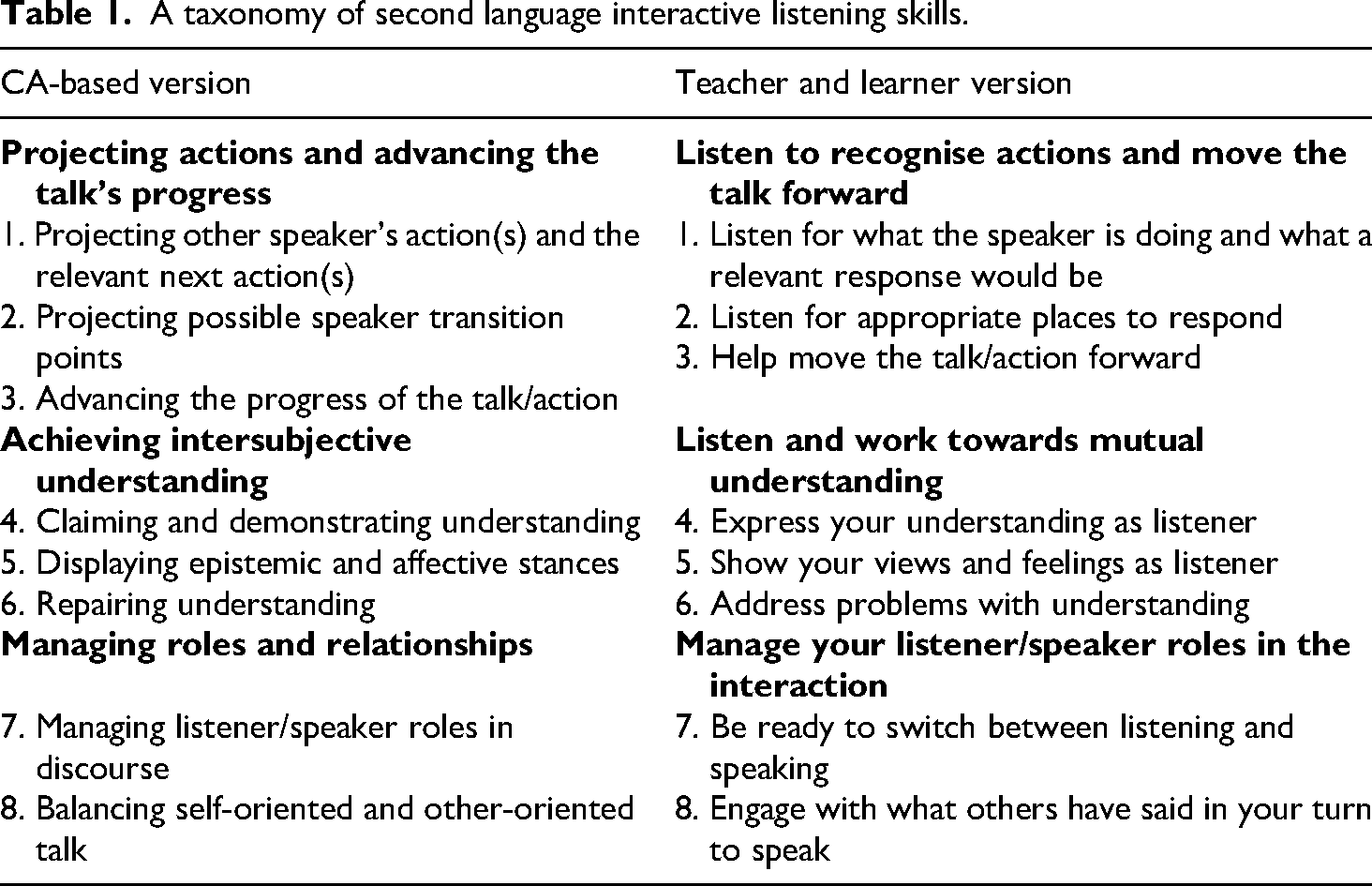
Drawing on the CA insights on interactive listening above, we propose here a taxonomy of interactive listening skills for L2 pedagogy that prepare learners to engage as participating listeners in interactions actively and meaningfully. Taking the perspective of interactive listening as an alternative angle of viewing spoken interaction (complementary to ‘speaking’) rather than a sub-component of interactional competence (Lam, 2024), the taxonomy of eight interactive listening skills below is organised around three broad dimensions of spoken interactions within a widely accepted definition of interactional competence – as ‘systematic procedures (of turn-taking, opening or closing a story-telling, repairing interactional trouble, etc.) through which participants in an interaction [1] coordinate their actions, [2] accomplish roles and relationships, [3] establish mutual comprehension, and maintain intersubjectivity’ (Pekarek Doehler, 2021: 23).
Table 1 below presents a CA-based version of the interactive listening taxonomy, and a corresponding teacher and learner version to be used in the classroom. Each interactive listening skill will be elaborated in the following, with the version for teacher and learner use woven into the explanation.
A taxonomy of second language interactive listening skills.
Projecting actions and advancing the talk's progress
Listeners in interactions are concerned with the social actions being progressed in talk, not just propositional meaning. They also need to concern themselves with prospective, not just retrospective, meaning. To jointly accomplish actions with others, L2 listeners need to develop the interactive listening skill (1) projecting other speaker's action(s) in the current turn – that is, listen for and recognise what the speaker is doing (e.g. request, invitation, complaint, compliment); and, correspondingly, what a relevant response would be in their own next turn (e.g. accepting, declining). To coordinate their talk with other participants, L2 listeners also need to develop the interactive listening skill (2) projecting possible completion of current speaker's turn – they need to listen for appropriate places to speak by comprehending and utilising syntactic and prosodic clues as well as the social action the turn is accomplishing. Related to interactive listening skill (1), L2 listeners also need the interactive listening skill (3) advancing the progress of the talk/action, developing practices and resources to use the listener's ‘influence’ (Brouwer, 1999) to help move the talk/action forward – for example, offering a relevant response to the speaker's action, signalling (non-)understanding as appropriate, formulating their tentative understanding or helping the speaker complete their turn (Hırçın Çoban and Sert, 2020).
Achieving intersubjective understanding
Success in interaction requires listeners to not only achieve their own individual comprehension (often evidenced by correctly answering a multiple-choice question, filling in a blank, or completing a table), but establish and maintain mutual understanding. The participants, as they switch between speaker and listener roles, need to proactively monitor each other's understanding and facilitate intersubjective understanding – getting each other ‘on the same page’. Thus, L2 listeners need to develop the interactive listening skill (4) claiming and demonstrating understanding – that is, to show your understanding as listener. More specifically, they need to be able to mobilise appropriate linguistic, prosodic and non-verbal resources to display their understanding of others’ talk in varying degrees of transparency as appropriate to the interactional moment (Gardner, 1988). Closely related is the skill in (5) displaying epistemic and affective stances – to show your views and feelings as listener towards the speaker and their talk. In displaying their stances, the listener signals to the speaker the extent to which they have understood what is being said and what action(s) are being accomplished; and whether they agree/disagree with the speaker.
Problems in intersubjective understanding are dealt with through conversational repair. Thus, L2 listeners need to develop the interactive listening skill (6) repairing understanding – that is, knowing how to address problems in understanding. Specifically, they can be taught how to initiate repair when problems with hearing or understanding occurs and to resolve such problems through repair (e.g. Kaneyasu, 2025), in line with relevant interactive listening strategies in the L2 listening literature (Goh and Vandergrift, 2022; Lynch, 1995; Rost, 2025). Skilful listeners in interactions would be able to select from a wide range of repair initiators – from general ones to those that specify the trouble source and the nature of non-understanding or offer candidate understanding for the speaker to confirm – as appropriate to the specific interactional context and moment (see Wong and Waring, 2021 for details). They would also be able to provide help with troubles in another speaker's ongoing talk – for example, by completing the speaker's word search or utterance. The range of classroom and textbook listening tasks need to expand, so as to afford learners opportunities to develop and practise these interactive listening skills focusing on mutual (not just individual) understanding.
Managing roles and relationships
Participants in interactions typically alternate turn-by-turn between the roles of speaker and listener. In some interactional contexts involving extended turns (e.g. storytelling, trouble telling), individual participants might be occupying the speaker or listener role for a more extended period. The relevant interactive listening skill to develop is therefore (7) managing listener/speaker roles in discourse – to recognise and to appropriately use linguistic, prosodic, and non-verbal resources to switch between listening and speaking in the interaction. Listening textbooks and classrooms could more explicitly and systematically develop learners’ knowledge of and agility in using the range of listener responses (e.g. from ‘uh huh’ and ‘yeah’ to ‘that's absolutely fantastic’) to signal continuation of listenership or readiness to take a speaking turn.
We have also discussed how the role of listener could operate at more macro levels of speech events and institutional discourse (e.g. counsellors and managers being listeners to their clients and employees respectively) and in everyday conversation (Wong, 2021). As such, L2 listeners also need the interactive listening skill (8) balancing self-oriented and other-oriented talk – to engage with what others have said in your turn to speak. Apart from displaying attention to others’ talk (‘recipiency’) through minimal or formulaic verbal responses and non-verbal cues (e.g. gaze, nodding), we need to develop learners’ listening and responding ability to extend topics the other participant(s) have initiated. In group discussion activities, for example, teachers can teach and exemplify developing co-participants’ topics in one's own turn through formulating the gist or implication of their talk, explaining why you agree/disagree or asking follow-up questions (Galaczi, 2014; Lam, 2018, 2025). Language assessment research suggests that lower-proficiency learners (Common European Framework of Reference for Languages (CEFR) B1 or below) tend to struggle with this aspect (see Lam, 2024).
Taking together all eight skills in the taxonomy, we propose that teachers should help learners develop their interactive listening skills such that they listen to recognise actions and move the talk forward; listen and work towards mutual understanding; and manage their listener/speaker roles in the interaction. Currently, L2 listening curricula that include strategy instruction teach learners to use strategies to arrive at understanding and address comprehension problems. There are similarities between the CA-informed interactive listening skills for achieving intersubjective understanding we have identified and interactive listening strategies that Lynch (1995), Goh and Vandergrift (2022) and Rost (2025) identified. We argue that it is time to rethink the place of these cognitive, social and affective processes that have hitherto been presented as strategies and afforded peripheral positions in listening skill taxonomies. Like many language skills that begin as conscious and effortful cognitive endeavours, the aim of L2 listening instruction should be for these to be used consciously by language learners and eventually to become automatised skills (Field, 1998). The other two groups of interactive listening skills should also be emphasised by including them in listening taxonomies that curriculum and assessment developers, teachers, and material writers can refer to.
Significance to language teaching research and practice
The theoretical contribution we strive to make to applied linguistics and language teaching is to expand the construct of L2 listening to include distinct elements of interactive listening, giving (over-)due attention to listener skills needed in spoken interactions. We argued that, although skills and cognitive processes for one-way receptive listening are necessary, they alone are insufficient in accounting for what listeners need to successfully engage in spoken interactions. Our proposed interactive listening taxonomy contributes to filling a parallel gap in L2 teaching and assessment practice, where the development of L2 listening skills has privileged one-way receptive listening. With learning activities and assessment items overwhelmingly focusing on discerning or reproducing comprehended propositional meaning, teachers stop short of developing L2 listeners’ ability to handle actions-as-meaning, prospective meaning, and intersubjective understanding – the kinds of interactive listening skills defined in our taxonomy.
Apart from contributing to research and pedagogy of L2 listening, our proposal of the interactive listening construct and its relevant skillset also addresses a long-standing issue plaguing researchers of L2 interactional competence – the research–praxis relationship. Although there is an ever-expanding body of research providing a robust understanding of the nature of L2 interactional competence and its development, researchers continue to lament the glacial pace at which such research trickle down to praxis in L2 teaching and learning (see Waring, 2018; Roever, 2023). In mainstream practices discussed above, listening pedagogy focuses on receptive listening comprehension and speaking pedagogy focuses on spoken production, with interactional skills somehow ‘slipping through the cracks’ and relegated to the periphery of L2 proficiency and its development. Our approach positions interactive listening not as an addendum to interactional competence or speaking skill, but as an alternative ‘face’ of spoken interactions and interactional skills (Lam, 2024). This represents a much-needed endeavour in moving interactional competence into L2 teaching and learning, but, notably, through integrating it into the prevailing four-skill framework rather than upending it (cf. alternative proposals for interaction to be a separate, fifth skill such as McCarthy and McCarten, 2023).
This article has focused on defining and elaborating on what interactive listening skills are, but of equal concern to language teachers is how interactive listening skills can be taught. One way is to harness some of the tried and tested current approaches to teaching L2 listening explicitly – using a process-based approach with metacognitive instruction (Goh and Vandergrift, 2022; Graham, 2017) to facilitate a more aware and strategic engagement with interactive listening among learners. The aim is for learners to develop these interactive listening skills eventually. For less proficient listeners, these abilities can be taught as strategies that they consciously use during interactions. This is where metacognitive instruction is important – to learn these abilities in a focused and conscious manner, typically guided by the teacher. With time, these strategies can become automatised as skills. Another way is to utilise the growing body of pedagogical sequences and activities developed by conversation analysts (Lam, 2025; Roever, 2022; Wong and Waring, 2021) and corpus linguists (Gerigk, 2024; McCarthy and McCarten, 2023). Drawing on insights from the respective disciplines, researchers have designed classroom activities ranging from recognition and awareness-raising (e.g. analysis of interaction extracts) to focused practice and more spontaneous interactions, including those targeting interactive listening skills (e.g. Kaneyasu, 2025; Ryan, 2022b).
An agenda for future research in interactive listening would include the need to verify the teachability of different interactive listening skills, and to explore effective approaches through which learners can move from awareness of interactive listening skills (declarative knowledge) to ability for use (procedural knowledge) in spontaneous spoken interactions. Equally important would be accumulating further research evidence on when (i.e. at what L2 proficiency levels) pedagogical interventions for interactive listening skills might be appropriate and conducive to development. More research addressing the interface between cognitive and social dimensions of L2 spoken interactions (see Glasson, 2026) would be fruitful in developing evidence-based approaches to pedagogy addressing interactive listening and other interactional skills, and to place these skills appropriately in L2 curricula.
Conclusion
Although there have been advancements in understanding how to teach L2 listening, much of these have centred on helping learners achieve comprehension in one-way listening. Yet listening in spoken interactions is the reality of L2 use for many learners, and it is the source of much anxiety for them because of the pressure to process and respond to what is said in real time. We have developed a taxonomy of interactive listening skills based on CA for the teaching of L2 listening. The expansion of the L2 listening construct with constituent elements of interactive listening provides a framework guiding teachers how to help learners develop these skills systematically and explicitly. As interactive listening requires participants to alternate between listening and speaking, the two skills can be developed in an integrated manner to improve learners’ competence as effective participants in spoken interactions.
Footnotes
Acknowledgement
We wish to express our sincere thanks to the two anonymous reviewers for their incisive comments and helpful suggestions on our article.

Ethical approval and informed consent statements
This viewpoint article does not report on an empirical study involving human participants.
Funding
The authors received no financial support for the research, authorship, and/or publication of this article.
Declaration of conflicting interests
The authors declared no potential conflicts of interest with respect to the research, authorship, and/or publication of this article.