




Abstract
Research on teacher agency in language education has expanded, yet limited empirical attention has been given to how teacher agency is negotiated in the everyday teaching of academic writing, particularly by early-career instructors working in under-resourced higher education contexts. This exploratory single-case study examines how an early-career English for Academic Purposes instructor in Bangladesh negotiated teacher agency while teaching academic writing within a resource-constrained public university. Guided by an ecological perspective on teacher agency, data were generated through a classroom observation, three semi-structured interviews, a reflective diary and a student focus group, and analysed using reflexive thematic analysis. The findings show that teacher agency was enacted through situated pedagogical judgement, including curriculum pacing, epistemic mediation and constraint-aligned instructional recalibration, rather than through overt resistance or pedagogical innovation. These judgements were shaped by the interplay of past experiences, present institutional constraints and future-oriented professional concerns, and were often ethically ambivalent, simultaneously enabling student access to academic writing while reproducing institutional priorities. By foregrounding teacher agency as everyday, negotiated professionalism in English for Academic Purposes writing instruction, the study offers contextually grounded insights into early-career teacher practice in under-researched South Asian higher education settings and suggests the importance of supporting reflective, context-sensitive pedagogical judgement in English for Academic Purposes teacher education within resource-constrained environments.
Keywords
Introduction
Teacher agency is increasingly recognised as a key lens for understanding how educators navigate the complex and often contradictory demands of classroom practice (Tao and Gao, 2021). Rather than being conceptualised as an individual capacity or a form of overt resistance, research in applied linguistics and teacher education, drawing on sociological theory (e.g., Emirbayer and Mische, 1998), conceptualises teacher agency as a situated, relational process shaped by teachers’ past experiences, present constraints and professional aspirations (Biesta and Tedder, 2007; Priestley et al., 2015). Within this ecological framing, teacher agency is enacted through teachers’ professional judgements as they interpret and recalibrate the layered conditions of practice, rather than operating outside or against structures.
Within English for Academic Purposes (EAP), this perspective is particularly salient. Unlike general academic writing instruction, EAP writing is typically institutionally bounded, assessment-driven and normatively regulated, positioning teachers at the intersection of curriculum mandates, disciplinary expectations and institutional accountability (Hyland, 2019). Writing pedagogy in EAP therefore often involves teaching highly conventionalised practices, such as argumentation, source use and citation, while simultaneously responding to students’ linguistic, epistemic and affective needs (Gao and Cui, 2024; Walková, 2024). This positioning renders EAP writing a theoretically distinctive site of agency negotiation, where pedagogical decisions are rarely neutral and frequently entail judgement under constraints (Ding and Monbec, 2024).
For early-career instructors, these tensions are often intensified. Entering the profession with limited pedagogical autonomy, uneven mentoring and developing professional identities, early-career EAP teachers frequently operate within prescribed curricula while being expected to deliver measurable learning outcomes (Bao et al., 2020). In such contexts, what appears as compliance may instead reflect strategic professionalism, whereby teachers adapt their practices in pedagogically meaningful ways while aligning with institutional expectations (Eteläpelto et al., 2015; Vähäsantanen, 2015). Such negotiated forms of teacher agency are particularly evident in large, exam-oriented classes, where pedagogical choice is constrained not only by policy but also by material and organisational conditions, necessitating ongoing micro-level pedagogical judgement.
These dynamics are particularly pronounced in under-resourced contexts such as Bangladesh, where EAP writing instruction is shaped by large class sizes, examination-oriented assessment regimes, limited instructional time and restricted access to professional development (Ali and Hamid, 2023; Chowdhury and Kamal, 2014). Although recent studies have documented agentive practices among Bangladeshi EAP teachers, such as translanguaging as pedagogical mediation (Rafi and Morgan, 2023) and adaptive feedback practices (Rahnuma, 2023), there remains limited empirical insight into how early-career EAP teachers negotiate the everyday demands of teaching academic writing itself, such as scaffolding argumentation, managing drafting cycles and teaching citation practices within resource-constrained higher education environments (Weng, 2023).
Moreover, existing research on teacher agency in EAP tends to foreground experienced instructors or policy-level negotiations, leaving it less understood how early-career teachers exercise professional judgement in routine, moment-to-moment pedagogical decision-making (Ding and Monbec, 2024). Addressing this gap is important, as early-career teachers often have fewer structural resources yet are required to make rapid, consequential decisions that shape students’ access to academic literacy practices.
This study addresses this gap through an exploratory case study of an early-career EAP teacher in a Bangladeshi public university. Informed by the ecological model of teacher agency (Priestley et al., 2015), it conceptualises teacher agency as emerging across the iterational, practical-evaluative and projective dimensions. Rather than categorising practices as either agentive or constrained, the analysis examines how teacher agency is negotiated through situated pedagogical reasoning in academic writing instruction. By doing so, this study contributes to ongoing debates on teacher agency as a negotiated form of professionalism, with relevance for EAP writing instruction in comparable higher education contexts.
Literature review
Conceptualising teacher agency in EAP
Teacher agency has been theorised in multiple ways, reflecting differing assumptions about how educators act within complex teaching environments (Kayi-Aydar, 2019). Priestley et al. (2015) distinguish three broad perspectives: agency as a personal trait, agency as a capacity to act and agency as a phenomenon of doing in which action emerges contextually. Although the first two perspectives foreground individual attributes, they tend to underplay the sociocultural and institutional conditions shaping teaching practice, particularly in strongly regulated contexts such as EAP writing.
Accordingly, this study adopts the ecological conception of teacher agency (Emirbayer and Mische, 1998; Priestley et al., 2015), which conceptualises agency as temporally embedded across iterational (past experiences and beliefs), practical-evaluative (present judgements under constraint) and projective (future-oriented goals) dimensions. Rather than classifying behaviours as either agentive or compliant, this model foregrounds how teachers exercise professional judgement within the affordances and limits of their professional ecologies (Biesta and Tedder, 2007). This orientation is particularly appropriate for EAP writing instruction, where pedagogical choice is shaped by assessment systems, genre conventions and institutional accountability.
Building on this framing, prior scholarship has emphasised teacher agency as a negotiated practice. Lasky (2005) conceptualises strategic compliance, whereby teachers align with policy while preserving pedagogical intent; Tao and Gao (2021) describe adaptive agency through shifting priorities across changing contexts; and Ding and Monbec (2024) frame teacher agency as context-sensitive negotiation involving locally rational trade-offs. Collectively, these perspectives position teacher agency not as resistance or autonomy per se, but as situated judgement exercised under constraint, which underpins the present study.
Teacher agency in EAP writing instruction
In EAP pedagogy, teacher agency operates within tightly structured instructional environments. EAP writing instructors are required to support students’ development of academic genres while adhering to assessment-driven curricula, predetermined learning outcomes and institutionally regulated norms of argumentation and source use (Hyland, 2019; Walková, 2024). Unlike broader academic literacy instruction, EAP writing involves sustained mediation of these normative expectations, leaving limited space for overt pedagogical discretion.
These constraints are particularly salient for early-career teachers, typically defined as those with approximately two to five years of teaching experience, who often operate with limited institutional authority while developing professional identities (Gao and Cui, 2024). For them, pedagogical decisions in writing classrooms frequently involve negotiating curricular mandates alongside students’ linguistic and epistemic readiness.
Although research on teacher agency has expanded, empirical studies in EAP tend to focus on professional identity formation, curricular alignment or policy mediation, rather than on how teacher agency is enacted through everyday pedagogical judgement in writing classrooms. Less attention is given to how teachers make situated instructional decisions, such as adjusting task sequencing, reformulating explanations or contextualising abstract writing concepts. Weng (2023) offers an illustrative account of how such micro-level decisions are shaped by contextual constraints, highlighting the relevance of examining such processes in EAP writing.
An ecological perspective (Priestley et al., 2015) enables such pedagogical judgements to be interpreted without framing them as either compliance or innovation. Alignment with syllabi or assessment regimes may reflect pragmatic professional judgement rather than a lack of agency (Lasky, 2005), whereas adaptive practices remain negotiated within constraints of time, class size and institutional accountability (Reeve and Shin, 2020). This understanding foregrounds early-career EAP instructors’ ongoing interpretive work in recalibrating writing pedagogy under constraint. Building on ecological and professionalism-oriented accounts of teacher agency (Ding and Monbec, 2024; Tao and Gao, 2021), the present study examines how such routine, context-sensitive pedagogical judgement unfolds in a resource-constrained EAP writing context.
Empirical perspectives on the situated negotiation of teacher agency
Empirical research often conceptualises teacher agency as enacted through pedagogical judgement, institutional mediation and reflective practice rather than through overt autonomy or resistance. Studies of curriculum adaptation and instructional decision-making highlight how everyday adjustments, such as reordering tasks, reformulating explanations or contextualising materials, constitute consequential sites of teacher agency when they involve deliberate professional reasoning (Bao et al., 2020). Such work positions pedagogical creativity as a routine expression of teacher agency.
Reflection has been identified as a key mechanism through which teachers sustain and recalibrate agency in response to emerging classroom challenges. In EAP writing contexts, Weng (2023) demonstrates how reflective engagement supports teachers’ moment-to-moment pedagogical judgements, particularly when navigating curricular constraints and student readiness. This work frames reflection as embedded within institutional expectations and pedagogical demands.
Institutional structures further mediate the enactment of teacher agency. Research shows that teacher agency is often co-constructed through policy environments, collegial interaction and informal professional networks (Montecinos et al., 2022; Scanlon and Connolly, 2021). In resource-constrained settings, constraints may entail responsive innovation, whereby teachers reconfigure pedagogical processes without challenging institutional norms (Vu, 2020). Similarly, studies of constrained teaching (e.g. Reeve and Shin, 2020) illustrate how professional judgement can be exercised even when autonomy is bounded.
Building on these insights, research on reframed professionalism positions teachers as interpreters who negotiate professional responsibility within institutional normativity rather than acting outside it (Vähäsantanen, 2015; Zhang et al., 2023). However, limited attention has been paid to how such negotiations unfold specifically in EAP writing instruction, particularly for early-career teachers working under time-compressed, assessment-driven conditions. This motivates the present study's focus on everyday pedagogical reasoning in EAP writing classrooms.
Teacher agency in the Bangladeshi EAP context
In Bangladesh, EAP writing instruction is shaped by systemic constraints, including large class sizes, exam-oriented curricula and limited access to sustained professional development (Ali and Hamid, 2023; Chowdhury and Kamal, 2014). These conditions often restrict pedagogical autonomy and intensify the need for pragmatic, moment-to-moment pedagogical decision-making, particularly in writing classrooms where assessment norms and genre expectations are prescribed. Within such environments, teacher agency is typically enacted as a negotiated and situated practice rather than as an independent capacity.
Empirical studies from Bangladesh illustrate how teachers respond to these conditions through context-responsive pedagogical practices. For example, Rafi and Morgan (2023) show how translanguaging operates as a mediational strategy that reconciles institutional writing expectations with students’ linguistic repertoires, and Rahnuma (2023) documents how feedback practices and task design are adapted to student readiness. These studies indicate how pedagogical intent is preserved through selective adjustment.
However, existing research in the Bangladeshi context has largely focused on experienced instructors or on EAP teaching broadly, with limited attention to academic writing pedagogy as a site of agency negotiation, particularly for early-career teachers. Little is known about how early-career instructors navigate the everyday demands of teaching writing, including scaffolding argumentation, managing drafting cycles and mediating feedback under time- and assessment-driven constraints. Addressing this gap, the present study examines how an early-career EAP instructor in a Bangladeshi public university negotiates pedagogical decisions and exercises teacher agency within the structural and cultural constraints of academic writing instruction. It is guided by the following research question: How does an early-career EAP instructor in Bangladesh negotiate and enact teacher agency within the structural and cultural constraints of academic writing instruction?
Methodology
Research design, context and participants
This study adopted an exploratory qualitative single-case study design to investigate how an early-career EAP teacher negotiated teacher agency in the teaching of academic writing (Stake, 1995; Yin, 2018). A single-case approach was appropriate because the study sought analytical rather than statistical generalisation, offering an in-depth, contextually grounded account of agency as an emergent and situated professional process (Tisdell et al., 2025).
The focal participant was selected as a critical yet typical case (Yin, 2018). Hasan (pseudonym) was an early-career instructor working under institutional conditions common in Bangladeshi public universities, including large classes, exam-oriented curricula and limited pedagogical autonomy. His position as a novice professional navigating routine instructional demands made his case analytically productive for examining how teacher agency is negotiated in everyday EAP writing practice, rather than in exceptional or reform-oriented contexts. This aligns with the ecological model of teacher agency (Priestley et al., 2015), which foregrounds how teachers’ past experiences, present constraints and future orientations interact within specific professional ecologies.
The research was conducted in a public university language centre in Bangladesh, where first-year undergraduates are required to complete compulsory EAP writing modules. These modules aim to develop academic writing competencies such as genre awareness, source use and iterative drafting (Hyland, 2019). In practice, however, instruction is shaped by structural constraints, including large class sizes (typically 50–60 students), assessment-driven curricula and limited institutional support (Chowdhury and Kamal, 2014). Within this setting, the study examined how teacher agency was enacted through routine pedagogical decisions in academic writing instruction.
Participants were recruited through purposeful case-based selection, consistent with qualitative case study methodology (Stake, 1995; Yin, 2018). Hasan was a 26-year-old instructor with three years of EAP teaching experience, holding an MA in Teaching English to Speakers of Other Languages (TESOL) and having completed short professional development courses in language education. To capture student perspectives on his pedagogical decisions, three first-year undergraduates from his writing class (two female, one male; aged 18–20) were also recruited and anonymised as Student A, Student B and Student C. Their participation was entirely voluntary. Including student perspectives alongside teacher accounts provided contextual triangulation, enabling insight into how Hasan's pedagogical decisions were experienced within the classroom ecology (Miles et al., 2014).
Ethical approval was obtained from the relevant institutional review board. Ethical procedures were guided by established qualitative research conventions (Tisdell et al., 2025), with particular attention to voluntary and informed participation of all participants and relevant non-participants (e.g. classmates present during observations and institutional gatekeepers), anonymity and the researcher's responsibility to minimise power imbalances.
Data collection
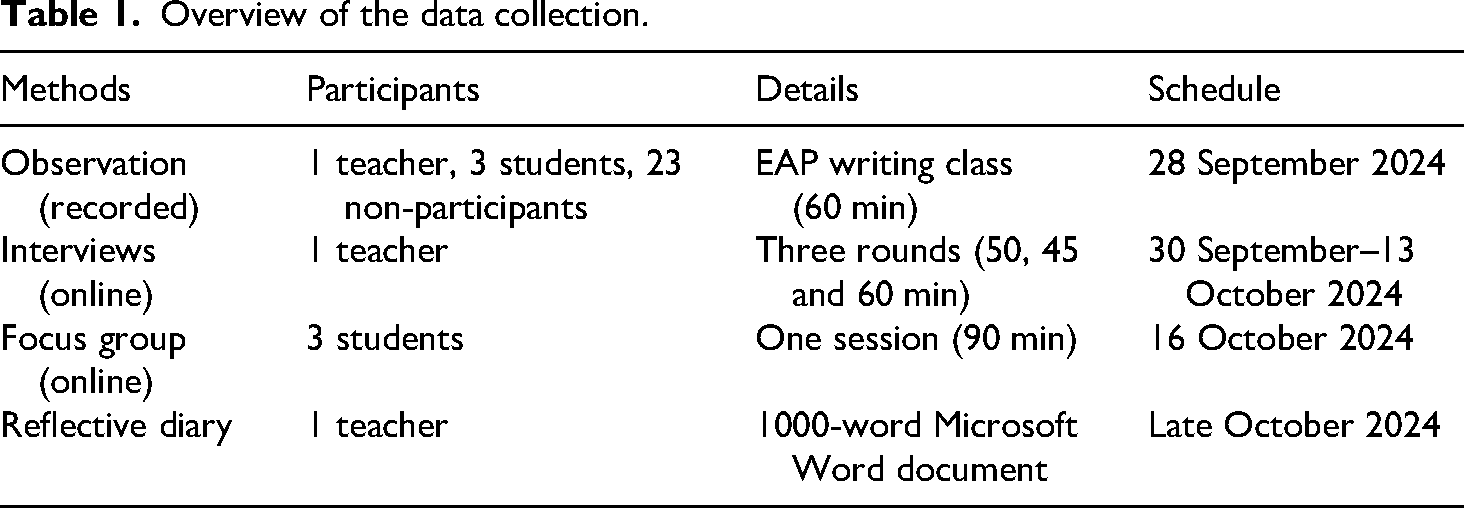
To capture multiple dimensions of teacher agency, four qualitative instruments were employed: one classroom observation, three semi-structured interviews, a student focus group and a reflective diary (see Supplementary Materials A–D). Each method served a distinct analytic function: the classroom observation documented practice-in-action; interviews explored temporal orientations of agency; the reflective diary enabled extended pedagogical sense-making; and the focus group provided insight into how pedagogical decisions were experienced by students. Together, these methods enabled triangulation across time, perspective and data type (Miles et al., 2014).
The focal classroom event was a 60-minute EAP writing lesson attended by Hasan, 3 participating students and 23 non-participants who were present during the observation and provided consent for recording and anonymisation. The session focused on genre-based writing tasks and was audio-recorded and transcribed verbatim (Richards, 2003). The lesson was selected as a typical instance of routine instruction rather than an exceptional or performative event. Importantly, the observation was not treated as a comprehensive account of agency, but as a bounded analytic window into routine pedagogical decision-making, particularly moments where Hasan adjusted explanations, task sequencing or interactional pacing. These in-situ moments were analytically interpreted in relation to interview accounts and reflective writing, allowing pedagogical reasoning to be examined beyond what was immediately observable.
Following the observation, Hasan participated in three online semi-structured interviews, each aligned with one temporal dimension of the ecological model of teacher agency: iterational (past experiences and beliefs), practical-evaluative (present actions and constraints) and projective (future aspirations) (Priestley et al., 2015). The reflective diary (approximately 1000 words, written in English) further supported analytic depth by allowing Hasan to articulate pedagogical reasoning that may not have been fully observable or interview-accessible. A 90-minute online focus group discussion, conducted in English, provided complementary insight into how Hasan's instructional adaptations were perceived by students.
Data were generated over one month, reflecting the intensive structure of the EAP writing module and its weekly assessment cycle. This temporal scope enabled close examination of situated pedagogical judgement while acknowledging limits to longitudinal tracing (see Table 1).
Overview of the data collection.
Data analysis
Data were analysed using reflexive thematic analysis (RTA) (Braun and Clarke, 2006, 2022), selected for its compatibility with an ecological understanding of teacher agency as situated, interpretive professional judgement rather than a fixed individual capacity. RTA explicitly foregrounds the researcher's role in meaning-making, aligning with the study's conceptualisation of agency as relational and contextually mediated.
Analysis followed Braun and Clarke's (2006) six recursive phases (i.e. familiarisation, coding, theme development, review, naming and reporting), moving iteratively between data and theory. Initial inductive coding captured pedagogical actions (e.g. task re-sequencing, scaffolding argumentation, selective translanguaging) alongside contextual conditions (e.g. syllabus pacing, institutional disruption). These codes were subsequently interpreted through the ecological dimensions of teacher agency (Priestley et al., 2015), allowing analytic attention to how past experiences, present constraints and future orientations informed pedagogical judgement.
To illustrate this process, Hasan's decision to simplify a citation task in response to student difficulty was interpreted as practical-evaluative judgement, whereas references to prior teaching experiences informed iterational interpretations, and expressed intentions to redesign tasks in future cycles were linked to the projective dimension. Through iterative clustering, four analytically interrelated themes were developed, foregrounding how teacher agency was enacted through routine, constraint-aligned pedagogical decisions rather than overt innovation. A summary coding framework with illustrative excerpts is provided in Supplementary Materials E to support analytic transparency.
Credibility was enhanced through triangulation across data sources, systematic reflexive memoing and brief member-checking dialogues focused on clarifying interpretations rather than validating findings (Miles et al., 2014). Consistent with RTA principles, inter-coder reliability was not pursued; instead, analytic accountability was maintained through transparency of interpretive decisions and close engagement with the data (Braun and Clarke, 2022).
The first author's insider positioning as a Bangladeshi EAP practitioner shaped both access and interpretation. Although this positionality facilitated contextual sensitivity, it also raised concerns regarding power relations and professional self-presentation in a hierarchical higher-education context. To address this, interpretations were deliberately cross-checked across multiple data sources, and reflexive memoing was used to interrogate moments of convergence and tension. Rather than seeking to neutralise positionality, these strategies rendered its influence visible and analytically productive, consistent with the epistemological assumptions of reflexive qualitative inquiry (Tisdell et al., 2025).
Findings
The analysis is organised around four interrelated themes illustrating how Hasan's teacher agency was enacted through everyday pedagogical practices in academic writing instruction. Rather than treating adaptation as inherently agentive, the findings distinguish between routine instructional adjustment and agentive pedagogical judgement, focusing on how Hasan interpreted curricular expectations, learner readiness and institutional constraints in situ.
Negotiating curriculum pacing and pedagogical recalibration
Practical-evaluative and iterational dimensions
This theme foregrounds how Hasan's teacher agency was enacted through situated judgement as he negotiated curriculum pacing and recalibrated instruction in response to students’ emerging needs. Although the EAP module required coverage of prescribed genres such as argumentative essays and reports, Hasan routinely adjusted sequencing and emphasis. He explained: ‘My long-term goals are always aligned with the course outline … But short-term goals change depending on students’ needs, like grammar issues that I have to address first’ (Interview 3).
Rather than representing resistance to the syllabus, this adjustment reflects practical-evaluative agency (Priestley et al., 2015), where institutional expectations were interpreted through learners’ immediate readiness. Student A corroborated this adaptive pacing: ‘The teacher understood we were confused in identifying fragments, so he didn’t rush. He gave another class just for examples’ (Focus group).
What distinguishes these adjustments from routine pacing decisions is their pedagogical timing and purpose. Hasan's decisions were oriented towards sustaining students’ access to core academic writing practices under constraint, rather than simply ensuring syllabus coverage. Such recalibration extended beyond pacing to instructional mediation. During one observed episode, Hasan briefly shifted to Bangla to clarify an abstract writing concept to students: Dekho, jodio essay structure fixed, tao amra nijer moto kore sajate pari, thesis mane sudhu ‘ami mone kori’ na, eta ekta prothom doro. [Even if the essay structure is fixed, we can arrange it in our own way, for example ‘thesis’ doesn’t just mean ‘I think’; it's a starting point. Author's translation.] (Observation)
Although translanguaging is a familiar strategy in Bangladeshi EAP contexts (Rafi and Morgan, 2023), its agentive significance here lay in Hasan's deployment of Bangla at moments of conceptual difficulty, enabling mediation of institutional writing norms through students’ existing linguistic repertoires.
At the same time, Hasan was aware of the limits of such recalibration. He noted: ‘Sometimes I want to go deeper into argumentative writing, but the time is too short … I just try to maintain the key structure’ (Interview 1). His reflective diary further captured how institutional disruptions constrained pedagogical depth: ‘Some lessons are rushed … because of holidays or protests. I try to adjust in tutorials, but it's not always enough’ (Diary). These accounts illustrate how Hasan's teacher agency operated within institutional constraints, mitigating their effects while simultaneously reproducing curricular logics that prioritised coverage over depth.
Reflection played a central role in sustaining this negotiation. Hasan drew on prior experience to anticipate difficulties: ‘I compare this class to those I learnt from my reading of classroom-based research from Asia … that helps me predict issues’ (Interview 3). Such reflective awareness translated into concrete pedagogical recalibration: ‘They weren’t getting the difference between an opinion and a thesis. I created a graphic organiser through PowerPoint … and it worked’ (Interview 2).
His diary reinforced this iterative orientation: ‘The lesson plan says we move to report writing this week, but students were still weak in source use. So, I took one extra class on citation skills’ (Diary, Extract 2). Rather than resisting policy, this re-sequencing demonstrates Hasan's ongoing negotiation between institutional pacing and learners’ developmental readiness.
Together, these excerpts show that Hasan's pedagogical decisions were shaped by sustained interpretive labour, deciding when to slow down, when to compress content and which academic norms could realistically be foregrounded, positioning teacher agency as a situated professional judgement rather than a departure from institutional expectations.
Culturally responsive instruction and epistemic negotiation
Projective and practical-evaluative dimensions
This theme examines how Hasan recontextualised academic writing tasks to align institutional expectations with students’ epistemic orientations, foregrounding teacher agency as epistemic mediation rather than surface-level cultural accommodation. In the Bangladeshi EAP context, academic writing often requires practices, such as establishing claims, critiquing sources or positioning oneself against authoritative texts, that may conflict with prior educational experiences shaped by deference to authority and moral consensus. Here, these orientations are understood as local epistemologies – that is, culturally and educationally shaped expectations about how knowledge and stance are legitimately expressed in academic work.
Hasan became aware of these epistemic tensions when prescribed writing prompts conflicted with students’ values. He reflected: ‘I gave an essay about having a boyfriend or girlfriend … many students resisted due to cultural background … So next time, I let them choose a culturally relevant topic’ (Interview 3). Rather than insisting on the original topic, Hasan reframed the task to preserve its academic purpose while accommodating students’ epistemic comfort zones. Student B explained: ‘We’re not used to writing about things that challenge our beliefs … it felt uncomfortable’ (Focus group).
This discomfort did not signal disengagement or lack of ability, but rather exposed a tension between institutional expectations for critical stance-taking and students’ prior epistemic orientations. As Hyland (2019) notes, dominant academic writing norms often assume familiarity with critique and contestation, whereas argumentation in many Bangladeshi classrooms is more commonly framed as balanced exposition. Hasan's decision to allow topic choice thus reflected projective agency (Emirbayer and Mische, 1998), as he anticipated how sustained epistemic dissonance might hinder participation and recalibrated tasks to support gradual engagement with academic discourse.
Importantly, this adaptation did not entail abandoning academic standards. Hasan described similar negotiations in argumentation-focused tasks: ‘When I ask students to argue against an author, many are silent. Arguing with scholars or texts not common for them. So, I now begin with neutral texts’ (Diary). In one observed episode, he reframed a hesitant student's task: ‘Let's think about examples from your own life, maybe not disagree but show a different experience, either by partially agreeing or disagreeing’ (Observation). These moves illustrate practical-evaluative judgement (Priestley et al., 2015), where institutional expectations for criticality were interpreted through students’ epistemic starting points.
Rather than treating criticality as immediate opposition, Hasan scaffolded it as graduated stance-taking, enabling incremental participation in academic argumentation without positioning students’ prior knowledge as deficient. From an EAP perspective, such mediation is pedagogically consequential, as academic writing instruction often presumes familiarity with adversarial argumentation that is not universally foregrounded in earlier educational contexts (Walková, 2024). Hasan's adaptations therefore represent context-sensitive negotiation (Ding and Monbec, 2024) rather than dilution of genre expectations, preserving academic aims while recalibrating epistemic entry points.
Collectively, these excerpts show that culturally responsive instruction in this context involved negotiating epistemic authority, not merely adjusting topics. Hasan's agency was enacted through decisions about when, how and to what extent students were invited to question texts and articulate positions, underscoring the interpretive labour required to mediate access to academic discourse under constraint.
Institutional constraints as limit and catalyst
Practical-evaluative and projective dimensions
This theme examines how institutional constraints simultaneously limited Hasan's pedagogical options and elicited responsive reconfiguration, foregrounding teacher agency as situated judgement exercised within structural conditions. In Hasan's context, disruptions to the academic calendar, syllabus rigidity and infrastructural shortcomings were recurring features of everyday EAP teaching.
Hasan described how such constraints directly shaped writing instruction: ‘We rushed through report writing due to closure for student protests … I had to skip peer feedback sessions’ (Interview 2). Student C echoed this experience: ‘We struggled with report writing because there wasn’t much time left … it felt rushed’ (Focus group). These accounts exemplify constrained teaching (Reeve and Shin, 2020), where institutional conditions actively structured Hasan's enacted pedagogical priorities rather than merely limiting choice. Opportunities for iterative drafting and peer feedback were compressed or deferred, requiring Hasan to make selective judgements about which instructional elements could be sustained.
At the same time, constraint also functioned as a catalyst for responsive reconfiguration. Reflecting on the same period, Hasan noted: ‘Midway through, I changed strategy … I added peer review to save time but still give constructive feedback’ (Diary). This adjustment illustrates practical-evaluative judgement (Priestley et al., 2015), as Hasan recalibrated pedagogical means to preserve core learning goals under reduced instructional time. Consistent with Vu's (2020) notion of responsive innovation, constraint here generated reorganisation rather than resistance, enabling pedagogical continuity without altering curricular mandates.
Material conditions further shaped Hasan's instructional decisions. He reflected: ‘The projector failed twice, and I had to use whiteboard. It slowed things down, but students followed’ (Diary). Such reliance on analogue tools did not transform curricular content but enabled continuity of instruction under infrastructural failure, reinforcing the view that teacher agency in EAP writing often operates through situated micro-level recalibration (Eteläpelto et al., 2015) rather than visible reform.
Hasan also explicitly acknowledged his alignment with institutional expectations: ‘I just follow the course outline … to prepare students for exams’ (Interview 1). Rather than signalling a lack of agency, this stance reflects reframed professionalism where compliance and adaptation coexisted (Vähäsantanen, 2015). Hasan's selective reordering of content and adaptive delivery worked through institutional norms while simultaneously mitigating their pedagogical consequences.
This positioning reveals an important tension in Hasan's practice: although his adaptations sustained students’ access to academic writing under constraint, they also risked reproducing institutional logics that prioritised coverage over depth. Teacher agency here was therefore ethically ambivalent, simultaneously enabling learning and sustaining the conditions that limited fuller engagement with writing processes.
These episodes illuminate how Hasan's teacher agency was enacted not through overt transformation of institutional structures but through interpretive decisions about which pedagogical elements could be preserved, compressed or temporarily sacrificed under constraint. This underscores teacher agency as a negotiated, professionally consequential practice in under-resourced EAP contexts.
Informal professional learning and socially distributed agency
Iterational and practical-evaluative dimensions
This theme illustrates how Hasan's teacher agency was socially distributed across informal professional networks, rather than enacted in isolation. In the absence of sustained institutional support for EAP writing pedagogy, Hasan relied on collegial relationships and peer-mediated learning to interpret curricular demands and refine assessment practices.
Hasan described how conversations with colleagues shaped his instructional decisions: ‘I talked with colleagues who were once my teachers … they helped me simplify writing rubrics’ (Interview 2). Through such dialogic engagement, Hasan adapted assessment criteria in ways that remained institutionally aligned while becoming pedagogically workable. This illustrates the co-construction of teacher agency, where professional judgement emerges through social interaction rather than individual autonomy (Scanlon and Connolly, 2021).
Beyond local collegial ties, Hasan also drew on informal transnational learning spaces: ‘Sometimes I check neighbouring such as Indian or Indonesian online teaching forums … their context is closer to ours than Western training modules’ (Interview 3). The agentive significance of this practice lay not in access to resources per se, but in Hasan's evaluative judgement regarding contextual relevance. Such selective mobilisation of knowledge aligns with accounts of self-directed professional learning (Montecinos et al., 2022) as context-sensitive rather than aspirational or prestige-driven.
Hasan also noted the lack of institutional provision for developing writing pedagogy: ‘I did not get any formal training on writing pedagogy … I learned through trial, feedback, and seeing what others do’ (Interview 2). Students recognised the outcomes of this relational learning. As Student B observed: ‘Our teacher tried new methods. It didn’t feel like he was just doing textbook things’ (Focus group).
From an ecological perspective (Priestley et al., 2015), these accounts show how meso-level social relations informed micro-level pedagogical enactment. Hasan's professional judgement was shaped through interaction with peers, regional communities and student feedback, enabling him to navigate institutional demands despite limited formal support. Teacher agency in this EAP writing context was therefore relational and cumulative, emerging through informal yet consequential professional networks rather than residing solely within the individual teacher.
Discussion
This study examined how an early-career EAP instructor in Bangladesh negotiated teacher agency while teaching academic writing under resource-constrained conditions. Interpreted through the ecological model of teacher agency (Priestley et al., 2015), the findings show that teacher agency in EAP writing instruction was enacted not through overt resistance or pedagogical innovation, but through situated, interpretive judgement exercised over time. Teacher agency emerged through the interplay of iterational resources, practical-evaluative reasoning and projective orientations as Hasan interpreted curricular demands, learner readiness and institutional constraints in everyday practice. This positions teacher agency as a negotiated and professionally consequential practice rather than a stable individual capacity.
A key contribution of the study lies in reframing curricular adaptation as agentive judgement rather than routine adjustment. Hasan's re-sequencing of content, selective pacing and strategic use of translanguaging did not challenge curricular authority but worked within it, exemplifying strategic compliance (Lasky, 2005). Although such practices are familiar in EAP classrooms, their agentive significance resided in when and why they were enacted. Hasan's decisions were guided by pedagogical responsibility to learner readiness rather than habit or efficiency, positioning teacher agency as interpretive labour enacted within institutional normativity. Reflection functioned as a mediating mechanism, linking prior experience to moment-to-moment instructional recalibration under constraint. In this respect, the findings extend existing work by showing that teacher agency may be exercised through constraint-aligned practices that preserve, rather than disrupt, dominant curricular structures (Bao et al., 2020; Ding and Monbec, 2024; Tao and Gao, 2021). In under-resourced EAP settings, teacher agency may therefore be more usefully understood in the principled decisions teachers make within largely fixed structures, shaping what kinds of writing development are realistically possible.
Building on this reframing, the findings also advance teacher agency scholarship by conceptualising culturally responsive instruction as epistemic mediation rather than surface-level accommodation. Hasan's reframing of writing prompts and scaffolding of argumentation responded to local epistemologies shaped by expectations of authority, moral positioning and knowledge production. Rather than rejecting academic writing norms that valorise critique and stance-taking, Hasan recontextualised them through graduated entry points. His projective judgement was evident in anticipating how sustained epistemic discomfort might hinder participation, prompting recalibration without abandoning genre goals. This clarifies how tensions between dominant academic norms and local epistemologies (Hyland, 2019) are navigated pedagogically through judgement rather than resolved through curricular reform, aligning with recent work on epistemic access in academic writing (Walková, 2024).
Institutional constraints further illuminated the ambivalent nature of teacher agency in EAP contexts. Disruptions to the academic calendar, rigid syllabi and infrastructural limitations constrained opportunities for drafting, feedback and peer review. Yet these same constraints elicited responsive reconfiguration, as Hasan selectively redesigned classroom processes to preserve learning goals under reduced conditions (Vu, 2020). Importantly, such adaptations also reproduced institutional logics that prioritised coverage over depth, reflecting reframed professionalism in which compliance and adaptation coexist (Vähäsantanen, 2015). Teacher agency here was ethically ambivalent: it enabled students’ access to academic writing while simultaneously sustaining the conditions that limited fuller engagement. This complicates celebratory accounts of teacher agency by foregrounding how agency may involve both mitigation and reproduction of constraint.
Finally, the study highlights teacher agency as socially distributed rather than individually enacted. Hasan's pedagogical judgement was shaped through informal collegial dialogue and regionally proximate online communities, which functioned as meso-level affordances in the absence of formal professional development. These relational resources enabled him to interpret assessment criteria, refine rubrics and sustain professional confidence, illustrating how teacher agency is co-constructed through networks rather than residing solely within the individual teacher (Montecinos et al., 2022; Scanlon and Connolly, 2021). This reinforces ecological arguments that early-career teachers’ agency is contingent on relational infrastructures rather than institutional provision alone.
Implications should be interpreted cautiously given the single-case design. Although the findings are analytically transferable, they are not intended to be generalised across EAP settings. One targeted implication for teacher education is that pre-service and early-career EAP preparation should move beyond technique-focused training to cultivate reflective, context-sensitive judgement, including engagement with pedagogical dilemmas, epistemic tensions and constraint-aligned decision-making in writing instruction.
Conclusion
This study reframes teacher agency in under-resourced EAP writing contexts not as heroic resistance or unproblematic innovation, but as everyday, negotiated pedagogical judgement enacted within institutional, epistemic and material constraints. Through an exploratory single-case study of an early-career EAP instructor in Bangladesh, the analysis demonstrates how teacher agency was exercised through routine yet consequential decisions, such as curricular pacing, scaffolding argumentation and citation practices, and mediating epistemic expectations, rather than through overt opposition to policy or curriculum. Importantly, the findings do not position teacher agency and constraint as opposites; instead, they show teacher agency being enacted within constraint, as teachers work inside institutional structures and, at times, inadvertently help sustain them.
Drawing on an ecological perspective (Priestley et al., 2015), teacher agency emerged through the interplay of iterational resources, practical-evaluative reasoning and projective orientations as Hasan navigated instructional recalibration under constraint. A central contribution lies in theorising epistemic mediation as a key site of teacher agency in EAP writing, illustrating how academic writing norms were recontextualised rather than imposed or rejected (Hyland, 2019; Walková, 2024). At the same time, the study foregrounds the ethical ambivalence of teacher agency: pedagogical adaptations both enabled students’ access to academic writing and reproduced institutional priorities that limited deeper engagement with writing processes.
The study is limited by its single-case design and short data-generation period, and the findings are analytically rather than statistically transferable (Tisdell et al., 2025). Although the researcher's insider positioning enhanced contextual sensitivity, it may also have shaped interpretation despite reflexive safeguards (Braun and Clarke, 2022). Accordingly, the contribution of this study is primarily analytic, offering insight into mechanisms of ecological judgement, epistemic mediation and ambivalent adaptation. Future research could extend these insights through longitudinal or comparative designs to examine how negotiated forms of teacher agency develop across career stages and institutional ecologies in similarly under-resourced EAP contexts.
Supplemental Material
sj-docx-1-rel-10.1177_00336882261445655 - Supplemental material for Negotiating teacher agency in English for Academic Purposes writing instruction: A case study of a Bangladeshi early-career teacher
Supplemental material, sj-docx-1-rel-10.1177_00336882261445655 for Negotiating teacher agency in English for Academic Purposes writing instruction: A case study of a Bangladeshi early-career teacher by Md Nabinur Rahman, Judith Hanks, Diana McCray and Loreto Aliaga-Salas in RELC Journal
Footnotes

Ethical considerations
This study received ethical approval from the University of Leeds Research Ethics committee (reference: 1576).
Consent to participate
All participants and relevant non-participants were provided with separate information sheets and signed informed consent forms prior to participation.
Consent for publication
All participants and relevant non-participants gave written consent for the anonymous use of their data in publication.
Funding
The authors received no financial support for the research, authorship and/or publication of this article.
Declaration of conflicting interests
The authors declared no potential conflicts of interest with respect to the research, authorship, and/or publication of this article.
Data availability statement
The data supporting this study are available from the corresponding author upon reasonable request.
Supplemental material
Supplemental material for this article is available online.
References
Supplementary Material
Please find the following supplemental material available below.
For Open Access articles published under a Creative Commons License, all supplemental material carries the same license as the article it is associated with.
For non-Open Access articles published, all supplemental material carries a non-exclusive license, and permission requests for re-use of supplemental material or any part of supplemental material shall be sent directly to the copyright owner as specified in the copyright notice associated with the article.
