




Abstract
This study examines the impact of metacognitive oral corrective feedback instruction on second-language adult learners’ metacognitive awareness of oral corrective feedback, and their spoken grammatical accuracy of definite and indefinite articles. In this exploratory experimental study, 33 Korean adult learners of English were randomly distributed into one of the following two groups: 1) receiving metacognitive instruction, or 2) not receiving metacognitive instruction. Both groups were given the Metacognitive Awareness Inventory for Oral Corrective Feedback pre- and post-instruction to examine the effectiveness of the intervention on increasing learners’ metacognitive awareness of oral corrective feedback. Learners were also given a pre- and post-test to evaluate changes in their spoken grammatical accuracy of the target grammar. Paired-sample t-test results showed that both groups increased their metacognitive awareness of oral corrective feedback as well as their spoken grammatical accuracy when using definite and indefinite articles. Analysis of variance test results showed no significant difference in the increase in metacognitive awareness and spoken grammatical accuracy between groups. The results suggest that oral corrective feedback alone may have enhanced the participants’ metacognitive awareness of oral corrective feedback. However, since both groups had heightened metacognitive awareness of oral corrective feedback, the results are inconclusive as to whether higher metacognitive awareness of oral corrective feedback significantly impacts learners’ spoken grammatical accuracy.
Keywords
Introduction
In recent years, the field of second language (L2) learning has shown a growing interest in metacognitive instruction. This trend has been driven by the increasing recognition of the significant role metacognition plays in effective L2 learning (Oxford, 2017; Sato, 2022; LJ Zhang and Zhang, 2018). Metacognition involves individuals’ knowledge and understanding of their own cognitive processes, as well as their ability to use this knowledge to regulate and control their learning (Flavell, 1976). Metacognitive instruction, therefore, entails explicitly teaching learners to be aware of their thinking processes and to use this awareness to manage and enhance their learning (Veenman et al., 1994). It has been found that explicit metacognitive instruction improves metacognition and promotes self-regulated learning through goal setting, monitoring and cognitive regulation (Pintrich, 2000). Furthermore, metacognitive instruction has been shown to enhance the effects of oral corrective feedback by fostering learners’ ability to consciously notice, interpret and internalize the feedback they receive. For example, Sato and Loewen (2018) reported in their study that learners who received metacognitive instruction were significantly more responsive to oral corrective feedback during oral tasks, particularly in terms of accurately modifying their output. This deeper awareness allows learners to treat oral corrective feedback not as isolated interruptions but as learning opportunities embedded in communication (Kartchava and Nassaji, 2017; Sato and Loewen, 2018) which can lead to greater uptake of oral corrective feedback and higher overall accuracy. Thus, metacognitive instruction is considered to enhance higher-order thinking skills and improve learning behaviors and outcomes by supporting cognitive processes (Sato, 2023).
Although a positive correlation between metacognitive instruction of oral corrective feedback and spoken grammatical accuracy was found in Sato and Loewen's (2018) study, it could not be determined how metacognitive instruction affects learners’ metacognition and whether increased metacognition resulted in greater uptake of oral corrective feedback, which led to greater accuracy in speaking. Therefore, this study set out to examine whether prior metacognitive instruction affects students’ metacognitive awareness of oral corrective feedback and if those receiving such instruction outperform others who do not in relation to spoken grammatical accuracy. Thus, the answers to the following research questions were pursued:
How does metacognitive oral corrective feedback instruction affect metacognitive awareness of oral corrective feedback among Korean adult learners of English? How does a group that receives metacognitive oral corrective feedback instruction prior to receiving oral corrective feedback perform compared to a group that receives oral corrective feedback alone regarding the spoken accuracy of a learned grammar structure (use of definite and indefinite articles)?
This study contributes to a greater understanding of possible impacts of metacognitive instruction of oral corrective feedback on learners’ metacognitive awareness of oral corrective feedback as well as its effects on learners’ spoken grammatical accuracy. The results contribute to greater awareness of the impact of metacognitive instruction which can inform L2 teachers’ decision making when considering whether to engage in metacognitive instruction in their classrooms if their goal is to help learners to increase their spoken grammatical accuracy. The results also have important implications for researchers as they highlight avenues that require further exploration in this area.
Literature Review
Metacognitive Instruction and English-Language Learners’ Proficiency
Metacognitive instruction is explicit instruction from teachers designed to enhance students’ metacognition and learning in general (Veenman et al., 1994). According to Veenman (1998), instructors are able to provide successful metacognitive instruction by following three fundamental principles: (a) embedding metacognitive instruction in the content matter to ensure connectivity; (b) informing learners about the usefulness of metacognitive activities to incite them to exert the initial extra effort; and(c) using prolonged training to guarantee the smooth and maintained application of metacognitive activity, which is also known as the WWW&H rule: What to do, When, Why and How. In accordance with these principles, Wenden (1998) presented the following procedures of metacognitive instruction:(a) eliciting learners’ metacognitive awarenes; (b) having them articulate the things that have come to awareness; (c) confronting them with an alternative view; and (d) having them reflect on the appropriateness of revision and expansion of their knowledge.
The studies that have investigated the impact of metacognitive instruction on L2 proficiency to date have yielded generally positive results. For example, a study by Vandergrift and Tafaghodtari (2010) investigated the effects of metacognitive instruction on the listening comprehension of L2 learners. In the 13-week study with 106 university French learners, metacognitive listening instruction was found to significantly improve learners’ listening comprehension compared to the control group. The results suggest that explicitly teaching learners how to plan, monitor and evaluate their listening can lead to measurable improvements in L2 listening proficiency. L Zhang et al. (2022) additionally found that metacognitive instruction significantly increased metacognitive awareness as well as the students’ listening skills. In this study, a classroom-based intervention was conducted with 136 students in Singapore learning Chinese as an L2. The results showed that metacognitive instruction incorporating the Metacognitive Awareness Listening Questionnaire (MALQ) enhanced students’ levels of self-regulation and performances in listening tasks.
Over time, metacognition has emerged as a strong predictor of learning outcomes across various subjects. For instance, Donker et al. (2014) conducted a meta-analysis of 58 studies and found that instructions targeting metacognitive strategies and knowledge had a moderate to large positive effect on students’ academic performance, particularly in writing, science and reading. Despite these promising findings and the potential benefits of increased metacognition in language learning, research on metacognitive instruction in relation to grammatical accuracy remains limited.
One of the only studies to look at the impact of metacognitive instruction of oral corrective feedback on learners’ oral grammatical accuracy was conducted by Sato and Loewen (2018). In their study, 83 university students of English as a Foreign Language (EFL) in Chile were separated into 4 groups: the metacognitive instruction + input-based oral corrective feedback group, the only input-based oral corrective feedback group, the metacognitive instruction + output-based oral corrective feedback group and the only output-based oral corrective feedback group. The target grammar focused on in this study was third-person singular –s and possessive determiners his/her. Among the groups, those who were treated with oral corrective feedback and metacognitive instruction outperformed other groups who received only oral corrective feedback in their accuracy of producing possessive determiners. Their results showed that metacognitive instruction generally improved the effectiveness of oral corrective feedback and learners’ uptakes by helping students notice and prompt more accurate modified outputs. However, they noted that the effectiveness of oral corrective feedback might depend on the type of feedback and linguistic target. Similarly, results from another study conducted by Kobayashi (2020) suggested that metacognitive instruction in oral communication can enhance self-regulation and interactional competence of learners. In this study, 58 participants from 4 oral communication classes at a private university in Japan were separated into 2 groups: the treatment group (n = 28) and the control group (n = 30). The results showed that students in the treatment group became more self-regulated learners and achieved greater gains in interactional competence, regulation of cognition, cognitive strategies and interaction strategies.
Oral Corrective Feedback and Metacognitive Awareness
Ellis (2006) defines oral corrective feedback as ‘[teachers’] responses to learner utterances containing an error’ (28). Oral corrective feedback can be categorized into two dimensions: (a) providing positive evidence, and (b) indicating explicitness (Lyster et al., 2013; Sheen and Ellis, 2011). According to the first dimension, the categorization divides the types of oral corrective feedback into input-providing and output-prompting oral corrective feedback. With input-providing oral corrective feedback, teachers provide the target language to learners with reformulations of their errors. Output-prompting oral corrective feedback provides learners with opportunities for self-corrections in conversations by withholding the target language. Through oral corrective feedback, learners can become more aware of their inaccuracies which can lead to an increase in spoken grammatical accuracy (Izumi and Bigelow, 2000). Additionally, through repetition of oral corrective feedback, learners can become more aware of its usefulness, leading to higher metacognitive awareness of oral corrective feedback (Sato, 2022).
There has been some work done, although minimal, which has examined the influence of oral corrective feedback on English-language learners’ metacognitive awareness. For instance, Wong and Dela Cruz (2021) explored how preferences for oral corrective feedback, particularly oral and positive feedback, led to higher levels of metacognitive awareness among senior high school students. The findings of this study highlight the importance of aligning feedback types with student preferences to foster metacognitive development (Wong and Dela Cruz, 2021). In addition, oral corrective feedback can also serve as a key element of metacognitive support in learning environments. According to the study by Biswas et al. (2006), it was demonstrated that learners who received oral corrective feedback focused more effectively on tasks and enhanced their metacognitive efficiency, especially when paired with targeted instructional strategies. The results of these studies suggest that oral corrective feedback can significantly impact learners’ self-regulation skills, contributing to improved metacognitive monitoring and control (Biswas et al., 2006). However, from these limited studies it remains unclear how metacognitive instruction may impact learners’ metacognitive awareness of oral corrective feedback since oral corrective feedback alone may contribute to students being more cognitively aware of it. Furthermore, studies to date have not clarified how metacognitive instruction may influence the effectiveness of oral corrective feedback, and therefore it remains uncertain whether the enhanced effect of oral corrective feedback is due to the metacognitive instruction itself or other factors, such as the general higher metacognition levels in older age groups (see Weil et al., 2013), which could improve performance in metacognitive activities.
Methodology
This study adopted an experimental exploratory design (Creswell and Creswell, 2018) as it is a small-scale, preliminary study aimed to explore (rather than conclude) the effects of metacognitive instruction on the metacognitive awareness and spoken accuracy of Korean adult EFL learners.
In this study, definite and indefinite articles were selected as the primary grammar point of focus as they have been noted as posing a significant challenge not only to individuals whose first language (L1) lacks articles but also to those whose native language includes them (Yoo, 2009). Furthermore, definite and indefinite articles have been reported as the most common grammatical mistakes made among Korean EFL learners (Yoon, 2012). As the participants in this study were mixed-level adult Korean EFL learners, the researchers predicted that targeted explicit instruction alone would have a minimal impact on their accuracy in oral usage. However, the researchers hypothesized that the group receiving metacognitive instruction would develop a higher metacognitive awareness of oral corrective feedback which would then lead to higher spoken accuracy of a learned grammar point (definite and indefinite articles).
Participants
The study was conducted in South Korea with 33 Korean adult students between 21 and 58 years of age who were attending English speaking-focused one-on-one classes at a private language institute in Seoul, South Korea. Following Institutional Review Board approval, all participants took part in this study on a voluntary basis and written informed consent was gathered prior to data collection. To recruit a representative sample, as suggested by Mackey and Gass (2005), the participants were recruited through simple random sampling procedures which involved random distribution of the sample among the adult students in level 1 and 2 classes at the institute. Adult learners were specifically chosen to participate in this study as they tend to have a higher level of uptake than children (Oliver and Grote, 2010). The average speaking proficiency level of the participants ranged from novice-high to intermediate-low (ACTFL, 2012).
Materials
In this study, the Metacognitive Awareness Inventory for Oral Corrective Feedback (MAIOCF) was administered prior to instruction and post-instruction to examine changes in participants’ level of metacognitive awareness of oral corrective feedback. The MAIOCF was specifically developed for this study because no existing valid or reliable measurements to measure metacognitive awareness of oral corrective feedback could be found when this research was conducted. Thus, the researchers drew from the survey by Mokhtari and Reichard (2002) which was used to measure students’ metacognitive awareness of reading strategies. The researchers adapted the questions from a reading strategy focus to an oral corrective feedback focus by referring to the guidelines for oral corrective feedback outlined by Ellis (2009), resulting in a total of 12 Likert-scale questions. The reliability of MAIOCF measured by Cronbach's alpha showed a high-reliability coefficient (.873).
Pre- and Post-Test Materials
Picture description tasks were used to measure the speaking accuracy of definite and indefinite articles in a pre-test and an immediate post-test (see Appendix D). In contrast to the study by Sato and Loewen (2018), drawn pictures, as opposed to real photos, were used for the tasks to avoid ambiguity. As shown in Appendix D, the participants were offered the same style of tasks but different pictures to avoid excessive overlap and repetition which might affect their performances. Participants were asked to describe the characters’ jobs, what they would say to purchase the listed items, and to identify problems the characters were encountering in the picture. The job and item tasks focused on participants’ oral use of indefinite articles, while the problem task focused on their oral use of definite articles.
Data Collection Procedures
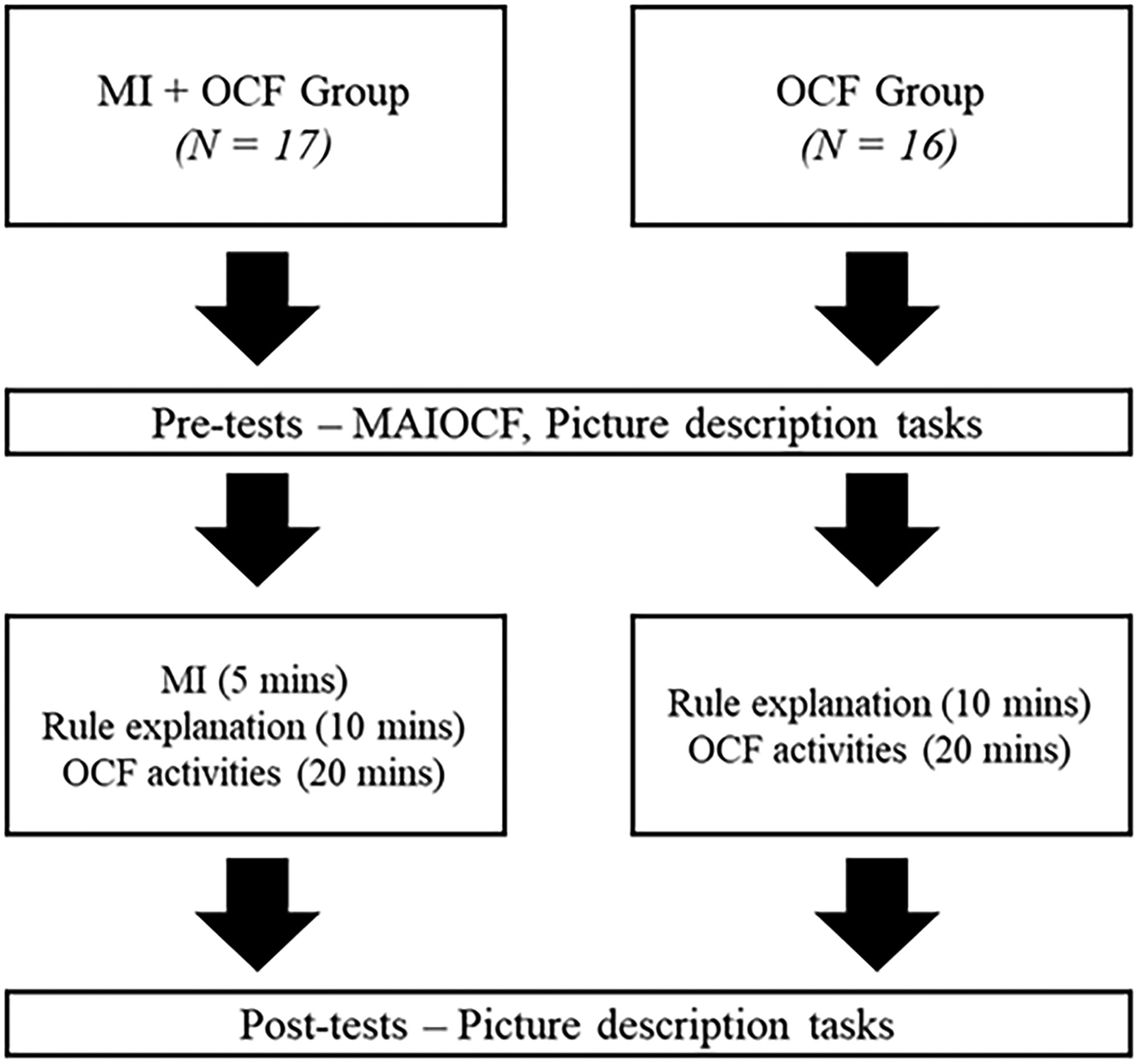
Each student in the two groups had a one-on-one class taught by the first author who acted as the teacher for all groups to keep the instruction as consistent as possible. The participants were randomly distributed to one of the following two groups: (a) the metacognitive instruction + oral corrective feedback (MI + OCF) group and (b) the only oral corrective feedback (OCF) group. The OCF group worked as a control group since the metacognitive instruction of oral corrective feedback was the main variable of the study. Every student in the groups individually attended the class so they had an equal amount of practice time with the teacher (Figure 1).
The Overall Design of the Study.
First, prior to instruction, all participants in both groups completed the MAIOCF in the pre-test phase. In addition, the students’ accuracy levels of the target grammar were measured by the sets of picture-based tasks. After the pre-test, each participant in the MI + OCF group had approximately five minutes of metacognitive instruction of oral corrective feedback while each participant in the OCF-only group moved straight to rule explanations about the targeted grammar. While the metacognitive instruction lasted only five minutes, this design reflects the recommendation of Cohen (2003) who states that strategy training – including cognitive strategies and metacognitive strategies – should be adapted to classroom realities and learner needs rather than fixed timeframes. As the participants in this study were all adult learners of English who had years of experience receiving oral corrective feedback, the researcher felt that five minutes of explicit metacognitive instruction of oral corrective feedback would be suitable to raise their awareness of the purpose and importance of this type of feedback – their metacognitive awareness of oral corrective feedback.
Metacognitive instruction of oral corrective feedback was based on Wenden's (1998) five steps in order to increase the students’ metacognitive awareness: (a) introduction to oral corrective feedback; (b) explanation of the effectiveness of oral corrective feedback; (c) discussion of oral corrective feedback; (d) preparation of getting oral corrective feedback; and (e) reminder of oral corrective feedback. This metacognitive instruction was only delivered to participants in the MI + OCF group. In the first stage, the teacher explained what oral corrective feedback is, what recasts and clarifications requests are and the objectives of each. In stage 2, the students were taught how oral corrective feedback supports learners in developing L2 speaking skills. In the third stage, the students had opportunities to ask questions and have a discussion about the purpose and benefits of oral corrective feedback. In the fourth and fifth stages, the teacher told students that they would be receiving oral corrective feedback through recasts and clarification requests (so that they were prepared for it) and reminded students that they would be receiving oral corrective feedback before each of the classroom activities. The target structure was not used at this stage to maintain equal conditions between the control group and the experimental group. In line with the suggestions of Cummins (2007) and Cook (2001), as the teacher and students both shared the same L1 (Korean), the grammar rule explanations were offered to every individual in their L1 (Korean) to avoid any misunderstanding of the targeted grammar.
The grammar rule explanations were presented at the beginning of each class for 10 minutes following the grammar explanation provided in Basic Grammar in Use (Murphy and Smalzer, 2011). The participants were explicitly introduced to definitions and usage of definite and indefinite articles with reference to example sentences. In order to check whether students understood the target grammar correctly, the teacher posed follow-up questions to students which required them to explain whether a definite or indefinite article is required in additional example sentences and why a definite or indefinite article should be used. After receiving the teacher's explanation about the targeted grammar, the students individually engaged in picture description activities for 20 minutes which focused on the use of definite and indefinite articles. While monitoring the tasks, the teacher used an equal mix of input and output-based oral corrective feedback when students made incorrect uses in their utterances. Each participant was given the opportunity to practice using definite and indefinite articles aloud with the teacher when they were asked to produce eight sentences. Specifically, the participants were asked to look at pictures on PowerPoint slides and describe them with specific attention being paid to the use of definite and indefinite articles. Each participant received on-the-spot oral corrective feedback when they made mistakes during this activity. The teacher used both input-based and output-based oral corrective feedback equally, alternating between these types for each correction to mitigate potential impacts on participants’ performances associated with different types of feedback. As a source of input-based oral corrective feedback, conversational recasts were provided whereas clarification requests were offered as a type of output-based oral corrective feedback. Recasts and clarification requests were selected as the primary types of oral corrective feedback as these strategies align closely with the established teaching practices in South Korean English classrooms (Lee, 2007; Sheen, 2004), ensuring that participants were already familiar with these feedback methods. By leveraging their existing familiarity, the study aimed to maximize the participants’ ability to engage with and benefit from the feedback, thereby enhancing their overall learning outcomes. After completing these picture description activities and receiving oral corrective feedback from the teacher, the students participated in an immediate post-test to measure their metacognitive awareness of oral corrective feedback and the effect of the metacognitive instruction of oral corrective feedback.
Data Analysis
Paired-samples t-tests and one-way between-groups analysis of variance (ANOVA) were used to compare the average scores of the 12 questions in MAIOCF and spoken grammatical accuracy percentages before and after instruction. In order to calculate grammatical accuracy in L2 speaking and percentages of the participants’ correct use of articles in sentences, this study referred to the extended formula of Obligatory occasion analysis (see Pica, 1983; Thewissen, 2015).

The obligatory contexts involve the number of the participant's correct use of target features while all of the incorrect uses are counted as oversuppliances. In the case of this study, the correct use and incorrect use of articles in sentences produced by the students during the picture description tasks in the pre-test and post-test were counted and calculated based on the formula above. Based on the accuracy scores of the participants, paired-samples t-test and one-way between-groups ANOVA were administered to determine if one of the two groups showed a significant difference from the other in terms of speaking accuracy when using definite and indefinite articles.
Results
The Impact on Metacognitive Awareness
The first research question of the study concerns the impact of metacognitive instruction of oral corrective feedback on metacognitive awareness of oral corrective feedback. In terms of metacognitive awareness of oral corrective feedback, a paired-sample t-test was used to compare each group's results in the pre-test with their scores in the post-test. Although researchers hypothesized that only the group with metacognitive instruction would show increased metacognition of oral corrective feedback, both groups demonstrated significant improvement from pre-test to post-test. As shown in Table 1, the MI + OCF group achieved a statistically significant improvement in the MAIOCF scores from the pre-test (M = 3.95, SD = 0.58) to the post-test (M = 4.62, SD = 0.30, t (16) = 4.60, p < .05 (two-tailed)). The mean increase in the MI + OCF group was 0.67 with a 95% confidence interval ranging from 0.36 to 0.99. The eta squared statistics for the MI + OCF group (.57) indicated a large effect size. The OCF-only group also had statistically significant improvement in the MAIOCF scores from the pre-test (M = 4.24, SD = 0.47) to the post-test (M = 4.70, SD = 0.25, t (15) = 5.593, p < .05 (two-tailed)). The mean increase in the OCF-only group was 0.46 with a 95% confidence interval ranging from 0.29 to 0.63. The eta squared statistics for the OCF-only group (.68) also showed a large effect size.
Descriptive statistics for metacognitive awareness of oral corrective feedback.
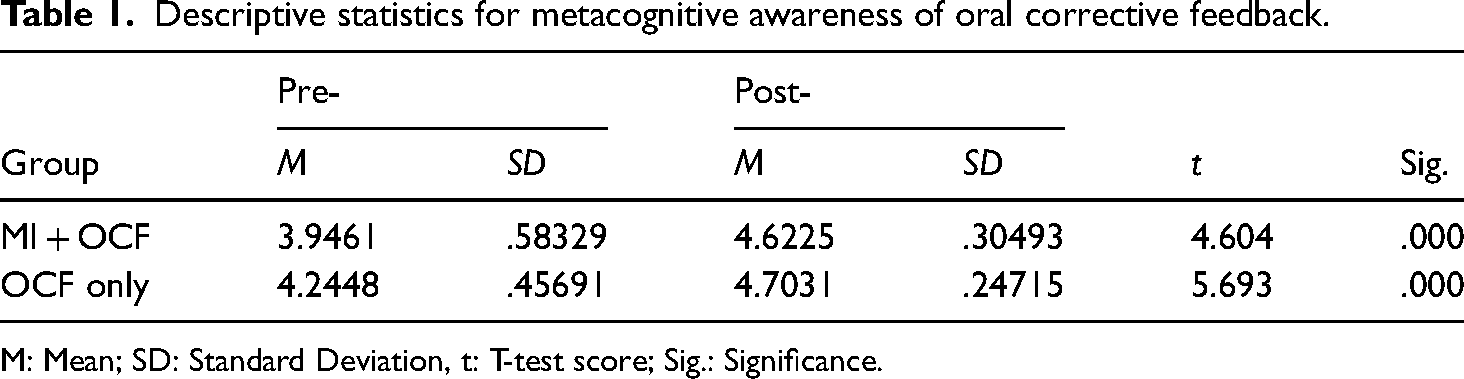
M: Mean; SD: Standard Deviation, t: T-test score; Sig.: Significance.
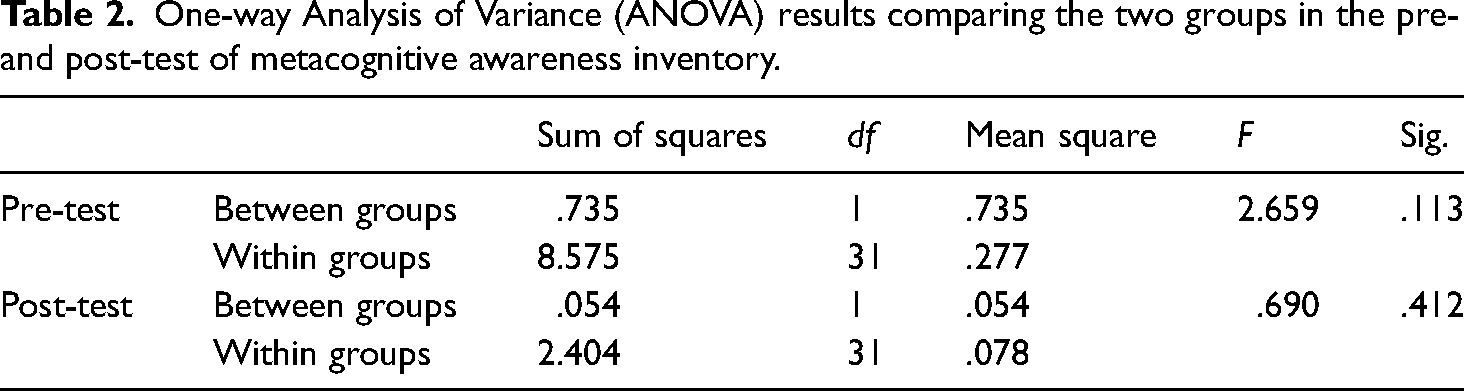
Furthermore, a one-way between-groups ANOVA was conducted to examine the differences in metacognitive awareness between the groups in each test. Table 2 shows that there was no significant difference at the p > .05 level in the scores of MAIOCF for the two groups in the pre-test: F (1, 31) = 2.659, p = .113. The effect size, calculated using eta squared, was about 0.08. In the post-test, there was also no significant difference at the p > .05 level in the scores of MAIOCF for the groups: F (1, 31) = 0.690, p = .412. The effect size, calculated using eta squared, was around 0.02.
One-way Analysis of Variance (ANOVA) results comparing the two groups in the pre- and post-test of metacognitive awareness inventory.
The Impact on Spoken Accuracy
This study's second research question is concerned with the participants’ spoken accuracy of the use of definite and indefinite articles. This question was also answered based on the comparison of the results between the pre-test and the post-test and the ones between the groups. In contrast to what the researchers hypothesized, there was a statistically significant improvement in both groups in their spoken accuracy of the target grammar point when comparing the pre-test and the post-test results (see Table 3). The results show that the MI + OCF group significantly improved their spoken accuracy from the pre-test (M = 53.59, SD = 30.25) to the post-test (M = 92.81, SD = 18.82, t (16) = 5.49, p < .05 (two-tailed)). The mean increase in the MI + OCF group was 39.22 with a 95% confidence interval ranging from 24.08 to 54.36. The eta squared statistics for the MI + OCF group (.65) indicated a large effect size. In addition, the OCF-only group also showed an increased level of speaking accuracy from the pre-test (M = 26.38, SD = 20.25) to the post-test (M = 88.21, SD = 13.73, t (15) = 13.63, p < .05 (two-tailed)).
Descriptive statistics for speaking accuracy of definite and indefinite articles.
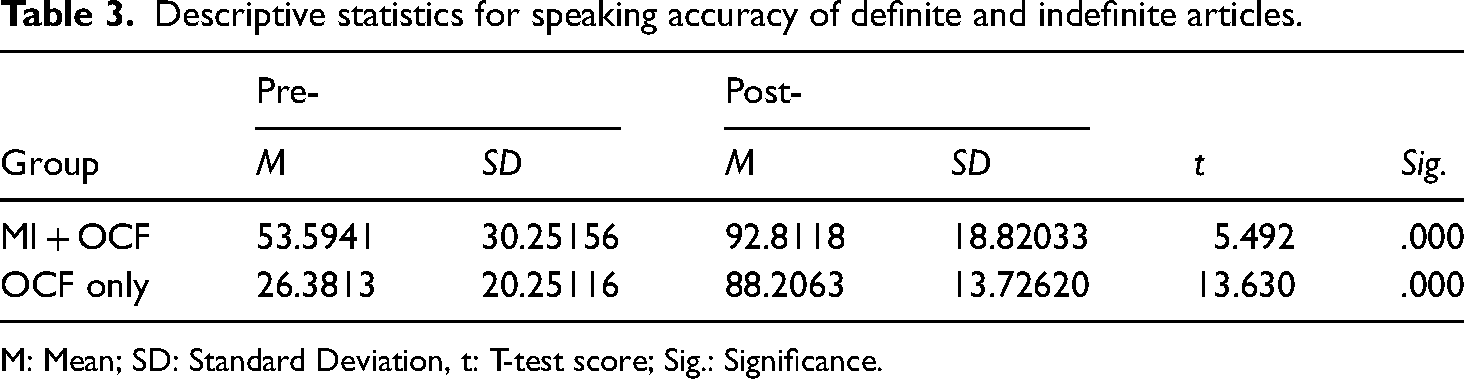
M: Mean; SD: Standard Deviation, t: T-test score; Sig.: Significance.
A one-way between-groups ANOVA was used to investigate the difference between the groups in the scores of their spoken accuracy. According to Table 4, there was a significant difference at the p < .05 level in the scores of speaking accuracy for the two groups in the pre-test (F (1, 31) = 9.10, p = .005, the effect size = 0.23), and no significant difference in the post-test (F (1, 31) = 0.638, p = .430, the effect size = 0.02).
One-way Analysis of Variance (ANOVA) results comparing the two groups in the pre- and post-test of spoken grammatical accuracy.
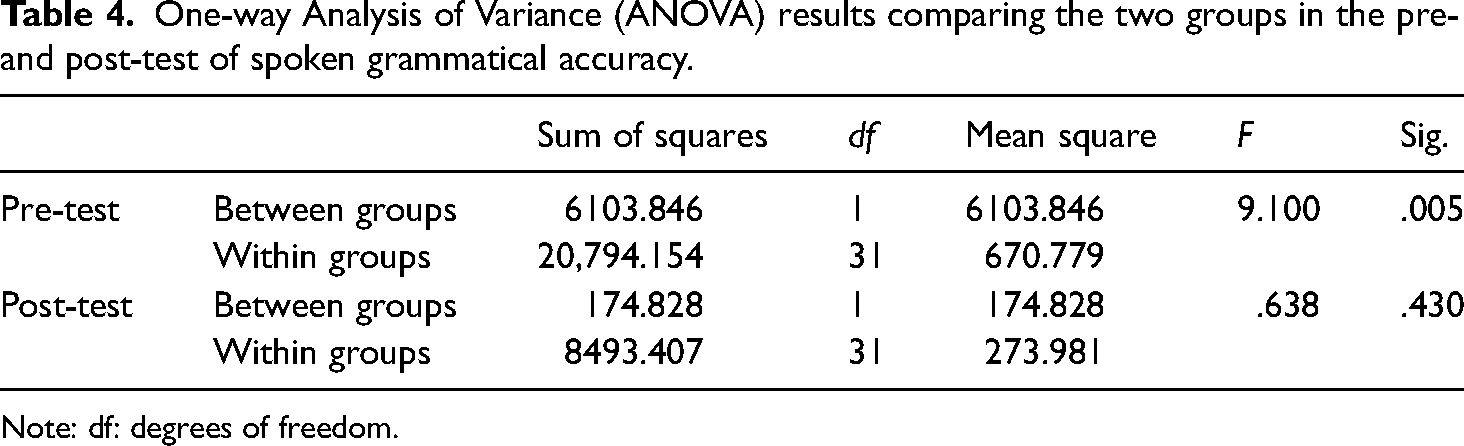
Note: df: degrees of freedom.
Discussion
This small-scale, exploratory experimental study investigated the impact of metacognitive instruction of oral corrective feedback on metacognitive awareness and spoken grammatical accuracy of definite and indefinite articles among Korean adult learners of English. Overall, the results of this study showed that both groups increased their metacognitive awareness of oral corrective feedback and spoken grammatical accuracy in speaking regardless of whether they received metacognitive instruction prior to oral corrective feedback or not. However, the two groups showed no significant difference in the amount of improvement of their metacognitive awareness of oral corrective feedback and spoken grammatical accuracy after the treatment.
Regarding the first research question, which asked how metacognitive instruction of oral corrective feedback affects the students’ metacognitive awareness of oral corrective feedback, the data showed that the group who received the metacognitive instruction of oral corrective feedback achieved significantly higher metacognitive awareness of oral corrective feedback. These results align with the results reported in Sato and Loewen's (2018) study. However, the participants in the OCF-only group also showed a higher score in their metacognitive awareness of oral corrective feedback even though they did not receive the metacognitive instruction of oral corrective feedback. In line with Sato (2022), the results of this study suggest that the adult learners’ metacognitive awareness of oral corrective feedback may have been enhanced by oral corrective feedback alone, repetitively provided by the teacher. In addition, the questionnaire itself might have worked as a tool to strengthen the participants’ metacognitive awareness since completing the survey stimulated students to think about oral corrective feedback. Since both groups seemed to have a significant increase in their metacognitive awareness of oral corrective feedback, the results suggest that explicit metacognitive instruction of oral corrective feedback may not be necessary to increase learners’ metacognitive awareness of oral corrective feedback. Adult learners most likely already have a higher level of metacognition (Weil et al., 2013), which might help them to enhance metacognitive awareness of oral corrective feedback by simply participating in classes and being surrounded by an oral corrective feedback-rich environment. This finding is aligned with the idea that metacognitive development can be implicitly enhanced as well as explicitly taught by metacognitive instruction (Veenman et al., 2006). In this respect, oral corrective feedback itself may have been enough to promote the participants’ metacognitive development and raise the participants’ metacognitive awareness of oral corrective feedback (Biswas et al., 2006; Wong and Dela Cruz, 2021); however, more research in this area needs to be conducted to make a stronger conclusion.
This study's second question asked how the MI + OCF group performed compared to the OCF-only group in regard to spoken accuracy of definite and indefinite articles. According to the data, both groups showed significant improvement in speaking accuracy of using articles in the post-test. This result is also aligned with the findings reported by Sato and Loewen (2018). Despite the higher scores of the two groups in the post-test, no significant difference between groups was found in terms of their spoken accuracy of the target grammar. The participants were able to achieve higher spoken accuracy of the use of definite and indefinite articles regardless of receiving metacognitive instruction of oral corrective feedback. This result poses counter-evidence to the results of other L2 acquisition studies showing metacognitive instruction promoted general L2 development including speaking accuracy (e.g. Sato and Loewen, 2018). The results indicate that receiving a teacher's explicit oral corrective feedback alone during class may be enough to spark adult learners’ metacognitive awareness of oral corrective feedback and lead to improvements of their spoken accuracy of the use of definite and indefinite articles.
Conclusion
This study contributes to a greater understanding of metacognitive instruction and L2 development by providing further empirical evidence regarding the relationship among metacognitive instruction, metacognitive awareness and spoken grammatical accuracy in L2 speaking. Based on a quantitative analysis of the scores of the two groups in this study, the results suggest that metacognitive instruction of oral corrective feedback may help L2 learners to increase their metacognitive awareness of oral corrective feedback and speaking accuracy in their utterances. However, teachers’ oral corrective feedback alone in a classroom environment may be powerful enough for adult learners to enhance their speaking accuracy as well as students’ metacognitive awareness of oral corrective feedback.
In addition, the results of this study raise a question regarding changes in metacognition of learners relating to age. According to developmental differences in metacognition, older children and adults have a higher level of metacognitive awareness than younger children (Baker, 1989). Even though Baker (1989) stated the possibility of age-related changes in metacognition during adolescence and adulthood, there is little literature to be found in this area. Based on the results of this study, it is recommended that teachers consider offering more activities with oral corrective feedback rather than utilizing direct metacognitive instruction of oral corrective feedback in the case of teaching L2 speaking to older students because they may have relatively greater metacognitive awareness of corrective feedback due to their previous classroom experiences.
We must point out that this study does come with some limitations. In this study, the learners’ metacognitive awareness of oral corrective feedback was measured through a self-reported questionnaire containing 12 Likert-scale questions. Traditionally, a self-report is the most common method to measure metacognition (Haukås, 2018); however, there is not any method to prove that an individual's metacognition has, in fact, been enhanced. Moreover, more accurate scores of metacognitive awareness of oral corrective feedback may have been garnered with a greater number of questions being added to the questionnaire. In the future, it is important for researchers studying metacognition in language learners to consider such limitations and work towards developing more accurate and effective tools to measure metacognition-related changes. Specifically, we recommend that future studies employ more reliable methodologies than self-reported surveys to assess changes in metacognitive awareness over time. Incorporating observational assessments or performance-based tasks could enable researchers to identify instances of enhanced metacognitive awareness through behavioral evidence rather than just self-reported data.
Furthermore, as this study was a small-scale exploratory study, future studies should be conducted with a larger number and a broader range of participants with different language backgrounds and skill levels to increase the generalizability of results. Moreover, future studies may also benefit from exploring how variations in teachers’ metacognitive instruction of corrective feedback impacts learners’ metacognitive awareness of corrective feedback since the metacognitive instruction in this study was controlled by having only one teacher teach the experimental group following the very specific procedures outlined in the methodology section. Additionally, conducting longitudinal studies would help to shed light on the possible lasting impact of metacognitive instruction on language skills, showing how these abilities may change and strengthen over time. Finally, based on the results of this study, we suggest that future research examines how age may impact the effects of metacognitive instruction of oral corrective feedback. Future work which implements these recommendations can lead to a deeper understanding of metacognitive instruction in language learning and how it may impact spoken grammatical accuracy.
Footnotes
Funding
The authors received no financial support for the research, authorship and/or publication of this article.

Appendix A
Appendix B
Appendix C
Appendix D
Picture description tasks for articles
(modified from Side by Side: Student Book 1 & 3 (Molinsky and Bliss (2001))
[Task A – What do they do?]
What are their jobs? (He/she is ∼)
What would you say to buy the following items? (I would like to buy ∼)
What are the problems in the pictures below?