



Abstract
As English continues to evolve as a global lingua franca, integrating Global Englishes into language education has become increasingly vital to address the diverse communicative needs of learners. However, research on the implementation of Global Englishes Language Teaching (GELT) framework in high school contexts, particularly for teacher education and curriculum innovation, remains limited. This qualitative study explored the needs of Macau high school students for GELT curriculum innovation and their perspectives on in-service GELT professional development. Through thematic analysis of the data collected from semi-structured interviews, the findings revealed students’ strong demand for changes across multiple dimensions of GELT, highlighting a gap between the current ELT curriculum and GELT, while also identifying opportunities for a greater alignment to GELT. Students considered multifaceted in-service GELT professional development crucial for empowering teachers to implement and localise GELT practices effectively. Rather than viewing GELT as an abstract concept, students recognised its practical value in motivating their English learning and preparing them to function as future English as a lingua franca (ELF) speakers. The study offers significant implications for the contextualisation of GELT in high school settings in Macau and beyond, shedding light on language policy change, teacher education reform, and curriculum innovation.
Keywords
Introduction
Under the influences of globalisation and social mobility, multilingualism has become commonplace worldwide, accompanied by the widespread use of various forms of English. Such phenomena have also extended to China's Macau Special Administrative Region (SAR). Given Macau's past colonial history, long immigration tradition, and the fast development of its gambling and hospitality industry, Macau has become a region with a multilingual landscape. In particular, Chinese and Portuguese are Macau's official languages. The residents also speak a mixture of different first languages (L1s), including Cantonese, Putonghua (Chinese Mandarin), Portuguese, and other Southeast Asian languages. In 2021, among Macau's 568,662 residents, 546,971 were Chinese, in addition to 8837 Portuguese, 5302 Filipino, 366 Thai, 1484 Vietnamese and 729 Indonesian (Macau SAR Statistics and Census Service, 2021). More recently, Macau has attracted many international visitors, most of whom are from non-English-speaking regions, including Europe, East and Southeast Asia (Macau SAR Statistics and Census Service, 2023). Given the social mobility across borders, there is an urgent need for the government to prepare Macau residents as speakers of English as a lingua franca (ELF) with sufficient English proficiency, intercultural competence, and various skills, such as project management, digital marketing and team collaboration, to deal with global issues in an international and multilingual setting.
Meanwhile, Macau SAR government has launched a professional development scheme to support local in-service English teachers financially, but it remains unclear how the needs of Macau high school students are considered in this scheme. In particular, traditional ideologies of native-speakerism in English language education seem to still heavily influence English language teacher education curricula and objectives involved in the scheme (see Macau SAR Education and Youth Development Bureau, 2024). For instance, the in-service professional development curricula in this scheme seem to neglect the existence and influence of the global spread of English and students’ contextual needs for becoming successful ELF speakers in international and multilingual settings. Instead, they tend to provide linguistic support and pedagogical supplements to high school English teachers, promoting accuracy teaching and Standard English norms in Macau high schools. At the same time, English Language Teaching (ELT) in Macau secondary education is driven by the institutional need for students to obtain a high score in the written exams, which is underpinned by the ideology of Standard English, rather than student needs for communicative competence in ELF settings. This oversight is particularly significant given Macau's multilingual landscape and the increasing number of visitors from different linguistic and cultural backgrounds. Therefore, there is a mismatch between in-service professional development for secondary English teachers and the contextual needs of their students. It remains questionable how student needs are considered in the professional development curricula, though these needs should be at the centre of decision making in teacher education.
Given the mismatch between Macau's local multilingual landscape and the issues identified in the professional development scheme for in-service English teachers, this study unpacks high school students’ needs for curriculum innovation and teacher education in responding to the pedagogical needs of the global spread of Englishes. This study aims to inform language policy change, teacher education reform and curriculum innovation in Macau and other similar contexts where traditional ELT prevails. More importantly, this qualitative study provides a crucial understanding of student needs of under-researched groups outside tertiary education, which will respond to the call for contextualisation of pedagogical implications of the global spread of English in specific contexts (Rose et al., 2021).
Literature Review
Global Englishes Language Teaching
Underpinned by Global Englishes (GE) that refers to the diversity and fluidity of the linguistic, sociolinguistic and sociocultural features of English use and users worldwide, Global Englishes Language Teaching (GELT) is a framework that serves to inform research and curriculum innovation in ELT (Rose and Galloway, 2019). The original framework proposed by Galloway (2011) attempted to provide nine themes to address the pedagogical implications of the global spread of English, showcasing the oppositions between ELT and GELT (see Table 1).
The Adapted Original GELT Framework (Galloway, 2011).
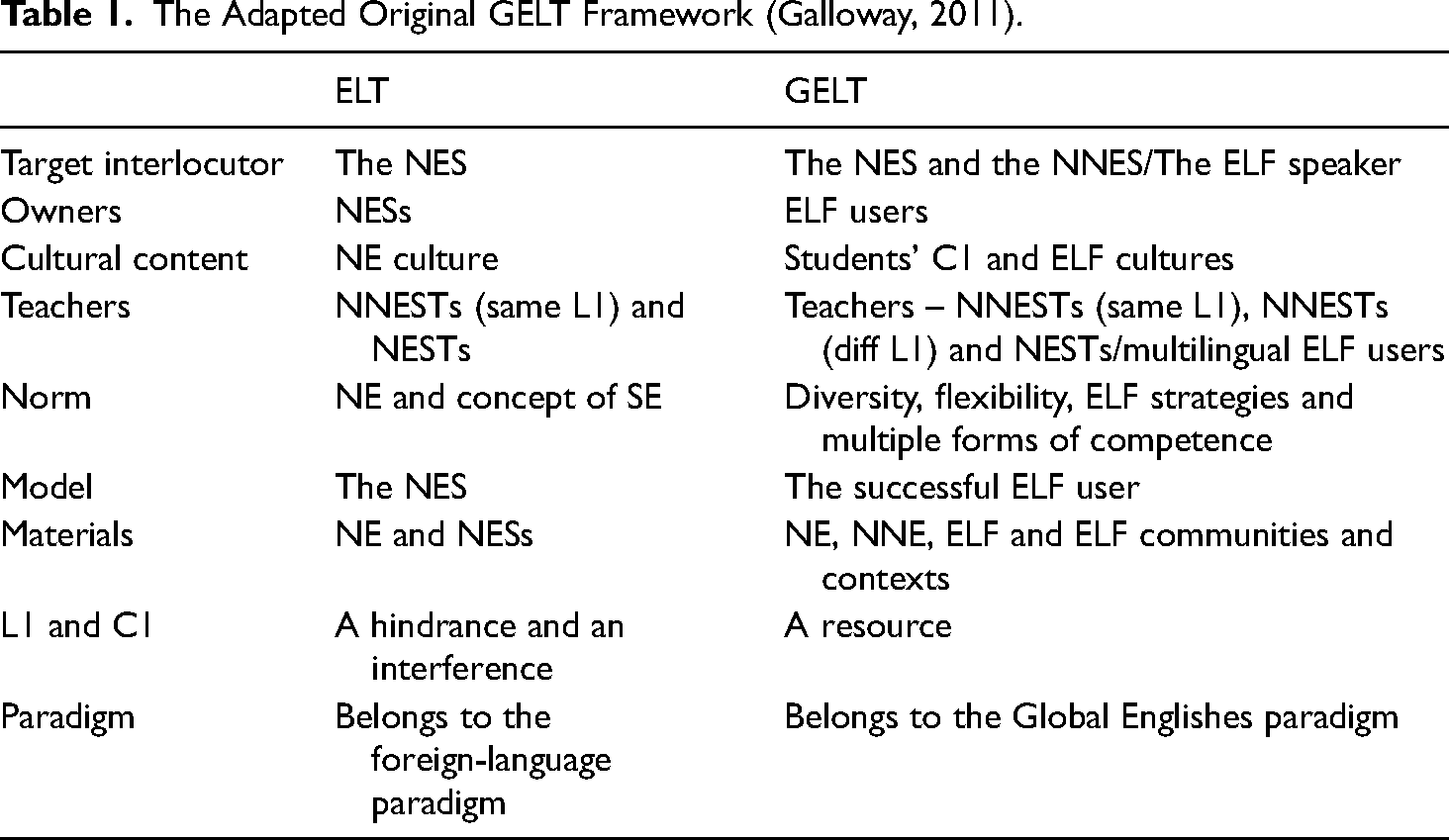
The critical information delivered by the original framework was to respect the fact that native English speakers (NESs) were not the sole target of English learners’ future interlocutors. The ownership of English shifted from NESs only to ELF speakers, extending the ownership to a broader community. The framework also indicated the need to respect and integrate multiculturalism and multilingualism into ELT, especially in the themes of cultural content, teachers, materials, and L1 and C1. Additionally, the original framework suggested that crucial changes should happen regarding teachers, norm, model and paradigm to support the ideological and practical reform of curriculum innovation informed by the global spread of English. Although the original framework was innovative and informative, it overlooked other vital aspects of ELT curriculum innovation, e.g. assessment. Also, the use of terms such as NES and NNES (non-native English speaker) is problematic due to the blurred boundaries between these communities shaped by global social mobility and the shifting ownership of English (Rose and Galloway, 2019). More proactive efforts are needed to move away from the NES–NNES dichotomy in the GE paradigm.
Rose and Galloway (2019) later updated the framework by increasing the inclusiveness and fluidity compared with the original, expanding the framework to include 13 dimensions for research and curriculum innovation. The update included the following dimensions: target interlocutors, ownership, target culture, norms, teachers, role model, source of materials, other languages and cultures, needs, assessment criteria, goals of learning, ideology, and orientation (see Table 2).
GELT Framework (Rose and Galloway, 2019).
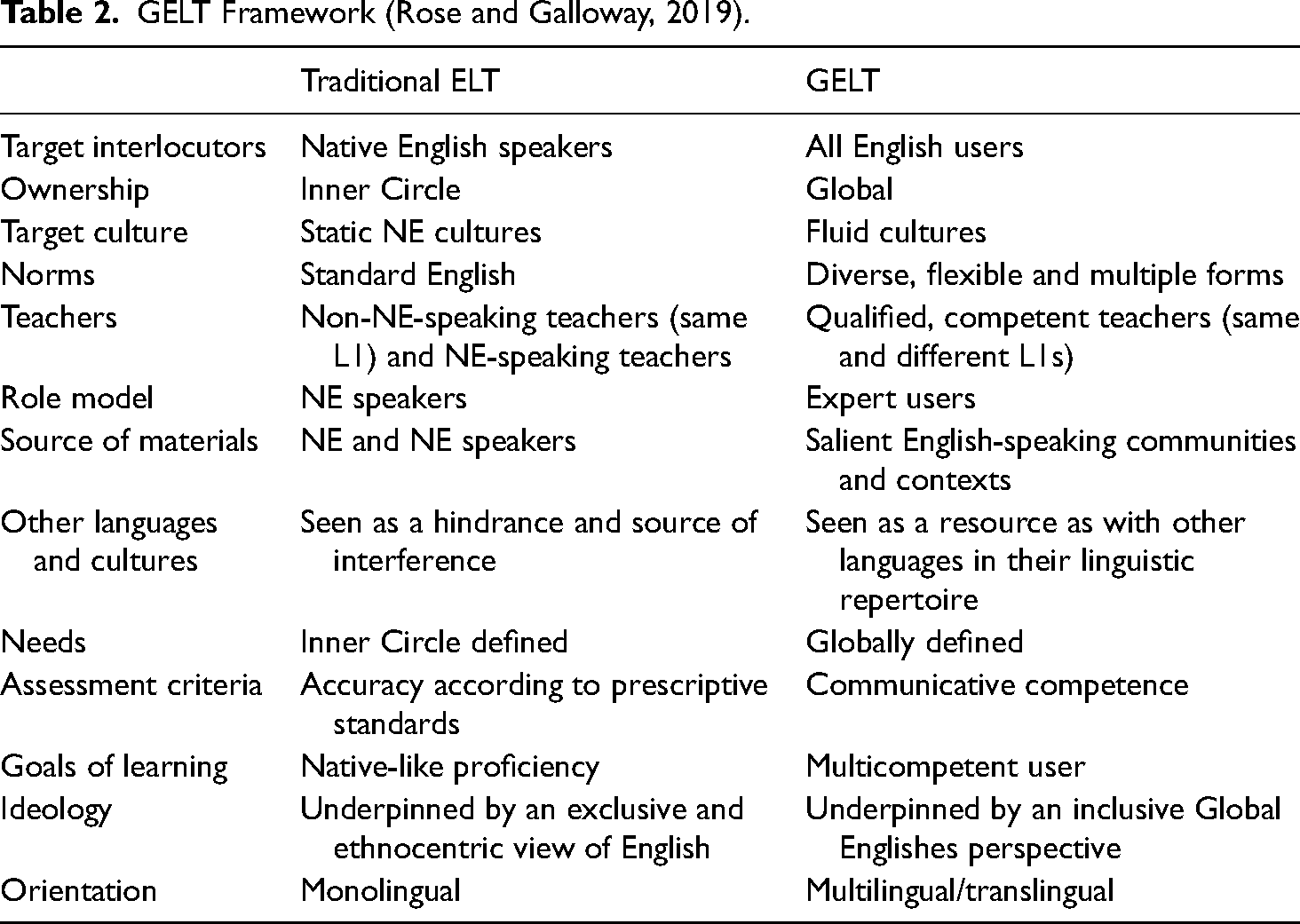
In the updated framework, more inclusive and fluid terms aligning with the current discussions in the field were used for GELT's descriptions of the dimensions – for example, all English users, global, globally, multicompetent, multilingual, and translingual. The updated GELT framework introduced several crucial changes. It redefined target culture as fluid and multiple rather than static and singular. Qualified teachers were defined by qualification and competence rather than L1. Material sources emphasised the salience of the communities and contexts over linguistic ownership of English. The updated framework acknowledges multiple languages and cultures as resources in students’ linguistic repertoires. The update added dimensions such as needs, assessment criteria, learning goals, ideology and orientation. It further provides multiple specific directions for GELT-informed curriculum innovation, in addition to its continuous emphasis on ideological shift to GE.
Given that Macau high school English learners need to become ELF speakers in and out of its multilingual landscape, this study adopts the updated GELT framework to investigate students’ needs for GELT curriculum innovation. By investigating student needs through the framework, the study aims to explore the key dimensions students deem essential for GELT implementation. It is hoped that the study can respond to the call for supporting future contextualisation of GELT in specific under-researched contexts outside tertiary education (Rose et al., 2021).
Global Englishes Language Teaching Teacher Education Studies
Despite the significant implications of the GELT framework, there is still a great absence of empirical studies on GELT teacher education. Although a few previous studies attempted to unpack ELT teachers’ attitudes towards GELT, student voices remained largely unheard in teacher education studies. For instance, based in the UK, Cameron and Galloway (2019) investigated how pre- and in-service ELT teachers viewed GELT in their learning and teaching contexts when taking a teacher education course on GELT, while examining the barriers to GELT implementation. Particularly, participants suggested increasing GE exposure to young learners. Participants showed willingness to adopt GELT-informed changes in their context, but their confidence was insufficient in having the changes happen. Cameron and Galloway (2019) therefore called for teaching materials and assessment designs to be informed by GE, increasing both learners’ and teachers’ awareness of GE. Similarly, at a UK university, Galloway and Numajiri (2020) explored pre- and in-service teachers’ attitudes towards GELT and its barriers and factors while taking a GELT course in a teacher education programme. In addition to the positive attitudinal changes in the GELT course, the findings revealed participants’ needs for teacher education to include clear guidelines of the GELT framework for future curriculum innovation practices. Also, participants expressed their concerns about English learners’ motivation to succeed in assessment and communicate with NESs as the barriers to GELT curriculum innovation.
Moving on to Thailand, Prabjandee (2020) examined Thai secondary school teachers’ attitudes towards GELT after taking a GELT teacher professional development. Prabjandee found that practitioners became more positive towards GELT after the professional development regarding the norm of English teaching, the goal of learning English, the ownership of English and the exposure of English varieties to students, though the change was minimal. Also in Thailand, Prabjandee and Fang (2022) explored GELT implementation through a professional development programme. They found that the professional development programme increased teachers’ knowledge of GELT, improved their attitudes towards it, and enhanced their skills for its implementation. They suggested that the changes were made as the professional development was practical, experiential, theoretical and inspirational. They therefore suggested GELT teacher education follow five principles, including ‘revisiting the ownership of English, raising awareness about the target interlocutors, challenging native-speaker norms, introducing a variety of English, and treating diverse Englishes with respect’ (Prabjandee and Fang, 2022: 307).
More recently, Schreiber and Jansz (2025) explored the changes in pedagogical beliefs and practices of in-service teachers after taking a GELT-oriented teacher education project in Sri Lanka. The study found the teachers had higher tolerance for informal language, more desire to incorporate communication in the real world into classroom teaching, and embraced more openness regarding pronunciation diversity to reduce students’ speaking anxiety. Schreiber and Jansz (2025) advised that GELT teacher education should provide interaction with diverse English speakers and encourage critical reflections on students’ linguistic contexts, in addition to greater empathy and understanding of students. Similarly, Aslan and Altınkaya (2024) examined the changes in Turkish pre-service ELT teachers while taking a GE-oriented course to raise teachers’ awareness of GELT. They found teacher education could significantly challenge the Standard English ideology by adopting the approach for critical awareness and inclusivity. The findings also argued for the needs for teacher education to expose participants to all English varieties to raise their awareness of the sociolinguistic reality behind the English language nowadays. When suggesting the future directions of GE-aware teacher education, Chen et al. (2023) also proposed that teachers should receive adequate exposure to concepts and issues relevant to GE through authentic materials and international interactions, while preparing teachers to raise students’ GE awareness.
Previous studies, though limited in number, have focused on teachers’ perspectives on the ideology and implementation of GELT. These studies have explored the factors and barriers influencing teachers’ attitudes and perceptions with proposals for developing GELT teacher education and documented changes in teacher beliefs and perceptions. However, students are crucial barriers to GELT curriculum innovation (Rose and Galloway, 2019). Other studies have identified students’ positive attitudes towards British English and American English, while finding students’ stereotypical views of other varieties (e.g. Meer et al., 2021, 2022). However, raising students’ GE awareness can positively influence students’ perceptions of language learning and use in varied aspects (Jindapitak et al., 2022). Furthermore, the involvement of varied stakeholders in ELT is demanded for teacher education (Selvi, 2025). Therefore, more links between student needs for GELT curriculum innovation and teacher education should be drawn to illustrate the efficient pathway for GELT teacher education. In particular, as an under-researched context of GELT teacher education, Macau secondary schools adopt various media of instruction across and within institutions, i.e. Putonghua, Cantonese, English and Portuguese, though ELT is often English-only. It remains uncertain if current ELT curricula and teacher education can meet the local students’ contextual needs to prepare for the challenges brought by the global spread of English. Therefore, this study aims to address two research questions as follows:
What are the needs of high school students for GELT curriculum innovation in Macau? What are the needs for in-service GELT professional development from Macau high school students’ perspective?
Methodology
Research Contexts and Participants
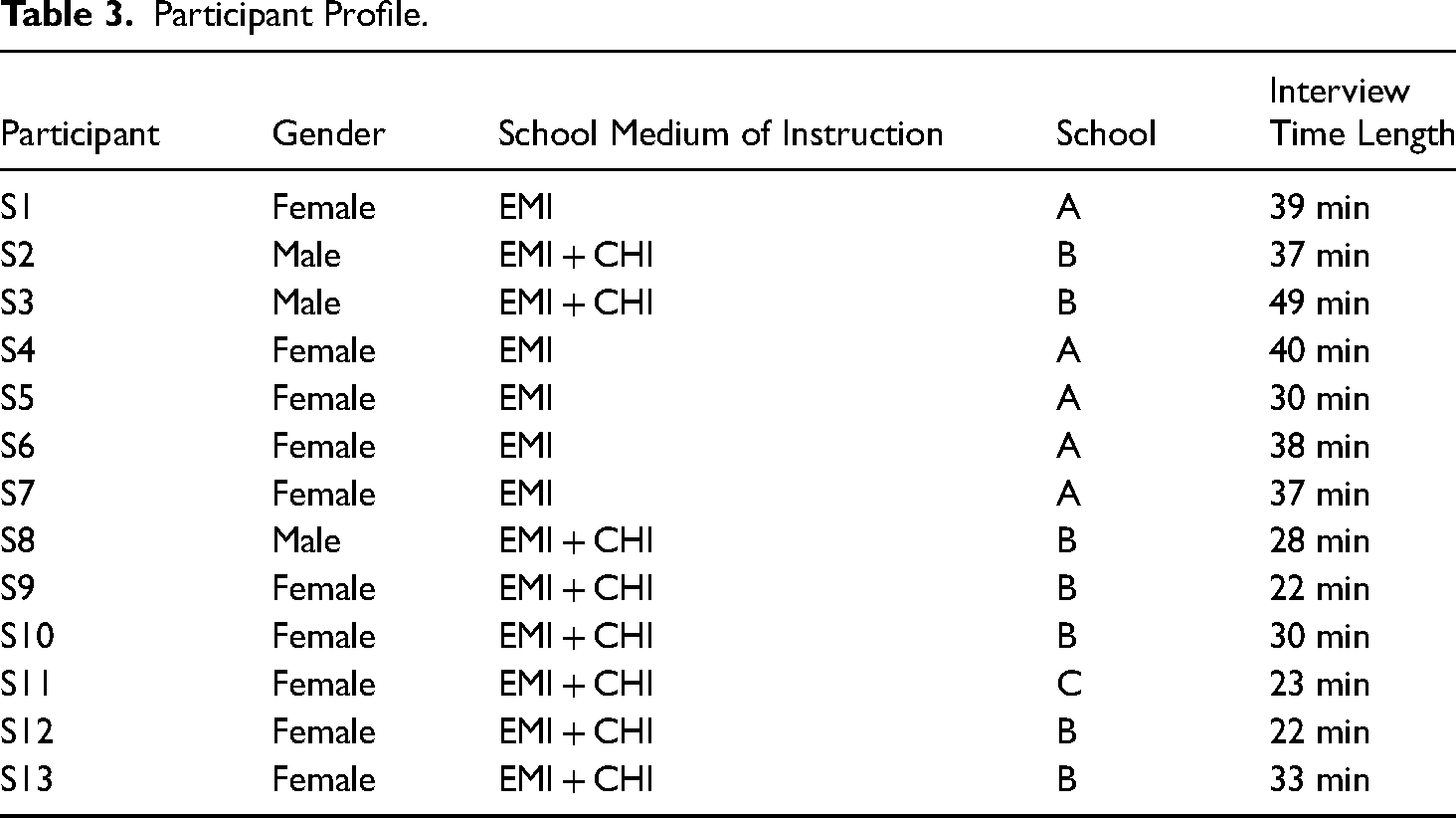
This qualitative research collected data from three Macau high schools, of which one school used English as the medium of instruction (EMI) (School A), and the other two (Schools B and C) used both English and Chinese as the media of instruction (EMI + CHI) (see Table 3). Among these three high schools, 13 students joined this study after snowball sampling due to the connections between the first author and participants. All 13 participants, aged 15–18, volunteered to be interviewed in this study. They all held Chinese, i.e. Putonghua and Cantonese, as L1 and English as L2. All participants took English as a compulsory subject in schools. They all received English lessons from a varied background of teachers, i.e. teachers from Macau SAR, Chinese Mainland and the Philippines, with none from the so-called inner circle countries (Kachru, 1992). Regardless of their different backgrounds, all these teachers adopted English-only policy in teaching practices. An informed consent sheet was distributed online to participants, allowing them to understand the research, ensuring their equal rights, and achieving confidentiality and anonymity.
Participant Profile.
Data Collection and Analysis
Semi-structured interviews were conducted for this qualitative research to gain deeper insights from the participants (Cohen et al., 2018). The interview schedule was negotiated with the students for convenience, avoiding conflicts with their schoolwork. Participants were allowed to translanguage in interviews, as all participants and the first author shared identical linguistic repertoires, i.e. Cantonese, Putonghua and English. Meanwhile, as a university-based researcher, the first author has rich experience living in Macau and understands Macau's English language education well. The first author's position also allowed students to perceive her as an outsider, giving students a sense of safety to share their personal views. Establishing a close bond with the student participants made it easier for the participants to share their perceptions honestly and directly. The interview procedure was seriously taken care of by the first author (see Appendix 1). Subsequently, participants understood the theories and framework before answering interview questions. All interviews were conducted via WeChat audio calls and lasted between 22 and 49 minutes. After audiotaping interviews, the first author manually transcribed interviews. Participants reviewed the transcripts to ensure the trustworthiness of the data.
Thematic analysis (Braun and Clarke, 2006) assisted by NVivo 13 was employed, including four stages of inductive coding. The first author first familiarised herself with the data by reading it three times. Then, she imported the transcripts into NVivo 13 and manually coded the transcripts for the first time. Third, she adjusted the initial codes, combined codes and generated themes. Lastly, the codes and themes were shared with the second author, allowing both authors to discuss the differences and achieve agreement for the data analysis. The codes and themes (see Appendix 2) will be reported in the order of significance next.
Findings
Macau High School Students’ Needs for GELT Curriculum Innovation
Ten students (S1, S2, S3, S4, S5, S6, S7, S8, S9 and S11) indicated a strong need to have GELT-informed sources of materials to prepare students as future ELF speakers. In particular, students argued that the current teaching materials in Macau high school ELT were still largely exam-oriented, which remained insufficient for GELT curriculum innovation, and neither could it reflect nor meet students’ needs. For example, S5 expressed her view regarding the low compatibility between assessment-oriented teaching materials and GELT curriculum innovation: S5: Recently, we use exam papers very often, but it is useless because I do not remember those complex grammar rules and feel nervous when encountering foreigners. Now, it is only exam, exam, and exam. S6: The teacher could play online videos to introduce other cultures to us in class. Now we only learn textbook English, but we do not know much about the cultures behind English nowadays … Teachers should keep up with the changing world and become interactive and use diverse pedagogical activities. S4: Actually, I feel the accuracy assessment-oriented English teaching doesn’t help prepare me as a future ELF speaker for global challenges. It is sufficient if we only learn the basic grammar rules. I only want to learn English for communication, so why should English lessons always only teach us grammar? S4: In the assessment, we often do true or false exercises to check our understanding of the literature, which makes it easy to get a higher grade. Instead, teachers can integrate some communicative components into exams, like interview opportunities. S5: It would be better if teachers allowed students to communicate more in student-centred rather than assessment-oriented classes. The scores in accuracy-oriented assessments do not speak much about our competence. To become a future ELF speaker, you need to speak more, or else you cannot make it.
Needs for In-service GELT Professional Development
After being introduced to the GELT framework, all high school students in the study supported their teachers in taking in-service GELT professional development to improve the ELT practices in classroom. When being asked what students wanted the GELT professional development to help inform their teachers with, the participants proposed that in-service GELT professional development should encompass multiple facets to better support their teachers in addressing student needs within their specific context: awareness raising, knowledge advancing and pedagogy enhancing.
Most importantly, eight students (S2, S3, S4, S5, S6, S7, S8 and S13) suggested that in-service GELT professional development should raise teachers’ awareness of individual differences in Macau's high school classroom and encourage their teachers to implement GELT to motivate students for English learning. The professional development seems crucial in informing teachers in the dimensions including needs, goals of learning and role model for GELT curriculum innovation. For instance, S2 highlighted the importance of in-service GELT professional development to help teachers understand the needs of students with low English proficiency and learn how to respond to their varied proficiency levels in the classroom: S2: I hope that my teacher can realise the importance of helping students with low English proficiency. When the teachers teach in English, maybe most students can understand the teacher, but some still have no clue about what to do. GELT professional development should remind teachers to support weaker students. S5: The teacher should learn how to use an innovative approach to adapt to students’ varied levels and needs in the classroom. If you speak too fast, or your vocabulary is too advanced, which we cannot follow, you will demotivate us in English learning. The fundamental goal of teaching is to motivate students to learn English and to make them understand the teacher. S8: My teacher, treating himself as my role model, often uses some vocabulary that I am unfamiliar with. Maybe my vocabulary is insufficient, but my teacher's vocabulary is too professional that I cannot understand, which is a torture to me.
Furthermore, seven students (S1, S2, S3, S4, S7, S9 and S11) proposed that in-service GELT professional development should raise teachers’ awareness of the need to respect multilingualism, encouraging teachers to use students’ L1 as a learning resource in their English learning and adjust the English-only language policy in the classroom. The professional development may be meaningful in transforming the orientation dimension from monolingual to multilingual/translingual in GELT curriculum innovation. For example, when discussing what professional development should inform their teachers about the language used in the classroom, S2 explicitly suggested that teachers should become aware of the supportive value of Cantonese as an additional learning resource in the classroom: S2: If the teacher is teaching the whole class, then it is ok to use English. When we are doing the exercise worksheet, the teacher can join those weaker students, using Cantonese to guide them and complete the worksheet. S7: Not all students can survive the English-only policy. The professional development should inform the teachers that the lower grade classes should have English teachers who use Chinese, especially Cantonese. S11: To become future ELF speakers, we need to communicate more in class, and the English we learn should be linked to authentic English in actual communication. S4: It's essential for GELT professional development to make our teachers aware that English usage can vary by location. Then, they can teach us these different usages, which will be practical for our future. It will be more beneficial than learning only Standard English grammar. S12: GELT professional development should inform teachers that language evolves every day, and they need to continuously update their knowledge of the English language. This way, they can teach their students the most up-to-date English. S10: Teachers can attend GELT professional development to improve pedagogical competence or at least attend some informative sections for pedagogical enhancement to prepare for implementing GELT.
Discussion and Implications
With respect to the first research question regarding student needs for GELT curriculum innovation, the findings indicated that Macau high school students’ needs have not been well nor fully considered for the current ELT curriculum design to reflect and align with the reality of GE. The findings revealed the need for GELT curriculum innovation to occur in multiple dimensions, such as source of materials, other languages and cultures, ideology, target interlocutors and assessment criteria (Rose and Galloway, 2019).
Particularly, students expressed their needs for GELT-informed teaching materials and the use of multimedia in GELT curriculum innovation to increase their exposure to diverse cultures and English varieties (Boonsuk and Fang, 2025; Cameron and Galloway, 2019). Students also stressed their need for GELT curriculum innovation to prioritise communicative competence in assessment criteria (Rose and Galloway, 2019) and tools to align with GELT. Moreover, students seemed to require multiple assessment criteria. This highlights the importance for contextualising assessment, as GELT-informed assessment reform should not be a ‘would you rather’ game. Students’ strong needs for GELT curriculum innovation in multiple dimensions indicates that there is a long way to go to increase the compatibility between GELT and existing ELT in Macau's high school context. More importantly, students called for increasing the authenticity and transnationality of real Englishes in their English learning, as they hoped teachers use multimedia technology to expose them to GE in class. This reveals a need for in-service ELT teachers to take small, brave steps in curriculum innovation practices.
In answering the second research question regarding the needs for in-service GELT professional development, the findings suggested that in-service GELT professional development seems to be perceived as an awareness-raising, knowledge-advancing and pedagogy-enhancing platform where high school teachers can be encouraged to listen and respond to students’ contextual needs for GELT curriculum innovation. Students proposed multifaceted suggestions for in-service GELT professional development based on their needs. Previously, Prabjandee (2020) revealed that practitioners showed potential positive attitudes towards GELT after professional development, regarding the dimensions including norm, goal of learning and ownership. Moving beyond this finding of Prabjandee (2020), students in this study indicated that GELT-informed professional development can inspire teachers for changes in more dimensions – namely, needs, goals of learning, role model, orientation, ideology, ownership, target interlocutors and norms. Therefore, students suggested that GELT professional development can inform in-service teachers to understand their globally defined needs to become multicompetent users. GELT professional development can encourage teachers to use experts as their role models in a multilingual/translingual English classroom underpinned by GE. It can inform their teachers of the global ownership of English, inspiring them to treat all English users as students’ target interlocutors and value diverse, flexible and multiple forms of English.
Particularly, students prioritised the need for in-service GELT professional development to raise teachers’ awareness of respecting students’ individual differences, regarding GELT as an innovative pedagogical approach to cater to students’ varied needs and motivate them for English learning. This finding is new to the field, as students highlighted the necessity of using in-service GELT professional development to meet their personal language learning needs, signifying the importance of student-centredness in GELT teacher education. Students also voiced their need for in-service GELT professional development to raise teachers’ awareness of respecting multilingualism and utilising students’ L1 in the classroom in order to transform the English-only policy and language standard imposed in the specific context (Galloway, 2017). Specifically, students deemed Cantonese and GE crucial in the learning context, advising that professional development undertake awareness-raising and confidence-boosting tasks to help their teachers respond to the reality of multilingualism in and out of Macau, aligning with the GELT framework (Rose and Galloway, 2019). Students challenged the value of adhering to Standard English as the gatekeeper. They devalued the current teaching practices that ignored their need for additional supportive resources due to the English-only policy, against teachers’ concern raised in Galloway and Numajiri (2020).
Also, students emphasised the knowledge-advancing and pedagogical-enhancing value of in-service GELT professional development. They proposed to update teachers’ knowledge regarding varieties of English while providing pedagogical enhancements (Galloway and Numajiri, 2020; Prabjandee and Fang, 2022). Thus, the findings echo Chen et al. (2023), supporting that teachers should receive adequate exposure to GE concepts and issues through authentic materials and international interactions, while mastering the skills to raise students’ GE awareness (Xie and Fang, 2025).
Overall, the findings of the research questions provide a crucial starting point for stakeholders, such as policymakers, school administrators, teachers, teacher educators and material developers, to reconsider their roles and initiatives in meeting students’ contextual needs through collaborative efforts in GELT curriculum innovation. Most importantly, changes are needed at the policy level. Students indicated that their needs to prepare for GE were neglected in the current ELT design. To motivate GELT curriculum innovation, the government and educational policymakers are advised to gain a further understanding of students’ up-to-date needs for language learning and usage in the current and future context where intercultural communication through multilingualism becomes the norm. High schools should adopt a multilingual policy. In contexts like Macau, where students are immersed in a mixture of instructional media, a school-wide policy for individualised language support will supplement students’ English learning. As critical agents in GELT curriculum innovation, teachers should cater to students’ various needs in English learning by language policy adaptation. Teachers are advised to respect students’ needs for using translanguaging as a learning resource in the multilingual classroom, as it may benefit teaching quality, classroom management and climate (Decristan et al., 2024).
To encourage in-service teachers to embark on GELT curriculum innovation, GELT teacher education should be based on students’ needs to prepare them about and for the sociolinguistic features and realities of GE simultaneously (Selvi, 2025). In addition to hearing student voices, the government must explore teachers’ needs for in-service GELT professional development on a large scale to benefit a wider community of practice locally. The professional development should incorporate practical examples from teacher educators and frontline practitioners in similar teaching contexts. It is critical to showcase multimodal evidence, e.g. audio and video recordings of varieties of English and their usages in real ELF communication contexts, to serve as the basis for raising teachers’ GE awareness and boosting their confidence in localising GELT for students. As students noted, professional development should encourage teachers to move away from native-speakerism and Standard English (Aslan and Altınkaya, 2024), redefining the contextual standard for students. Instead of purely introducing GELT theories, it is essential to show teachers how to develop and transform teaching materials practically and effectively to align with GELT. Furthermore, long-term critical reflections should be encouraged to challenge teachers’ beliefs about L1 use in the classroom and students’ linguistic contexts and needs (Schreiber and Jansz, 2025), in addition to micro-teaching practices in professional development. Hence, a more practical pathway and insights into GELT may inspire teachers to initiate GELT curriculum innovation in a student-centred manner.
Furthermore, GELT curriculum innovation requires a mindset change when teachers explore the compatibility and feasibility of GELT implementation with the current ELT curriculum. Teachers should view GELT curriculum innovation process as bridging the gap between the reality of GE in multilingual landscapes and teaching practices. Moving towards GELT from traditional ELT means respecting students’ needs in the real world as the core of ELT curriculum innovation. This mindset would naturally place student needs at the centre of curriculum development and pedagogical innovation. Additionally, teachers should undertake a bottom-up assessment reform, including developing tools and criteria to support students’ progressive learning to become ELF speakers (see Hu, 2021). Teachers should revisit the role models and learning goals embedded in the ELT curriculum, aligning with students’ needs to become ELF speakers. To make these changes, teachers require more flexibility in material development and pedagogical innovation, in addition to the contextualised teaching materials created by local publishers. Teachers should also expose students to multilingual and multicultural elements via new methods and transnational platforms. Subsequently, GELT curriculum innovation can respond to glocal needs and realities in specific teaching contexts, meeting ‘the current and future pedagogical needs of the individuals they serve’ (Selvi et al., 2023: 61).
Conclusion
This study examined Macau high school students’ needs for GELT curriculum innovation and their perspectives on in-service GELT professional development. Students emphasised their needs for changes in multiple dimensions of GELT. Their contextual needs revealed a gap between the current ELT curriculum and GELT (Liu and Fang, 2022). However, students indicated possibilities for enhancing the compatibility between the two. Students deemed it crucial for a multifaceted in-service GELT professional development to be awareness-raising, knowledge-advancing and pedagogy-enhancing. They believe this approach would encourage teachers to initiate and localise GELT. Rather than viewing GELT as purely theoretical, students saw its value in motivating their English learning and preparing them as future ELF speakers.
This study has several limitations. Due to the limited access to potential participants, with a small sample size, this study did not aim to generalise its findings to all Macau high school students regarding in-service GELT professional development and curriculum innovation. Besides, student from Portuguese-medium-instruction schools were not included in this study, which may limit the representation of students’ perspectives. Another limitation is that only one-off retrospective data was collected due to the limited availability of student participants and restrictions on classroom observation in high schools. Although the opportunity for triangulation was reduced because of the above restrictions, the in-depth data provided detailed answers to the research questions from student perspectives outside tertiary education, which addressed researchers’ call for future contextualisation (Rose and Galloway, 2019).
Future studies should employ longitudinal designs to investigate student voices in under-researched context and, if possible, track GELT teacher education with extended follow-up phases to understand teacher cognitions and curriculum innovation practices. Employing designs such as action research, case studies and ethnography with multiple methods can help achieve triangulation and offer deeper insights into the compatibility and efficacy of GELT in classroom settings. Involving more stakeholders, including administrators and policymakers, will provide valuable insights and inform collaborative decision-making in language policy changes, GELT teacher education development and curriculum innovation.
Footnotes
Declaration of Conflicting Interests
The authors declared no potential conflicts of interest with respect to the research, authorship, and/or publication of this article.
Funding
The authors disclosed receipt of the following financial support for the research, authorship, and/or publication of this article: This work was supported by Beijing Normal University (grant number 12900--312200502574) and the Center for Southeast Asian Overseas Chinese Culture and Language Strategic Studies of Shantou University (grant number 2024WXYDNY-RP01).

Appendix 1: Interview Procedure
Stage
Activities
Pilot Study
• The first author piloted the interview prompts with 3 potential participants with the same L1 and C1 in Macau for feedback and revision.
Before Interviews: Briefing
• The first author introduced the key concepts involved in the study and the GELT framework to student participants. Being aware of the difficulty level of the relevant theories and the framework, the first author used simplified wording in Cantonese and gave examples for participants to visualise GELT.
• Students were given sufficient time to ask questions before interviews.
During Interviews
1. Students first introduced educational background and current English learning experience in high school.
2. Students explicitly compared their English learning experience with GELT, voicing their needs for GELT.
3. Students indicated their views on the needs for in-service GELT professional development in Macau, illustrating what they deemed essential for teachers to know and develop by attending GELT professional development.
Follow-up questions were asked when crucial moments appeared for gaining deeper insights from students.
Appendix 2: Table of Codes and Themes
Themes
Codes
Student Needs for GELT Curriculum Innovation
• GELT-informed sources of materials
• Lack of compatibility of the teaching materials for GELT
• Increasing use of multimedia in GELT curriculum innovation
• Assessment reform for GELT curriculum innovation
Needs for In-service GELT Professional Development
• Support for teachers to take in-service GELT professional development
• Raise teachers’ awareness of individual differences
• Encourage teachers to implement GELT to motivate students for English learning
• Redefine students’ learning goals and role models
• Raise teachers’ awareness of the need to respect multilingualism and stop English-only teaching in class
• Raise in-service teachers’ awareness of GE
• Update their teachers’ knowledge base about the English language and its varieties
• Facilitate pedagogical enhancement to support GELT curriculum innovation