




Abstract
With the increasing demands for academic listening and note-taking in English for academic purposes (EAP) settings, L2 English students are expected to understand academic listening tasks introduced by their professors, understand the key information given by the speakers, and take notes while listening so as not to miss the important points. This study reports on EAP students’ note-taking in academic listening from a translanguaging perspective. It explores the integration of note-taking (Turkish and English, translanguaging) into an academic listening course in Türkiye and its effects on 45 Turkish students’ L2 English listening test scores, with the achievement level of students as a moderating variable. The results show the noticeable effect of note-taking in English and translanguaging on the students’ listening test scores. The article provides empirical descriptions of note-taking instruction and discusses the pedagogical implications, including suggestions for teachers to expand their repertoire of strategies for teaching academic listening and note-taking with a translanguaging approach.
Introduction
Academic listening poses significant challenges for second language (L2) learners, even at advanced levels, often surpassing the difficulties associated with reading, writing, and speaking (Field, 2008). The listening skill is frequently considered one of the most daunting tasks for language learners due to its inherent cognitive and mental complexity (Ferris and Tagg, 1996). Developing robust academic listening skills is essential for improving overall language proficiency in L2 (Newton and Nation, 2020). Recent research has highlighted the importance of note-taking in enhancing learners’ listening comprehension and learning. According to Siegel (2023), note-taking has a positive impact on these areas, particularly as learners exercise their linguistic repertoire by engaging in translanguaging practices. Studies on translanguaging in communication and interaction at both theoretical and practical levels (e.g., Canham et al., 2024; Zhou et al., 2022) have called for more research demonstrating the potential benefits of translanguaging for English for academic purposes (EAP) students’ note-taking. Such research is needed to help teachers prepare their students for English medium instruction (EMI) courses in higher education and raise their awareness of note-taking by allowing translanguaging, namely using first and second languages. Most higher education institutions now offer subject-specific EMI and EAP courses, emphasizing academic listening and note-taking in the L2 context. In an EMI class, English serves as the medium of instruction for academic subjects like science, where students might learn about plant and animal cells. Accurate note-taking in English is crucial for expressing detailed information, such as the differences between these cells. EAP courses are often considered supplementary, aimed at improving students’ academic language skills outside the standard curriculum. However, as Airey (2016: 74) points out, “disciplinary language learning at the university level is often relegated in status to a remedial activity carried out in EAP courses outside the standard curriculum.” Allowing translanguaging in EMI and EAP courses could help students better comprehend subject content and improve their English proficiency by enabling them to make connections between L1 and L2 English.
The use of L1 and L2 (or translanguaging) in second language learning has been a subject of debate and research (Conteh, 2018; García, 2009; Siegel, 2016). While the traditional monolingual approach emphasizes exclusive use of the target language, recent research suggests that strategic use of the L1 can be a valuable pedagogical tool. Growing research on translanguaging (Macaro and Aizawa, 2024; Siegel, 2023) implies maximizing its effectiveness in developing academic skills in multilingual and plurilingual contexts. Most of the research discussed translanguaging in reference to academic writing (e.g., Canagarajah, 2011), academic reading (e.g., Ślęzak-Świat, 2022), and note-taking in EAP courses (e.g., Siegel, 2020b). A number of studies have been conducted on the impact of note-taking on students’ learning (e.g., Siegel, 2022, 2023; Siegel and Kusumoto, 2022) and L2 listening comprehension (e.g., Hayati and Jalilifar, 2009; Tsai and Wu, 2010). Recent research has begun to explore the potential benefits of leveraging learners’ full linguistic repertoire during note-taking in academic listening contexts. Studies by Canham et al. (2024) and Zhou et al. (2022) suggest that allowing students to utilize their entire language repertoire while taking notes may lead to improved performance compared to restricting them to either their L1 or L2. However, the effectiveness of translanguaging approaches in note-taking for enhancing listening comprehension and test scores remains an area requiring further empirical investigation. As Conteh (2018: 446) notes, Teachers who recognize the importance of translanguaging in constructing relationships with their learners that nurture mutual empowerment, and researchers who recognize this power and are committed to acknowledging its importance in their classroom-based investigations, together have the potential to develop translanguaging pedagogies in the future.
Translanguaging pedagogy to teaching requires educators to adopt what García et al. (2017) refer to as a juntos/together perspective. This viewpoint recognizes that learners construct meaning by drawing upon and interconnecting various elements from their linguistic repertoire. To go beyond only adopting this stance, educators should design courses and assessments that incorporate and leverage translanguaging practices.
Despite the recognized need for research on the practical applications of translanguaging in language education, discussions on the topic often remain confined to the theoretical realm. There is a notable scarcity of research in practice that effectively integrates the translanguaging perspective into classroom-based research. While previous research has explored translanguaging with Chinese L1 speakers (Zhou et al., 2022) and European students speaking Dutch, French, German, Italian, and Spanish (Canham et al., 2024), this study fills an important gap by focusing on the Turkish context. The research provides valuable insights into how translanguaging manifests in Turkish higher education, offering a distinctive perspective that was previously absent from the literature. This study, therefore, contributes to this line of inquiry by examining the effect of note-taking instruction on Turkish EAP students’ academic listening test scores and their perceptions of note-taking in English and translanguaging approaches.
Translanguaging Theory
Translanguaging is a concept used to describe the natural language practices of bilingual and multilingual individuals who fluidly switch between languages (Conteh, 2018) and record information by note-taking while listening to academic content in L1 and L2 (outlining, mind-mapping, paraphrasing, using abbreviations, etc.) (Siegel, 2022). This approach serves to affirm students’ multilingual identities. For instance, in EMI contexts, encouraging students to engage in translanguaging practices, such as note-taking in both L1 and L2, allows them to fully utilize their multilingual repertoires. Research has shown a positive correlation between students’ listening test scores and the number of information units they noted down (Siegel, 2023), highlighting the cognitive benefits of this practice. As Wei (2022) aptly pointed out, translanguaging is not simply about permitting the use of multiple languages in the classroom. Rather, it is about “respecting and valuing diverse and dynamic linguistic practices as key resources in knowledge construction” (Wei, 2022: 180). This perspective emphasizes the importance of leveraging students’ entire linguistic repertoire as an asset in their learning process. It advocates for a more holistic and equitable understanding of multilingualism in educational settings. The primary goal of translanguaging in language education is to maximize learners’ multilingual and/or plurilingual potential (García, 2009). This can be achieved by fostering critical thinking and creativity and exposing students to diverse ideologies, practices, and values. Translanguaging allows for the dynamic and integrated use of multiple languages and meaning-making resources in both language learning and teaching (Siegel, 2020a). This approach not only supports language acquisition but also promotes a deeper understanding of academic content across subjects (García, 2009).
Translanguaging is also defined as “the deployment of a speaker's full linguistic repertoire without regard for watchful adherence to the socially and politically defined boundaries of named (and usually national and state) languages” (Otheguy et al., 2015: 14). In contrast, code-switching refers to “the alternation between two languages in a specific communicative episode” (Otheguy et al., 2015: 15). Translanguaging can occur in both multilingual and monolingual settings and involves the flexible use of a person's full linguistic repertoire, while code-switching typically occurs in bilingual and multilingual contexts and involves alternating between two or more languages within a conversation or sentence. Code-switching can happen when all participants are bilingual/multilingual and can occur when a bilingual speaker accommodates a monolingual speaker. There are controversies surrounding translanguaging in policy, research, and practice (Conteh, 2018; Wei, 2022). Controversies arise from the idea of whether there is a need for such a notion, while “code-switching” and “code-mixing” have already provided a similar framework to understand multilingualism in education. However, among other concepts, translanguaging deliberately breaks ideological and artificial differences between minority versus majority, native versus non-native, and mother tongue versus target languages. It empowers learners and teachers, changes power relations, and focuses on meaning-making, the development of identity, and building experiences during the learning and teaching process (García, 2009). Translanguaging as a pedagogical practice in language education might be used to alternate L2 learners’ receptive and productive use of languages. For instance, learners might be allowed to use their L1, L2, and translanguaging when taking notes in L2 academic lectures.
The relationship between translanguaging and academic performance is complex and nuanced, with research yielding mixed results. Several studies (Canham et al., 2024; Park, 2019; Tsai and Wu, 2010; Wang, 2021, Zhou et al., 2022) have explored this connection, revealing varying outcomes. Some research indicates that restricting language use to the target language (English) may improve test performance in certain contexts. For example, Tsai and Wu (2010) found that Taiwanese students performed better when required to take notes in English, likely due to the alignment with English-language assessments. Similarly, Wang (2021) suggested that English-only note-taking may enhance performance on English-language tests. On the other hand, Park (2019) found that there was no statistically significant impact of translanguaging practices on the test performance of students living in the United States, all of whom were L1 Korean speakers with English as their L2.
Recent research suggests that allowing students to utilize their full linguistic repertoire may be beneficial. Zhou et al. (2022) and Canham et al. (2024) found that students had better test performance when they were given the choice to use all their language resources. These findings suggest that educators should carefully consider the context and goals of their instruction when deciding whether to implement translanguaging practices. While allowing students to use their full linguistic repertoire may enhance understanding and engagement, there may be situations where targeted language use is beneficial for specific learning outcomes. Further research is needed to better understand the nuanced effects of translanguaging on academic performance across different contexts and subject areas.
Listening to Lectures and Note-Taking
Listening to lectures at EAP programs using sheltered instruction (Krashen, 1996) is vital for university students because so much of what they need to learn is conveyed through lectures in which teachers utilize content and language objectives (Echevarria and Graves, 2007; Fritzen, 2011). To support students’ academic and linguistic skill development, teachers establish a positive learning environment by acknowledging and respecting linguistic and cultural diversity. For example, recording the information presented in lectures in L1, L2, or a combination of both while listening to academic content, is a significant part of what students do in the university setting. However, both listening to lectures and taking notes can be challenging for students who have not previously experienced academic listening and note-taking.
Kiewra (1989) highlights the benefits of note-taking for organizing information and enhancing comprehension of the listening materials. Clerehan's (1995) comparative study of L1 and L2 students’ lecture notes revealed that L2 students recorded significantly fewer top-level elements of the lecture's hierarchical structure. This finding underscores the need for further subject-specific and cross-disciplinary research on authentic lecture note-taking across different language groups. Note-taking can be particularly daunting for L2 learners, as they must simultaneously process aural input, interpret visual aids such as graphic organizers, diagrams, and mind maps, and decide what information to record (Rodgers and Webb, 2016). According to Piolat et al. (2005), note-taking is a cognitively demanding task that requires more mental effort than reading or learning. However, it is still less demanding than the creative process of composing an original text. This comparison highlights the varying levels of cognitive load associated with different academic tasks, positioning note-taking as an intermediate activity in terms of the mental effort required.
Siegel (2020b) and Siegel and Kusumoto (2022) have noted that note-taking provides opportunities to organize lecture content and helps students maintain their attention during lectures. Earlier research by Siegel (2016) suggested that note-taking had positive benefits for EAP students. He investigated note-taking strategies used by language learners, why they used them, and what the nature of the mental processes behind the students’ note-taking habits and behaviors were. Tsai and Wu (2010) have addressed the effects of explicit note-taking instruction and compared the influence of English and Chinese languages used on both types of input when note-taking in English lectures. Moreover, research by Song (2012) highlights the interconnectivity of listening skills and note-taking. Song found that the quality of taking notes during the lectures was a good indicator of academic listening proficiency. However, learners’ ability to identify and note topical ideas was a better indicator of proficiency than recording the detailed information. Further, these findings highlight the importance of explicit note-taking pedagogy in EAP programs, particularly to have language learners not only record details but, more importantly, identify and prioritize the ideas presented through lectures.
There have been advances in recent years in note-taking pedagogy, and some researchers (e.g., Siegel, 2022; Wei, 2022) have laid the groundwork for future research that could shed light on the effects of note-taking instruction on students’ listening test scores through the lens of translanguaging. As such, this study aims to provide a clearer understanding of how note-taking instruction can be achieved in language classrooms from a translanguaging perspective. It explores the effect of note-taking instruction and three different note-taking approaches on EAP students’ academic listening test scores.
The present study aimed to answer the following research questions:
What is the effect of note-taking instruction on EAP students’ academic listening comprehension test scores? Is there a statistically significant difference among three note-taking approaches—namely, note-taking in English, note-taking in English and Turkish (i.e., translanguaging) and non-note-taking—in terms of their effect on EAP students’ academic listening test scores?
Methodology
The current quantitative research design uses a quantitative perspective to probe the possible effect of note-taking instruction on the EAP students’ academic listening test scores (Dörnyei, 2007). This study was approved by the Human Research Ethics Committee of the university where the research was conducted. All participants provided written informed consent before enrollment in the study. Before obtaining consent, all participants were given a clear statement of the purpose of the study and the procedure they would follow in the research. They were informed that participation was entirely voluntary and there would be no penalties for refusing to participate. The participants could withdraw from the study at any time without negative consequences. All participants were informed that anonymization and pseudonymization processes would be used in the data analysis and reporting in order to protect their privacy. The participants were given contact information to reach the researcher for any questions regarding the study. The participants were also informed that their grades would not be affected by their choice to participate in the study.
Setting and Participants
The research was conducted with 45 Turkish students (aged 18–20) studying in an EAP program at a university in Türkiye. In this program, teachers use PowerPoint slides to present new content. Since the students have to listen to the instructors’ presentations, the students have to take notes to record the additional details that are not presented on the slides. The language policy of the university fosters the use of English as L2 in the learning environment. This study was conducted in a mandatory course titled “Academic Listening” that was part of the program.
Note-Taking Instruction
The purpose of note-taking instruction was to improve the general academic listening skills and strategies of 45 students in a 14-week EAP course (2 h per week). The teaching materials and note-taking activities for the course were co-designed by the teacher and the researcher in the Moodle course management system. The note-taking instruction focused on teaching students how to take notes using the Cornell method (Darrow, 2005), which is a 5-step note-taking method used for recording, reducing, reciting, reflecting, and reviewing notes. In the first class of the 14-week course, students received 2 h of instruction on the Cornell method. Throughout the duration of the course, they participated in weekly note-taking training sessions, each lasting approximately 15 to 20 min. During the course, the students completed listening and note-taking activities designed to develop strategies such as identifying the gist, using graphic organizers, jotting down numbers and keywords, using abbreviations, paraphrasing, encoding, and storing information (e.g., Bui and McDaniel, 2014; Kiewra, 1989; Siegel, 2021; Song, 2012). The students were taught how to capture key information from the listening texts by taking notes in Turkish, English, or both. In the first week of instruction, the course addressed the use of L1 (Turkish), L2 (English), and translanguaging (Turkish and English) during note-taking. The discussion on these three conditions aimed to guide learners on leveraging their full linguistic repertoire during academic listening and note-taking tasks. By incorporating these multilingual approaches, students were encouraged to maximize their comprehension and retention of information across different language contexts. Throughout the instruction, the teacher monitored the students’ note-taking practices and provided feedback. In this study, neither PowerPoint slides nor printed handouts of the slides were provided to the students during their listening. Instead, students were required to take notes in their own notebooks or on separate sheets of paper. Worthington and Levasseur (2015) investigated the impact of slide access and note-taking methods on student performance. Their findings revealed that while access to slides did not significantly affect performance, the method of note-taking did have an impact. Specifically, students who took notes on printed handouts of slides performed worse than those who took notes on separate pieces of paper.
Data Collection Instruments and Procedure
Listening tests were used to collect data in this study. Two listening sections of the IELTS (International English Language Testing System) academic test were used as a pre- and post-test to measure the participants’ listening comprehension skills. This 40-min paper-based test comprises four parts and 40 test items, including multiple-choice questions, form/note/summary/sentence completion, matching, and short answers involving no more than two words. (A copy of the test is available at: https://osf.io/uxm25/?view_only=5f0d022bbbf04cf8bc360bc833f9d57d.) The pre-test was administered in Week 1 to determine the students’ preferred note-taking approach and their listening test scores. In this study, the participants were allowed to choose their preferred note-taking condition, enhancing ecological validity compared to assigning students to predetermined conditions (e.g., Tsai and Wu, 2010). This approach aligns with findings from Artz et al. (2020), who demonstrated that forcing students into unfamiliar note-taking methods can significantly influence research outcomes. By permitting participants to use their habitual note-taking styles, the study likely captured more authentic learning behaviors and outcomes. Based on their choice of a note-taking approach during the pre-test, the participants were classified into the following three groups: Group 1 “Note-takers in English” (n = 17), Group 2 “Note-takers in Turkish and English (Translanguaging)” (n = 15), and Group 3 “Non-note-takers” (n = 13). As there were no participants who took notes only in their L1 during the pre-test, a group of note-takers in Turkish was not created for this study. The pre-test scores showed no significant differences in students’ test performance across these three groups. All students received note-taking instruction during Weeks 2–13. In Week 14, all students completed the post-test. The participants were informed that all the collected data were kept confidential, and the data would not influence their grades. The reliability of the pre- and post-tests was reasonable, as indicated by Cronbach's alpha values of 0.73 for the pre-test and 0.87 for the post-test.
Data Analysis
To answer the research questions, three types of tests were conducted. To address the first research question, a skewness analysis was conducted to assess the normality of the data, as recommended by Pallant (2016). After confirming that the data met the assumption of normality, a one-way analysis of variance (ANOVA) was run to compare the effect of note-taking instruction on the students’ listening post-test scores. To answer the second research question, the Scheffe post hoc test for multiple comparisons was employed to determine the specific source of the difference among the three groups.
Results and Discussion
The results of the skewness analysis disclosed that the assumption of normality was observed in the distribution of students’ test scores. The value of skewness was zero, which indicated that the distribution was symmetric. A one-way ANOVA was performed to compare the effect of note-taking instruction on EAP students’ academic listening comprehension test scores. As seen in Table 1, the one-way ANOVA revealed that there was a statistically significant difference in the listening post-test mean scores at the p < .05 level between the groups (F(2, 42) = [8.160], p = .001).
One-way ANOVA for three groups on post-test.
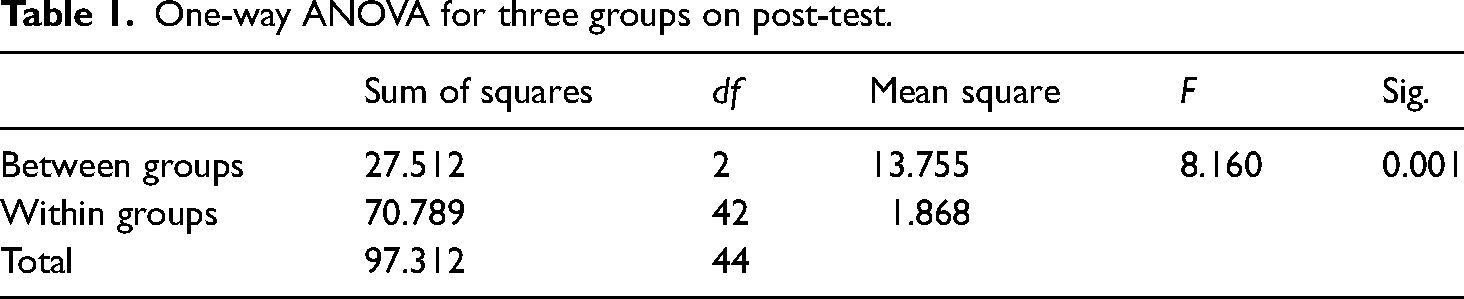
The high F-value (F = 8.160) in the ANOVA showed that there was a noticeable effect of note-taking instruction on the students’ listening test scores. The p-value (p = .01 < .05) indicated that the effect was statistically significant. As such, the results of the ANOVA revealed that note-taking instruction influenced the listening test scores of the groups differently. The groups, note-takers in English and note-takers in Turkish and English (translanguaging), outweighed the listening test scores of the non-note-takers’ group. When the reference was made to the mean difference between the three groups on the listening test scores, it was seen that the positive influence of note-taking in English made the largest difference among the mean scores of note-takers in English and non-note-takers (MD = −1.800). This substantial difference supported the conclusion that note-taking in English considerably benefits students’ listening test performance. This result demonstrated that providing note-taking instruction to students during academic listening led to better listening test scores compared to those who did not take notes. Specifically, the students who took notes in English and used a translanguaging approach (combining Turkish and English) performed better on the listening tests than those who did not take notes. Similarly, earlier studies revealed the positive effects of note-taking instruction on students’ learning (Siegel and Kusumoto, 2022; Siegel, 2020b) and listening comprehension test performance (Hayati and Jalilifar, 2009; Song, 2012; Tsai and Wu, 2010). Their findings advised the necessity of understanding how note-taking instruction grounded in academic listening can be achieved in different note-taking conditions.
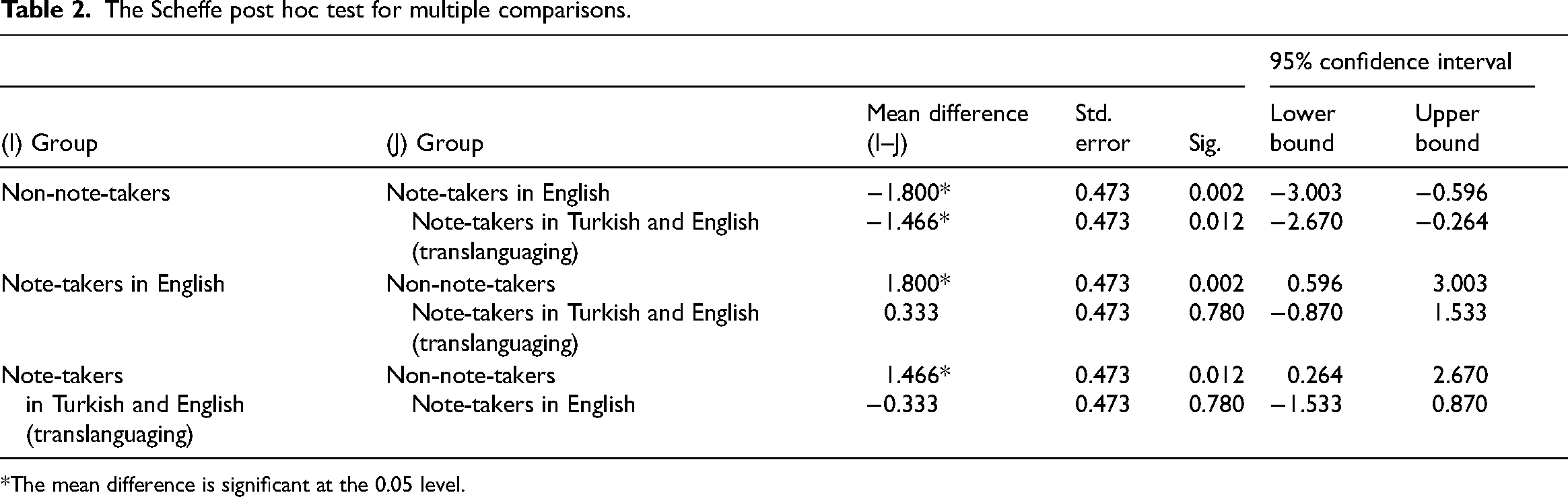
In order to find the location of difference in the three note-taking approaches, a Scheffe post hoc test for multiple comparisons was run. As seen in Table 2, the mean difference between note-takers in Turkish and English (translanguaging) and the non-note-takers was 1.466 (p = .013 > .05), which indicated that there was a significant effect of using note-taking in Turkish and English (translanguaging) on listening comprehension test scores.
The Scheffe post hoc test for multiple comparisons.
*The mean difference is significant at the 0.05 level.
The results of one-way ANOVA and the Sheffe post hoc test revealed that although there was a significant difference among the three groups in terms of listening test scores (p = .001), the significant difference was only between note-takers in English and non-note-takers (p = .002) and note-takers in Turkish and English (translanguaging) and non-note-takers (p = .012). The results indicated that listening test scores of note-takers in English and note-takers in Turkish and English (translanguaging) were not statistically different (p = .780 > .05, MD = .33). These findings indicated that using English and translanguaging (Turkish and English) to write down notes during academic listening affected Turkish EAP students’ listening test scores. Using English and translanguaging could allow them to capture and jot down the information while listening. Both note-takers in English and translanguaging compared to non-note-takers could obtain higher scores, which indicated the usefulness of note-taking regardless of language differences. These findings suggested that allowing the students to leverage their linguistic repertoire in note-taking can be beneficial to improve listening. In contrast, the students who did not take notes during the listening were unable to achieve listening test scores as high as the note-takers. Similarly, the results from the study by Wang (2021) comparing three alternative approaches to note-taking (i.e., L2 English, L1 Chinese, and translanguaging) showed that students who took notes in English L2 only outperformed those who took notes in their L1 Chinese and translanguaging on a retention test. This indicates that matching the language of the input (English lecture) with the language used for note-taking (English) can enhance students’ comprehension and retention of the lecture content. The findings align with previous research by Tsai and Wu (2010) who compared two groups, L1 Chinese and L2 English, showing that taking notes in the same language as the lecture input (i.e., English) can reduce cognitive demands and improve learning outcomes compared to translating between languages during note-taking. Also, as stated by Rodgers and Webb (2016) and Song (2012), accurate note-taking is indicative of academic proficiency and intellectual capacity in academic listening. Encouraging learners to take notes using their full linguistic repertoire, including their L1, L2, and translanguaging strategies, can help them regulate their listening and note-taking processes while increasing their metacognitive awareness.
Conclusion and Implications for Further Research
The overarching goal of this study was to provide a clearer understanding of EAP students’ note-taking in academic listening from a translanguaging perspective. The results of this study showed that good note-takers were the self-regulated ones evaluating their note-taking performance in academic listening, connecting their prior knowledge with the lecture content, and assessing their notes for completeness and accuracy. Furthermore, note-taking instruction highlighted the opportunities for the usage of note-taking strategies and translanguaging. The note-taking instruction implemented in an academic listening course in the EAP program was found to be pedagogically beneficial in encouraging students to use effective note-taking strategies.
The note-taking tasks during the instruction enabled some students to preserve the information in their notes in L1 and L2 (translanguaging). This research demonstrated that note-taking instruction in academic listening led to better listening test scores of the students who took notes in English and translanguaging. However, the ones who did not take notes during listening did not have as high listening test scores as the note-takers. Bearing this in mind, note-taking practices from the translanguaging perspective may be beneficial in EAP and EMI academic listening courses.
This study offers significant insights with broad implications. While focused on the Turkish context, its findings are relevant to tertiary education systems worldwide. Educators should consider the potential benefits of translanguaging in reducing cognitive load for students during note-taking and processing of complex information. However, further research across diverse educational settings is necessary to fully comprehend its effects. The results of this study have important implications for researchers and teachers involved in EAP and EMI courses. Future studies could enhance the current research design by involving larger student groups in various contexts, including upper secondary EMI and content and language integrated learning programs, and comparing findings across different settings where academic listening and note-taking from translanguaging perspectives are taught. Further research should examine the quality of notes taken in L1, L2, and translanguaging, considering content, accuracy, and relevance. To assess the note quality comprehensively, researchers might combine note-taking data with multiple sources such as follow-up interviews and eye-tracking. EAP students should receive training in effective note-taking skills for complex academic content, while teachers should strive to enhance students’ awareness of diverse note-taking strategies.
Footnotes
Declaration of Conflicting Interests
The author declared no potential conflicts of interest with respect to the research, authorship, and/or publication of this article.
Funding
The author received no financial support for the research, authorship, and/or publication of this article.

Appendix 1
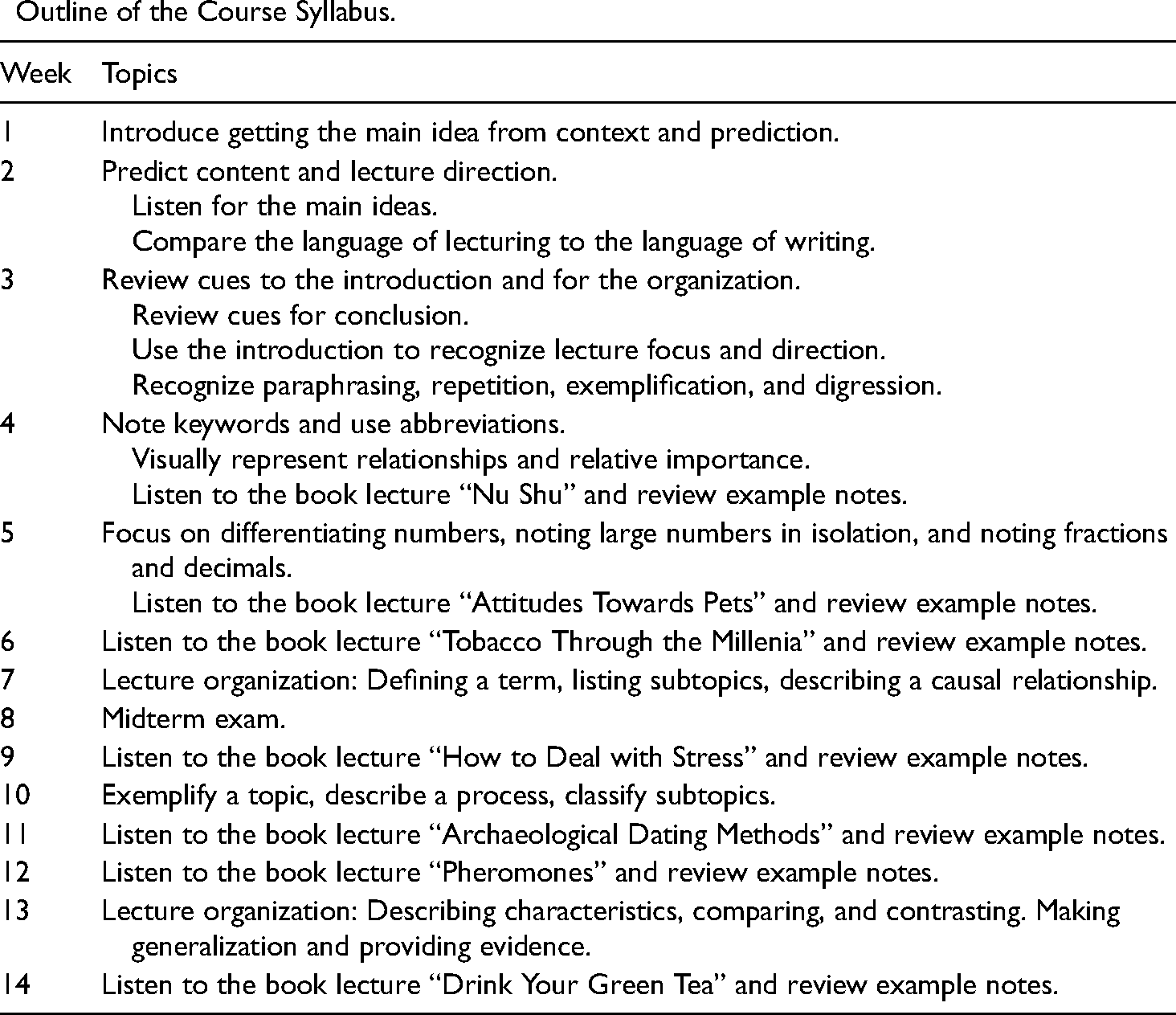
Outline of the Course Syllabus.
| Week | Topics |
|---|---|
| 1 | Introduce getting the main idea from context and prediction. |
| 2 | Predict content and lecture direction. Listen for the main ideas. Compare the language of lecturing to the language of writing. |
| 3 | Review cues to the introduction and for the organization. Review cues for conclusion. Use the introduction to recognize lecture focus and direction. Recognize paraphrasing, repetition, exemplification, and digression. |
| 4 | Note keywords and use abbreviations. Visually represent relationships and relative importance. Listen to the book lecture “Nu Shu” and review example notes. |
| 5 | Focus on differentiating numbers, noting large numbers in isolation, and noting fractions and decimals. Listen to the book lecture “Attitudes Towards Pets” and review example notes. |
| 6 | Listen to the book lecture “Tobacco Through the Millenia” and review example notes. |
| 7 | Lecture organization: Defining a term, listing subtopics, describing a causal relationship. |
| 8 | Midterm exam. |
| 9 | Listen to the book lecture “How to Deal with Stress” and review example notes. |
| 10 | Exemplify a topic, describe a process, classify subtopics. |
| 11 | Listen to the book lecture “Archaeological Dating Methods” and review example notes. |
| 12 | Listen to the book lecture “Pheromones” and review example notes. |
| 13 | Lecture organization: Describing characteristics, comparing, and contrasting. Making generalization and providing evidence. |
| 14 | Listen to the book lecture “Drink Your Green Tea” and review example notes. |