



Abstract
The collaborative competence of subject (discipline) teachers and language (English for academic or specific purposes) teachers in higher education is a central concern in English-medium instruction contexts, where they frequently interact. This brief scoping review provides a snapshot of the current state of English-medium instruction teacher collaboration and guides collaborative practice to better support language teachers, subject teachers and (ultimately) students. The review is restricted to empirical studies and focuses on the forms of teacher collaboration, barriers to collaboration, and strategies to overcome these challenges. Teacher collaborations occur at institutional, departmental and individual levels, and, at each level, some obstacles limit the effectiveness and sustainability of collaborations. Proposed solutions range from individual initiatives to systematic institutional support. Based on these findings, the paper concludes with practical recommendations to enhance future collaborations.
Keywords
Introduction
In contexts of English-medium instruction (EMI) in higher education – involving ‘the use of the English language to teach academic subjects (other than English itself) in countries or jurisdictions where the first language (L1) of the majority of the population is not English’ (Dearden, 2014: 2) – the collaborative competence of EMI teachers has emerged as an area of interest (Pérez Cañado, 2018). Collaboration in this context refers to various forms of partnerships between subject teachers in the disciplines and other teachers, frequently language teachers specializing in English for academic or specific purposes (EAP/ESP). EMI is a pedagogical context that presupposes the use of English, and it is widely assumed that language teachers can support subject teachers and students in EMI in meaningful ways as they navigate disciplinary and academic discourses in second-language or foreign-language English.
Stakeholders in and around EMI have called for more research into collaborations between subject teachers and language specialists (e.g. Schmidt-Unterberger, 2018). To enhance the effectiveness of teacher collaborations and to better meet the needs of teachers and students in EMI settings, it is important to establish what the state of the art is concerning teacher collaborations in EMI. For these reasons, and in keeping with the overarching rationale proposed by Arksey and O’Malley (2005), we present a brief scoping review of collaborations between subject teachers and language specialists in EMI. We followed the five steps outlined by Arksey and O’Malley for conducting scoping reviews. Three guiding review questions were our starting point:
What forms of teacher collaboration exist in EMI between subject teachers and language specialists? What are the primary obstacles encountered when subject teachers and language specialists collaborate? How do practitioners overcome challenges and foster effective collaboration between subject teachers and language specialists?
Searches for relevant literature were made in Web of Science and Scopus, using various combinations of search terms (variations of ‘English medium education/instruction’ combined with the word ‘collaboration’). ‘Backward searches’ (Xiao and Watson, 2019: 104) were also made, utilizing, for example, lists of references in the articles retrieved in the database search.
This review focuses on collaboration between subject teachers and language specialists, emphasizing language-related issues. It is acknowledged that such collaboration can lead to curriculum development and other forms of pedagogical support, and that EAP/ESP language specialists often provide general pedagogical support intertwined with the linguistic support they offer subject teachers, but space constraints prevent us from exploring this additional dimension in detail.
Figure 1 describes the process adopted for identifying 19 empirical studies from an initial list of 134 publications based on criteria for inclusion and exclusion. We highlight that, for a study to be included in the review, it had to be empirical and based on first-hand data. As a result, significant conceptual contributions in this cross-over area of EMI and EAP/ESP (e.g. Airey, 2016; Dafouz, 2021; Lasagabaster, 2018; Wingate and Hakim, 2022; Yuan, 2023) were not included, even though teacher collaboration is a central concern in such research.
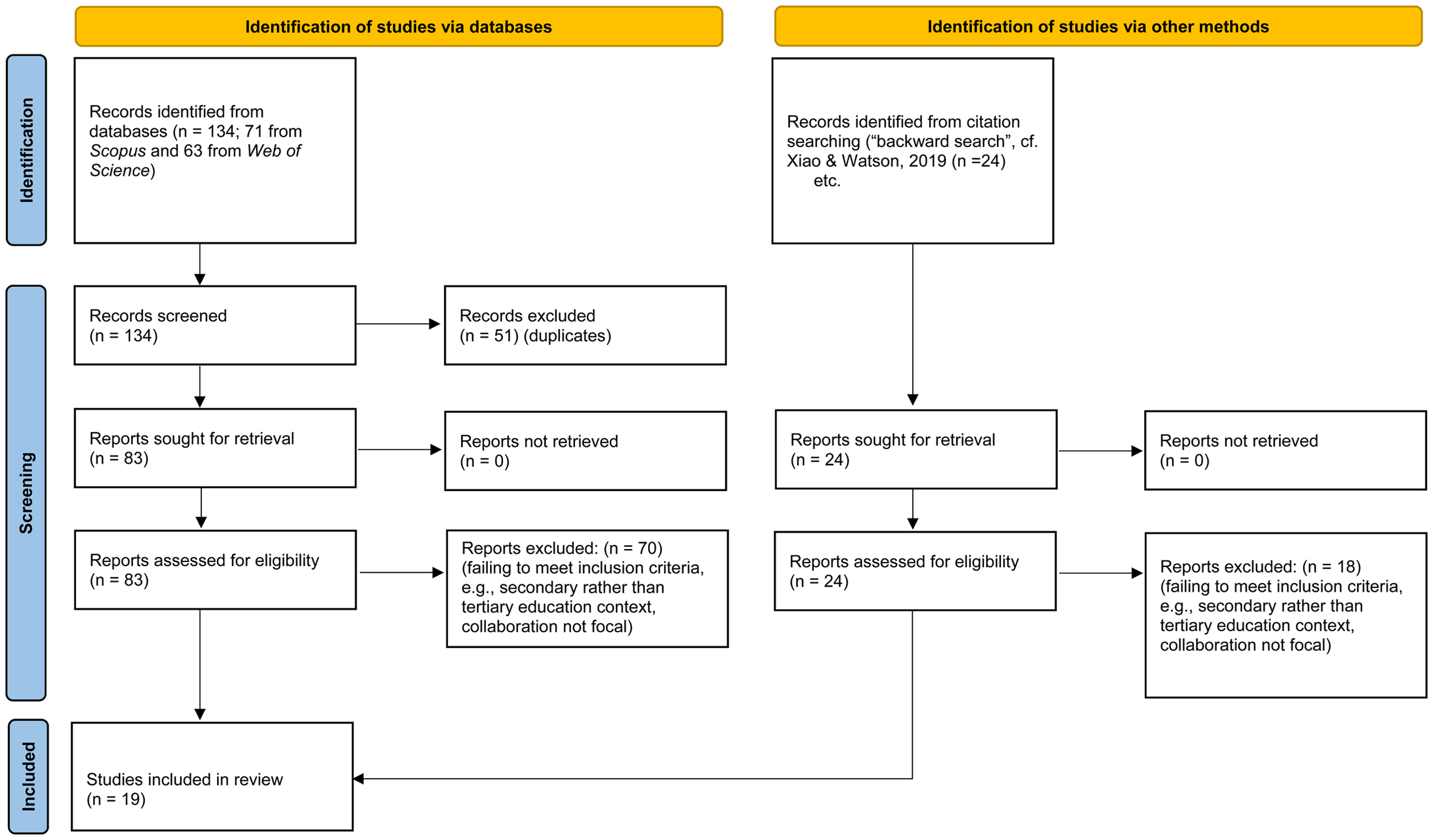
PRISMA 2020 flow diagram. Baseline criteria for inclusion/exclusion: (a) any publication date; (b) publication written in English; (c) journal article; (d) designated as English as a medium of instruction (EMI) under a broad definition – that is, involving English as an instructional language (whether wholly or partly) in geographical contexts where English is not a first language for the majority of the population; (e) empirical research – that is, a study of collaboration grounded in first-hand data, investigations or observations; (f) level of study; only collaborations in higher education contexts were included; (g) collaboration a focal concept – that is, not just mentioned in passing, or (very frequently) featuring as a recommendation on the back of findings from a study with a different empirical focus.
Forms of Collaboration
Our review identified collaboration at three levels: (a) institutional-level collaboration; (b) faculty/department-level collaboration; and (c) individual-level collaboration.
At the institutional level, teacher collaboration is implemented top-down with institutional support, often initiated and led by language teaching departments. This collaboration involves regular participation from both subject and language teachers and can be centralized or decentralized. From Colombia, Ramírez et al. (2023) describe a centralized project launched by a university's language department promoting ‘English Across the Curriculum’ over two years. Conversely, Wallace et al. (2020) present a decentralized model from a Canadian university where language teachers are assigned to faculties to assist in course planning, curriculum development and extensive collaboration in classroom activities.
Collaboration at the faculty/department level involves language specialists working with subject teachers to address specific English demands within (a) discipline(s). This often leads to integrated learning interventions – for example, an integrated course (Siebörger et al., 2015) or joint English workshops (Clarence et al., 2014). In South Africa, Siebörger et al. (2015) describe designing an integrated course to improve business students’ ESP, based on an analysis of teachers’ and students’ needs. The course used ‘boundary objects’ (Siebörger et al., 2015: 90), representing natural, non-intrusive opportunities for collaboration, such as inviting language experts to deliver guest lectures in business courses or designing assignments in language courses reflective of business content. Clarence et al. (2014) report on law faculty writing workshops co-designed by an English specialist and law teachers. The language specialist led the workshops, created writing exercises and developed rubrics based on faculty feedback.
Most of the reviewed studies, however, describe individual-level collaboration, either initiated by external researchers or developed organically by teachers. This can encompass entire curricula (Ploettner, 2019; Rui and Lo, 2023) or parts of courses (Doiz et al., 2019; Eriksson, 2018; Macaro et al., 2016). In China, Rui and Lo (2023) detail a 13-week collaboration between an EMI drama course teacher and an English teacher, based on Lo's (2015) framework. The teachers met to discuss pedagogical changes, ways of integrating language objectives, adjusting strategies for clarity and improving students’ character analysis skills. Similarly, Ploettner (2019) reports on a two-month collaboration in Spain, where a novice medicine teacher and an experienced language specialist worked on course objectives, lesson planning, teaching rehearsal, co-teaching and evaluation. A third example is the extensive team teaching experience described by Xu and Zhang (2022); this collaboration, involving an engineering teacher and an applied linguist, took place over 10 months and included recursive stages of classroom observation, co-planning and co-teaching.
Some individual-level collaboration focuses on specific curriculum components rather than entire courses. Common forms include co-lesson planning (Macaro et al., 2016; Moore et al., 2015), team teaching (Breeze and Sancho Guinda, 2017; Doiz et al., 2019; Eriksson, 2018; Xu and Zhang, 2022) and assignment grading support (Eriksson, 2018; Woźniak, 2013). In Turkey, Macaro et al. (2016) developed a ‘collaborative planning tool’ (CPT) for nine pairs of subject and language teachers, helping them reflect on pre-reading materials, slides and language use. Using the CPT, subject teachers received language advice, amended lectures and provided feedback. Eriksson (2018) describes team teaching in Sweden, where a writing specialist redesigned a task and lectured on data commentary in an electrical power engineering course. Co-designing and co-grading assignments, sometimes with language teachers offering direct feedback on students’ work, also feature among the examples of individual-level collaboration (Eriksson, 2018; Wallace et al., 2020; Woźniak, 2013).
Hurdles in Collaboration
Several obstacles in subject–language teacher collaborations are cited in the studies included in the review. A frequent challenge is defining shared teaching objectives (Doiz et al., 2019; Ramírez et al., 2023; Rui et al., 2024; Sampaio et al., 2021; Wallace et al., 2020; Woźniak, 2013). Differing language ideologies can cause conflicts over language emphasis in the EMI curriculum (Doiz et al., 2019; Rui et al., 2024; Wallace et al., 2020). In Rui and Lo's (2023) study in China, subject teachers feared losing content–language balance if language perspectives became integrated. In Canada, Wallace et al. (2020) noted discipline faculties' unease with language teachers’ presence in class, and how teachers complained that an ‘unnecessary emphasis on language’ could ‘impede students from thinking creatively’ (137). According to Ramírez et al. (2023), the key question is whether collaboration aims to integrate content and language into a complex whole or simply adds situational language teaching to address content learning difficulties.
Unclear division of responsibilities between subject and language teachers is another common challenge (Doiz et al., 2019; Moore et al., 2015), and tensions might persist despite ‘negotiations’ (Moore et al., 2015; Ploettner, 2019; Rui and Lo, 2023). In Spain, Doiz et al. (2019) found that EMI subject lecturers felt their responsibility was solely academic, not linguistic, due to a lack of time and language teaching qualifications; instead, they expected that all language issues would be handled by the language experts during co-teaching. Moore et al. (2015) reported that language teachers preferred mentoring subject teachers to enhance their EMI pedagogical skills rather than directly teaching students, a pedagogical model not all subject teachers may be comfortable with.
Negotiations of responsibilities often face setbacks due to unequal power relations. Subject teachers, usually holding higher academic positions, often dominate collaborations (Moore et al., 2015; Xu and Zhang, 2022). In Colombia, Ramírez et al. (2023) found that subject teachers viewed themselves as ‘owners’ of courses, limiting language teachers to language teaching and class management only. Factors such as employment status, professional rank (Wallace et al., 2020) and teaching experience/expertise (Ploettner, 2019) also contribute to these unequal power dynamics.
The sustainability of teacher collaboration is often called into question by insufficient institutional support and time constraints. Alhassan et al. (2022) emphasize that long-term initiatives require top-down (institutional) support to sustain teacher engagement – indeed, Yuan (2023: 270) goes as far as saying that ‘occasional and one-off training cannot lead to long-term, sustainable teacher development, which requires continuing collaborative engagement and contextual support’. However, several studies note a lack of resources and incentives (Arnó-Macià and Mancho-Barés, 2015; Clarence et al., 2014). For example, EMI lecturers in Spain felt unrecognized by their institutions (Arnó-Macià and Mancho-Barés, 2015). Time commitment and scheduling challenges are also significant barriers (e.g. Alhassan et al., 2022; Doiz et al., 2019; Lu, 2022; Sampaio et al., 2021; Wallace et al., 2020, Xu and Zhang, 2022), with co-planning and co-marking requiring extra time from teachers (Lu, 2022; Wallace et al., 2020). Finally, coordinating meeting times might be difficult due to differing schedules, reducing teachers’ willingness to participate in long-term collaboration (Sampaio et al., 2021).
Turning Challenges into Successful Collaboration
The reviewed studies also propose solutions to overcome hurdles and improve collaborations.
Collaborations are more likely to succeed when they are based on bottom-up collaborations involving individual subject and language teachers who develop mutual understanding (Rui and Lo, 2023; Xu and Zhang, 2022). Prior to the actual collaboration, an external researcher/facilitator can introduce the rationale, strategies and benefits of collaboration to raise awareness and build a solid foundation (Lo, 2015). Classroom observations and EMI lecture recordings might help language teachers become familiar with disciplinary content (Alhassan et al., 2022; Lu, 2022; Xu and Zhang, 2022), fostering mutual awareness of goals, needs and priorities of teaching. Initial small-scale collaboration trials focusing on selected course components can be implemented first, utilizing tools like the CPT to guide discussions on key language and content components (Macaro et al., 2016). These explorations should aim to establish mutual understanding, set expectations for collaboration and identify potential collaboration forms.
Collaborations benefit from leveraging the strengths of both subject and language teachers. An approach tested in several contexts is genre-based collaborative language support (Clarence et al., 2014; Eriksson, 2018; Ramírez et al., 2023; Siebörger et al., 2015), as genre-based approaches provide common ground and ownership for both sides (Eriksson, 2018). Language centres (Ramírez et al., 2023) or discipline faculty (Siebörger et al., 2015) can lead genre-based initiatives, depending on institutional structure. Boundary objects such as language assignments reflecting disciplinary content or additional EAP/ESP workshops with a distinct language focus are crucial for balancing expertise without intruding (Siebörger et al., 2015). Subject teachers’ input is vital in identifying these objects as insiders in their fields (Clarence et al., 2014). Emphasizing the interdependency of content and language – essentially a disciplinary literacies approach (cf. Dafouz, 2021) – is another potentially effective way for collaborators to leverage the strengths of both subject and language teachers. An illustrative example is the three-stage team teaching collaboration between an engineering teacher and a language specialist in a Chinese EMI context reported in Xu and Zhang (2022). This collaboration led the EMI teacher to reflect on and expand their identity not only as a subject teacher, but also as a language teacher to help students better understand subject-specific language use. In this regard, the authors noted that the collaboration had enabled the engineering teacher to develop ‘a more nuanced understanding of the bidirectional and dialectical relationship between content and language’ (Xu and Zhang, 2022: 364).
When (if) collaborations reach the stage of systematic roll-out, institutions should implement effective incentive mechanisms to recognize teachers’ extra efforts (Moore et al., 2015). Woźniak's (2013) study in Spain exemplifies this with institutions awarding additional credits and teaching hours to courses integrating subject-language perspectives. As collaborations evolve, institutional support needs to adjust to meet teachers’ changing needs. Ramírez et al. (2023) illustrate this with a structured project where a language centre supported faculty teachers through stages involving training, coaching and ongoing support. To manage administrative costs as another potential obstacle to collaboration (Siebörger et al. 2015), digital solutions have been proposed. Online platforms like the Education, Languages and Internationalisation Network (ELINET) can foster collaboration and knowledge-sharing among EMI practitioners with little extra cost (Galloway et al., 2017). Similarly, Lu (2022) discusses how social media platforms enable continuous dialogue between subject and language teachers and enhance collaborative practices and equality in partnerships. One advantage of digital tools is that they create an open space which teachers can access at their convenience; if this is done collaboratively, it may foster a stronger sense of a community of (collaborative) practice and contribute to more equal collaborative relationships between subject and language teachers.
Concluding Remarks: Recommendations for Practice
This paper has focused on practical aspects of teacher collaboration in EMI. In line with this practical focus, this concluding section presents four recommendations for collaboration between subject and language teachers in EMI, informed by the findings of this review. Space prevents elaboration of the points listed, but we encourage RELC readers to explore the studies included in this review for further inspiration:
The roles, rights and responsibilities of all collaborators should be established early on, addressing any misconceptions. The collaborative nature of the relationship should be emphasized with a high degree of transparency, ensuring language teachers are treated as teacher peers, not merely supporters of learning. Some dimensions of the collaboration may require negotiation and a(n implicit) contract, concerning, for example, access to students, active teaching participation and involvement in formative and/or summative assessment. Initiatives for collaboration between subject and language teachers in EMI, whether implemented bottom-up or top-down and regardless of scope, need to be recognized and incentivized in different ways by the teachers’ institutions; specifically, appropriate allocation of time for all collaborating teachers is necessary, including time for preparation and follow-up/evaluation. Begin with small-scale initiatives and expand the collaboration scope as stakeholders become receptive/demonstrate buy-in. Implementing extensive changes to a syllabus can be daunting; starting with modest interventions, like a single written assignment, offers a better chance of success and lays the groundwork for future sustainable collaborations. The contentious role of language in the EMI curriculum should be addressed explicitly, rather than avoided when initiating teacher collaborations. Prioritizing a discussion about disciplinary literacy and the fruitful integration of content and language perspectives, rather than focusing solely on language (particularly English), is likely beneficial. This approach offers common ground where both subject and language teachers can feel empowered as experts.
Six years ago, Schmidt-Unterberger (2018) expressed hope for ‘a language-conscious implementation of English-medium education that would entail the integration of ESP and EAP teaching’ (536). Our review indicates that achieving effective and sustainable integration of EAP/ESP perspectives in EMI remains a work in progress, specifically in terms of developing awareness that EAP/ESP perspectives are meant to complement, rather than compete with, disciplinary foci. As the scope of our review focused on the practical facet of collaboration, we encourage future work in this area to further explore how these collaborations are shaped by the wider educational context to capture its multifaceted nature.
