




Abstract
In this study, I report on my use of critical autoethnographic narrative (CAN) writing with English language teacher candidates (TCs) in a graduate-level teacher education course. In that iterative, scaffolded writing activity, I coached TCs to construct their teacher identity in narrative and make visible to themselves ideologies dominant in the sociopolitical context of language teaching. Drawing data from my CAN implementation in Spring 2023, I analyze Pamela's (pseudonym) case to address this research question: How does she construct her English language teacher identity in a semester-long CAN writing activity? The qualitative data analysis demonstrates that Pamela's language teacher identity involved: (a) becoming a social justice advocate, (b) grappling with neurodiversity, and (c) positioning language as an evolving local contextualized practice. Based on her positioning of language, she denies ‘one right way’ approach to language use, ‘teaching as correcting errors’ approach, and ‘assessment as gatekeeping’ approach as part of her teacher identity. Pamela's CAN shows that the personal, professional, and political dimensions of language teaching are intricately intertwined in teacher identity, and that teacher identity construction involves tensions of competing ideologies in the sociopolitical context.
Keywords
Introduction
Teacher identity provides researchers of language teacher education with a conceptual ‘frame’ (Olsen, 2008: 5) that informs the scholarship on who language teachers are, how they become teachers, and how they learn. Following sociocultural approaches and building on the previous research on teacher learning, beliefs, and cognition, the research on language teacher identity (LTI) has attended to the teacher as an embodiment of the intersection between personal, political, and professional dimensions of language teaching (Kamali, 2024; Kessler, 2024; Richards, 2023; Ustuk and Yazan, 2024a). That attention led to increased research on teachers’ ideologies, agency, investment, and emotions, which are all individual but interconnected substrands of research now. LTI scholars have consistently called for the integration of teacher identity into teacher education practices and relying on it as a ‘pedagogical tool’ (Olsen, 2008: 5), which has not received much attention yet. That research call requires pedagogizing identity in teacher education, which involves designing, implementing, and researching identity-oriented teacher-learning activities in teacher education programs. Colleagues responded to that call in the past 8 years with different activities (e.g. Yazan, 2019; Canagarajah, 2020; Flores and Aneja, 2017; Ustuk and Yazan, 2024a, 2024b; Valencia et al., 2020; Varghese et al., 2019). Building on that line of research in this study, I provide another example of pedagogizing teacher identity in teacher education practices, which is the main theme of the RELC Journal's special issue. More specifically, I report on my use of critical autoethnographic narrative (CAN; Yazan, 2019) with English language teacher candidates (TCs) in a graduate-level teacher education course. In that scaffolded writing experience, I coached TCs to construct their teacher identity in narrative and make visible to themselves ideologies dominant in the sociopolitical context of language teaching. Drawing data from my CAN implementation in Spring 2023, I analyze Pamela's (pseudonym) case to address this research question: How does she construct her English language teacher identity in a semester-long CAN writing activity?
Conceptualizing Language Teacher Identity
The current research on LTI converges on the premise that becoming a teacher involves constructing a professional identity intersecting with and grounded in existing social identities, and teachers’ identities inform their emotions, agency, and investment in their professional lives (Barkhuizen, 2016; Richards, 2023; Tajeddin and Yazan, 2024). In this study, I broadly conceptualize identity as ‘ideological becoming’ (Bakhtin, 1981: 341) and more specifically rely on Akkerman and Meijer's (2011: 317–318) Bakhtinian definition: ‘an ongoing process of negotiating and interrelating multiple I-positions in such a way that a more or less coherent and consistent sense of self is maintained throughout various participations and self-investments in one's (working) life.’ Those participations and self-investments require navigating ideological landscapes at the nexus of macro, meso, and micro levels of sociopolitical contexts. Therefore, LTI is ‘produced and discursively constructed within hierarchically organized racial, gendered, linguistic, religious, and classed categories and processes within teachers’ personal lives as well as in and through their teacher education programs, classrooms, schools, disciplines and nation states’ (Varghese et al., 2016: 546). That is, LTI is the nexus of personal, professional, and political dimensions of language teaching. Unique to language teaching, language: (a) is both the medium and content of instruction; (b) serves as a vehicle to maintain and subvert hierarchies; (c) provide the meaning-making space for individuals to negotiate and construct identities; and (d) is an important part of every individual's identity. Teachers’ orientations towards language then inform their instructional beliefs, values, and priorities, which are integral in their LTI.
Identity-oriented Teacher-learning Activities
Existing research on LTI suggests that teacher learning and teaching practice inevitably involve identity work (Clarke, 2009) which is intertwined with teachers’ emotions, agency, and investment (Miller et al., 2018). Therefore, identity provides a holistic and comprehensive framework to understand teachers’ professional growth and life and does not deny the importance of gaining pedagogical knowledge and skills as part of becoming a language teacher. It helps TCs understand what knowledge and skills mean for the kind of teacher they would like to become (Yazan and Lindahl, 2020). Incorporating an identity framework into pedagogies of language teacher education can benefit TCs in at least two main ways. First, designing teacher learning with an identity framework attends to the intersection and interface of personal, professional, and political dimensions of being a language teacher (Varghese et al., 2016). In such teacher learning, language teachers can make connections between who they are (i.e. all relevant identities they bring to teaching) and how they (learn to) teach (i.e. instructional beliefs, values, and priorities). Second, identity orientation can help teachers understand ongoing inevitable tensions between the kind of teacher they are and the kind of teacher they are expected to be based on ideologically laden identity options defined and confined in the sociopolitical context (Ustuk and Yazan, 2024b). Understanding their orientations towards dominant ideologies (Bartolomé, 2004), teachers can assert their agency and invest their cognitive and emotional energy to chart the contours of their teacher identity within contextual parameters (Ilieva and Ravindran, 2018; Richards, 2023).
Common teacher-learning activities that center teachers’ beliefs, values, narratives, and reflections tend to include a focus on identity implicitly. That is, although not explicitly attended to, completing such activities involves identity work. For example, language learning autobiographies offer narrative space in which teachers talk about their past experiences with languages and discuss their motivation, personal language learning theories or best methods, challenges, as well as model/favorite teachers (Selvi and Martin-Beltrán, 2016). However, recently teacher educators have made teacher identity an explicit goal in their practices. In some cases, teacher educators have used activities in which TCs made sense of connections between their professional identities and identities of language, race, culture, and nationality among others. For example, Canagarajah (2020) used literacy autobiographies in which teachers constructed their translingual and transnational identities vis-à-vis their language learning, use, and teaching. Flores and Aneja (2017) designed a translingual project that TCs completed over three drafts with peer and faculty feedback to have TCs use translingualism as a framework to understand and problematize ideologies that define and confine their identity positions. Additionally, Valencia et al. (2020) introduced multimodal examples such as audio-visual identity texts, identity portraits, and duoethnographic experience, and engaged teachers in explicit identity work to make visible the relationships between their sociocultural identities and professional identities. In another multimodal example, Lindahl et al. (2021) had TCs draw their language portraits (Coffey, 2015) and language ideologies trees in which TCs critically reflected on their identities of language, culture, race, ethnicity, and nationality in relation to their future work with language learners. Finally, in an interactional activity outside the teacher education classroom, Varghese et al. (2019) implemented race-based caucuses, including caucuses for TCs of color and caucuses for white TCs in which facilitating teacher educators organized eight meetings with TCs informally to share their stories with thoughts and emotions about being a teacher in the US. Pushing toward a critical perspective to power and racialization, facilitators helped TCs to ‘engage the relationship between teachers’ racialized selves and teacher identities within their teacher education programs’ (Varghese et al., 2019: 3).
In other cases, teacher educators redesigned the entire course with an explicit identity focus infused across all teacher-learning activities. In two examples (Martel and Yazan, 2021; Ustuk and Yazan, 2024a), we modified the activities in two practicum courses, a graduate-level one in California and an undergraduate-level one in Türkiye, to make identity work the central pedagogical goal. Practicum as a course was convenient and significant for such a goal because TCs visiting schools for observations and practice teaching had a lot more to discuss about the kind of teacher they would like to be and how they would enact their teacher identity in classroom practices. Finally, Ilieva and Ravindran (2018: 11) describe teacher-learning activities with an identity lens in a MATESOL program, which they note ‘could be seen as an instance of a LTE program that makes LTI its central organizing principle, even though this principle was not overtly shared with students in the program.’
In all studies above, teacher educators conducted research on the use of identity-oriented teacher-learning activities and shared research-based evidence for their effectiveness. That is, engaging in such activities, TCs articulated their instructional beliefs, values, and priorities, and developed awareness of their sociopolitical situatedness in the context by discussing how they position themselves and how they are positioned by dominant ideologies. Narrative as identity construction supported TCs’ engagement with identity work (Canagarajah, 2020; Flores and Aneja, 2017). The use of multimodal activities helped TCs understand the connectedness between their sociocultural and professional identities (Lindahl et al., 2021; Valencia et al., 2020). Additionally, when teacher educators acted as facilitators to bring identity issues to group conversations over an extended period, TCs benefitted from collaborative discussions to make sense of their professional identity hierarchically constructed in the context (Varghese et al., 2019).
Adding to those examples, since 2018, I have designed and implemented CAN four times in my teacher education classes as an identity-oriented teacher-learning activity. In the studies I conducted with CAN data (e.g. Yazan, 2019, 2023a), I found that engaging in scaffolded iterative narration and analysis of own stories of language learning and teaching over a 16-week semester supported TCs’ development of an identity lens to their pedagogies and professional growth. That lens also included the importance of emotions and agency as inseparable dimensions of their identity work. After analyzing how ideologies operated in their narrated stories and how they constructed identities by demonstrating their orientations toward those ideologies, TCs could see their whole person in their teaching and make sense of own pedagogical approaches vis-à-vis the kind of language teacher they are and imagine becoming within contextual constraints. Colleagues who followed my CAN design also shared research-based evidence of the effectiveness of CAN use in teacher education practices (Arshavskaya and Reyes, 2023; Kamali, 2024; Kessler, 2024).
In the most recent iteration, I used CAN with a group of 10 TCs in a MATESOL program at a large public Hispanic serving university in South Texas, USA. Most of those TCs in that class identified as Hispanic and ethno/racio-linguistic ideologies frequently came up in class discussions and CAN writing process. Below I discuss its purpose, design, and implementation.
Critical Autoethnographic Narrative: Purpose, Design, and Implementation
CAN is a scaffolded reflective writing activity in which teachers are expected to narrate and analyze their past lived experience of learning, using, and teaching languages. The initial writing prompt was ‘In this submission, narrate your earlier language learning and teaching experiences by focusing on the important incidents that supported or hindered your learning and teaching.’ As we had feedback sessions, I asked them to make revisions and narrate and discuss more stories they can re-remember. I also reminded them that they ‘can (a) incorporate the features of other genres like drama or poetry into your autoethnography, (b) interweave all world languages into your writing, and (c) use varying modalities, like art-based or otherwise.’
CAN relies on the existing research on language teachers’ narrative inquiry as professional development (Johnson and Golombek, 2002) and narrative as identity construction (Barkhuizen, 2016). Attending to teacher identity as ‘a potential site of pedagogical intervention and an area of explicit focus in teacher preparation’ (Morgan and Clarke, 2011: 825), CAN offers the space in which teachers construct their identities in a narrative with a critical lens toward the invisible ideologies circulating in discourses. The main purpose is to have teachers engage in critical examination of the intricate interplay between ‘the self,’ ‘the other,’ and surrounding sociocultural/political discourses and understand the situatedness of their professional identities vis-à-vis other social identities as well as corresponding tensions they could be grappling with. My hope is for teachers to leave the activity with an identity lens toward their pedagogy, that is, becoming cognizant and informed about how their pedagogy is identity enactment, which is very much intertwined with their emotional and agentive engagement. That is, CAN helps them gain the understanding that their pedagogical decisions and practices are informed by their professional identity and being a language teacher is an emotionally charged experience in which they need to assert agency to act as the kind of teacher they are or aspire to be.
The design of CAN included installments of narrative writing exercises that received individual feedback via Zoom meetings and general feedback in the class meetings. I chose to meet on Zoom for feedback because of its convenience for TCs and myself to decrease the amount of time spent in traffic in a metropolitan area and to record easily the meetings for our review afterwards. Each installment built on the earlier ones by addressing the feedback and adding additional content. It is a free writing practice, into which I encouraged teachers to include literary and multimodal components. Additionally, teachers submitted two drafts of a teacher identity paper (TIP), one at the beginning and one at the end of the semester. The TIP replaced the ‘teacher philosophy statement’ and I asked teachers to answer the question ‘what kind of teacher am I and do I aspire to become?’ based on their CAN writing.
The first iteration of CAN in my teacher education practices was in Spring 2018 when I had six teachers in a graduate-level linguistics course. The most recent (and the fourth) implementation was in spring 2023, in which I worked with 10 TCs in a graduate-level second language teaching methods (SLTM) course (see Supplementary Materials for the description and rubric of CAN). As TCs learn about different methods of teaching English as a second language (e.g. grammar, vocabulary, four skills), they were expected to make sense of those methods in light of the analysis of their stories in CAN. The class was a mix of in-service teachers, substitute teachers, instructional assistants in K-12 and post-secondary settings, as well as those who are completing their teaching practicum or internship. Pamela was one of those TCs who entered the program with extensive post-secondary teaching experience but needed the graduate certificate to teach adult ESL. She completed three installments of CAN over the semester, and received from me written feedback which was followed by an individual feedback session on Zoom. Feedback sessions clarified written comments if she needed and discussed her subsequent steps in continuing to write her CAN. In the first two installments, I encouraged all teachers to narrate as many relevant stories as they could re-remember, and in the third installment, I asked them to start analyzing those stories from the perspective of language ideologies. They also drew a concept map of their CAN toward the end of the semester and delivered an individual presentation in the last class of the semester.
To support teachers’ CAN writing, we read first two chapters from Olsen's (2016) book on teacher learning and identity early in the semester. I did classroom check-ins to see how their writing was going throughout the semester. When TCs shared any relevant experiences in the classroom, I encouraged them to story those experiences in their CAN. Almost all our class discussions included conversations around identity, agency, and emotions in learning and teaching languages. If I had already read their installment, I would give examples from their stories in our discussions. At times, we would analyze some of those stories collaboratively in the class to model the analysis to provide a critical examination of cultural discourses. I modeled the analysis by demonstrating how to ask the following guiding questions to data excerpts I brought from my then ongoing research projects:
Who is involved? What are the actors/agents? What has happened or is happening? Who makes the decision? (who holds the power?) What is the justification for the decision? (herein lie ideologies mostly) Who is expected to act on this decision? What identity positions are assumed/enacted? What is the imagined/future decision, action, and identity? What do the actors feel about what happened? (Yazan, 2023b: 129–130)
Methods
Researcher Positionality
Before sharing Pamela's experience in CAN writing, I would like to poke my head behind the veil of research to humanize the research process and discuss my relationship to the research participant, topic, setting, and context. In this subsection, I share my self-reflexivity as a researcher that I engaged in during the design, implementation, and researching of CAN as an identity-oriented teacher-learning activity. This reflexivity involved my continuous investigation of how identities I bring to my research impacted the research process from conception to publication. Acknowledging that investigation in my paper could help the reader better contextualize the findings I will share.
My (trans)national, (trans)linguistic, and educational backgrounds are inseparable from my researcher identity that informed this study throughout. I grew up in a small village in Northwestern Türkiye on the border of Greece and socialized into my home language of Turkish, which is also the ‘national’ majority and official language. As a child, I heard Greek and Balkan Romani languages from people in neighboring villages and nomadic Romani people who would travel across villages and offer services like weaving wicker rugs, tinsmithing, and basketry. Later in life, formal language studies during my educational trajectory contributed English, Arabic, German, and French to my linguistic repertoire, and English and Turkish are currently dominant in my daily communication. I completed an undergraduate degree in English language teaching and master's in English literature. I taught English in K-12 and post-secondary settings before moving to the US to pursue my doctoral education in curriculum and instruction. Since 2010, I have been engaged in teacher education in the US by working with teachers of emergent bilinguals in K-12 schools in the US. I view myself a transnational teacher educator as I maintain my pedagogy-oriented research both in Türkiye and the US.
Sharing those identities, I need to note that my interests in the nature, learning, and teaching of languages as well as in preparing critical language teachers with awareness about sociopolitical dynamics have been impactful in designing an identity-oriented teacher-learning activity. Onto-epistemologically, I believe in the collaboration and co-construction between the teacher educator/researcher and language TCs/participants. Therefore, I committed to carrying out CAN with my TCs as an extended scaffolded narration and analysis of past and recent experiences by centering on their construction of professional identities.
My identities as the professor of the course which Pamela took and the coordinator of the MATESL program she was in were important in the CAN writing process. Pamela engaged in CAN as a course assignment, which earned her a grade to receive credit toward her graduate certificate. My institutionally approved authority and power as the course professor and the program coordinator might have influenced the level of her willingness, engagement, and participation in this activity. For example, she may have wanted to meet course requirements by completing her CAN writing and decided to (not) include certain stories or details from her life because I was the immediate reader. I incorporated CAN into this course due to my interest in the topics of identity and critical autoethnography as a teacher educator and researcher, and that interest led my use of CAN and helped infuse the dimensions of identity and criticality across all activities in the setting of a graduate course. Our class conversations and feedback sessions included the discussions of the ethno-racio-linguistic landscape of the South Texas context, and some teachers with international teaching or learning experience brought in additional contextual complexities into their stories and corresponding class discussions.
Data Collection and Analysis
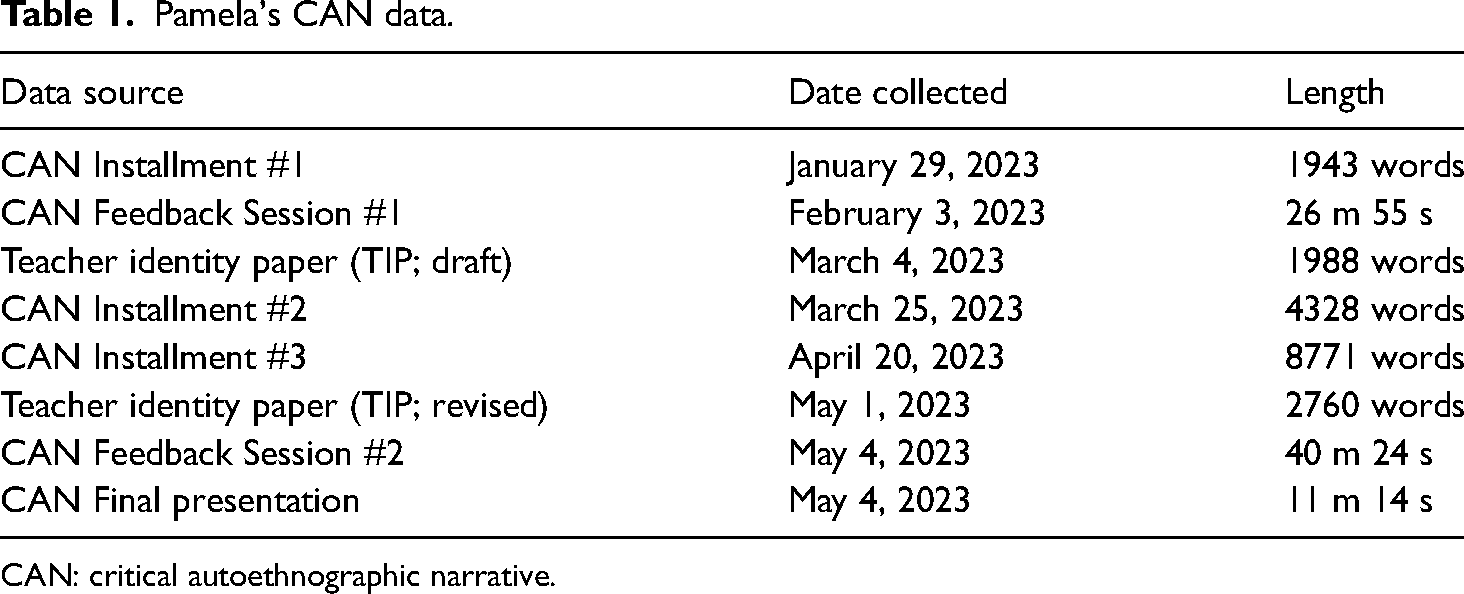
As data for this study which was approved by my university's IRB office (FY22-23-171), I used all artifacts and conversations from the implementation of CAN. I chose Pamela as my focal participant because she completed all assignments throughout the semester, demonstrated high engagement with the analytic writing process, evidenced significant professional identity construction intersecting with other identities, and showed increased ideological and political clarity (Bartolomé, 2004) in her CAN. I collected all her CAN installments, recordings of our feedback sessions, teacher identity paper drafts, and final presentation. Table 1 includes the summary list of data sources included in this study.
Pamela's CAN data.
CAN: critical autoethnographic narrative.
My data analysis followed three stages that included narrative analysis and thematic coding to answer my research question: How does Pamela construct her English language teacher identity in a semester-long CAN writing activity? First, I reviewed the data to familiarize myself with Pamela's autobiography and to create a chronological timeline and plot including the stories in her CAN. I used narrative analytic strategies of temporal sequencing and (re)emplotting. Second, to understand better her ‘ideological becoming’ (Bakhtin, 1981: 341) as a language teacher, I read the data again to code: (a) ideologies she attends to as important in her life and her shifting orientation toward those ideologies; and (b) identities she constructs in her autoethnographic writing. In that stage, my codes included, for example, ‘ideology of standard language,’ ‘ideology of linguistic correctness,’ ‘ideology of white supremacy’ to which her orientation has shifted over the years and ‘English language user identity,’ ‘Spanish learner identity,’ ‘writing professor identity,’ ‘ESL teacher identity,’ and ‘religious educator identity.’ I organized the data based on those codes to prepare for the next step of the analysis to understand relationships between ideologies Pamela discusses and her identities. Finally, I returned to the data to examine how she views and destabilizes ideologies, and how she constructs her identities through her orientation toward those ideologies. In that stage, I constructed themes by making connections between the existing codes to make sense of her language teacher identity construction vis-à-vis her other identities within ideologically laden contexts. Below I share my findings around three themes. The first two, namely: (1) becoming a social justice advocate; (2) grappling with neurodiversity, focus on the relationship between Pamela's ESL teacher identity and other significant identities. The third theme: (3) positioning language as an evolving local contextualized practice, presents Pamela's understanding of language with a focus on its nature, learning, use, and teaching. This theme includes three subthemes, each of which involves a different but interconnected dimension of that understanding and is framed in what she opposes to in dominant ideologies around language (teaching): (3a) denying the ‘one right way’ approach to language use; (3b) denying the ‘teaching as correcting errors’ approach; (3c) denying the ‘assessment as gatekeeping’ approach.
Pamela's Brief Biography from CAN
When taking the SLTM course with me in Spring 2023, Pamela was in her last semester in the MATESL certificate program. She wanted to complete this certificate to teach adult ESL as her second career after working as a professor of English at different universities in the US. She earned her doctorate in renaissance drama at the University of South Florida.
Part of a white working-class family, Pamela lived in a trailer park in Dayton, Ohio until the age of seven and was not allowed to venture outside of the fence that surrounded the park. Then, she moved to Tampa, Florida with her 10-year-old brother and single mom when she got a job at Macdill Air Force Base. Then her world expanded. In Tampa, they lived in a small rental home in a lower middle class neighborhood, and there were no boundaries. This was her first encounter with language differences. She remembers both her dad who did not go to college and mom who had a few semesters of college speaking ‘correct’ ‘standard’ English. Her mother would sometimes say ‘don’t say ain’t; it ain’t right!’ to her brother (Installment #2). Not needing such correction, Pamela grew to value ‘correctness’ of language. She tended to correct her siblings’ and friends’ English and still often has a negative ‘gut’ reaction to certain errors that are frequently made by L1 speakers of English such as apostrophes in non-possessive plural nouns and less vs. fewer.
She really wanted to learn Spanish in middle school before she would take Spanish class in grade 8. She received help from her friends to memorize a conversation in Spanish, which she shared in her CAN. She took Spanish for 4 years in high school, but never became as fluent as she wished. Despite less frequent classes, she kept taking Spanish in college where classes had more homework but met only 3 hours a week, which was not enough time for her. Despite opportunities for Spanish interaction outside the class, the conversation shifted to English as her interactants’ English would be so much better than her Spanish; it made sense to speak in English.
She began teaching at a very young age as a graduate assistant teaching freshman composition right after she graduated with a BA and began a master's in English at the University of South Florida in 1983, at age 21. She did not receive any pedagogical training and needed to learn in the job. Retrospectively reflecting on her practice, she discusses aspects of her teaching she could have conducted differently with her current knowledge. She shared that she was too busy pursuing her PhD in renaissance drama. Teaching basic writing was just a way to get the bills paid while she pursued her true interest. After completing her PhD, Pamela taught at a lot of different institutions including private colleges and community colleges in the US, because of the financial exigencies of supporting a household.
Regarding her exposure to languages other than English, Pamela storied her travel experience. When she was 14, she went on a trip to Toronto with her friend's family for the first time leaving the US. She especially loved going into a McDonalds and seeing all the items on the menu in French. Seventeen years later, she visited Chihuahua, Mexico with two professors from the university, close to the border, where Pamela was a visiting professor. Her most recent bout of Spanish learning happened around 10 years ago when she and her husband decided to visit Chile. Several months ahead of this trip, Pamela worked with a Spanish tutor online, read Spanish books as much as possible, listened to Spanish CDs in the car, and engaged Spanish-speaking friends to engage with her. Although she thought she was rusty initially, she improved enough to have a conversation with a friend. However, except for two situations in which her Spanish was really put to the test, her conversations were dominated by English because workers in hotels, restaurants, and tourist attractions would always respond in English if she asked them a question in Spanish. In such instances, she would either switch to English immediately, or as soon as she couldn’t think of the appropriate word in Spanish. She considered the two Spanish-only conversations, that is, dropping off a rental car and finding their hotel, challenging. Her last big trip was to Cambodia and Vietnam during Spring 2023 semester when she was taking the graduate course with me, so she took notes on her thoughts about language issues. She was struck by the value placed on the English language in those countries. For example, her tour guide told them he would use his living money to pay for English lessons, sacrificing personal comfort in hopes of one day being able to leverage his language skills to improve his life.
Finally, in her final paper, she discusses her involvement in the Unitarian Universalist church. During the final year of her PhD program, due to the lack of jobs in teaching English she got an additional job as a quarter-time religious educator, moved to Odessa for the job and joined the church. Completing her PhD, she moved from Odessa to Corpus Christi to work at a large public university. After working at the university for a few years, she got a quarter-time job at the church as a religious education director when working part time at the university. When it was time to go back to the university full time, she decided instead to take a full-time religious education position at her church. She discusses her experience as a religious educator as conducive to her current social justice advocate identity.
Findings
In her CAN, entitled in the final version as ‘There Ain’t Nothin’ Wrong with the Way Y’all Talk: Confessions of a Gatekeeper,’ Pamela narrated her storied experience, which she later analyzed to denaturalize language ideologies dominant in her life as a language user, learner, teacher, and religious educator. Because ideologies define and confine identity options, Pamela's orientation toward those ideologies demonstrates her identity construction. Writing her CAN, Pamela constructed an identity of ESL teacher who: (1) is a social justice advocate; (2) grapples with neurodivergence but enjoys the privileges of being a ‘white, cisgender, heterosexual’ individual; and (3) denies (a) ‘one right way’ approach to language use, (b) ‘teaching as correcting errors’ approach, and (c) ‘assessment as gatekeeping’ approach.
Becoming a Social Justice Advocate
In her CAN, Pamela went back to a fifth-grade experience to share early evidence of her social justice advocate identity: When I was in fifth grade, a new immigrant from China was placed in my class. He could speak no English. Another classmate said that the Chinese boy must be stupid, since he couldn’t speak English. I responded that maybe the newcomer would think he, the classmate, was stupid, since he couldn’t speak Chinese. The teacher who overheard the exchange, admonished me for being argumentative. (Installment #2)
With this example of her social justice advocacy, Pamela constructed an identity of an ESL teacher who problematizes the dominant ideology that equates the majority language with intelligence. Based on that identity, she indicates how her teacher missed the opportunity to have a teachable moment that hence reinforced the ideology in that classroom context.
As discussed in her CAN, Pamela's social justice orientation became more prominent as her experiences as a theological educator ‘have helped [her] understand the ethical and social justice implications in a pluralistic society of holding all people to standards set by the historically dominant groups, in this case, Anglo Europeans who standardized English grammar and spelling’ (Installment #3). She situates one significant experience at the nexus of her identities as a language teacher and religious educator. In the church where I directed the religious education program for many years, we strove to create a culture of welcome and inclusion so that people of all cultural backgrounds, genders, and economic situations would feel welcome and fully included. For people of dominant identities (i.e. white, heterosexual, cisgender) such as myself, this endeavor entailed a lot of self-education and professional development in racial and other forms of social justice. (TIP Draft)
Being part of her identity, Pamela's social justice learning informed her teaching. As she exemplified and discussed later in the final CAN installment, becoming inclusive required destabilizing in her preconceived notions. For example, when listening to a person of color in her congregation who talked to her about honorific names of classrooms and buildings (e.g. Jefferson building), Pamela shared: ‘I had to put aside some of my own ingrained presuppositions and predispositions and reorient my way of thinking to see their point of view. I had similar experiences with transgender and disabled members of the congregation’ (Installment #3). Such experiences as a religious educator led her orientation as a language teacher as she discussed her renewed approach to linguistic correctness and corresponding ramifications which I will share in the findings – that is, how Pamela positioned language as an evolving local practice.
Pamela shared two critical learning points, both from her theological background, that ‘greatly influenced’ her teacher identity with a social justice orientation and ‘have ramifications for language teaching and learning’ (Installment#3). ‘One of these is Martin Buber's formula of I-thou and I-it relationships. Buber describes I-It relationships as monologic and I-thou relationships as dialogic.’ Pamela highlights that in that dialogic relationship ‘One person is not trying to change or affect the other for personal gain or self-satisfaction or vindication.’ The second one was process theology which denies: ideas of God as eternal and immutable [that] often lead holders of that belief to value fixed and unchanging standards of good and bad, right and wrong, which often bleeds into ideas about language as well. In this view, there is one standard of correctness for every context, and changes in language equate to degradation of language. (Installment#3)
Those two theological perspectives have shaped her world view in which she ‘value[s] change, both temporal and contextual, in life and in language,’ which is also an example of how her theological identity intersects with her identity as a language user and teacher.
Grappling with Neurodiversity
Another significant dimension of Pamela's language teacher identity is her neurodiversity. While narrating her schooling experience and her social relationships with classmates and friends, Pamela mentioned her struggles with ‘lack of social perception’ (Installment #2) which became a recurrent dimension in her teaching life as well. She shares that growing up, ‘[t]he social side of things were not always so bright.’ For example, she tells ‘my best friend in third grade got angry at me once for saying ‘identification card’ instead of ‘i.d. card’. Exasperated, she asked why I couldn’t just talk like everybody else. I felt frustrated’ (Installment #2). She concludes later that ‘nuances of social relationships were like a foreign language to me’ (Installment #2). Reflecting on those experiences which she later connects to her neurodiversity in her TIP, Pamela constructed an identity as an ESL teacher who understands ‘helplessness’ people, including her future students, experience when linguistically marginalized: It may be due to these early experiences that now, as an adult, I can relate to feelings of linguistic inadequacy and marginalization. In this case, my mastery (for my age) of language norms of the adult world put me at odds with the norms of my immediate culture – children. There's a sense of helplessness that can easily turn to anger when one is judged as less than and ostracized or teased based on the way one speaks. (Installment #3)
Additionally, she reflected on how her teaching was influenced by her challenges in social relationships – that is, how her neurodivergence impacted the kind of teacher she was. She was not as strong in ‘the affective element of teaching.’ She was aware ‘that students had emotions around writing and the composition class, and I sincerely wanted my students to enjoy and feel good about their experience in my classroom, but I would have seen that goal as irrelevant to academic priorities’ (Installment #2). She would not come to class earlier ‘mainly because I am innately uncomfortable with small talk’ (Installment #2) and ‘don’t always intuitively grasp the intricacies of interpersonal relationships’ (Installment #3). Through teacher education, she was working on corresponding challenges of her neurodiversity as she received ‘explicit information and advice about maintaining a positive learner attitude’ (Installment #3). That is, she constructed an identity as an ESL teacher who ‘would arrive in the classroom several minutes before the start of class in order to greet early arrivals as they enter’ (Installment #3) to establish relationships with her students, which she values significantly as part of her teacher identity. She believes ‘relationship is the foundation of all effective teaching experiences’ (TIP #1)
Although she never mentioned her neurodiversity in her CAN installments as she discussed her challenges in the social relationships, she explained that aspect of her identity toward the end of her TIP, which she entitled as ‘evolving perspectives’: Earlier in this paper I addressed some aspects of my identity as non-marginalized: white, cisgender, heterosexual. An exploration of my teacher identity would not be complete, however, without addressing a marginalized aspect of my identity: neurodiversity. Over the years, two simultaneous realizations have developed and dovetailed in my understanding: the importance of relationship as discussed earlier, and the personal challenges I face with forging relationships. I often do not function interpersonally in ways that society tends to uplift as ideal. Social skills that come naturally to others, I have had to learn cognitively over time, as another person would learn mathematics – or a second language! (TIP #1)
Those two realizations have become part of Pamela's ‘evolving’ teacher identity and point out aspects of being a language teacher that are not always considered important immediately. Pamela's case is an example for the concomitance of marginalization and privilege in LTI construction, and CAN led her explicitly to juxtapose her privileged identities such as ‘white, cisgender, heterosexual’ with her marginalized identity as a neurodivergent individual.
Positioning Language as an Evolving Local Practice
The third dimension that recurred in Pamela's CAN writing was her approach to the nature, learning, and teaching of language, which is foundational for her LTI. Her overarching approach is characterized by her positioning language as an evolving local practice as opposed to standardized and stabilized ways of using the language that are reflective of dominant racio-linguistic groups’ language practices. Throughout her CAN, Pamela narrated the evolution in her approach and destabilized above-mentioned standardized language use as the only ‘correct’ way. She highlighted the dynamic nature of language: ‘what is accepted as correct usage evolves as culture evolves. Take, for example, the evolution of my teaching of the use of pronouns to refer to indefinite, unknown, or mixed gender antecedents that are singular’ (Installment #3). Later in her writing, she pointed out inconsistencies involved in how ‘the grammar police’ treat linguistic diversity in English: ‘It's interesting that a language such as English, which is replete with illogical usages, such as irregular verbs, that are deemed correct, should have so many advocates of pure logic in certain instances’ (Installment #3). Below I share three interrelated ways she critiques those ‘advocates of pure logic,’ through which she constructed her LTI.
Denying the ‘One Right Way’ Approach to Language Use
In her current teacher identity, Pamela denies language ideologies that support the premise of ‘one right way’ in language use by denigrating all other ways. In her CAN, she analyzed how she was socialized into valuing linguistic correctness starting from her childhood: ‘I have been reinforced most of my life in valuing correctness as a thing of ‘worth’ in and of itself, almost like a moral code’ (Installment #1). With several examples from her life history, she discussed how people like herself: who grow up in an environment permeated with notions of linguistic right and wrong, can develop the sense that what is deemed “correct” is somehow inherently right in a way that transcends time and mere convention. And following on the heels of that belief, may come a sense that those who speak the “correct” way, usually those in power, hold their privileges by virtue of a justice that transcends time and mere convention. (Installment #3)
In her conclusion, Pamela denaturalized how one way of speaking is solidified as an ‘inherently right’ way of speaking that neglects cultural and spatiotemporal realities of language use. Her critical orientation demonstrated how that ‘inherently right’ way of speaking reflects the powerholders’ language in the society and maintains ‘their privileges.’
Pamela applied her stance into interpreting inevitable linguistic diversity and its sociopolitical ramifications. She made an argument that redefined correctness in language learning ‘as mutual meaning making that differs according to individuals involved and their communicative context and needs’ rather than ‘as a system of rules imposed by self-appointed gatekeepers of linguistic purity’ (Installment #3). Again, bringing her critical perspective, she added that the latter inescapably ‘contributes to the marginalization and othering of anyone whose speech differs from hierarchically imposed norms’ (Installment #3).
Denying the ‘Teaching as Correcting Errors’ Approach
Pamela made it clear in her CAN that she also denied the teaching approach especially in teaching writing framed predominantly as correcting errors in learners’ language production. Reflecting on her early teaching experience, she storied a conversation with the department head about error correction: The predominant approach to error correction during the years I was teaching may be illustrated by a situation I encountered while teaching in a small private college. The head of the English department, who had a PhD in composition and rhetoric, suggested an exercise in which we would each grade a set of papers from one of the other's classes. When he returned my students’ papers to me with his comments, they were drenched in red. Every single departure from the norms of standard written English was circled and commented upon. One of his favorite comments was HUH??? written in huge, red all-caps, to indicate a sentence or passage that he did not find clear.
He called me into his office to discuss my marking of his class's papers. He asked me if I had been distracted while correcting these papers, because some errors had been left unmarked. To be clear, I had marked at least a few errors on every single paper, but was taken to task because I had failed to mark Every. Single. One. (Installment #1)
Pamela narrated this encounter in her first CAN installment to explain the dominant pedagogy in teaching writing that represented the ideology of standard English. Her purpose of narrating this story was probably to show what ideologies she was exposed to as a teacher and how much she has evolved since then. Pamela narratively constructed current ESL teacher identity on her prior teaching experience and identities which she analyzed with that story above. She exemplified how she felt the influence of the ideology of standard English on her writer teacher identity back then through her department head's adherence to that ideology and his power and authority over her teaching practices. She made it clear that her teacher identity did not align with that ideology.
Denying the ‘Assessment as Gatekeeping’ Approach
Pamela made it clear in her CAN's title that her current LTI did not include the ‘gatekeeper’ identity which used to orient her approaches to language teaching. Her evolved identity as a teacher was evident in her stance to evaluating any language use. I will share two examples from her CAN that represented the application of ‘ultimate goal of language education’ assessment in her teacher identity: ‘to give people the tools to discern the intended meanings of others and to express themselves so that others can discern theirs’ (Installment #3). In one instance, she demonstrated her assessment stance by engaging in self-assessment of her experience in using Spanish in Chile: ‘I don’t see my linguistic misadventures in Chile as unsuccessful because I failed to conjugate verbs correctly, or because my pronouns and their antecedents failed to agree. They were unsuccessful because they didn’t achieve their purposes in the moment’ (Installment #3). She explicated that she valued expressing herself in Spanish to accomplish the communicative goal over complying with its grammatical conventions.
Later in her TIP, she further contextualized that stance into her LTI by pointing out the connection between her current views on language and its assessment procedures. She discussed: As my views on standards and conventions have changed, so have my views on assessment. I used to view assessment from the point of view of an institutional gatekeeper. Now, I see assessment as primarily formative; that is, an ongoing process of helping the learner make choices about how and where to concentrate effort in moving forward, and for me as a teacher to evaluate the effectiveness of my own teaching and make course corrections as necessary. I also have a new appreciation for mistakes, both mine and my students’. I used to think of errors as indicators of a learning deficit. Now, I see mistakes as an indicator of effort and incipient growth. (TIP #2)
She accentuated formative assessment practices more in her LTI and viewed assessment as feedback for herself as a teacher as much as for learners she serves. Contrasting her previous approach to mistakes, Pamela now focused on her own mistakes as much as her students’ and viewed them as an organic part of ongoing development.
Discussion and Conclusion
The analysis of Pamela's CAN leads me to make four main arguments about LTI and the use of CAN to pedagogize it. First, the personal, professional, and political dimensions of language teaching are so intricately intertwined in teacher identity, which corroborates complex and holistic view of language teachers in previous studies (Barkhuizen, 2016; Pennington and Richards, 2016; Varghese et al., 2019). Examining identity to understand teachers as three dimensional provides us the lens to see how impossible it is to separate those three dimensions in teachers’ lives. For example, Pamela's neurodiversity, religious community membership, social justice orientation, and opposition to dominant language ideologies intersect in her LTI. Pedagogizing identity through CAN can lead language TCs to see their LTI holistically with all intricate connections with other ‘I-positions’ (Akkerman and Meijer, 2011) that they constantly negotiate and interrelate in their professional lives. Existing research presents evidence for the intersectionality of LTI with multiple I-positions (Vitanova, 2023), and CAN builds on that evidence to have TCs explore that intersectionality first hand in their own lives and make sense of who they are as a language teacher.
Second, CAN as an identity-oriented activity provides TCs with the narrative and experiential space in which they have agency to construct their identity grounded in their life stories (Arshavskaya and Reyes, 2023; Kamali, 2024; Kessler, 2024; Yazan, 2019, 2023a). This argument supports the existing research evidence for teacher agency in constructing LTI (Miller et al., 2018), but adds to it with CAN's pedagogical implementation. To clarify, without CAN, Pamela could still assert agency in her LTI construction inseparable from her (re)interpretation of past and recent experiences, but the pedagogizing role of CAN made that agency visible to her and legitimated her narrative knowledge generation (Barkhuizen, 2016), including that (re)interpretation, as part of her professional teacher learning. CAN writing allowed Pamela explicitly to attend to dominant ideologies and corresponding identity positions, and gain ideological and political clarity (Bartolomé, 2004) to become a critical language teacher.
Third, pedagogizing identity through CAN in teacher learning affords TCs experiential and discursive space in which they engage in extended reflection on who they are as teachers by narrating and analyzing their lived experience. That argument aligns with other identity-oriented teacher-learning activities (Flores and Aneja, 2017; Varghese et al., 2019). The reflection through CAN supports transformative learning because it makes direct connections with identity and traces identity changes (Illeris, 2014). Also, the iterative and scaffolded nature of CAN leads TCs’ reflection to deeper understanding of their sociopolitical situatedness in the context, thanks to co-constructed knowledge dialogically generated through feedback conversations. Thereby, the use of CAN is a push-back against the transmissive conceptualization of teacher learning in which: (a) TCs do not have much agency in the kind of teacher they are becoming; (b) their emotions are not considered important; and (c) their professional growth is disconnected from self. Such assessments as CAN help teacher educators take the risk to think outside the box of existing assessments in teacher education and to bridge the gap between teachers’ selves and their practice. As a teacher educator, CAN has worked well for me, especially with small groups of teachers, and I would like to encourage colleagues to innovate their own ways of pedagogizing identity in their practices.
Challenges and Future Research Directions
This study was not without its challenges. First, it was challenging to have all TCs understand teacher learning and practice as identity work. Their responses to CAN writing varied. Some took up the idea of an identity lens to their professional growth intertwined with their other identities, while some others needed more scaffolding to examine their life stories to make sense of what kind of language teacher they are or aspire to become. Second, implementing CAN in a teacher education class always takes a lot of time. Especially arranging individual feedback sessions and having TCs understand how they need to attend to my feedback have been challenging for me as an autoethnography coach and a teacher educator. Having multiple iterations of their CAN writing through installments was helpful for me to provide three rounds of written and oral feedback, but the response to feedback varied across 10 TCs. It is part of my learning to provide CAN feedback. Third, TCs experienced challenges in conducting analyses of their stories vis-à-vis their identities and ideologies and connecting that analysis to theoretical literature. Autoethnographic research was new to all of them and analyzing data from their own life and writing about it proved challenging for them.
Looking at future research directions, first I will use CAN as the only major assignment in the class because TCs need more time to concentrate on the narration and analysis of their stories. That change will also allow me more time to spend on giving more feedback to TCs and scaffolding their learning throughout. Second, I will have them make more explicit connections between their identities and their teaching beliefs, values, and priorities. Although the TIP assignment was useful for Pamela and several others, it did not yield the same critical reflection for all. Third, I will provide more scaffolding specifically for the analysis. I will provide more analysis examples and modelling much earlier and more often, which some TCs really needed. Fourth, in my next study, I will try analyzing multiple TCs’ CAN experience to provide comparative findings for the reader. So far, I have always focused on one specific case of a TC to have the analytical space to analyze their experience in depth, but I believe comparative analysis has its merits as well. Finally, in the current study, I did not engage in member-checking with Pamela because the continuous communication throughout the semester was helpful for me to check with her about her identities and orientation toward dominant ideologies. However, I believe conducting member-checking with TCs as I analyze CAN data after the implementation ends will contribute to the rigor of my future studies. Through these future directions, I will continue enacting my teacher educator and researcher identities through the implementation and examination of CAN as a language teacher-learning activity.
Supplemental Material
sj-docx-1-rel-10.1177_00336882241293835 - Supplemental material for Pedagogizing Identity in Teacher Education Through Critical Autoethnographic Narrative
Supplemental material, sj-docx-1-rel-10.1177_00336882241293835 for Pedagogizing Identity in Teacher Education Through Critical Autoethnographic Narrative by Bedrettin Yazan in RELC Journal
Footnotes
Acknowledgements
I am grateful to RELC Journal editor Dr Marie Yeo for her leadership, guidance, and patience as I was working on this manuscript as well as to the four anonymous reviewers who read my paper so carefully and provided such constructive suggestions pushing my thinking. I am also thankful to Pamela and all teachers who trusted me when I introduced CAN as a new assignment to my teacher education classes.
Funding
The author received no financial support for the research, authorship, and/or publication of this article.

Supplemental Material
Supplemental material for this article is available online.
References
Supplementary Material
Please find the following supplemental material available below.
For Open Access articles published under a Creative Commons License, all supplemental material carries the same license as the article it is associated with.
For non-Open Access articles published, all supplemental material carries a non-exclusive license, and permission requests for re-use of supplemental material or any part of supplemental material shall be sent directly to the copyright owner as specified in the copyright notice associated with the article.
