




Abstract
Teacher research (TR) has become popular as a transformative continuing professional development (CPD) activity for in-service teachers. In Vietnam, English as a foreign language teachers carry out TR through a top-down national scheme called ‘Sang kien kinh nghiem’ (‘initiatives–experiences’ (I-E)) to explore and attempt to resolve classroom issues through the application of ‘innovative solutions.’ This paper reports a part of a larger study which examines I-E scheme implementation. It focuses on the narratives of two teachers who engaged with the I-E scheme. The narratives, constructed through narrative analysis from narrative frames, semi-structured interviews, and the teachers’ I-E reports, reveal the affordances and hindrances in the experience of the teachers when engaging with the I-E scheme. The paper offers insights into TR for teachers’ CPD in Vietnam and has implications for effective implementation of TR for teachers’ CPD elsewhere.
Keywords
Introduction
An oft-promoted form of transformative continuing professional development (CPD) for language teachers is teacher research (TR) (e.g., Borg, 2015; Burns, 2019), which involves teachers conducting classroom-based inquiries into their own practice. However, contextual factors such as a lack of mentoring, collaboration or financial support can make implementing TR challenging (e.g., Borg and Liu, 2013; Burns and Westmacott, 2018; Gao et al., 2010) . In Vietnam, English as a foreign language teachers are expected to carry out TR through a national policy called ‘Sang kien kinh nghiem,’ or ‘initiatives–experiences’ (I-E). Stakeholders such as teachers, education managers and teacher trainers (e.g., V.T. Nguyen, 2018; N. Nguyen, 2019) often voice scepticism on the value of the I-E scheme, but empirical studies in response to such concerns are limited.
This paper provides much-needed empirical evidence to contribute to debates around the implementation of the I-E scheme in Vietnam by taking a close look at the experiences of two teachers who conducted the I-E projects. The data for each teacher include their response to a narrative frame (NF), a semi-structured interview and their I-E report. A narrative for each teacher was collated using narrative analysis (NA) (Barkhuizen, 2011; Polkinghorne, 1995). The teachers’ narrated experiences revealed factors that facilitate or constrain teachers’ effective engagement with the I-E scheme. From this, the paper draws implications for the implementation of TR for language teachers, particularly in contexts where TR is mandated or strongly encouraged as part of teacher professional development.
TR for Language Teachers’ CPD
Teacher research is an umbrella term that encompasses various types of classroom-based, teacher-led inquiry. Borg (2006: 395) highlights four features of TR: (a) systematic; (b) potentially collaborative; (c) made public; and (d) having a potentially wider impact.
Firstly, being systematic means that TR, as a form of research, is ‘beyond’ any intuitive thinking or reflection that happens during teaching. TR needs to be a rigorous and trustworthy inquiry process if it is to generate sound knowledge that can inform teaching practice (Borg and Sanchez, 2015).
Secondly, collaboration among the participating teachers in a TR project enhances the benefits of TR by facilitating collegiality and institutional development (e.g., Burns, 2010; Mockler, 2015; Richards and Farrell, 2005).
Thirdly, and closely related to the first feature, TR needs to be made public. Borg (e.g., Borg, 2013, 2016) argues for making TR public because this opens it up to being ‘scrutinized, reviewed, replicated or built on by others’ (Borg and Sanchez, 2015: 2). This adds to the robustness of TR as a form of inquiry (Borg, 2006). Moreover, as teachers publicize their works, they are empowered as generators of knowledge in the field (Borg, 2016). For TR, being made public means being made available to the local teacher community through channels such as teacher magazines, blogs, newsletters (Borg, 2010; 2016), demonstration lessons, written reports, or presentations (Yuan and Burns, 2017).
Lastly, TR should have an impact on the wider community (Burns, 2010; Groundwater-Smith and Dadds, 2004; McNiff, 2013). When teacher learning and professional development become collective and dialectic, teachers in a school community develop a shared language and shared vision of their collective development, and schools have a greater potential to become knowledge-building organizations (Groundwater-Smith and Dadds, 2004).
The I-E Scheme in Vietnam
In Vietnam, TR was officially implemented as a component of teacher development through the national I-E scheme. The Vietnam Ministry of Education officially implemented the I-E scheme as a component of teacher development in the ‘National Project on Foreign Language Education up to 2020’ in 2008 (Le, 2018). The I-E scheme aims to develop the ability of language teachers to reflect on and evaluate their teaching practices. Specifically, teachers are required to conduct ‘I-E projects’ in which they identify an issue in their classroom and attempt to resolve the issue by adopting some kind of innovation. They then collect evidence as to the impact of the innovation and pull these steps together to write an I-E report that can be shared with other teachers (Vietnam Government, 2012).
Despite the successful implementation of TR elsewhere in the world (e.g., Atay, 2006; Banegas et al., 2013; Burns and Edwards, 2014; Burns and Westmacott, 2018), the I-E scheme in Vietnam has met with some scepticism from teachers and other stakeholders. One concern is teachers’ lack of confidence in doing research, particularly quantitative research (Le, 2018; Pham, 2006). Teachers may also question the practicality of research (Le, 2018). Furthermore, as Pham (2006) points out, Vietnamese teachers usually lack access to relevant literature or to the resources needed to conduct research.
To date, little research has been conducted into the experience of I-E schemes by teachers, a gap that this study sought to address with reference to two research questions:
What are the teachers’ experiences of conducting I-E projects? What are the constraints and affordances in teachers’ engagement with the I-E projects?
Methodology
The data reported in this paper are part of a larger study. The whole study was approved by the Human Ethics Committee of the New Zealand tertiary institution through which the study was carried out. The study generated a total data set of: (a) 51 NFs written by teachers about their experiences with I-E projects (each around 350-words long); (b) 13 I-E reports (each around 25 pages); and (c) six 1-h semi-structured interviews. This paper focuses on a rich description and analysis of the contrastive experiences of two teachers, drawing on their data from all three data sources described above.
Participants
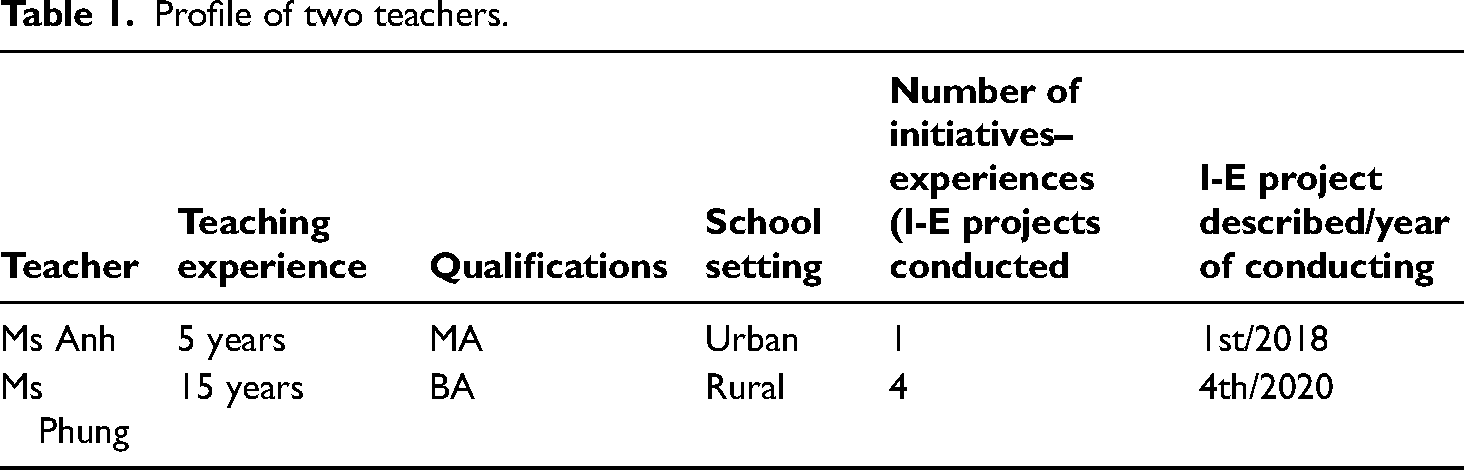
The two participating teachers in this study teach English in two different high schools in different regions in Vietnam. Both had done at least one I-E report at the time of the research. A brief profile of each teacher is presented in Table 1, and fuller details of each teacher are presented as part of each of the case studies below.
Profile of two teachers.
Data Collection
Data collection involved three stages over a span of ten months from January to October 2021. Because this was the height of the COVID-19 pandemic, data collection was fully online. Participants were recruited via e-mail. The e-mail described the nature of the study and contained a link to a NF on the Qualtrics survey platform. A NF is a writing template consisting of a series of sentence prompts and blank spaces that guide respondents to write reflections on their experiences (Barkhuizen, 2008, 2014). In this study, the NF prompted the teachers to reflect on their experience of conducting a specific I-E project (see Figure 1). Prior to accessing the NF, participants completed a consent form in Qualtrics along with a set of prescreening questions to ensure that they belong to the target group.
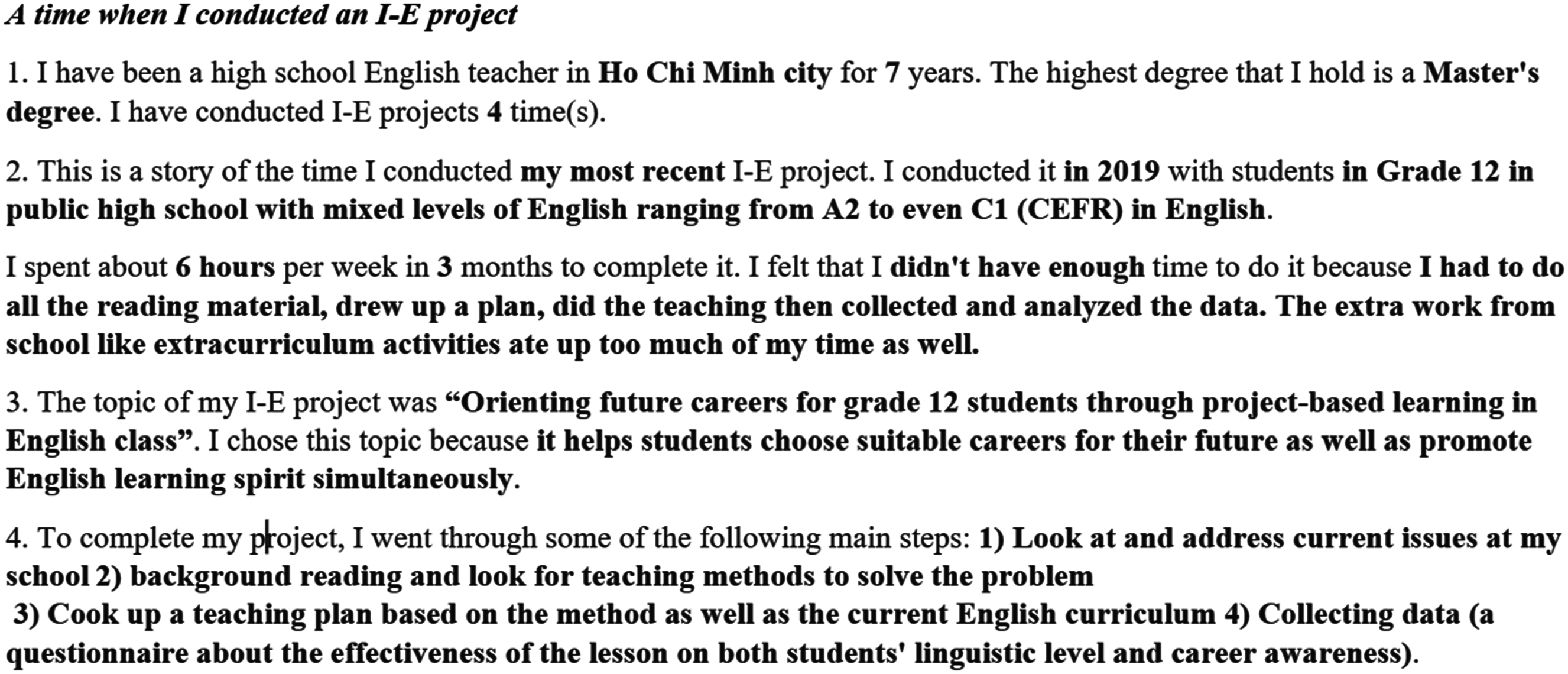
Part of the narrative frame, with sample responses.
At the end of the NF survey, participants were invited to offer their I-E report for analysis and to be interviewed. I then contacted interested participants to collect their I-E reports and set up arrangements for Zoom interviews. The interviews were semi-structured and participants were asked to elaborate on their NF and their I-E reports. Each interview lasted around an hour.
Data Analysis
To analyse the data, I (first author) use NA (Polkinghorne, 1995). NA is different to other analyses in that it produces a story that illuminates the issues that the researchers are investigating (Barkhuizen et al., 2014). In other words, in NA, the researcher systematically interprets, selects and arranges different sources of data (such as from NFs and interviews) into a story. NA is often used in research in which case studies of individual experience are the focus (Benson, 2018).
In this study, I reconstructed each teacher’s’ narratives from three data sources: a written NF; an I-E report; and a semi-structured interview. I followed a systematic approach to story the data. First, I read the three sources of data from each teacher to familiarize myself with the content. Following Clandinin and Connelly (2000) and Barkhuizen (2016), I identified narrative events consisting of the characters (i.e., the people involved, their relations and interactions), the time (i.e., past, present and future) and the setting (i.e., physical context, socioeconomic context and national policy). I then organized the narrative events using a table adapted from Ollerenshaw and Creswell (2002) (see Table 1). Next, I confirmed this narrative organization with the teachers. I then chose significant incidents and decided the temporal order that the narrative would take and retold the narrative using my own interpretative voice and the teachers’ voice by adding their quotes and sources (Holliday, 2007). In this sense, the stories were co-constructed between me, the researcher and the participants. Throughout this process, the second and third authors provided feedback and guidance (Figure 2).
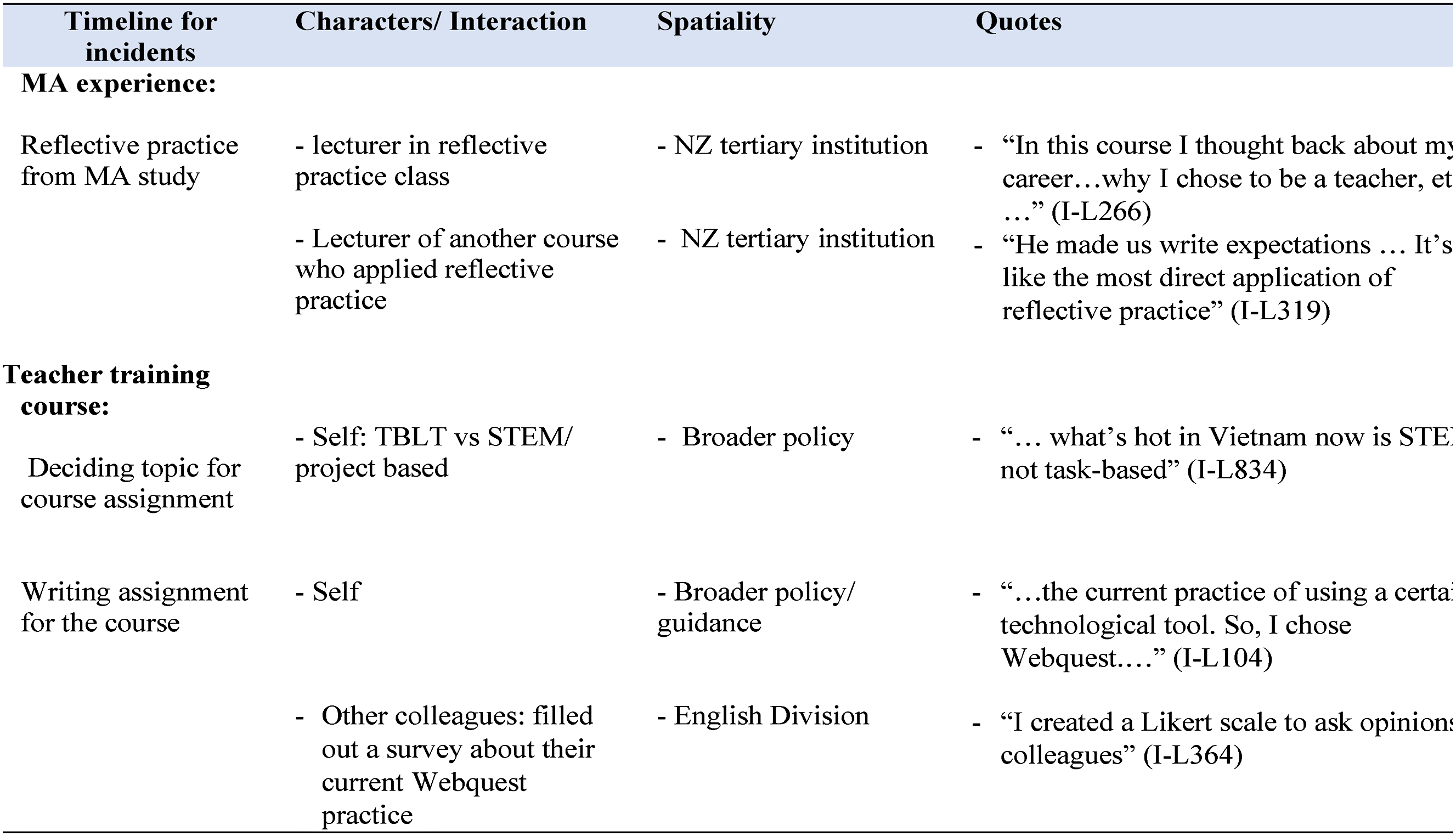
Example of the construction of a participant's story, using the table adapted from Ollerenshaw and Creswell (2002) to organize narrative events.
Findings
In this section, narratives from the two teachers who engaged with the I-E scheme are presented. Both narratives illustrate teachers’ experiences and show the constraints and affordances in their engagement with the I-E scheme. NF data are labelled ‘NF,’ report data labelled ‘R’ and interview data labelled ‘I.’
Ms Anh's Narrative
Ms Anh earned a Masters’ Degree in Applied Linguistics from a New Zealand tertiary institution. She had been teaching for five years at a top high school in a major city in the South of Vietnam. Her students were ‘excellent’ in English and ‘active’ in class. The I-E project which she shared focused on using WebQuest to deliver a project-based lesson on the topic of Environment. It was her first and only I-E report so far.
Building Confidence Through Previous Experiences
The I-E report was written in 2019. However, the idea for it started in 2018 when she participated in an in-service training course. In one of the course assignments, Ms Anh evaluated WebQuest as a teaching tool in relation to her own teaching context.
Later in the same year, Ms Anh had a full teacher inspection in which she had to give a demonstration class. For this, she decided to create a WebQuest project on the topic of Environment because she had taught the topic before, and she was familiar with WebQuest from an in-service training course. She explained that this decision gave her confidence: ‘I often have this habit of making use of the bright points that I had. […] I felt secured, I convinced myself that I did have something available.’ (I, L667–696)
This showed us how Ms Anh as an early-career teacher drew on her previous teaching and learning experiences to build up her confidence. Her demonstration lesson was received very positively. She was also convinced that her lesson brought benefits to her students, noting that the students ‘improved communicative, collaborative and critical thinking skills’ (NF, L35–37). Ms Anh felt empowered by this: ‘I could see the impact, long-term impact even. I only taught that lesson in Grade 10, but the students remembered exactly that lesson even when they were in Grade 12. And it seems like they still like learning that style.’ […] (I, L594–608)
A Focus on Performance-Based Evaluation
After the demonstration class, the Head of the English Division (HED), who was her direct manager, urged Ms Anh to write an I-E report based on it: ‘My HED didn’t force me; she just encouraged. […] Just because that year I had inspection. She thought it is killing two birds with one stone, and so it was easy to convince me.’ (I, L478–484)
The HED was aiming for an I-E report, even if she knew that this report did not stem from an I-E project, but a teaching demonstration. While Ms Anh framed this as an ‘encouragement,’ she admitted that more authority was involved: ‘There is a push from higher-up requiring me to [write a report]. Because this also counts as performance for the Division [HED].’ (I, L38–40)
Ms Anh explained that the performance evaluation of the HED depended largely on the number of I-E reports that the teachers in the Department produced. Thus, every year, the HED was under pressure to ensure that this target number of I-E reports was met. In other words, the main driver for teachers’ engagement with the I-E scheme at this school was performance-based evaluation of individual teachers. Collectively, this contributes to the evaluation of the whole ED. Accordingly, what the HED had in mind was just producing an I-E report to be submitted to the ED and the school, rather than the process of conducting an I-E project for professional development.
A Lack of Support at School
Ms Anh complied with the ‘push’ and started to write her first ‘I-E report.’ The HED did not provide further support beside providing her with the I-E report writing guide and evaluation rubric, while suggesting Ms Anh went online to find sample I-E reports to use as models. However, Ms Anh was not satisfied with the quality of the sample reports she saw online. She turned to a senior colleague for support, but her request was turned down: ‘At my school everyone just keeps their own soul […] There is another senior teacher. […]. I did ask her (laughs) if I could I see her I-E report as a sample, she declined (laughs) […] I think they just want to keep it to themselves.’ (I, L836; L989–997)
A Mixed-up I-E Project
With no support from colleagues in the ED, Ms Anh resorted to her own experience to understand what she had to do. She conceptualized the I-E project as ‘a mini research project’ (I, L55) based on her post-graduate learning. In Ms Anh's opinion, research needed to involve more than just describing this teaching demonstration. Therefore, she attempted to retrospectively collect evidence to include in her I-E report. She designed two Likert scale surveys, one for her colleagues who observed her demonstration class and the other for the students in her class. She also added her own reflection on the experience (R4, p19–22), which shows the influence of her overseas MA course, in which reflective practice was strongly featured (I, L315–316).
Ms Anh did her best to align her I-E report with research by including data, even though these data were collected after she had written most of the report. Her project also aligned with TR in that the WebQuest training course mentioned earlier served as theoretical input; her demonstration class was where she applied this new idea that she read about to the classroom; she used the evidence she collected to decide whether the teaching practice worked in her class; and finally, reflection was provided at the end of the process as Ms Anh evaluated WebQuest as a teaching tool.
A Lack of Transparent Evaluation
Ms Anh then submitted her I-E report to the school for evaluation. The result would influence whether the teacher would earn an award that year. Unfortunately, Ms Anh's report was not highly graded by her school. This frustrated Ms Anh, who questioned the qualification of the evaluation board and the voting system: ‘The people who evaluated my report was a group of teachers at school. So, their level could be BA or MA, a mix of that. And they would vote. […] You could imagine, from more than ten teachers and I got two votes! […] All your effort for one or two votes, what is the point?’ (I-Anh, L451–469)
Ms Anh suggested a lack of transparency in evaluating the I-E reports at her school. This was mainly due to ineffective communication between the school and their staff about the evaluation process. This demotivated Ms Anh and she confessed her loss of enthusiasm for the I-E scheme (I, L444 and L501).
Ms Phung's Narrative
Ms Phung held a BA degree in English teaching and had 15 years of teaching experience. Her school is in a rural province in Central Vietnam. Students here are from ethnic minorities groups with low socio-economic backgrounds (I, L61–63). English is possibly a third language for some students. Ms Phung said that her school was ‘second-grade’ and students were from the local communes who could not get to better schools in town (I, L9-L22).
A Collective Drive at School to Improve Students’ Performance
Improving students’ performance and improving the school reputation is a common vision for teachers at this school. One of the ways to do this was a collective effort from teachers at this school to engage in the I-E scheme, with the purpose of improving teaching practice: ‘Not just only a few people but almost all teachers in my school would write the I-E report to share about their experience, their innovation to improve the quality of the students.’ (I, L96–102)
Recently, there had been some success, which boosted the teachers’ morale: ‘Recently, most of our students passed the high school test. Last year, we even achieved 100% of passing grades for English […]. We did not use to win prizes in student competition, but recently our students won - just the consolation prize, but still! This is great encouragement for us teachers.’ (I, L33–47)
Conducting an I-E Project to Boost Students’ Interest
Like other teachers at her school, Ms Phung saw the I-E scheme as a means to improve her students’ achievement. The major problem that she observed in her classes was a general lack of interest in learning English. All of her I-E projects focused on this problem. She had introduced a range of fun and interactive activities to boost students’ interest throughout her I-E projects. However, while students’ interest could be garnered quickly from these activities, she had to keep coming up with new activities to maintain their interest and this was not sustainable over a long time (I, L357).
The I-E project that Ms Phung described in this study was yet another attempt to boost students’ interest, using games and exercises to engage students in learning English vocabulary (NF, L8–9). For this, Ms Phung did not consult any literature, as ‘there is no need for in-depth knowledge’ (I, L249). Instead, she searched for vocabulary games from in-service training or teaching resource websites. Her dismissal of theoretical resources reflects a perception that I-E projects are practical rather than academic.
While downplaying the need for a theoretical framework, she still believed that an I-E project was essentially research ‘with all the research elements’ (I, L214–215). Accordingly, Ms Phung designed and implemented an ‘experimental study’ in which she employed games in one class, while still teaching normally in another class. After one semester, she compared the percentage of students with high scores between the two classes and concluded that the application of games in the classroom was an effective intervention (R8). Ms Phung commented on this process: ‘I did not really work with data […] Usually people just […] compare the beginning of the school year and then at the end of the school year to see how students changed. Just like that.’ (I, L190–197)
This showed that she followed a common practice, despite knowing that this was not a satisfactory approach to data analysis. Nevertheless, she settled for this process as she did not know a better way.
I-E Report as Resources at School
After implementing the games, Ms Phung wrote up her I-E report. The report draft was submitted to the HED for several rounds of revision (I, L311). The lengthy revision and evaluation process was to ensure the high-quality of the I-E reports. This was communicated clearly to the teachers, who thus happily complied.
The feedback she received, however, was rather minor, targeting issues such as word choice, font, format and typos (I, L320–326). This suggested that while the teachers in the ED were keen to give feedback to each other, they lacked the expertise to comment on the research process, and so focused on the format of the I-E report itself.
After all corrections were done, the report was submitted to the school for evaluation. The evaluation could result in an award at the school level, or nomination for awards at the provincial level. For this report, Ms Phung only got an award at the school level. However, she happily accepted the result, mentioning that only 10% of the teachers were nominated to the province (I, L129).
The teachers then logged a copy of their I-E reports to the school library so that other teachers could view the reports as sources of reference for their teaching, rather than just using the I-E reports for teacher evaluation (I, L340–342). Ms Phung remained enthusiastic about the I-E projects and believed that it would help herself and her students to achieve better results.
Discussion
The two narratives offered insights into teachers’ experience with the I-E projects. The experiences varied greatly between the two teachers due in large part to unique features of each of their teaching contexts. Both narratives, when read together, inform the conditions needed to improve teachers’ engagement with TR.
The first condition in facilitating teachers’ engagement with TR is that the teachers need to have a sense of agency and motivation for professional development. Teacher agency and motivation is conducive to TR, because it allows TR to be teacher-led and autonomous (Borg, 2017) and thus relevant to the teacher's personal knowledge, goals and needs (Borg, 2006). Both teachers in this study demonstrated their agency and motivation to improve their teaching practice and students’ performance. Ms Anh's narrative showed how she, as a young teacher, actively drew on her previous experiences and knowledge to improve her practice and to engage with TR. Even when the I-E report was not planned, she knew that she needed data to produce a legitimate research report and chose to act on this call. Ms Phung was intrinsically motivated to improve her students’ performance and took pride in every small achievement of her students. This was the main reason for her continuous engagement with the I-E scheme.
The second condition is that national TR schemes need to move away from being a means to evaluate teachers. A focus on teachers’ evaluation, in the long run, erodes teachers’ motivation and agency for professional development (Day and Gu, 2007; Sachs, 2016). However, in the I-E scheme, the focus was on evaluation of teachers’ performance, rather than on professional development for teachers. This is reflected in Ms Anh's comments that the HED was only interested in the quantity of I-E reports, regardless of whether they were based on TR projects or not. A performance-focused, result-driven perspective also took away from Ms Anh's experience with the I-E scheme, as she felt that the evaluation was unfair to her. Her disillusionment and disappointment after the I-E report was submitted and evaluated led to her disengagement with the I-E scheme at the end of the narrative. While Ms Phung did not have such a negative experience with the evaluation of her report, her focus remained on producing the I-E report itself rather than the quality of the research. This emphasis was reinforced by her colleagues’ feedback, which focused solely on how the I-E report was written, its format and its layout. Such feedback was of little help for Ms Phung, as her research capacity remained unimproved.
The third condition is that teachers need research capacity so that they can engage with TR better, and this capacity needs to be developed and supported, such as through in-service training. Borg (2006) suggests that if teachers have this research capacity, the research output is likely to be more methodologically sound and teachers can be more confident in engaging with TR. In the two narratives, we see that both Ms Anh and Ms Phung had some understanding of TR being a form of research as reflected in their attempt to collect evidence to inform their projects. Ms Anh appeared to be more adept at designing and analysing the Likert scale survey in her project. Ms Phung also attempted to conduct an ‘experiment’ for her project, but her capacity was limited to simple comparisons between the percentage of students gaining a certain grade in each class, rather than drawing on sound statistical tests to make sense of the data. Ms Anh was more adept because she had experience with TR in her post-graduate study, while Ms Phung had not. Neither teacher received support in research capacity on the job or while conducting their projects. The intent of the I-E scheme is to build teachers’ research knowledge, but our data suggest that the institutional support to achieve this is sorely missing.
The last condition is opportunities for teachers to work collaboratively on their TR projects. Research shows that collaborative TR delivers benefits, such as helping teachers to have a clearer idea of research designs (Burns and Westmacott, 2018), being offered a new perspective from a different vantage point from peers (Benson et al., 2017) and sharing workloads (Denny, 2005; Dikilitaş and Mumford, 2016). However, in both teachers’ narratives, the I-E project was largely an individual endeavour. Ms Anh did not have the support needed from her colleagues and the HED as she hoped, because the teachers at her school were not willing to share their work. Ms Phung, by contrast, was in a better situation in terms of collegiality because her colleagues were all doing I-E projects. However, the only help they gave each other was feedback on their report writing and so she essentially carried out her project individually, without any involvement from her colleagues. In both cases and in the larger data set from which these cases were drawn (Pham, 2023) a strong emphasis on using I-E to evaluate and reward individual teachers clearly disincentivizes teachers from collaborating. This is a major shortcoming of the I-E scheme, as it hinders opportunities for teachers to draw on collaboration to strengthen their professional practices and identities.
Conclusion
This paper presents an in-depth analysis of the experience of two teachers in relation to their work on TR projects within the I-E scheme in Vietnam. These data are part of a larger study that captures the collective experiences of teachers from across Vietnam (Pham, 2023). Our analysis of the stories of these two teachers shows that a heavy emphasis on using TR for performance-based teacher evaluation risks undermining the value of TR. For these two teachers, producing an I-E report to comply with external pressure and expectations eroded their autonomy and agency. It also took the emphasis off the important goal of conducting TR to improve student learning outcomes. Our findings also point to how important schools are in supporting their teachers to conduct TR and fostering a collaborative environment. Lastly, the study emphasizes the need for research training and support for teachers if they are to conduct TR projects.
