




Abstract
Following Hyland's model of metadiscourse, evidential is defined as an expression that references information from other texts. Evidence in traditional academic writing may include peer-reviewed articles, published books and personal communication with field experts. With a sharp increase in the use of online teaching and learning environments by education providers, such as Google Classroom and Canvas, and a vast range of sources of evidence available in non-traditional forms, are types of evidence in students’ academic writing changing and, if yes, how? In this study, we analysed the use of evidentials in course discussion forums by students at the Universiti Brunei Darussalam, revealing the types of evidence included in the writing. Our findings show that students’ academic writing in online teaching environments expands what is traditionally considered academic evidence to some extent, but more targeted teaching intervention may be needed to broaden the range and quality of evidentials used by students.
Introduction
With a sharp increase in the post-pandemic period of the use by education providers of online teaching and learning environments, such as Google Classroom and Canvas (see for example, GlobeNewswire, 2022) university students are routinely engaging in computer-mediated course communications using online discussion forums and blogs. These new forms of academic communication can encourage deeper learning through debate, reflection and peer feedback (Aderibigbe, 2021; Aloni and Harrington, 2018; Bloch, 2007; Halic et al., 2010) and create a clearer sense of audience, authorship and artefact (Warschauer and Grimes, 2007). Combined with a vast range of sources of information freely available online (e.g., webpages, communities of practice, databases and research repositories and social software platforms), these new forms of academic communication may be changing students’ and educators’ understanding of what constitutes evidence in academic writing and how it may be used.
In traditional academic writing, propositions and argumentation are supported by referring to published sources of evidence, such as peer-reviewed articles and book chapters. Providing these types of evidence is a requirement of academic writing in university courses around the world and is an important indicator of academic integrity skills that students are expected to acquire. In academic writing, such as essays and reports, expressions that refer to other texts in a current text, called ‘evidentials’ (Hyland, 2005), play a significant role in differentiating between a novel, original argument from a writer and an idea derived from a larger academic community or body of work.
The type of evidence presented in a text can be a marker of a genre (Hyland, 2005; Khedri, 2018) and, thus, the use of evidence in academic writing also indicates familiarity, expertise and belonging in the field. Bondi and Sezzi (2017) concluded that the forms of citations used in writing have to serve the intended purpose of the writer. They differentiated the effects of foregrounding different elements of previous research, either the proposition used in previous research or the researcher(s). When a proposition is foregrounded, the writer's intention may be geared toward validating the research design or procedure, while the emphasis on the previous researcher may be a signal of belonging (this is especially relevant when the field of investigation has several major strands).
The study of the use of evidence or citations in academic writing has gained traction over the years, including attempts to classify evidentials in academic writing (Dehkordi and Allami, 2012). In the present study, the focus is evidence used by student writers in online learning platforms (such as Blackboard or Canvas), which has not been studied extensively (to our knowledge). The study of online learning is particularly relevant now, in the wake of the global pandemic, with the goal of supporting students in their learning endeavour in the digital environment (Tîrziu and Vrabie, 2015). Although online learning is not a new concept, many institutions adopted online learning solutions due to the COVID-19 pandemic, because it was the only way to ensure the continuity of education during that crisis (Le Ha et al., 2021). Although the brunt of the COVID-19 pandemic is now behind us, educational institutions continue to deliver their curriculum using online learning platforms (Chan, 2022). In addition, digital sources of information are becoming increasingly common, with some only available online. Therefore, developing digital academic literacies, including how to cite different types of evidence in online writing, is an important component of post-pandemic learning and teaching.
In the present study, we analysed the use of evidentials and evidence, in course discussion forums by students at the Universiti Brunei Darussalam. To achieve this, we operationalized evidentials as the language that shifts readers’ attention to information from other texts (sources) that support the writer's position. Typical expressions that are categorized as evidentials include, according to X, or, X states. Evidence, on the other hand, refers to information sources used to validate a point made by the writers of a forum. Evidence can be citations of experts and references to sources external to the text, such as government reports or media artefacts.
The findings of this study will add to the English for Academic Purposes/English for Specific Purposes (ESP/EAP) literature by providing examples of how evidence is used by university student in the digital discussion forums. This could help ESP/EAP teachers to identify needs and support students in their use of digital communication platforms for learning. The findings may also be relevant to material developers and policy-makers who are interested in the emerging trends in students’ online interactions.
Literature Review
There are several implications in using evidentials in academic writing. The choice of evidentials is a marker of the genre to which a text belongs. It is also indicative of the source of information, from which the writer obtains an idea and, more importantly, as a marker for the quality of ideas. Aikhenvald (2004) illustrated the importance of evidentials to signal the different types of information sources, varying from hearsay to inferences from data. He emphasized that evidentiality does not mark the level of certainty of the writer, merely signalling the information source. This means that evidentials do not automatically tell the reader whether the writer knows the information to be truthful or otherwise. It may, however, signal the writer's sense of belonging or source of support, while leaving it to the reader to judge whether this source is credible, hence giving credibility to the writer in the process. In academic writing, the types of evidence are traditionally limited to a handful of acceptable sources that Hyland (2005: 60) termed “community-based literature”, such as peer-reviewed journals or edited books. Using these acceptable sources gives the impression that the writer is familiar with the field and that the text should be viewed as part of accepted knowledge, with the new information presented in the text being an extension of that knowledge.
While evidentials do not mark whether a piece of information is accurate, they validate the information the writer presents. Referring to evidence in academic writing, using evidentials to mark a writer's information source qualifies the writer's position (Abdi et al., 2010; Hyland, 2005) and, simultaneously, the ideas presented. The use of evidence paves the way for a writer to establish their position and actively participate in the dialogue that shapes the field. Since evidence also helps set the narrative context and the state of affairs in the field, it indicates the writer's familiarity with the subject being discussed. Subsequently, it gives the impression that the writer is purposeful in their writing and can link their ideas to a larger community of practice. This linkage is essential in academic writing as the nature of this genre requires negotiation with the reader (Hardjanto, 2022; Hyland, 2005), and such negotiation will only be successful if the information source for the specific text is acceptable.
However, the notion of what constitutes acceptable evidence in academic writing, or academic discourse in general, is changing. Biber (2006) defined academic discourse as all the university registers that students encounter in their academic settings. In traditional brick-and-mortar university contexts, this commonly includes student essays submitted as assignments, presentations, tutorials and lectures. Over the last 20 years, these familiar academic discourses are increasingly being generated and delivered using communication technology; for example, essays may be collaboratively written online with peers (using Google Docs), lectures delivered via video-conferencing or streaming services (e.g., Zoom) and tutorial discussions conducted via online discussion forums in the institutional online teaching and learning environments (e.g., Canvas) or instant-messaging platforms (e.g., WhatsApp).
New affordances of technology-mediated writing may affect both the format and type of evidentials used in university academic writing. According to Biri, “the affordances users perceive as available influence both how they engage with the platform and how they connect with each other” (Biri, 2021: 135). For example, the ability to embed images and video in writing affords multimodal communication. In this study, we aim to discover and account for an open category of evidence that helps relay information in the context of online teaching and learning. Focusing on one online learning activity – discussion forums – we question what can be considered evidence in academic writing, what impact new types of evidentials have on the genre and what these new forms of evidence mean for teaching academic writing as we go forward.
New forms of academic writing necessitate new forms of academic literacy that are generated to digital literacy. Digital literacies are “ways in which people use the mediational means available to them to take actions and make meaning in a particular social, cultural, and economic contexts” (Jones and Hafner, 2021: 18). Beyond their own mastery of new digital technologies and tools available in the rapidly changing digital landscape (Darvin and Hafner, 2022), ESP/EAP teachers are also expected to help students use these tools well to achieve their academic and social goals. It is important therefore that teachers expand their understanding of academic literacy to include digital literacies (Jones and Hafner, 2021), including the varied usage of evidence and evidentials. Indeed, one essential component of academic digital literacy is the ability to locate, critically evaluate, and use digital sources in academic writing. Teachers have an important role to play in modelling how to navigate the digital space, as the proliferation of information available online can lead to dubious sources (Radia and Stapleton, 2008) being used as evidence in academic discourses.
The Present Study
The following research questions (RQs) were addressed in the study:
What types of evidentials are used by students in online discussion forums? What types of evidence are provided by students to support arguments made in online discussion forums?
Method
Study Context
The present exploratory study identifies new forms of evidence presented in online discussion forums of four university modules called Film Studies, Television Studies, Issues and Practices in the Workplace and Communication and Pop Culture. These modules were offered to undergraduates from the Professional Communications and the Media major in Universiti Brunei Darussalam. Lectures and tutorials for these modules were offered face to face, and the online forum served as an additional voluntary activity for students to discuss the lecture and tutorial materials.
English was the medium of instruction for the modules from which the forum was extracted. Students who took part in the forum were assumed to be proficient in the English language, as the English Language entry requirement for the university is an International English Language Testing System score of 6.0, which is equivalent to a grade C6 in an English Language GCE ‘O’ Level examination.
The teacher provided a prompt at the beginning of each week (see example in Figure 1) for seven weeks, but was not an active participant during the discussion (i.e., the teacher was simply an observer as no post by the teacher was found in the Corpus). The students themselves were the writers and readers of the forum. This means that the discussion forum only consisted of learner–learner interaction (Moore, 1989), as the teacher did not facilitate or take part in the discussion in any way and students interacted with each other to discuss the prompt of the week. However, because students’ posts and comments in this forum were used by the teacher as evidence of mastery (see Figure 1 for an example prompt), the students’ awareness of the teachers’ presence may have affected their use of evidence to support their ideas in the posts.
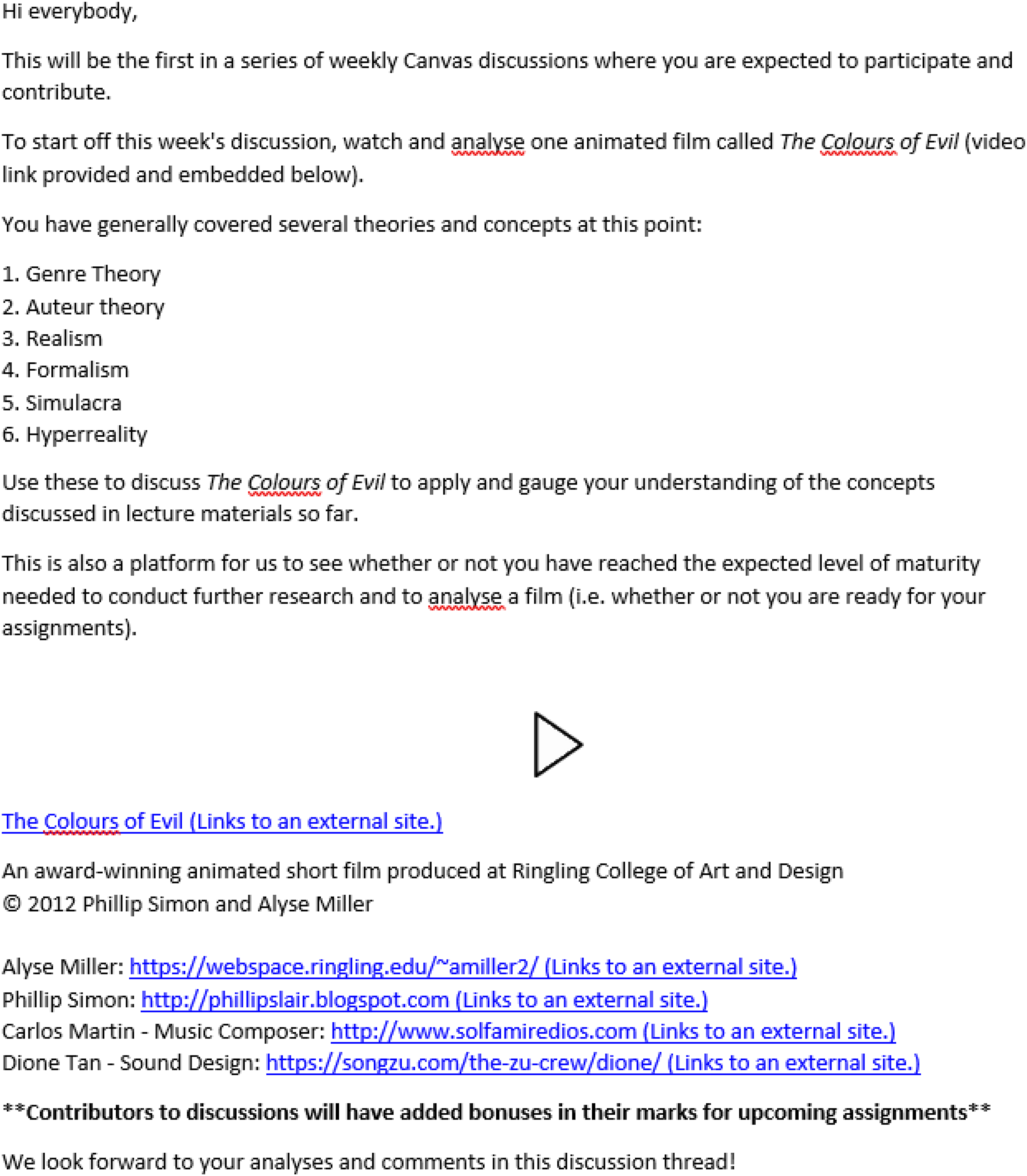
An example of teacher prompt for weekly discussions.
The prompt shows that students were discussing a range of topics that have been covered in the lectures. It communicates an expectation that the students were able to apply and test their knowledge obtained from lectures in the forum. The prompt also indicates that the forum was used as a gauging device to see whether students have understood what was being taught.
Data Collection
After obtaining ethical approval from the university, the data were compiled by way of extracting all contributions to the discussion forum in Canvas from the four modules. Once the data were extracted (interactions copied onto Microsoft Word), all identifying features including the name and identification (ID) of students were removed and replaced with researcher allocated ID for ease of reference at the later research stages. The resultant label for the post was in the format ‘Module Acronym–New Student ID-Post Type’. For example, ‘CPC-5-D’ refers to a post found in the module Communication and Pop Culture, written by student number 5, and the response is for the main prompt given by the teacher (D). The other labels for the module acronyms are FS referring to Film Studies, TS for Television Studies and IPW for Issues and Practices in the Workplace. The second Post Type is ‘C’, the comment posts that refer to the posts directed to respond to a D post.
The corpus for this investigation comprised 294 main response posts and 390 comment posts, written by 108 students. The forum was active for seven weeks. The resultant Discussion Corpus is 157886 words, comprising 115703 words from the Main Response Corpus (posts that respond to the prompt given by teachers) and 42183 words from the Comment Corpus (posts directed to the Main Response Corpus). Due to the differences in the size of the Main Response and Comment Corpus, the counts for both evidentials and evidence are presented in raw number (n) and frequency per 100,000 words (f/100k).
All the evidence in Extracts used in the next section is underlined, with the
Data Analysis
To our knowledge, currently, there is no standard unit of analysis to specifically code for evidentials in the academic discourse genre occurring online. In this qualitative investigation, we combine a top-down approach using a keyword list of evidentials typically found in traditional academic discourse from Hyland (2005) and a deductive approach to content analysis. The keywords list comprised the following search terms: (date)/(name); cit*; quot*; [ref. no]/[name]; and according to X. The keyword list was fed into NVivo (Mackey and Gass, 2012) to generate concordance lines of evidentials found in the Discussion Corpus. The asterisk (*) is a wildcard function to represent any character. For example, when cit* is searched, the potential hits will include cite, citing and citation. Similarly, when quot* is searched, the results will include quote, quoting and quotation.
The inductive approach was used to identify evidence, in a broader sense. It consisted of close reading of the Corpus to identify any references to text-external sources. To qualify as evidence, these referred sources had to complement the ongoing conversation in the text, contributing to the writer's credibility and/or sense-making. (Note that gauging the reliability and truthfulness of the sources fall outside of this study.) We focus on discovering new forms of evidence used by learners in the online forum to support their proposition in the ongoing peer discussions.
When the keyword list was fed into NVivo, we could locate the position and context of the terms in the data. The following are the results for the keyword, according to: Excerpt 1 To support this statement that Happn app is a popular culture,
In Except 1, the keyword according to points to the evidence Seaman and O’Brien (2017), which is a form of citation that is usually found in academic writing. In the excerpt, the writer distinguishes between the cited sources and his/her point of view (the following sentence starts with In my point of view…). After presenting the writer's opinion, they concluded that the Happn app meets popular culture's characteristics. The analysis using evidentials from the keyword list would have picked up the use of text-external sources, such as the citations in Excerpt 1 above.
On the other hand, applying the inductive approach allows us to identify evidence, such as that found in Excerpt 2: Excerpt 2 In addition to that, the use of formalism in this film is very unique in spreading the message intended by the film. The slow-pan shooting of Alex walking into the school and the slo-mo scene of the rainbow flags shows that the film is indeed an LGBT awareness film.
In Excerpt 2, the writer tries to convince the reader by pointing to the exact place in the film which supports her claim, using a timestamp (4:14) as evidence and details how formalism is realized in this scene. Although no evidentials from Hyland's list are used in Excerpt 2 to indicate evidence in close proximity, the inductive approach shows that a timestamp is used in the post as a form of evidence. Therefore, both top-down and bottom-up approaches are needed to identify instances of evidence in the Corpus.
Findings
Evidentials
In relation to RQ1, not many instances of evidentials were found in the discussion forum (Table 1). Only the Main Response Corpus contained some evidentials and but none were found in the Comment Corpus.
Evidentials found in the online discussion forum from the Corpus.
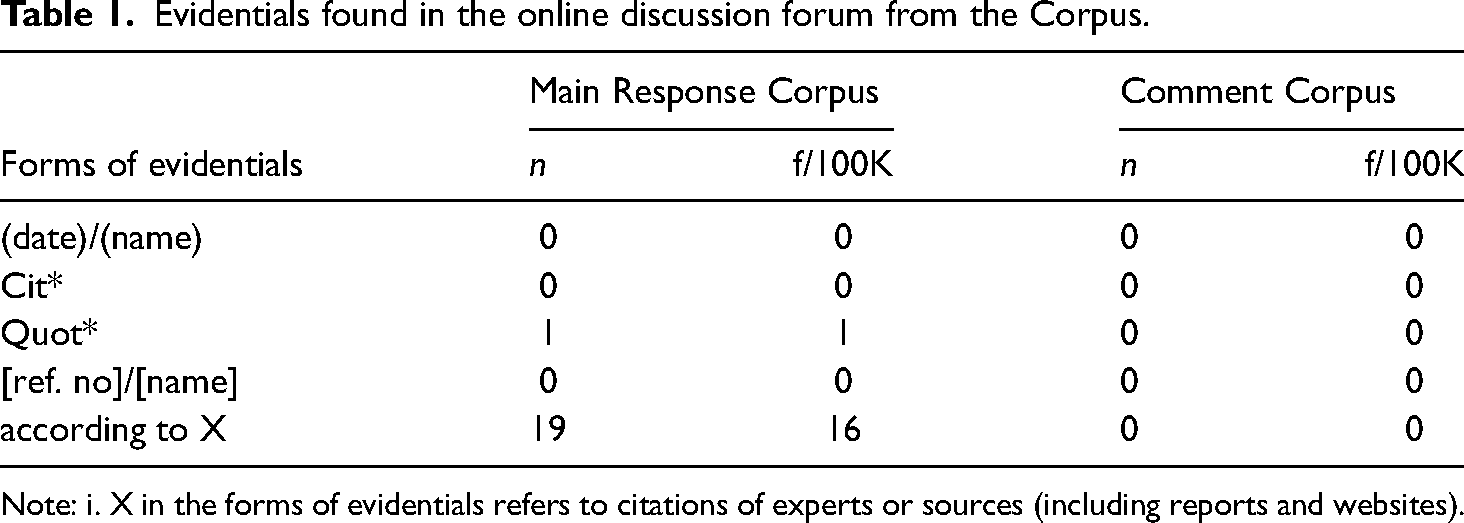
Note: i. X in the forms of evidentials refers to citations of experts or sources (including reports and websites).
The most observed form of evidentials in the Corpus was according to X. In Excerpt 3, the prompt for the discussion was to prove that Happn, a dating app, is an instance of popular culture. The evidential, according to X, was used to shift the reader's attention to the source of information that became the basis of the writer's train of thought, leading to the conclusion that Happn is a part of popular culture.
Excerpt 3
According to the telegraph, Happn is ranked the best 20 dating sites and apps in UK. It is less known than Tinder but it still appeals to the general masses, targeting the dating culture. Dating is a part of life. The commercial has mass appeals, cleverly portrayed an ordinary woman who longed for romance and is looking for someone. Thus, Happn meets the characteristics of a popular culture. (CPC-19-D)
Another form of evidential found in the Main Response Corpus is quot*, although it only occurred once. In Excerpt 4, the writer used “as quoted by” to refer to the work of two experts: Long (2012) and Khuong (2013), in support of the writer's claim that loyalty is difficult to measure.
Excerpt 4
So to teach employees to really stay loyal is very difficult,especially when other (better) opportunities lands on their feet. So i think loyalty maybe the most difficult to measure
Forms of Evidence
In response to RQ2, we shift our attention to the presence of evidence in the forum. Table 2 provides a summary of the types of evidence found in the Corpus.
Evidence found in the online discussion forum from the Corpus.
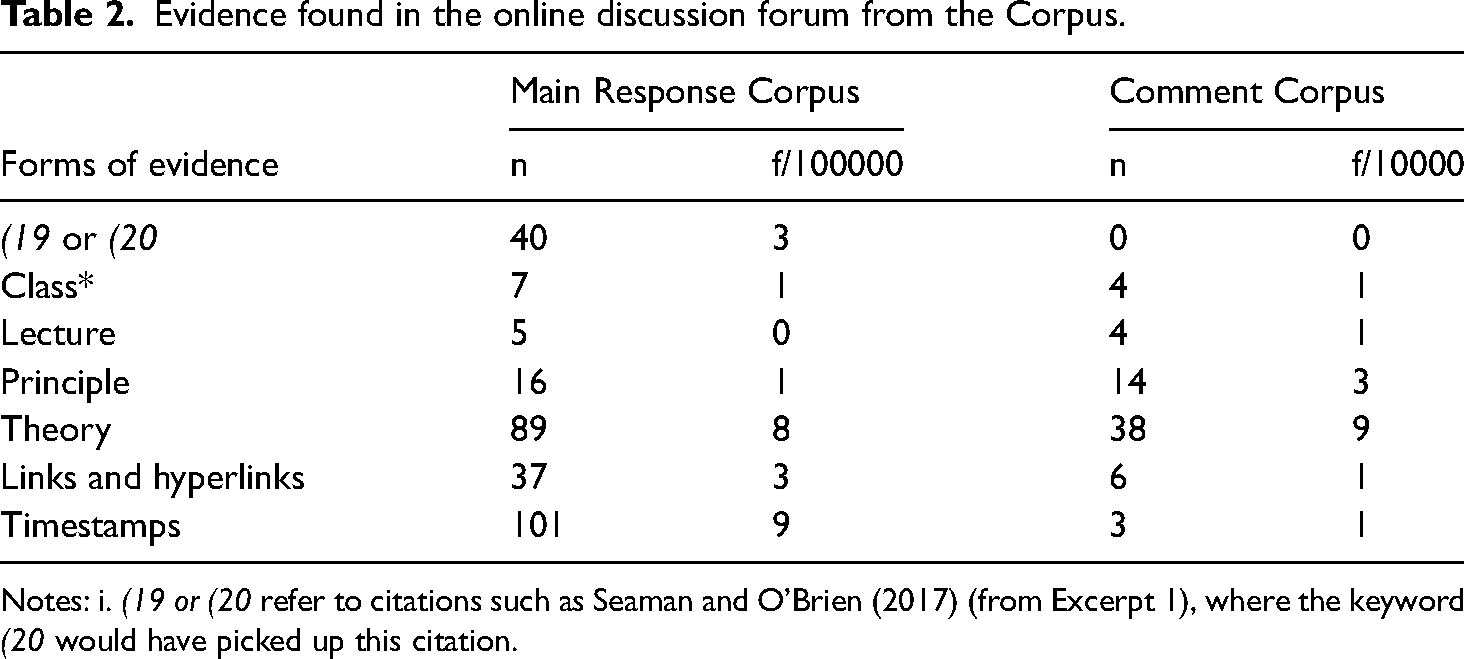
Notes: i. (19 or (20 refer to citations such as Seaman and O’Brien (2017) (from Excerpt 1), where the keyword (20 would have picked up this citation.
Unsurprisingly, in the Main Response Corpus, (19 or (20 is one of the top forms of evidence (after timestamps and the word theory). This is likely because this discussion forum was a course learning activity and students adhered to the conventions of academic writing. Following closely behind the (19 or (20 form is the use of links and hyperlinks. On the other hand, in the Comment Corpus, only the use of theory stands out compared with the other forms of evidence in that Corpus. The four top forms of evidence identified in the two corpora and their use in the online discussion forum are discussed in the next sub-section.
(19 or (20
The use of citations as evidence is typical in academic writing and it seems that this practice is still predominant in online discussion forums. Excerpt 5 is a typical use of citations found in the Corpus.
Excerpt 5
Millennials today are more aware of social and political issues and are generally more progressive than previous generations
The writer incorporates the citation as a point of reference to derive his/her conclusion on the preferences of the millennials on what is assumed to be television content. The writer cited a credible source inviting the peers (and the teacher) reading this post to agree with the writer's conclusion. The conclusion would not have been as persuasive were the writer to simply assume some arbitrary millennials’ attributes.
Theories
Theories (as well as principle in Table 2) refer to a set of suppositions by experts in the field of knowledge that usually help explain the phenomenon being observed. These are also typically found in traditional academic writing as evidence. Similarly, in the current study, theories or principles mentioned by the student writers relate to the subject being discussed (e.g., see Excerpt 6).
Excerpt 6
The reference to ‘Genre Theory’ is used by the student to frame the argument that the film (Red Umbrella) belongs to the horror genre. The writer first introduces the genre and then relates the elements of the film to that genre (e.g., ‘characteristic of ghosts in Malay films’, ‘ghost in the film’, and the act of checking rear-view mirror). Even readers who have not seen the film would agree that these are elements typical of horror.
By introducing the theories or principles first, the writer gains the right to choose how to present his/her argument, creating a frame of mind for the reader to interpret the content of the discussion post. In Excerpt 6, the writer chose the ‘Genre Theory’ as the backdrop for the upcoming argument. Then he/she showed his/her understanding of this theory and ability to apply it to the current film (i.e., the Red Umbrella) and to other films of the same genre (when ‘ghosts in Malay films’ was referenced). The entire Excerpt 6 demonstrates that he/she is familiar with the horror film genre, using the theory as evidence of his/her proposition.
Timestamps
The use of timestamps is specific to the discussion forum related to digital media, as timestamps do not normally appear as evidence in academic writing. In the present forum, it was more likely to be used and accepted as evidence because of the nature of the objects being discussed (see Excerpt 7).
Excerpt 7
Of course, some people might often see short hair as something shows manly. Well, yeah i do agree some women cut her hair to show her manly side, but some women also cut her hair to feel different and comfortable. This relates with Coco Channel when she mentioned that Cutting hair means changing of life. It can be that Alex cut her hair to feel something new and in ease. Also,
The discussion prompt for the Corpus includes a variety of sources, such as short films, digital posters, online advertisements, etc., which can be complex and have a myriad of elements. The references to a specific point in time help specify where, in the video, the reader should find the focus of the writer's discussion. In that week's discussion prompt, students were given a short, animated film, with a focus on Feminism and Queer ideologies. So, from the animation, students were probably identifying feminist and queer elements and using them as evidence in building their argument in online posts. The use of timestamps allowed the writer to direct the reader's attention to a specific time and element relevant to the discussion, as seen in Excerpt 7. Expressions can be fleeting, and readers could have easily missed them if the writer did not include timestamps in the discussion.
To support a point, especially when references to expert sources and theories are not immediately available, the writer provides visual evidence with the help of timestamps. The reader can then make judgements according to what is observed.
Links and Hyperlinks
Links and hyperlinks were another frequently used form of evidence in the Corpus. Links refer to the insertion of a complete website address that starts with the standard protocols HTTP/HTTPS. A hyperlink is a function that allows a writer to insert a code that makes a word or phrase in a conversation clickable by the reader and it immediately takes the reader to the source cited. There is a subtle difference between these two terms but separating them in the present analysis is unnecessary. Excerpt 8 contains links as evidence: Excerpt 8 As for children and books, there are now digitalised copies of books and ebooks that does not limit its content just because it does not have thick pages. There are also dedicated children sites that aims to exercise the mind of young kids ie:
When reading the post in Excerpt 8, the reader may not be aware of the resources “to exercise the mind of young kids”; the evidence in the form of links creates the pathway for the reader to expand his/her knowledge. Using the links in the post, the reader can make his/her own judgement about the credibility of the claim made by the writer. The reader can evaluate the evidence before accepting or refuting the claim made by the writer about the benefits of the sources cited. When the reader returns to the conversation in the originating forum post, he/she can then choose to accept or reject the conclusion drawn by the writer.
Summary
Based on the analysis of the online discussion posts, we only found two forms of evidentials used by student writers (and only one of them was used repeatedly). Considering the top four frequently used forms of evidence, there seems to be a balance between traditional and new forms of evidence in the discussion forum. The traditional forms of evidence in course online discussions include citations of experts or peer-reviewed sources, as indicated by the keywords (19 & (20, or references to established knowledge (theories or principles). These forms of evidence align with the expectations of academic discourse, showing that student writers are aware of what makes acceptable evidence to support their proposition, even when communicating with peers in an online forum. Additionally, the use of new types of evidence in the form of timestamps, links and hyperlinks implies that student writers deem these forms of evidence acceptable to strengthen their position or conclusions. Importantly, these alternative forms of evidence make the interaction between the writer and readers more explicit, detailed and interactive. The evidence acknowledges that the reader is not a passive recipient of information provided by the writer; they can make their own judgement before accepting the ideas articulated in the post. Moreover, there is a shared assumption that the writer and the readers operate in a multimodal environment that offers non-traditional forms of evidence that can be used in academic writing. The writer must then exercise more agility in deciding what evidence to include that will increase the likelihood of the reader agreement.
Discussion and Conclusions
Discussion
The present study aimed to discover evidentials and evidence used by university students in online course discussions. We argued that online discussions represent a form of academic writing, where students are writing for a different audience, their peers, and not only for the teacher/s, as is normally the case with traditional course submissions, such as essays and reports. We found that student-writers who engage in online course discussions with their peer-readers broaden and adjust the types of evidence they use to support their position by referring to information from other sources. The limited use of evidentials in students’ posts could be due to the nature of the online interactions. The conversations in the forum are arranged in the form of a thread, so readers can easily read preceding posts to find the supporting evidence. In addition, the current data seem to be less informal and more conversational than traditional academic writing, as indicated by the use of short forms (“u” for the pronoun “you”) and lower case to start their sentences. Therefore, the use of evidentials may be unnecessary or does not fit the informal tone of the discussion forum. This adjustment suggests that students are actively making decisions about what should be included in their writing to convince their predicted audience to agree with their propositions; this is consistent with previous findings on audience awareness (Warschauer and Grimes, 2007) and critically selecting evidence to serve the intention of the writer (Bondi and Sezzi, 2017).
When writing about multimedia content, students readily adopt timestamps as evidence because they offer a more efficient way for the reader to find the place in the digital video the writer refers to. This suggests that certain disciplines and subject areas may necessitate the use of subject-specific types of evidence and students’ familiarity with these conventions signals their membership in the respective communities of practice (Abdi et al., 2010; Hyland, 2005; Khedri, 2018). Failure to use timestamps as supporting evidence in the analysed forum would have resulted in ineffective communication. For example, in Excerpt 5, without the timestamp, the writer would have had to describe the sequence of events leading to the focused scene, as well as the character's facial expressions. With the timestamp used as evidence, the writer was able to focus on persuading the reader to accept his/her proposition.
When constructing an argument or making a judgement, links and hyperlinks embedded in the text of forum posts afford immediate access to digital evidence on the Internet, if the reader chooses to act on it (see Biri, 2021 for user autonomy in the use of affordances). This affordance of immediate access creates a new dynamic in the writer–reader relationship: the source is now only one click away from the original text, which makes it easier for the readers to verify the writer's claims compared, for example, with a reference to a page in a journal article. Future studies can investigate what motivates readers to act on hyperlinks embedded in online course discussions and how the inclusion of linked evidence affects validation of writer's proposition. It would be interesting to test whether the inclusion of hyperlinks in the forum post facilitates readers’ acceptance of the writer's propositions, due to the mere presence of this form of evidence, whether or not the hyperlink has been acted on.
Even though we uncovered preferences in the use of evidence in the present study, students behaved in a rather conservative way, making only limited use of the affordances of digital writing. For example, there were no instances of embedding images or multimedia (e.g., clips from the digital video they were discussing) directly into their writing, as a form of evidence (Biri, 2021). This may be due to the student perception of course discussion boards being a form of traditional academic learning environment. (Elgort, 2017), for example, found that second language writers used a more traditional, objective academic writing style in the course blog posts, compared with their first language counterparts. In the present study, we noticed a mix of writing styles and approaches to providing evidence (e.g., Excerpt 5 contains both a traditional in-text citation and informal use of language, “Well, yeah i do agree…”).
Implications for Teaching
This study’s findings have implications for teaching in the post-pandemic digital age. One role of a teacher in today's post-pandemic education is to promote digital literacy and better utilization of technological, social and pedagogical affordances of online communication platforms (Fareed, 2010). Course online discussions, for example, could include multimodal evidence, new approaches to referencing external sources and, potentially, the emergence of new forms of evidentials in academic writing. Digital and multimodal literacy and fluency development is now starting to be recognized as part of the core literacy skill set and is gradually being included in school and tertiary curricular. For example, the Te Kete Ipurangi portal of the New Zealand Ministry of Education defines digital literacies as “being … able to locate, understand, organize, evaluate, and adapt digital content”, while the Brunei Darussalam Leaders and Teachers Academy spearheaded professional training initiatives for teachers to teach online and the Brunei Ministry of Education set digital literacy standards incorporated into the school curriculum. To help students develop digital literacy in academic writing, ESP/EAP teachers will themselves need professional development and support to gain skills and confidence in multimodal writing instruction. Teachers need to be digitally literate in various aspects of learning in the digital space and in the case of the current study this refers to being well-versed in new forms of evidence and evidentials. Only then can teachers model academic communications in the digital world and instruct their students. For instance, the use of new, digital forms of valid/verified evidence to support the writer's argumentation and evaluation could become a marking criterion for coursework submissions.
It important to acknowledge that a key goal of language teaching, in addition to the improvement of students’ language proficiency, is helping students develop competence in the use of the target language. In the context of the current study, this means that learners need opportunities to develop their ability to convey ideas and present their perspectives in a logical, convincing and coherent manner to their peers (and teachers), in the target language. Thus, in line with the new affordances of digital communication tools, such as course forums, instructors must be strategic in their language teaching. Traditionally, language teaching is deliberately crafted to “cultivat[e] fundamental linguistic skills” (Qu, 2017). However, language instructors also need to inculcate the ability to bring new forms of evidence to the conversation naturally and skilfully to achieve the intended purpose of the text and align with the text genre. Therefore, the learning goal of skilfully using multimodal evidence afforded by online learning platforms needs to be incorporated into the overarching goal of fluently and accurately engaging in scholarly communication in the target language, in order to achieve new literacy expected for 21st century language competence.
Limitations and Conclusions
The limitations of the present study need to be acknowledged. Firstly, while the relatively small size of the Corpus used in this study makes it possible to scrutinize the context in which the evidence and evidentials occur, the findings cannot be readily generalized to larger communities of practice where online learning platforms are used in the academic setting. Secondly, the current study did not consider students’ language proficiency in the discussion forum. The language used in the posts was not always accurate, as grammatical errors could be seen in the Excerpts that were copied verbatim from the Corpus. It is unclear if this is due to the conversational and fast-paced nature of discussion forums or if the learners are not sufficiently competent in English. If the latter is true, their use of evidentials may be affected by their target language proficiency (e.g., see the use of “as quoted by X” in Excerpt 4).
In conclusion, the current exploratory study found a mix of the traditional and new forms of evidence used by university English language learners in the course discussion forums. In the context of an academic task where teachers formally assign the discussion topic to the students, the students did not restrict themselves to using the acceptable evidence found in traditional academic discourses, such as citations and theories. They also used other forms of evidence to encourage their peers to make their judgements and convince the readers to accept the writer's propositions. This evidence included timestamps (pointing to a specific event in the digital video sources), as well as hyperlinks. Future investigations should look for new forms of evidence used by students in online course discussions in different disciplinary areas and how readers (both peers and teachers) engage with these new forms of evidence.
Footnotes
Funding
The author(s) received no financial support for the research, authorship, and/or publication of this article.
Declaration of Conflicting Interests
The author(s) declared no potential conflicts of interest with respect to the research, authorship, and/or publication of this article.
