




Abstract
This article introduces the use of Internet-mediated joint construction (JC) to engage second language (L2) writers to participate in virtual classroom activities in an online teaching environment. Affected by the ongoing COVID-19 pandemic, schools and universities in the People’s Republic of China were required to rapidly transit to remote teaching. The switch from the traditional classroom-based scenarios to the online environment was challenging for teachers. One of the extreme difficulties is to engage students in virtual-class activities. To address this issue, the authors designed an Internet-mediated JC teaching practice and implemented it on ClassIn, an online teaching platform for one semester. Analysis of students’ after-class online surveys and interviews suggested that the Internet-mediated JC practice helped students to build a connected network and thus engaged them in actively interacting with both the teacher and peers in the online environment. Pedagogical implications are discussed to contribute to the teaching practice of L2 online writing instruction.
Keywords
Reasons for the Innovation
The ongoing COVID-19 pandemic disrupted the teaching practices worldwide. At the early stage of the outbreak, many educational institutions in the People’s Republic of China (PRC) were forced to cease face-to-face (F2F) instruction to cut off the physical transmission. Conducting synchronous online lessons via web-conferencing applications has become an alternative way to resume teaching (Kohnke and Moorhouse, 2020). However, the abrupt shift from the traditional classroom to the online environment brought many challenges to both teachers and students, among which the most demanding is engaging students in virtual-class activities (Cheung, 2021; Moorhouse et al., 2021). When students are taking classes online, digital gadgets become necessary tools. Students can easily get distracted in online lectures when social media and texts are pinging with notifications. Therefore, engaging the students behind the screens is essential in virtual classes, especially in second language (L2) online writing classes, where interaction and collaboration are particularly significant (Moorhouse and Kohnke, 2021).
Joint construction (JC) is a collaborative writing stage in the Teaching and Learning Cycle (TLC), a Sydney School genre pedagogy for scaffolding literacy development (Humphrey and Macnaught, 2011). The TLC model shows how writing can be explicitly modelled by moving through three supportive stages of Deconstruction, JC and independent construction, with setting the context emphasised throughout (Rothery 1994). Deconstruction involves teacher-led modelling of a target genre. JC features the writing teacher and students collaboratively drafting and revising an essay. Independent construction requires students to write an essay of a given genre independently. Some researchers extended Rothery’s (1994) three-stage model and developed four-stage or five-stage TLC approaches for different teaching contexts (e.g., Derewianka & Jones, 2016; Feez, 1998 ; Humphrey, 2017; Rossbridge and Rushton, 2015). Despite the various modifications, JC remained a critical stage where students review the background knowledge and co-construct a text through interactive activities with their teacher and peers. JC has long been recognised by researchers as an effective way to engage students in F2F L2 writing classes (Huang and Zhang, 2020; Humphrey and Macnaught, 2011; Yu et al., 2020). However, little is known about how it can be applied to synchronous online instruction. Engaging students in communicative activities is not an easy task for L2 writing teachers in the F2F classroom settings (Huang and Zhang, 2020; Rahimi and Zhang, 2021; Shi et al., 2019; Teng and Zhang, 2020). When it comes to the online environment, many teachers would feel more anxious due to the uncertainties and unfamiliarity with the online platform. Therefore, many of them did most teacher talk with limited student engagement.
In this innovation, the authors reconfigured the practices of JC to fit into the online scenario. Through describing the innovation, this article aims to support L2 writing teachers in designing their teaching plans and carrying out class activities to engage learners in collaborative writing activities, thus facilitating students’ understanding of the complicated processes and the communicative nature of L2 writing.
The Teaching Context
The innovation practice was implemented in an English as a Foreign Language (EFL) writing class in a university in East China. Because of the ongoing COVID-19 pandemic, the spring semester of 2020 was conducted online. In this online class, one author was the writing teacher, and the other was the course counsellor, discussing the teaching plan with the teacher and providing curriculum advice for this course. The attendees were 25 first-year students in the second semester of their college study. Twenty-three of them were from the PRC, one from Thailand, and one from South Korea. None of them were native English speakers, although the South Korean students had lived in the United Kingdom and Canada for quite a few years. All the students majored in International Politics. Since English communicative ability is an essential skill for their future career, an Integrated English Course, including the semester-long L2 writing instruction of the present study, is compulsory for the students in the first two years of their Bachelors’ programme. Before entering university, most of them had learned EFL for more than 10 years. Although their English proficiency varied, they could speak and write English for general purposes.
The Innovation: Internet-Mediated JC
In F2F L2 writing classrooms, JC involves students contributing ideas and the teacher “selectively scribes on the whiteboard or projected screen” (Martin, 1999). When transferring from traditional classroom settings to an online environment, many teachers face challenges engaging students in communicative activities (Cheung, 2021). To mitigate the uncertainties, some of them adopted a teacher-centred approach and kept students mute most of the time. To address this issue, our innovative practice aims to create an interactive, engaging and collaborative online environment through sequenced and visible JC activities. Our innovation was inspired by practices of the TLC (Derewianka and Jones, 2016; Feez, 1998; Rossbridge and Rushton, 2015; Rothery, 1994), with an emphasis on the JC stage. It is believed that engaging students in the Internet-mediated interactive activities with their advanced peers and the teacher can promote “a gradual transfer from a socially mediated process to an internalised or intra-psychological process” (Gray, 2007: 36).
The innovative teaching practice was conducted via ClassIn, a live interactive teaching platform to conduct synchronous online teaching. We chose ClassIn as the teaching platform because it provides many interactive teaching tools to make online teaching engaging. For instance, it has a shared, interactive blackboard on which teachers and students can construct outlines and drafts collaboratively. It allows teachers to invite students onto the “stage”, ask students to answer questions and give them a “trophy” as a reward. Students can ask questions by “raising hands” or leaving a message in the chatbox. One of the interactive functions is to automatically assign students into groups, allowing them to do live group discussions in breakout rooms. Although our innovation was implemented on ClassIn, we believe it could be realised in other online interactive teaching platforms or web-conferencing apps (e.g., Zoom and Microsoft Teams).
The design of the writing classes was based on the themes of the Integrated English Course. Considering the length of the semester, the course syllabus and students’ writing proficiency, the authors designed five writing topics, with each topic involving three 90-minute teaching sessions. Each teaching session involves one or two stages and their corresponding activities (see Figure 1).
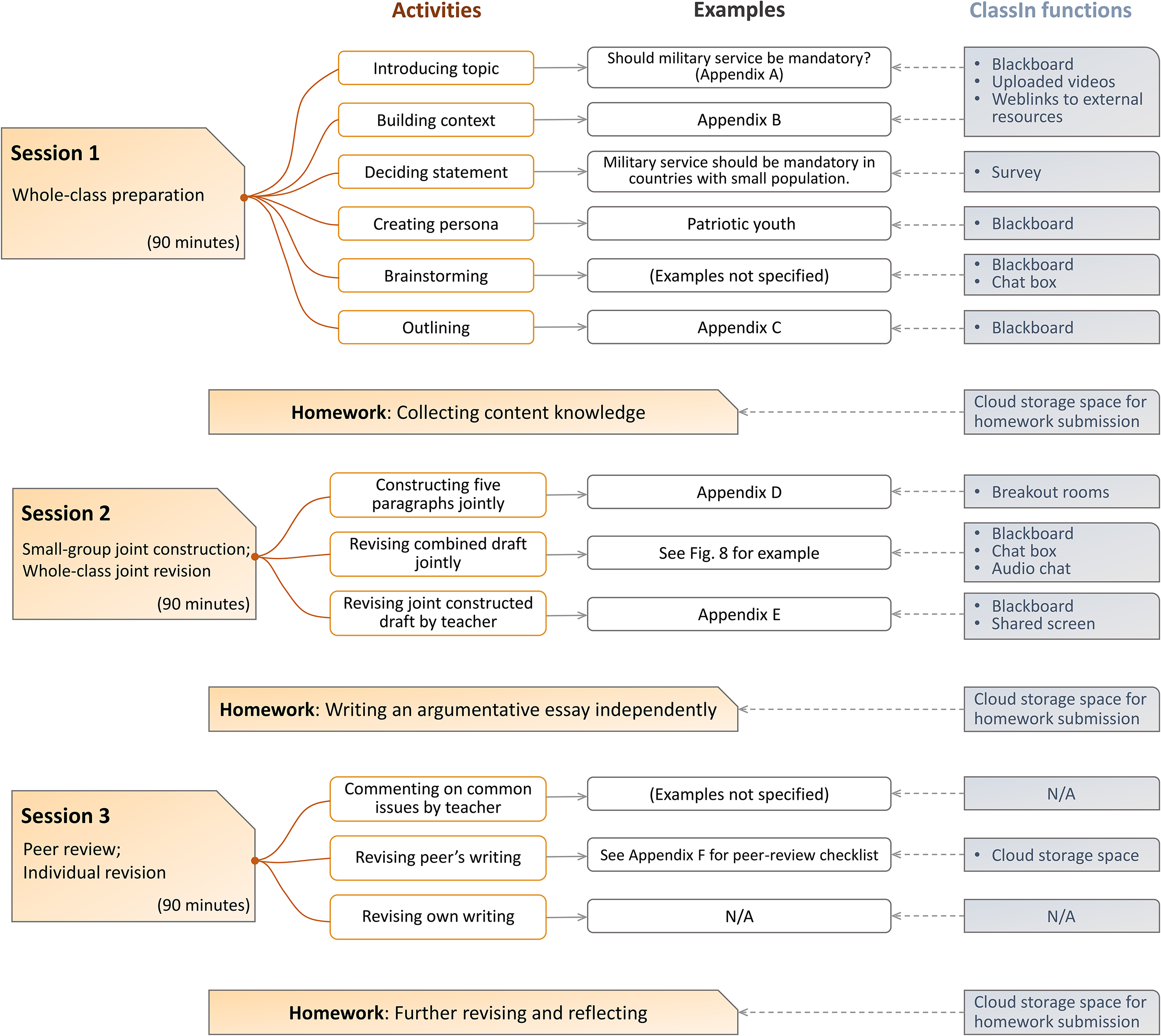
The sequence of the online teaching practices.
Session 1 – Whole-Class Preparation
The first session was the whole-class preparation, consisting of context building, stance deciding, persona creating and teacher-led brainstorming and outlining. The teacher began the class by introducing the topic for argumentation (e.g., presenting a piece of relevant news or an editorial), then building the context. After building the context, the teacher would present and deconstruct a model essay with the whole class. With the model essay, students would have an idea of how a specific genre of written text was organised and learn some syntactic and lexical resources from the model text. And then, a survey was conducted to decide whether students would like to argue for or argue against the statement (see Figure 2). The stance selected by the majority would be the authorial stance for the jointly-constructed essay. Once the authorial stance was decided, an agreed persona would be created for JC. Students were then asked to brainstorm the possible reasons and evidence to support their arguments. The three most convincing reasons would be picked up for small-group JC. After the first session, students were also asked to collect supporting evidence from different sources to ensure that they obtained sufficient content knowledge to go through the small-group JC in Session 2.
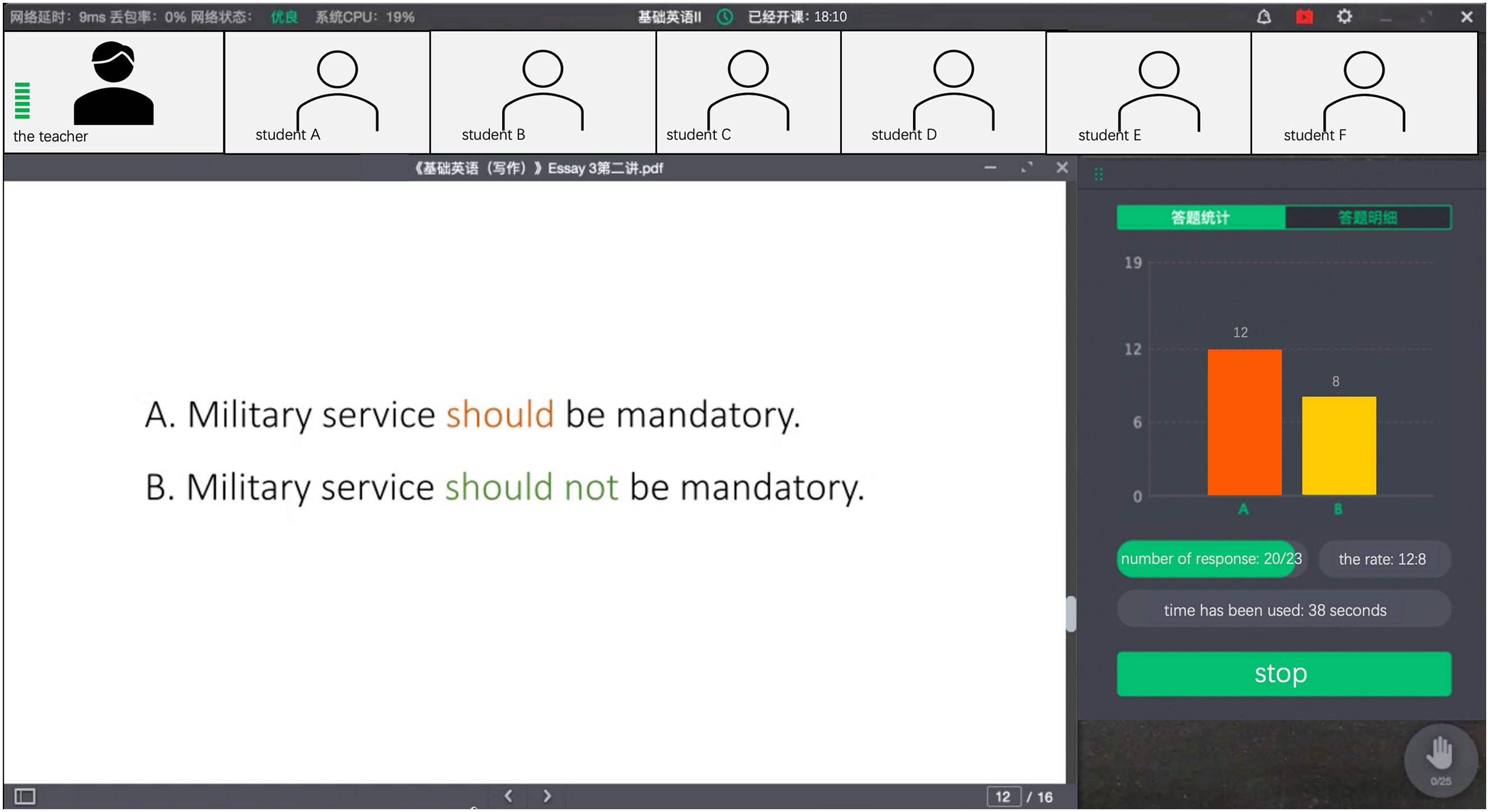
“Online survey” function to determine the authorial stance.
Session 2 JC
The second session was a substantial part of this innovation, as it shows how students were guided to write an essay collaboratively with their classmates in the online environment. JC mainly includes small-group JC and whole-class joint revision.
Small-Group JC
In the small-group JC, the teacher divided the students into five groups using the “breakout rooms” function. Students were assigned into each breakroom randomly for small-group JC (see Figure 3). Members within each breakout room collaborated to write one paragraph. To ensure coherence, the teacher required students to write for the argument with the agreed persona, and groups were required to use the suggested reasons to construct the body paragraphs. Students could discuss with their group members through audio chat while composing on the blackboard (see Figure 4). They were also encouraged to use the content knowledge they had prepared before the class to construct their paragraphs. The teacher, at this stage, took the responsibility of monitoring and facilitating. If group members could actively participate in the small-group JC, the teacher would stay in the main meeting room, monitoring the whole class. However, if any small groups have difficulties progressing, the teacher would enter that breakout room to facilitate students’ discussion by providing ideas or language support.
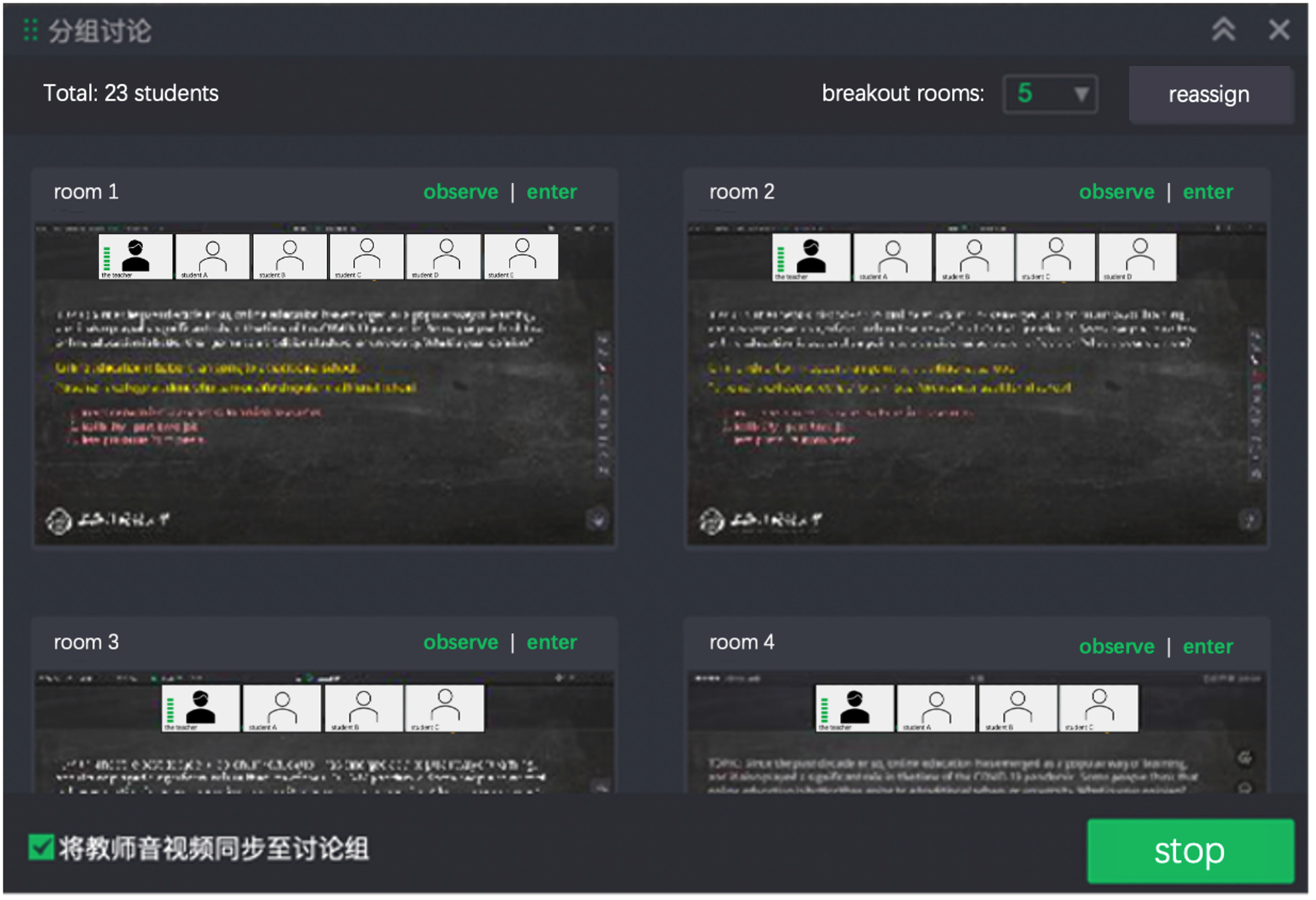
Overview of “breakout rooms” from teacher's view.
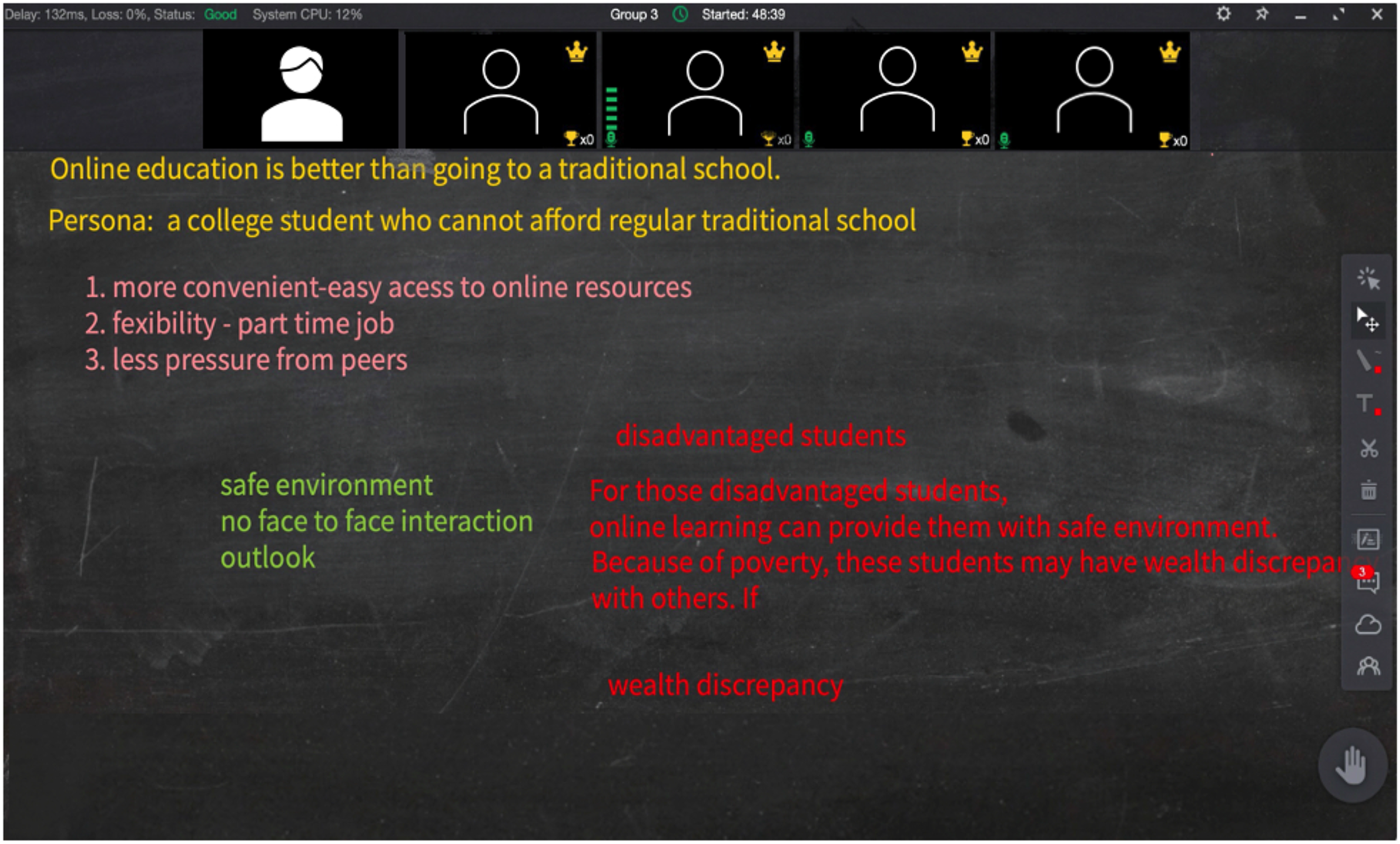
Teacher facilitating individual breakout room discussion and idea-generating.
Whole-Class Joint Revision
After all the five groups had finished their jointly-constructed paragraphs, the group leader would send each completed paragraph to the teacher. The five paragraphs written by each group were then combined into a draft essay for whole-class joint revision (see online supplementary Appendix D ). The teacher encouraged students to contribute to revising the draft essay, where language accuracy, the fitness of the content, logic, and the power of persuasion were considered. Coherence was especially emphasised at this stage since each small group constructed their paragraph independently. The teacher would mark changes on the text according to students’ revising suggestions, and a “trophy” would be rewarded to the volunteers to encourage their participation (see Figure 5). After the whole-class revision was finished, the teacher would comment on the jointly-revised essay, give constructive feedback and polish the essay. By watching the revision process and comparing the jointly-revised essay and the earlier draft, students could quickly identify areas for improvement in lexicogrammatical choices, rhetorical features and organisational structures (see Figure 6). After the second teaching session, students were asked to write an essay independently, which would be reviewed by their peers in the third session.
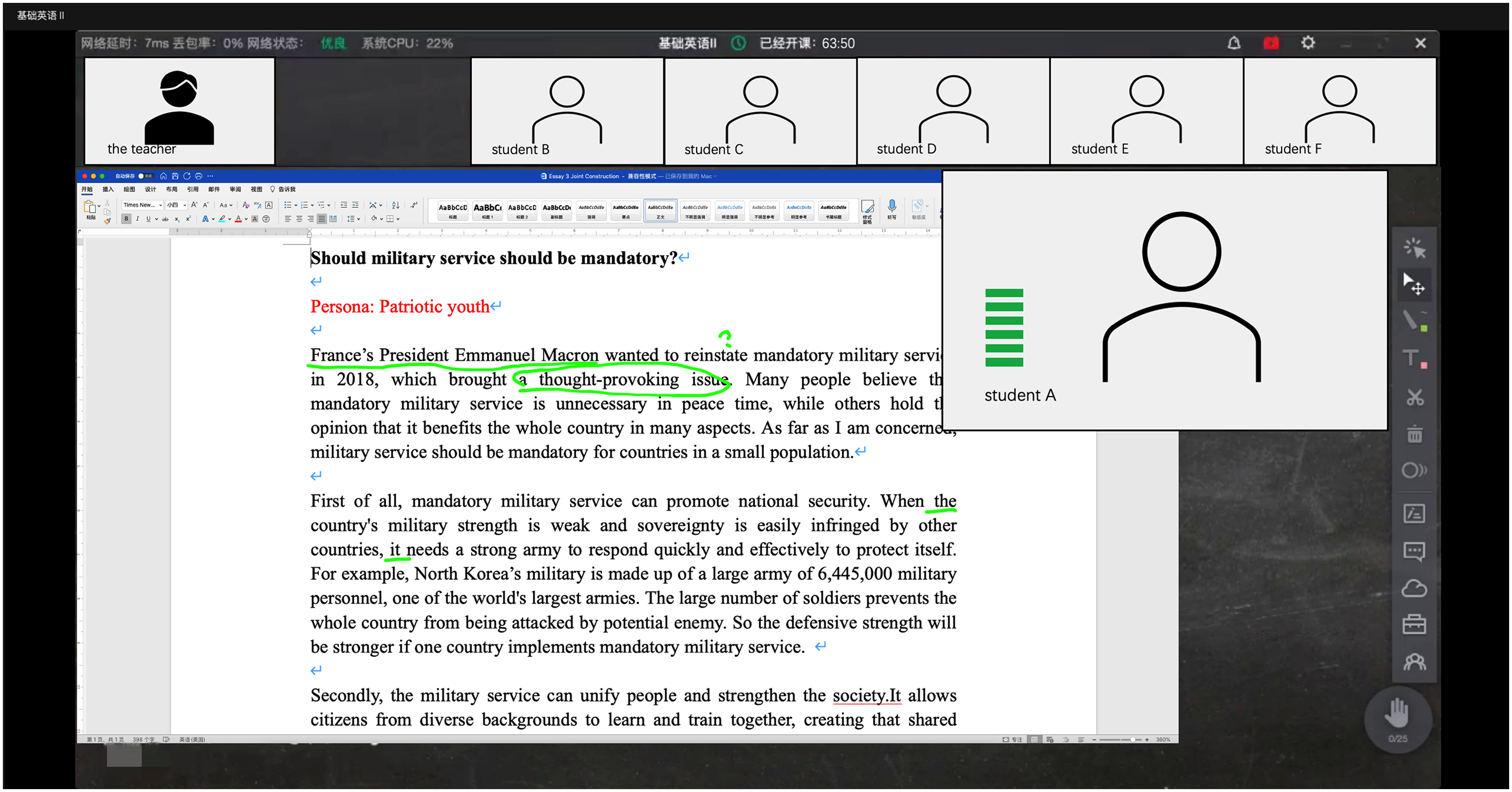
Student contributing revision ideas of the draft essay.
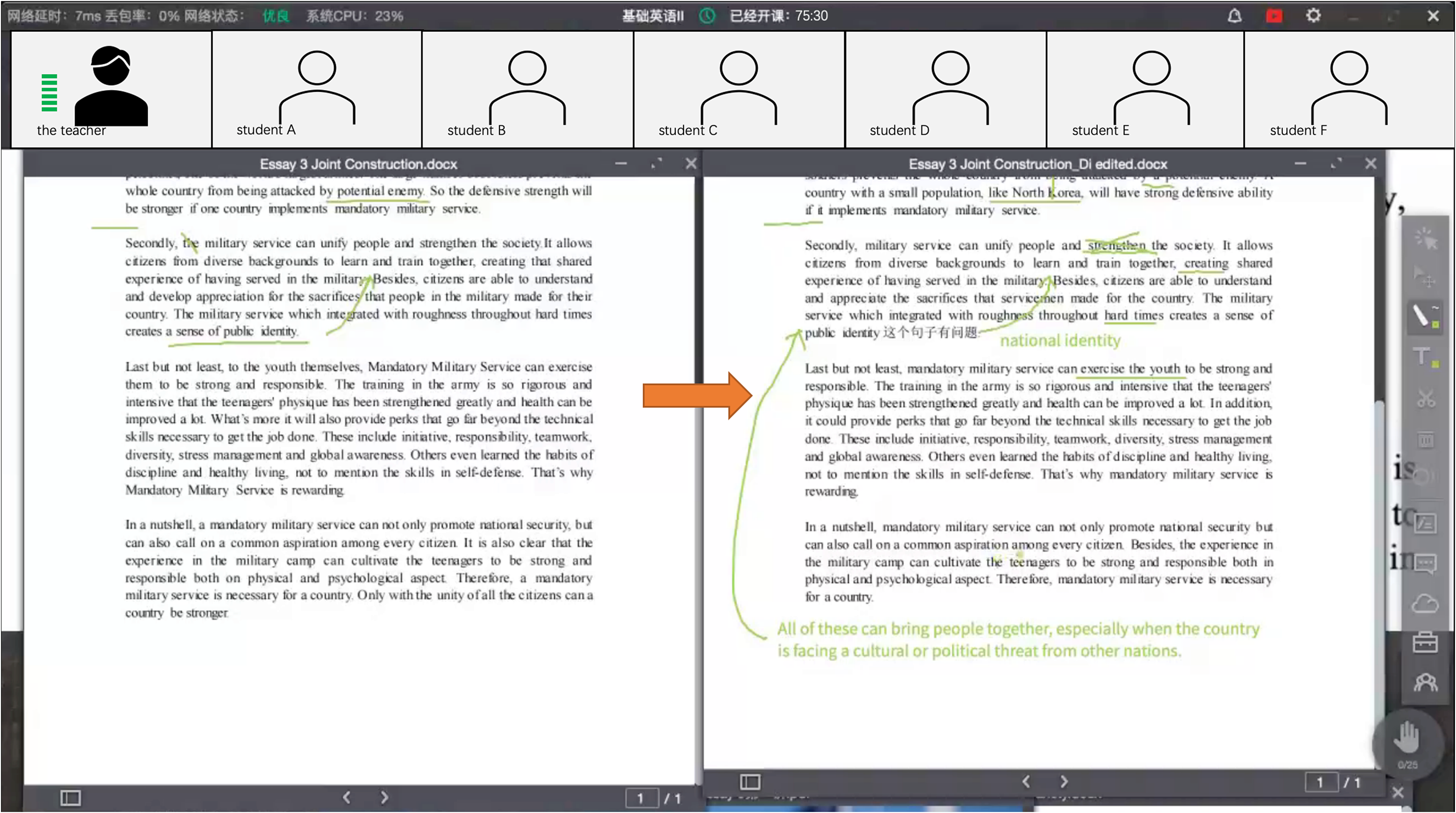
Comparison between the teacher's revised essay and the earlier draft.
Session 3 Peer Revision
At the beginning of this session, the teacher would familiarise students with the revision checklist (see online supplementary Appendix F), which they could use in their following peer review. The peer revision was conducted in pairs. The two students would review each other's draft essays on Tencent Docs, an online file collaboration tool that enables real-time editing and comments. After collecting feedback from their peers, students were then asked to revise their drafts individually and submit their final draft.
Reflection and Future Directions
This article describes the design and application of the Internet-mediated JC in an online L2 writing course via the ClassIn app. Analysis of the classroom recordings and students’ responses in the after-class surveys suggested that the implementation of the Internet-mediated JC practice can actively engage students in the planning–drafting-revising writing processes in the online teaching environment. Many students believed that the online writing class was “captivating” and “interesting”, and it was “the most engaging” and “the most fruitful” course for that semester. Possible reasons are as follows.
Easy Collaboration
Collaboration is the core of Internet-mediated JC. In this innovative practice, the authors designed realisable online class activities using the built-in functions of ClassIn. These interactive functions made teacher–student and students–student collaboration easier. For instance, the “online survey” function helped the teacher to quickly decide an authorial stance that was in line with most students’ ideas. The chatbox allowed all the students to contribute to the supporting reasons simultaneously, providing sufficient materials for outlining. These online activities addressed the limitation of the F2F classroom interaction, where only one student can respond to the teacher's question at one time, with the others listening in (Lim, 2020). When students were in the breakout rooms, they could turn on their microphones and cameras to talk with their group members in real-time. In this way, the students could gain ideas and receive immediate feedback from their group members. They could also use the online notebook to record helpful information provided by their peers. The online word processor enables students’ real-time drafting and editing, making collaboration much easier than in the traditional classrooms, where students contribute to the text and the teacher types what students have produced on the computer during the JC stage.
Convenient Access to Online Resources
Although students are allowed to use smartphones or laptops to assist learning in most universities in the PRC, some teachers might still be doubtful about using digital gadgets in class because of the possible distraction. Consequently, using cell phones in the traditional classroom is sensitive and not encouraged, preventing students from instantly acquiring online information. In our innovative practice, students were encouraged to use online resources. They could use search engines to search for statistics, examples, anecdotes, authorities, and other forms of evidence to support their argument. Students would upload the online resources to the shared cloud storage, which can be viewed and saved by their peers. The convenient access to these online resources can help students gain extensive content knowledge and linguistic input in time for their draft completion. Besides, students can employ various online tools such as online dictionaries and proofreading tools to assist writing. Students also reported that the easy access to the course recordings on ClassIn would help them review the lesson more comprehensively than they could in the F2F class, so that they were better prepared for the independent construction.
Perceived Improvement
Another possible reason for students’ engagement was that their improvements could be easily perceived. Interviews with some students indicated that they benefited from the immediate feedback from their peers regarding useful expressions, complex syntactic structures, and various views in the collaborative drafting process. The teacher also noticed that group members provided instantaneous support to their peers in terms of grammatical errors and the use of evidence to avoid logical fallacies, usually with further explanation or discussion to follow. In the whole-class joint revision, the teacher often presented the original and revised drafts on the screen so that students could compare the differences between the two versions. In the independent writing stage, students were required to submit multiple drafts to the shared cloud storage to visualise the progress made. When students perceived their language and content knowledge improvement, they were more positive to be engaged in the following writing process.
Positive Emotions
Positive emotions also served as contributing factors to the high engagement of the online writing class. In the interview, one intermediate-level student revealed that she felt “equally treated” while discussing in the chatbox because everyone has equal opportunities to voice their thoughts and view others’ ideas simultaneously. The teacher would not merely listen to voices from high-achieving students. Besides, she had more time and space to get into in-depth thinking before responding, and those quick-minded students would not take her speaking opportunity. Some students also reflected that they felt “relaxed” in the breakout rooms because these provide a relatively “private space” for discussion, so that they were not afraid of making mistakes. We also observed that in breakout rooms, students feel a strong sense of connection with their peers, so that they would be more active in contributing to the JC, making comments and giving suggestions.
Internet-mediated JC was effective in engaging students in online interactive activities. However, we also encountered some challenges during the implementation. The most challenging factor is the stability of the Internet connection. A few times, students had Internet problems in the small group discussion, so the progress was disrupted, and it took some time for students to re-enter breakout rooms. This limitation can be ameliorated with the development of high-speed Internet access such as 5th generation (5G) technology and the invention of more mature online learning platforms. Another problem is that some low proficiency or passive learners may still feel reluctant to participate in interactive activities. At this point, the teacher's role as a facilitator is pivotal in these activities. To make the activities more appealing to passive learners, teachers can choose writing tasks that are not overly challenging and create a relaxing and highly sociable online environment. Furthermore, teachers’ digital literacy should be well-developed. Although our innovation practices provide a clear and sequenced description of the online activities, the actual implementation might still be a challenge for some writing teachers with weak technical competencies. Therefore, it is essential that teachers update their knowledge and skills in using online platforms. Schools and universities can also provide professional training, workshops and technical support to help teachers adapt to the online environment. Finally, while we believe that the practice of Internet-mediated JC can also be realised using other similar applications (e.g., Zoom and Microsoft Teams), adaptions should also be made regarding the time allotment for each activity and the step-by-step application of the online functions in other L2 contexts.
Although our innovative practices are designed for online teaching, pedagogical implications are not exclusive in the online environment. Some functions (e.g., collaborative online document and shared cloud storage) can also be used in the traditional F2F classes to facilitate collaboration. When carrying out interactive F2F activities, the teacher needs to consider the psychological factors of the students. It is not recommended to ask students to answer questions in front of the whole class without voluntary participation; instead, teachers can start from the small-group discussion so that students would feel comfortable sharing ideas with others.
Supplemental Material
sj-docx-1-rel-10.1177_00336882221090278 - Supplemental material for Internet-Mediated Joint Construction: Engaging Second Language Learners in Synchronous Online Writing Instruction Through ClassIn
Supplemental material, sj-docx-1-rel-10.1177_00336882221090278 for Internet-Mediated Joint Construction: Engaging Second Language Learners in Synchronous Online Writing Instruction Through ClassIn by Di Wang and Yu Huang in RELC Journal
Footnotes
Declaration of Conflicting Interests
The authors declared no potential conflicts of interest with respect to the research, authorship, and/or publication of this article.
Funding
The authors disclosed receipt of the following financial support for the research, authorship, and/or publication of this article: This work was supported by the China Foreign Language Education Foundation (Grant Number: ZGWYJYJJ10A058).

Supplemental material
Supplemental material for this article is available online.
References
Supplementary Material
Please find the following supplemental material available below.
For Open Access articles published under a Creative Commons License, all supplemental material carries the same license as the article it is associated with.
For non-Open Access articles published, all supplemental material carries a non-exclusive license, and permission requests for re-use of supplemental material or any part of supplemental material shall be sent directly to the copyright owner as specified in the copyright notice associated with the article.
