




Abstract
Shadowing is the act of vocalizing the speech one is listening to as simultaneously as possible. The primary function of shadowing is learners’ listening skill and pronunciation skill development. Despite the importance of second language (L2) listening skills, this pedagogical technique has not received focal attention in the field. In this paper, shadowing is situated in the framework of systematic and deliberate practice, which is supported by an L2 acquisition theory called the skill acquisition theory. Based on this framework, a total of 16 different primary types of shadowing are classified into shadowing for phonological processing and shadowing for intake through meaning-focused processing. The proposed classification and guideline will be useful for teachers to adapt a variety of shadowing techniques for their teaching context and learners as well as highlighting shadowing as an important pedagogical tool of teaching bottom-up listening skills.
Introduction
With the growing interest in listening and pronunciation in the field of second language acquisition (SLA), shadowing, defined as ‘a paced, auditory tracking task which involves the immediate vocalisation of auditorily presented stimuli’ (Lambert, 1992: 266), has been increasingly attracting researchers’ attention. The most important feature of shadowing is simultaneity. Still, a small lag naturally exists between audio stimuli and shadower's repetition. As soon as the shadower hears the first syllable of the modelled audio stimuli, the shadower starts replicating it. As the modelled stimuli continue, the shadower's reproduction lags slightly.
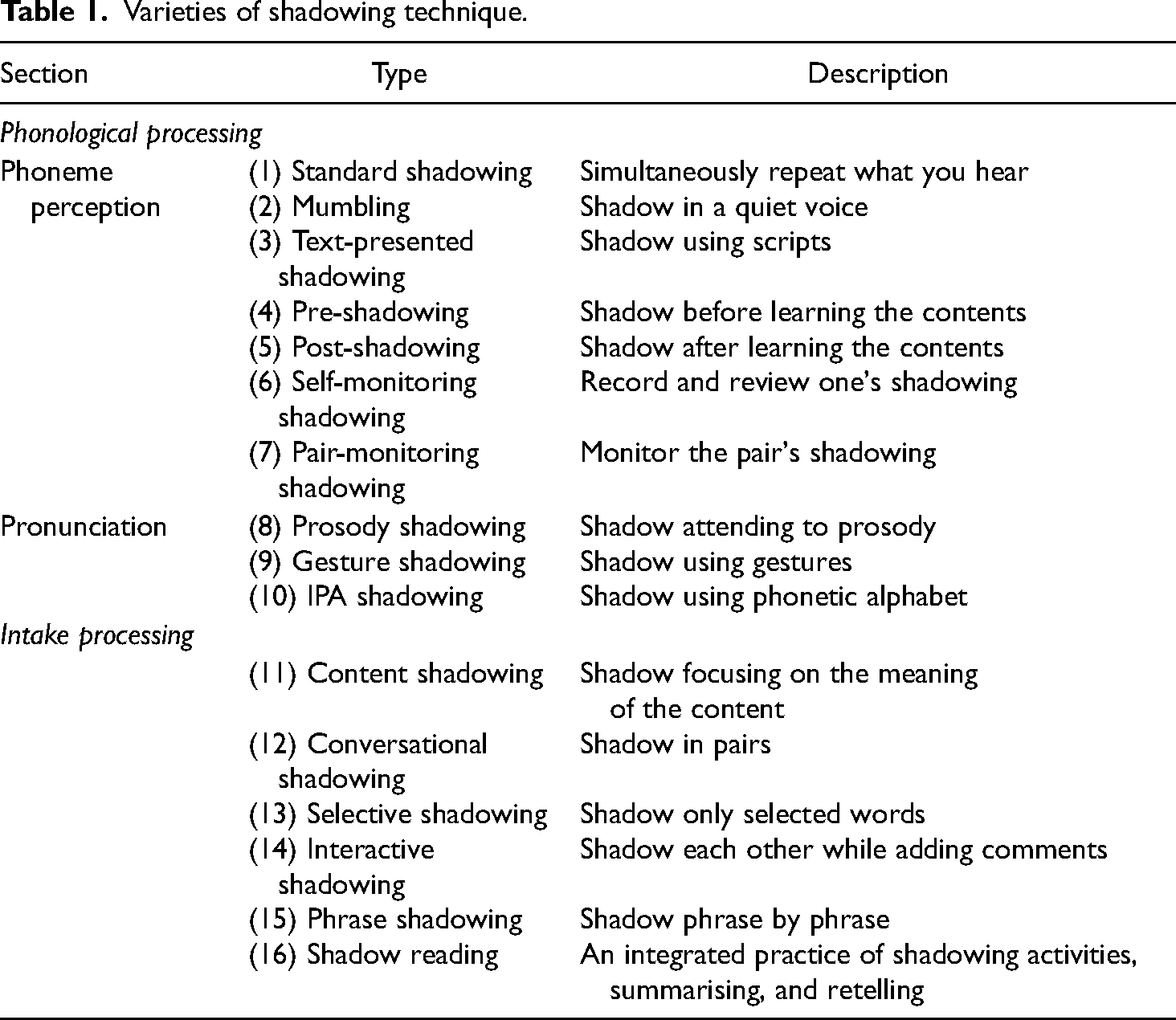
Hamada (2018a) summarised previous second language (L2) shadowing research on assisting the development of the listening skill as its primary function, and possibly the pronunciation skill, proposing future directions for shadowing research and practice. However, his work fails to consider two important points. First, the theoretical framework of shadowing in SLA acquisition is yet to be proposed. Second, numerous shadowing activities and similar yet different names for those activities have been suggested (Table 1); thus, they should be comprehensively summarised to be effectively selected and applied in L2 classrooms. Therefore, in this paper, shadowing is first situated in the context of L2 teaching, particularly from the perspective of systematic and deliberate practice (DeKeyser, 2007; Suzuki et al., 2019). Following this theoretical basis, 16 shadowing techniques are presented based on two primary categories (Table 1): shadowing for phonological processing and shadowing for intake processing.
Varieties of shadowing technique.
The Role of Systematic and Deliberate Practice in Language Teaching
The importance of authentic communication has been emphasised in current language teaching, including communicative language teaching approaches and task-based language teaching (Richards and Rodgers, 2014). However, research has demonstrated that purely communicative tasks do not always facilitate L2 development as learners can often complete them without engaging in linguistic processing (e.g., Loschky and Bley-Vroman, 1990). Especially in a classroom context where the nature and amount of input, interaction, and output are limited, it is often insufficient to only provide communicative tasks. A way to address this limitation is to use an approach to communicative language teaching, sometimes called ‘the weak version’ (Howatt, 1984), where form-focused instruction or learning is integrated with ample opportunities to use English.
More broadly, form-focused learning may be better conceptualised as practice (DeKeyser, 2007; Suzuki et al., 2019). In this framework of L2 practice, the concept of practice was refined using the perspectives from applied linguistics and cognitive psychology, embracing form-focused and meaning-focused activities. Practice is defined as ‘specific activities in the second language, engaged in systematically, deliberately, with the goal of developing knowledge of and skills in the second language’ (DeKeyser, 2007: 1). This conceptualisation of practice does not exclude exercises, 1 which refers to highly controlled and decontextualised drills (e.g., mechanical substitution drills), but they are not a primary concern from the perspective of practice. If the goal of L2 learning is to attain communicative skills, the notion of practice resonates with the importance of meaningful and purposeful L2 use. Perhaps more critically, L2 teaching techniques such as shadowing, which are not necessarily decontextualised drills or have creative L2 uses, and typically fall outside the scope of L2 research, can be embraced in the conceptualisation of practice (Suzuki, 2021).
The pivotal role of practice, characterised as deliberate and systematic repetition, is supported by an L2 acquisition theory called the skill acquisition theory (DeKeyser, 2015). It stipulates three stages of skill development: declarative, procedural, and automatisation. The initial declarative stage is associated with declarative knowledge consisting of linguistic exemplars and rules, often described as ‘knowledge THAT’. The next stage primarily concerns procedural knowledge that enables the performance of L2 skills by converting declarative knowledge into action, often described as ‘knowledge HOW’. For instance, L2 classroom learners typically start with declarative knowledge (e.g., metalinguistic information about articulation of sound) and use it as a crutch to proceduralise their L2 skills, including reading, listening, speaking, and writing. Repeated, extensive practice leads to the final stage called automatisation, which is characterised as fast, efficient, stable, and effortless use of knowledge (DeKeyser, 2015). More automatisation in one skill (e.g., phoneme perception skills) frees up attentional resources, which can be allocated to other skills (e.g., pronunciation). Automatisation entails a long and gradual learning trajectory and is considered a goal in L2 learning (DeKeyser, 2007). Deliberate and systematic practice that focuses on a specific skill (e.g., articulation of English sounds) contributes to the progress of declarative, procedural, and automatised skills.
Situating Shadowing in the L2 Practice Framework
In this paper, we aim to situate shadowing activities as integrated receptive and (semi-)productive practice within the framework of L2 practice by providing a useful categorisation of various shadowing activities. Based on the skill acquisition theory, shadowing can progress the declarative–procedural–automatisation phases in L2 skill development in three significant ways. First, shadowing potentially improves the sub-processes of listening skills, such as phoneme perception (Hamada, 2018a; Kadota, 2019). Because it requires learners to efficiently process auditory input under time constraints due to its nature of real-time (online) language processing, repeated online practice enables more efficient bottom-up processing of input (i.e., proceduralisation and automatisation). Unlike self-paced, offline repeated practice (e.g., oral repetition of sentence by sentence), time pressure and online processing may be conducive to proceduralisation. More specifically, the online nature of shadowing practice may be beneficial, as it resembles the listening processes in which auditory information unfolds in real time.
Second, shadowing may enhance the learning of a variety of pronunciation features, especially improving comprehensibility and fluency (Foote and McDonough, 2017). It is important that learners notice their weak linguistic points (e.g., through teacher feedback) and improve their shadowing performance by overcoming those weaknesses. This type of deliberate practice is useful because meaning-focused practice alone is insufficient; some aspects of language are too complex or difficult to proceduralise, let alone automatise, in part because learners cannot pay enough attention to form while they are focusing on the message. In contrast, shadowing activities require learners to pay close attention to and repeatedly use the same language features in the spoken text, which leads to automatisation. As outlined above, automatisation in one subskill (e.g., phoneme perception) leaves extra attentional resources at the learner's disposal. These freed-up attentional resources allow them to focus on phoneme perception as well as other linguistic skills, such as pronunciation and semantic processing.
Third, shadowing may scaffold the internalisation of linguistic exemplars and rules, and their further proceduralisation and automatisation. In English as a Foreign Language (EFL) contexts, where exposure to L2 input is limited, beginner-level L2 learners do not have the linguistic resources to perform purely meaning-focused production practice. Some deliberate practice for accumulating these learners’ declarative knowledge (e.g., vocabulary, collocations, and rules) should be provided to prepare them for effective engagement into meaning-focused practice (DeKeyser, 2010). Shadowing has unique advantages over other typical activities in form-focused practice (e.g., pronunciation drills, pattern practice, and flashcard vocabulary learning). Instead of decontextualised single sentences, authentic passages (e.g., movies or dramas) (e.g., Foote & McDonough, 2017) or passages from a textbook, are usually employed. Learners can use these contextualised inputs as models (i.e., a declarative base) for deliberate shadowing. This type of repeated deliberate practice may result in the intake of various linguistic exemplars and expressions as products. As shadowing requires learners to vocalise sentences, it may help them remember the linguistic exemplars rather than simply (passively) listen to the passage repeatedly (MacLeod & Bodner, 2017). 2
Shadowing for Phonological Processing
Ten shadowing varieties will be introduced, along with supporting empirical research findings. They primarily focus on phonological processing (not meaning-focused processing), which is further divided into: (a) phoneme perception; and (b) pronunciation.
Phoneme Perception
Shadowing has been shown to improve learners’ listening comprehension skills, specifically by developing phoneme perception skills (e.g., see more details in Hamada, 2018; Kadota, 2019).
In this category, keeping up with fast speech by attending exclusively to phonological features is prioritised over accurate reproduction. In this paper, we refer to the basic shadowing practice as: (1) standard shadowing, which also applies to other terms such as complete shadowing (Murphey, 2001) and phonemic shadowing (Norman, 1976, as cited in Lambert, 1992); (2) Mumbling is the same practice; however, it requires learners to shadow in smaller volume with less mouth movement, especially in the initial stage of the practice (Kadota and Tamai, 2004), to prepare them to practice shadowing with louder and clearer mouth movements. In addition, if students find it difficult to keep up, they can occasionally practise with a written script; and (3) shadowing with a script is called text-presented shadowing (Kuramoto et al., 2007), or parallel reading and synchronised reading (Kadota, 2019). In this practice, the script helps learners keep up with the speed of the audio stimuli and allows for more efficient input processing (Kadota and Tamai, 2004).
However, the question regarding whether learners should practise shadowing techniques before or after learning content, called (4) pre-shadowing and (5) post-shadowing, respectively (Hamada, 2014) is raised. When using difficult materials, learners are recommended to engage in post-shadowing whereby they study the text (e.g., new vocabulary), comprehend the contents, and then focus more on phonological information when shadowing. In contrast, when the content is easy to understand, learners can start shadowing without learning the content (i.e., pre-shadowing).
Next, it is recommended that students monitor shadowing performance by themselves ([6] self-monitoring shadowing) and/or have others check their shadowing performance during the shadowing activity ([7] pair-monitoring shadowing) (Nakayama and Suzuki, 2012). While pair-monitoring shadowing can promote collaborative learning, empirical research suggests that self-monitoring may be more effective than pair-monitoring in developing listening skills (Hamada, 2015). Unlike pair-monitoring, self-monitoring allows for checking their recorded shadowing performance offline to focus on reviewing and analysing their performance themselves multiple times afterwards.
Pronunciation
In terms of the cognitive process, when learners shadow for listening, their attention should be focused on phonological information, whereas for pronunciation, their attention needs to be focused on segmental and suprasegmental pronunciation features. Therefore, sufficient levels of bottom-up listening skills are recommended for these types of practices (Hamada, 2018a).
In (8), prosody shadowing (Kadota and Tamai, 2004), learners attend to features such as stress, rhythm, and intonation, whereas in standard shadowing, learners exclusively attend to perceiving phonological information. Empirical research has shown that when advanced ESL learners work on shadowing by attending to pronunciation features, they improve comprehensibility, fluency, and imitation of the speech model (Foote and McDonough, 2017).
The combined practice of shadowing and physical movement (gesture-shadowing, hereafter), can also be used for pronunciation development. In (9) gesture-shadowing, students hold a ball and shadow, performing an air-punch (arms reaching out) on the most-stressed words, with weaker punches on the less-stressed words, as shown in Figure 1 (Hamada, 2018b). 3 Before jumping into gesture-shadowing, learners should check the stressed and unstressed parts in their scripts and work on text-presented shadowing to ensure that they can become accustomed to the speed and suprasegmental features. Empirical research findings confirm that combining shadowing with gesture-shadowing improves the comprehensibility, segmental and suprasegmental features of pronunciation among intermediate-level EFL learners.
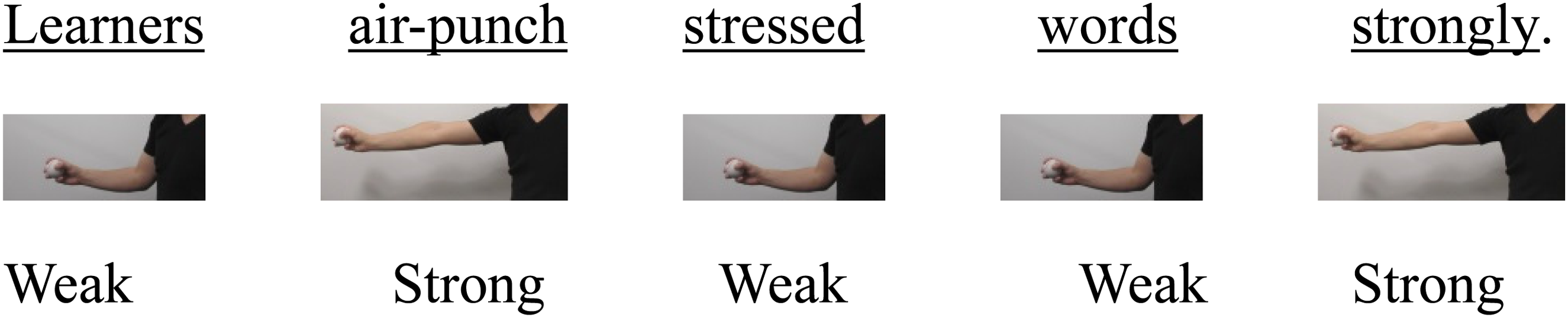
An example of gesture-shadowing.
(10) In International Phonetic Alphabet (IPA)-shadowing (Hamada, 2018b), learners shadow with a transcription written in the IPA. This type of shadowing connects phonemic sounds to the phonetic alphabet, which develops the segmental features of pronunciation. If only using IPA is difficult, complementing it with text-presented shadowing can aid this process. Research has shown that intermediate-level EFL learners improve their comprehensibility and segmental features of pronunciation after intensive IPA-shadowing practice (Hamada, 2018b).
Shadowing for Intake Through Meaning-focused Processing
We will introduce meaning-based shadowing variations that may facilitate the noticing and intake of linguistic aspects in auditory input.
First, (11) content shadowing (Kadota and Tamai, 2004) appears to be the same as standard shadowing; however, it differs in that the learners shadow the speech while considering its meaning. Since content shadowing usually splits attention resources to higher-level processing (e.g., comprehension), as well as lower-level linguistic processing (e.g., phonological, lexical, and articulatory processing), heavier cognitive demands are imposed on learners. Therefore, sufficient practise on standard shadowing is required before content shadowing.
(12) Conversational shadowing is an inclusive blanket term covering multiple pair-practice activities in which the shadower repeats the input delivered by a conversation partner. Murphey (2001) introduces conversational shadowing by referring to three practices: complete (standard) shadowing; (13) selective shadowing; and (14) interactive shadowing. Complete or standard shadowing is normally used for improving phoneme perception and is done individually; however, it can be done as pair-work in the framework of conversational shadowing.
While in complete/standard shadowing the shadower shadows everything the speaker says, selective shadowing is an instructional technique in which the shadower selects only certain words and phrases to shadow, as shown below:
Terri: I’d like to tell you about two places. The first one is Boston.
Eriko: Two places. Boston.
(Murphey, 2001: 129)
In interactive shadowing, students are paired, and one shadows the other, adding questions and comments. Demonstrating more involvement by adding original comments rather than only shadowing one's partner helps the conversation flow naturally.
Eriko: They um? they ah he is a member of basket club. yes
Wanda: ah really basketball club
Eriko: basketball club So he is tired in home yes so in home at home
Wanda: aha okay oh, really at home aha
(Murphey, 2001: 129)
These techniques prompt learners to focus on the meaning of the sentences they shadow. As shadowing is typically cognitively demanding, these activities may assist learners to engage in semantic processing in an in-depth manner.
(15) Phrase shadowing (e.g., Miyake, 2009) can be an effective way to facilitate the intake of spoken input. In phrase shadowing, learners repeat a chunked phrase that is not a complete long sentence with a slight delay from the input, and not too long to impose a burden on short-term memory (Norman, 1976 as cited in Lambert, 1992). For example, learners shadow phrases such as ‘a book about cooking’ and ‘the restaurant around the corner’ (Miyake, 2009: 28). Compared with standard shadowing, where the shadower simultaneously repeats the input, phrase shadowing requires the shadower to temporarily store the input in short-term memory before repeating it.
Finally, (16) shadow-reading (De Guerrero and Commander, 2013) was recently proposed as an integrative practice effective to promote text comprehension and retention based on conversational shadowing. Briefly, it encompasses a series of shadowing practices with text-based summary practices through pair work, and follows a few steps. First, a pair of learners (A and B) engage in complete shadowing, where one learner (A) occasionally divides sentences into manageable segments for the shadower (B). Second, the pairs perform selective shadowing, where one learner (A) reads the text, and the shadower (B) shadows keywords. Third, one learner (A) reads the passage to the shadower (B) to summarise (first paragraph, and then the whole passage).
Conclusion
In this paper, we situated shadowing in the framework of practice (DeKeyser, 2007; Suzuki et al., 2019). Shadowing is an effective technique to incorporate deliberate and systematic practice in communicative L2 classrooms. Sixteen types of shadowing were categorised based on their relative strengths in targeting subskills in listening and speaking, as well as intake processing. In reality, these variations should be adapted depending on learner skill levels and teaching contexts. Shadowing practice for phoneme perception may be prioritised for lower-level learners. When learners’ proficiency is higher and allows for efficient bottom-up listening skills including phoneme perception, they may also be more likely to benefit from shadowing for pronunciation and for noticing and intake. Our broad classification of shadowing activities is not definitive; however, it constitutes a useful, sorted toolbox that facilitates teachers’ decisions to select an appropriate shadowing practice for their students.
Footnotes
Acknowledgements
We would like to thank Dr. Nobuhiro Kamiya, reviewers, and editors for their helpful ideas and comments.
Declaration of Conflicting Interests
The authors declared no potential conflicts of interest with respect to the research, authorship, and/or publication of this article.
Funding
This research was supported by a Japan Society for the Promotion of Science Grants-in-Aid for Scientific Research, Grant Number: 18K00733.
